
ESG consulting, financial services ESG, SFDR Article 8 9, PRI reporting 2026, UK SRS readiness
ESG Consulting in Financial Services Explained
By ESG Consulting Team · · 16 min read
A fund board is reviewing its stewardship report when someone asks a simple question: can every climate statement be reconciled to the financed-emissions figures in the latest data feed? The answer is often less comfortable than the report suggests. Holdings have changed, issuer data has been refreshed, estimated emissions sit beside reported figures, and nobody can point to one controlled record showing who approved each methodological choice.
That's the point at which consulting in financial services stops being a policy-writing exercise. Asset managers, lenders and their advisers need a disclosure architecture that connects regulatory claims to source data, controls and evidence. The challenge covers SFDR, PRI, FCA reporting, UK Sustainability Reporting Standards, financed emissions and assurance, but the practical question is narrower: can the firm prove what it has reported?
The UK market is substantial enough that this work sits inside a mature financial ecosystem, not a specialist corner of sustainability. Financial and related professional services employed nearly 2.5 million people in 2021, representing 7.6% of UK employment, while financial services alone employed more than 1.1 million people. Management consultancy contributed £14.5bn to UK output in 2022, alongside £33.5bn from financial services, as documented in TheCityUK's sector factsheet.
If your existing narrative can't survive reconciliation, board challenge or an assurance sample, the issue isn't the prose. It's the operating model. This is also why the question whether ESG is still relevant in 2026 has become a question about evidence, applicability and control design.
Table of Contents
- When Climate Narrative Is No Longer Enough
- What ESG Consulting Actually Means in Financial Services
- The Regulatory Stack UK Asset Managers and Lenders Face
- Core ESG Services Financial-Services Clients Buy
- Choosing the Right Consulting Model for Financial Services
- How a Typical Financial-Services ESG Engagement Runs
- Why Disclosure Architecture Beats Climate Storytelling
- Procurement Mistakes and How to Avoid Them
When Climate Narrative Is No Longer Enough
A board approves a polished transition narrative, then asks for the supporting portfolio metric. The investment team uses one perimeter, the emissions workbook another, and the reporting date differs again. The document reads consistently because a consultant reconciled the prose, not because the evidence is connected.
That weakness matters during the UK's regulatory transition. The FCA consulted in January 2026 on replacing current sustainability disclosures for listed companies with UK SRS, expects a Policy Statement in autumn 2026, and plans rules that would take effect from January 2027, subject to the consultation outcome, according to its climate-related reporting requirements. Firms may still have annual TCFD publication obligations while preparing for the new basis. The consulting task is therefore to build a controlled transition environment, not rewrite a report once.
What a defensible engagement produces
A defensible engagement produces a disclosure architecture with four connected outputs:
- A canonical data model linking holdings, counterparties, issuer information, emissions inputs and reported metrics.
- A methodology record explaining boundaries, estimation choices, coverage and calculation logic.
- A control framework showing who reviewed source data, approved assumptions and signed off disclosures.
- An evidence pack allowing an assurance provider to test reported information without reconstructing the entire process.
The FCA's current ESG sourcebook requires TCFD entity and public product reports by 30 June each year. The transition can therefore create a dual-track workload rather than a clean cutover. A communications-led exercise will struggle to reconcile entity-level statements with product-level metrics.
Practical rule: If a reported figure cannot be traced from disclosure to source record, calculation method, reviewer and approval, it is not assurance-ready.
Consulting value sits in resolving those breaks. A senior adviser should first test whether each obligation applies, then identify the authoritative source for every metric and document the remaining judgement calls. The finished work should let the board see both what the firm says and what it can demonstrate.
That evidence standard also explains whether ESG is still relevant in 2026. The question increasingly turns on applicability, data lineage and control design, rather than the strength of a climate narrative alone.
What ESG Consulting Actually Means in Financial Services
For a financial-services firm, ESG consulting is closer to building the controlled infrastructure behind a regulatory return than drafting a sustainability brochure. The consultant maps obligations to data owners, systems, calculations, controls and sign-off points. The report is an output of that system.
The buyers vary, but their underlying needs overlap:
- Asset managers need defensible SFDR Article 8 or Article 9 classifications, pre-contractual disclosures, periodic reporting and product governance.
- Lenders need financed-emissions methods, borrower mapping, estimation policies and evidence that portfolio figures are complete enough for review.
- Fund boards need a clear view of UK SRS readiness, material gaps, governance responsibilities and the reliability of management information.
- In-house ESG leads often coordinate PRI reporting while managing dependencies across investment, risk, compliance, finance, procurement and company secretarial teams.
A useful engagement starts with applicability, not a template. A purely UK-domiciled fund with no EU marketing may not be caught by SFDR. That doesn't remove the need for credible climate information, but it changes the legal basis, scope and deliverables. Consultants should state that conclusion in writing rather than sell an EU disclosure package by default.
What the engagement should produce
The typical envelope includes:
- SFDR classification and disclosure review, including the evidence supporting Article 8 or Article 9 claims.
- Financed-emissions methodology, often using PCAF principles, with data quality treatment and documented estimates.
- PRI reporting support, including ownership of inputs, senior review and consistency checks.
- UK SRS readiness, covering governance, strategy, risk management, metrics and targets.
- Transition-plan development, linked to investment or lending decisions rather than a standalone ambition statement.
- Assurance preparation, with control descriptions, data lineage logs, methodology memos and sample evidence.
The practical distinction is between a document and a repeatable process. What an ESG consultant does matters less than whether the engagement leaves the client with clear ownership, controlled inputs and a credible route from source data to signed disclosure.
The Regulatory Stack UK Asset Managers and Lenders Face
A UK asset manager or lender with EU activity rarely works under one ESG rulebook. Different regimes use different legal triggers, reporting perimeters and terminology. The first consulting task is an applicability assessment that separates obligations applying to the legal entity, product, investment activity and distribution route.
The UK track
The FCA's current framework requires TCFD-style entity and product reporting for relevant firms and products. Its January 2026 consultation points towards UK SRS for listed-company sustainability disclosures, with rules planned to take effect from January 2027. During the transition, firms may need to maintain existing reporting while building the data lineage, controls and ownership model required for the new standard.
The FCA anti-greenwashing rule, introduced through PS23/6, applies at product and marketing level. Sustainability statements must be fair, clear and not misleading. Testing should connect each claim to the investment process, portfolio evidence and customer-facing materials. Editing the wording alone does not address the underlying control problem.
The EU track
SFDR applies where a UK manager markets products into the EU or otherwise falls within its scope. Article 8 and Article 9 classifications create disclosure obligations, so the firm must evidence its environmental or social characteristics, sustainable-investment approach and do-no-significant-harm analysis.
CSRD and ESRS may enter through an in-scope group, subsidiary, listing or EU operation. The answer depends on the legal structure and applicable thresholds. A UK presence alone does not establish that CSRD applies. PRI reporting has a different status: it is a responsible-investment framework for signatories, not a replacement for mandatory regulatory disclosures.
| Regime | Primary source | Who it catches | What it requires |
|---|---|---|---|
| UK TCFD-style reporting | FCA ESG rules | Relevant UK-regulated firms and products | Entity and public product climate disclosures |
| UK SRS | FCA consultation and final rules | In-scope listed companies and potentially other regulated entities as rules develop | Structured sustainability reporting across governance, strategy, risk, metrics and targets |
| FCA anti-greenwashing | FCA PS23/6 | FCA-authorised firms making sustainability-related claims | Claims that are fair, clear and not misleading |
| SFDR | EU sustainable-finance rules | Products and firms within SFDR scope, including relevant EU marketing activity | Product classifications and prescribed pre-contractual, periodic and website disclosures |
| CSRD and ESRS | EU corporate reporting framework | In-scope groups and entities | Corporate sustainability reporting using ESRS requirements |
| PRI | PRI reporting framework | PRI signatories | Structured responsible-investment reporting, with applicable confidential and public modules |
The consulting deliverable should be a live applicability and evidence workplan, not a static deadline list. A practical UK ESG reporting deadlines guide for 2026 and 2027 should sit beside a matrix recording the legal entity, product, jurisdiction, reporting date, owner and required evidence. That structure shows where the obligation applies, which data supports it and whether the eventual disclosure can withstand assurance review.
Core ESG Services Financial-Services Clients Buy
Financial-services clients buy defined outputs that let investment, risk, compliance and reporting teams complete controlled obligations. The consulting value sits in the evidence chain, from portfolio data and methodology to review controls and disclosure.

SFDR classification and disclosure
An Article 8 or Article 9 review should start with the investment process, not the preferred label. The consultant tests the strategy's binding elements, exclusions, indicators, sustainable-investment methodology and principal adverse impact approach. The output should show which claims the portfolio can evidence and align the prospectus, website, periodic disclosure and distributor factsheet.
A classification memo alone leaves control gaps. The firm also needs a disclosure inventory, evidence register and process for portfolio changes that could alter the original classification rationale. Where SFDR does not apply to the entity or product, the work should document that conclusion rather than create unnecessary disclosure activity.
Financed-emissions methodology
For lenders and asset managers, financed-emissions work typically uses PCAF-aligned methods. The deliverable should record how counterparties are identified, exposure is allocated, emissions are reported or estimated, and data quality is assessed.
The UK SRS financial-services guidance highlights the importance of Scope 1, 2 and 3 breakdowns for investees or borrowers, alongside coverage measures such as assets under management in scope or gross exposure included. The PRA's emphasis on climate data and data architecture reinforces the need for lineage and controls. PwC's YE25 UK benchmarking records that the share of banks receiving limited assurance on financed emissions increased by about 10% year on year. That finding supports a practical output: a methodology paper, data dictionary, calculation file, exception log and review controls.
PRI, UK SRS and transition plans
PRI support under the 2026 framework is mainly a coordination and evidence exercise. The adviser maps structured indicators to investment-policy documents, stewardship records, governance minutes and implementation evidence, then routes the submission through senior review.
UK SRS readiness requires a gap assessment, reporting perimeter, ownership map and controlled timetable. The UK SRS financial-services guidance should inform the reporting design where relevant, but an obligation that does not apply should be recorded as out of scope. Transition-plan work aligned to TPT should connect targets to capital allocation, engagement, underwriting, portfolio construction and risk management. A plan held only by the sustainability team will not guide investment or lending decisions.
Choosing the Right Consulting Model for Financial Services
Procurement should focus on delivery mechanics rather than firm reputation. The right model depends on whether the client's main constraint is specialist regulatory interpretation, integration across a wider transformation programme or assurance-grade documentation.
| Criterion | Boutique specialist | Full-service firm | Big Four |
|---|---|---|---|
| Regulatory depth | Often strong in focused UK, FCA and EU source material | Broad, with depth varying by team | Broad and supported by established technical functions |
| Named senior lead | Usually direct partner or director access | Must be confirmed contractually | Available, but day-to-day work may move to a larger delivery team |
| Fixed scope and fee | Often easier to define | Possible, though wider dependencies can expand scope | Possible, but change control can become formal and complex |
| Assurance-ready evidence | Strong where the team is control-focused | Strong when integrated with risk and reporting specialists | Typically structured for audit and assurance expectations |
| Common failure point | Limited capacity or narrow adjacent expertise | Hand-offs between workstreams | Generic outputs or too many junior layers |
A boutique can be the better choice when the client needs a senior practitioner who understands SFDR evidence, FCA sourcebooks and financed-emissions methodology in detail. The risk is over-reliance on a small number of people or insufficient systems integration.
A full-service management consultancy suits a programme that also includes risk transformation, operating-model design, technology implementation or finance reporting. Its weakness appears when ESG specialists hand work to teams that haven't followed the underlying methodology.
A Big Four practice can work well where the board expects extensive documentation and the assurance provider needs a familiar evidence format. The buyer should still insist on a named senior lead, clear boundaries and a methodology review. A large team doesn't automatically make a disclosure defensible.
Procurement test: Ask to see a redacted lineage log and methodology memo, not just a sample presentation. The artefacts reveal how the firm works.
How a Typical Financial-Services ESG Engagement Runs
Consider an Article 8 equity fund preparing for limited assurance while its management company develops UK SRS-aligned entity reporting. The engagement begins by defining the product perimeter, legal entity, assets, reporting dates and distribution footprint. The team then tests the Article 8 rationale against the investment process and records what the fund can evidence.

From holdings to controlled metrics
The data model pulls holdings, exposure, issuer identifiers, revenue information and emissions inputs from custodians, vendors and investee disclosures. The consultant resolves duplicate identifiers, documents missing data and records whether each input is reported, estimated or replaced using an approved proxy.
PCAF calculations then connect portfolio exposure to financed-emissions outputs. The control design records extraction dates, transformations, calculation versions, reviewer actions and exceptions. That makes it possible to explain why a number changed without treating every change as a reporting failure.
The product and entity disclosures should use the same controlled sources where the perimeter overlaps. Product-level metrics can feed relevant SFDR disclosures, while the entity architecture supports UK SRS governance, risk and metrics reporting. Transition-plan indicators aligned to TPT should link to decisions the investment team can demonstrate, such as engagement priorities or portfolio monitoring.
The assurance pack is assembled before the external reviewer arrives. It includes the classification assessment, disclosure crosswalk, methodology memo, data lineage log, control attestations, exception register and evidence samples.
The following video offers a useful visual introduction to the wider relationship between sustainability data, reporting and decision-making.
The consultant's job isn't to make the process look simple. It's to make the dependencies visible, assign owners and prevent an assurance provider from having to reverse-engineer the calculation.
Why Disclosure Architecture Beats Climate Storytelling
Narrative still has a role. Boards need a clear explanation of climate risks, strategy and progress, and clients need disclosures they can understand. But narrative cannot substitute for the evidence architecture beneath it.
Financed-emissions reporting illustrates the difference. Firms are being asked to disclose more granular information across Scope 1, Scope 2 and Scope 3 for investees or borrowers, alongside coverage measures and methodological explanations. As assurance expectations rise, the reported figure needs a defensible chain from portfolio record to source emissions data, allocation method, review and approval.

What the architecture contains
A model normally includes:
- A source layer, covering holdings, counterparty identifiers, exposure, issuer emissions and supporting documents.
- A calculation layer, recording allocation rules, factors, estimates, coverage and version control.
- A control layer, showing validation, reconciliations, approvals, overrides and exception treatment.
- A disclosure layer, mapping metrics and statements to the relevant entity, product and jurisdictional requirements.
- An evidence layer, preserving the documents an assurance provider can sample.
A narrative-only report often aggregates screenshots, footnotes and marked-up drafts. That approach may satisfy a communications review, but it becomes fragile when a reviewer asks why a figure changed, whether the source was complete or who approved the estimate.
Assurance doesn't test how persuasive the story sounds. It tests whether the reported information is supported, controlled and reproducible.
That changes the consultant's role. The adviser needs enough technical understanding to challenge data architecture, enough regulatory knowledge to test applicability and enough project discipline to keep investment, risk, compliance, finance and sustainability teams working from one controlled version.
Procurement Mistakes and How to Avoid Them
The most damaging procurement mistake is buying a report when the firm needs a reporting capability. A one-off document may meet an immediate publication date, but it won't necessarily support the next data refresh, product change, regulatory request or assurance cycle.
The second mistake is treating EU and UK work as interchangeable. A firm that completes SFDR work but ignores the UK SRS transition can leave entity reporting, product reporting and underlying data controls on separate tracks. The FCA's current TCFD-style requirements and planned UK SRS timetable make that separation difficult to sustain, particularly where the same portfolio data supports several disclosures.
Four avoidable failures
| Common mistake | Corrective action |
|---|---|
| Treating ESG as a one-off disclosure project | Contract for a recurring reporting cycle, including refreshes, control testing and board sign-off support |
| Running only EU SFDR work during the UK transition | Require a dual-track plan covering current FCA reporting and UK SRS readiness |
| Choosing a team without UK regulatory depth | Name the individuals responsible for FCA, DBT, UK SRS and EU source interpretation |
| Accepting unauditable data | Make source mapping, lineage logs, methodology records and evidence retention contractual deliverables |
A weak statement of work also hides who owns the judgement calls. It should specify whether the consultant or client approves classification, emissions factors, estimation methods, materiality decisions and final wording. Without that clarity, disputes surface late, usually when a board or assurance provider challenges the output.
Fees deserve the same precision. Fixed scope and fixed fee can work when the data perimeter is known, but the contract should define change triggers such as a new product, missing vendor feed or revised reporting boundary. The objective isn't to eliminate every variation. It's to prevent an apparently complete engagement from excluding the controls that make the disclosure credible.
Finally, ask for evidence of the delivery method. A capable adviser should explain how source data will be reconciled, how exceptions will be escalated and how the firm will identify obligations that don't apply. Those questions reveal more than a generic sustainability credentials deck.
ESG Consulting helps asset managers and lenders with SFDR disclosures, PRI submissions, financed-emissions data, UK SRS readiness, TCFD reporting and TPT-aligned transition planning, with outputs designed around traceable evidence and assurance-ready controls. Visit ESG Consulting to discuss your regulatory perimeter, data gaps and the specific disclosure architecture your team needs to build.
More from the blog
· 12 min read · Regulation
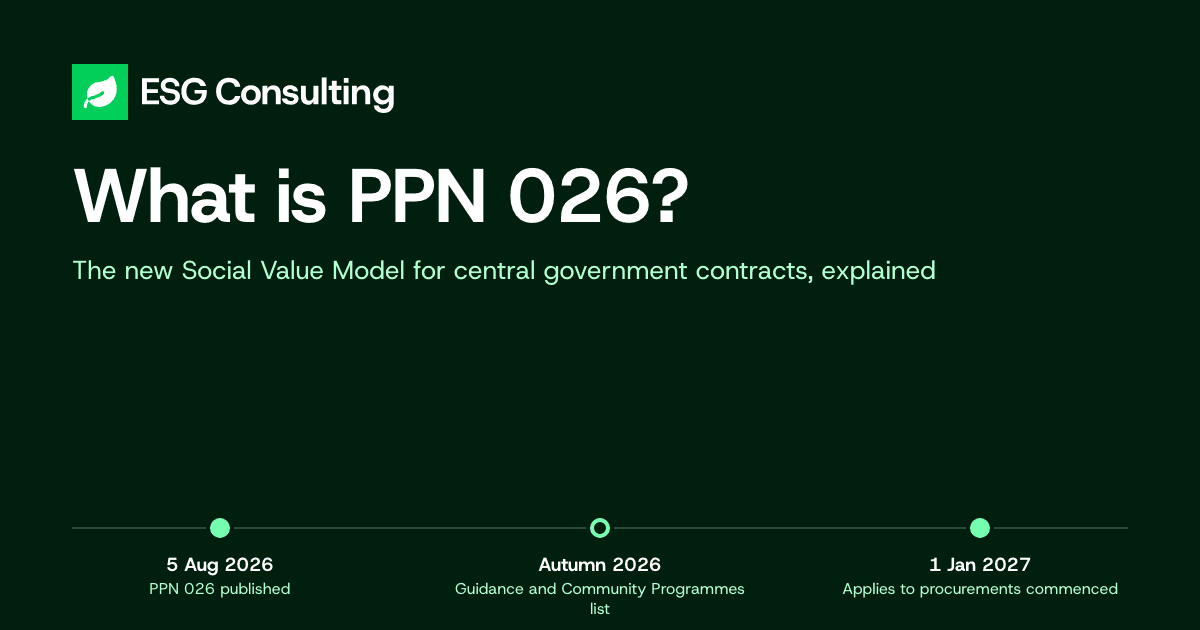
What is PPN 026? The new Social Value Model
PPN 026 replaces PPN 002 as the Social Value Model for central government contracts from 1 January 2027. Scope, the 10% and 20% weightings and the six criteria.
Read article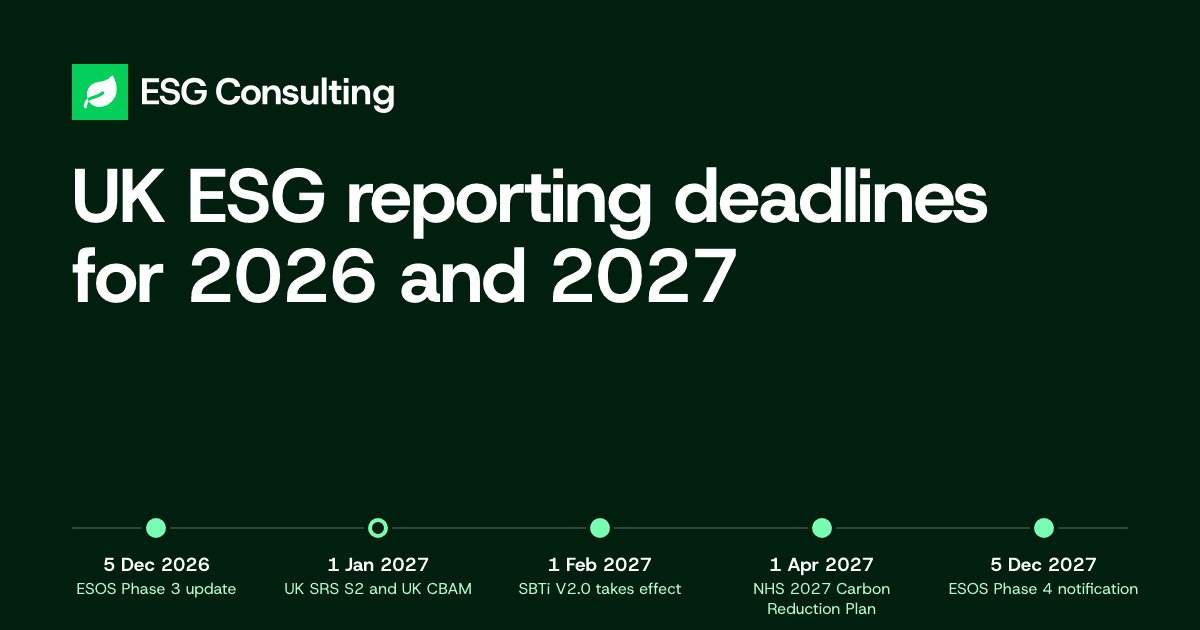
· 14 min read · Regulation
UK ESG reporting deadlines for 2026 and 2027
Every UK ESG reporting date to December 2027 - UK SRS, ESOS, SECR, UK CBAM, CSRD, SBTi, PPN 026 and the NHS - each marked mandatory, proposed or voluntary.
Read article