Table of contents
PPN 026 is the Cabinet Office Procurement Policy Note that rewrites how central government scores social value. It was published on 5 August 2026 and applies to procurements whose tender notice is published on or after 1 January 2027. For suppliers to government departments, executive agencies and non-departmental public bodies, it determines between 10% and 20% of the score on every contract worth £1m or more.
We have read the PPN line by line, checked it against the Procurement Act 2023 and compared it with every explainer published since 5 August 2026. This article sets out what is known as at 9 September 2026 and what will follow in the guidance due in autumn 2026.
What PPN 026 is and what it replaces
The PPN defines social value for central government contracts as "taking account of how a supplier will work for our communities to provide good British jobs, skills and opportunities in every postcode". That sentence contains the whole policy and the rest of the document sets out the mechanism for delivering it.
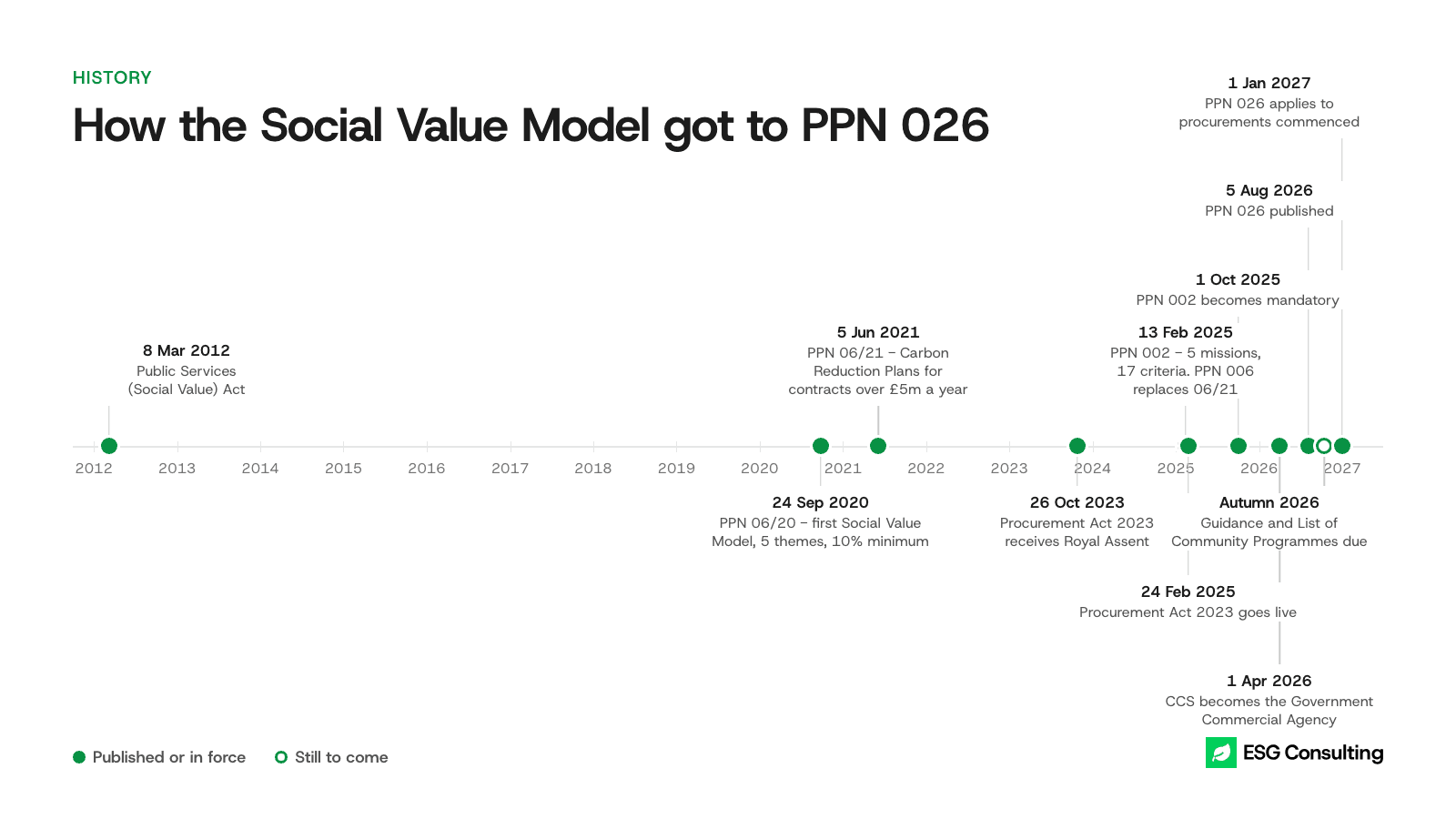
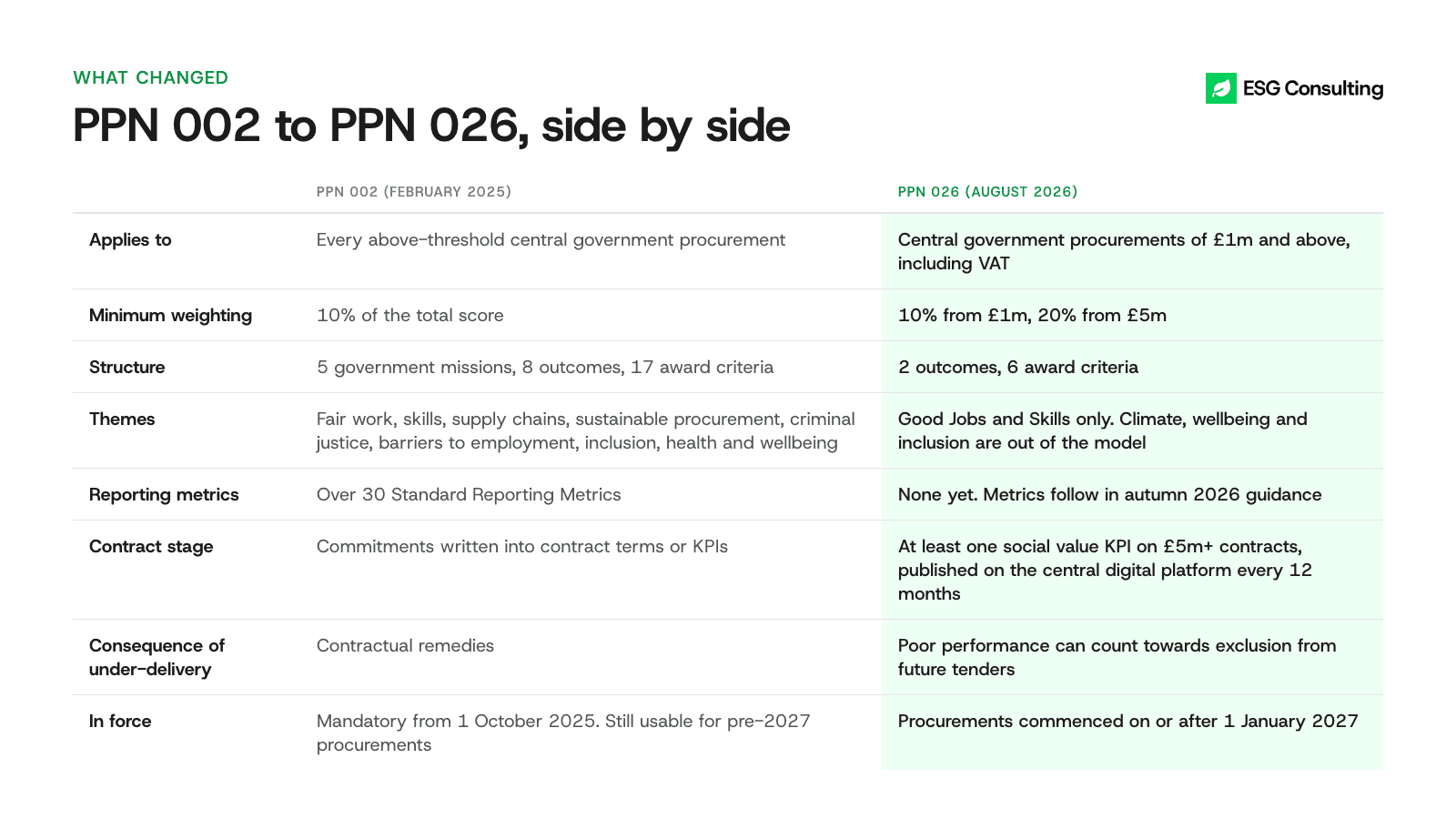
PPN 026 replaces the model in PPN 002, which was published in February 2025 and became mandatory from 1 October 2025. That model scored bids against 5 government missions, 8 outcomes and 17 award criteria, supported by more than 30 standard reporting metrics. PPN 026 reduces this to 2 outcomes and 6 criteria and, for the time being, includes no metrics at all.
This is the third version of the model since 2020. PPN 06/20 introduced the first in September 2020 with five themes, including fighting climate change and wellbeing. PPN 002 reorganised the model around the government's missions and PPN 026 now narrows it to jobs and skills. The Cabinet Office press notice described the previous rules as a "tick box exercise" and valued the market they govern at £90bn a year.
The PPN never names PPN 002 and instead refers to "the previous edition" and confines the transition rules to procurements commenced before 1 January 2027, so "replaces" describes the practical effect rather than the legal wording.
Which organisations and contracts PPN 026 applies to
Four tests determine whether PPN 026 applies to a tender.
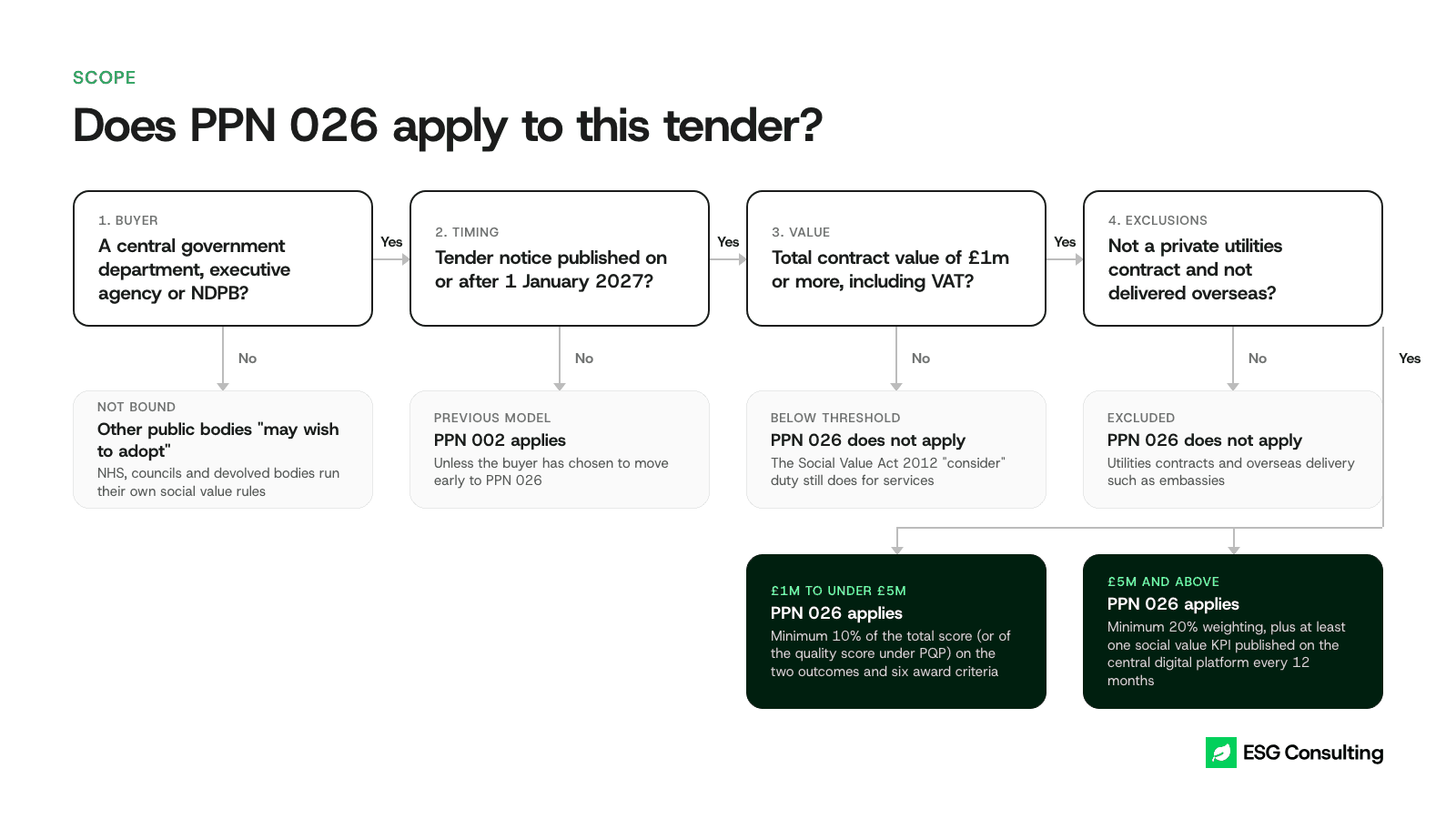
The buyer. PPN 026 applies to central government departments, their executive agencies and non-departmental public bodies. The PPN states that other contracting authorities "may wish to adopt" it, but it does not bind the NHS, local authorities, schools, housing associations or the devolved administrations, all of which operate their own social value rules. The Ministry of Defence is a department and therefore falls within scope in principle, although the PPN says nothing specific about defence.
The timing. PPN 026 applies to procurements commenced on or after 1 January 2027 and a procurement commences when the tender notice is published. For procurements already under way on that date, buyers are "encouraged to transition" but can retain the previous model where switching "would require disproportionate resources or invalidate previous market engagement activities". Suppliers should therefore expect PPN 002 and PPN 026 tenders to run side by side for most of 2027.
The value. The threshold is a total contract value of £1m or more including VAT, valued under section 4 and Schedule 3 of the Procurement Act. That figure is the maximum the buyer can pay, so options to extend, options for additional volume and the full value of a framework all count towards it. A three-year contract at £350,000 a year with a two-year extension option is therefore a £1.75m contract.
The exclusions. The PPN states only two exclusions, namely private utilities contracts and contracts whose primary purpose is delivery overseas, such as those for embassies. Contracts below £1m fall outside PPN 026, although the "consider" duty in the Public Services (Social Value) Act 2012 still applies to services contracts.
Frameworks fall within the scope of PPN 026 and buyers should assess social value at both framework and call-off stage. The footnote to this provision matters more than the paragraph itself. Under section 46(8) of the Act, a call-off can only be assessed against criteria used to award the framework, so social value that was not scored at framework level cannot be scored at call-off. Frameworks awarded under PPN 002 in 2025 and 2026 will still be running in 2027 with PPN 002 criteria built into them.
Key PPN 026 dates
| Date | What happens |
|---|---|
| 5 August 2026 | PPN 026 published |
| Autumn 2026 | Guidance, sub-criteria, evaluation method, metrics and the "Resource for bidders: List of Community Programmes" |
| 1 January 2027 | Applies to procurements whose tender notice is published on or after this date |
| 2028 | First annual social value KPI ratings appear on the central digital platform for £5m+ contracts let in 2027 |
The PPN 026 model - two outcomes and six award criteria
Annex A sets out the model, which has two outcomes with three Model Award Criteria under each. Buyers score every criterion on what the supplier will deliver through the contract.
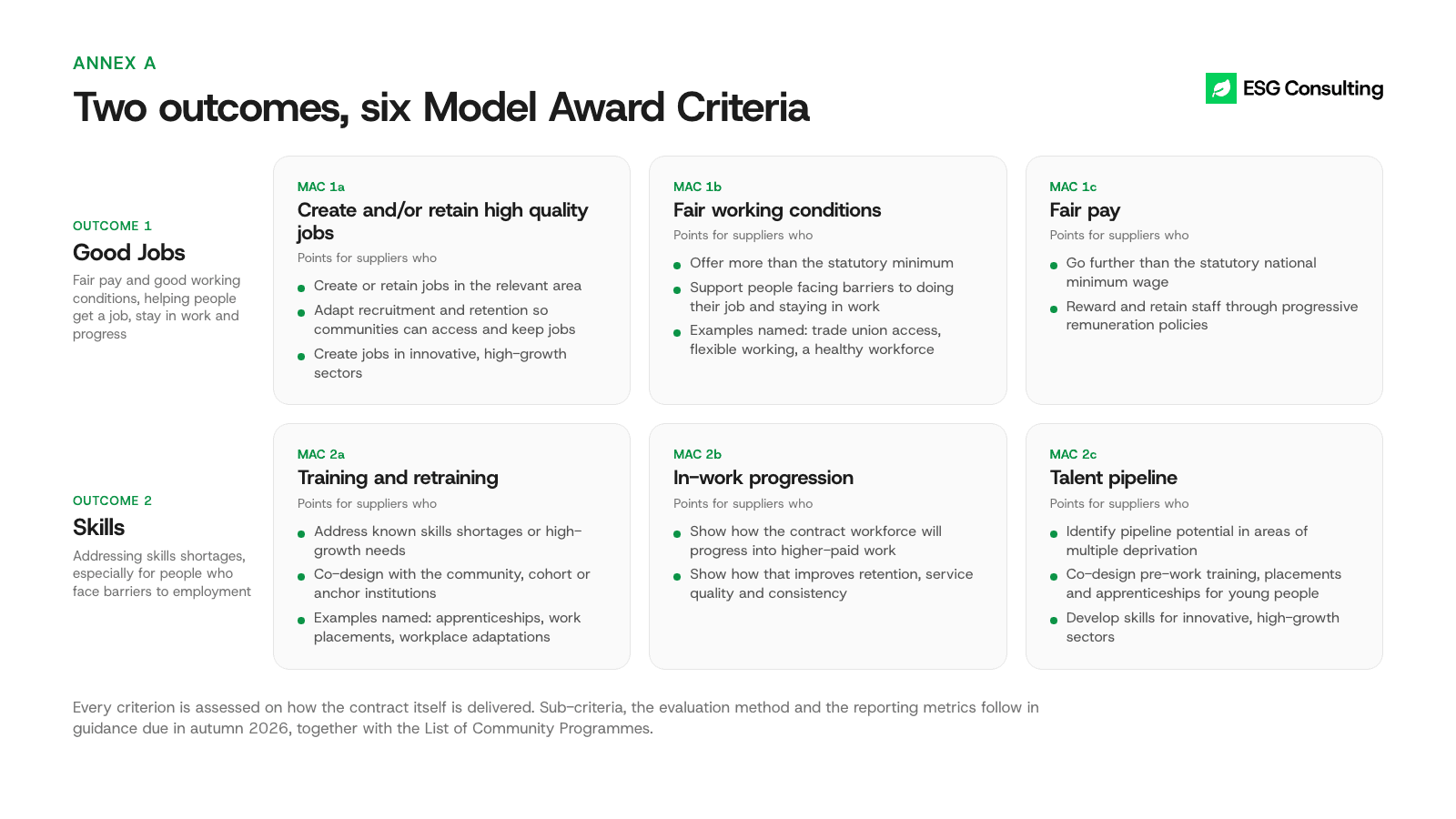
Outcome 1, Good Jobs. Criterion 1a rewards creating or retaining jobs in the relevant area, adapting recruitment so that local communities can access those jobs and creating jobs in high-growth sectors. Criterion 1b rewards working conditions beyond the statutory minimum and support for people who face barriers to staying in work and the PPN names trade union access, flexible working and a healthy workforce as examples. Criterion 1c rewards pay that goes "further than the statutory national minimum wage" and "progressive remuneration policies" that help retain staff.
Outcome 2, Skills. Criterion 2a rewards training that addresses known skills shortages and is co-designed with the community or cohort it serves, with apprenticeships, work placements and workplace adaptations as the named examples. Criterion 2b rewards in-work progression for the contract workforce, together with evidence that it improves retention and service quality. Criterion 2c rewards a talent pipeline built with communities in areas of multiple deprivation and contains the most specific line in the document, which states that "45 days of work experience is exactly the kind of social value the Prime Minister is seeking to see delivered through this policy."
Three further elements sit alongside the six award criteria.
Target cohorts. The PPN names people not in employment, education or training, those moving from education into work, people with a long-term health condition or disability and care leavers and further cohorts will follow in the guidance.
Target skills. The target skills are drawn from government skills strategies. The only example given is "skills for clean energy jobs", which is the one place where the environment survives in the model.
The List of Community Programmes. The government will publish a curated list of programmes with the guidance and buyers will attach relevant programmes to their tender documents. Where a bidder commits to a programme, the contract KPI monitors delivery of that programme and buyers will evaluate community programme and non-community programme commitments separately. We expect this list to shape bid content more than the criteria themselves.
The guidance will also address "existing, inherent social value", using the example of "the wider community benefits of retaining local jobs". This marks a significant departure from the additionality principle in PPN 06/20 and PPN 002 and favours incumbent suppliers. The extent of that change is the most important open question in the document.
How PPN 026 weights and scores bids
The minimum weightings are 10% of the total score for contracts from £1m to under £5m and 20% for contracts of £5m and above and buyers can set higher weightings. Where the evaluation uses an absolute methodology such as Price per Quality Point or a value-for-money index, the percentage applies to the non-price criteria, so social value accounts for 10% or 20% of the quality score rather than of the total.
The PPN does not state whether buyers will score responses qualitatively, as method statements, or quantitatively, as committed numbers. PPN 06/20 required qualitative evaluation and PPN 002 combined both approaches through its standard reporting metrics, whereas PPN 026 leaves the "relevant evaluation methodology" to the guidance. Until that guidance is published, bid teams should prepare for both approaches by writing the narrative and holding the figures that support it.
Two legal safeguards from the Procurement Act remain in place. Award criteria must relate to the subject-matter of the contract and be proportionate under section 23 of the Act and buyers cannot discriminate against suppliers from treaty states under section 90. The second rule is how "good British jobs" is reconciled with the UK's trade agreements, because the criteria score what happens in the communities where the contract is delivered rather than where the bidder is headquartered. An EU or Canadian supplier can therefore achieve full marks by committing to the same jobs and training in the same places. A criterion that scored UK ownership would be unlawful.
Contract management after a PPN 026 award - KPIs and the exclusion risk
On contracts worth £5m or more, the buyer should set at least one social value KPI in addition to the three or more KPIs already required by section 52 of the Act. The buyer publishes all KPIs on the central digital platform and reports performance against them at least once every 12 months through a contract performance notice, rated Good, Approaching target, Requires improvement, Inadequate or Other.
Suppliers' social value commitments therefore become public, dated and rated. Competitors and future buyers can read every one of them on Find a Tender.
The PPN adds that "evidence of poor performance against social value KPIs can be taken into account in considering whether there are grounds to exclude suppliers from bidding for future tenders". This provision needs to be read precisely, because a poor rating in an annual notice is not in itself a ground for exclusion. The discretionary ground in Schedule 7 of the Act requires either a sufficiently serious breach or performance with which the buyer remained dissatisfied after giving the supplier a proper opportunity to improve. Where that process leads to a breach notice, the ground applies for five years. A route from a missed apprenticeship target to exclusion therefore exists, but it runs through the contract rather than the scorecard, which is why suppliers should only commit to figures they can deliver.
What changed from PPN 002 and where climate went
Climate requirements did not move into PPN 026, but neither did they disappear. Carbon Reduction Plans were never part of the scored social value weighting and remain a condition of participation under PPN 006, which still requires a board-signed plan, updated at least annually and published on the supplier's UK website, for contracts above £5m a year. PPN 016 adds an optional contract schedule with in-contract emissions reporting and a default 10% annual reduction target. Neither PPN refers to PPN 026 and neither has changed.
What has been removed is the ability to score environmental commitments as social value, since the former "fighting climate change" theme and its successor "sustainable procurement practices" outcome have no equivalent in the new model. A buyer can still score environmental quality criteria where they relate to the subject-matter of the contract and the Cabinet Office guidance on assessing tenders names carbon reduction as a permissible factor. The buyer must now justify such criteria contract by contract rather than drawing them from the model.
Wellbeing, equal opportunity, supply chain resilience, modern slavery and the criminal justice outcome have no successor either and disability survives only as a target cohort. Social value practitioners have been direct in their criticism. Darren Knowd, a member of Social Value Portal's expert panel, called it "a policy about employment and skills". Sarah Stone of Samtaler said that without clarification on the environment "it could set us back years".
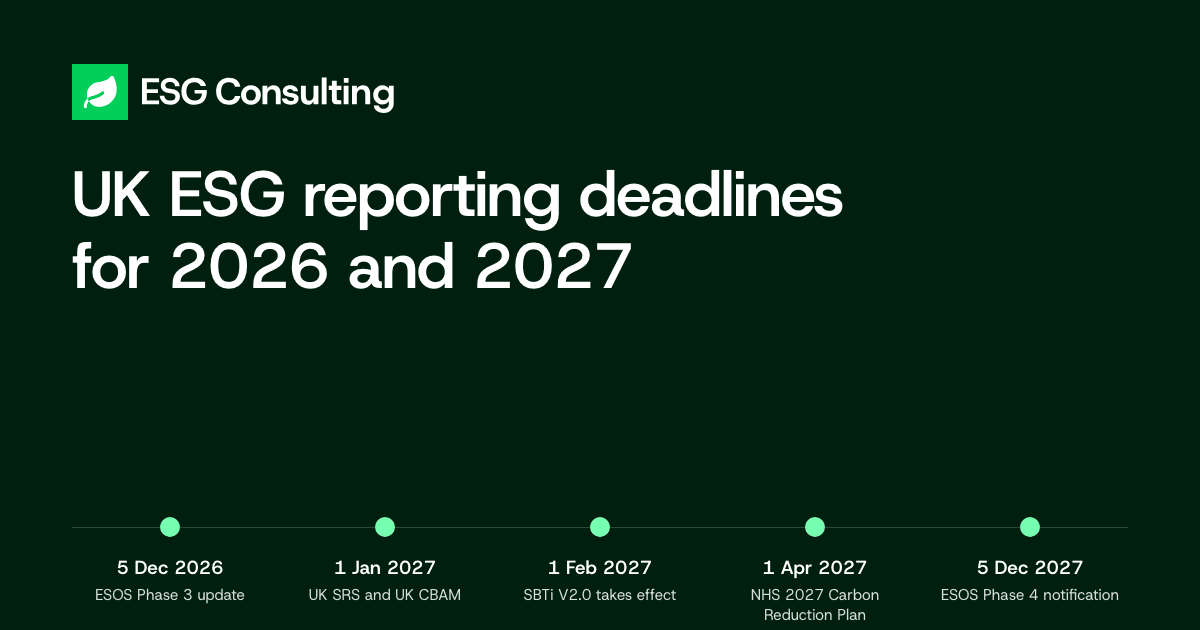
Outside central government the position for suppliers is unchanged. The NHS retains its 10% minimum weighting on net zero and social value and introduces its 2027 Carbon Reduction Plan standard on 1 April 2027, which sits alongside PPN 026 in our overview of UK ESG reporting deadlines for 2026 and 2027. Councils retain the Social Value Act duty and the TOMs frameworks, while Wales and Scotland operate their own statutory regimes.
How to prepare for PPN 026 before 1 January 2027
Bid teams have until 1 January 2027 before the model takes effect and the guidance has yet to be published. Suppliers should complete five pieces of preparatory work now.
- Map existing evidence to the six criteria. Bid teams should collate the HR, payroll, training and apprenticeship data the organisation already holds and sort it under criteria 1a to 2c. Most bid libraries are organised around PPN 002 themes and relabelling them is not sufficient because supply chain, environmental and wellbeing content has no place in the new model.
- Agree a position on pay. Criterion 1c scores pay above the statutory minimum and progressive remuneration, which is a finance decision with a cost across the whole contract workforce rather than a bid-writing decision. The CFO should be involved before the first tender is submitted.
- Build the local evidence base. Criteria 2a and 2c reward co-design with communities in areas of multiple deprivation, so suppliers should understand the indices of deprivation and the skills shortages in the places where their contracts are delivered and build relationships with the colleges and anchor institutions in those areas.
- Design KPIs that can withstand publication. Every commitment on a contract worth £5m or more will be rated publicly once a year, so the figures in a bid should be signed off by the delivery team, with a named owner and a data source, before submission.
- Review live frameworks. Suppliers should list the frameworks they sit on that run beyond 1 January 2027 and the social value criteria under which those frameworks were awarded, because those criteria determine what can be scored at call-off.
Consultants advising bidders should add a sixth step and read the autumn 2026 guidance before committing clients to positions on inherent social value, sub-criteria or metrics. Every point in this article that is not drawn from the PPN itself is subject to change.
Our ESG consulting team helps suppliers turn workforce, skills and carbon commitments into bids that score well and contracts that deliver. For organisations with PPN 026 tenders in their pipeline, speak to a consultant.
Sources
- PPN 026, The Social Value Model, Cabinet Office, 5 August 2026
- PPN 026 PDF including Annex A
- Government orders that public spending must back British jobs and skills in every postcode, press notice, 5 August 2026
- PPN 002, Taking account of social value in the award of contracts, February 2025
- PPN 06/20, Taking account of social value in the award of central government contracts, September 2020
- Procurement Act 2023, section 23 award criteria
- Procurement Act 2023, section 46 frameworks
- Procurement Act 2023, section 52 key performance indicators
- Procurement Act 2023, section 71 contract performance
- Procurement Act 2023, Schedule 7 discretionary exclusion grounds
- Procurement Regulations 2024, regulation 39 contract performance notices
- Guidance, Assessing Competitive Tenders, Cabinet Office
- PPN 006, Carbon Reduction Plans in major government contracts
- PPN 016, Carbon reduction contract schedule
- 2027 NHS Carbon Reduction Plan requirements, NHS England
- Crown Commercial Service becomes the Government Commercial Agency
- PPN 026, what the government's new social value guidance means for you, Social Value Portal, 24 August 2026