Table of contents
Most ESG deadlines catch organisations unprepared, not because the dates were unpublished but because the qualifying date, the reporting period and the filing date rarely fall on the same day. As a result, a rule that takes effect in 2027 usually requires decisions in 2026.
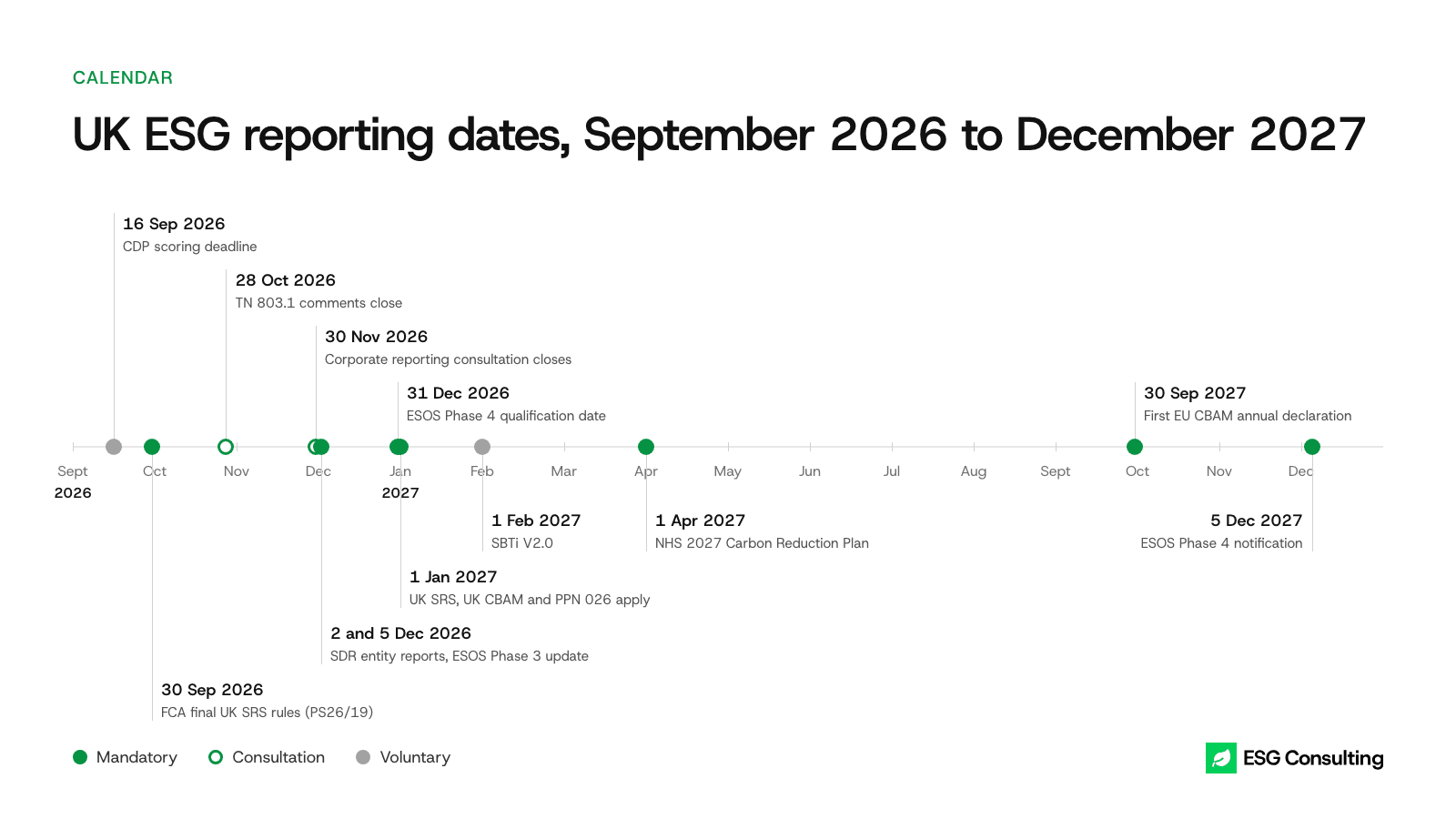
This is the calendar our ESG consulting team works from with clients. It covers every UK regime with a fixed date between September 2026 and the end of 2027, together with the EU rules that reach UK groups. Each entry carries one of three statuses. Mandatory means the law or rule has been made, consultation means a government or regulator is still seeking views and voluntary means the requirement binds an organisation only once it has signed up.
We checked every date against its primary source on 8 September 2026, the day after the government's Modernising Corporate Reporting consultation proposed no date for private company UK SRS reporting. We updated the article on 7 October 2026 to reflect the FCA's final UK SRS listing rules, PS26/19, which were published on 30 September 2026.
UK ESG reporting calendar
| Date | Regime | What happens | Status |
|---|---|---|---|
| 16 September 2026 | CDP | Scoring deadline for the 2026 disclosure cycle | Voluntary |
| 30 September 2026 | FCA | Final UK SRS listing rules published (PS26/19) | Mandatory |
| 28 October 2026 | FCA | Comments close on draft guidance TN 803.1 on comply or explain | Consultation |
| 30 November 2026 | Modernising Corporate Reporting | Government consultation closes | Consultation |
| 2 December 2026 | FCA SDR | First entity-level sustainability reports, asset managers with £5bn to £50bn under management | Mandatory |
| 5 December 2026 | ESOS Phase 3 | Second annual progress update, with director sign-off | Mandatory |
| 15 December 2026 | ISSA (UK) 5000 | Sustainability assurance standard effective for periods beginning on or after this date | Voluntary |
| 30 December 2026 | EUDR | Deforestation rules apply to large and medium operators placing goods on the EU market | Mandatory (EU) |
| 31 December 2026 | ESOS Phase 4 | Qualification date | Mandatory |
| 1 January 2027 | UK SRS | Listing rules apply, comply or explain, to accounting periods beginning on or after this date | Mandatory |
| 1 January 2027 | UK CBAM | Carbon levy on imported aluminium, cement, fertiliser, hydrogen, iron and steel | Mandatory |
| 1 January 2027 | UK ETS | Second free allocation period begins and free allocation for CBAM sectors starts to phase out | Mandatory |
| 1 January 2027 | PPN 026 | New Social Value Model for central government procurements of £1m and above | Mandatory |
| 1 January 2027 | CSRD | First reporting year for EU companies still in scope, on the simplified ESRS | Mandatory (EU) |
| 1 February 2027 | SBTi | Corporate Net-Zero Standard V2.0 takes effect | Voluntary |
| 1 February 2027 | EU CBAM | Certificate sales begin | Mandatory (EU) |
| 19 March 2027 | CSRD | Member state deadline to transpose Omnibus I | EU |
| 1 April 2027 | NHS | 2027 Carbon Reduction Plan standard for contracts of £5m a year and all new frameworks | Mandatory |
| Spring 2027 | CFD | Government review of Companies Act climate-related financial disclosures concludes | Review |
| 30 June 2027 | EUDR | Deforestation rules apply to micro and small operators | Mandatory (EU) |
| 30 September 2027 | EU CBAM | First annual declaration, covering 2026 imports | Mandatory (EU) |
| 5 December 2027 | ESOS Phase 4 | Compliance notification to the Environment Agency | Mandatory |
Two further dates fall just outside the window covered by the calendar. 31 January 2028 is both the UK CBAM registration deadline for 2027 liability and the last day on which a company can submit an SBTi target under the current standard.
UK SRS - the FCA's final rules apply from 1 January 2027
The FCA's UK SRS listing rules are now made and apply, on a comply or explain basis, to accounting periods beginning on or after 1 January 2027.
The Department for Business and Trade published the final UK Sustainability Reporting Standards, UK SRS S1 and S2, on 25 February 2026. The standards bind a company only where a regulator makes rules that apply them. For listed companies that regulator is the FCA, which has now made those rules.
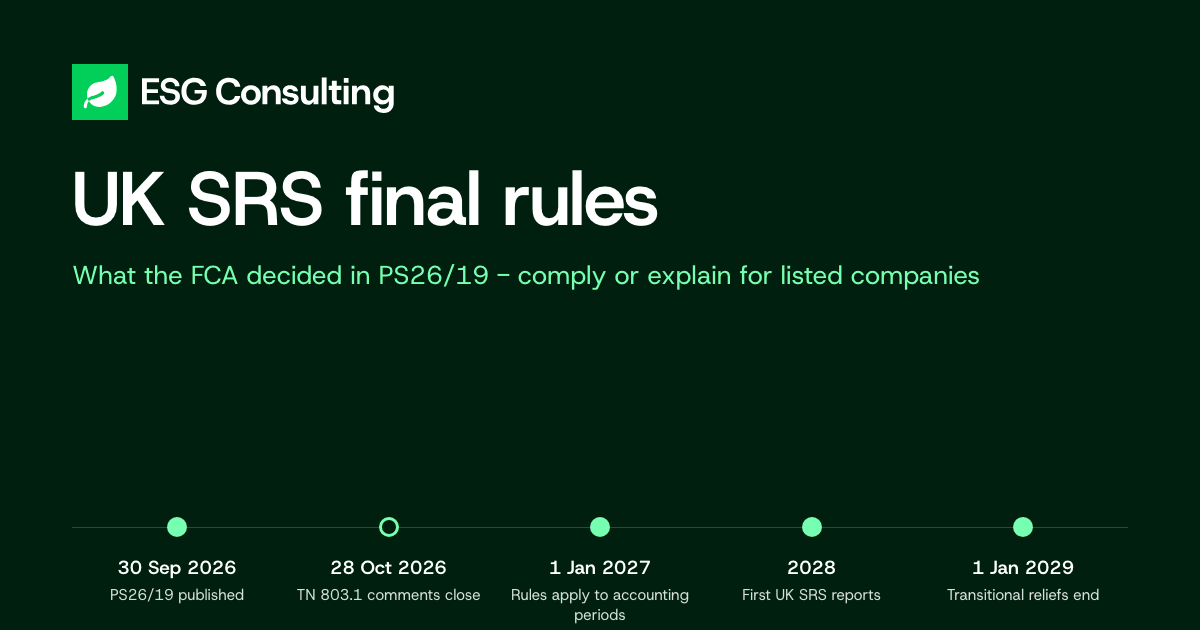
The FCA published its final rules in PS26/19 on 30 September 2026. They replace the TCFD listing rules with UK SRS for commercial companies, secondary listings, depositary receipts, non-equity issuers and the transition category, which together account for around 600 issuers. Investment funds and shell companies fall outside the scope of the rules and there is no size threshold.
What the FCA decided
The final rules apply comply or explain across all of UK SRS, which departs from the January 2026 consultation, CP26/5, under which UK SRS S2 would have been mandatory. A company that does not comply must set out which requirements it has not met, the reasons for that and the steps it is taking to address them. A one-year relief applies to Scope 3 emissions and a two-year relief applies to UK SRS S1 disclosures beyond climate. A company that uses either relief must state that it has done so but does not need to explain why.
Assurance is not required, although companies must state whether they have obtained it, from whom and to what level. A transition plan is not required either, although companies must state whether they have published one and where it can be found. Accounting periods beginning before 1 January 2027 remain subject to the TCFD listing rules unless a company chooses to adopt UK SRS early.
The FCA is consulting until 28 October 2026 on draft guidance, TN 803.1, which sets out what a compliant explanation should contain. Our article on the FCA's final UK SRS rules covers PS26/19 and the draft guidance in full.
Mapping the date to a company's year end
The 1 January 2027 date attaches to the accounting period rather than to the calendar year. A company with a 31 December year end reports on FY2027 in spring 2028. A company with a 31 March year end begins its first UK SRS period on 1 April 2027 and reports in mid-2028, while a company with a 30 June year end begins on 1 July 2027.
Private companies
The government has not set a UK SRS date for private companies. The Modernising Corporate Reporting consultation, published on 7 September 2026 and open until 30 November, asks how UK SRS should be reflected in the Companies Act and proposes a new "very large" company category. It does not propose to mandate UK SRS for private companies and sets no timetable, so any 2028 date for private companies reflects commentary rather than government policy.
Preparing for UK SRS in 2026
Listed companies should run a gap assessment of their most recent TCFD statement against UK SRS S2 and decide, before the first UK SRS period begins, where they will comply and where they will explain. In our experience the governance narrative and the scenario analysis carry over, while the gaps sit in the metrics, the industry-based disclosures and the evidence trail behind the numbers that an assurer will ask to see.
ESOS - one date in 2026 and one in 2027
ESOS is mandatory, with Phase 3 and Phase 4 overlapping during 2026.
The final Phase 3 obligation is the second annual progress update, which is due to the Environment Agency by 5 December 2026 with board-level director sign-off. After that date, organisations report progress against their Phase 3 action plan within their Phase 4 assessment, including an explanation for any committed measure that they did not implement.
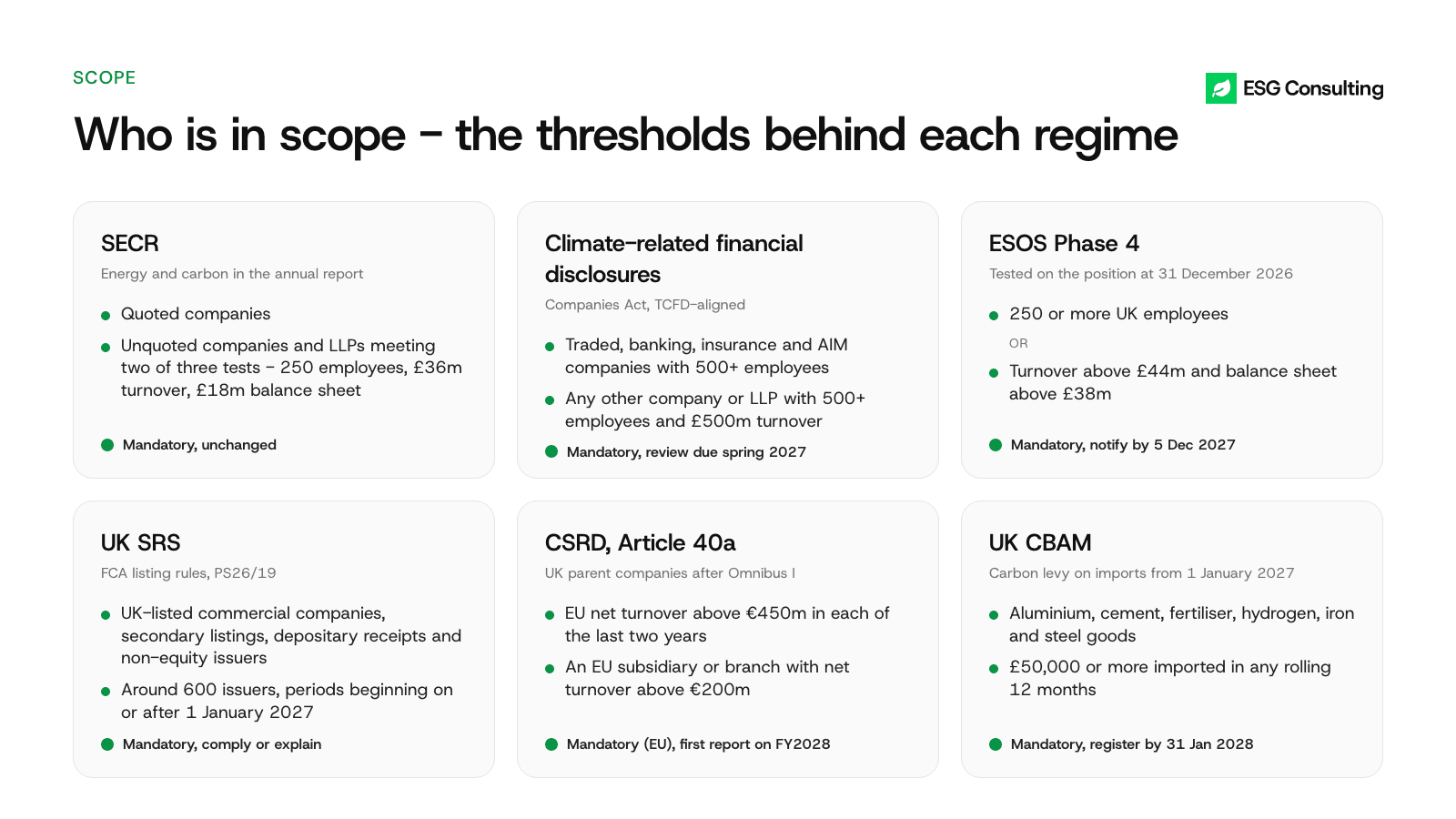
Phase 4 qualification depends on an organisation's position at 31 December 2026. A UK undertaking qualifies if it employs 250 or more people, including employees it contracts overseas, or if its annual turnover exceeds £44m and its balance-sheet total exceeds £38m. Group structures and historical size rules also affect whether an undertaking qualifies. The compliance notification is due by 5 December 2027, followed by the action plan by 5 December 2028.
Changes to ESOS in July 2026
The ESOS (Amendment) Regulations 2026 came into force on 22 July 2026 and removed Display Energy Certificates and Green Deal Assessments as compliance routes. An ISO 50001 certificate covering 95% or more of an organisation's energy use now removes the need for an ESOS report and a Lead Assessor altogether. All other organisations need a Lead Assessor audit covering 95% of consumption, together with a new action plan review that lists each measure implemented since Phase 3 and its estimated kWh saving. Net zero assessments remain a voluntary part of the scheme.
Lead Assessor availability tightens in the last six months of every phase, so booking in 2026 for a 2027 audit is the least expensive decision on this list.
SECR and climate-related financial disclosures - unchanged but under closer scrutiny
Both regimes are mandatory and neither changes for FY2026 or FY2027 reporting.
SECR continues to apply to quoted companies and to unquoted companies and LLPs that meet two of three tests, namely 250 employees, £36m turnover and an £18m balance sheet. Those figures did not change when the company size thresholds rose in April 2025, so a company that is now classed as medium-sized for its accounts can still fall within the scope of SECR. The government's post-implementation review, published on 26 May 2026, recommended retaining SECR with targeted amendments and a standard template and a consultation has been promised but not dated.
The Companies Act climate-related financial disclosures (CFD) continue to apply from 500 employees for traded, banking, insurance and AIM companies. For all other companies the test is 500 employees together with £500m turnover. The government confirmed in February 2026 that a UK SRS S2 report satisfies the CFD requirement, so no company will need to report twice. A review of CFD is due to conclude in spring 2027.
What has changed is the level of scrutiny, as auditors and investors now test methodology, boundaries and restatements against source data and a carbon footprint that cannot be traced back to invoices and meter readings is the finding organisations most need to avoid.
UK CBAM - the levy begins on 1 January 2027
UK CBAM is mandatory, with primary legislation in the Finance Act 2026 and regulations made on 13 July 2026.
Any business that imports aluminium, cement, fertiliser, hydrogen, iron or steel goods worth £50,000 or more in any rolling 12-month period becomes a CBAM taxpayer from 1 January 2027. The charge equals the embedded emissions of the goods multiplied by a rate based on the mean UK ETS auction price of the preceding quarter, less any carbon price already paid overseas.
The compliance dates fall later than the start of the levy. Registration for 2027 liability is due by 31 January 2028 and the first return and payment, covering all of 2027, are due on 31 May 2028. Returns then move to a quarterly cycle and records must be kept for six years.
The data requirement begins immediately, because importers need verified embedded emissions data per product from their suppliers, or they will pay on default values. In many businesses this is the first regime that requires the reporting team and the procurement team to work together.
Exporters to the EU face the equivalent obligation in reverse. EU CBAM entered its definitive period on 1 January 2026, EU customers begin buying certificates from 1 February 2027 and they must file their first annual declaration by 30 September 2027, so they will request emissions data from UK suppliers before then.
CSRD after Omnibus I - the Article 40a test decides whether to continue
CSRD is mandatory for companies within its scope in the EU. Omnibus I has been in force since 18 March 2026 and member states must transpose it by 19 March 2027.
For a UK parent company, the deciding test is Article 40a. A group falls within scope if its EU net turnover exceeded €450m in each of the last two financial years and it has an EU subsidiary or branch with net turnover above €200m. The test contains no headcount criterion. EFRAG estimates that the number of non-EU groups in scope has fallen from around 10,000 to around 1,200, of which 150 to 200 are British.
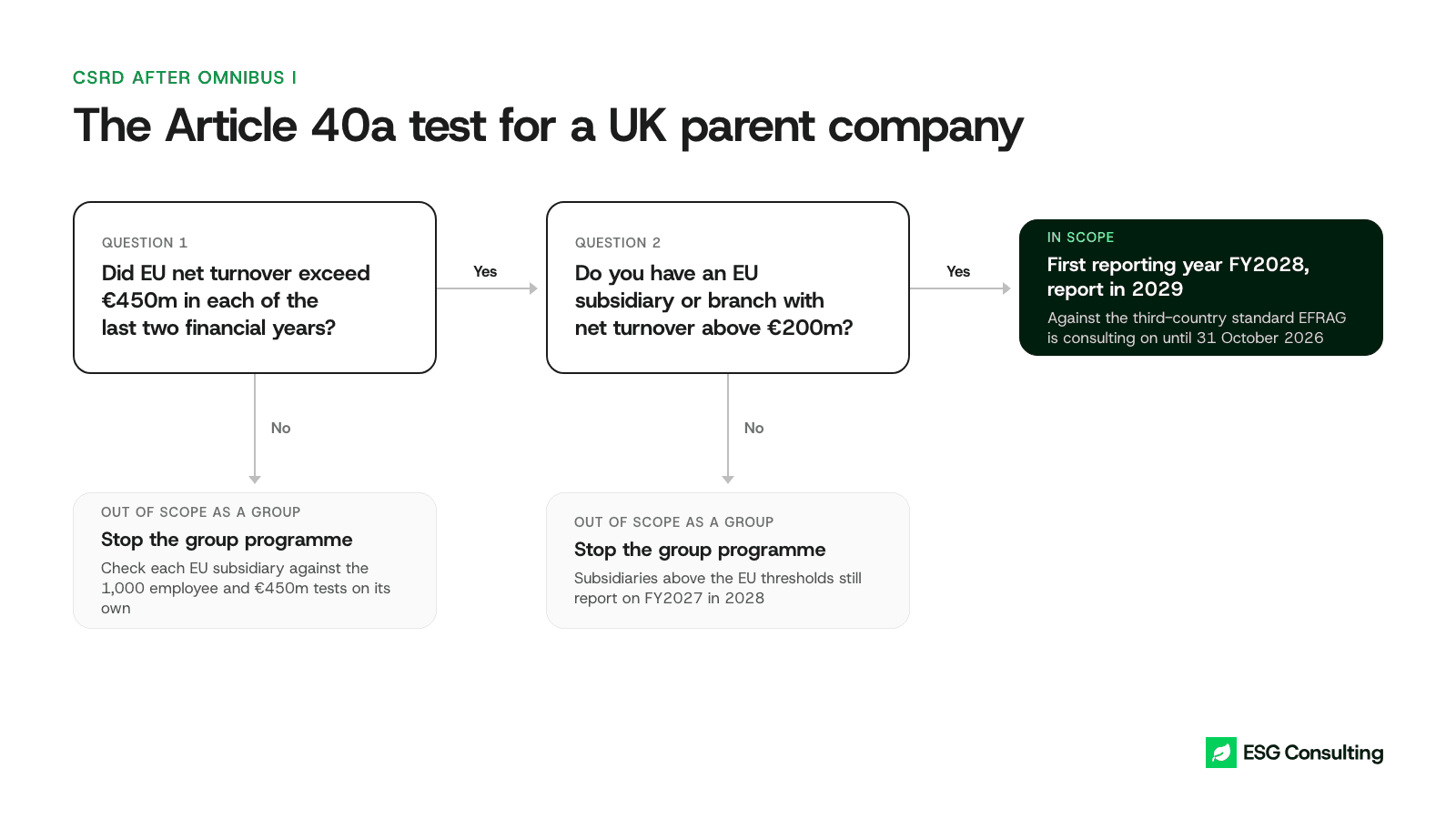
A group that meets the test reports for the first time on FY2028, with the report published in 2029, against a third-country standard on which EFRAG is consulting until 31 October 2026. A group that does not meet the test should stop its group-level programme. We have been closing down CSRD projects that are no longer needed and redirecting the budget for clients.
EU subsidiaries require a separate assessment against the EU thresholds. A subsidiary with more than 1,000 employees and €450m turnover reports on FY2027 in 2028, using the simplified ESRS that the Commission adopted on 3 July 2026 with mandatory datapoints reduced by more than 60%. A wave 1 subsidiary that now falls below the thresholds exits from FY2027 and its obligation for FY2026 depends on whether its member state has used the option to exempt it. As at August 2026, Germany, France, the Netherlands and Ireland had not legislated on that option.
SBTi Corporate Net-Zero Standard V2.0 - 1 February 2027
The standard is voluntary and its final version was published on 11 June 2026.
V2.0 takes effect on 1 February 2027, although companies can continue to submit targets under the current standard, V1.3.1, until 31 January 2028. From 1 February 2028 every new submission must use V2.0.
The changes to the standard are structural. Scope 1 and Scope 2 emissions receive separate targets and Scope 2 is measured on a location-based method. Scope 3 targets must cover every category that represents 5% or more of a company's Scope 3 total, replacing the previous 67% coverage rule. Companies with turnover of €450m or 1,000 employees, defined as Category A in the standard, must disclose a transition plan and obtain limited assurance over base-year data.
For most companies the decision concerns the sequencing of target submission. A company whose target is close to submission should file under V1.3.1 before 31 January 2028 and plan the move to V2.0 at its next five-year review. A company that is more than a year from submission should model against V2.0 now, because re-baselining after validation costs more than setting the boundary correctly the first time.
Public sector buyers - PPN 026 and the NHS 2027 standard
Both requirements are mandatory for suppliers bidding for the contracts concerned.
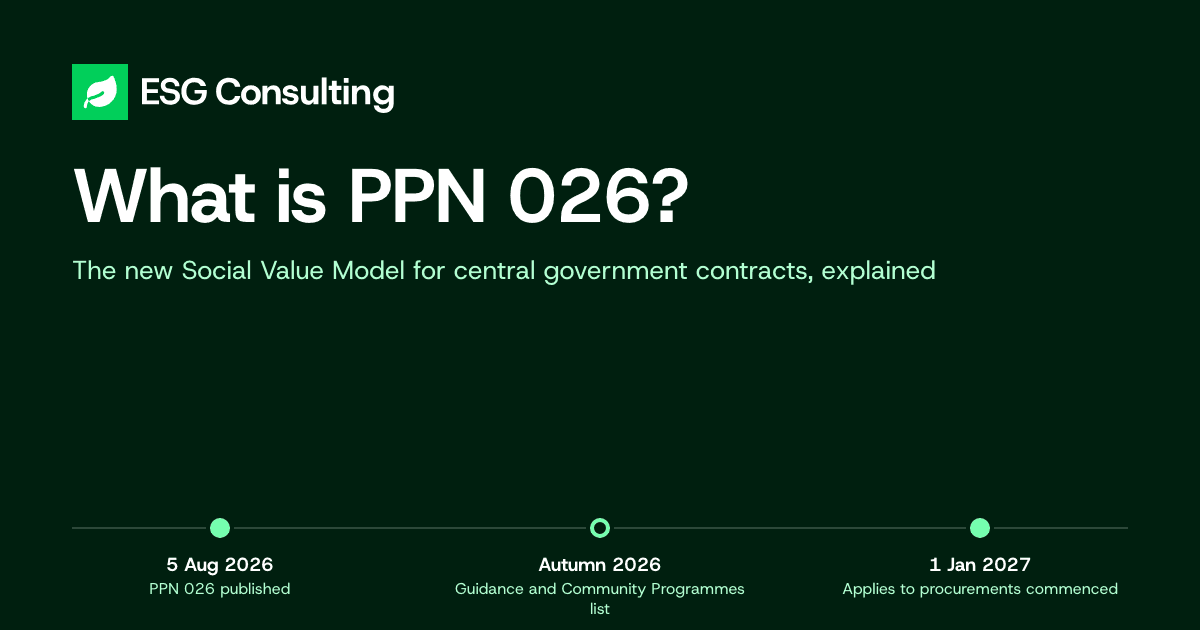
Central government's new Social Value Model, PPN 026, was published on 5 August 2026 and applies to procurements of £1m or more that commence on or after 1 January 2027. It narrows social value to two outcomes, jobs and skills, as our guide to what PPN 026 is and how it scores bids sets out in full. The climate theme no longer appears in the model, but carbon remains part of tenders through PPN 006, which requires a board-signed Carbon Reduction Plan, updated annually, for contracts above £5m a year. An expired plan remains the most common reason a bid fails at that stage.
The NHS has gone further than central government. From 1 April 2027, contracts worth £5m a year and every new framework, regardless of value, require the 2027 NHS Carbon Reduction Plan. The plan must cover global Scope 1 and Scope 2 emissions and all relevant Scope 3 emissions, set a net zero target of 2050 or earlier, be approved by the board, be published on the supplier's website and be updated annually. Contracts worth less than £5m a year remain on the 2024 standard. NHS Supply Chain has required Evergreen Level 1 at tender close since 6 April 2026 and Level 2 aligns with the 2027 requirements.
Fund managers - SDR now and SFDR 2.0 later
SDR is mandatory, while SFDR 2.0 remains a proposal.
UK asset managers with £5bn to £50bn under management must file their first entity-level SDR sustainability reports by 2 December 2026. In the EU, the Commission's SFDR 2.0 proposal of 20 November 2025 replaces Articles 8 and 9 with three product categories, Sustainable, Transition and ESG Basics, each with a 70% minimum threshold. The Council agreed its position on 24 June 2026 and a vote in the European Parliament will follow, with application expected in 2028 at the earliest.
How to ensure ESG compliance in 2026 and 2027
Four checks cover most of the obligations on this list.
- Groups with EU operations should run the Article 40a test and stop the CSRD programme if they do not meet it.
- Organisations in ESOS scope should diarise 5 December 2026 for the Phase 3 progress update and book a Lead Assessor for Phase 4 now.
- Listed companies should gap-assess their latest annual report against UK SRS S2 and map 1 January 2027 to their year end.
- Importers of CBAM goods should ask their suppliers for embedded emissions data before the end of the year.
Each of these checks is a scoping exercise rather than a full project. For a second opinion on any of them, speak to a consultant.
Sources
- UK SRS S1 and S2, Department for Business and Trade, 25 February 2026
- FCA CP26/5, Aligning listed issuers' sustainability disclosures with international standards, 30 January 2026
- Modernising Corporate Reporting consultation, 7 September 2026
- ESOS Phase 4 guidance, 30 July 2026
- The Energy Savings Opportunity Scheme (Amendment) Regulations 2026
- 2026 post-implementation review of the SECR Regulations 2018, 26 May 2026
- UK CBAM policy summary, HMRC, 16 July 2026
- Directive (EU) 2026/470, Omnibus I, Official Journal 26 February 2026
- Commission adopts revised ESRS, 3 July 2026
- SBTi Corporate Net-Zero Standard Version 2.0, June 2026
- PPN 026, The Social Value Model, 5 August 2026
- PPN 006, Carbon Reduction Plans in major government contracts
- 2027 NHS Carbon Reduction Plan requirements, NHS England, 9 June 2026
- CDP disclosure 2026 timeline