
sustainability reporting consultant, UK SRS reporting, SECR and ESOS, assurance readiness, ESG consulting UK
Sustainability Reporting Consultant How to Choose One
By ESG Consulting Team · · 12 min read
You're probably staring at a draft, a deadline, and three different requests from finance, procurement, and the board, all asking for “the sustainability report” as if that's one document with one rulebook. It isn't. In the UK, the work now sits across mandatory and emerging regimes, and the wrong consultant can waste budget by writing beautifully for the wrong scope.
A sustainability reporting consultant should not be a glossy report writer. The right one scopes obligations, builds evidence, and gets disclosures ready to survive challenge from procurement teams, regulators, and assurance providers. That's the standard I'd apply on any UK engagement, whether the client is a listed group, an NHS trust, or a supplier trying to stay in the frame for contracts.
Table of Contents
- Why UK Organisations Hire a Sustainability Reporting Consultant Now
- What UK Reporting Actually Covers and How to Scope It
- How to Choose the Right Consultant and What Good Looks Like
- Working With Your Consultant From Scoping to Sign Off
- Procurement Questions Tips and Red Flags to Avoid
- Getting Assurance Ready and Making the Engagement Stick
Why UK Organisations Hire a Sustainability Reporting Consultant Now
A procurement team sends over an RFP, the CFO asks whether the company is “in scope”, and the sustainability lead has to turn three frameworks into one deadline. That is the point where organisations stop needing another deck and start needing someone who can separate obligation from noise.
The pressure is coming from different directions. UK government guidance requires sustainability reporting for central government bodies producing annual reports and accounts under the FReM, and the UK Sustainability Reporting Standards were issued by the Department for Business and Trade on 25 February 2026. UK companies above certain thresholds still face Companies Act climate-disclosure requirements and SECR obligations, so assumptions based on a single prior framework quickly fall apart.
What usually triggers the brief
The brief is usually triggered by board governance, supplier scrutiny, investor expectation, and a growing fear that the organisation has already disclosed less than it should have. A good consultant cuts through that uncertainty before it turns into a control failure.
Practical rule: if no one can answer “what applies to us, and why?” in one meeting, bring in a consultant before you bring in a writer.
The 2026 UK SRS milestone matters because it gives advisers an ISSB-based reporting baseline. Those standards are voluntary today, and proposed for future FCA-led adoption for listed companies from FY2027. For buyers, that changes the brief. The job is no longer just narrative polish. It is scoping judgement, disclosure design, and evidence discipline.
That is why procurement should treat this as an assurance-readiness decision. A competent consultant should be able to tell you what applies, build the data trail, and leave you with output that can stand up to challenge. Anything less is a waste of budget.
What UK Reporting Actually Covers and How to Scope It

The first mistake buyers make is jumping straight into data collection. The second is asking a consultant to “do sustainability reporting” without defining the regime, the legal entity, and the reporting boundary. In the UK, that vagueness gets expensive fast.
The regimes that actually matter
SECR covers energy and carbon disclosure. ESOS is the audit-and-action-plan scheme for large organisations, and it is not a narrative exercise. Companies Act climate disclosures still apply to certain companies, including entities with more than 500 employees and more than £500 million turnover, and they sit alongside central government reporting requirements under the FReM and the emerging UK SRS baseline (UK SRS milestone and UK reporting requirements, FCA climate and sustainable finance reporting requirements).
A competent consultant starts with applicability. They test the corporate group, confirm which legal entity is reporting, and pin down whether the work is about SECR, ESOS, Companies Act disclosures, UK SRS readiness, or all of the above. If the organisation is in scope for ESOS Phase 3 or 4, the sequence matters even more. The consultant has to move from qualification testing to boundary checks, then audits, then action planning and notification (ESOS Phase 3 data and workflow).
Scope boundaries come first
The right scoping question is not “What can we report?” It is “What do we have to report, and what evidence proves it?” That means checking organisational boundaries, site coverage, source systems, and whether Scope 1, Scope 2, and Scope 3 are relevant for the entity and framework in question. In practice, a consultant should ask for company structure charts, site lists, utility data, prior disclosures, and any existing audit trail before they write a word.
An internal scoping note should also flag where obligations do not apply. That matters because some buyers waste budget on over-reporting, while others miss mandatory work because they assumed a voluntary standard was enough. The FCA is consulting on replacing current TCFD-aligned listing rules with UK SRS-based disclosures, with mandatory climate reporting proposed to apply from accounting periods beginning on or after 1 January 2027, subject to FCA confirmation, while Scope 3 and broader sustainability topics would be phased in later on a comply-or-explain basis in 2028 and 2029 (Read the UK ESG reporting deadlines and what they mean for 2026 and 2027).
Use that timetable as a procurement filter. If a supplier talks only about “beautiful sustainability storytelling”, they are not scoping risk. They are selling decoration.
How to Choose the Right Consultant and What Good Looks Like
A weak procurement process starts with a glossy proposal and ends with rework. A good one starts with risk, evidence, and who will stand behind the final disclosure. That is how you separate a report writer from a consultant who can handle assurance readiness. See what an ESG consultant does and how the role differs from a report writer
The market splits into three broad types. Generalist writers can package a report, boutique carbon specialists can go deep on specific schemes, and full-scope ESG consultancies can handle broader disclosure, assurance readiness, and cross-framework mapping. Procurement should care less about branding and more about whether the team can support a defensible process.
Compare the models by risk, not by brochure polish
| Consultant Model Compared for UK Assurance Readiness | ||
|---|---|---|
| Selection Criterion | What to Ask For | Why It Matters for Assurance |
| Regulatory depth | Clear examples of SECR, ESOS, UK SRS, and Companies Act work in the UK | The consultant must know which rule applies before drafting starts |
| Named lead | One named senior person from brief to sign-off | Accountability stops handoffs from drifting |
| Evidence design | A traceable source-data chain and control owner per data stream | Assurance teams need a defensible trail |
| Fixed scope | A defined deliverable list, not open-ended advisory time | Prevents budget creep and vague change requests |
| Sector fit | Relevant work in FTSE 100, NHS, or large private organisations | Sector context affects governance, data quality, and buyer scrutiny |
| Assurance support | Preparation for external assurance, not just drafting | Reduces rework when numbers are challenged |
A strong consultant should sound procurement-aware from the first call. They should explain what they will do, what they will not do, what evidence they need, and how change requests will be handled. If they dodge those points, they are selling ambiguity.
Commercial rule: fixed-fee accountability beats open-ended “support” every time. If scope is not defined, risk gets dumped back on your team.
The best consultants build disclosures that can survive review. One named lead, source-data traceability, and draft outputs designed for assurance matter more than polished prose. They also need to say clearly when something does not apply. That is competence, not caution.
A consultant who gives you a neat narrative but cannot show how the numbers were assembled will cost you later. Finance, legal, and operational owners should be able to follow the logic without detective work. If they cannot, the engagement is not ready for sign-off.
What good looks like in practice
Good work looks boring in the right ways. The data is reconciled, the assumptions are written down, the boundary logic is clear, and the client can explain the numbers to finance without backtracking. A consultant who cannot do that is not reducing risk, they are moving it around.
Working With Your Consultant From Scoping to Sign Off

A serious engagement starts with scope and ends with a file that finance, legal, and assurance teams can follow without chasing five people for one answer. If the consultant cannot show that workflow at the outset, they are not ready for assurance. A tidy-looking report is useless if the evidence trail is weak.
The handoffs that matter
Discovery and materiality should identify the stakeholders, decision-makers, and topics that drive disclosure. Data mapping then needs to show where the figures come from, who owns them, and where the gaps sit across operations, finance, HR, property, and procurement. After that comes emissions calculation, using GHG Protocol logic for Scope 1, 2, and 3, not a loose spreadsheet habit.
Drafting should be narrative-led, but never narrative-only. Governance statements, risk language, and transition claims must match the underlying data. Internal review then brings in leadership, legal, finance, and operational owners to challenge the numbers, assumptions, and boundary treatment before sign-off.
Where ESOS fits without derailing the project
For ESOS delivery, the consultant has to keep qualification, audits, and action planning in the right order. As noted in scoping, official UK data shows the scale of the Phase 3 workflow and why evidence control matters. This is a compliance process, not a filing exercise, and it only works if the records are organised.
If the consultant treats ESOS as a box-ticking exercise, you will pay for a filing that does not stand up to scrutiny.
A credible engagement also makes ownership clear. Finance should reconcile the figures that flow into the annual report. Operations should own site activity data. Procurement should support supplier and value-chain inputs. The consultant should coordinate, challenge, and document, not become the permanent owner of your reporting system.
A realistic delivery pattern
Good engagements surface gaps early, agree supplier chase lists fast, and keep the board away from drafts until the control owners have signed off the evidence. If the consultant starts writing before the numbers are locked, expect rework. If they rely on assumptions they cannot defend, expect trouble later.
The work should feel controlled, not clever. That is what procurement should buy.
Procurement Questions Tips and Red Flags to Avoid

An RFP is where bad consultants reveal themselves. Ask for specifics, and the weak ones get vague. Ask for methodology, and the template merchants start talking about “journeys”.
What to ask in the RFP
- UK SRS readiness: Ask how they approach ISSB-aligned disclosure design and whether they can show prior work on UK SRS-style scoping.
- SECR and ESOS methodology: Ask how they handle boundaries, site coverage, audits, and evidence, not just report drafting.
- Data controls: Ask who owns each data stream and how the consultant traces figures back to source systems.
- Assurance support: Ask how they prepare disclosures for external assurance, because retrofitting controls later usually costs more.
- Sector experience: Ask for examples from your sector, especially if you operate in government supply chains, healthcare, or listed-company environments.
If you also need procurement compliance support, align the conversation with PPN 026 readiness and related public-sector expectations, not just carbon language. That point matters for suppliers who think a generic carbon reduction plan is enough when the buyer wants a more specific response. Use the PPN 026 guidance and readiness discussion to shape that part of the brief.
Red flags I would not ignore
- Vague methodology: If they can't explain evidence flow, they're not assurance-ready.
- No UK experience: UK climate disclosure and energy schemes are specific. Generic ESG talk won't cut it.
- Guaranteed assurance: Nobody serious promises a pass without seeing the data.
- One-size reporting: A generic template is a liability when your boundary or sector is unusual.
- Box-ticking ESOS work: An action plan with no implementable measures wastes everyone's time.
Shortlist test: if the consultant can't answer your procurement questions in plain English, they won't hold up under audit pressure either.
A better purchasing discipline
Keep the scope fixed, the fee fixed, and the lead named. Ask for one control owner per data stream, a method for source-data reconciliation, and an outline of what will be ready for assurance at each stage. That's how you buy down risk instead of buying more meetings.
Getting Assurance Ready and Making the Engagement Stick

The engagement only pays off if the disclosure survives review and the internal team can repeat the process next year without rebuilding everything from scratch. That means the consultant has to leave behind controls, not just documents. It also means the organisation has to keep ownership once the sign-off happens.
The habits that make reporting durable
A serious consultant will push you to build a traceable evidence chain for every material metric, reconcile ESG figures to finance or operational systems, and assign one owner per data stream before assurance fieldwork begins. That approach matters because KPMG reports that 85% of FTSE 100 companies obtain third-party ESG assurance, 98% of those assured entities include Scope 1 and 2 greenhouse gas emissions, and 54% of UK companies still struggle with inadequate ESG data access (KPMG ESG assurance maturity index). If your data is weak, your assurance bill and your risk both rise.
The consultant should also leave your team with a reporting rhythm, not just a report. Put ESG disclosures into governance calendars, procurement reviews, and decarbonisation planning so the work isn't rediscovered every year. If you're moving towards UK SRS readiness or later CSRD exposure, re-scope early rather than treating the old pack as reusable by default.
What success actually looks like
Success is not a tidy PDF. It's a disclosure that stands up to challenge, a board that understands the numbers, and a team that can explain where the data came from. It's also the absence of panic when assurance starts.
Work with a consultant who treats the engagement as a control exercise, not a copywriting project. If they can't help you lock down the scope, the evidence, and the sign-off path, they're not the right fit.
ESG Consulting advises UK organisations on carbon reporting, sustainability disclosure, and net-zero strategy across SECR, ESOS, UK SRS, TCFD, CSRD, SBTi, and SFDR. If you need a consultant who scopes obligations, builds evidence trails, and supports assurance-ready reporting, visit ESG Consulting to discuss the right engagement for your organisation.
More from the blog
· 12 min read · Regulation
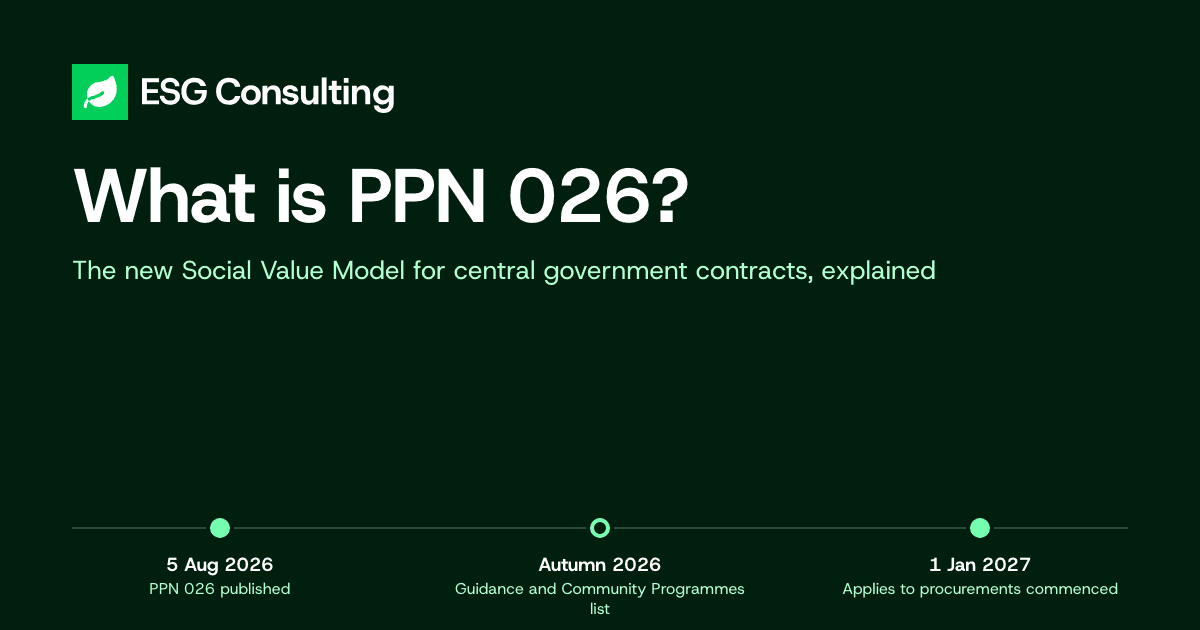
What is PPN 026? The new Social Value Model
PPN 026 replaces PPN 002 as the Social Value Model for central government contracts from 1 January 2027. Scope, the 10% and 20% weightings and the six criteria.
Read article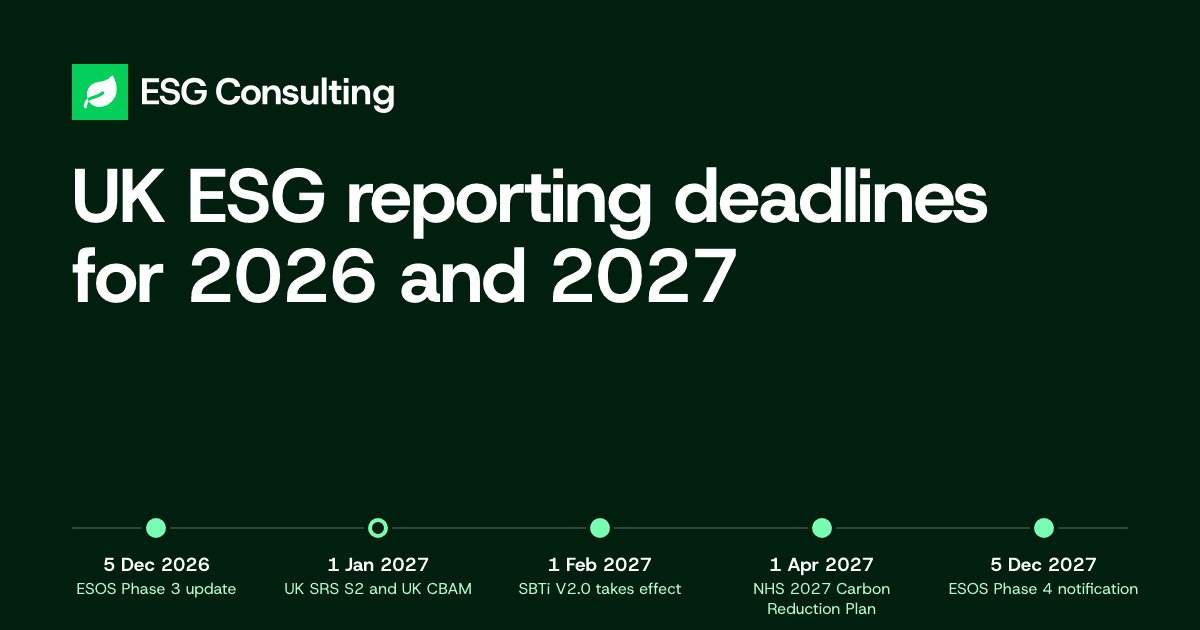
· 14 min read · Regulation
UK ESG reporting deadlines for 2026 and 2027
Every UK ESG reporting date to December 2027 - UK SRS, ESOS, SECR, UK CBAM, CSRD, SBTi, PPN 026 and the NHS - each marked mandatory, proposed or voluntary.
Read article