carbon emission reporting, SECR reporting, Scope 1 2 3 emissions, UK carbon reporting, greenhouse gas reporting
Carbon Emission Reporting for UK Organisations: A Guide
By ESG Consulting Team · · 15 min read
Your finance team has the electricity bills, facilities has the gas readings, and someone in fleet management holds the fuel records. The annual report deadline is approaching, but nobody's quite sure whether those records describe your organisation's carbon footprint or just the part you're legally required to disclose.
That distinction matters. Carbon emission reporting should produce figures you can explain, reproduce and use, not just a total you can publish. A sound approach starts with classifying emissions, checks which reporting obligations apply, and builds an evidence trail that supports both compliance and business decisions.
Table of Contents
- The Three Emission Scopes and What Each One Covers
- Which UK Reporting Rules Apply to Your Organisation
- Setting Boundaries and Gases So Totals Hold Up
- How to Calculate Emissions in Six Steps
- The Evidence Trail an Auditor Will Expect
- Where a Compliant SECR Report Falls Short
- Build One Controlled Dataset for SECR and UK SRS
The Three Emission Scopes and What Each One Covers
Take a head office with a gas boiler, a leased fleet and an electricity supplier's bill. Where does each one sit? Start with what your organisation controls, rather than who processes the invoice.
Think of the scopes as rings around the building. Scope 1 covers emissions from sources you own or control, including fuel you burn and refrigerants that escape. Scope 2 covers emissions associated with purchased energy, while Scope 3 reaches into the wider value chain.
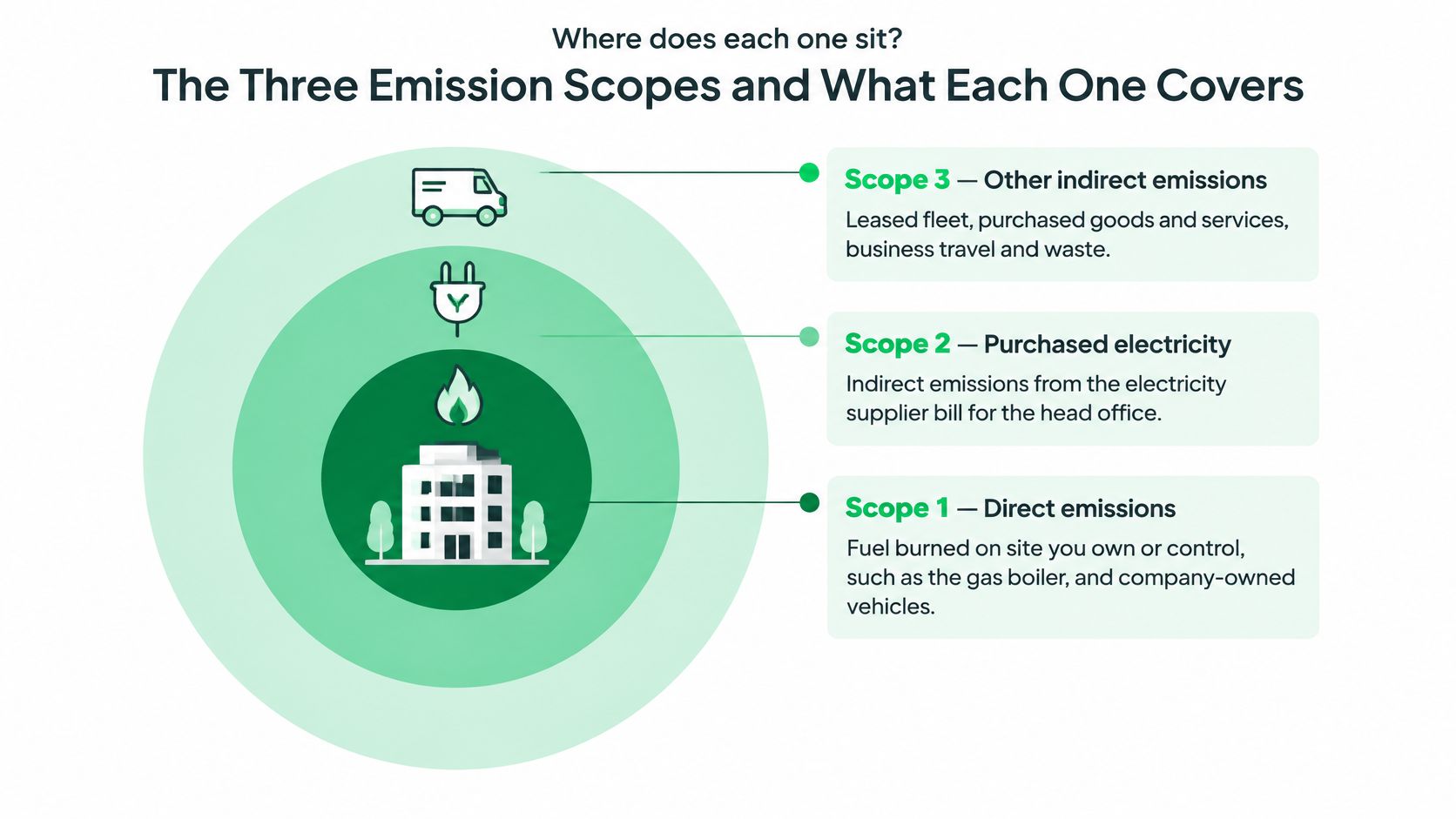
Emission scopes and their UK reporting status
| Scope | What it covers | Typical UK sources | Core SECR requirement |
|---|---|---|---|
| Scope 1 | Direct emissions from sources the organisation owns or controls | Gas boilers, generators, company vehicles, refrigerant leakage | Required, subject to the applicable reporting boundary and source requirements |
| Scope 2 | Emissions from purchased electricity, heat, steam and cooling | Grid electricity for offices, sites and data centres | Required |
| Scope 3 | Other indirect emissions across the value chain | Business travel, purchased goods, waste, commuting, supplier activity | Not a core SECR requirement; check specific transport disclosures |
The table is a starting classification, not permission to assume every source receives identical treatment under SECR. Its core operational disclosures centre on energy and associated emissions; a broader inventory also considers sources and value-chain activities needed for other reporting purposes.
For the office, gas burned in a boiler under your control belongs in Scope 1. Electricity belongs in Scope 2 because the generation emissions occur elsewhere, even though your organisation uses the power. The manufacture of office furniture and employees' journeys to work sit outside those operational sources, in Scope 3.
Classification mistakes to avoid
A lease doesn't automatically place an asset in Scope 3. For a leased vehicle or building, examine the arrangement and apply your chosen organisational boundary consistently.
- Purchased electricity isn't Scope 1. Paying the bill doesn't mean you directly produced the generation emissions.
- Business travel isn't the same as commuting. Keep employee journeys for work separate from journeys between home and the usual workplace.
- Refrigerant leakage isn't electricity consumption. Air-conditioning equipment can create distinct emission sources.
- Supplier activity isn't automatically outside your footprint. It may belong in your value-chain inventory even when you don't control the supplier.
Practical rule: Assign every line of an energy bill, fleet log or refrigerant record to a scope before calculating emissions.
Keep uncertain classifications visible. A short note explaining the judgement is more useful than a confident-looking total built on an undocumented assumption.
Which UK Reporting Rules Apply to Your Organisation
Does your organisation meet the relevant size and eligibility tests? Don't assume carbon reporting applies only to listed businesses, or that a familiar threshold remains the right test for every reporting period.
The government's Environmental Reporting Guidelines describe quoted-company emissions reporting from 1 October 2013, its SECR expansion from 1 April 2019, and the large-unquoted-entity test generally based on meeting at least two thresholds: more than 250 employees, turnover above £36 million, or a balance-sheet total above £18 million. Confirm the applicable company-size rules, exemptions and group treatment for your financial year before deciding you're in or out.
UK carbon and climate reporting regimes by who they apply to
| Regime | Who it applies to | What it requires | Timing |
|---|---|---|---|
| SECR, quoted companies | UK quoted companies within the statutory definition | Global energy use, relevant Scope 1 and Scope 2 emissions, intensity ratio and energy-efficiency action | Established annual-report obligation |
| SECR, large unquoted companies and large LLPs | Entities meeting the applicable size and eligibility tests | UK energy use, associated emissions, intensity ratio and energy-efficiency action | Established annual-report obligation |
| Climate-related financial disclosures | In-scope large UK companies and financial institutions | Governance, strategy, risk management, metrics and targets based on TCFD | Applies to qualifying financial years |
| Carbon Reduction Plans | Suppliers whose central government tender falls within the relevant procurement policy | A Carbon Reduction Plan meeting the applicable PPN 006 requirements | Check the live tender and procurement policy |
| UK SRS, S1 and S2 | Entities brought within any applicable adoption requirements | Sustainability and climate disclosures based on IFRS S1 and S2 | Confirm final standards and separate mandatory application rules |
| CSRD, EU rules | Groups meeting the applicable EU scope tests, including some UK groups with EU activity | ESRS-aligned sustainability reporting | Check current EU scope, implementation and reporting timetable |
Treat procurement and EU applicability as separate assessments, not extensions of the SECR size test. A customer questionnaire can also request information beyond your statutory disclosure.
A carbon inventory isn't a climate-risk assessment
The government's mandatory climate-disclosure announcement stated that more than 1,300 of the largest UK-registered companies and financial institutions would be required to disclose climate-related financial information for financial years beginning on or after 6 April 2022. Those disclosures address governance, strategy, risk management, metrics and targets.
An emissions inventory answers how much your activities emit. Climate-related financial disclosure asks how climate risks and opportunities could affect your organisation's business model and finances.
For company SECR reporting, identify the disclosure's required home in the Directors' Report, checking the applicable rules if environmental information is presented in the Strategic Report. LLPs should check the corresponding reporting arrangements rather than copying a company template.
Setting Boundaries and Gases So Totals Hold Up
A leased office can look straightforward until you inspect its heating arrangements. The landlord might operate a shared boiler and recharge tenants for heat, while your organisation controls a separate boiler serving its own space.
Operational control helps resolve the classification, but the lease, plant responsibilities and billing arrangement provide the evidence. Don't assume occupying a building means controlling every emission source inside it.
Why CO2e matters
The UK public-sector sustainability reporting guidance uses tonnes of CO2e and covers the seven greenhouse gases: carbon dioxide, methane, nitrous oxide, hydrofluorocarbons, perfluorocarbons, sulphur hexafluoride and nitrogen trifluoride. It also directs public bodies to assess SECR applicability and align methodology with the Environmental Reporting Guidelines.
Carbon dioxide equivalent, or CO2e, provides a common measure for gases with different warming effects. It lets you combine relevant emissions without pretending a mass of refrigerant has the same climate impact as an equal mass of carbon dioxide.
Example source-level boundary register
Use this as a working template, then record your actual control arrangements.
| Source | Scope | Boundary status |
|---|---|---|
| Gas boiler in a leased office | Scope 1 if tenant-controlled | Judgement call: include here only if the tenant controls it under the chosen boundary |
| Purchased electricity for offices | Scope 2 | In: reported separately from Scope 1 |
| Company vehicles | Scope 1 for controlled combustion sources | In: supported by a mileage or fuel log |
| Refrigerant leakage | Scope 1 for controlled equipment | In: separate line in the register |
| Landlord-metered heat recharged to tenant | Scope 2 for purchased heat | Judgement call: check supply arrangements and allocation to avoid duplicate entries |
Add the site, responsible person and supporting document to each register entry. When consolidating a group, those details help the reporting team identify the same meter appearing in both a site return and a landlord recharge.
Distinguish accidental duplication within your inventory from legitimate reporting by different organisations under their respective scopes. The aim isn't to erase every shared connection between a supplier and customer.
Choose an intensity ratio that suits your activities, such as tonnes CO2e per floor area, staff member or clinical activity measure. Then mark every source in, out or judgement call, with a reason another reviewer can follow.
How to Calculate Emissions in Six Steps
Say a hypothetical site uses 10,000 kWh of gas and 50,000 kWh of purchased electricity during its reporting year. Those are activity figures, not emissions figures, and they need separate conversion factors.
The UK government conversion-factor collection provides annual factors for corporate greenhouse-gas reporting across the scopes. Select the reporting-year category that matches the activity and its units, rather than using whichever factor is easiest to find.
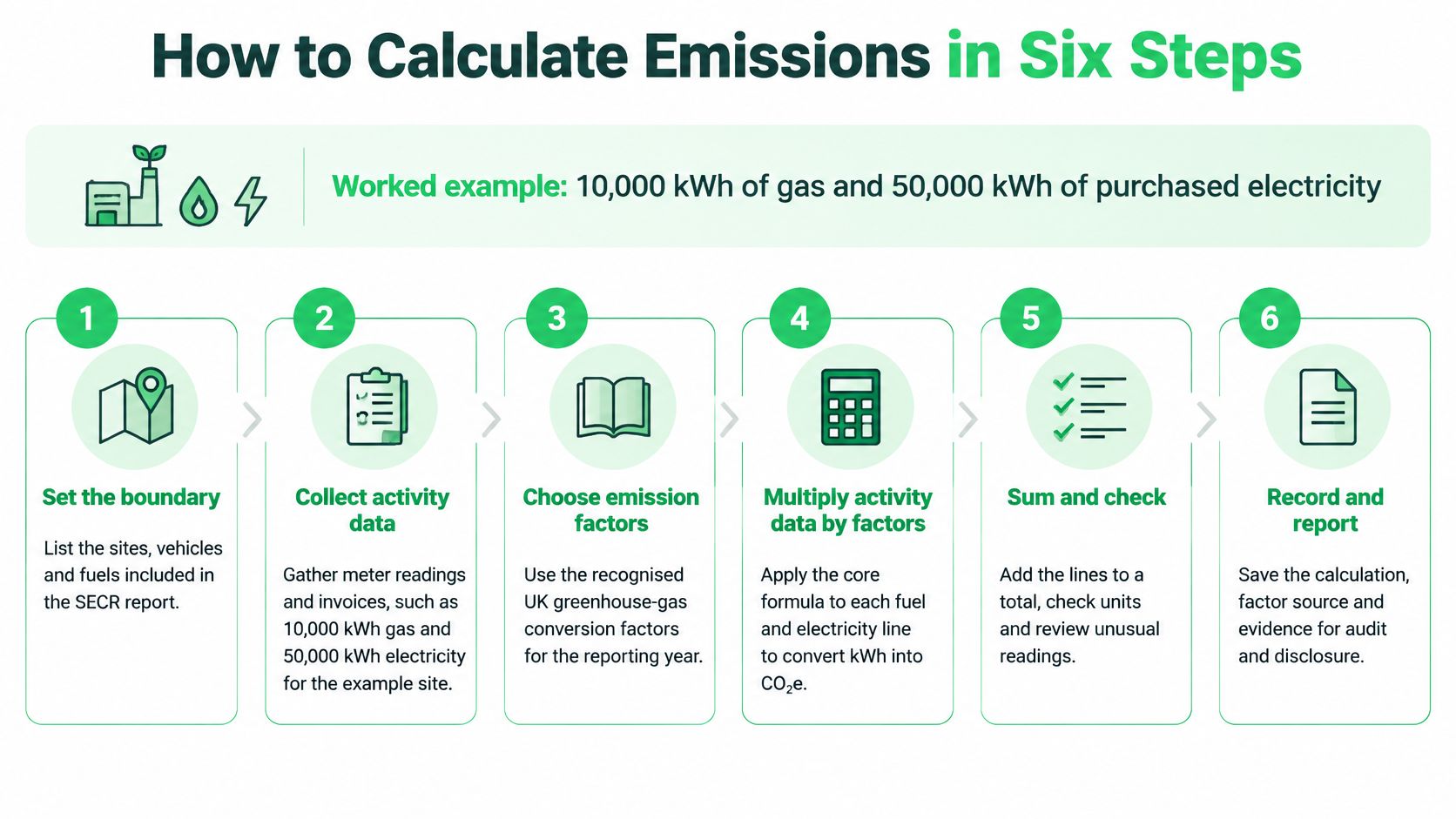
From bills to a reportable inventory
Set the organisational and operational boundary.
List the entities, sites, assets and activities included. For the hypothetical site, establish whether the gas boiler is controlled by your organisation and whether the electricity meter serves only your premises. A common slip is starting with available invoices and overlooking a site that hasn't supplied its records.Collect activity data.
Gather invoices, meter readings, fuel-card records and mileage logs for the reporting period. Reconcile opening and closing dates, and distinguish actual readings from supplier estimates. Don't treat invoice value as energy consumption, or mix a financial-year total with calendar-year records.Select the reporting-year conversion factors.
Match the fuel, electricity or transport category to the underlying activity. Save the factor's description and units alongside its value. Reusing a previous workbook without reviewing its factor references can make an apparent performance change partly a calculation error.Multiply each activity by its matching factor.
In the example, calculate the gas line and electricity line separately: gas consumption multiplied by the gas factor, and electricity consumption multiplied by the electricity factor. Convert the resulting mass unit into tonnes CO2e where necessary. Never multiply litres by a factor expressed per kilowatt-hour.Sum by scope and calculate the intensity ratio.
Keep the underlying lines visible so reviewers can inspect a site or fuel total without rebuilding the workbook. Match the intensity denominator to the same organisational boundary and reporting period. Using group-wide staff numbers beneath emissions from only selected sites produces a misleading ratio.Record the methodology and energy-efficiency action.
Explain boundary choices, exclusions, estimates and calculation methods. Describe actions undertaken, such as adjusting heating controls or replacing inefficient equipment, without presenting planned projects as completed savings. Give the narrative an owner who can verify it.
Check consumption before interpreting performance
Fuel, electricity and refrigerant factors can change between reporting years. Keep changes in activity separate from changes in factors when explaining why emissions rose or fell.
Before publication: Reconcile the activity totals with the bills, then reconcile the emissions totals with the calculation lines.
The reported carbon total won't match an energy bill's numerical total because the units differ. What should match is the underlying consumption, with any adjustments explained.
The Evidence Trail an Auditor Will Expect
A carbon total should work like a well-organised receipt folder. A reviewer starts with the reported figure and follows a clear route back to the original activity record, rather than asking the preparer to reconstruct the calculation from memory.
Build that route while collecting the information. Adding evidence after the annual report is drafted makes it harder to distinguish an approved estimate from an accidental omission.
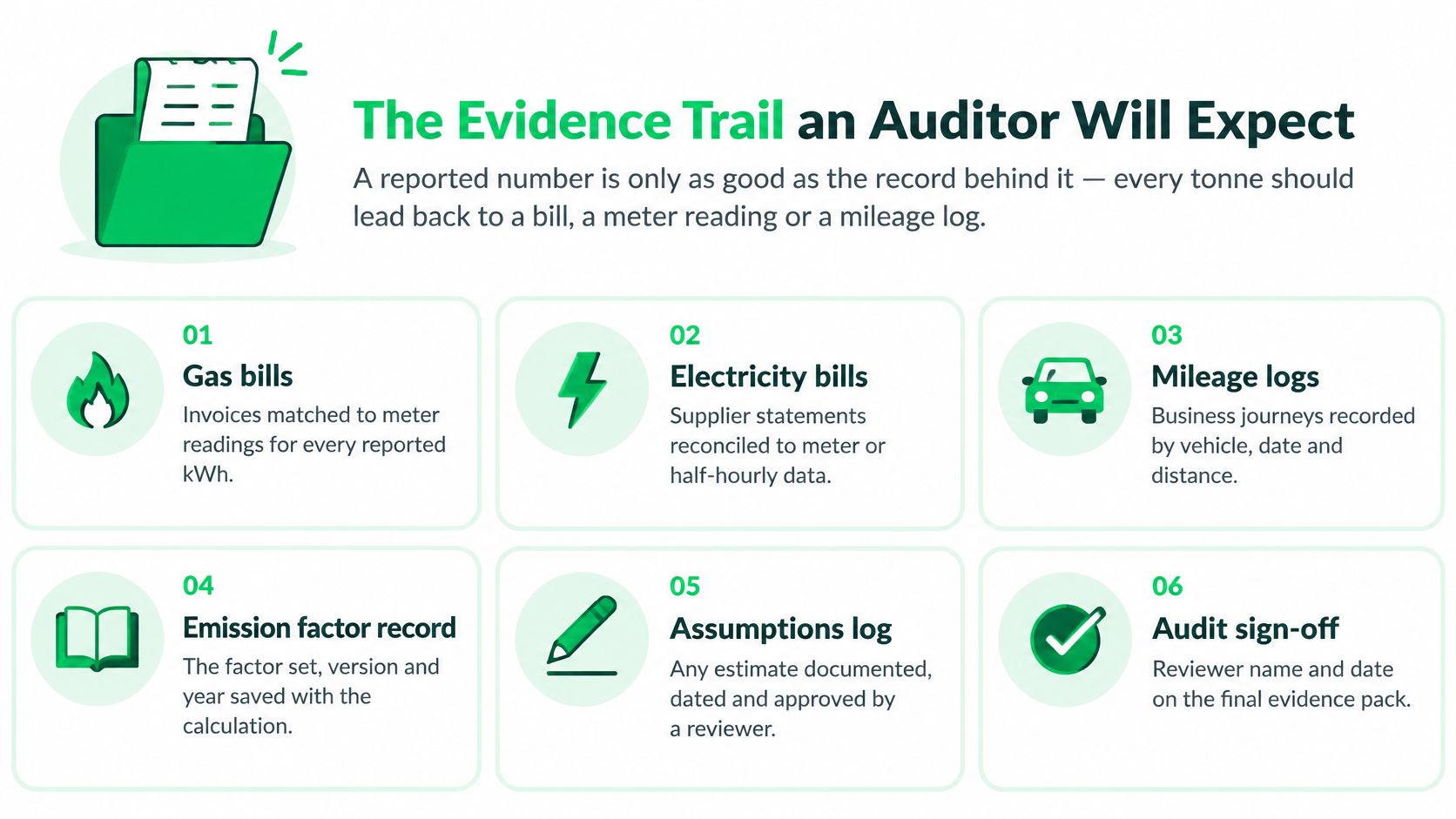
Assemble a reviewable evidence pack
- Site records. Retain invoices and meter readings, identified by site, account, meter and reporting period.
- Vehicle records. Save fuel or mileage logs with the vehicle category and enough detail to justify the selected calculation method.
- Factor records. Preserve the factor year, category, units and source document, not just a value pasted into a cell.
- Unit conversions. Show how the original recorded units became the units used in the calculation.
- Calculation version. Keep the final spreadsheet or system export, with formulas and a clear version history.
- Boundary and methodology. Document exclusions, allocations, estimates and the reasons for judgement calls.
- Review approval. Record who checked the figures, when they checked them and how outstanding questions were resolved.
A traceable figure can be tested. A total without supporting records leaves the reviewer unable to distinguish a valid result from a plausible-looking mistake.
Keep estimates visible
If current-period information is missing, flag any substituted prior-period figure explicitly. Record why it was used, how it was adjusted and who approved it; don't relabel it as current consumption.
For automated workflows, retain the imported machine-readable factor file and the mapping used to match activities to categories. Automation doesn't remove the need to check that a fuel record points to the correct factor.
At ESG Consulting, every figure we produce traces back to source data, with methodology, boundaries and assumptions documented for the client's auditor or assurance provider. Apply the same discipline internally by keeping each reporting period's inputs, factors, calculations and approvals together.
Pick a reported number and ask a colleague to trace it to the original bill without your help. Any missing step is a control to improve.
Where a Compliant SECR Report Falls Short
A company can file a compliant SECR disclosure and still lack a baseline suitable for net-zero planning. Legal sufficiency and management usefulness are different tests, because the reporting obligation and the business decision may cover different activities.
The government's SECR post-implementation review identifies weaknesses in comparability arising from different intensity metrics and calculation choices, limited verification, and inconsistent placement and formatting. It also finds Scope 3 information and intensity ratios harder to compile than energy and operational-emissions totals.
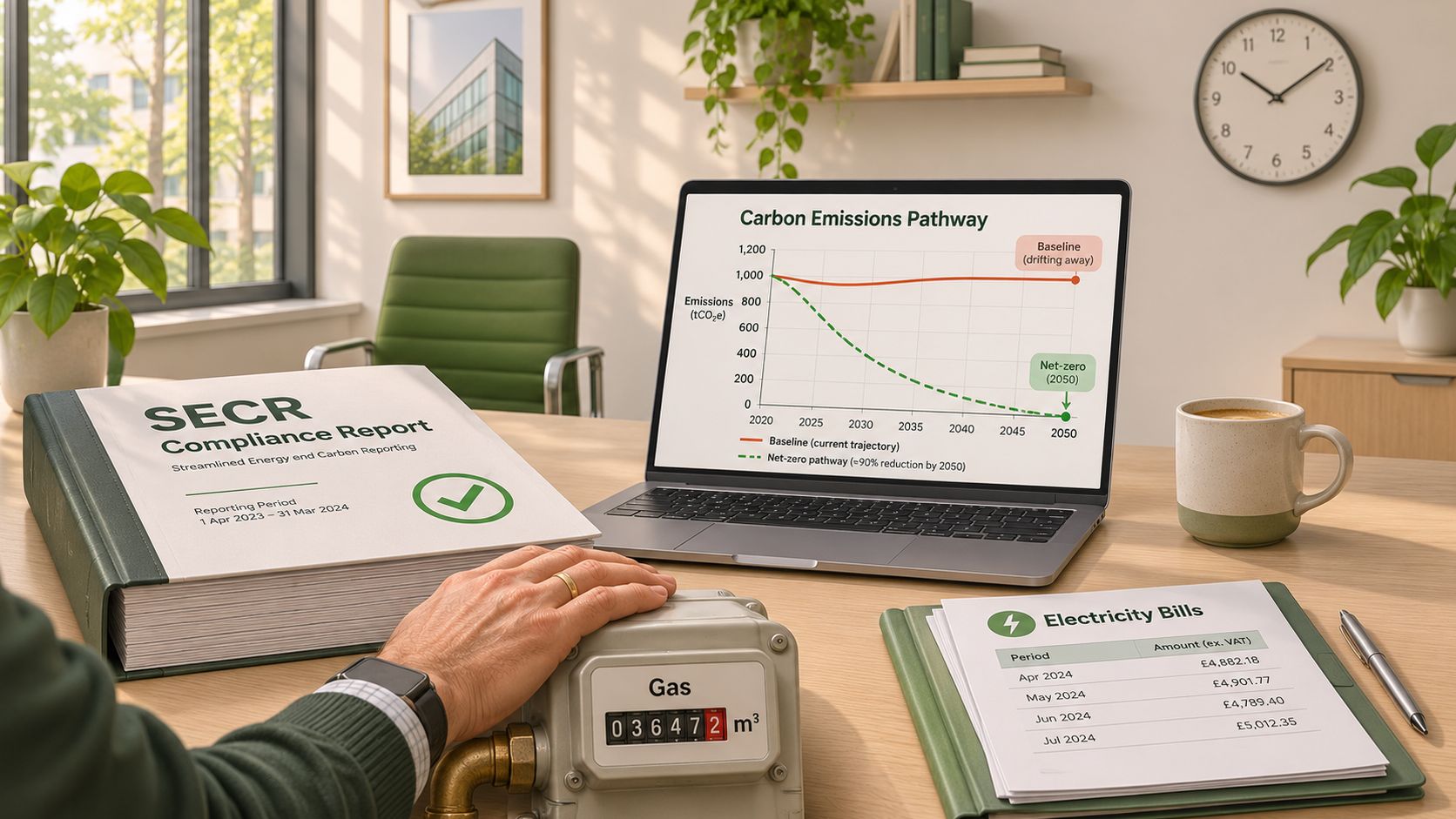
Test the baseline against its intended use
For qualifying unquoted entities, a UK-focused disclosure can leave overseas operations outside the reported baseline. Don't apply that geographical limitation indiscriminately to quoted companies, whose reporting requirements include global information.
SECR also doesn't consistently require every direct-emission source, including process or fugitive emissions. A narrow energy-based total therefore shouldn't automatically become the organisation's complete operational footprint.
Apply these decision tests:
- Overseas activity. Would excluding an overseas factory, office network or distribution operation materially change the decisions management makes?
- Omitted sources. Could manufacturing processes, refrigerant losses or other excluded activities change the apparent priorities for reduction?
- Inventory reconciliation. Can you explain the difference between the SECR total and the broader GHG Protocol inventory without manually rebuilding either?
Consider a hypothetical manufacturer whose disclosure covers its UK energy-related emissions but whose reduction strategy also needs to address overseas production and purchased materials. Using only the statutory total could direct attention towards office electricity while leaving important production and supply-chain opportunities unassessed.
Build a bridge between totals
Create a reconciliation table with a row for each source category. Include the SECR amount, broader-inventory amount, geographical coverage, treatment of exclusions and reason for each difference.
| Reconciliation item | What to record |
|---|---|
| Shared sources | Confirm matching activity records, factors and periods |
| Additional geography | Identify operations outside the statutory disclosure boundary |
| Additional direct emissions | Explain process, fugitive or other sources added to the broader inventory |
| Value-chain emissions | Keep relevant Scope 3 categories distinct |
| Methodological differences | Document changes in allocation, estimates or calculation treatment |
That bridge helps group reporting teams consolidate consistently and lets procurement or investor teams answer questions without issuing competing versions of the footprint. It also makes exclusions visible rather than disguising them within a single headline total.
Use compliance to define the required disclosure. Use the decisions you need to make to define the baseline.
Build One Controlled Dataset for SECR and UK SRS
Waiting for every future reporting detail to settle won't resolve missing supplier information. Producing separate workbooks for each disclosure can create a different problem: teams publish inconsistent figures because they use different boundaries, assumptions or versions.
The UK Sustainability Reporting Standards consultation material records the June 2025 exposure-draft consultation based on IFRS S1 and IFRS S2, alongside UK corporate-reporting evidence that 97% of surveyed companies disclosed at least one Scope 3 category. That evidence also identifies unavailable or unreliable information, supplier-engagement difficulties and the use of prior-period data when current information wasn't available.
Build for decisions, not just templates
Disclosure of a category doesn't establish that the information is complete or reliable. Give each material source an owner, a collection method and a quality assessment so the reporting team knows where improvement is needed.
Keep the distinction between an exposure draft, a final standard and a mandatory application requirement explicit. Confirm the live position before committing to a reporting timetable, and don't treat transition reliefs as permanent exemptions.
A controlled dataset should retain the activity record, reporting period, entity, location, scope, category, factor reference and approval status. Reporting teams can then select the appropriate records for SECR, UK SRS S2, TCFD-style metrics and customer questionnaires without changing the underlying evidence.
Put ownership and approval in place
- Confirm applicability before designing outputs. At ESG Consulting, we confirm which obligations apply before anything is built or scoped. Internally, assign responsibility for keeping that assessment current.
- Map sources into the shared dataset. Give records stable identifiers so the same electricity supply or vehicle return isn't entered again for another questionnaire.
- Flag Scope 3 gaps. Distinguish supplier information from estimates, identify prior-period substitutions and prioritise gaps according to materiality and decision usefulness.
- Agree sign-off before publication. Set clear responsibilities for preparing, checking and approving figures, including how late changes are authorised.
Keep reporting outputs separate from the controlled inputs. A change to a presentation table shouldn't alter source consumption, and a corrected activity record should prompt a documented review of affected disclosures.
Before release, reconcile the signed-off dataset to the SECR figures and boundary register. Every difference should have a reason, an owner and an approved treatment.
ESG Consulting helps organisations establish carbon inventories, prepare SECR disclosures and assess readiness for wider sustainability reporting, with figures traceable to their source records. Visit ESG Consulting to discuss your reporting boundary, evidence gaps and applicable obligations with an ESG specialist, not a sales team.