Table of contents
The FCA published its final UK SRS rules for listed companies, PS26/19, on 30 September 2026. From accounting periods beginning on or after 1 January 2027, around 600 listed companies will report against UK SRS S1 and S2 in place of the TCFD listing rules, with every part of both standards applied on a comply or explain basis.
Press coverage reported that the FCA had abandoned mandatory climate disclosures, which is only partly accurate. The FCA dropped its proposal to make the climate standard mandatory, but UK SRS still replaces the TCFD listing rules in full. A company that explains rather than complies must now set out which requirements it has not met, the reasons for that and the steps it is taking to address them.
We have read PS26/19, the made rules and the draft guidance in Technical Note 803.1 line by line. This article sets out what is known as at 7 October 2026 and which questions remain open.
What the FCA decided on 30 September 2026
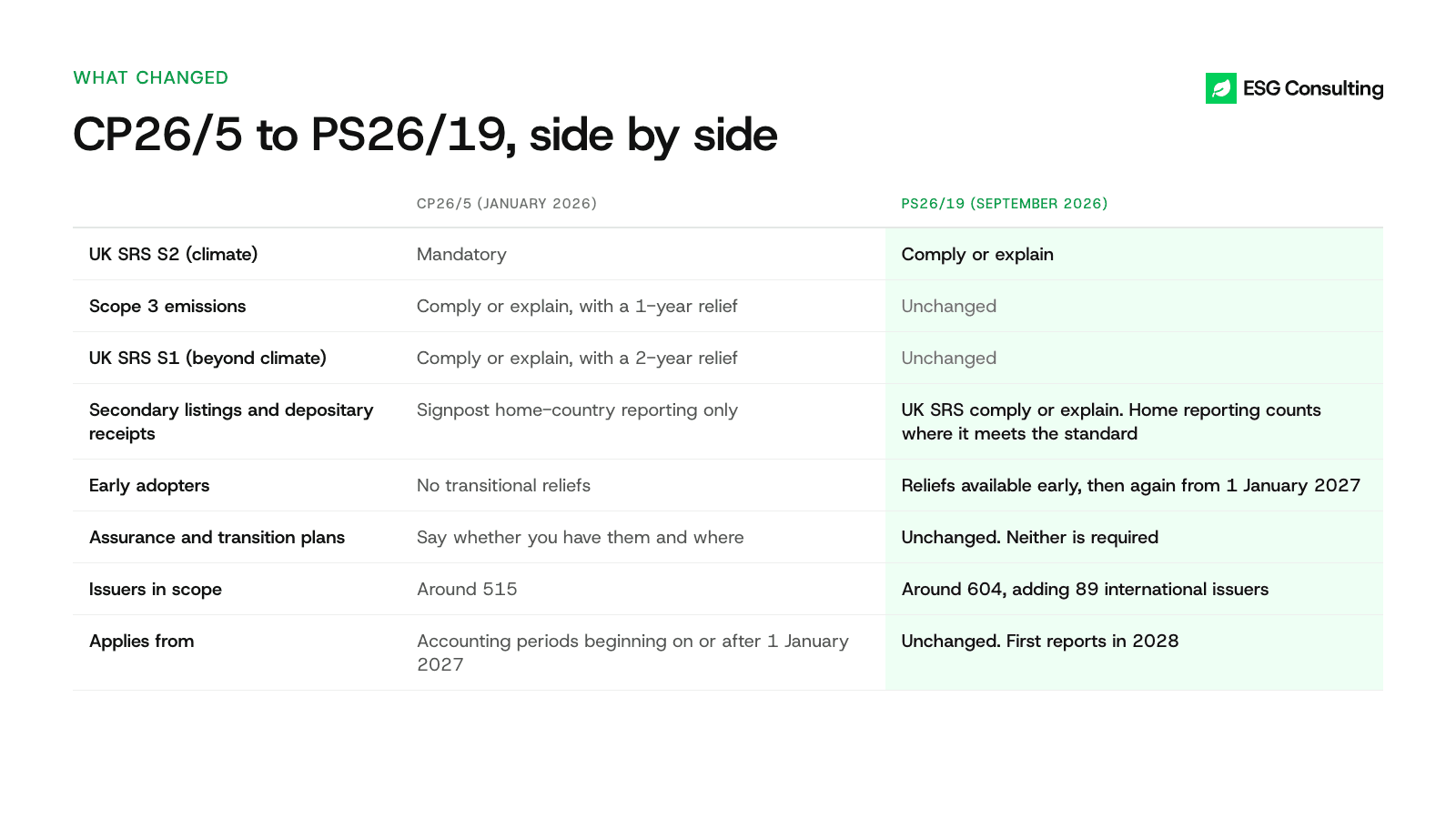
The final rules depart from the January 2026 consultation in two respects and the FCA confirmed every other proposal as consulted on.
UK SRS S2 is comply or explain rather than mandatory. CP26/5 proposed a mandatory climate standard with a comply or explain basis only for Scope 3 emissions. The final rules apply comply or explain across all of UK SRS, so the climate disclosures now operate in the same way as the non-climate disclosures in UK SRS S1. The FCA cited proportionality for smaller issuers, the competitiveness of the UK as a listing venue and feedback that a regime that was partly mandatory and partly comply or explain was "complicated to follow".
International companies also report against UK SRS. CP26/5 proposed that companies with a secondary listing or depositary receipts would only signpost the reporting required in their home jurisdiction. Respondents warned that this would give UK companies an incentive to downgrade their listing in order to avoid disclosure. The final rules therefore place those 89 issuers on UK SRS comply or explain and they can comply by cross-referring to home reporting where that reporting meets the standard.
The FCA's compatibility statement adds a third reason that does not appear in the summary, noting that since CP26/5 "there has also been a change in the approach to ISSB standards from some international jurisdictions". The EU has reduced the scope of CSRD through Omnibus I and the US has withdrawn its federal climate disclosure rule, so a mandatory UK standard would have left the UK further from its peers than it was in January.
Who the UK SRS listing rules apply to
The rules apply to issuers in five UK Listing Rules categories.
- Equity shares (commercial companies), UKLR 6
- Equity shares (international commercial companies secondary listing), UKLR 14
- Certificates representing certain securities (depositary receipts), UKLR 15
- Non-equity shares and non-voting equity shares, UKLR 16
- Equity shares (transition), UKLR 22
This is the same population that the TCFD listing rules cover, with the international categories now subject to UK SRS on the new basis. The FCA estimates that around 515 domestic issuers and 89 international issuers fall within scope.
Closed-ended investment funds, open-ended investment companies, shell companies, debt and debt-like securities, securitised derivatives and miscellaneous securities fall outside the scope of the rules. Investment funds remain subject to the asset manager rules in the ESG Sourcebook and firms in scope of both regimes can now cross-refer to their UK SRS disclosures in their TCFD entity report.
The rules contain no size threshold because the FCA rejected requests for one from several respondents, on the grounds that thresholds would cause companies to move in and out of scope and that climate exposure "depends on the company's business model and industry specific climate vulnerabilities, not its size". It gave energy and transport companies as examples of businesses exposed to climate risk regardless of their size.
AIM companies are not subject to the Listing Rules and therefore fall outside the scope of PS26/19 and private companies have no UK SRS requirement. The government's Modernising Corporate Reporting consultation, which is open until 30 November 2026, asks how UK SRS should be reflected in the Companies Act but does not set a date. The Companies Act climate-related financial disclosures continue to apply on their own terms and the draft guidance states explicitly that compliance with the listing rules does not alter any Companies Act obligation.
What comply or explain requires under UK SRS
To comply, an issuer prepares its disclosures in accordance with UK SRS. When an issuer prepares UK SRS S2 disclosures, the parts of UK SRS S1 that support them continue to apply, including the conceptual foundations, the general requirements and the statement of compliance.
The rules prescribe the content of an explanation. For UK SRS S2 disclosures, the annual financial report must set out:
- A summary of the UK SRS S2 disclosure requirements that the company has not met.
- The reasons for not making those disclosures.
- Any steps the company is taking or plans to take to make them in future.
For UK SRS S1 the same three elements apply, except that the first is a statement of the sustainability-related risks and opportunities that the company has identified but not disclosed. A company that has not identified any such risks or opportunities meets the rule with a one-sentence statement to that effect.
The previous TCFD rule also required companies to state the timeframe within which they expected to make the missing disclosures and the new rule removes that requirement. Draft TN 803.1 describes a timeframe as helpful where one is known, but does not require it.
What a good explanation looks like
Draft TN 803.1 sets out the FCA's expectations for explanations. Companies do not need to explain each unmet requirement individually and can identify the gaps by heading or paragraph number. Explanations can be brief, but they must not omit material information and the FCA expects them to be "clear, concise and cogent" and "issuer-specific".
The FCA's illustrative examples are a useful minimum standard. One reads, "Our report includes climate-related financial disclosures prepared in accordance with UK SRS S2 requirements, except in relation to Scope 3 emissions (paragraph 29(a)(vi)) and targets (paragraphs 33 - 37)." The example goes on to give the reason for the omission, the supplier engagement under way and the reporting period from which the company expects to be able to set targets.
The most significant constraint on explaining sits outside the new rules. DTR 4.1.8R already requires issuers to disclose their principal risks and uncertainties and PS26/19 reminds issuers twice that where climate or another sustainability matter is a principal risk, they should take that into account when choosing to explain. A company that lists climate as a principal risk in its strategic report while explaining against UK SRS S2 in the same document presents an inconsistency that investors, the FRC or the FCA are likely to identify.
The statement of compliance
UK SRS S1 permits an explicit and unreserved statement of compliance only where a company meets every requirement of the standard. Draft TN 803.1 sets out how the statement interacts with the listing rules.
| Issuer's position | UK SRS S2 statement | UK SRS S1 statement |
|---|---|---|
| Meets UK SRS S1 and S2 in full | Yes | Yes |
| Meets UK SRS S2 using the reliefs and uses the climate-first relief | Yes, stating the reliefs used | No, stating the relief used |
| Meets UK SRS S1 in full, explains against part of S2 | No, explanation required | Yes |
| Meets UK SRS S2 in full, explains against part of S1 | Yes | No, explanation required |
| Explains against part of both | No, explanation required | No, explanation required |
Relying on the Scope 3 relief does not prevent a company from making a UK SRS S2 statement of compliance, whereas explaining against any S2 requirement does. The climate-first relief removes the UK SRS S1 statement for two years but does not require an explanation. Explanations that the standards themselves permit, such as those under UK SRS S2 paragraph 21, count as compliance. Companies whose investors also hold issuers in other ISSB jurisdictions should expect those investors to look for the statement of compliance first.
UK SRS transitional reliefs mapped to accounting year ends
The FCA has kept the dates it consulted on, so the rules apply to accounting periods beginning on or after 1 January 2027 and the first reports under them will be published in 2028. Two time-limited reliefs apply on top of the core requirements.
- Scope 3 relief. Companies do not need to disclose Scope 3 emissions for their first UK SRS accounting period.
- Climate-first relief. Companies do not need to make UK SRS S1 disclosures beyond climate for their first two UK SRS accounting periods.
Using either relief does not engage the explain rules. A company relying on a relief states in its annual financial report that it is doing so under the relevant paragraph of UK SRS and the transitional provision in UKLR TP 16 and does not need to provide any further explanation. The comparative information relief and the one-year relief allowing a company to retain its existing GHG measurement method also apply.
The final UK SRS published by the Department for Business and Trade in February 2026 no longer set their own time limits for these reliefs. The standards leave the duration of the reliefs to the FCA rules, which is why UKLR TP 16 now defines them.
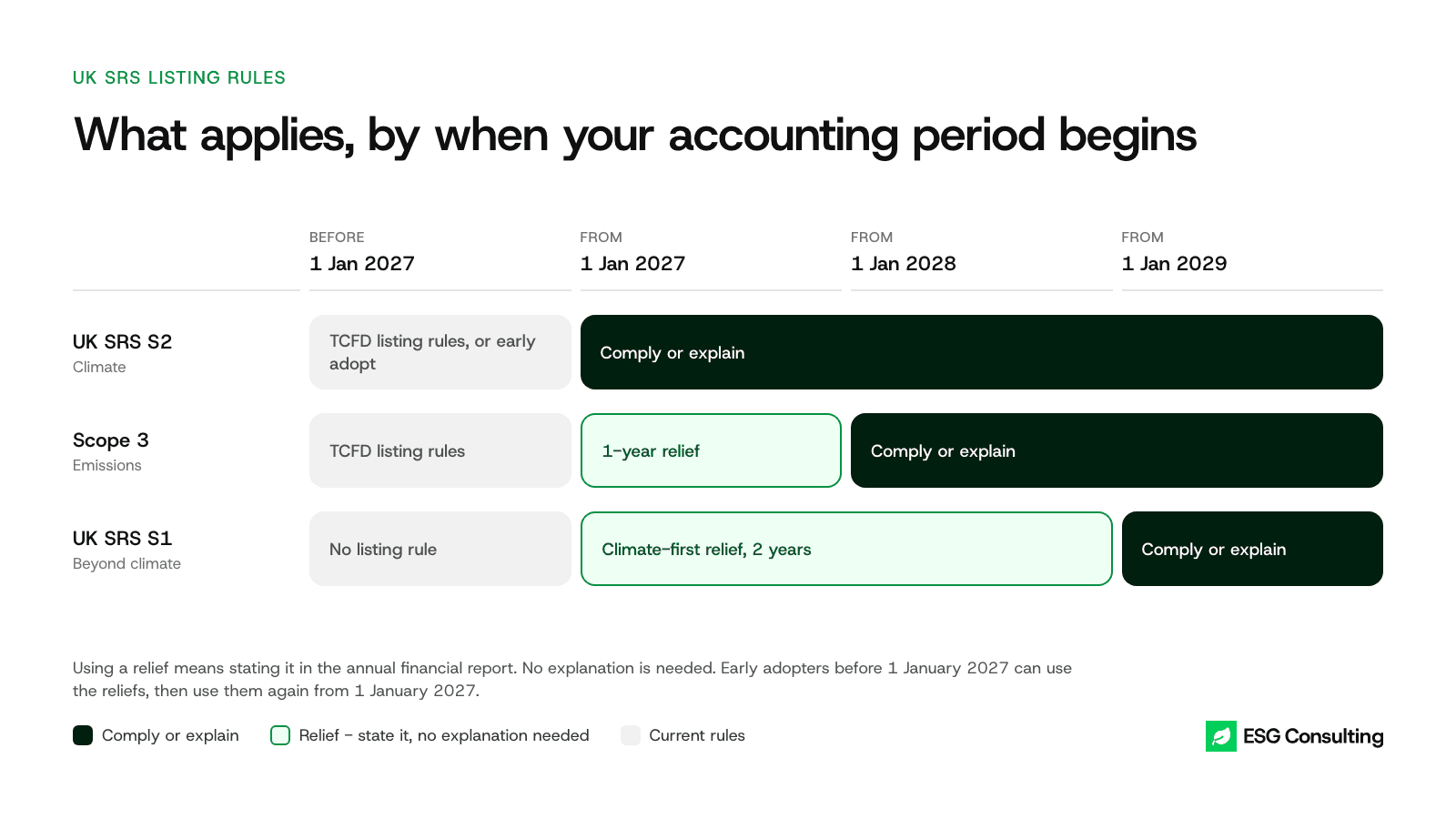
The reliefs attach to the accounting period rather than to the calendar year.
| Accounting period begins | What applies |
|---|---|
| Before 1 January 2027 | TCFD listing rules, or UK SRS early adoption with the reliefs |
| 1 January 2027 to 31 December 2027 | UK SRS comply or explain, Scope 3 relief and climate-first relief |
| 1 January 2028 to 31 December 2028 | UK SRS comply or explain, climate-first relief only |
| On or after 1 January 2029 | UK SRS comply or explain, no reliefs |
A company with a 31 December year end reports on FY2027 in spring 2028, must disclose Scope 3 emissions or explain their absence for FY2028 and covers the remainder of UK SRS S1 from FY2029. A company with a 31 March year end begins its first UK SRS period on 1 April 2027 and reports in mid-2028, with Scope 3 required from the period beginning 1 April 2028 and the remainder of UK SRS S1 from the period beginning 1 April 2029.
The final rules make early adoption more attractive than the consultation did. CP26/5 would have denied the reliefs to early adopters, whereas PS26/19 allows them to use the reliefs before 2027 and again from 1 January 2027, which the FCA describes as an additional year of relief. Only a small number of respondents said they intended to adopt early.
Assurance and transition plans under the UK SRS rules
The FCA confirmed its proposals on assurance and transition plans without change.
Assurance is not required. Companies must state whether they have obtained third-party assurance over their UK SRS disclosures or explanations. A company that has obtained assurance must name the provider, identify which disclosures were assured and to what level, name the assurance standard used and state where the assurance report is published. A company that has not obtained assurance must say so but does not need to explain why. The FCA will keep mandatory assurance under review alongside the FRC's voluntary sustainability assurance register and respondents suggested a review after two to five years beginning with limited assurance over Scope 1 and Scope 2 emissions.
A transition plan is not required. Companies must state whether they have published a climate-related transition plan and where it can be found, or explain why they have not published one. The FCA has placed no requirements on the content of that explanation and refers companies to the IFRS S2 guidance on transition disclosures as optional material. Secondary listings and depositary receipts fall outside the transition plan rule and government policy on transition plans has not yet been published.
What the FCA's cost estimates show about the choice to comply or explain
The cost benefit analysis is the most candid section of PS26/19. The FCA expects 37% of domestic listed companies to explain against most of UK SRS, a further 19% to align mainly with UK SRS S2 excluding Scope 3, 29% to align with most of the standards already and 15% to align almost in full.
The FCA's cost estimates for a large issuer, expressed as an uplift on the cost of existing TCFD reporting, are set out below.
| Reporting choice | One-off | Every year |
|---|---|---|
| Comply with all of UK SRS | £127,900 | £194,700 |
| Comply with S2 only, without Scope 3, explain the rest | £55,600 | £67,600 |
| Explain against all of UK SRS | £22,200 | £8,900 |
Explaining costs far less than complying, although it is not free and every explanation appears in the published annual report. Under the TCFD rules, which also operated on a comply or explain basis, Reuters reported the FCA's finding that 92% of FTSE 350 companies complied in their 2025 annual reports. Comply or explain did not lead the largest companies to explain rather than disclose and it produced a level of comparability against which a thin explanation stands out.
In our view the decision should follow a company's exposure to climate risk rather than the cost table. Companies for which climate is a principal risk, whose investors already request ISSB-aligned data or whose EU subsidiaries or major customers need the same figures should comply with UK SRS S2 and use the reliefs for their intended purpose. For a business with limited climate exposure, a short and specific explanation is a legitimate response that the rules are designed to accommodate. In both cases the work that delivers value is the same, namely a Scope 1 and Scope 2 inventory that can be traced to source data and a risk assessment that shows the board where climate affects cash flows, supply chains and the cost of capital.
What is still open after PS26/19
The rules have been made, but the guidance that accompanies them is still in draft.
| Date | What happens |
|---|---|
| 19 October 2026 | FCA webinar on the new rules |
| 28 October 2026 | Comments close on draft TN 803.1, the amended TN 801.4 and the deletion of TN 802.3 (GC26/6, PMB 66) |
| 30 November 2026 | Modernising Corporate Reporting consultation closes |
| 1 January 2027 | UK SRS listing rules in force, with TN 803.1 due to be final by then |
| H2 2027 | FCA update on its supervisory approach, ahead of the first reporting season |
| 2028 | First annual reports under UK SRS |
| 1 January 2029 | Accounting periods from this date have no transitional reliefs |
The FCA and the FRC will supervise the rules together. The FCA does not expect to carry out a formal post-implementation review and will instead monitor compliance rates, explanation rates and costs, providing aggregated feedback to the market as it did under the TCFD rules.
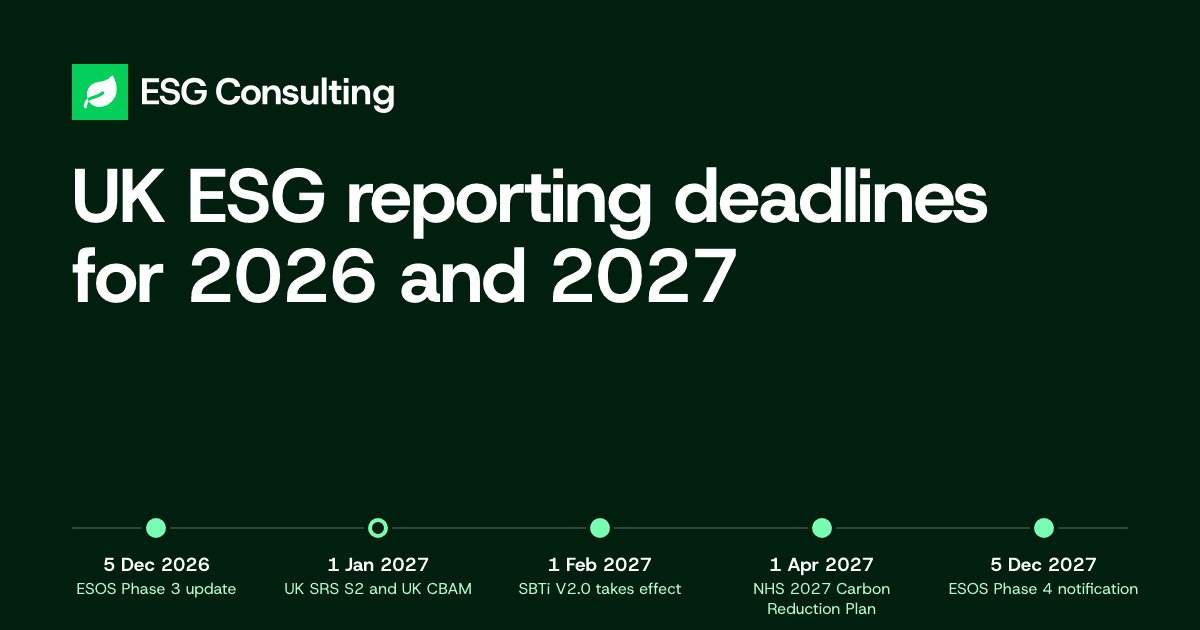
These dates sit alongside the ESOS, SECR and UK CBAM deadlines in our guide to UK ESG reporting deadlines for 2026 and 2027.
How to prepare for UK SRS before 1 January 2027
Listed companies should complete five pieces of preparatory work this quarter.
- Confirm the first UK SRS accounting period. Companies should map 1 January 2027 to their year end and record which period will use the Scope 3 relief and which will use the climate-first relief.
- Gap-assess the most recent TCFD report against UK SRS S2 paragraph by paragraph. In our experience the governance narrative and scenario analysis usually carry over, while the gaps sit in industry-based metrics, anticipated financial effects and the evidence trail behind the numbers. Paragraph references are also what any explanation will need to cite.
- Reconcile principal risks with any planned explanation. Where climate is a principal risk under DTR 4.1.8R, the decision to explain should go to the audit committee before it reaches the annual report.
- Settle the assurance and transition plan statements. Both statements are required whichever route a company takes, so boards should decide now whether limited assurance over Scope 1 and Scope 2 emissions is worth obtaining for FY2027 and whether the company's transition plan is ready to be referenced.
- Respond to the TN 803.1 consultation by 28 October 2026. Companies whose circumstances are not reflected in the draft examples should raise this with the FCA before the guidance is finalised.
Our ESG consulting team runs UK SRS gap assessments, builds the Scope 1, 2 and 3 data that sits behind them and advises clients on where an explanation is the right answer. For organisations whose first UK SRS period begins in 2027, speak to a consultant.
Sources
- FCA PS26/19, Aligning listed issuers' sustainability disclosures with international standards, 30 September 2026
- FCA PS26/19 PDF, including the made rules in Appendix 1
- FCA GC26/6, Primary Market Bulletin No 66, 30 September 2026
- FCA Primary Market Bulletin 66
- Draft Primary Market Technical Note 803.1, UK SRS sustainability disclosures for listed companies, September 2026
- FCA CP26/5, Aligning listed issuers' sustainability disclosures with international standards, 30 January 2026
- UK SRS S1 and S2, Department for Business and Trade, 25 February 2026
- UK SRS guidance and documents, Department for Business and Trade
- Modernising Corporate Reporting consultation, 7 September 2026
- UK SRS consultation, what was asked and decided, uksrs.org.uk