carbon reduction plan examples, PPN 006, net zero strategy, SECR reporting, SBTi targets
8 Carbon Reduction Plan Examples That Actually Work
By ESG Consulting Team · · 16 min read
You're partway through a UK public-sector bid when procurement asks for a Carbon Reduction Plan. The submission deadline is two weeks away. Finance has electricity invoices, facilities has a spreadsheet of gas readings, and HR has never collected commuting data. Someone suggests adapting the parent company's sustainability report.
The immediate task is producing a document the buyer can assess. The harder task is making sure its emissions figures, targets and promised actions stand up to scrutiny after the bid has closed.
The strongest carbon reduction plan examples follow recognisable patterns. They define whose emissions they cover, distinguish measured results from estimates, and connect commitments to decisions that someone has the authority and budget to make. A polished document without those foundations won't become credible because a director signs it.
The examples below serve different purposes. PPN 006 concerns procurement readiness; SBTi concerns target-setting; TPT concerns transition planning; ESOS and SECR support energy assessment and reporting; and NHS Green Plans address healthcare delivery. Microsoft and Unilever offer corporate reference points for thinking about removals, operational change and supply-chain dependencies.
These aren't interchangeable templates. A supplier qualification document isn't an energy audit, and a validated target isn't proof that reductions have happened. Use each example for the problem it helps solve, then bring the evidence together into a plan your organisation can deliver.
Table of Contents
- 1. UK Government Carbon Reduction Plan (PPN 006)
- 2. Science Based Targets initiative (SBTi) Corporate Net-Zero Standard
- 3. Transition Plan Taskforce (TPT) Disclosure Framework
- 4. Energy Savings Opportunity Scheme (ESOS) Action Plan
- 5. Streamlined Energy and Carbon Reporting (SECR)
- 6. NHS Net Zero Standard and Green Plans
- 7. Microsoft Carbon Negative Plan
- 8. Unilever Climate Transition Action Plan
- Comparing the 8 Carbon Reduction Plan Examples
- Building a Carbon Reduction Plan That Stands Up to Scrutiny
1. UK Government Carbon Reduction Plan (PPN 006)
For a government supplier, the bidding entity matters as much as the emissions total. A group sustainability report may explain corporate ambition without clearly identifying the organisation submitting the tender.
The Cabinet Office's PPN 006 guidance provides for Carbon Reduction Plans in relevant central-government procurements above £5 million per year, including VAT, with a commitment to net zero for UK operations by 2050. Its technical standard addresses reporting coverage, publication, approval and annual updating.
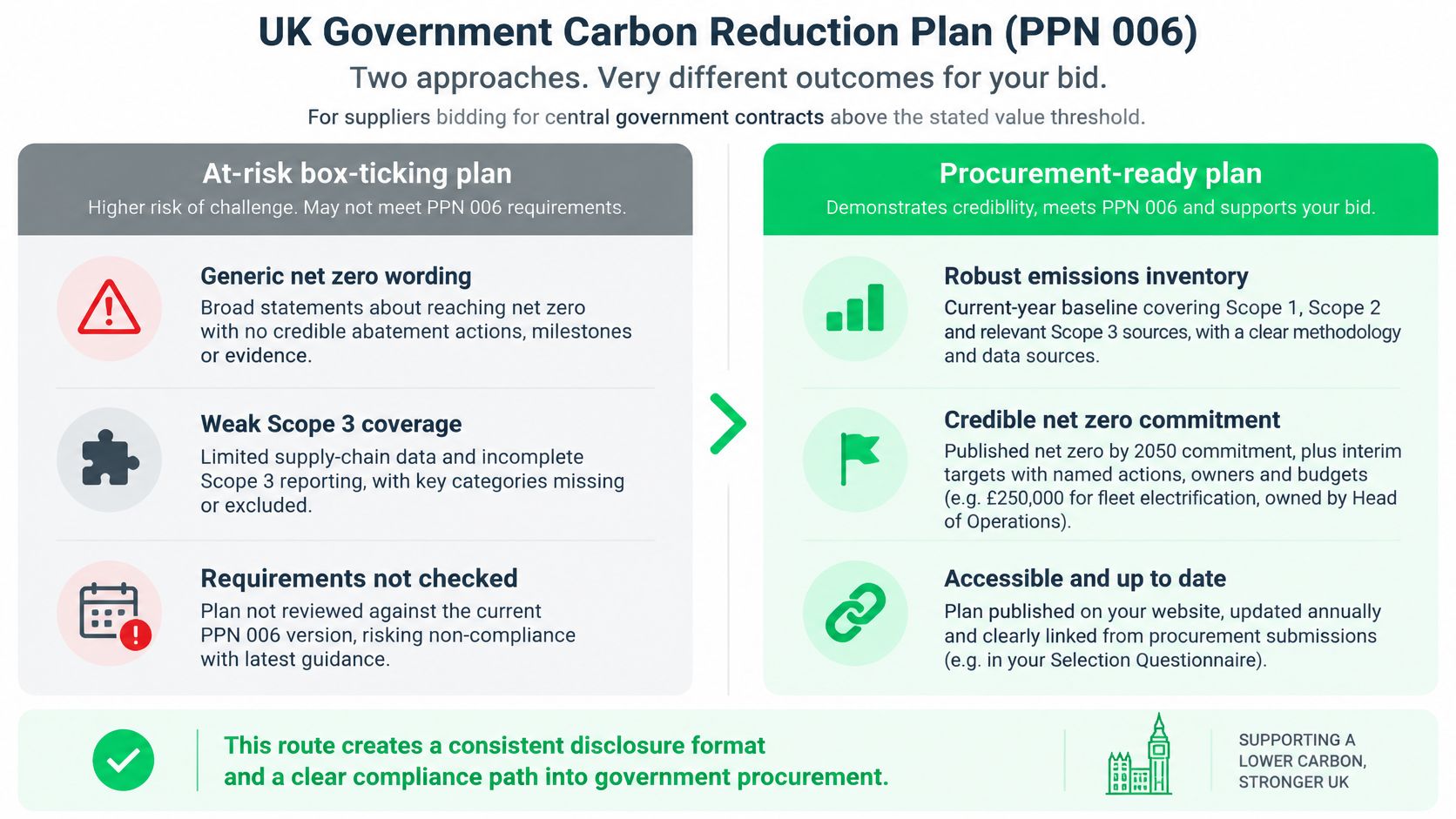
Make the document procurement-ready
A facilities management supplier should connect its inventory to the activities it controls and the measures it can implement during contract delivery. Fleet changes, building controls and staff travel policies need clear boundaries, particularly where the customer owns the premises or equipment.
- Required foundations: Identify the supplier, baseline and reporting period, emissions methodology, required emissions categories and approval arrangements.
- Typical stumbling point: Publishing a parent-company commitment without establishing whether it meets the bidding organisation's requirements.
- Replicable tactic: Build an evidence register alongside the plan, linking each disclosure to its calculation, supporting record and accountable owner.
Don't describe every environmental initiative as a carbon reduction measure. Recycling communications, for example, need a defensible connection to the reported emissions source before you attribute savings to them.
Use the document comparison above as a practical review prompt, not a substitute for checking the current technical standard. For organisations coordinating procurement and sustainability responsibilities, UK ESG consulting support should fit around the tender evidence rather than produce a disconnected report.
Procurement rule: Check the legal entity, reporting boundary and approval trail before polishing the narrative.
2. Science Based Targets initiative (SBTi) Corporate Net-Zero Standard
Target credibility and delivery credibility are different tests. SBTi provides a framework for assessing corporate emissions-reduction targets against its criteria. Your operating plan still needs to explain how the organisation intends to achieve them.
A consumer-goods business might use the framework to structure operational and value-chain targets. Before modelling a pathway, however, its sustainability team needs a reliable inventory, an appropriate organisational boundary and a clear understanding of the current criteria applicable to its submission.

Turn target modelling into an operating plan
Start with emissions hotspots, not a preferred announcement date. Model what changes when facilities electrifies heating, procurement changes material specifications, and logistics alters transport arrangements. Keep business growth assumptions visible so the board can distinguish operational improvement from changes in activity.
The common failure is treating target validation as validation of the entire transition plan. It doesn't establish that a supplier will cooperate, that infrastructure will arrive on time or that capital expenditure has been approved.
For a worked scenario, take a manufacturer expanding production. Its emissions per unit may improve while total emissions increase. The plan should explain both outcomes rather than using the intensity improvement to imply an absolute reduction.
A replicable tactic is a target-to-action reconciliation. Assign every proposed reduction to a defined emissions source and intervention, then show the remaining gap. Mark uncertain contributions separately instead of adjusting assumptions until the pathway meets the target.
Keep reductions and removals distinct, and verify the applicable SBTi version before making claims about conformity. A credible plan acknowledges unresolved delivery questions while giving management a practical route to resolve them.
3. Transition Plan Taskforce (TPT) Disclosure Framework
A board approves a net-zero ambition, but the capital plan still funds business as usual. The TPT approach is useful precisely where those decisions need to meet. It structures transition planning around ambition, implementation and accountability rather than an isolated emissions chart.
The wider UK context also favours staged planning: the government's Net Zero Strategy executive summary describes legally binding carbon budgets covering five-year periods, rather than relying solely on a distant endpoint. An organisation shouldn't copy national targets, but it can adopt the discipline of connecting long-term direction to nearer-term decisions.

Put finance beside the emissions pathway
For a listed property business, a transition plan might connect heating replacement, refurbishment cycles and tenant engagement to asset-level investment decisions. Finance should be able to reconcile the proposed programme with approved expenditure, while asset managers identify lease restrictions and operational dependencies.
- What it requires: Explain the ambition, delivery levers, financial implications, governance and assumptions.
- Where organisations stumble: Presenting a technically plausible pathway whose investment requirements aren't reflected in financial planning.
- One replicable tactic: Give every material lever a joint review by its operational owner and a finance representative.
Separate approved investment, proposed investment and externally dependent measures. Readers should be able to tell which reductions management can authorise and which depend on another party.
That distinction also improves board oversight. Instead of receiving a general progress narrative, directors can examine delivery gaps, challenge assumptions and decide whether to fund alternatives. The document becomes useful when it records choices, not merely aspirations.
4. Energy Savings Opportunity Scheme (ESOS) Action Plan
An energy audit can identify good projects without changing anything on site. An effective ESOS-linked action plan turns recommendations into operating decisions, with costs, sequencing, accountable owners and a method for verifying savings.
For a multi-site retailer, the practical programme might include lighting controls, ventilation scheduling and refrigeration optimisation. Confirm scheme applicability, current obligations and assessment arrangements before treating a previous audit as sufficient.
Measure the intervention, not just the bill
The DECC RE:FIT case study reports that an LED-lighting retrofit at its London headquarters reduced electricity use by almost 30% during the monitored period. That is a project-level result, not a saving that another organisation can assume for its entire estate.
A manufacturer considering lighting upgrades should therefore establish operating hours, existing equipment loads and the measurement boundary before estimating benefits. Sub-metering or automatic meter reading can help distinguish a project's effect from changes in production or occupancy.
The usual stumbling point is the handover. The assessor identifies an opportunity, but nobody owns the business case, shutdown window, procurement specification or post-installation check. A recommendation remains unfunded while the organisation reports it as planned progress.
A completed installation isn't yet a verified saving. Check what changed in operation and what the meter actually recorded.
The replicable tactic is to give each recommendation a delivery record covering approval status, operational constraints, expected energy savings and verification method. Track energy and emissions separately: a change in emissions factors shouldn't be mistaken for an equipment-efficiency improvement.
Where capital is constrained, start with sound controls and maintenance opportunities while developing the investment case for larger replacements.
5. Streamlined Energy and Carbon Reporting (SECR)
SECR is a reporting requirement, not a complete decarbonisation strategy. Its value as a carbon reduction plan example lies in the reporting discipline it encourages: a defined boundary, consistent energy and emissions calculations, an intensity measure and an explanation of efficiency actions.
Check applicability and the precise disclosures relevant to your organisation before drafting. Different corporate circumstances need careful assessment rather than a copied annual-report paragraph.
Consider a distribution business reporting emissions relative to its activity. Management also needs absolute emissions, fuel consumption and information about changes in routes or service mix. Otherwise, a favourable intensity movement can conceal rising total emissions.
Make the annual narrative explain performance
A useful disclosure answers operational questions. Did energy consumption fall because the business improved controls, closed a site or handled less work? Did a newly acquired subsidiary change the reporting boundary?
- Required foundations: Reconcile underlying energy records to the reported inventory and document calculation methods.
- Typical stumbling point: Changing the intensity denominator without explaining why comparisons have become less meaningful.
- Replicable tactic: Maintain a movement analysis separating activity changes, structural changes, methodology changes and operational improvements.
Don't imply that every fall in reported emissions represents management-led abatement. Explain uncertainty, estimates and missing records clearly, then set out how the organisation will improve them.
A reliable inventory can support wider planning, but additional frameworks may require broader boundaries or more detailed value-chain information. Reuse controlled source data, not assumptions about equivalent coverage.
For teams aligning annual reporting with wider sustainability governance, ESG Consulting provides a relevant organisational reference point. The practical objective remains a reporting process that finance, sustainability and operations can reconcile before publication, rather than separate spreadsheets producing conflicting totals.
6. NHS Net Zero Standard and Green Plans
A healthcare provider can't treat decarbonisation as an estates project alone. A credible Green Plan connects clinical delivery, buildings, procurement and travel, while protecting patient care and service continuity.
For suppliers, the related challenge is evidence. A corporate sustainability statement needs to be translated into information that buyers can assess against the relevant procurement and Evergreen requirements. Check the current NHS guidance and tender documents rather than assuming that a general Carbon Reduction Plan answers every question.
A trust planning to replace heating equipment illustrates the trade-off. The lower-carbon option must be assessed alongside resilience, electrical capacity, maintenance capability and the disruption associated with installation.
Give clinical and operational teams ownership
The sustainability team can coordinate the plan, but it can't independently authorise changes to clinical practice or capital programmes. Assign delivery responsibility to the functions that control the assets, specifications and operating procedures.
Organisations stumble when the Green Plan becomes a catalogue of worthwhile initiatives without a delivery hierarchy. A staff awareness campaign shouldn't receive the same management attention as an unresolved major infrastructure dependency.
For a practical workstream, map a proposed theatre ventilation change through clinical approval, estates assessment, implementation and monitoring. Record the safety conditions and operating arrangements that must remain intact.
Delivery test: If the named owner can't authorise the change, identify who can and make that approval an explicit dependency.
The replicable tactic is a shared evidence register for the trust and its suppliers. Link actions to procurement records, project approvals, energy measurements and progress reviews. For Evergreen preparation, distinguish evidence already available from commitments still awaiting implementation.
That approach avoids a familiar reporting problem: a strong narrative supported by documents that describe intentions rather than completed work.
7. Microsoft Carbon Negative Plan
Microsoft provides a useful reference point for examining the relationship between emissions reduction and carbon removal. Those activities need separate treatment in any plan, particularly where business growth creates additional energy and infrastructure demand.
For a UK technology business, the transferable lesson isn't to copy a multinational's purchasing arrangements. It's to establish who pays for emissions-related decisions and how management distinguishes reducing its footprint from financing removals.

Keep separate accounts for separate claims
Take a software company expanding its computing capacity. Its plan should examine electricity demand, infrastructure procurement and purchased services before presenting removal purchases as an answer to rising emissions.
An internal carbon charge can help departments consider the consequences of travel, equipment and procurement decisions. But the charge only influences behaviour if budget holders understand it and have realistic lower-emissions alternatives.
- What it requires: Separate reporting of gross emissions, operational reductions and removal activity.
- Where organisations stumble: Presenting a removal contract as though the corresponding removal has already occurred.
- One replicable tactic: Maintain a removal ledger showing contracting status, delivery evidence, accounting treatment and unresolved quality risks.
Assess durability, additionality and verification arrangements before relying on a removal claim. Also distinguish contractual renewable-electricity accounting from a reduction in electricity demand.
A credible corporate example reports setbacks as clearly as favourable results. If growth outpaces efficiency improvements, show that movement and revise the delivery programme rather than allowing a net figure to obscure it.
The useful management question is straightforward: what changed in the business, what changed in its accounting, and what happened outside its value chain? Keep those answers visible.
8. Unilever Climate Transition Action Plan
For organisations with complex supply chains, Unilever is a useful reference point for thinking about value-chain transition planning. The practical challenge is connecting sourcing, manufacturing, logistics and product decisions without assuming that the company directly controls every emissions source.
Delivery constraints deserve explicit treatment. Ofgem's Businesses' Experiences of the Energy Market report identifies cost as the most commonly cited decarbonisation barrier, alongside practical obstacles such as rented premises, older buildings and operational constraints.
Those constraints belong in the plan, not in a later explanation for missed targets. A food manufacturer sourcing agricultural ingredients, for example, may influence specifications and supplier contracts without controlling farming practices or access to investment.
Turn supplier engagement into an abatement programme
Start by identifying material emissions categories and the purchasing decisions that influence them. Then distinguish suppliers providing better information from suppliers implementing changes that can support a defensible reduction estimate.
Sending a questionnaire is an activity. Receiving verified evidence of a changed production process is a different achievement. Neither should automatically become a quantified reduction in the reporting inventory.
The common stumbling point is confusing commercial influence with operational control. A buyer can request better data or offer a longer contract, but the supplier may still need equipment, finance or technical support.
Use a supplier action record containing the intervention, buyer contribution, supplier responsibility, expected evidence and fallback option. For a packaging change, for instance, include product protection, manufacturing compatibility and the risk of increased waste alongside the carbon assessment.
The replicable tactic is to classify each lever as directly controlled, commercially influenced or externally dependent. Give the board a realistic view of delivery confidence and avoid counting unfunded supplier ambitions as secured abatement.
Comparing the 8 Carbon Reduction Plan Examples
| Example | Type | Scope coverage | Mandatory or voluntary | Best for |
|---|---|---|---|---|
| UK Government Carbon Reduction Plan (PPN 006) | Procurement disclosure framework | Scope 1, 2 and relevant Scope 3 | Mandatory for qualifying central government bids | Suppliers bidding for UK central government contracts |
| Science Based Targets initiative (SBTi) Corporate Net-Zero Standard | Target-setting and validation standard | Scope 1, 2 and material Scope 3 | Voluntary | Companies seeking independently validated climate targets |
| Transition Plan Taskforce (TPT) Disclosure Framework | Climate transition plan disclosure framework | Emissions targets, actions, dependencies and financial planning | Voluntary framework informing UK reporting expectations | Organisations preparing investor-ready transition plans |
| Energy Savings Opportunity Scheme (ESOS) Action Plan | Energy assessment and action-planning scheme | Energy use across qualifying organisations | Mandatory for qualifying large undertakings | Large organisations identifying and prioritising energy savings |
| Streamlined Energy and Carbon Reporting (SECR) | Corporate energy and emissions reporting requirement | Scope 1, Scope 2 and UK energy use | Mandatory for qualifying companies and LLPs | Large UK companies building annual emissions disclosures |
| NHS Net Zero Standard and Green Plans | Sector-specific net-zero standard and planning framework | Directly controlled emissions and wider value chain | Required for relevant NHS trusts and providers | NHS organisations and healthcare suppliers |
| Microsoft Carbon Negative Plan | Corporate climate commitment and transition plan | Operational and value-chain emissions, plus historical emissions removal | Voluntary | Companies exploring emissions reduction, carbon removal and internal carbon pricing |
| Unilever Climate Transition Action Plan | Corporate climate transition plan | Scope 1, 2 and 3 | Voluntary | Consumer goods companies planning value-chain decarbonisation |
Building a Carbon Reduction Plan That Stands Up to Scrutiny
The most useful carbon reduction plan examples aren't necessarily the longest or most ambitious. They make it possible to follow the reasoning from source records to reported emissions, from emissions to priorities, and from priorities to funded decisions.
A credible plan begins with an auditable inventory. Establish the reporting entity, operational boundary, calculation methodology and treatment of estimates before debating presentation. Where records are incomplete, explain the limitation and assign responsibility for improving the underlying data.
Targets then need intermediate checkpoints. The government's published Carbon Reduction Plan example sets out a target to halve its stated footprint to 203.2 tonnes by 2028, a planned milestone rather than evidence that the reduction has already happened. The transferable lesson is to express the pathway in dated emissions outcomes, not just a distant aspiration.
Keep the plan connected to management decisions
Each material action needs a named owner, a realistic delivery window and an explanation of its expected contribution. Distinguish approved projects from options still requiring investment, technical assessment or external agreement.
Avoid adding project savings together without checking overlaps. If controls reduce electricity demand before equipment is replaced, the replacement project must be assessed against the revised consumption, not the original baseline. Otherwise, the plan can promise the same saving through different interventions.
Use this short preparation checklist:
- Confirm applicability: Establish which procurement, reporting and voluntary frameworks apply to the relevant entity.
- Build the inventory first: Retain activity records, factors, assumptions and a clear calculation trail.
- Sequence costed measures: Prioritise genuine abatement while accounting for operational constraints and asset replacement cycles.
- Keep evidence assurance-ready: Record approvals, delivery status, measurement results and explanations for changes.
- Review delivery: Update forecasts when projects slip, assumptions change or business activity grows.
Governance should make those reviews consequential. If an action is delayed, management needs to decide whether to fund an alternative, revise the sequence or disclose the resulting gap. Republishing the same commitments isn't progress.
ESG Consulting prepares Carbon Reduction Plans to the PPN 006 technical standard, alongside net-zero strategy, Scope 3 inventories and NHS Evergreen readiness for UK organisations. Each engagement is led by a senior consultant from scoping through to sign-off, with every figure traceable to source data and the methodology, boundaries and assumptions documented for assurance.
If you're preparing a tender submission or replacing a template-led plan, visit ESG Consulting to discuss a PPN 006 Carbon Reduction Plan and the evidence needed to support it. Bring your tender requirements, existing inventory and proposed reduction measures so the scope can address both procurement readiness and practical delivery.