carbon reduction policy, corporate net zero, Scope 3 emissions, carbon baseline, UK emissions reporting
Carbon Reduction Policy: How to Write One That Works
By ESG Consulting Team · · 16 min read
The board wants a carbon reduction policy for its next meeting. Finance has utility invoices, facilities has meter readings, procurement has supplier questionnaires, and nobody can confirm whether the leased warehouse sits inside the emissions boundary. You can write a commitment today, but you can't yet defend it.
The practical answer is to separate what the business can approve now from what still needs evidence, funding or an external decision. A useful policy gives directors both, a credible basis for immediate action and clear conditions for larger investments.
Table of Contents
- What a Carbon Reduction Policy Covers
- Setting Scope and Baseline Emissions
- Targets and KPIs Anchored to Carbon Budgets
- Governance, Approvals and Ownership
- Implementation Measures in Order of Readiness
- Monitoring, Scorecards and Proving Savings
- Draft Your Carbon Reduction Policy Using This Template
What a Carbon Reduction Policy Covers
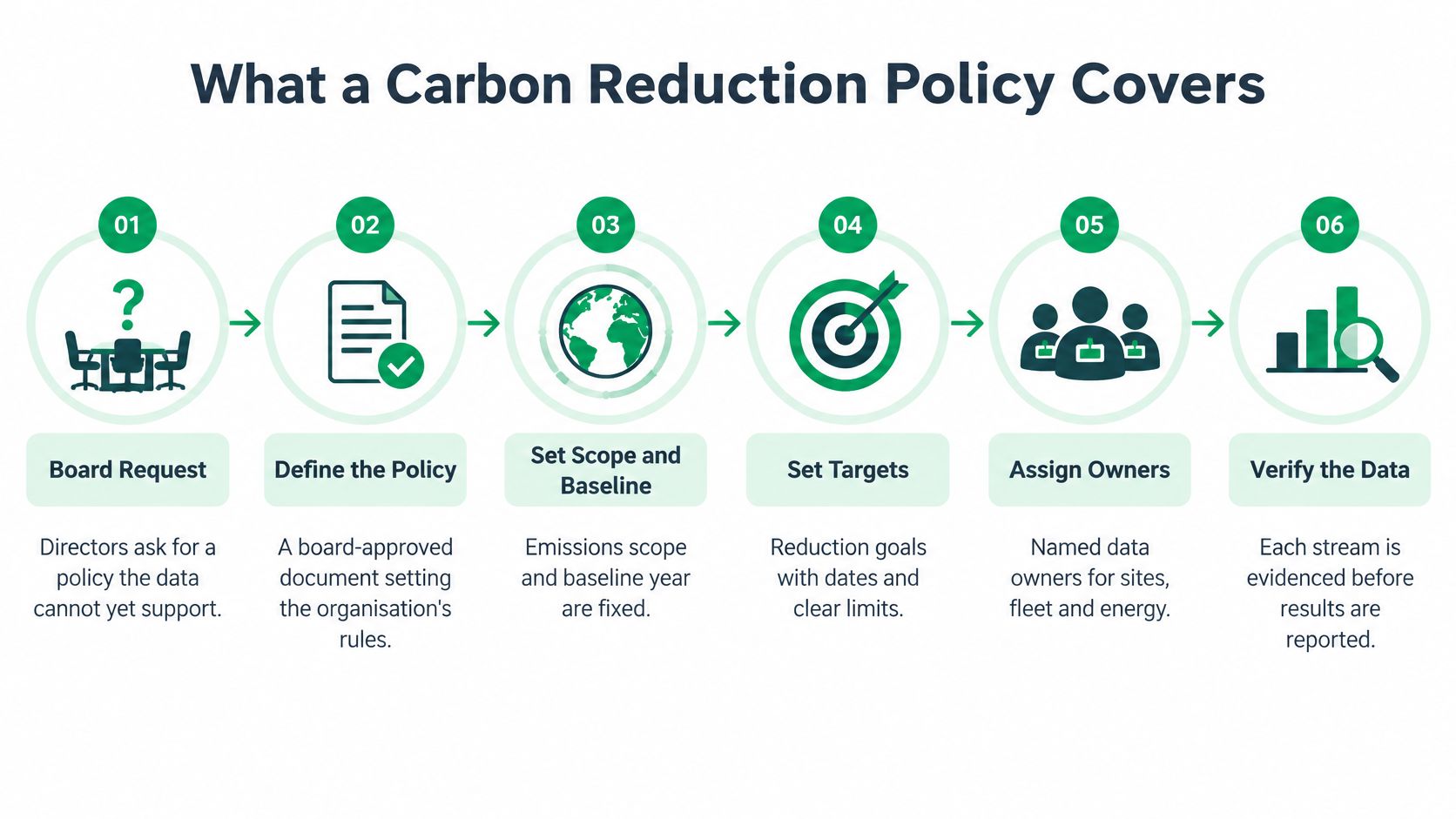
A carbon reduction policy sets out what an organisation will measure, who can approve action, and how progress will be checked. It is a board-approved working document covering emissions boundaries, a baseline, targets, accountable owners, funded measures and reporting rules. Employees need to know what they must record and when to escalate a problem.
Organisations may use a policy to support Streamlined Energy and Carbon Reporting (SECR), the Energy Savings Opportunity Scheme (ESOS), public-procurement Carbon Reduction Plans, NHS Green Plans, or investor and CDP questionnaires. Check each obligation against its own requirements. One policy may support several frameworks, but it does not automatically satisfy them all.
National progress provides context, not a measure of your organisation's performance. The Climate Change Committee's assessment reported UK emissions 50.4% below 1990 levels in 2024.
Build the evidence before polishing the wording
Use a seven-step sequence, with a practical output at each stage:
- Set scope and boundary. Record which operations are included.
- Fix the base year. Prepare the inventory and define when it must be recalculated.
- Anchor targets and KPIs. Specify owners, units and calculation methods.
- Assign governance. Set responsibilities and the approval route.
- Choose measures. Rank projects by what can start now, and state what triggers each one.
- Design reporting. Define the scorecard and how evidence files will be organised.
- Approve and review. Issue the authorised policy and set a review date.
This sequence connects board decisions to records operational teams can maintain. Rank measures by readiness: actions within the organisation's control can proceed first, while projects dependent on approvals, funding or grid changes need clear conditions.
Keep detailed calculations in annexes, where reviewers can check them without obscuring policy decisions. Mark each stage covered, partly covered or missing, then address the first gap. Reporting effort is worth the cost when it produces decision-quality evidence; don't set a publication deadline that assumes missing data will arrive on time.
Setting Scope and Baseline Emissions
Decide the organisational boundary before calculating emissions. Otherwise, teams can produce internally consistent numbers for different versions of the business.
Under an operational-control approach, include activities according to the organisation's authority to introduce operating policies. An equity-share approach instead allocates emissions according to ownership interests. Choose the appropriate approach with your reporting adviser, document it and apply it consistently across subsidiaries, sites and leases.
Name joint ventures and outsourced assets explicitly. A warehouse shouldn't disappear because procurement calls it outsourced while facilities treats it as part of the estate.
Match each scope to its evidence
The following is a practical inventory design, not a substitute for checking the requirements of the framework you're reporting against.
Emissions scopes, data sources and first-cycle treatment
| Scope | What it covers | Typical data source | First-cycle treatment |
|---|---|---|---|
| Scope 1 | Gas boilers, company vehicles, refrigerant losses | Fuel invoices, fleet logs, refrigerant service records | Measure included direct sources; flag estimates and gaps |
| Scope 2 | Purchased electricity, heat, steam and cooling | Meter data, utility invoices, supplier tariff evidence | Calculate purchased-energy emissions; distinguish location-based and market-based results where applicable |
| Scope 3 business travel | Flights, rail, hotels, employee-owned vehicles used for work | Booking exports, expense claims, mileage records | Screen materiality and use evidenced activity estimates |
| Scope 3 purchased goods and services | Upstream supply chain by category | Procurement ledger, supplier emissions data | Start with clearly labelled spend estimates where necessary |
| Scope 3 use of sold products and end-of-life waste | Product operation, disposal and recycling | Product specifications, usage assumptions, waste records | Screen relevance before deciding the depth of calculation |
Scope 1 means direct emissions; Scope 2 covers purchased energy; Scope 3 covers other value-chain emissions. Location-based electricity calculations reflect the relevant grid average, while market-based calculations reflect qualifying contractual purchasing arrangements.
Spend-based estimates can help identify supply-chain priorities, but they're a weak way to demonstrate operational improvement. A price increase can change the estimate without changing the goods purchased. Keep the method visible and replace coarse estimates where better supplier or activity data would change a decision.
Lock the baseline deliberately
Choose a base year supported by reliable records and reasonably representative operations. Investigate closures, unusual production patterns and missing billing periods before accepting the annual total.
Write a recalculation rule for acquisitions, disposals and material methodological changes. Set and approve a significance threshold appropriate to the organisation rather than copying an unexplained percentage.
- Confirm the boundary in writing with finance and operations.
- Collect source records covering the proposed baseline and a comparison period.
- Calculate direct and purchased-energy emissions, reconciling records to the included assets.
- Screen value-chain categories by likely size, relevance and evidence quality.
- Lock the inventory, with assumptions and exclusions in a controlled register.
Practical rule: An unexplained gap is a data problem, not evidence of low emissions.
Targets and KPIs Anchored to Carbon Budgets
A company setting a target needs to test whether its pace of reduction is credible against the UK's statutory trajectory, then ground its commitments in its own baseline, assets and investment choices. Under the Climate Change Act framework, carbon budgets cover five-year periods and must be established 12 years ahead; the fourth permits 1,950 MtCO2e across 2023–2027, approximately 51% below 1990, while the sixth sets 965 MtCO2e across 2033–2037, approximately 78% below 1990. These national ceilings are not company allocations. Copying a national percentage without accounting for the business model does not make a target deliverable.
Target types compared
| Target type | How it is expressed | Strength | Weakness |
|---|---|---|---|
| Absolute reduction | Tonnes CO2e cut from the base year | Keeps total emissions visible | Growth can make delivery harder |
| Intensity | tCO2e per unit of output or revenue | Shows emissions relative to activity | Total emissions can rise while intensity falls |
| Science-based absolute | A pathway submitted for validation against SBTi criteria | Provides an external assessment route | Requires modelling, submission and continuing maintenance |
| Renewable electricity share | Proportion of electricity purchased from renewable sources | Makes purchasing progress visible | Doesn't address direct fuel use or most value-chain emissions |
| Activity target | Share of fleet electrified or heating systems replaced | Connects directly to operational delivery | Can reward activity without proving emissions savings |
Separate the destination from delivery indicators
For sources the business controls, prefer an absolute target. Where growth makes intensity useful, report the absolute total alongside it. Otherwise, directors can approve a better ratio while total emissions rise.
Set an interim milestone, a later checkpoint and a long-term destination. State what residual emissions means, which sources remain unresolved and what assumptions will guide their eventual treatment. A distant net-zero date cannot replace funded near-term action.
Pair each target with a compact set of key performance indicators, or KPIs. For every KPI, record its owner, unit, reporting frequency and link to the proposed reduction. Useful operational measures include energy per unit of production, electric fleet share and supplier-data coverage.
Keep Scope 3 targets distinct from targets for controlled operations. A supplier-engagement measure tracks progress in obtaining evidence; it does not demonstrate that suppliers have cut emissions.
A buyer should be able to reconstruct the target from the baseline, exclusions and calculation method without relying on the person who built the spreadsheet.
Use renewable purchasing as a supporting indicator, not the headline. It is easier to communicate than changes to heating, transport or production, but does not show whether those operational sources are reducing. Choose KPIs that give decision-makers enough reliable information to compare actions and direct investment, rather than adding reporting effort that does not improve decisions.
Governance, Approvals and Ownership
A carbon reduction policy stalls when the person accountable for delivery cannot approve spending, or when nobody owns the records behind reported emissions. Give an executive sponsor with budget authority, usually a finance or operations director, responsibility for resolving those issues. The sustainability lead coordinates the work. Site, fleet, procurement and facilities leads own the records for their respective sources.
Board approval should assign decision rights, review points and escalation routes, not merely endorse the wording.

Reporting effort is worth incurring when the information improves investment or operational decisions. If teams repeatedly chase records, reconcile figures manually or report data no one uses, change the controls and collection process. Keep the records that help leaders compare options and track delivery; avoid building a separate dataset for every request.
Use an approval path that tests affordability
- Draft with data owners. Check figures against invoices, meter exports and other source records.
- Obtain finance review. Test formulas, reconciliations, access controls and the evidence trail.
- Challenge capital assumptions. Compare proposed measures with approved budgets and operational shutdowns.
- Secure sponsor sign-off. Record unresolved dependencies and name who has authority to accept them.
- Obtain formal approval. Document the board or audit committee's decision, conditions and actions.
- Issue the controlled version. Give relevant staff access and set a review date.
For every data stream, name its owner and reviewer, and identify where supporting evidence is stored. Specify who covers absences and who resolves discrepancies. A shared folder alone does not establish accountability.
At the approval meeting, ask: Which assumptions could change the investment decision, who can verify them, and what evidence is still missing? Record the answers with the decision, so unresolved questions do not disappear after approval.
Smaller organisations can appoint a director as approver and use scheduled management reviews. Someone other than the preparer should still challenge significant assumptions.
Aim for lower cost per decision-quality emissions insight. Reuse controlled information in applicable disclosures, energy assessments and investment papers, but check that it is fit for each purpose. Reuse saves effort only when the underlying figures remain traceable and useful.
Implementation Measures in Order of Readiness
A facilities team can adjust operating schedules before a company approves a fleet replacement or waits for a grid connection. Rank measures by what the business can start now, then assess expected savings, cost and contribution to the target. This keeps near-term work moving while longer projects clear their approval and infrastructure gates.
Many emissions reductions depend on policy, infrastructure and energy systems outside a company's direct control. For UK businesses, that makes it important to distinguish measures they can implement themselves from those that rely on grid capacity, tariffs or external decisions.
Implementation measures ranked by readiness
| Measure | Typical effect | Lead time | Dependency | Start when |
|---|---|---|---|---|
| Building controls and scheduling | Reduces avoidable energy demand | Short, subject to access and testing | Local operating authority | Operating hours and safety requirements are checked |
| LED lighting replacement | Reduces lighting electricity demand | Short to moderate | Design, access and purchasing approval | Survey confirms suitability |
| Renewable electricity contract | May lower market-based Scope 2 results for qualifying purchases | Contract-dependent | Contract terms and credible supporting evidence | Certification and additionality claims are checked |
| Fleet electrification | Removes vehicle tailpipe emissions, adds electricity demand | Replacement-cycle and connection-dependent | Charging, routes, depot power | Charging survey and connection position are confirmed |
| Gas boiler to heat pump | Reduces direct gas combustion, adds electricity demand | Survey and infrastructure-dependent | Building suitability, grid capacity, tariff | Heat-loss assessment and running-cost case are approved |
| Industrial electrification | Replaces selected fossil-fuel processes | Project-specific, potentially extended | Process performance, power supply, energy economics | Defined engineering and commercial gates are passed |
Start with demand the business can control
Begin with operating settings: heating schedules, ventilation, compressed-air systems and equipment left on outside production hours. Check comfort, safety and product-quality requirements before changing controls. A blanket instruction to switch equipment off can disrupt production where processes need stable conditions.
LED replacement calls for a site survey, not a generic savings estimate. Check illumination requirements, controls, access for installation and maintenance, and disposal costs before approving the business case.
Treat renewable electricity procurement as a separate decision from energy-demand reduction. Check who owns the certificates, which consumption the contract covers and what the supplier means by additionality, whether the purchase supports renewable generation beyond what would otherwise happen. A change in market-based accounting is not the same as a metered efficiency saving.
Survey early, commit capital at the right gate
Fleet projects need route and payload assessments alongside charging design. Heat-pump projects need a heat-loss assessment, suitable operating temperatures, confirmed electrical capacity and a realistic tariff comparison. If these inputs are missing, a headline technology case can conceal higher costs or an unusable installation.
Industrial projects need clear stage gates: feasibility, engineering, connection offer, commercial approval and commissioning. Set out the evidence required at each gate, who approves it and what happens if a condition is not met.
- Fleet trigger: Confirm charging requirements and the depot's connection position before approving vehicle deployment.
- Heat trigger: Approve the building assessment, electrical capacity and operating-cost case together.
- Industrial trigger: Require process-performance evidence and acceptable energy-price sensitivities before commitment.
- Supplier action: Prioritise suppliers by spend and likely emissions relevance, then request activity data and credible reduction plans.
Investment discipline: Record verified efficiency savings where evidence supports them, and begin feasibility work for difficult projects early. Show any funding gap explicitly. Savings may help fund later work, but do not assume they will cover the capital required.
Readiness is a way to sequence action, not a reason to defer measures needed for deeper reductions. Keep low-dependency work progressing while developing the evidence, approvals and infrastructure position for larger investments.
Monitoring, Scorecards and Proving Savings
A scorecard needs both outcomes and leading indicators. Outcomes show whether emissions fell; leading indicators show whether the projects intended to produce future reductions are progressing.
The CCC monitoring framework combines emissions trends, technology deployment, demand and enabling conditions. Apply that logic to company reporting: compare actual reductions with the required trajectory, adjust building performance for weather and examine whether operational changes explain the result.
Scorecard layout and rating rules
| KPI | Unit | Owner | Frequency | Rating rule |
|---|---|---|---|---|
| Annual reduction against required rate | tCO2e per year | Sustainability lead | Annual | On track at required pace; at risk where recovery is uncertain; off track where no credible recovery plan exists |
| Weather-adjusted building emissions | tCO2e per square metre | Facilities owner | Quarterly | Compare with the adjusted trajectory |
| Heat-pump installations completed | Completed installations | Estates lead | Quarterly | Compare with the approved site programme |
| Electric share of fleet | Proportion of vehicles | Fleet manager | Monthly | Compare with the replacement plan |
| Supplier spend covered by primary data | Proportion of spend | Procurement lead | Quarterly | Compare with the approved coverage plan |
Support each rating with an actual value, planned value, explanation and corrective-action owner. Define tolerances before results arrive, rather than negotiating them when a project turns red.
Prove attribution, not just movement
A mild winter, reduced production or a fuel-price shock can lower reported emissions without demonstrating structural improvement. Keep the actual inventory intact, then present adjusted analysis separately so readers can distinguish accounting totals from management interpretation.
The government's greenhouse-gas appraisal guidance requires a business-as-usual counterfactual against which impacts are assessed. For each claimed saving, retain activity data, the emissions factor, the assumed no-project pathway and an uncertainty range.
Test activity growth and changing emissions factors. Consider rebound, such as equipment being used more because operating costs fall, and avoid counting the same saving under overlapping projects.
Keep territorial and consumption perspectives distinct. Moving production abroad can reduce emissions within a domestic boundary without eliminating the emissions associated with purchased products.
Use a repeatable reporting routine rather than rebuilding the evidence at year-end.
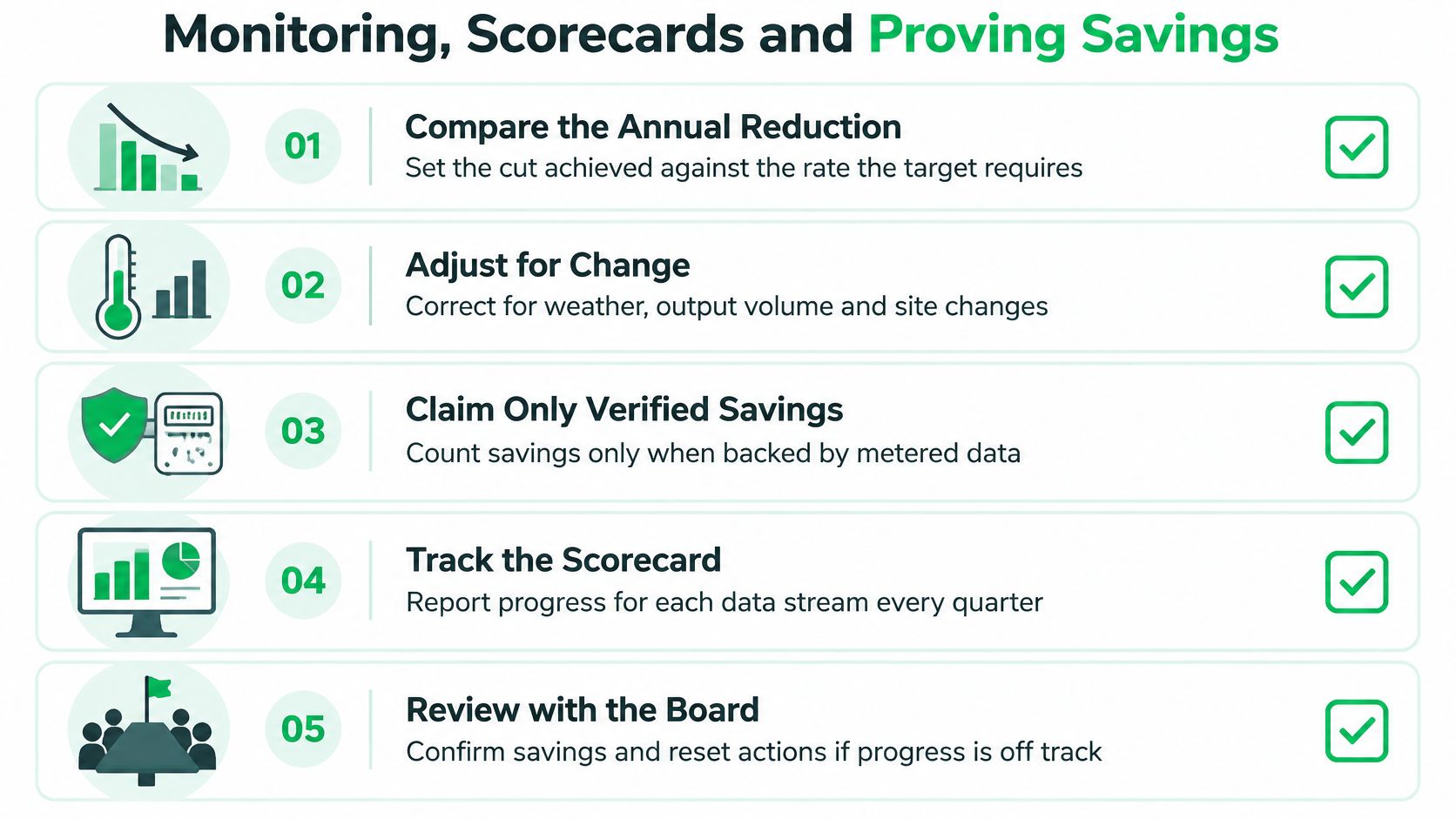
- Load monthly records for energy and fleet activity.
- Review quarterly performance, including weather adjustment and project ratings.
- Check baseline triggers annually, escalating relevant organisational changes.
- Publish the disclosure with a controlled supporting evidence file.
- Record staff effort by reporting task, so managers can identify avoidable rework.
Don't reject modelling merely because a saving can't be directly metered. Label the method and confidence candidly, and strengthen the evidence where uncertainty could change an investment decision.
Draft Your Carbon Reduction Policy Using This Template
Use the following headings as a working document. The example wording describes an illustrative logistics business, not a case study or a recommended target.
Working policy wording
Purpose and scope
This policy covers our UK depots, vans and leased offices, and applies to employees and contractors operating our fleet.Organisational boundary and base year
We apply operational control to the included operations and use the approved inventory year as our baseline, subject to the documented recalculation rule.Targets and KPIs
We will deliver the approved absolute reduction pathway for direct and purchased-energy emissions, reporting value-chain progress separately through the target register.Governance and roles
The operations director sponsors this policy, the fleet manager owns vehicle records, and the designated approving body reviews performance and material changes.Implementation measures and funding rules
We prioritise justified controls and lighting improvements, while depot charging requires confirmed electrical capacity and an approved investment case.Monitoring and reporting
Fuel, telematics and utility records feed the management scorecard, supported by documented checks and a controlled evidence file.Review and revision triggers
We review the policy when organisational changes, calculation methods, relevant requirements or energy arrangements materially affect its assumptions.Annex of data sources and emissions factors
The annex identifies invoices, meter exports, telematics records, contractual evidence and the emissions-factor version used for each reporting period.
Make approval a decision, not a writing exercise
Replace the example wording with actual names, boundaries and authorised commitments before circulation. Put unresolved matters in a decision log with an owner and due date; don't hide them behind phrases such as “where practicable”.
The board paper should distinguish approved action, conditional investment and unfunded ambition. Ask directors to approve the policy and immediate programme, acknowledge dependencies and assign responsibility for closing funding gaps.
Draft the policy this month, circulate it to the people who own the records, and set a clear deadline for their checks. Take the checked version to the next available board meeting with its inventory, ranked measures and outstanding decisions attached.
ESG Consulting offers emissions inventories, carbon reporting and costed net-zero pathways that connect operational measures to governance and investment decisions. Visit ESG Consulting to discuss a carbon reduction policy, bringing your latest inventory, reporting requirements and proposed capital projects so the engagement can start with the decisions your business needs to make.