csrd reporting requirements, csrd scope, esrs disclosures, uk sustainability reporting, csrd assurance
CSRD Reporting Requirements: Scope, ESRS and Key Dates
By ESG Consulting Team · · 25 min read
CSRD is not a blanket UK reporting requirement. Its reach depends on a company's EU listing, legal structure and European operations. A UK-headed group needs to establish which entities fall within scope before building disclosures. Group turnover alone cannot settle that question.
Treat CSRD reporting requirements as an entity-by-entity legal and geographic assessment.
Then connect each ESRS datapoint to evidence at the reporting entity level. An external assurance provider needs source records, with the methodology, boundaries and assumptions documented. Confirming the perimeter first gives finance teams a clear basis for deciding whose information belongs in the report and which records must support it.
Table of Contents
- Why CSRD Reporting Requirements Reach UK Organisations
- Which Entities Fall Inside CSRD Scope
- What the ESRS Standards Require You to Disclose
- How to Build a Reporting Process That Survives Assurance
- Key Dates and Phase-Ins to Plan Around
- CSRD Compared With UK Sustainability Reporting Standards
- Confirm Your CSRD Perimeter Before You Build Anything
Why CSRD Reporting Requirements Reach UK Organisations
A finding in the UK government's 2025 consultation response on sustainability-reporting assurance caught many boards off guard: a higher-than-expected number of private UK-headquartered entities will face mandatory CSRD reporting and assurance obligations from 2028 onward. That single observation reframes European sustainability compliance for British companies. Private ownership doesn't shield a UK group once its European operations cross legal thresholds.
Here's the plain verdict. The Corporate Sustainability Reporting Directive (CSRD) is EU law, and since Brexit it holds zero domestic legal force in the United Kingdom. You won't file a CSRD return at Companies House, and UK incorporation alone never pulls a company into scope.
Instead, CSRD reaches UK organisations through three distinct legal doors:
- EU regulated market listings: A UK company with equity or debt securities admitted to trading on an EU regulated market falls directly under the directive.
- Qualifying European presence: An EU-incorporated subsidiary or an EU branch that crosses statutory size or revenue tests creates a local obligation inside the European Union.
- Non-EU parent turnover: A UK-headed group generating substantial net turnover across EU member states can trigger consolidated reporting even when its parent sits in London, Manchester or Edinburgh.
Below is the visual reality facing UK leadership teams mapping their European regulatory footprint.

Who Needs to Make the Scope Decision Now
Group finance directors, company secretaries and heads of ESG sit in the firing line whenever a budget cycle opens. Without a settled legal position, teams either under-invest and scramble before an audit deadline, or spend six figures collecting European datapoints nobody will ever request.
To manage that decision properly, leadership needs five concrete outputs in place:
- Entity-by-entity scope matrix: A documented check of every UK and EU legal entity, branch and debt listing against current thresholds.
- ESRS disclosure and evidence map: A clear line connecting mandatory and material European standards to the primary records an assurer will test.
- Assurance-ready reporting workflow: A sequenced seven-step process from perimeter lock to digitally tagged publication.
- Phased compliance calendar: A backwards-planned timeline accounting for reporting waves, reliefs and lead times.
- UK regime comparison: A practical split showing where CSRD overlaps with UK Sustainability Reporting Standards and where it diverges.
European sustainability rules are still moving. The EU's stop-the-clock directive and the broader Omnibus simplification package continue to shift timelines and proposed size thresholds, which means an informal verdict from last year is already stale. Every scope conclusion needs a dated statutory reference attached to it.
Good governance looks like a signed perimeter note sitting in the audit committee pack, not a rough spreadsheet guess passed between finance and sustainability.
Which Entities Fall Inside CSRD Scope
Scoping starts with legal form and geography, never with consolidated UK group revenue. The UK Government's January 2025 overview of EU reporting regulations sets out the baseline quantitative test for large EU-connected businesses as a "two out of three" check applied across two consecutive financial years: more than 250 employees, more than €25 million in balance-sheet assets, and more than €50 million in net turnover. Crossing any two of those three criteria for two straight years brings an EU undertaking into scope, and the same overview confirms that listed small and medium-sized enterprises on EU-regulated markets sit inside the directive's wider population, with all CSRD reporters required to apply the European Sustainability Reporting Standards (ESRS).
Non-EU parent groups face a different gate. Rather than applying the two-of-three test at parent level, the directive looks at consolidated EU net turnover paired with either a qualifying EU subsidiary or an EU branch crossing its own local turnover bar. Separately, a UK or EU subsidiary can claim an exemption if its parent publishes a consolidated CSRD sustainability report covering that subsidiary, provided an authorised assurance provider signs off the parent report.
CSRD Scope by Organisation Type
Use the lookup table below to match each legal structure in your group against its applicable threshold test and reporting route.
| Organisation type | Threshold test | EU nexus | Reporting route |
|---|---|---|---|
| Large EU-listed undertaking (PIE) | EU regulated listing plus two of three for two consecutive years: >250 employees, >€25m total assets, >€50m net turnover | Listing venue | Entity-level sustainability statement in the management report |
| Other large undertaking | Two of three for two consecutive years: >250 employees, >€25m total assets, >€50m net turnover | EU incorporation or EU regulated listing | Entity-level statement; group route where the parent is itself in scope |
| Listed SME | Securities admitted to an EU regulated market | EU regulated market listing | Entity-level statement with SME phase-in reliefs |
| Non-EU group with a qualifying EU subsidiary | >€150m EU net turnover plus a large or listed-SME EU subsidiary | EU subsidiary | Group-level sustainability statement by the non-EU parent |
| Non-EU group with only an EU branch | >€150m EU net turnover and branch turnover >€40m | EU branch | Branch-level reporting |
| UK subsidiary of an in-scope EU parent | Already included in the parent's consolidated sustainability report | Parent in EU scope | Exempt, provided the parent report carries an assurance opinion from an authorised provider |
| UK plc with EU-listed debt | Securities admitted to trading on an EU regulated market | Listing venue | Entity-level statement for the issuing entity |
Building an Entity-by-Entity Perimeter Map
A consolidated trial balance hides the exact facts CSRD tests. To scope accurately, pull your statutory group structure chart and log seven fields for every entity and branch with any EU link:
- Listing venue: Record whether equity or debt securities trade on an EU regulated market (such as Euronext Dublin, Frankfurt or Luxembourg's regulated board), distinguishing regulated markets from multilateral trading facilities like Euro MTF.
- Legal form: Separate limited liability companies, holding companies and unincorporated branches, because branches follow different reporting mechanics from subsidiaries.
- Average headcount: Count all employees employed by the legal entity on the statutory basis required in its member state of incorporation.
- Net turnover and balance-sheet total: Extract statutory figures for the last two closed financial years so you can test the consecutive-year rule cleanly.
- Branch Union turnover: Isolate revenue generated through any EU branch where no qualifying subsidiary exists.
- FX translation policy: Fix a documented euro conversion rule before running calculations, typically using the closing exchange rate for balance-sheet totals and the annual average rate for turnover to match your financial consolidation accounting policy.
- Consolidation and exemption route: Flag whether an in-scope subsidiary can shelter under an assured parent report or must file on its own.
Worked Example Testing the Thresholds
Say a UK plc's only European footprint is a German GmbH sales subsidiary employing 40 staff and booking €60 million in annual net turnover. Finance directors often assume that crossing the €50 million turnover bar triggers CSRD automatically. It doesn't.
With 40 employees, the German subsidiary misses the headcount test by a wide margin. Turnover alone satisfies only one of the three criteria, so the entity stays out of scope unless its balance-sheet assets exceed €25 million for two consecutive years. If that German sales office holds €12 million in receivables and cash, it has no CSRD obligation; if it carries a €30 million warehouse and inventory balance for two straight years, it crosses two criteria and falls in.
Now change one variable. Suppose that exact same UK plc issued corporate bonds admitted to trading on a Frankfurt regulated exchange. The issuing UK entity enters scope immediately through its listing venue, regardless of whether its German subsidiary passes or fails the balance-sheet test. Meanwhile, because total EU net turnover sits at €60 million, the group remains well below the €150 million non-EU parent route.
Practical scoping rule: Never take a verbal assurance from treasury that "we only list in London". Check every legacy bond prospectus and Eurobond listing venue before signing off your perimeter.
One final caution on timing. The EU's Omnibus simplification package includes proposals to raise employee and turnover thresholds substantially and introduce early opt-in options, which could remove mid-sized subsidiaries from mandatory scope once enacted in member-state law. At ESG Consulting, we check our regulatory positions against DBT, FCA, Environment Agency and EU Official Journal sources so every scoping opinion reflects enacted law rather than press commentary. Confirm the live legislative status in each relevant EU member state before locking multi-year compliance spend.
What the ESRS Standards Require You to Disclose
Once an entity lands inside scope, the disclosure engine shifts to the European Sustainability Reporting Standards (ESRS). As Deloitte's IAS Plus sustainability reporting resource explains, CSRD applicability rests on an entity's EU nexus rather than UK incorporation, capturing UK issuers with shares or debt on an EU regulated market, qualifying EU subsidiaries, and non-EU groups generating more than EUR 150 million in EU net turnover alongside a qualifying EU subsidiary or an EU branch with more than EUR 40 million in Union turnover. Each in-scope reporting entity must prepare sustainability disclosures under ESRS, and CSRD reporting can also trigger EU Taxonomy disclosure obligations.
How the ESRS Architecture Works
Think of ESRS as a three-tier structure built from the centre outwards rather than a flat checklist:
- ESRS 1 (General requirements): Sets the binding rules on reporting boundaries, value-chain coverage, time horizons, comparative figures and how you run double materiality. It contains no standalone disclosures of its own, yet assurers audit your compliance with every rule inside it.
- ESRS 2 (General disclosures): Mandatory for every single reporter, regardless of what your materiality assessment concludes. It covers board governance, strategy and business model, how you ran your materiality assessment, and overarching policies, actions, metrics and targets.
- Ten topical standards: Five environmental standards (E1 to E5), four social standards (S1 to S4) and one governance standard (G1). Together they house a dense catalogue of quantitative metrics and narrative disclosures, yet you report a topical standard in full only when it proves material to your business.
Double Materiality in Practice
Double materiality isn't an academic exercise; it acts as the gatekeeper deciding how large your reporting and assurance bill becomes. You must test every sustainability topic along two independent axes:
- Impact materiality (inside-out): How your operations and value chain affect people and the environment, measured by scale, scope, irremediable character and likelihood.
- Financial materiality (outside-in): How sustainability risks and opportunities affect your cash flows, financial position, access to finance or cost of capital over the short, medium and long term.
A topic becomes material if it passes either test. You can't use low financial exposure to dismiss a severe environmental or labour impact, and you can't skip a financial climate risk just because your own emissions footprint looks small.
ESRS E1 (Climate change) shows how strict this architecture is in practice. Climate is effectively expected to be material for almost every reporter. If an organisation concludes climate isn't material, it can't leave E1 blank; it must publish a detailed, assurance-tested written explanation justifying that conclusion. For the vast majority of companies where E1 is material, disclosures pull in Scope 1, 2 and 3 greenhouse gas emissions, energy consumption and mix, reduction targets, a credible climate transition plan and anticipated financial effects from physical and transition risks.
Two relief mechanisms keep the workload realistic. Phased transitional reliefs allow eligible reporters to delay selected complex datapoints (such as certain biodiversity, workforce and anticipated financial effect disclosures) in early reporting cycles. Alongside those phase-ins sits the value-chain cap, which restricts what an in-scope company can legally demand from smaller suppliers so compliance doesn't cascade unbounded questionnaires down the supply chain.
ESRS Standards and the Evidence Assurers Demand
An assurance provider doesn't audit prose; they test underlying records. The table below maps every ESRS standard and the EU Taxonomy against its reporting basis and the primary evidence you need ready.
| Standard | What it covers | Reporting basis | Typical evidence |
|---|---|---|---|
| ESRS 1 | Reporting principles, value chain, materiality approach, structure of the statement | Mandatory framework, no separate disclosures | Documented methodology, boundaries and value-chain scope |
| ESRS 2 | Governance, strategy, business model, materiality process, metrics and targets | Mandatory for all reporters | Board terms of reference, strategy papers, impact and risk assessment records |
| E1 Climate change | Scope 1, 2 and 3 GHG emissions, energy, transition plan, targets, financial effects | Effectively expected to be material for all reporters | Meter data, fuel invoices, supplier emissions data, model workings |
| E2 Pollution | Emissions to air, water and soil, substances of concern | Subject to materiality | Permit returns, emissions monitoring, substance registers |
| E3 Water and marine resources | Water consumption, abstraction, discharge, marine resources | Subject to materiality | Abstraction licences, discharge consents, water bills |
| E4 Biodiversity and ecosystems | Sites near protected areas, land use, impact drivers, restoration | Subject to materiality, with phased datapoints | Site registers, ecological surveys, land-use records |
| E5 Resource use and circular economy | Resource inflows and outflows, waste, product design | Subject to materiality | Procurement volumes, waste transfer notes, product data |
| S1 Own workforce | Headcount, pay, health and safety, training, collective bargaining | Subject to materiality, with phased datapoints | HR extracts, payroll, incident logs, training records |
| S2 Workers in the value chain | Labour practices, forced labour risk, supplier engagement | Subject to materiality | Supplier questionnaires, audit reports, contract clauses |
| S3 Affected communities | Community impacts, engagement, grievances | Subject to materiality | Engagement logs, grievance registers, site assessments |
| S4 Consumers and end users | Product safety, data protection, accessibility, complaints | Subject to materiality | Product testing records, complaints data, privacy assessments |
| G1 Business conduct | Anti-corruption, lobbying, payment practices, whistleblowing | Subject to materiality | Policies, training logs, payment data, whistleblowing case records |
| EU Taxonomy | Share of turnover, capex and opex aligned with taxonomy activities | Where CSRD applies and taxonomy-eligible activity exists | Activity-level capex and turnover analysis |
Centralising sustainability data collection at a UK head office often makes commercial sense, yet centralisation creates a trap if you lose statutory boundaries. Your control framework must preserve auditable evidence at the reporting-entity level, documenting intercompany eliminations, EU turnover allocation and proof of any subsidiary exemption relied upon. Because every in-scope entity faces limited assurance from its very first reporting year, any ESRS figure that can't be traced back to an entity-level invoice, payroll extract or signed calculation working will trigger an assurance qualification or delay sign-off.
How to Build a Reporting Process That Survives Assurance
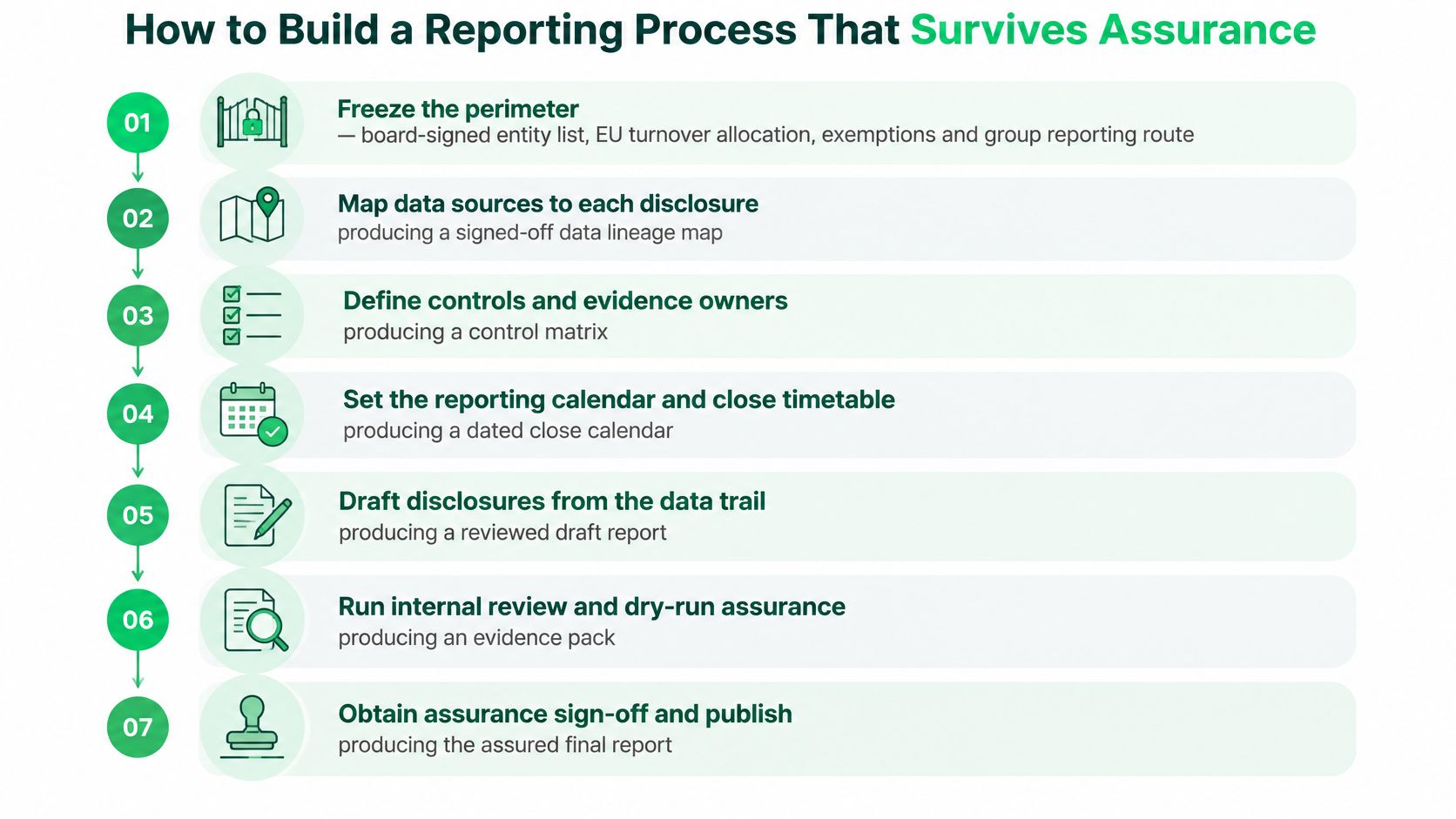
Most sustainability teams design reporting workflows backwards: they draft narrative text first, hunt for numbers second, and call an assurance provider two months before publication. That approach fails under CSRD because limited assurance examines your governance, materiality rationale and source data trail as closely as the final table.
The workflow below lays out the seven stages required to produce an assurance-ready sustainability statement.
The Seven Steps and What Each One Produces
Follow these steps in order, and don't move to the next stage until the concrete artefact from the current stage is signed off.
- Freeze the reporting perimeter. Finalise your entity list, EU turnover allocation, exemptions and chosen group reporting route, then take that document to the board or audit committee for formal sign-off. Artefact: A board-approved CSRD perimeter note.
- Run the double materiality assessment. Assess impacts, risks and opportunities across your operations and value chain, setting explicit severity and likelihood thresholds and recording how affected stakeholders and internal specialists informed each score. If a topic is ruled out, write down why so an assurer can re-perform your logic without guessing. Artefact: A documented double materiality matrix and methodology file.
- Map every material datapoint to its ESRS paragraph. Cross-reference each material topic directly to its exact ESRS disclosure requirement and mark every applicable phase-in relief. This discipline stops operational teams from wasting months collecting metrics the standards never asked for. Artefact: A signed-off ESRS disclosure and gap register.
- Assign owners, source systems and controls, and appoint your assurer. Give every datapoint one named business owner across finance, HR, procurement or operations, link it to its primary ERP or HRIS system (such as SAP, Workday or utility billing portals), and write a methodology note fixing boundaries, emission factors and estimation rules. Appoint your limited-assurance provider here, not at drafting stage, so they can review your materiality logic and methodology before data collection locks. Artefact: A datapoint control matrix and documented basis of preparation.
- Consolidate with full financial reconciliation. Pull entity-level submissions together while recording intercompany eliminations and EU turnover allocations so sustainability totals reconcile cleanly to the statutory financial statements. Artefact: A reconciled consolidation workbook with entity-level drill-down.
- Assemble the assurance evidence pack. Compile primary source evidence (utility meter data, fuel invoices, payroll and HR extracts, supplier responses, waste transfer notes), complete calculation workings and a version-controlled audit log before running an internal dry run. Artefact: An indexed, assurer-ready evidence repository.
- Draft, digitally tag and publish. Write the sustainability statement directly from the verified data trail, apply digital ESEF/XBRL tagging so the filing is machine-readable, secure audit committee and board approval, and publish inside the management report alongside the assurance opinion. Artefact: The assured, tagged statutory sustainability statement.
If your ESG software outputs a single group-wide carbon number but can't produce the underlying invoices for your French or Dutch reporting subsidiary, your data model won't survive limited assurance.
Realistic Timelines and Where First Cycles Break
Plan your timetable realistically from the start. A first CSRD cycle normally takes several quarters of dedicated cross-functional work, and stretches across a full financial year whenever Scope 3 value-chain emissions are material and supplier engagement is needed. Waiting until the final quarter of the reporting year virtually guarantees incomplete evidence and late adjustments.
For teams structuring these controls alongside existing UK reporting, our ESG consulting team builds the data trail around audit readiness from day one. Every figure ESG Consulting produces traces back to source data, with the methodology, boundaries and assumptions documented for the client's auditor or assurance provider.
The short walkthrough below highlights practical steps for aligning internal data owners with external assurance expectations.
Managing the Three Budget Drivers
First-cycle CSRD budgets rarely blow up because of drafting costs; they escalate because of poor scoping and weak systems. Three cost drivers dictate what you'll spend:
- Internal collection hours per entity: Every in-scope subsidiary requires finance, HR and site-level hours to pull and check primary records. This cost scales directly with your legal-entity perimeter.
- External assurance fees: Assurance providers price engagements based on the number of reporting entities, geographic spread and how many topical standards prove material. Tightening materiality and eliminating duplicate entity filings through valid parent exemptions cuts this fee directly.
- System and control upgrades: Adapting ERP, payroll and emissions platforms to capture entity-level evidence creates an upfront capital or configuration outlay. Unlike annual collection hours, solid controls pay back across every future reporting cycle and scale far less steeply if the EU Omnibus reforms later narrow your perimeter.
Key Dates and Phase-Ins to Plan Around
Work from an outdated CSRD calendar and you'll build controls for the wrong reporting year. Legislative pauses and simplification negotiations have already moved the dates once, and the Omnibus package could move them again.
The timeline below maps the main reporting milestones across the directive's phased rollout.
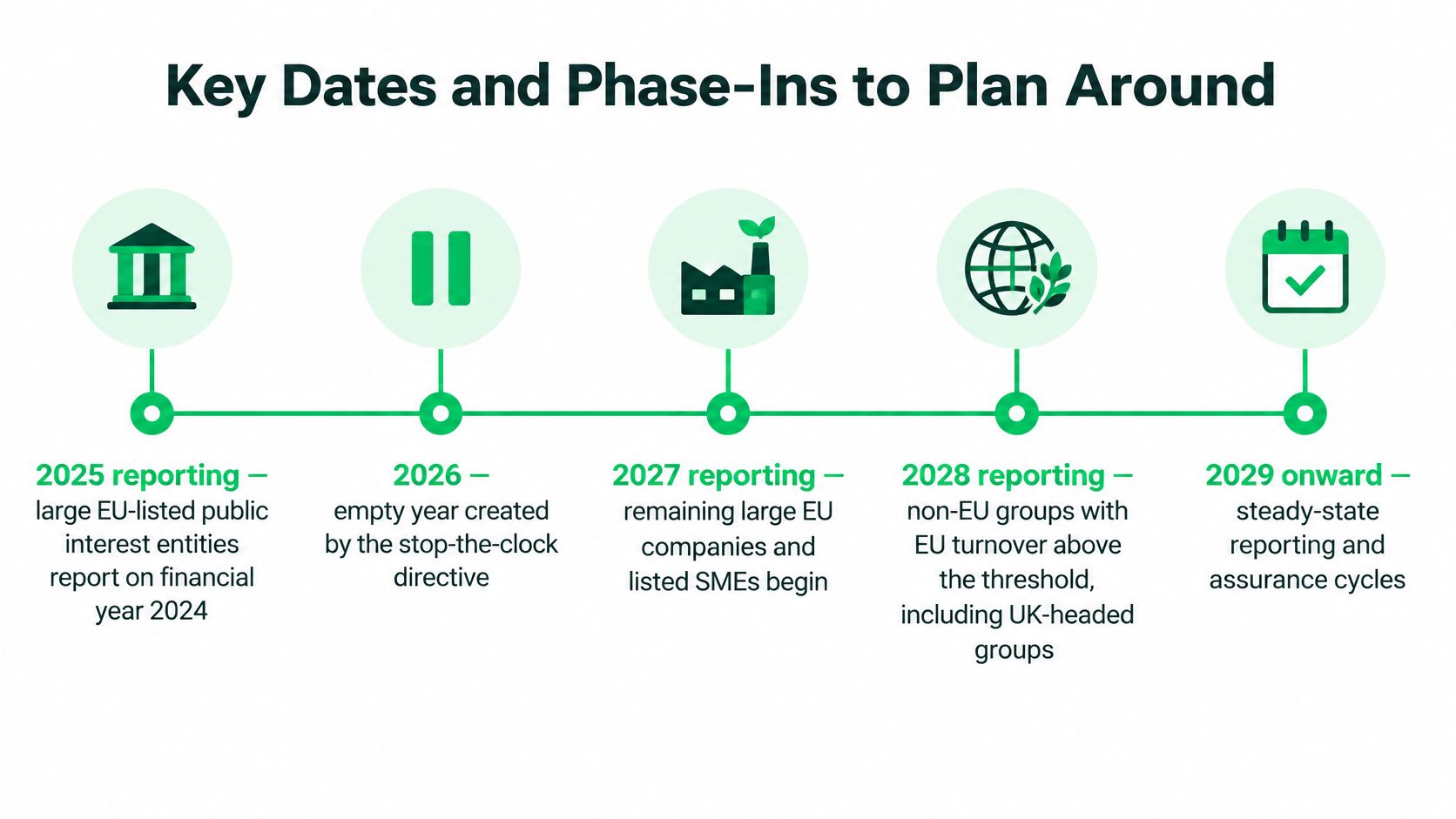
CSRD Reporting Waves and First Reporting Years
The stop-the-clock directive deferred the later reporting cohorts by two years, which is why 2026 sits empty between Wave 1's first published reports and the next group entering mandatory reporting.
| Wave | Who reports | First financial year | Reporting year |
|---|---|---|---|
| Wave 1 | Large EU-listed public interest entities | FY2024 | 2025 |
| Wave 2 | Other large undertakings meeting the two-of-three test | FY2027 | 2028 (a two-year deferral under the stop-the-clock directive) |
| 2026 | No new wave reports | None | 2026 (empty year) |
| Wave 3 | Listed SMEs on EU regulated markets | FY2028 | 2029 (a two-year deferral) |
| Wave 4 | Non-EU groups above €150m EU net turnover | FY2028 | 2029 |
Read the table entity by entity, not group by group. A UK holding company can sit outside Wave 4 while a single EU subsidiary inside Wave 2 reports on its own account from FY2027. If FY2027 is your first reporting year, data capture and controls need to run from the start of that financial year, because you cannot recreate a clean year of meter readings, payroll splits and supplier records retrospectively.
Two structural shifts sit alongside the calendar. EU policymakers deferred sector-specific ESRS, leaving reporters focused on the sector-agnostic standards for now. The ongoing Omnibus simplification package may still reshape which undertakings fall into Wave 2 and Wave 4 and adjust transitional reliefs, so monitor transposition in every member state where you hold a subsidiary.
Reliefs Grouped by Who Qualifies
Rather than memorising reliefs standard by standard, group them by the type of organisation that can claim them:
- All first-time reporters: Eligible to defer anticipated financial effects across environmental topics and take a transitional breathing space on complex Scope 3 value-chain emissions while supplier data pipelines are built.
- Smaller in-scope undertakings: Companies beneath the directive's lower headcount tier for phase-ins receive extended multi-year omissions on Scope 3 emissions and selected own-workforce metrics (social protection, training metrics and work-life balance breakdowns), plus staged adoption of biodiversity disclosures.
- Value-chain suppliers: Smaller suppliers outside CSRD scope benefit from the value-chain cap, letting them decline customer sustainability requests that go beyond voluntary SME reporting boundaries.
Claim a relief and the assurer still asks two questions: why the omission applies to this entity, and how you intend to close the gap. Document both answers at the point you take the relief, because an unexplained omission reads like missing data rather than a lawful phase-in.
The Direction of Travel on Assurance
Assurance rules explain why UK boards can't treat CSRD as a lightweight ESG narrative exercise. In its consultation on developing an oversight regime for assurance of sustainability-related financial disclosures, the UK Government notes that some large UK-parent companies fall inside CSRD scope through EU regulated market listings or revenue thresholds, and that in-scope entities must obtain limited assurance over ESRS disclosures from their first reporting year.
One mechanic in that consultation decides whether a UK subsidiary can rely on a parent's consolidated CSRD report. The subsidiary exemption holds only when the parent's consolidated sustainability report satisfies CSRD requirements and carries an assurance opinion issued by a person or firm authorised under the relevant national or EU member-state rules. Appoint an unaccredited reviewer and the exemption fails, leaving the subsidiary in breach of its own filing obligation.
EU policymakers continue to debate the path from limited assurance toward stricter reasonable assurance alongside a harmonised oversight regime for practitioners. Build your evidence to the stricter standard now. Every ESRS datapoint should trace to a source record a reviewer can reperform, because an assurance opinion is only as strong as the trail behind it.
Work backwards from your publication date, not forwards from today. Reliable controls, opening balances and comparative datasets require two financial years of operational lead time before an assurer can sign off cleanly.
CSRD Compared With UK Sustainability Reporting Standards
While Brussels refines CSRD, the UK is building its own domestic baseline. The Department for Business and Trade (DBT) is developing UK Sustainability Reporting Standards (UK SRS), grounded in the International Sustainability Standards Board's IFRS S1 (general sustainability disclosures) and IFRS S2 (climate-related disclosures). The DBT government response to the 2025 UK SRS exposure drafts consultation recorded 209 responses and specifically noted that some respondents' parent companies already report under the EU CSRD.
Many UK groups now face a practical question: can one sustainability report satisfy both regimes? Comparing them on the criteria that change workload gives the answer immediately.
CSRD and UK SRS Compared
| Criterion | CSRD (ESRS) | UK SRS (S1 and S2) |
|---|---|---|
| Who is captured | EU-listed entities, large EU undertakings, listed SMEs and non-EU groups above €150m EU turnover | UK companies within the scope set by DBT under the final UK SRS |
| Standards applied | ESRS 1 and ESRS 2 plus ten topical standards | ISSB-aligned S1 general sustainability and S2 climate, adapted for the UK |
| Materiality basis | Double materiality: impact or financial materiality each triggers disclosure | Financial materiality as the ISSB baseline, with UK policy additions |
| Assurance | Limited assurance from the first reporting year, with EU movement toward reasonable assurance | Subject to the UK assurance oversight regime under consultation |
| Digital tagging | ESEF/XBRL tagging of the sustainability statement | Tagging expected to follow UK digital reporting requirements |
| First reporting | Waves 1 to 4 reporting from 2025 to 2029 | Confirmed through DBT consultation, with reporting expected after the standards are finalised |
| Taxonomy | EU Taxonomy eligibility and alignment disclosure | No equivalent UK taxonomy disclosure at present |
Two Clear Verdicts Depending on Your Group Structure
If your UK group has an in-scope EU entity: You must deliver ESRS disclosures at the required reporting-entity level. You can't substitute a UK SRS report for an ESRS statement, because your EU assurance provider must test compliance directly against European standards, including impact materiality and EU Taxonomy rules.
If you're a UK-only business with no EU nexus: Ignore CSRD entirely. You have zero legal obligation under European law, and chasing ESRS datapoints will burn internal hours that belong on a proportionate S1 and S2 dataset aligned to UK investor and lender expectations.
Where the Two Regimes Share One Engine
Dual-regime groups don't need to build two separate reporting teams. Five core operational assets serve both CSRD and UK SRS at the same time:
- Greenhouse gas inventories: Well-governed Scope 1, 2 and 3 carbon accounts built to GHG Protocol rules feed both ESRS E1 and UK SRS S2.
- Board governance records: Committee charters, oversight minutes and remuneration links answer general governance requirements under both regimes.
- Targets and transition plans: Costed, time-bound decarbonisation pathways and interim milestones sit at the heart of both frameworks.
- Risk identification processes: Enterprise risk registers that capture physical and transition climate exposures translate directly across financial materiality assessments.
- Internal control frameworks: Documented data owners, reconciliation checks and evidence logs satisfy both UK auditors and EU limited-assurance providers.
The trap to avoid is treating UK SRS as a lighter version of CSRD. Because the two regimes differ in statutory scope and materiality philosophy, an assured ESRS sustainability statement won't transfer directly into a UK annual report without targeted editing and cross-referencing. Build one shared data foundation underneath, then generate disclosures at the reporting layer.
Confirm Your CSRD Perimeter Before You Build Anything
Uncertainty costs more than compliance. Before buying ESG software, hiring consultants to draft policies or sending questionnaires to suppliers, execute three dated actions inside the current quarter.
- Get your Step 1 perimeter note signed off by the board or audit committee. Don't leave the entity-by-entity scope assessment sitting as an unsigned draft in a shared drive. Record the legal verdict for every subsidiary, branch and listed debt vehicle, attach the dated legislative sources relied on, and minute the approval so your external auditor sees a clear governance trail.
- If any entity lands in scope, book materiality and early assurance scoping this financial year. Waiting until the reporting year opens compresses your schedule and leaves no time to repair broken ERP or utility data feeds. Your first reporting year sets the comparative baseline and evidence standard for every annual cycle that follows, so lock in your assurance provider's expectations early.
- If nothing is in scope, record the conclusion and redirect the budget. Document exactly why each entity falls outside CSRD, set an annual trigger to re-check if you acquire an EU business or issue European debt, and put your team's energy into UK SRS readiness and genuine buyer requests rather than unasked-for ESRS disclosures.
At ESG Consulting, we confirm which obligations apply to a client before anything is built or scoped, and we tell clients plainly when an obligation doesn't apply and when a rating can wait. Paying to comply with a European directive that never legally caught your group is wasted capital.
Apply one simple litmus test at your next leadership meeting: if you can't name the exact legal entity, the listing venue and the EU turnover figure behind your CSRD decision, your position is unresolved.
If you want a settled, board-ready CSRD scope position or need to build an ESRS evidence trail that stands up to limited assurance, our senior consultants work directly with UK finance, legal and sustainability teams from perimeter review through to sign-off. We also advise on UK SRS readiness, Scope 3 inventories and assurance-grade carbon reporting where European rules don't apply. Visit ESG Consulting to review your regulatory position before committing next year's budget.