capex and opex, CapEx vs OpEx, capital expenditure, operating expenditure, UK tax treatment
Difference Between CapEx and OpEx: A UK Guide for 2026
By ESG Consulting Team · · 14 min read
A contractor's invoice is open on your screen, mixing five different things into one line total: a heat pump, the installation and commissioning, a design report, a year of energy monitoring software and a maintenance contract for the system you have just bought. Your finance team needs one answer before the purchase order goes out.
Treat the whole invoice as capital expenditure and you will capitalise costs that belong in this year's profit and loss, overstating both your asset base and your earnings. Expense the lot as operating expenditure and the opposite happens: this year's profit takes a hit it never earned, while an asset that will still be on your site in a decade never reaches the balance sheet. Neither answer is right, and the invoice itself won't tell you where to draw the lines.
The difference between CapEx and OpEx isn't about the size of the payment, the supplier's wording or which budget line the spend came from. UK tax guidance calls operating spend revenue expenditure, and the test behind it is narrower than many non-specialists expect. Once that test is clear, the invoice stops being a judgement call and becomes a set of components you can split, classify and defend.
Table of Contents
- CapEx and OpEx at a Glance
- Classify Any Cost and Avoid Common Errors
- How the Choice Changes Profit, Tax and Cash Flow
- Classifying Software, Subscriptions and Mixed Contracts
- Keeping Audit-Ready Records for Each Classification
- Confirm the Classification Before You Approve Spend
CapEx and OpEx at a Glance
Say a plumbing firm buys a used delivery van for £18,000 and expects to keep it on the road for ten years. The same firm spends £240 a month on diesel. Both payments leave the same bank account, and neither supplier describes them differently. In the accounts they behave nothing alike.
The van leaves the business with something that will still be earning after the year end, so it's capital expenditure, or CapEx. The diesel is burned getting this month's jobs done, so it's operating expenditure, or OpEx. UK tax guidance usually calls the second category revenue expenditure, where "revenue" refers to the running of the trade, not to sales income.
Everything else follows from one question. Does this spend leave the business with a benefit that outlasts the current accounting period? If yes, it's likely capital. If it only keeps the lights on, it's likely revenue.
CapEx and OpEx compared across the criteria that matter
| Criterion | CapEx | OpEx |
|---|---|---|
| Purpose | Creates, acquires or substantially improves an enduring asset | Keeps the business running day to day |
| Typical examples | Plant, premises, major energy-efficiency systems | Rent, utilities, wages, routine maintenance |
| Initial accounting | Recognised as an asset on the balance sheet | Recognised in the profit-and-loss account when incurred |
| Effect on profit | Charged through depreciation or amortisation over useful life | Charged in full in the period incurred |
| Effect on EBITDA | Depreciation sits below EBITDA, so the asset charge does not reduce it | Reduces EBITDA in the period incurred |
| Tax treatment | Generally not deducted directly; relief may come through capital allowances | Qualifying revenue costs are generally deductible when wholly for the trade |
Read the table as a set of consequences rather than a set of rules. Two companies can spend exactly the same amount in a year and report wildly different profit, different operating cash flow and a different tax profile, purely because of where each cost landed. That's also why the two routes get different approval treatment: capital requests usually need an investment case and sign-off above the budget holder, while operating spend sits with whoever owns the cost centre.
The classification is a judgement about facts, not a labelling exercise. Two identical-looking payments can land on opposite sides of the line depending on what the business gets back and how long it gets it for. Once you can hold the two ideas apart, the harder work starts: applying the test to a single cost line, and then living with what it does to your profit, your tax computation and your evidence file.
Classify Any Cost and Avoid Common Errors
One invoice can hold three costs wearing one coat: a machine, its installation and a service plan. The payment is single. The classification can be plural. HMRC is explicit that the answer turns on the practical effect and circumstances of the transaction, rather than the item's name or management's purpose for it, and that the boundary is fact-specific enough that no universal itemised list settles it. The HMRC Business Income Manual guidance on capital and revenue sets out the underlying principle: capital spend creates, acquires, improves or substantially alters an identifiable asset or another advantage with an enduring benefit, while revenue spend covers the recurring cost of running the business or restoring an asset to its existing condition.
Work through the five steps below in order. Each one narrows the answer, so a later step can rescue a cost that looked ambiguous at first.
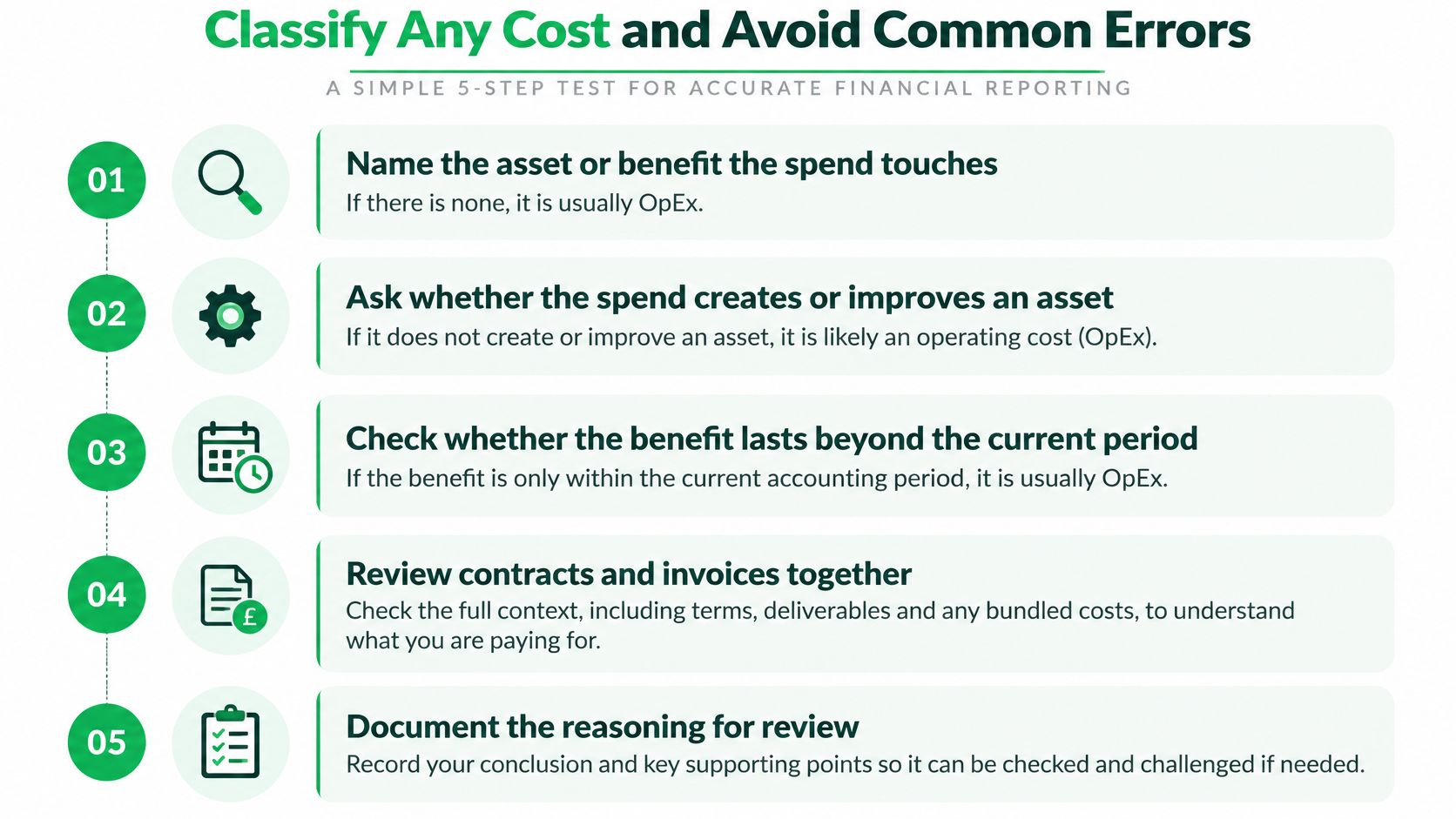
1. Name the asset or benefit the spend touches. If you cannot name one, you are usually looking at OpEx. Rent, wages, insurance, an audit fee and a software support retainer keep the business running; nothing durable is created, so the classification rarely causes an argument.
2. Ask whether the spend creates, acquires, improves or substantially alters that asset. Extending a building, buying plant, installing a major energy-efficiency system or constructing premises all point to capital. The word that does the work is “substantially”: capability, life or value has changed enough that the business has gained an asset with endurance.
3. Check whether the spend only restores the asset to its existing condition. Repairs, routine maintenance and ordinary running costs sustain something that already exists. They keep the benefit going; they do not create a new one.
4. Test the practical effect rather than the invoice title. The same HMRC manual gives the cleanest pair of examples available. Replacing roof tiles damaged by a storm is normally revenue expenditure, because the roof ends up as watertight as it was before. Extending the roof or adding another storey is normally capital expenditure, because the building is now a different and more valuable asset.
5. Split mixed invoices into components and say why each was classed as it did. A single commercial arrangement can contain both capital and revenue elements. Contract structure matters more than the label on the front page: a hire-purchase or leasing payment can blend a capital element with a finance charge, and a supply contract can bundle equipment, installation, training and support. Classify each component by the benefit it creates, then keep the quote, contract or work package that shows which pound did which job.
Apply step four to a real energy project and the answer falls out quickly. The heat pump itself, its installation and commissioning are capital, because they create an asset that will run for years. The monthly energy monitoring fee and the maintenance contract are revenue, because they sustain an asset that already exists.
Practical rule: if you cannot name the asset a payment creates or improves, and you cannot point to a useful life stretching past the current period, you are almost certainly looking at OpEx.
Where people go wrong
- Treating the whole invoice as one thing. This is the costliest error, because it forces a single answer onto a mixed purchase and guarantees that part of it is wrong. Split by work package, then classify.
- Assuming accounting decides tax. The accounting classification is the starting point, and the tax treatment can diverge from it.
- Assuming every subscription is OpEx. A lump-sum licence for a long-lived platform, or the build cost of the platform itself, can be capital. The pricing model does not decide it; useful life and functionality do.
- Treating depreciation as a deduction. Depreciation is a proper accounting charge, and it is normally added back in the tax computation.
- Reading “not immediately deductible” as “no relief”. Capital spend can attract relief through capital allowances, which depend on the asset category and the rules in force. The timing changes, and the relief can still exist.
- Letting the budget label decide. “ESG programme”, “decarbonisation plan” and “sustainability project” are internal labels. Each work package inside them needs its own treatment.
How the Choice Changes Profit, Tax and Cash Flow
Take a £1 million machine with a five-year useful life, depreciated straight-line, and set it against a £1 million operating contract paid in Year 1. Same money out of the bank in total, completely different shape in the accounts.
Illustrative profit charge for a £1 million spend over five years
| Year | CapEx: £1m machinery | OpEx: £1m paid in Year 1 |
|---|---|---|
| Year 1 | £200,000 | £1,000,000 |
| Year 2 | £200,000 | £0 |
| Year 3 | £200,000 | £0 |
| Year 4 | £200,000 | £0 |
| Year 5 | £200,000 | £0 |
| Total | £1,000,000 | £1,000,000 |
That table shows accounting profit only. The machine's cost is spread because it delivers benefit across five years. The operating contract is consumed at once, so it lands at once.
Where tax relief actually enters
Tax doesn't follow that picture exactly. HMRC's stated general rule is that capital expenditure isn't deductible when calculating trading profits, though specific statutory reliefs such as capital allowances may apply, while qualifying revenue costs incurred wholly for the trade are generally considered in the taxable profit calculation. The HMRC guidance on capital expenditure and trading profits also confirms that depreciation of capital items isn't generally an allowable deduction and must normally be added back.
So the £200,000 annual depreciation charge reduces accounting profit but not taxable profit. Relief for the machine arrives through capital allowances instead, and how much arrives, and when, depends on the asset category and the rules in force at the time. That's the distinction that catches people: the absence of an immediate deduction isn't the absence of relief.
EBITDA moves on a different logic again. Depreciation sits below the EBITDA line, so capital spend leaves EBITDA untouched in the years after purchase, while the operating contract reduces it in Year 1. A change in classification can therefore improve a headline metric without a penny of extra cash arriving.
Both routes consume £1 million of cash. What differs is the timing of the profit charge, the timing of tax relief and the shape of the numbers your board and lenders see.
Treat all of this as illustration. It ignores capital allowances and assumes the operating contract is revenue in nature and incurred wholly for the trade.
Classifying Software, Subscriptions and Mixed Contracts
Technology contracts cause more classification arguments than any other category, because the supplier's invoice title is almost always useless as evidence. "Platform subscription" can describe a licence, a build, a hosting arrangement and a support desk bundled together.
A carbon-data or building-management proposal should be decomposed before anyone classifies it: acquired functionality, implementation and configuration, integrations and data migration, then continuing subscription and support. Each element stands or falls on its own useful life.

Payment structure does some of the work. HMRC's guidance on acquiring and improving assets sets out that a lump-sum software licence expected to last less than two years may be treated as revenue, while a longer-lived lump-sum licence may be capital. Regular periodic licence payments are normally revenue and spread across the service period. Application, infrastructure, hardware and operating software that create the functionality of a website are normally capital, while routine content updates and maintenance are revenue.
Usual treatment of common software and platform contract elements
| Contract element | Usual treatment | Reason |
|---|---|---|
| Lump-sum software licence lasting under two years | Revenue expenditure | Short-lived benefit |
| Lump-sum software licence lasting two years or more | Capital expenditure | Longer-lived benefit |
| Regular periodic licence payments | Revenue expenditure | Spread over the service period |
| Website or platform functionality, including hardware and operating software | Capital expenditure | Creates the functionality |
| Routine content updates and maintenance | Revenue expenditure | Keeps existing functionality running |
The same restoring-versus-improving principle governs physical assets. A repair puts an asset back into the condition it was already in. An alteration that changes or enhances it goes the other way.
For an ESG business case, the split changes the EBITDA presentation, the cash-flow timing, the capital-allowance analysis and whether two projects' payback figures are comparable. A capitalised platform spreads cost through amortisation and puts a visible asset on the balance sheet. A subscription keeps cash flexible and keeps the cost out of fixed assets. Neither is automatically better; what matters is that the comparison is made on consistent treatment.
Here's the practical sequence for a technology negotiation.
Ask the supplier to price each element separately in the contract and on the purchase order: implementation, configuration, data migration, development, licences, hosting, support and updates. Then record the useful-life assumption for anything you capitalise. That single request moves the classification from a guess about marketing language to a reading of the contract, which is the only defensible basis for the answer.
Keeping Audit-Ready Records for Each Classification
A classification is only as good as the trail behind it. An auditor, an assurance provider or an HMRC officer will ask the same question in three different ways: show me what you bought, show me why you treated it that way, and show me how it reaches the tax computation.
Build the file so the answer takes minutes, not a week.
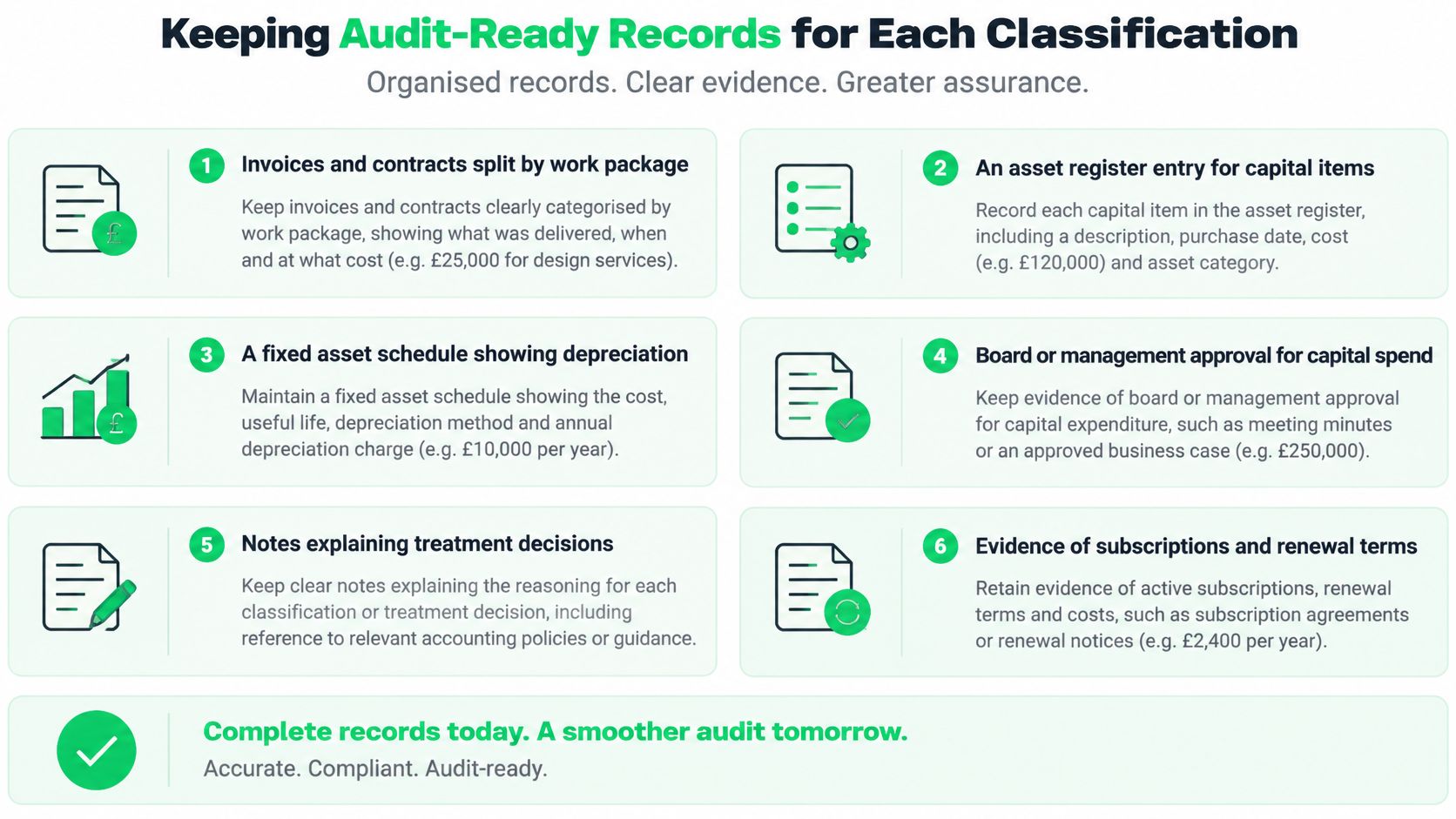
- Invoices and contracts split by work package. One purchase order covering five deliverable types is the single biggest source of rework. Insist on itemised lines at the point of ordering.
- An asset register entry for every capital item. Record useful life, ownership, commissioning date and upgrade scope. Without an entry, there's no asset to depreciate and no basis for a capital allowance claim.
- Payment frequency and renewal terms for each subscription or service. Monthly or annual billing, plus the renewal date, tells a reviewer immediately that the benefit is consumed within the period.
- A written rationale referencing the enduring-benefit test. Two sentences per classification is enough. The point is that the reasoning exists at the time of the decision, not that it's elaborate.
- A reconciliation from accounting treatment to the tax computation. Show the depreciation added back and the capital allowances claimed, so the two views are visibly connected.
- Source data and assumptions for every ESG figure used in the case. Emissions abatement, energy savings and cost baselines all need to trace back.
Every figure we produce at ESG Consulting traces back to source data, with the methodology, boundaries and assumptions documented for the client's auditor or assurance provider. That discipline exists for the same reason this record-keeping does: a number nobody can follow is a number nobody will accept.
The boundary between capital and revenue is fact-specific, so no template replaces judgement. What a template can do is force the judgement to be written down while the facts are still fresh.
The reviewer test: could someone who has never seen this project follow the trail from invoice to asset register to depreciation to the tax line in a single afternoon? If the answer is no, the file isn't finished.
Confirm the Classification Before You Approve Spend
The verdict depends on what you're buying, and the honest answer is rarely a single word for a whole project.
- Capital-heavy decarbonisation. Equipment, installation and commissioning of solar, heat pumps or building controls are usually capital. Energy supply, monitoring and maintenance running costs are usually revenue. Budget them separately from day one.
- Software and data platforms. Classify by contract element, not by product. Build and integrations often land as capital; subscriptions, hosting and support normally don't.
- Mixed projects. Every work package gets its own treatment, and the approval goes through by component rather than as one lump. This is also the only way the business case survives scrutiny.
Before the budget goes to sign-off, confirm three things for each element: its classification, the useful life of anything you intend to capitalise, and the effect on both EBITDA and tax. Do that and your investment case becomes comparable with every other case competing for the same money. Skip it and you're comparing a capital project presented as operating spend with an operating contract presented as an asset.
Line up the finance and tax advisers early, while the contract is still negotiable. At ESG Consulting, we confirm which obligations apply to a client before anything is built or scoped, and our net-zero strategy work produces a costed, sequenced decarbonisation pathway that separates capital items from running costs rather than presenting one blended figure.
The action is small and it saves a lot of rework. Take your next supplier proposal, list every work package on a single page, and write the treatment next to each one before anyone approves a figure.
If you're approving decarbonisation spend and can't yet say which parts of the proposal are capital and which are operating, ESG Consulting can help you get there before the budget is fixed. Our net-zero strategy service builds a costed pathway with capital and operating costs separated and sequenced by what abates emissions in your operations, and each engagement is delivered for a fixed fee agreed in writing beforehand. Visit ESG Consulting to talk through your next project.