emissions trading scheme uk, UK ETS, UK carbon market, UK allowances, carbon pricing UK
Emissions Trading Scheme UK: How It Works in 2026
By ESG Consulting Team · · 16 min read
The sectors covered by the UK Emissions Trading Scheme account for approximately 25% of the UK's territorial greenhouse-gas emissions, according to the UK Government's UK ETS policy overview. For businesses within its scope, carbon is therefore more than a reporting topic: it's an operating cost tied to a limited supply of emissions allowances.
The practical question isn't merely what an allowance costs today. It's how your organisation will manage its emissions, purchasing and investment decisions as the available supply tightens.
Table of Contents
- What the UK Emissions Trading Scheme Is and Why It Matters
- Which Sectors and Activities Fall Under the Scheme
- How the Annual Compliance Cycle Runs
- Allowance Auctions, Free Allocation and the Price Floor
- UK ETS Versus EU ETS
- Linking, CBAM and Planning for Three Possible Futures
- Confirm Your Compliance Position Before 30 April
What the UK Emissions Trading Scheme Is and Why It Matters
The UK Emissions Trading Scheme, usually shortened to UK ETS, is a cap-and-trade system. The public authorities limit the total emissions permitted across covered activities, while operators trade allowances to meet their individual obligations.
Think of a town whose authorities issue a limited pool of permits for its factory chimneys. Each factory must hand back enough permits to cover what it emits. A factory that installs cleaner equipment may need fewer permits and can sell any surplus; another factory may buy those permits while it prepares its own improvements.
Under the scheme, a UK Allowance, or UKA, represents permission to emit a tonne of carbon-dioxide equivalent. Carbon-dioxide equivalent, abbreviated to CO2e, expresses different greenhouse gases using a common measure.
Key UK ETS figures at a glance
The Government's policy overview gives the following launch and cap figures. These describe the scheme-wide allowance budget, not an emissions entitlement for any individual business.
| Measure | Value | What it means |
|---|---|---|
| Launch date | 1 January 2021 | Replaced UK participation in the EU ETS after Brexit |
| Original 2021–2030 cap | 1,366 million tonnes CO2e | Starting total for the first trading period |
| Revised 2021–2030 cap | 936 million tonnes CO2e | Net-zero-aligned total after reforms |
| Reduction to total cap | 430 million tonnes, about 31.5% | Tightening compared with the original total |
| Annual cap, 2021 | 156 million tonnes | Starting annual limit |
| Annual cap, 2030 | 50 million tonnes | Planned end point of the trading period |
The UK, Scottish and Welsh Governments and Northern Ireland's Department of Agriculture, Environment and Rural Affairs established the scheme jointly. Operators meet their obligations through the UK system rather than continuing their former participation in the EU system.
Practical rule: The cap applies across the scheme. Your surrender obligation follows your own verified emissions, not an equal share of that cap.
For a manufacturer, this creates a direct connection between engineering decisions and finance. Replacing an inefficient furnace can reduce fuel spending and the allowances needed for compliance. Buying allowances can settle an emissions obligation, but it doesn't remove the underlying exposure.
The UK ETS combines a legally enforceable obligation with a tradable carbon price. Its shrinking supply gives large emitters a reason to assess lower-emission equipment before their existing assets reach replacement age.
Which Sectors and Activities Fall Under the Scheme
UK ETS covered sectors and activities
| Sector | Covered activity | Coverage note |
|---|---|---|
| Energy-intensive industry | Refineries, cement, lime, glass, steel, chemicals, ceramics and paper | Assess the regulated activity, installation boundary and applicable capacity rules |
| Power generation | Combustion plants producing electricity | Check thermal input, aggregation rules and any applicable exclusions |
| Aviation | Flights within the scope of UK aviation rules | Assess routes and operator-specific requirements, not simply the airline's headquarters |
| Domestic maritime | Domestic shipping activity | Subject to expansion arrangements; confirm applicable phase-in requirements |
| Waste incineration | Planned expansion | Distinguish preparatory monitoring requirements from full allowance-surrender obligations |
Coverage follows regulated activities and installations, rather than company turnover or a sustainability team's reporting boundary. A covered site creates obligations for its responsible operator; it doesn't automatically make every site in the corporate group subject to the same requirements.
That distinction matters for diversified groups. A group might own an industrial installation, distribution warehouses and offices, but those assets shouldn't all be treated as equivalent for UK ETS purposes.
Start with the installation, not the company name
For industrial sites, prepare an equipment register showing combustion equipment, production processes, rated capacities and operating arrangements. Compare that register with the installation's greenhouse-gas emissions permit and monitoring plan.
Don't assume that a familiar sector label settles the question. A ceramics business should assess its actual production equipment and activities, while a hospital or university should examine relevant combustion assets rather than assuming that its institutional purpose excludes it.
For aviation and maritime operations, the analysis is different. Route, voyage, vessel or operator information may matter more than a conventional factory boundary. A corporate emissions inventory remains useful, but it isn't a substitute for the relevant regulatory scope assessment.
Consider a group that acquires a manufacturing site. The transaction team should establish who holds the permit, which equipment falls within its boundary and whether changes to the operator require regulatory action. Leaving those questions until the next reporting cycle can create an avoidable gap in responsibility.
Changes that should trigger a fresh scope review
- Equipment changes: Adding boilers, furnaces or generating equipment can change the capacity assessment or the monitoring arrangements.
- Operational changes: A new production process, fuel or operating configuration may require a permit or monitoring-plan update.
- Ownership changes: Acquisitions, disposals and reorganisations can affect the responsible operator and registry arrangements.
- Sector expansion: Businesses approaching newly covered activities should separate monitoring preparation from the start of financial obligations.
A permit is important evidence, but an old permit doesn't prove that an expanded or modified site remains correctly scoped. Check it against the equipment and activities operating today, and seek regulator confirmation where the boundary is unclear.
Use this self-check for each potentially relevant site:
- Activity: What regulated activity does the site carry out?
- Capacity: What capacity rules, aggregation provisions and exclusions apply?
- Regulatory status: Does the operator hold the appropriate permit and maintain the required emissions reporting arrangements?
How the Annual Compliance Cycle Runs
The cycle resembles a utility bill settled after the reporting period: operations create the usage, records establish the total, and the operator settles the obligation afterwards. The important difference is that the authorities constrain the overall supply of allowances; they don't set your installation's actual emissions.
The process illustration provides a useful orientation, but its displayed deadlines and penalty amount shouldn't be treated as current legal advice. Confirm the applicable reporting, verification, surrender and penalty provisions with your regulator for each compliance cycle.
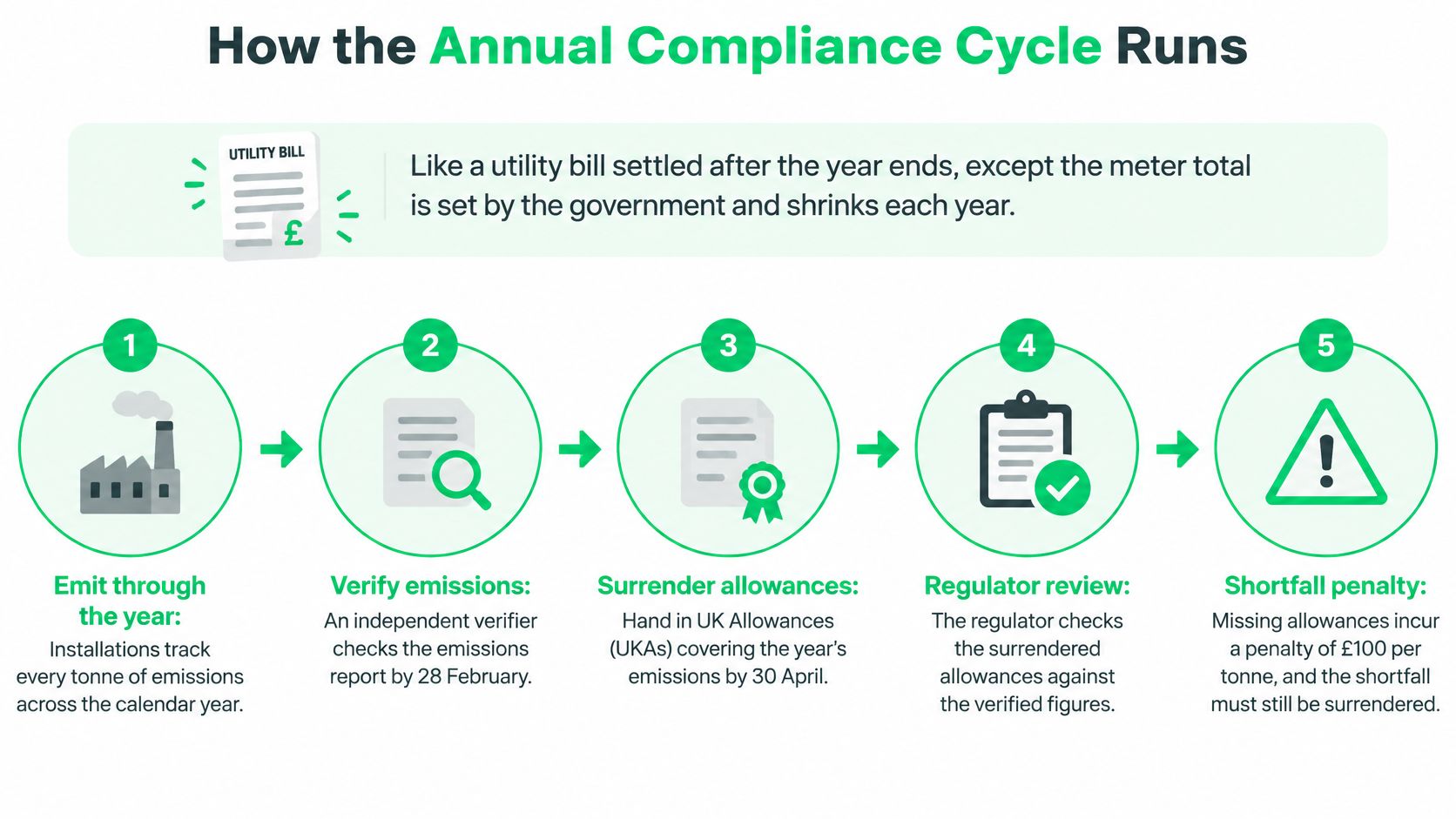
From emissions records to surrendered allowances
Understand the supply framework. The Authority sets the scheme's allowance framework, while your team forecasts the installation's likely requirement. Don't confuse a lower scheme cap with an automatic reduction in your own surrender obligation.
Identify how allowances will reach the account. An operator may obtain allowances through purchasing and, where eligible, free allocation under the applicable rules. Finance should distinguish expected allocation from allowances actually received, rather than budgeting as though an anticipated credit is already available.
Maintain registry access and purchasing authority. Confirm that authorised representatives can access the UK registry and that procurement approvals work before a purchase or transfer becomes urgent. A common failure is having enough budget but no available person with authority to complete the transaction.
Monitor emissions throughout operations. Follow the approved monitoring plan and retain fuel records, meter readings, calibration evidence and calculation files. Waiting until reporting season to investigate missing readings makes it harder to reconstruct reliable evidence.
Prepare and independently verify the emissions report. Give the verifier a reconciled evidence pack, with clear explanations for estimation methods, equipment changes and unusual results. Don't assume that booking the verifier also reserves enough time to resolve findings and submit the final report.
Surrender the required allowances. Reconcile the verified emissions total with eligible holdings, execute the surrender and retain confirmation. Holding allowances in an account is not the same as surrendering them.
Resolve discrepancies and respond to regulatory action. A shortfall can lead to enforcement and doesn't remove the underlying obligation to provide the missing allowances. Escalate any discrepancy promptly rather than treating a potential penalty as an alternative way to settle compliance.
Give each hand-off an owner
Operations usually controls the source records, sustainability or environmental teams prepare the inventory, finance funds allowance purchases, and authorised representatives execute registry actions. Put those responsibilities into a shared compliance calendar, with deputies and approval routes.
A completed purchase isn't a completed compliance cycle. Keep evidence of the surrender transaction and reconcile it to the verified report.
Use an emissions workbook or controlled reporting platform with locked calculation methods, version history and an exceptions log. The aim is to make another competent reviewer able to reproduce the reported total without relying on someone's memory.
Allowance Auctions, Free Allocation and the Price Floor
UK ETS auction supply milestones
The National Audit Office's UK ETS summary describes the following auction-supply milestones, including planned reductions and transitional releases.
| Year | Auction supply | Context |
|---|---|---|
| 2024 | 69 million allowances | Lowest auction volume since launch; 12.4% below 2023 |
| 2027 | About 44 million allowances | Planned level; 45% below 2023 |
| 2030 | About 24 million allowances | Planned level at the end of the 2021–2030 period |
| Transitional releases | 53 million carried-over allowances | Released between 2024 and 2027 to smooth the transition |
The same summary reports that 35% of issued allowances were distributed free between 2021 and mid-June 2025. That is a scheme-wide historical measure, not the proportion any particular operator should expect to receive.
Auction supply and the overall cap aren't interchangeable. Auctions are a route through which allowances enter circulation; free allocation and transitional arrangements also affect what operators receive and when.
For buyers, lower auction volumes mean procurement teams should assess availability alongside price. That doesn't prove prices will rise continuously: industrial output, fuel choices, trading behaviour and expectations can change demand.
What the auction floor does
An auction reserve price establishes the lowest acceptable auction bid. It doesn't guarantee that a business can purchase all its required allowances at that price, and it isn't a guaranteed price for transactions in the secondary market.
The distinction is important when an investment committee asks for a carbon-cost assumption. A reserve price can provide a low-price sensitivity, but using it as the only forecast can understate purchasing exposure.
Free allocation addresses a different concern: carbon leakage, where carbon costs could encourage production or investment to move to jurisdictions with weaker carbon constraints. It supports eligible businesses without removing their duty to measure emissions and surrender allowances.
Say a steelworks competes with imported steel from a producer facing no equivalent carbon cost. Free allocation can reduce the domestic plant's immediate purchasing burden while it develops lower-emission production. The plant still needs to understand its eligibility, allocation conditions and remaining shortfall.
Separate the compliance balance from the cash budget
Finance should maintain distinct views of:
- The emissions requirement: Forecast allowances needed for the installation's emissions.
- The available position: Eligible allowances held, expected allocation and committed purchases.
- The cash exposure: The cost of procuring the remaining requirement under different market conditions.
This avoids a common budgeting error: treating free allocation as though it eliminates carbon exposure. Production changes, allocation adjustments and purchasing timing can still alter the final cost.
UK ETS Versus EU ETS
UK ETS and EU ETS compared
| Feature | UK ETS | EU ETS |
|---|---|---|
| Launch | Established as the UK's separate post-Brexit scheme | The earlier European scheme from which UK participation was replaced |
| Allowance unit | UK Allowance, or UKA | EU Allowance, or EUA |
| Covered sectors | Industry, power and aviation, with maritime expansion arrangements and planned waste expansion | Industry, power, aviation and maritime, with separate expansion arrangements |
| Cap approach | Declining allowance supply under UK rules | Declining allowance supply under EU rules |
| Border carbon charge | UK CBAM has its own implementation arrangements | EU CBAM has separate implementation and reporting arrangements |
| Linking status | Proposed linking must not replace current compliance arrangements | Existing EU obligations remain relevant while linking arrangements are developed |
The schemes have a shared history, but they aren't interchangeable compliance systems. For a multinational group, the most useful comparison isn't which scheme looks simpler. It's which operator, installation or activity belongs to which legal obligation.
The differences that change decisions
Allowance identity comes first. UKAs and EUAs are separate instruments. A consolidated treasury report may show both as carbon assets, but the compliance team must distinguish the units eligible for each surrender obligation.
Use separate ledger codes and clear instrument descriptions in purchase instructions. A broker confirmation should identify the allowance type, delivery arrangements and purchasing entity, rather than referring loosely to carbon credits.
Border charges require a different calculation. An installation's emissions report and a product's embedded-emissions calculation serve different purposes. Exporters shouldn't assume that a verified installation total can be copied directly into a customer's border-charge declaration.
Product data may require allocation across production lines, treatment of relevant inputs and reconciliation with sales quantities. Purchasing and sales teams should agree who provides that information and who is responsible for correcting it.
A future link doesn't justify merging current controls. Until operative arrangements establish what can be transferred and recognised, maintain the registry, reporting and purchasing controls needed for each existing obligation.
Control point: Label every carbon position by legal entity, scheme, allowance type and intended compliance use.
What this means for different businesses
A UK-only manufacturer should first establish whether its installations are covered. Selling domestically doesn't itself create a UK ETS obligation, and being UK-based doesn't establish that an industrial activity is out of scope.
A UK exporter serving EU customers needs a separate assessment of relevant border-carbon requirements. Exporting doesn't automatically make the manufacturer an EU ETS operator, but customers or importers may need detailed embedded-emissions evidence.
A group with EU subsidiaries should map each responsible operator to the appropriate registry and reporting process. Central purchasing can support that structure, provided the group preserves clear ownership, transfer authority and scheme-specific reconciliation.
The same discipline applies to lenders and asset managers reviewing industrial exposures. Compare borrowers' or portfolio companies' net purchasing needs, allocation assumptions and data quality, rather than comparing headline carbon prices alone.
Linking, CBAM and Planning for Three Possible Futures
Linking is not yet operational. The UK Government's future markets policy material records the UK and EU's May 2025 agreement to work towards linking, and says that linking could support access to a deeper market and conditions for mutual CBAM exemptions, subject to final legal provisions and compliance with both systems.
The same material describes plans to introduce UK CBAM in 2027 and begin phasing out free allocation for CBAM-covered sectors from that year. Businesses should treat those plans as inputs to scenario analysis, not assume that a future link will remove border-carbon exposure.
The bridge analogy is useful: a connection under construction isn't an open crossing.

Plan for different implementation outcomes
- Separate markets: Retain distinct price assumptions, compliance processes and border-charge assessments. Test how a widening price difference would affect production costs and customer pricing.
- A linked market: Assess the effect of more closely connected prices and aligned rules. Don't assume that linking would erase every administrative or product-data requirement.
- Delayed or partial implementation: Keep a workable fallback if legal arrangements, technical connections or sector coverage develop more slowly than expected. Avoid making a major purchasing decision dependent on an unconfirmed implementation event.
A deeper market could improve purchasing options. It doesn't follow that every operator's costs would fall, because the outcome would also depend on allowance prices, allocation and the final rules.
Prepare the evidence and contracts
Check whether installation boundaries and product classifications can be reconciled across the relevant reporting systems. Record how fuel and process emissions become product-level embedded-emissions figures, including assumptions and supporting production records.
Ask legal and commercial teams to examine:
- Allocation treatment: How would free allowances affect the relevant border-charge calculation?
- Evidence ownership: Who supplies emissions information, and who can audit it?
- Cost pass-through: Which party bears allowance-price changes or new border charges?
- Change provisions: Can contracts accommodate revised rules without leaving liability undefined?
The useful readiness test is whether your data, controls and contracts can support each outcome. A confident prediction about linking is less valuable than a documented process that still works if implementation changes.
Confirm Your Compliance Position Before 30 April
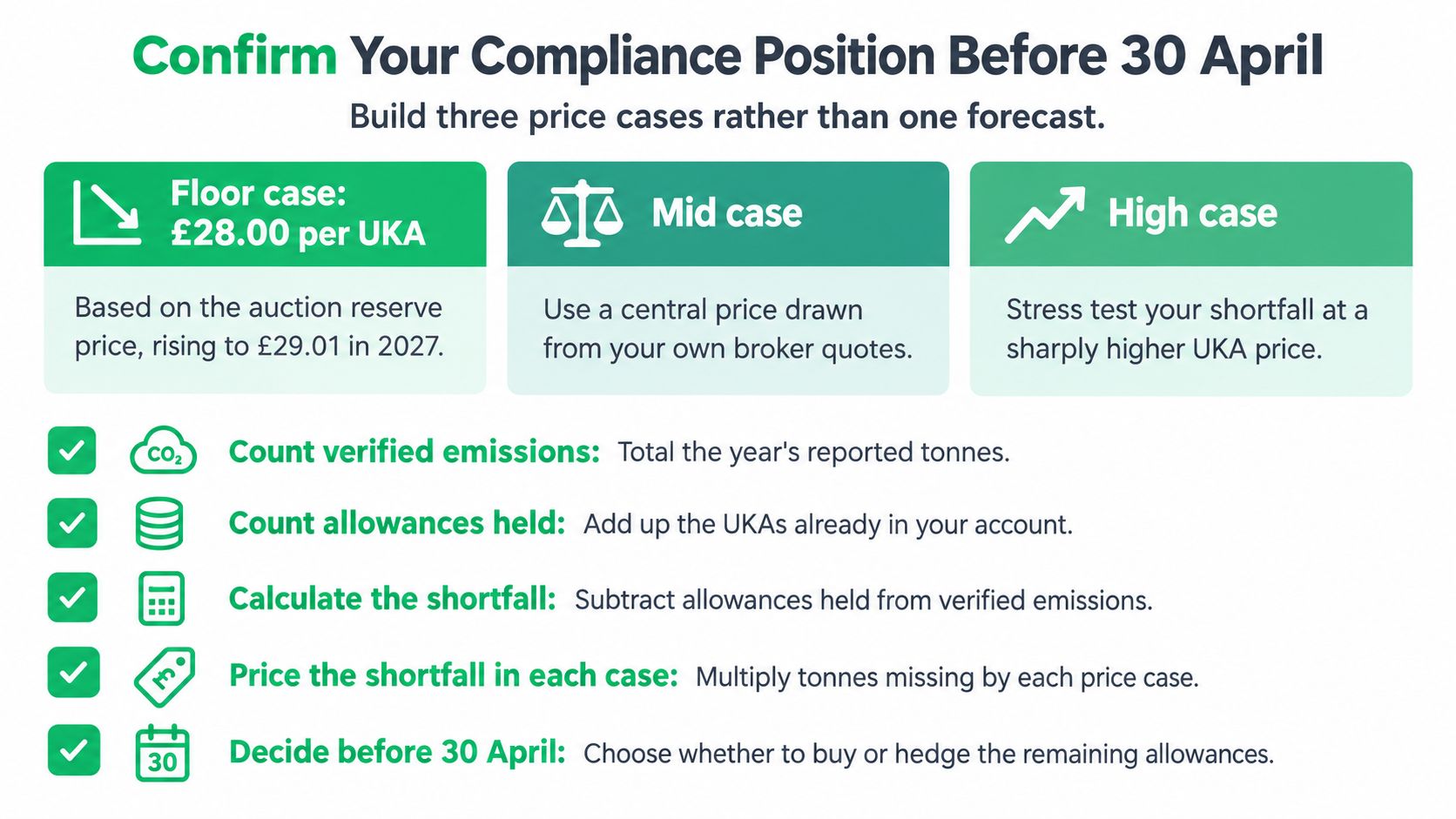
Build different price cases rather than relying on a single forecast. The UK Government's guidance on participating in UK ETS markets states an Auction Reserve Price of £28 per UKA, with an inflation-based increase to £29.01 in 2027; bids below the applicable auction threshold are rejected.
Turn price assumptions into decisions
Use the reserve price as an auction-floor sensitivity, not a guaranteed procurement price. For your central case, document the market quotations, demand assumptions and policy expectations used by finance.
The stress case should test a materially higher purchasing cost and more difficult execution conditions. Consider whether tighter supply, fuel-switching constraints or an unexpected production increase could enlarge the shortfall at the same time as prices rise.
Apply each case to the net allowance requirement, after assessing free allocation and existing holdings. Then test proposed abatement projects after including energy costs, verification costs, operational constraints and potential carbon-leakage exposure.
A marginal-abatement-cost curve can help prioritise projects by the cost of avoiding emissions. Pair it with a delivery schedule so that technically attractive projects aren't credited with savings before equipment is installed and operating.
The checklist graphic is a planning aid. Confirm the applicable legal surrender deadline with your regulator rather than relying on its title.
Close the remaining planning gaps
- Confirm installation scope: Map potentially covered sites to the relevant activities and resolve uncertain boundaries before signing off the compliance forecast.
- Calculate the projected position: Reconcile expected emissions, eligible holdings, allocation assumptions and committed purchases. Show finance the remaining exposure rather than only the gross emissions total.
- Test market and linking scenarios: Apply the price cases and implementation outcomes to the installations with the largest purchasing requirements.
- Review allocation and product exposure: Identify where allocation changes or border-carbon requirements could affect margins, procurement or customer disclosures.
- Assign contractual responsibility: Record who bears carbon-cost changes, who provides supporting evidence and who approves adjustments to customer prices.
For monitoring, verification and registry execution, retain a separate operational calendar with named owners. The board-facing summary should focus on unresolved scope questions, purchasing exposure, investment decisions and exceptions requiring approval.
The objective is a compliance position that can be explained and reproduced. Finance should understand the cash requirement, operations should understand the emissions assumptions, and legal teams should understand where contracts transfer or retain risk.
ESG Consulting's advisory services help organisations clarify reporting scope, build traceable emissions inventories and develop costed decarbonisation plans, with senior-led support from scoping through to sign-off. To discuss how stronger data and assurance-ready controls can support your UK ETS planning, visit ESG Consulting.