energy audit services, ESOS audit, energy audit UK, decarbonisation planning, SECR compliance
Energy Audit Services Explained: A UK Buyer's Guide
By ESG Consulting Team · · 14 min read
Finance wants a defensible savings forecast. Facilities wants someone to explain why equipment is running outside occupied hours. Your sustainability team needs evidence for reporting, and the bills you've collected don't quite match the sites on your property register. You're looking at energy audit services, but the proposals seem to promise different things.
The buying decision isn't just about who can identify waste. It's about who can turn incomplete records and site observations into decisions your organisation can fund, implement and verify. Judge the provider on the evidence it leaves behind, not just the recommendations in its report.
Table of Contents
- Types of Energy Audit and Which One You Need
- How a Defensible UK Energy Audit Runs
- Proving Coverage Across Multi-Site Portfolios
- What to Expect from an Energy Audit Provider
- How to Choose the Right Audit Provider
- Turning Audit Findings into Decarbonisation Plans
- Measuring Savings and Your Next Step
Types of Energy Audit and Which One You Need
Start with the decision you need to make. Are you investigating an inefficient building, preparing a capital proposal or meeting an Energy Savings Opportunity Scheme (ESOS) obligation? These aren't interchangeable briefs.
A site survey is a useful starting point when you need to understand the building and scope further work. The consultant walks through the premises, discusses operations and identifies likely opportunities. Buy it as an exploratory review, not as an assumed substitute for a compliance assessment.
An ESOS-compliant audit needs a more extensive evidence base and documented assessment. The purchase should cover the applicable compliance requirements, not just a longer site visit.
| Buying consideration | Exploratory site survey | ESOS-compliant audit |
|---|---|---|
| Main purpose | Identify issues and scope investigations | Assess energy use and improvement opportunities within a compliance process |
| Appropriate output | Observations, initial opportunities and further data needs | Evidence-led findings, cost-and-benefit assessment and implementation considerations |
| Buyer's main risk | Treating indicative findings as investment-ready calculations | Assuming the report alone completes every compliance task |
| Suitable brief | Explain what warrants investigation | Define the assessment boundary, evidence requirements and responsibilities |
Remote analysis is a delivery method
The distinction between visiting a building and reviewing data remotely is separate from the distinction between exploratory and compliance work. Ask providers to explain both.
The visual below compares ways of gathering evidence, rather than alternative compliance statuses.
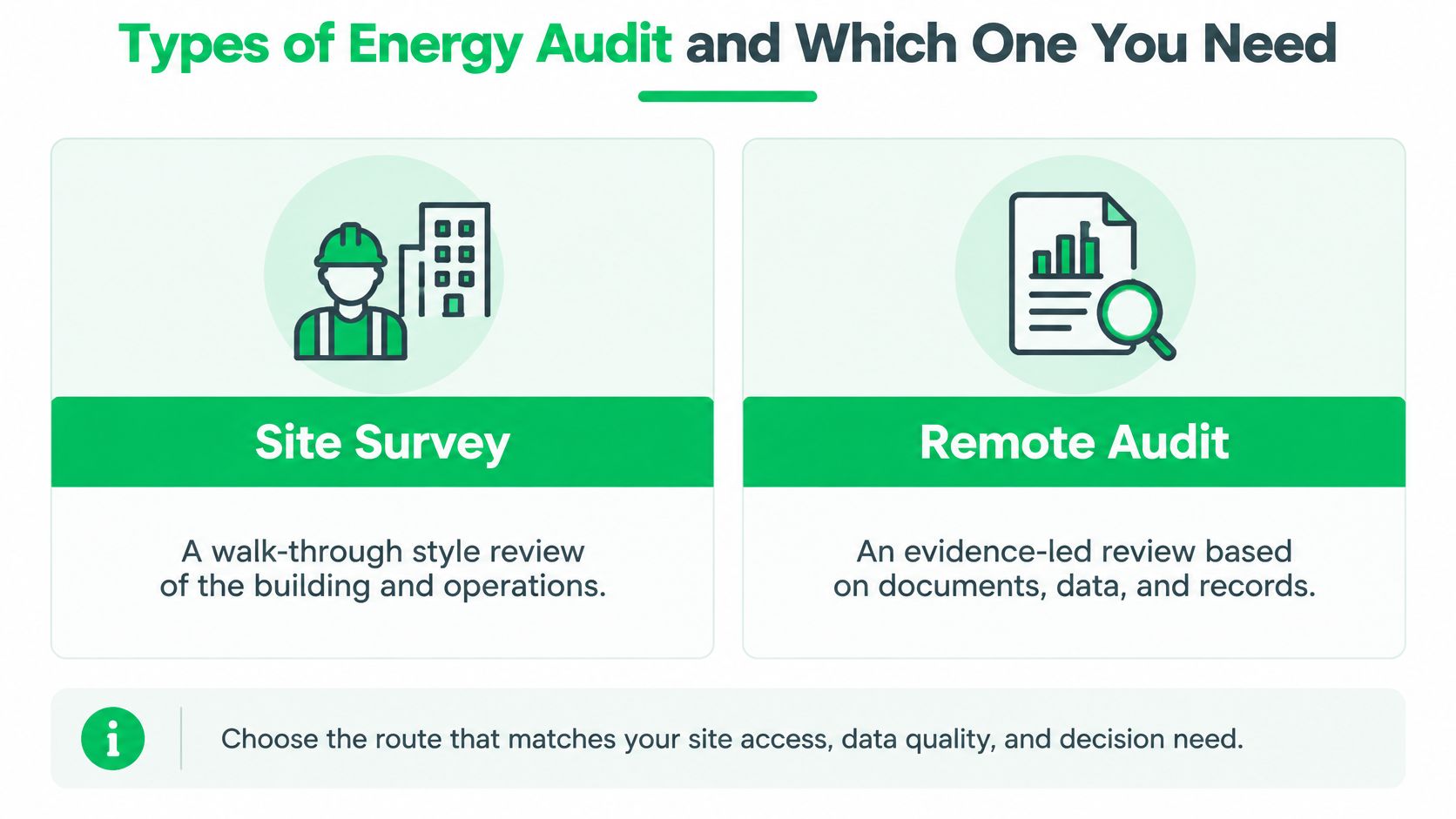
A remote review can help frame questions before a visit. For example, you might ask the consultant to investigate an unexplained overnight load, then arrange access to the relevant plant and controls. Don't accept the delivery label as proof that the proposed scope meets your needs.
Buying rule: Ask what decision the deliverable will support, and what further work you'll need before approving expenditure.
For an internal scoping exercise, a focused survey may be enough. For compliance, require the proposal to identify the applicable requirements and explain how the work addresses them. For a major investment, specify the technical and financial detail needed for approval.
Avoid buying an elaborate report when you need a targeted investigation. Equally, don't buy a cheap walk-through and expect the consultant to reconstruct an organisation-wide assessment afterwards.
How a Defensible UK Energy Audit Runs
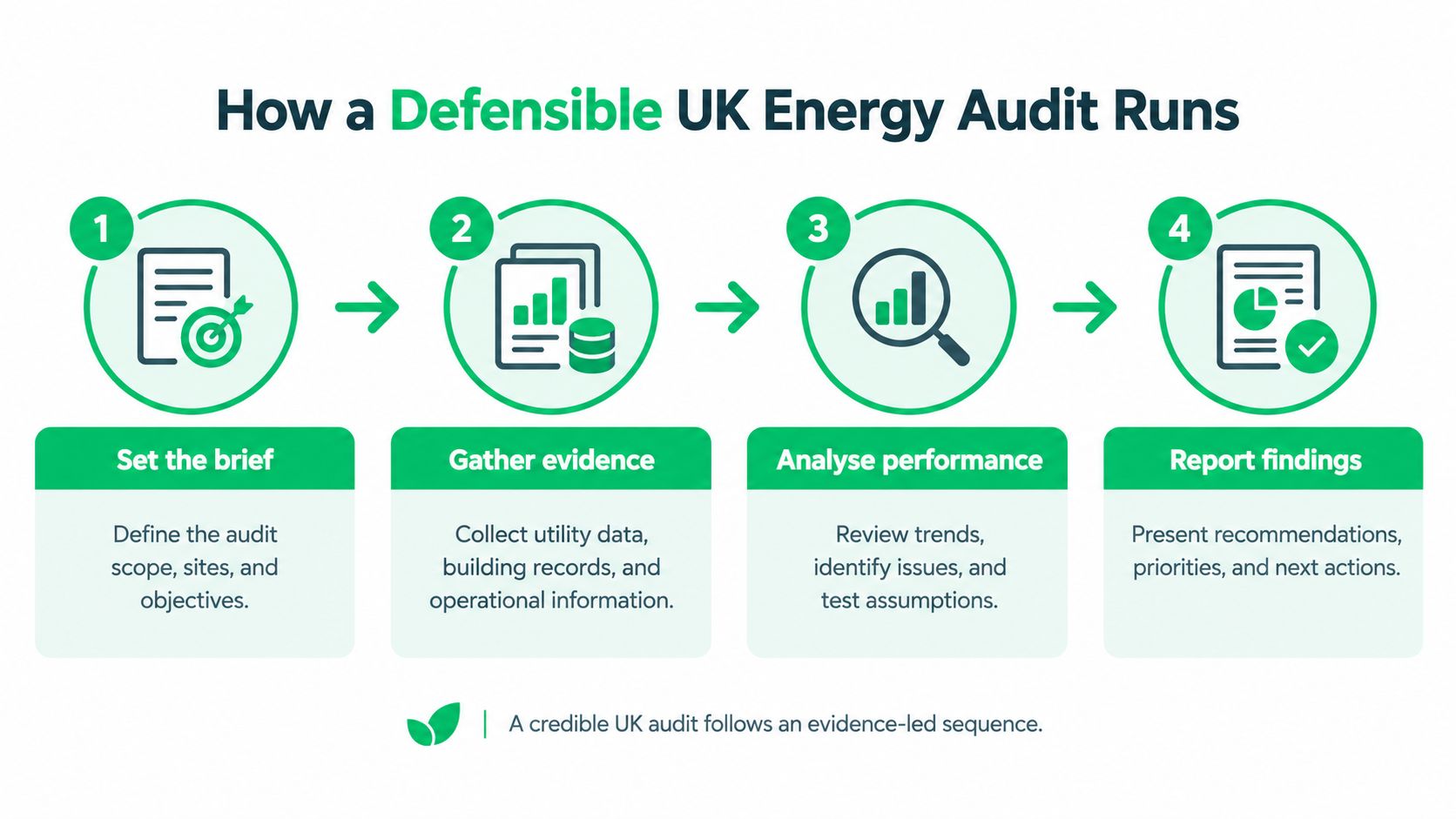
Set the boundary before analysing performance. Agree which organisational activities, sites, fuels and processes the audit covers. Otherwise, the consultant could produce accurate calculations for an incomplete scope.
Use the following process as a procurement check, then ask how the provider will document each stage.
Establish evidence before estimating savings
The evidence-led sequence starts with at least 12 consecutive months of verifiable consumption data in energy units, followed by segmentation, representative visits, performance analysis and assessment of technically feasible measures, as set out in the government's ESOS audit guidance.
Give the consultant invoices and meter records, but also explain what happened operationally during the reference period. A shutdown, production change or altered occupancy pattern should become an explicit analytical input, not an unexplained variation.
- Separate consumption meaningfully. Break it down by site, process, fuel and significant energy use. This helps the auditor direct attention towards activities that warrant investigation.
- Test the operating explanation. Compare load profiles, meaning how consumption changes over time, with working hours and operational requirements.
- Normalise comparisons. Adjust the interpretation for weather, occupancy, production volume and operating hours rather than treating raw bills as like-for-like performance measures.
Turn observations into traceable calculations
During visits, the consultant should test the assumptions behind the data. If the facilities team believes equipment stops overnight, ask the auditor to reconcile that explanation with the recorded load and observed settings.
For each feasible measure, expect energy and emissions impacts, capital and operating costs, payback and life-cycle benefits. The assessment should also address implementation risk and strategic priority. These are the audit expectations described in the guidance cited above.
BS EN 16247 and ISO 50002 provide recognised structures, but ESOS doesn't prescribe a single methodology. Ask how the chosen approach suits your organisation rather than treating a standard's name as sufficient evidence of quality.
Keep meter reads, invoices, calculation files, assumptions and approvals together. That record allows another reviewer to understand how the recommendation was reached and can support Energy and Carbon Reporting (SECR), assurance and board decisions.
Use this accompanying video as an additional discussion prompt when agreeing the assessment process.
Proving Coverage Across Multi-Site Portfolios
A neat spreadsheet isn't proof that an audit represents the whole organisation. The harder question is whether the consultant can explain what is included, what is missing and why the sites examined represent the wider estate.
Under the ESOS compliance guidance, organisations need a defensible 95% energy-coverage boundary and must document the total number of sites, the number visited and the rationale for representative selection. The reference period must cover 12 months, using verifiable consumption data in energy units rather than expenditure, so far as reasonably practicable.
Treat missing data as a controlled exception
Create a site-and-meter register before agreeing the visit programme. Record the activity, energy supplies, data owner, available records and unresolved questions for each location.
For difficult records, agree an explicit response:
- Landlord-controlled meters. Request the underlying consumption records and clarify which premises or shared services they cover.
- Estimated bills. Flag estimates and seek actual readings. Keep any unresolved estimation method visible.
- Energy within service charges. Separate the financial allocation from evidence of consumption. Don't treat a charge as a meter reading.
- Acquisitions and changes. Record ownership and operational changes, then document the treatment agreed for the assessment.
- Missing interval data. State which analysis cannot be completed confidently without detailed consumption records.
These are practical controls, not permission to exclude inconvenient sites. Keep an exception log with the issue, evidence requested, responsible person and agreed resolution.
Choose representative sites deliberately
A large sample can still be weak if it contains only similar, accessible offices. An operationally unusual hospital, energy-intensive process or poorly understood warehouse may deserve closer attention than another familiar administrative building.
Ask the provider to explain its selection against consumption, activity, equipment, operating hours and data uncertainty. Where access isn't available, require a documented account of the limitation and its consequences for the conclusions.
A defensible sample explains the differences between sites. It doesn't just count visits.
The same compliance guidance removes Display Energy Certificates and Green Deal Assessments as alternative routes for ESOS Phase 4, leaving energy audits or qualifying ISO 50001 coverage as the relevant pathways. Don't assume an existing building certificate settles the organisation's position.
For portfolio buyers, data governance belongs in the scope and fee discussion. If nobody owns the missing records, the consultant can't resolve the problem through engineering analysis alone.
What to Expect from an Energy Audit Provider
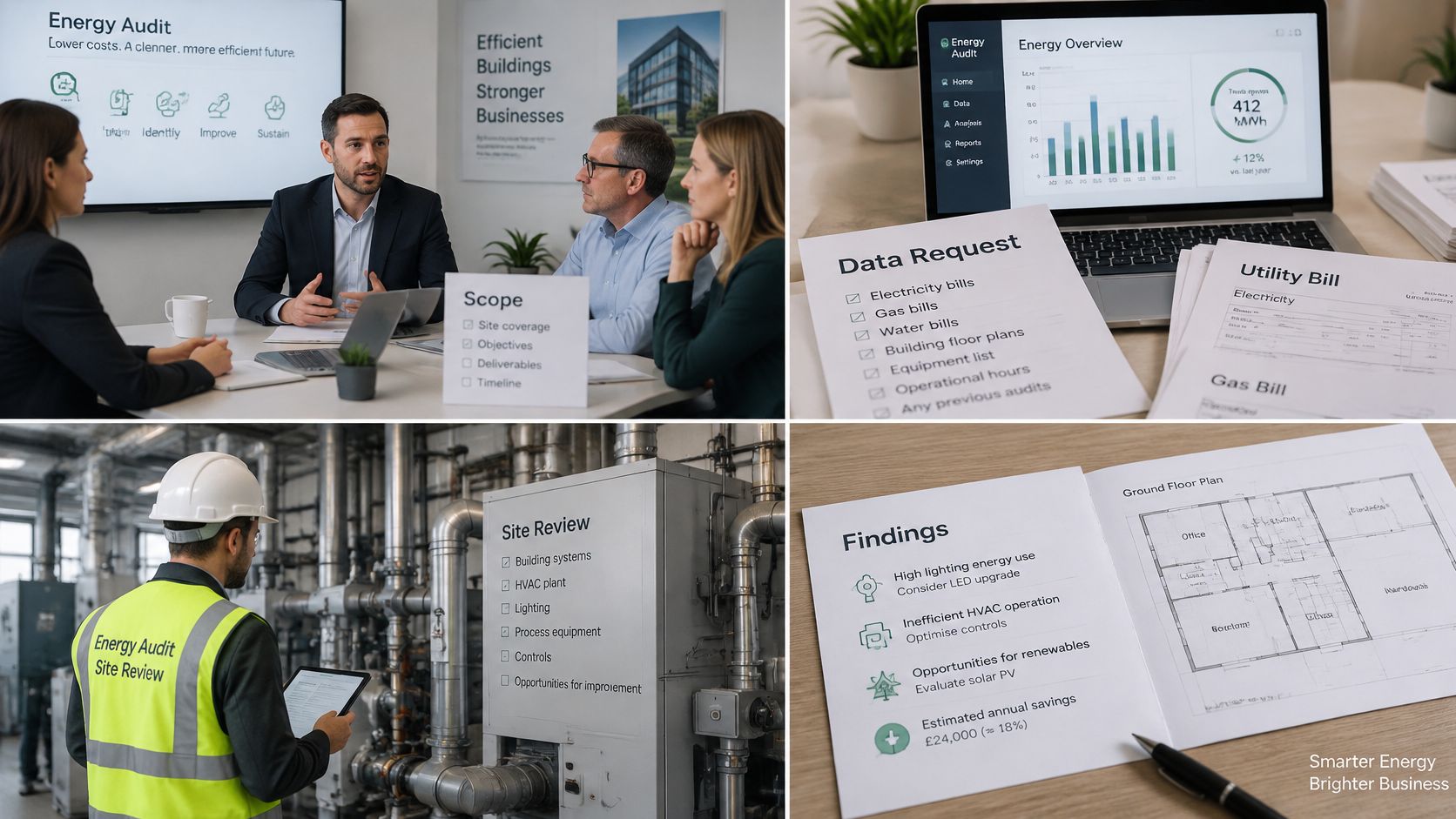
Consider a hypothetical engagement involving offices and a warehouse. At the first visit, the facilities lead points to lighting upgrades as the obvious project. The finance lead wants to know whether the proposed savings justify replacement.
A useful consultant doesn't immediately endorse the purchase. They ask about operating schedules, existing controls, maintenance plans and the evidence available to calculate a baseline. The purpose is to distinguish an attractive idea from a supported recommendation.
This is the combination of site understanding and analysis you're buying.
Agree the handovers before work starts
Although the visit is visible, much of the client's preparation should happen earlier. Expect a scoping discussion, a structured data request and an agreed access plan. Ask who will resolve data queries and who can explain controls, production requirements and maintenance constraints.
After the visit, request a findings discussion before the final report. This gives operational staff a chance to challenge assumptions without allowing unsupported preferences to replace evidence.
The final handover should separate the following:
| Deliverable | What the buyer should be able to do |
|---|---|
| Opportunity assessment | Understand the proposed change and its technical basis |
| Financial appraisal | Review costs, tariff assumptions and the treatment of maintenance |
| Delivery considerations | Identify permissions, downtime, dependencies and further design work |
| Action programme | Decide what to approve, investigate, defer or reject |
The energy-unit requirements established earlier should remain visible in the recommendations. A monetary estimate alone won't let finance distinguish consumption savings from changes in tariff.
Understand what changes the quotation
Ask providers to explain how their price and programme depend on data condition, portfolio complexity, access and analytical depth. Don't request a fixed completion date without agreeing when the client must provide records and access.
A focused investigation and an investment-ready technical assessment shouldn't be priced as though they're identical. Ask whether equipment sizing, detailed design, supplier quotations and post-installation checks are included or require separate appointments.
Also establish ownership of the working files. Receiving an executive summary isn't the same as receiving calculations your team can review and update.
The handover should leave facilities knowing what to change and finance knowing what remains uncertain. If neither team can act without commissioning another broad review, the original scope was probably too vague.
How to Choose the Right Audit Provider
Choose accountable technical delivery over the lowest headline fee. A proposal is only comparable with another proposal when the scope, evidence requirements and exclusions are comparable.
Ask to meet the person who will direct the work. Sales materials won't tell you whether that person can challenge a weak baseline, explain an unusual process or resolve disagreement between operational and finance teams.
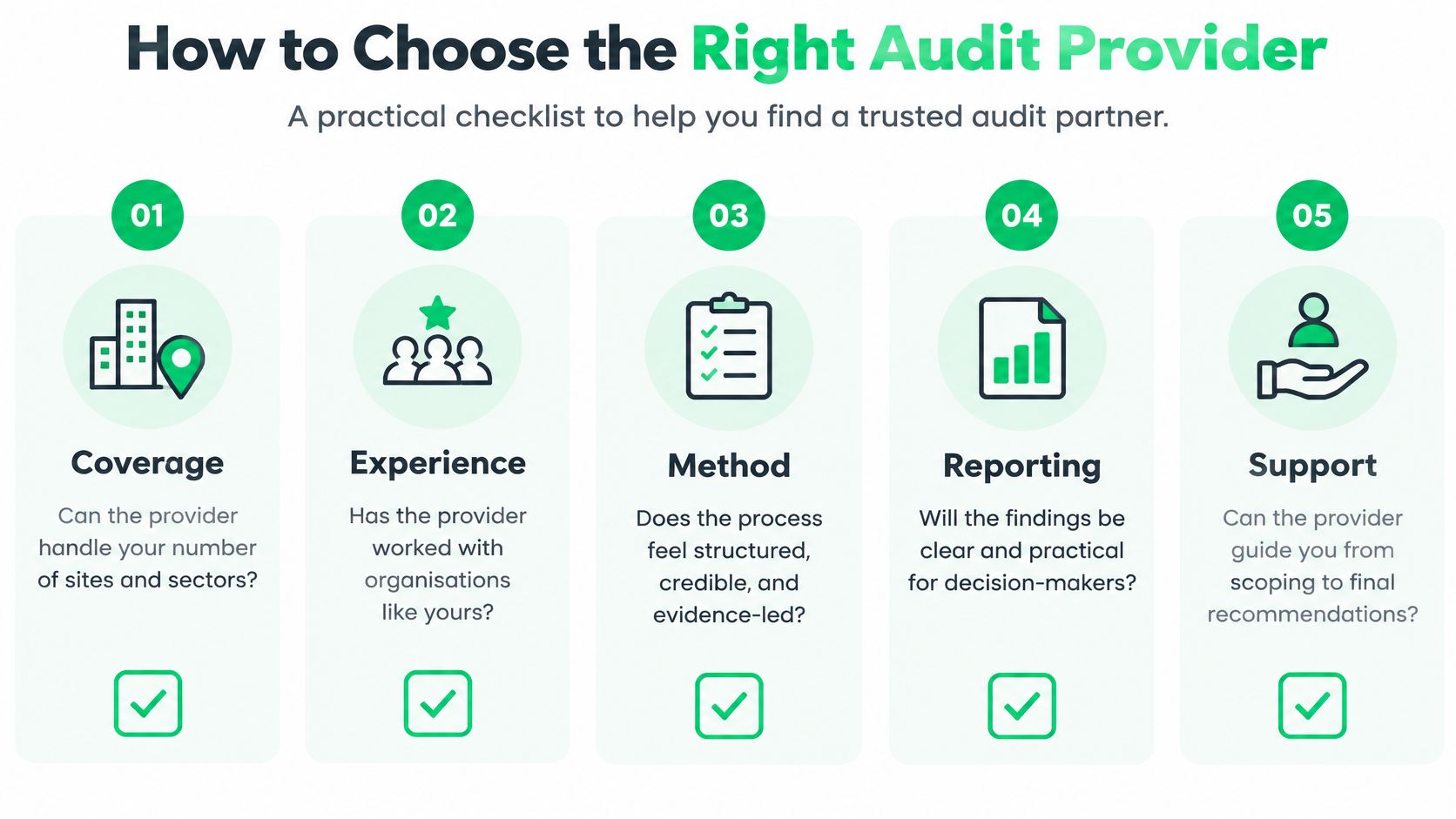
Use the checklist below to structure the conversation, then request evidence behind the answers.
Test capability rather than accepting badges
Ask providers to explain relevant qualifications, professional credentials and experience with your operating environment. For ESOS work, establish who provides Lead Assessor sign-off and when that person becomes involved.
- Coverage. Can the proposed team assess your mix of buildings, transport and operational processes?
- Technical judgement. Can it explain where further measurement is needed before recommending expenditure?
- Reporting quality. Will it share a redacted example showing assumptions, limitations and practical actions?
- Continuity. Who remains accountable when a data issue or disputed finding needs resolution?
Look for examples of reasoning, not just client logos. Ask how the consultant would handle an apparent saving that conflicts with the site team's operational explanation.
A credible provider should also tell you when an obligation doesn't apply. Selling unnecessary compliance work isn't a substitute for checking scope.
Compare commercial terms fairly
A fixed scope and fee can make approval straightforward, provided the proposal describes the inputs, exclusions and change-control process. An open-ended appointment may suit an uncertain investigation, but request spending controls and decision points before authorising it.
As one option, ESG Consulting is a London-based UK sustainability consultancy that assigns a senior consultant from scoping through sign-off, agrees scope and fee in advance, and uses registered Lead Assessor sign-off for ESOS assessments. Compare that model with specialist engineering practices and other consultancies against your actual technical and delivery requirements.
Contract check: Ask what happens if the records are incomplete, a visit becomes impossible or a recommendation needs further technical investigation.
A named account lead helps you direct questions, but accountability must extend to resolving them. Put responsibilities, review stages and acceptance criteria into the appointment rather than relying on assurances made during procurement.
Turning Audit Findings into Decarbonisation Plans
A payback ranking is where most audit reports stop. It is also where most decarbonisation programmes stall. Finance still lacks a spending sequence, facilities still lacks a view of dependencies and disruption, and the board still lacks a clear statement of what it is being asked to approve.
Treat identified savings as a pipeline of opportunities rather than a forecast. The government's ESOS impact assessment frames audit findings exactly that way: technical potential, with delivery dependent on the investment and operational decisions each organisation takes afterwards. A consultant who presents the register as promised savings has already oversold it.
Build a programme around decisions
Sort recommendations by the approval and delivery work they require, rather than presenting every measure as an equivalent project.
| Programme category | Appropriate treatment |
|---|---|
| No-regret operational measures | Confirm operational acceptability, authorise the change and check persistence |
| Funded retrofit projects | Develop the business case, procurement brief and installation programme |
| Longer-payback capital interventions | Align investigation and approval with asset strategy and wider investment decisions |
For every retained action, assign an owner, deadline, baseline and measurement plan. Record its status too: approved, awaiting evidence, deferred or rejected. A rejection should carry a written reason. Otherwise the measure vanishes from the next version of the spreadsheet, and nobody can later explain why it was dropped.
Technical feasibility and organisational readiness are separate questions. A sound measure may still need design work, access arrangements, procurement approval or an agreed maintenance response before it can start.
Sequence for practical value
The cheapest theoretical measure is rarely the right first intervention. Better metering can make later investment decisions more reliable. An enabling control change can remove an operational constraint. Preparatory work can support a later electrification project even where it offers a poor standalone payback.
Assess interactions as well. Where several proposals affect the same system, ask the consultant to recalculate the combined outcome rather than adding the individual estimates.
- Protect operations. Make service, production and comfort requirements explicit before approval.
- Expose dependencies. Identify which projects need another action completed first.
- Retain uncertainty. Label provisional costs and assumptions that require validation.
The resulting pathway should separate committed expenditure from future options. Boards can then approve a defined package without appearing to endorse every preliminary idea.
Judge the plan by the trail it leaves behind. An action register with named owners, dated decisions and recorded reasons for deferral gives your next assessor, and anyone reviewing progress against commitments, something to work from. The test is whether your organisation can move a recommendation to an authorised project and show, with records, what changed.
Measuring Savings and Your Next Step
A completed audit isn't evidence of delivered savings. Nor is a lower bill, by itself, proof that an efficiency project worked. You need a planned comparison and records that explain the result.
Official ESOS guidance requires Phase 4 progress reporting against action-plan commitments, including explanations where commitments weren't met. Its checklist also expects potential reductions in pounds sterling and kWh, with breakdowns by organisational purpose and energy-saving category.
Decide how to verify before installation
Build a measurement-and-verification plan, meaning an agreed method for checking the project's actual performance. Use the operational adjustments described earlier consistently rather than choosing whichever comparison produces the most attractive result.
- Define the test. Identify the equipment or activity affected and the records that will demonstrate performance.
- Record the intervention. Keep approval, installation, commissioning and control-setting evidence.
- Explain changes. Document relevant operational differences and how they're treated in the comparison.
- Separate outcomes. Report energy performance and financial results distinctly, with assumptions visible.
An inconclusive result should trigger investigation, not an unsupported success claim. Check whether the equipment operates as intended, whether settings changed and whether the available data can answer the question.
Keep a usable progress record
Use a quarterly review to update project status, spending, performance and unresolved issues. Keep the decision history so that a future reviewer can understand why the organisation changed or deferred an action.
This week, prepare your site list, meter-coverage register, available bills and known data gaps. Add your immediate decision: compliance, operational investigation or investment approval. That gives a prospective provider enough context to propose a meaningful scope rather than a generic report.
Buy energy audit services with the end in mind: an implementable decision and evidence you can defend afterwards.
ESG Consulting offers ESOS assessments and costed, sequenced decarbonisation planning, with traceable evidence for reporting and assurance. Visit ESG Consulting to arrange a scoping conversation, bringing your site list, meter coverage and existing bills so the team can confirm which audit route applies.