ESG reporting requirements, SECR reporting, UK SRS, ESOS compliance, climate disclosures UK
ESG Reporting Requirements UK: Who Must Report in 2026
By ESG Consulting Team · · 18 min read
Are you preparing an ESG report because the law requires it, or because someone has assumed that every large UK business needs one? That distinction should come before appointing a reporting team, buying software or commissioning a sustainability report.
ESG reporting requirements in the UK aren't a single obligation. They combine statutory corporate disclosures, energy assessments, listing requirements and information requested by buyers or lenders. The right starting point is an entity-by-entity applicability assessment, followed by a clear decision about what must be filed, what must be supplied commercially and what can wait.
Table of Contents
- UK ESG Reporting Regimes at a Glance
- Check Whether Each Regime Applies to You
- SECR Energy and Carbon Disclosures Explained
- ESOS Energy Audits and Lead Assessor Sign-Off
- Climate Disclosures in the Strategic Report
- Moving From TCFD to UK SRS Reporting
- CSRD, ESRS and SFDR for UK Groups in the EU
- Procurement, Lender and Private-Company Requirements
- Confirm Which Regimes Apply Before Your Next Filing
UK ESG Reporting Regimes at a Glance
| Regime | Applies to | Status | Published in |
|---|---|---|---|
| SECR | UK-registered quoted companies and qualifying large unquoted companies and LLPs | Statutory annual reporting for in-scope entities | Directors' report or energy and carbon report, filed at Companies House |
| Climate-related financial disclosures, TCFD-aligned | Qualifying UK companies, including specified listed, banking, insurance, AIM and high-turnover categories | Statutory for qualifying entities | Strategic report |
| UK SRS S1 and S2 | Issuers within the relevant FCA listing-rule perimeter | Prospective comply-or-explain reporting, with transitional relief | Annual report |
| ESOS Phase 4 | Undertakings qualifying under the applicable energy assessment rules | Establish qualification and the current compliance requirements | Environment Agency notification, supported by retained assessment evidence |
| CSRD and ESRS | UK groups whose EU entities, branches or activities bring them within EU scope | Confirm the applicable EU scope and reporting timetable | Sustainability reporting under the applicable EU route |
| SFDR | Financial market participants and financial products within its regulatory perimeter | Establish entity-level and product-level disclosure duties | Relevant website, pre-contractual and product disclosures |
| PPN 006 Carbon Reduction Plans | Suppliers pursuing procurement opportunities carrying the relevant requirement | A condition of qualifying procurement exercises | Carbon Reduction Plan and associated procurement submission |
| NHS Evergreen | Suppliers asked to complete the NHS assessment through the relevant buying arrangements | Buyer-led assessment requirement to verify for the opportunity | Evergreen assessment submission |
Treat this as a routing map, not a legal determination. A company's description as large, sustainable or investor-backed doesn't establish which row applies. Legal form, listing category, financial evidence, group structure and the wording of a procurement exercise matter more than the label attached to the organisation.
Separate legal duties from commercial conditions
A statutory disclosure belongs in the legally specified reporting document. A contractual request belongs in the submission or information exchange agreed with the counterparty. Both can matter commercially, but they require different decisions about ownership, approval and publication.
That separation also prevents inappropriate substitution. A polished sustainability brochure doesn't necessarily satisfy an annual-report obligation, and a compliant corporate filing doesn't necessarily answer a buyer's supplier questionnaire. Finance and legal teams should identify the required output before the sustainability team starts drafting.
For EU-facing groups and listed issuers preparing for a reporting transition, confirm the current position before committing budget. Don't turn an anticipated requirement into a current filing duty, or assume an EU reporting timetable applies unchanged to every group entity.
Use the relevant row to identify the assessment you need. The immediate question isn't which framework looks most thorough, but which authority or counterparty requires which information from which entity.
Check Whether Each Regime Applies to You
Applicability depends on the legal entity, its listing or regulatory status and the relevant financial tests. Assess each entity separately: a parent company's position does not automatically determine whether a subsidiary has a reporting duty.
- Identify the entity. Record its registered name, jurisdiction and legal form, including whether it is a company or LLP.
- Establish listing status. Record whether it is quoted and, where relevant, its trading venue and listing category.
- Collect size evidence. Use employee, turnover and balance-sheet records for the relevant reporting period.
- Check sector-specific routes. Assess banking and authorised insurance categories separately.
- Record other demands separately. Note EU activities, procurement conditions, customer questionnaires and lender requests without treating them as interchangeable legal duties.
Size and listing thresholds by regime
| Regime | Employees | Turnover | Balance sheet | Other test |
|---|---|---|---|---|
| SECR, large unquoted company or LLP | More than 250 | Above £36 million | Above £18 million | Meet at least two of the three size tests |
| SECR, UK-registered quoted company | No employee threshold for this scope route | No turnover threshold for this scope route | No balance-sheet threshold for this scope route | Check quotation status and applicable reporting provisions |
| Climate disclosures, AIM company | More than 500 | No separate turnover trigger for this category | No separate balance-sheet trigger | AIM status |
| Climate disclosures, other UK-registered company | More than 500 | Turnover exceeding £500 million | No separate balance-sheet trigger | Both employee and turnover thresholds must be met |
| Climate disclosures, banks and authorised insurers | More than 500 for the specified categories | Category-specific | Category-specific | Confirm the regulated entity's statutory classification |
| ESOS, qualifying undertaking | At least 250 employees, or | Turnover above €50 million | Balance-sheet total above €43 million | Alternatively, meet both financial tests; check group treatment |
| UK SRS S1 and S2 | Not a standalone applicability test | Not a standalone applicability test | Not a standalone applicability test | Relevant FCA listing-rule scope |
| CSRD, UK group with EU activity | Depends on the relevant EU entity category | Depends on applicable EU turnover tests | Depends on applicable EU entity tests | EU presence, group structure and current scope provisions |
For SECR, a large unquoted company or LLP meets the size test if it exceeds at least two of the three thresholds shown. The climate disclosure thresholds are set out in the Companies (Strategic Report) (Climate-related Financial Disclosure) Regulations 2022. The employee condition also applies to the specified traded, banking and insurance categories.
Record the reason, not just the answer
Keep an applicability record showing the rule tested, evidence considered, conclusion and reviewer. If an entity is out of scope, state which condition it failed and what change would prompt reassessment.
The ESG Consulting approach to regulatory applicability confirms which obligations apply before work is built or scoped, and identifies when an obligation does not apply or a rating can wait.
Practical rule: An evidenced decision not to produce a report is a legitimate compliance outcome. An undocumented assumption is not.
SECR Energy and Carbon Disclosures Explained
Energy and Carbon Reporting, or SECR, connects operational energy information to statutory corporate reporting. The required content includes energy use, associated greenhouse-gas emissions, consumption expressed in kilowatt-hours, an emissions-intensity ratio and a description of the principal energy-efficiency measures taken during the reporting period.
The government's sustainability reporting guidance records SECR's introduction for reporting periods beginning on or after 1 April 2019, covering UK-registered quoted companies and qualifying large unquoted companies and LLPs. The size assessment described there requires at least two of these tests: more than 250 employees, turnover above £36 million, or a balance-sheet total above £18 million.
For companies, the disclosures form part of the directors' report. Large LLPs use the equivalent energy and carbon report, with the relevant reporting filed at Companies House. Establish the entity's detailed reporting coverage before deciding which operations and energy sources belong in the statement.
Make the intensity ratio reproducible
An intensity ratio needs a documented numerator and denominator. If the chosen denominator is turnover, record which turnover figure is used, its accounting period and how it reconciles to the financial statements.
Consider a hypothetical company operating several sites. Its reporting team removes a site's energy consumption because invoices are incomplete, while leaving the company-wide turnover denominator unchanged. The resulting ratio may look better even though operational efficiency hasn't improved.
The correct response isn't to hide the gap. Investigate whether an estimate is appropriate, document the treatment and explain any exclusion that the applicable rules permit. A reporting boundary shouldn't change merely because one site has inconvenient records.
Build the evidence file alongside the statement
- Boundary record. Identify the reporting entity, included operations and treatment of changes during the year.
- Consumption evidence. Retain supplier invoices, meter exports, fuel records and a log of missing information.
- Calculation workbook. Record unit conversions, emissions factors, assumptions and checks.
- Narrative support. Keep evidence of the energy-efficiency actions described, including implementation dates and responsible teams.
- Approval trail. Assign a preparer, reviewer and final approver before figures enter the annual-report draft.
Every figure we produce traces back to source data, with methodology, boundaries and assumptions documented for the client's auditor or assurance provider. Draft the energy statement against the required information categories, then test whether another reviewer can reproduce its figures without asking the preparer to explain undocumented choices.
ESOS Energy Audits and Lead Assessor Sign-Off
ESOS qualification needs its own decision. Don't infer it from SECR applicability or assume that publishing an energy statement completes an energy assessment obligation. Confirm the applicable qualification route, group treatment and compliance period before scheduling site work.
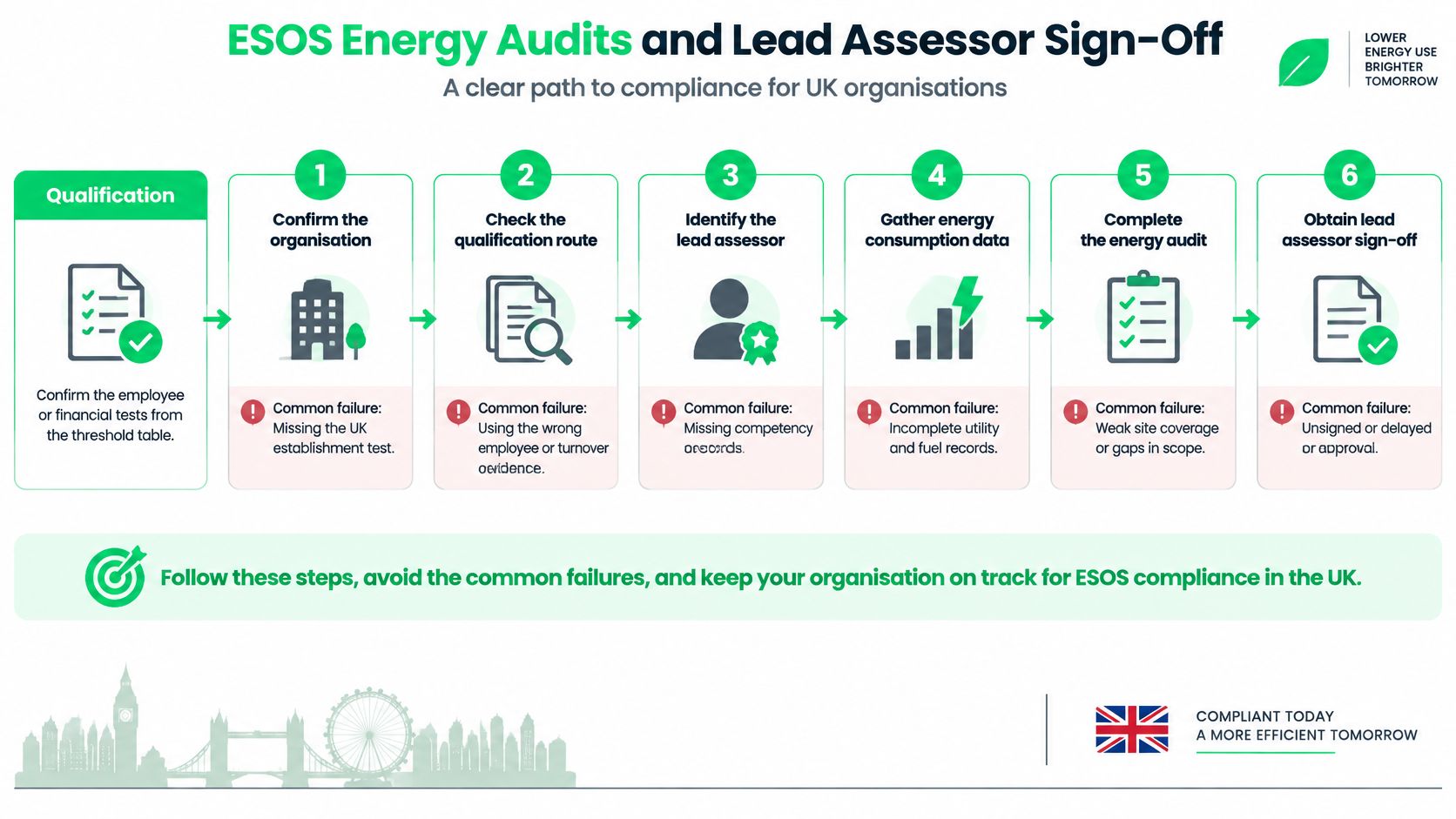
The process should connect scope, evidence, assessment and approval rather than treating the audit visit as the whole exercise.
Control the assessment sequence
- Confirm the organisation and period, because an assessment built around the wrong entity boundary or compliance period may need substantial reworking.
- Set the operational boundary, explicitly checking buildings, transport and industrial processes so that fleet fuel or less visible sites aren't overlooked.
- Collect a complete energy dataset, reconciling invoices and meter records so gaps aren't mistaken for reduced consumption.
- Agree the assessment coverage, checking the applicable requirements before selecting sites so convenience doesn't determine the audit scope.
- Secure Lead Assessor review and sign-off, rather than leaving approval arrangements until the assessment is otherwise finished.
- Prepare the notification and evidence file, checking the applicable Environment Agency deadline so a completed assessment isn't followed by a missed submission.
Reuse evidence without confusing obligations
Audit findings can support practical energy-efficiency narratives and provide evidence for climate metrics. Keep the purposes distinct: an operational recommendation isn't automatically an annual-report disclosure, and a disclosed target isn't proof that an energy assessment has been completed.
For example, an assessor may identify opportunities in heating controls and fleet management. Give operational managers responsibility for evaluating those recommendations, while the reporting owner decides which implemented measures and supporting figures belong in corporate disclosures.
Our ESOS assessments are signed off by registered Lead Assessors. Before booking site access, name the assessor, confirm the current phase requirements and work backwards from the applicable submission deadline.
Climate Disclosures in the Strategic Report
Climate-related financial reporting asks a different question from an energy inventory: how do climate risks and opportunities affect the business and its decisions? The government's climate-related financial disclosure guidance applies to relevant financial years beginning on or after 6 April 2022, and records the government's estimate that more than 1,300 of the largest UK-registered companies and financial institutions would be covered.
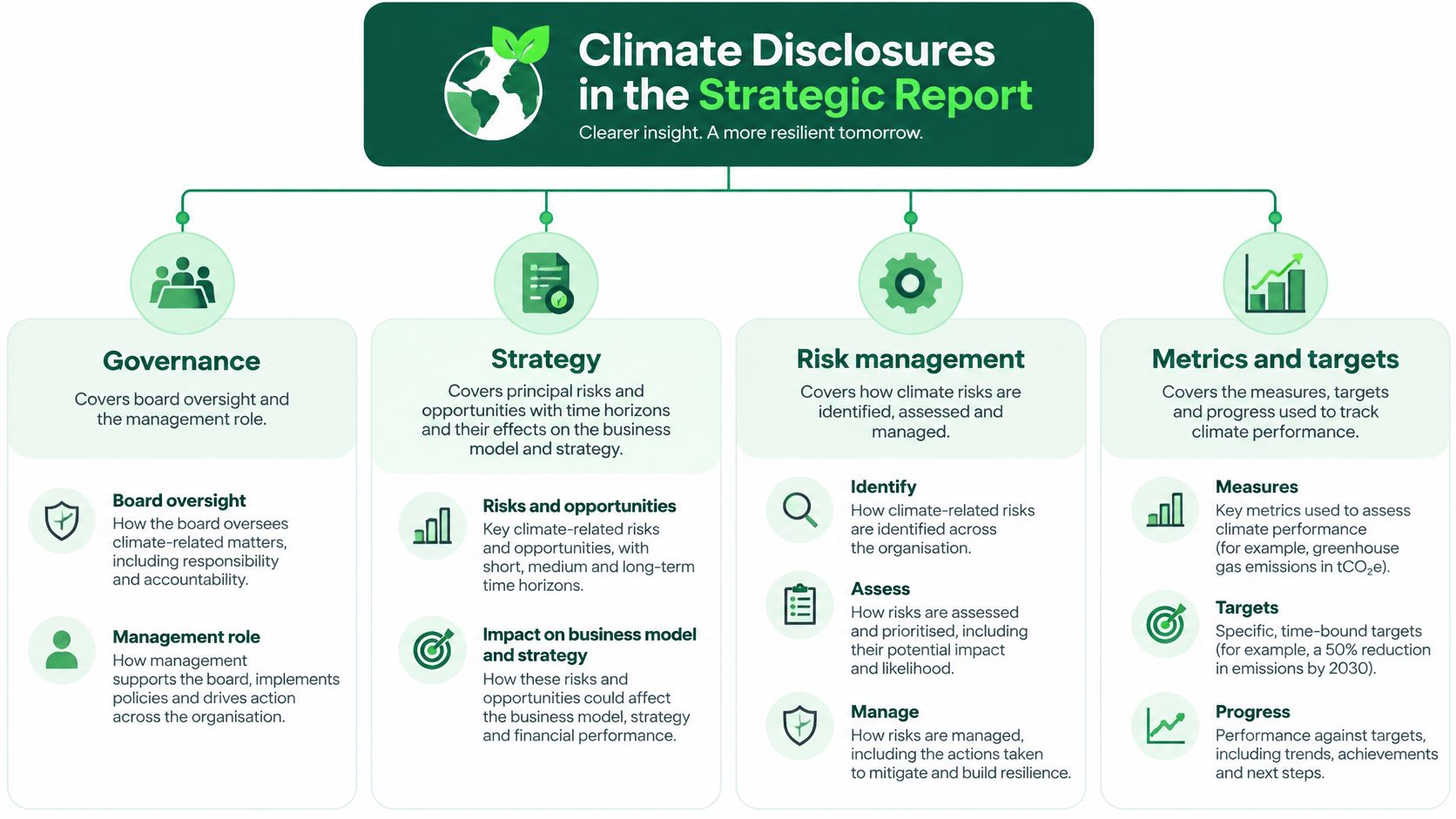
The disclosure belongs in the strategic report and follows the TCFD-aligned structure. Its substance should connect board oversight, business planning, risk processes and measurable performance.
Connect the pillars to business evidence
| Pillar | What the reader needs to understand | Useful supporting evidence |
|---|---|---|
| Governance | Who oversees climate matters and how management escalates decisions | Board papers, committee responsibilities and management reporting |
| Strategy | Which risks and opportunities matter, over which horizons, and with what business effects | Strategic plans, investment appraisals and scenario assumptions |
| Risk management | How climate risks are identified, assessed and integrated into wider risk processes | Risk registers, assessment criteria and escalation records |
| Metrics and targets | Which measures track performance and how they're calculated | KPI definitions, calculation files and target approvals |
A hypothetical lender assessing a transition scenario should explain how changes in borrower costs, demand and investment requirements could affect its portfolio. Merely naming a scenario doesn't show resilience. The analysis should identify the business decisions management might reconsider and the assumptions that drive that conclusion.
Document judgement as carefully as calculation
Don't treat permission to omit particular information as a general exemption from climate reporting. Any omission should be tested against the relevant provision, supported by the directors' reasoning and limited to the disclosure for which that reasoning is appropriate.
A useful review compares the draft with actual board and risk evidence. If the report describes established oversight but the committee papers contain no corresponding discussion, resolve that mismatch before publication. If a KPI cannot be recalculated from retained records, improve the calculation record rather than adding more narrative.
A credible climate disclosure explains what directors oversee, what management does and which evidence supports the account.
Give each pillar a named owner. Then ask each owner to identify the records that substantiate the proposed disclosure, including the assumptions behind resilience analysis and the methodology behind performance measures.
Moving From TCFD to UK SRS Reporting
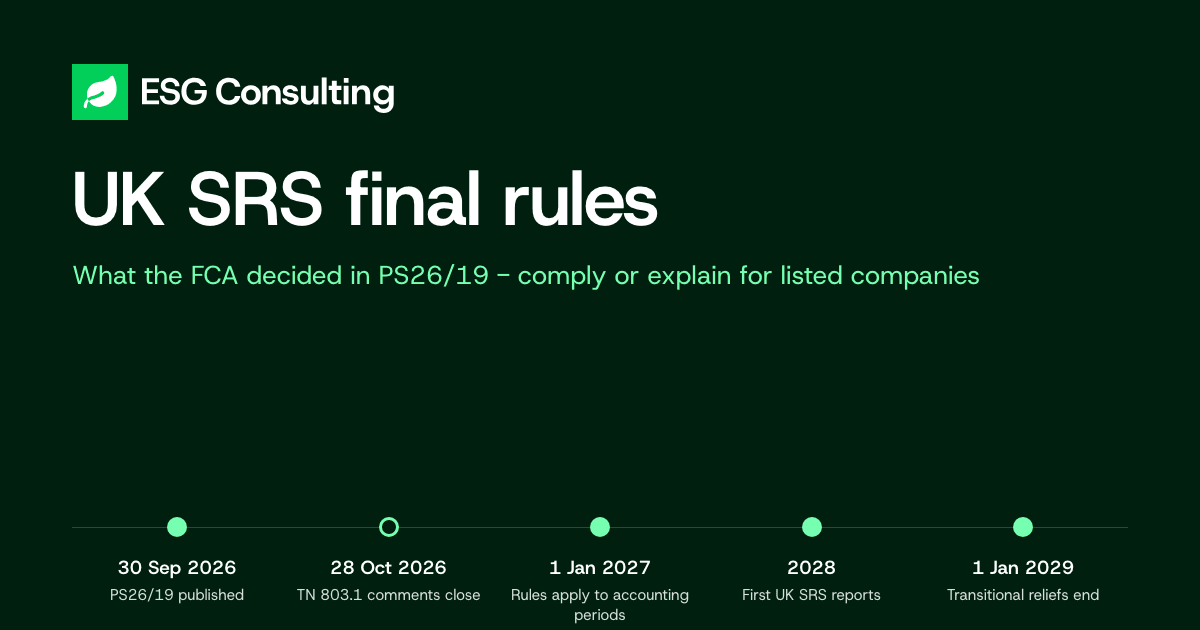
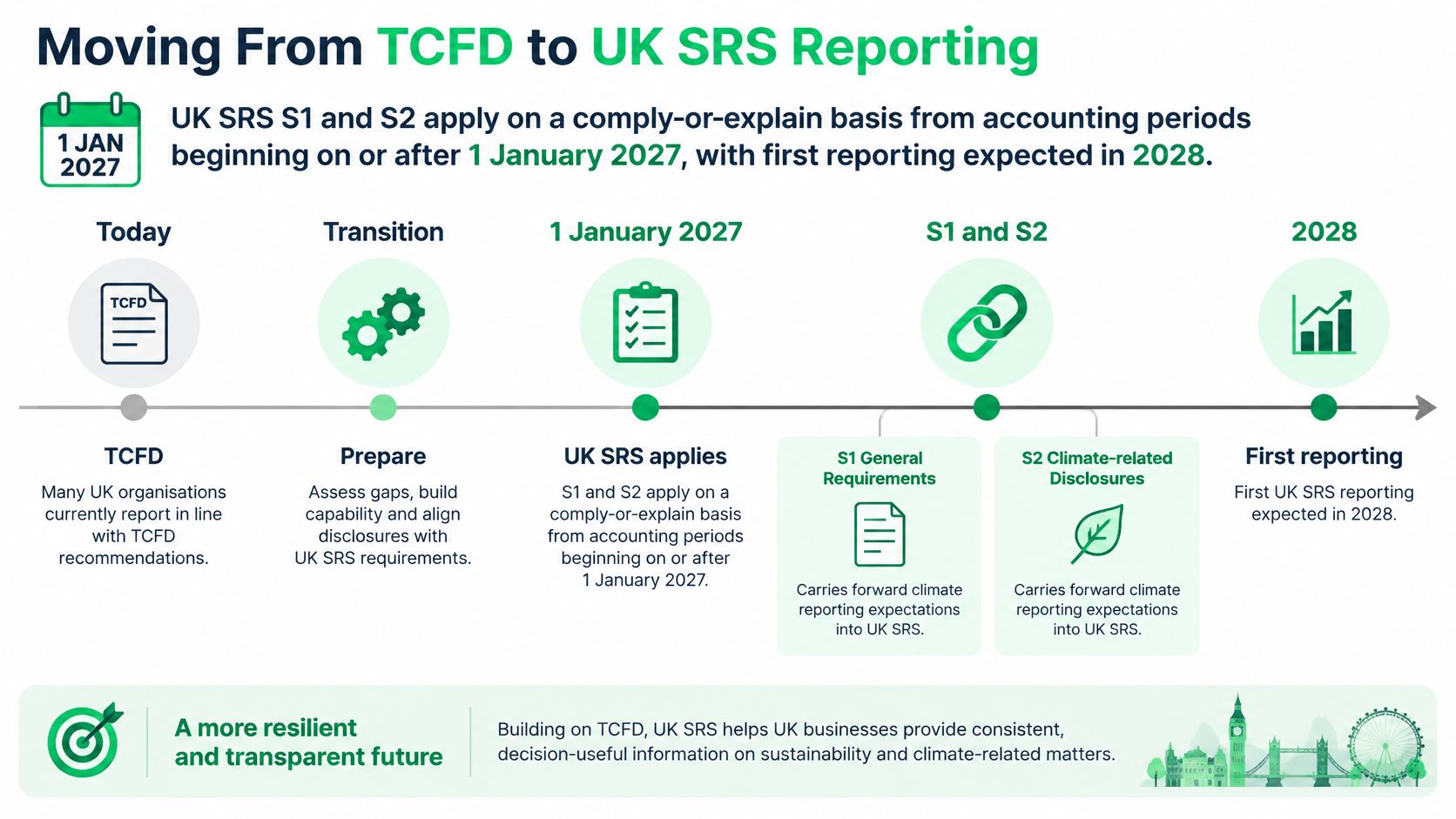
Under the FCA's published approach to sustainable finance, UK SRS S1 and S2 are scheduled to apply on a comply-or-explain basis for accounting periods beginning on or after 1 January 2027, with first reporting expected in 2028. The approach includes transitional relief allowing a one-year deferral of Scope 3 disclosure and a two-year deferral of UK SRS S1 sustainability disclosures.
The important preparation task is not just changing the headings in an existing TCFD report. Reporting teams need to establish what they can disclose, what remains incomplete, and how they can substantiate the explanation.
The timeline distinguishes the planned reporting start from the first expected published reports.
Make explanations specific enough to review
A credible gap record should contain:
- Reporting boundary. Define which entities and activities the missing information concerns.
- Precise limitation. Identify the absent disclosure and the reason it can't yet be completed.
- Interim methodology. Describe any estimates, proxies or alternative evidence used.
- Board oversight. Name the responsible oversight role and the management owner delivering the work.
- Remediation milestones. Set dates, dependencies and completion evidence.
- Consistency check. Resolve discrepancies with existing climate disclosures before approving the explanation.
Relief from immediate disclosure shouldn't become a reason to postpone assigning responsibility. An explanation that identifies a data limitation but no owner or corrective action gives the board little basis for judging whether the position will improve.
Test the explanation against a supplier-data gap
Suppose a listed group has reliable supplier-specific emissions information for only part of its purchasing activity. Its explanation should distinguish measured coverage from estimated coverage, describe how the remainder is treated and identify the supplier-engagement work needed to improve the inventory.
Avoid describing the whole inventory as unavailable when only particular categories are incomplete. Equally, don't describe estimates as supplier-reported figures. The distinction affects how reviewers interpret both the current disclosure and the remediation plan.
The accompanying video provides additional context for the reporting transition.
Build a gap register with a separate entry for each missing disclosure. Link each entry to evidence, an owner and a deliverable, rather than treating readiness as a single percentage-complete exercise.
CSRD, ESRS and SFDR for UK Groups in the EU
A UK registered office doesn't settle EU reporting exposure. For a cross-border group, the useful starting point is a map of EU subsidiaries, branches, activities and financial products, followed by a current legal scope assessment.
Don't commission an ESRS report merely because a customer mentions CSRD. First establish whether the group itself must report, whether an EU entity has a duty, or whether the customer is requesting information for its own reporting. Those situations can require very different outputs.
Separate the corporate reporting route
For a CSRD assessment, ask legal and finance teams to assemble the group structure and the financial information relevant to the applicable EU tests. Record which reporting route is being considered, the entity responsible and the current timetable confirmed for that route.
Where ESRS reporting is required, the materiality assessment should drive the reporting work rather than follow a pre-written sustainability narrative. Distinguish the organisation's impacts from sustainability matters that create financial risks or opportunities, and retain the reasoning behind topic selection.
| Assessment question | Decision to record |
|---|---|
| Which EU entity or group route is relevant? | Reporting entity and legal basis |
| Which current scope provisions apply? | Evidence and reviewer |
| What reporting period is applicable? | Confirmed timetable |
| Can existing UK information be reused? | Data mapping and identified gaps |
Treat fund disclosure as a separate exercise
An asset manager assessing SFDR exposure should work at both manager and product level. List the funds involved, their documentation and distribution arrangements, then obtain a current determination of the disclosures required. Don't assume a corporate sustainability report satisfies a product disclosure duty.
Consider a hypothetical UK manager distributing a sustainability-focused fund in Germany and France. The review should identify the affected prospectus or other pre-contractual material, website statements and ongoing product disclosures, rather than rewriting every group document indiscriminately.
The practical efficiency lies in reusing controlled evidence, not assuming equivalent compliance. Corporate emissions information may support an investor request, but the product team still needs to establish whether it answers the relevant fund-level question.
Record the EU route that applies, the reason for the conclusion and the documents requiring change. Where the conclusion is that no direct duty applies, retain that assessment while handling any customer or investor request on its own terms.
Procurement, Lender and Private-Company Requirements
A private company doesn't automatically need a standalone UK SRS report because a lender asks about climate risk. The government's UK Sustainability Reporting Standards guidance describes the standards' availability for voluntary use, rather than establishing an automatic reporting obligation for every large private business.
The commercial request may still deserve a prompt response. A lender might need emissions figures, governance information or evidence of a credible plan. The appropriate deliverable is the information needed for that decision, unless a separate statutory or contractual obligation requires more.
Read the procurement condition before building the response
For a central government opportunity referring to PPN 006, obtain the actual procurement documents and identify the Carbon Reduction Plan requirement being applied. For NHS buying arrangements referring to Evergreen, confirm the requested assessment, the responsible supplier entity and the buyer's submission instructions.
Don't infer the requirement from the buyer's sector alone. Ask the commercial team to retain the relevant tender clause or buyer communication, including the submission route and deadline. That record is more useful than an internal instruction to become ESG compliant.
Scope discipline: A buyer's request can be commercially important without becoming a statutory annual-report obligation.
Build a controlled data pack
- Ask for the exact request. Obtain the data field, reporting boundary, period, format and deadline from each counterparty.
- Map existing evidence. Identify figures and policies already controlled by finance, facilities, procurement or risk teams.
- Create a reusable pack. Maintain approved calculations, methodology notes, governance statements and supporting policies in a controlled location.
- Set the refresh cycle. Align review dates with buyer and lender calendars, assigning responsibility for changes between submissions.
A data pack should be assurance-ready in substance, not merely look audited. Keep evidence trails, distinguish estimates from measured information and don't imply that external assurance has been obtained when it hasn't.
For a private business with limited direct reporting duties, this approach can be more proportionate than adopting every available framework. It also leaves room to expand the reporting system when a genuine legal or commercial requirement emerges.
List every counterparty request and mark whether existing statutory information already answers it. Commission additional work only for the unresolved fields and the obligations identified.
Confirm Which Regimes Apply Before Your Next Filing
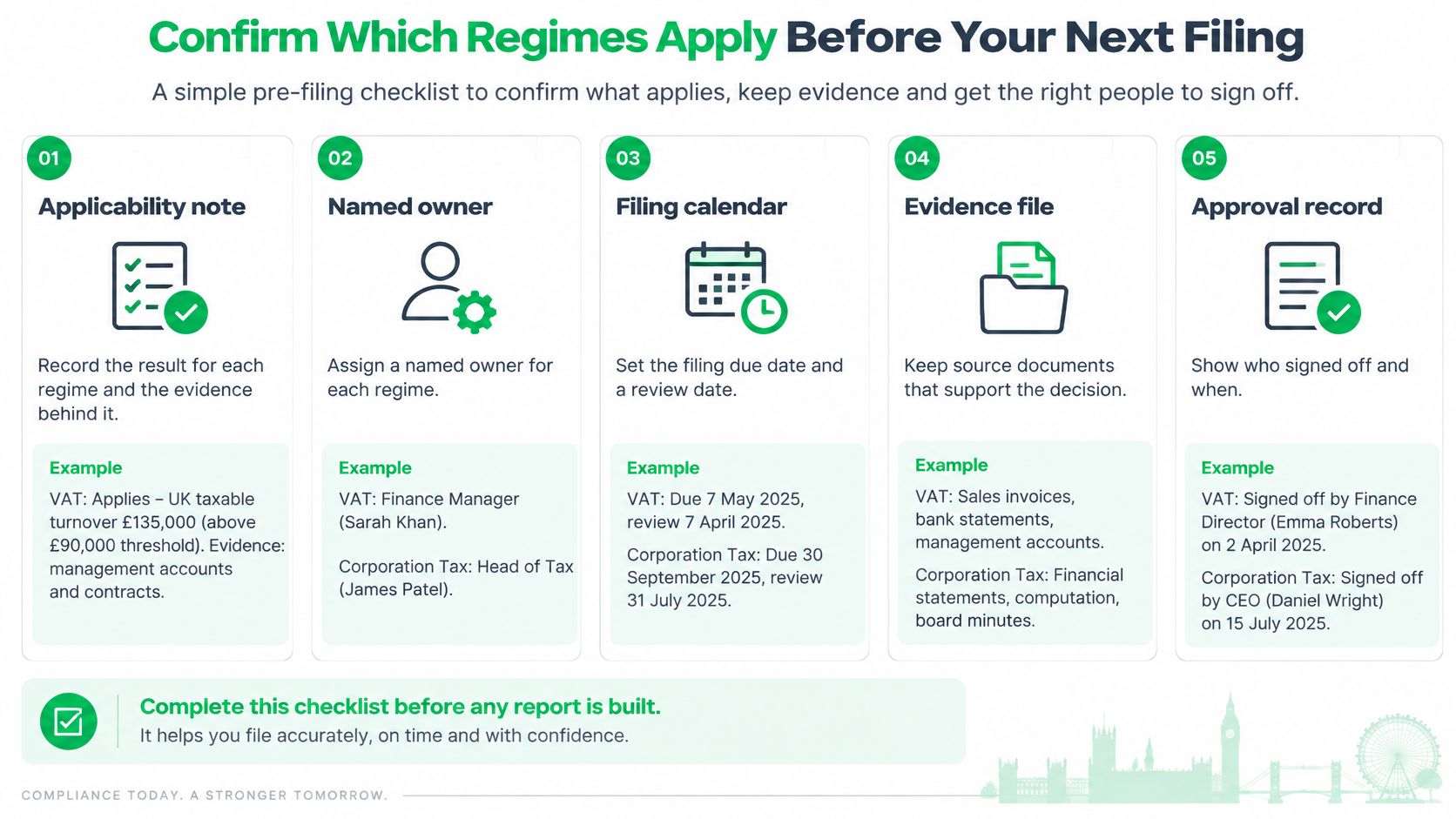
Before approving a reporting project, record the decision for each regime. Keep the evidence and rationale for any conclusion that it does not apply.
- Applicability note: Record the regime, outcome, supporting evidence and reason for any out-of-scope conclusion.
- Named owner: Assign responsibility for interpretation, preparation, review and approval.
- Filing calendar: Include corporate reporting milestones, energy assessment deadlines, listing-rule transitions and contractual submissions.
- Counterparty register: Separate statutory information from buyer, lender and group requests.
- Evidence and approval record: Retain source documents, calculation versions and sign-off decisions.
Make the figures defensible at filing
The government's SECR evaluation highlights the connection between energy and emissions information and statutory reporting. For each disclosure, document the reporting boundary, source coverage, calculation method, estimates, exclusions and changes.
Before publication, have the reviewer trace selected figures to invoices, meter records and calculation files. Check that the narrative matches the entity boundary and reporting period used for the figures, then resolve discrepancies before directors receive the final draft.
Confirm applicability before anything is built or scoped. That decision identifies the relevant obligations and helps prevent reports that no law or counterparty requires.
ESG Consulting provides ESG and sustainability consulting for UK businesses and confirms which obligations apply before work is scoped. It replies to contact-form enquiries within one working day. For email enquiries, write to hello@esgconsulting.co.uk.
ESG Consulting advises UK businesses on carbon reporting, sustainability disclosure and net-zero strategy across mandatory and voluntary frameworks. Share your entity list, latest reporting documents and buyer or lender requests to establish which requirements apply and agree the work needed.