ESOS Lead Assessor, ESOS compliance, ESOS sign-off, ESOS Phase 4, UK energy audit
ESOS Lead Assessor: Role, Requirements and How to Qualify
By ESG Consulting Team · · 14 min read
An ESOS Lead Assessor is the registered reviewer who decides whether an organisation's Energy Savings Opportunity Scheme assessment meets UK requirements and signs off that decision. That's a narrower, more accountable job than many expect. A technically competent energy audit can still leave you non-compliant if no registered reviewer can verify its scope, evidence and route to compliance.
That distinction matters because ESOS isn't a voluntary efficiency exercise. It's a regulatory assessment with a named person attached to the compliance decision. If you understand who that person is, what they check, and when their duties are triggered, the rest of ESOS becomes much easier to plan.
Table of Contents
- What an ESOS Lead Assessor Does and Why It Matters
- Who Needs an ESOS Lead Assessor and Who Is Exempt
- How to Qualify and Get on an Approved Register
- What a Lead Assessor Checks Before Signing Off
- Sign-Off Duties and the Seven-Day Notification
- Proving Phase 3 Savings in Phase 4 Evidence
- Engaging a Lead Assessor and Next Steps
What an ESOS Lead Assessor Does and Why It Matters
An ESOS Lead Assessor is not just an energy auditor with a different title. The GOV.UK guidance on complying with ESOS Phase 3 describes the assessor as the regulated technical reviewer who determines whether the assessment satisfies the scheme, so an audit can fail review if scope, evidence, methodology or compliance route can't be verified.
Think of a builder and a building inspector. The auditor is closer to the builder, gathering consumption data, visiting sites, examining plant and transport, and identifying savings. The Lead Assessor is closer to the inspector, checking whether the finished work meets the rules before it's signed off for use.

The three duties in order
- Review the scope and evidence: The assessor tests whether the assessment covers the right entities, assets, activities and period, and whether the evidence pack supports the conclusions.
- Decide on compliance: They determine whether the assessment meets the regulatory requirements, not whether they personally like every recommendation in it.
- Report the outcome: They notify the organisation of that decision and then complete the separate notification to the relevant approval body.
That sequence explains why timing matters. You don't appoint a Lead Assessor at the end to rubber-stamp a finished PDF. A reviewer brought in late may find missing sites, weak data or an unjustified exclusion, and fixing those problems can mean new site visits and recalculated totals.
A good audit finds savings. A proper Lead Assessor review proves the assessment itself can withstand regulatory scrutiny.
The accountability is visible because the assessor's name and approved register are recorded in the ESOS report and notification of compliance. A regulator can trace who made the compliance decision and under which register they held approval. For the organisation, that creates discipline. For the assessor, it means the signature carries professional consequences if the review was superficial.
The next practical question is usually the simplest one. Does your organisation need this reviewer at all, or does an exemption apply before you commission anything?
Who Needs an ESOS Lead Assessor and Who Is Exempt
ESOS applies to large undertakings and corporate groups containing large undertakings, and the GOV.UK guidance on how to comply with ESOS Phase 4 says an organisation generally falls within ESOS when it employs at least 250 people, or exceeds both annual turnover above £44 million and an annual balance-sheet total above £38 million. The same guidance notes the qualification date for the third compliance period was 31 December 2022.
Corporate groups catch people out. A small subsidiary shouldn't assess itself in isolation if it sits inside a group containing a large undertaking. The group position can bring entities into scope that would look too small on their own accounts, so headcount and financial tests need checking at the correct level before any audit is scoped.
When a Lead Assessor is needed and when an exemption applies
| Case | Lead Assessor needed? | Check before relying on this |
|---|---|---|
| 250 or more employees | Yes | Confirm headcount for the relevant period |
| Turnover above £44 million and balance sheet above £38 million | Yes | Confirm both financial figures for the relevant period |
| Part of a corporate group containing a large undertaking | Yes, for the group | Group-level assessment and sign-off |
| Fewer than 250 employees and not both financial thresholds met | No, generally outside ESOS | Check group status before relying on this |
| Energy use fully covered by an ISO 50001-certified system | No | Confirm the certification covers all applicable energy use |
| Total energy consumption below 40,000 kWh | No | Confirm the consumption figure for the relevant period |
| Zero energy use reported | No | Notification of compliance still required |
Read the financial row carefully. It's both tests together, not either one alone. Say a company has 180 employees, £60 million turnover and a £30 million balance-sheet total. It passes the turnover figure but not the balance-sheet figure, so it generally falls outside the scheme on those facts unless its group status changes the answer.
The exemptions also need precision. Fully covered means the ISO 50001-certified energy-management system covers the applicable energy use, not just a flagship site. Below 40,000 kWh means total consumption, evidenced for the relevant period. Zero energy use removes the need to appoint an assessor, but it doesn't remove the notification duty.
Practical rule: Confirm applicability before you price site audits, because a scoping error at this stage wastes more time than any later data problem.
We confirm which obligations apply to a client before anything is built or scoped. Do the same internal check first. Pull headcount, turnover and balance-sheet figures for the relevant period, test the group position, then find your row in the table and keep the workings.
How to Qualify and Get on an Approved Register
You can't qualify by sending an application to the Environment Agency and waiting for approval. Individuals must belong to a professional-body register approved for ESOS purposes. That register system is the competence control for the scheme, which is why organisations are told to check registration rather than accept a CV at face value.
The route has four connected stages, from choosing the right register through to acting on an assessment.
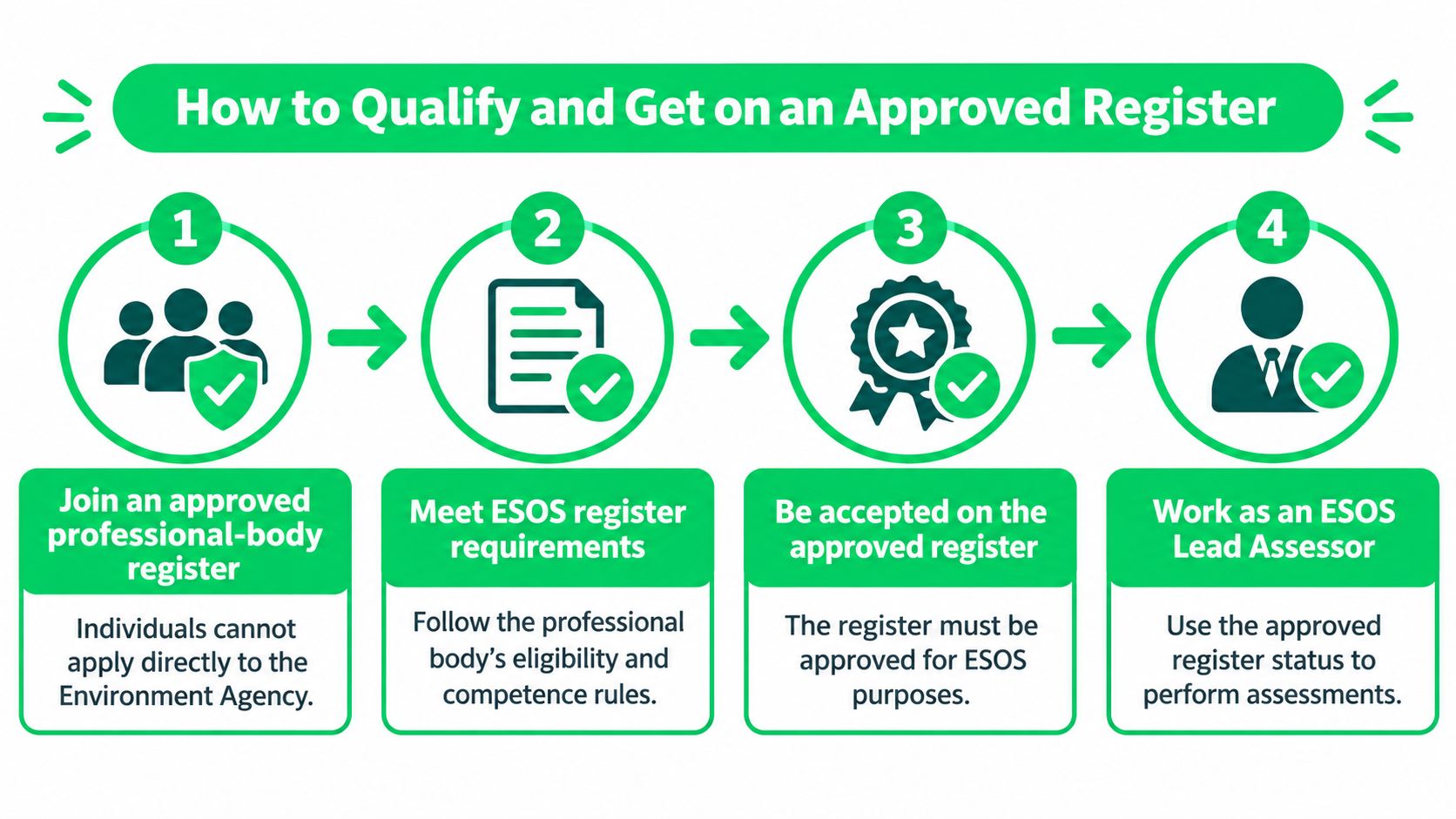
Steps to get listed
- Check the current GOV.UK list first. Look for professional-body registers approved for ESOS, because approval status matters more than how well known the body sounds. A respected membership that isn't an approved ESOS register won't let you sign off an assessment.
- Test your experience against that register's entry requirements. You'll need to show relevant energy assessment experience and sector knowledge in the form the body requires. General auditing experience may not be sufficient if you can't evidence work on buildings, processes or transport at the scale ESOS covers.
- Apply through the professional body. Submit the evidence, references, qualifications or assessment material that body asks for, and complete any interview, examination or portfolio review it sets. Don't apply to the regulator instead, because that route doesn't exist for individuals.
- Keep the listing current after acceptance. Renew on time, meet continuing conditions, and update the body if your employment or contact details change. A lapsed registration discovered during a client's compliance period creates a problem for everyone.
- Give the appointing organisation your exact register details. Your name and approved register must be recorded accurately when you're appointed. Small mismatches between your register entry, the ESOS report and the notification create avoidable queries later.
Sector knowledge deserves a separate check. Being listed proves you met the register's competence requirements, but a responsible undertaking should still ask whether you've reviewed comparable estates, industrial processes, fleets or multi-site groups. A hospital estate, a cold-storage network and an office portfolio raise different evidence problems, even though the regulatory decision looks similar on paper.
This short video gives a useful visual overview before you compare individual register requirements.
Three mistakes stop people most often. They apply directly to the Environment Agency, they assume a general energy-auditing certificate automatically qualifies them, or they let registration lapse between compliance cycles and try to fix it under deadline pressure. Avoiding those errors is straightforward if you treat the register, not the training course alone, as the destination.
What a Lead Assessor Checks Before Signing Off
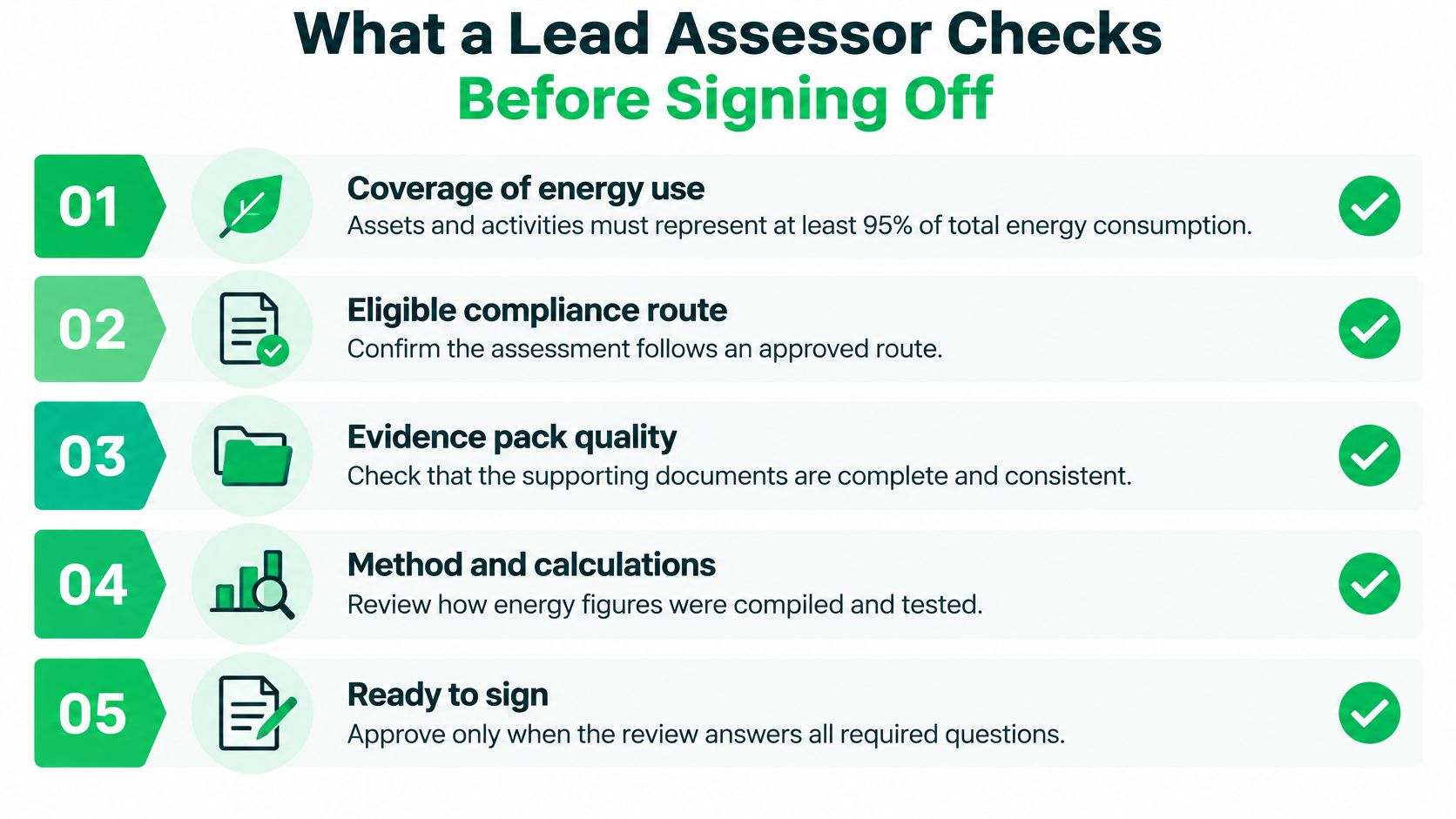
People often assume sign-off means the Lead Assessor has read the audit and agrees with its recommendations. That's too weak a test. The reviewer is asking whether the evidence proves the assessment meets ESOS, and the Environment Agency guidance on ESOS requires assets and activities representing at least 95% of total energy consumption to be covered by an eligible compliance route, with audits using verifiable data for a continuous 12-month period so far as reasonably practicable.
Start with the coverage question. Does the 95% calculation add up? The reviewer reconciles total consumption against meters, invoices and fuel records, checks conversions into a common unit, and looks for sites or fleets that were left outside the boundary.
Questions a reviewer asks
- Is the data verifiable and complete? A continuous 12-month set should reconcile to source records, with estimates identified and gaps explained rather than smoothed over.
- Were the visited sites representative? The file should state how many sites exist, how many were visited, and why that selection represents the organisation's energy use.
- Is every exclusion justified? Leased space, minor depots and shared services still need a reasoned treatment, especially where another party controls the meter.
- Do savings link to real drivers? A lighting measure should connect to operating hours and load, a transport measure to mileage or fuel use, and a process measure to production patterns.
Say a group visits its head office and two large factories but leaves out a leased distribution centre with refrigeration and a busy vehicle yard. The reviewer recalculates coverage and finds, in this made-up example, only 88%. The assessment can't be signed off in that state until the centre is brought into an eligible route or its treatment changes the calculation lawfully and transparently.
If the site sample only shows your best-understood buildings, it isn't evidence about the estate. It's evidence about the buildings you found easiest to visit.
The report itself then gets checked line by line. The reviewer looks for the audited period, consumption totals, total and visited site counts, the representativeness rationale, and a clear analysis description. They also confirm that each Phase 3 action-plan commitment has been reviewed in the current assessment, with delivery evidenced or non-delivery explained. Missing narrative can fail an otherwise sound set of numbers.
Sign-Off Duties and the Seven-Day Notification
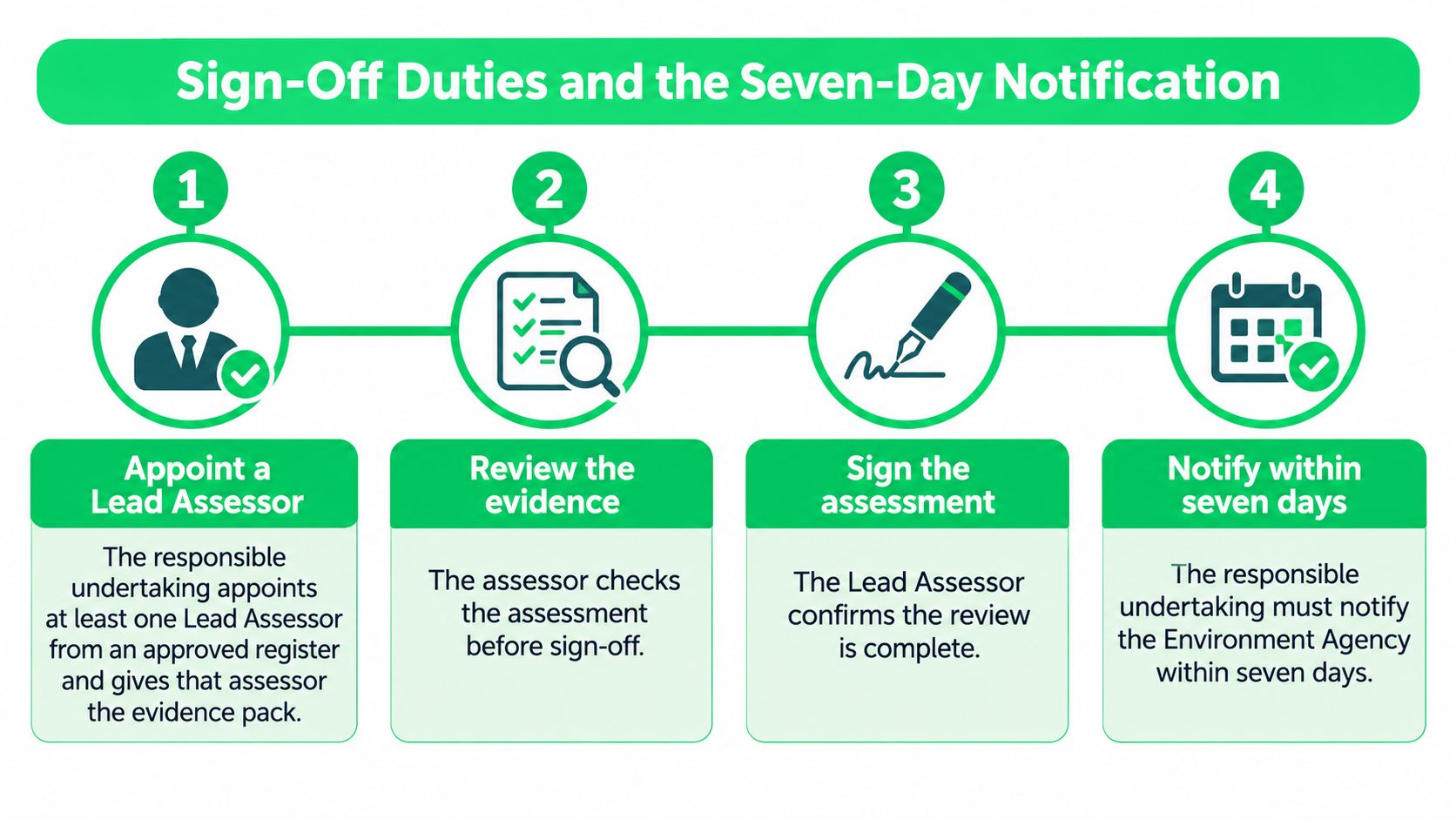
Sign-off assigns responsibility for two separate steps: reviewing the assessment and notifying the approval body. The responsible undertaking appoints at least one Lead Assessor from an approved register and provides the evidence needed for the review.
The sequence after appointment
- The undertaking appoints and equips the assessor. It provides the evidence from the previous assessment, including relevant action-plan information, so the assessor can review the current assessment in context.
- The assessor reviews the assessment. They check whether it meets the ESOS requirements and raise gaps that need correcting before sign-off.
- The assessor tells the undertaking the outcome. This confirms whether the assessment is complete and establishes when the notification period begins.
- The assessor notifies the approval body. The GOV.UK guidance on complying with ESOS Phase 4 sets out a seven-day deadline, beginning the day after the undertaking is told the assessment is complete. The notification includes the completion date and identifying and contact details for the responsible undertaking.
Record the completion date and agree who will provide the undertaking's details and retain proof of submission. The seven-day window is short, so leaving these tasks until after sign-off can create avoidable delays.
The Lead Assessor's sign-off is the formal review decision; the undertaking remains responsible for appointing the assessor and supplying the information needed. The external notification is a separate step. Keep the appointment record, review outcome, notification proof and report together so the decision and its follow-through can be traced later.
Proving Phase 3 Savings in Phase 4 Evidence
A compliant Phase 3 report proves you assessed energy use at that time. It doesn't, by itself, prove you delivered the savings you later committed to. The GOV.UK collection on complying with ESOS Phase 4 requires Phase 3 action-plan commitments to be reviewed in the Phase 4 assessment, with fuller reporting including each measure's description, estimated energy savings and category.
That shifts the Lead Assessor's attention from historic audit quality to delivery evidence. Build a register that can be checked measure by measure, rather than relying on a facilities team's recollection that a project definitely happened.
Evidence to assemble for each commitment
- List the original commitment. Copy across every Phase 3 action-plan measure, its site, owner, category and estimated saving, so nothing disappears between cycles.
- Attach dated delivery evidence. Use commissioning records, completion certificates, contractor invoices, photographs, control settings or updated asset registers that show when the measure went live.
- Quantify what changed. Compare metered or modelled savings with the estimate using the same baseline, and explain adjustments for weather, occupancy, production volume or operating hours.
- Explain non-delivery. Record why a measure was delayed, cancelled or replaced, who approved that decision, and what alternative action, if any, delivered savings instead.
Large multi-site organisations face the hardest task here. FTSE 100 groups, NHS bodies and national property portfolios can have action plans spread across estates teams, landlords, fleet managers and capital programmes, so evidence fragments quickly unless one owner maintains the tracker between cycles.
This record makes the sign-off meaningful. It connects a regulatory decision to whether energy performance improved, and it exposes weak governance early enough for directors to act. Treat ESOS as a performance-accountability cycle, not a periodic exercise in producing a report.
Engaging a Lead Assessor and Next Steps
You can use an internal employee or an external practitioner, provided the person is properly registered. An internal assessor already knows your estate, meters and data owners, which can speed up evidence gathering. An external assessor brings a separate view and wider sector comparisons, but needs time to learn your sites and obtain records from teams who don't report to them.
Internal and external Lead Assessor options compared
| Option | Register check the organisation makes | Main strength | Main risk |
|---|---|---|---|
| Internal employee | Confirm registration and sector knowledge | Knows the estate, meters and data | Independence may be questioned |
| External practitioner | Confirm registration and sector knowledge | Separate view and sector experience | Needs time to learn the estate and records |
Neither route transfers your responsibility. The undertaking still has to check registration and sector knowledge, provide access to evidence, and act on review findings. At ESG Consulting, ESOS assessments are signed off by our registered Lead Assessors, and one senior consultant leads each project from scoping through to sign-off, so the person who scoped the work is the person who delivers it.
Questions to settle before you engage anyone
- Will applicability be confirmed before scoping? You need the group and exemption position settled before site work is priced.
- Who exactly will sign off? Ask for the named individual and approved register, not just a firm name.
- Will scoping and delivery stay with the same person? Continuity reduces the risk that assumptions made early are lost at review.
- Can you speak to a specialist first? Our clients get a speaking call with an ESG specialist who knows the subject, not a sales team.
If you're already in scope, keep the next steps short. Confirm your table row, appoint a register-approved assessor before the review starts, choose the internal or external route deliberately, and diarise the seven-day notification. You can review our wider approach through our ESG consulting services, or contact us via esgconsulting.co.uk with your group structure and current evidence position. Early scoping avoids the expensive pattern of discovering missing coverage only when the reviewer is ready to sign.
If you need an ESOS assessment scoped properly, evidenced to the 95% coverage standard and signed off by a registered Lead Assessor, talk to ESG Consulting before your next compliance cycle hardens into rework. We'll confirm whether ESOS applies to your group, identify the evidence gaps that could block sign-off, and set out a clear route from data collection to notification.