Scope 3 emissions, Scope 3 reduction, value chain emissions, supplier engagement, UK procurement carbon
How to Reduce Scope 3 Emissions: A Practical UK Guide
By ESG Consulting Team · · 14 min read
The usual advice on how to reduce Scope 3 emissions starts with collecting better supplier data. That's useful, but it becomes counterproductive when procurement teams postpone obvious changes until every supplier has returned a complete carbon questionnaire. You don't need a perfect product footprint to stop buying unnecessary material, consolidate deliveries or challenge an energy-intensive specification.
Run measurement and reduction together. Build a traceable baseline, identify likely hotspots and start changes that remain sensible even if the estimates move. Reserve detailed investigation for decisions where uncertainty could change which option you choose.
Table of Contents
- Where Your Scope 3 Emissions Really Sit
- How to Map Your Value Chain in Five Steps
- Ranking Hotspots to Decide What to Act On First
- Engaging Suppliers Without Shutting Out Smaller Ones
- Procurement Levers That Cut Emissions Fastest
- Tracking Coverage and Abatement Over Time
- Your First Three Actions for the Next 90 Days
Where Your Scope 3 Emissions Really Sit
Purchased goods and services and capital goods are sensible starting points, particularly for organisations buying substantial materials, equipment, construction or outsourced services. But don't assume they dominate your organisation before checking downstream activities. A manufacturer selling energy-using equipment and a lender financing businesses need different priorities.
Use the GHG Protocol categories as a ledger-to-activity lookup. Upstream categories cover activities before and around your operations; downstream categories cover activities associated with what you sell, lease, franchise or finance.
| Category | Typical activity | Usual data source |
|---|---|---|
| 1. Purchased goods and services | Raw materials, packaging, bought-in components | Purchase ledger and supplier invoices |
| 2. Capital goods | Machinery, vehicles, buildings and fit-out | Fixed asset register |
| 3. Fuel- and energy-related activities | Upstream fuel and grid losses | Energy invoices and grid factors |
| 4. Upstream transportation and distribution | Inbound freight and third-party logistics | Freight invoices and carrier data |
| 5. Waste generated in operations | Waste disposal and treatment | Waste contractor records |
| 6. Business travel | Flights, rail and hotel stays | Travel booking data |
| 7. Employee commuting | Staff journeys to work | Staff survey or commuting data |
| 8. Upstream leased assets | Leased buildings and vehicles outside Scope 1 and 2 | Lease schedules |
| 9. Downstream transportation and distribution | Delivery of sold products | Sales volumes and freight records |
| 10. Processing of sold products | Processing by customers or intermediaries | Customer or intermediary records |
| 11. Use of sold products | Energy used by products in customers' hands | Product specifications and use profiles |
| 12. End-of-life treatment of sold products | Disposal and recovery of products and packaging | Sales quantities, material composition and treatment assumptions |
| 13. Downstream leased assets | Assets leased to other parties | Lease schedules |
| 14. Franchises | Franchisee operations outside Scope 1 and 2 | Franchisee activity and energy data |
| 15. Investments | Financed emissions | Investment portfolio data |
National figures explain why looking beyond UK operations matters: the UK government's carbon footprint statistics report 371 MtCO2e embedded in imports in 2023, representing 53% of the UK's total carbon footprint. That's national context, not an estimate of your organisation's Scope 3.
Find the purchases behind the footprint
Match ledger descriptions to activities, not just supplier names. A facilities supplier might provide cleaning services, replacement equipment and waste collection, requiring different treatment.
Shortlist categories combining substantial purchasing volumes with carbon-intensive inputs. Check product use and investments before excluding them, then bring procurement, finance and the relevant operational owner into the mapping exercise.
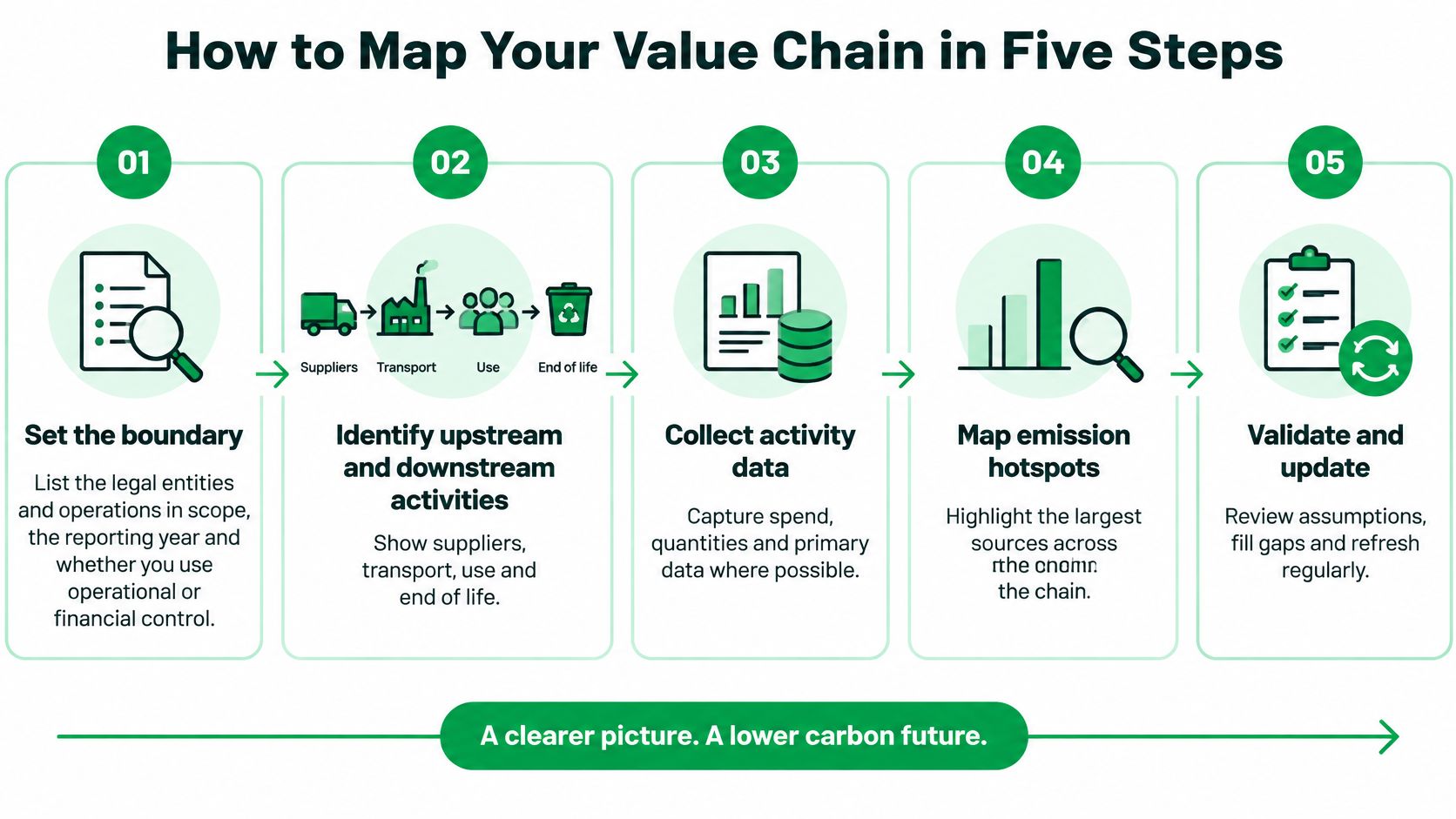
How to Map Your Value Chain in Five Steps
A useful baseline is a working decision tool, not just a total for the annual report. Finance should be able to reconcile its purchasing inputs, procurement should recognise the supplier groupings, and an assurance provider should be able to follow the calculations.
Use the process below to organise the work.
Build a baseline people can trace
Set the organisational boundary. Record the legal entities, operations and reporting period, together with the chosen consolidation approach, such as operational or financial control. Resolve joint ventures, leased assets and outsourced activities early, because inconsistent boundaries can leave omissions or place the same activity in different scopes.
Extract and classify the purchasing records. Pull the purchase ledger, expense claims and corporate card transactions for the reporting period, then map supplier and cost lines to categories. Don't overlook indirect purchases outside purchase orders, and reconcile totals to finance records before adding separate travel or freight datasets that could overlap.
Calculate screening estimates. Use emissions = activity data × emission factor, selecting spend-based factors for suitable purchasing categories and physical activity factors where quantities are available. The UK government conversion-factor methodology supports activity-based calculation and the treatment of material-use and waste emissions; record factor year, units, currency basis, geography and assumptions so later comparisons remain meaningful.
Refine the suppliers that could change your decisions. Start with suppliers combining high spend, carbon-intensive products and realistic procurement influence, then replace screening estimates with quantities, product footprints or verified activity data. Request the functional unit, life-cycle boundary, allocation method and verification status, because a supplier's corporate total isn't interchangeable with the footprint of what you buy.
Maintain an assumptions and evidence register. Give each calculation an owner, source file, method, data-quality rating and unresolved gap, with a clear distinction between measured inputs and estimates. Save the original supplier response alongside any adjustments rather than overwriting it, so someone else can reconstruct the reported result.
Spend-based estimates are quick but blunt. A price increase can raise the calculated footprint without any change in material quantities, while a discount can create an apparent reduction without changing production.
Practical rule: Improve a dataset when the improvement could change a purchasing decision, substantiate a reduction or resolve a material reporting gap.
A usable first baseline is traceable, rough and dated. It should show where estimates remain, which exclusions need investigation and which purchasing decisions can proceed immediately. A polished total without that supporting record is harder to manage and harder to defend.
Ranking Hotspots to Decide What to Act On First
You're unlikely to finish collecting supplier data before the next sourcing decision. Waiting therefore has a cost: buyers may renew an unchanged specification or commit to equipment whose emissions will be difficult to alter later.
The government's public-sector emissions technical report records that only 66% of surveyed organisations in UK electrification supply-chain evidence had emissions data for at least one Scope 3 category, and that purchased goods and services plus capital goods represented 97% of Oxfordshire County Council's Scope 3 emissions. These are distinct examples, not benchmarks for every UK organisation.
Rank decisions, not just categories
Assess each hotspot against these criteria:
- Estimated emissions share. Would this activity remain material under plausible alternative factors or quantities?
- Abatement potential. Can you reduce demand, change the specification, substitute a material or alter the delivery method?
- Cost of change. Include implementation, testing, maintenance, disruption and disposal, not just the purchase price.
- Supplier influence. Consider contract timing, purchasing power, technical alternatives and the supplier's willingness to collaborate.
| Estimated share of Scope 3 | Abatement potential | Action |
|---|---|---|
| High | High | Act now: set a reduction target and a supplier abatement plan |
| High | Low or unclear | Engage suppliers for primary data and product-level footprints |
| Low | High | Quick win: fund it in the next budget cycle |
| Low | Low | Monitor annually using spend-based estimates |
Treat the matrix as a starting point, not automatic spending approval. A low-cost logistics change may deserve immediate attention, while a material substitution could require clinical, engineering or safety validation before implementation.
Set a defensible act-now threshold
Define high relative to your inventory and decision budget rather than borrowing an arbitrary percentage. Act when the category remains important under conservative assumptions, an intervention has a credible physical mechanism, and operational owners can manage the risks.
Say a construction buyer is comparing structural options. If embodied-carbon estimates consistently identify the structural materials as a hotspot, the buyer can commission lower-material designs while requesting comparable product declarations. It doesn't need to settle the footprint of office stationery first.
Document the estimate range, its basis, the chosen intervention and what evidence would reverse the decision. Don't present an uncertainty range as statistically validated unless you've established that.
Engaging Suppliers Without Shutting Out Smaller Ones
Segment suppliers before sending requests. Strategic suppliers need detailed engagement because of their emissions relevance or purchasing relationship; high-risk suppliers need questions aimed at carbon-intensive activities; transactional suppliers need a lighter process.
Build the request around the information your buyer will use.

Match the request to the relationship
- Strategic suppliers. Request a baseline year, operational inventory, relevant value-chain data, product carbon intensity, reduction target, renewable-electricity evidence and a dated abatement plan. Tie delivery to contract renewal and agree who will resolve technical questions.
- High-risk suppliers. Ask about their principal emission sources, such as process heat, material production or freight. A targeted questionnaire is more useful than a lengthy form covering irrelevant activities.
- Transactional suppliers. Offer a short activity-data template or retain screening estimates. Escalate only when the purchased product or service warrants closer investigation.
Score data completeness, methodological quality and actual abatement separately. A confident net-zero pledge shouldn't compensate for missing product boundaries or an unsupported reduction claim.
For smaller suppliers, provide worked templates, accept a staged improvement plan and avoid demanding external verification where it won't affect the purchasing decision. The government's Carbon Reduction Schedule guidance explicitly calls for relevant, proportionate requirements that don't place undue burdens on smaller businesses and voluntary organisations.
The accompanying video can support an internal supplier-engagement discussion.
Turn responses into contract management
Insert minimum evidence requirements into tenders and use corrective-action plans where primary data is absent. For material purchasing streams, request activity updates quarterly, but align the format with records suppliers already maintain.
The Nottingham Trent University case study illustrates the limitations: supplier data covered 18% of analysed goods-and-services expenditure, while improved analysis reduced the reported footprint by 8,221 tCO2e. That's an accounting improvement, not proof that the university's suppliers physically eliminated those emissions.
Watch for unanswered requests, incompatible product boundaries and suppliers submitting corporate totals instead of purchase-specific evidence. Don't price a capable smaller supplier out of a tender merely because a larger competitor has a more polished reporting team.
Procurement Levers That Cut Emissions Fastest
| Lever | Categories reached | Evidence to request |
|---|---|---|
| Lower-carbon materials | 1, 2 | Product-specific footprint or environmental product declaration |
| Product redesign | 1, 2, 11 | Before-and-after bill of materials and footprint |
| Logistics consolidation and mode shift | 4, 9 | Tonne-kilometres and mode split by quarter |
| Renewable electricity in supplier operations | 1, 2, 3, where relevant to the purchased activity | Renewable tariff or certificate evidence |
| Waste prevention and recovery | 5, plus 1 where purchasing is avoided | Waste tonnage by treatment route and avoided material purchases |
| Travel and commuting policy | 6, 7 | Trip data by mode and travel class |
| Contract carbon criteria | 1, 2, 4 | Supplier reduction plan and annual progress |
Change what you buy before focusing only on who supplies it. Removing unnecessary packaging, extending equipment life, or reducing material requirements can avoid production altogether. Switching suppliers without checking equivalent product boundaries may replace a conservative estimate with a more favourable one.
Choose the lever that fits the decision
Contract criteria and requests for renewable-electricity evidence can be introduced during a tender cycle. Physical reductions may take longer, particularly where suppliers need new equipment or buyers must validate redesigned products.
Use this checklist to turn a sourcing discussion into an evidence request.
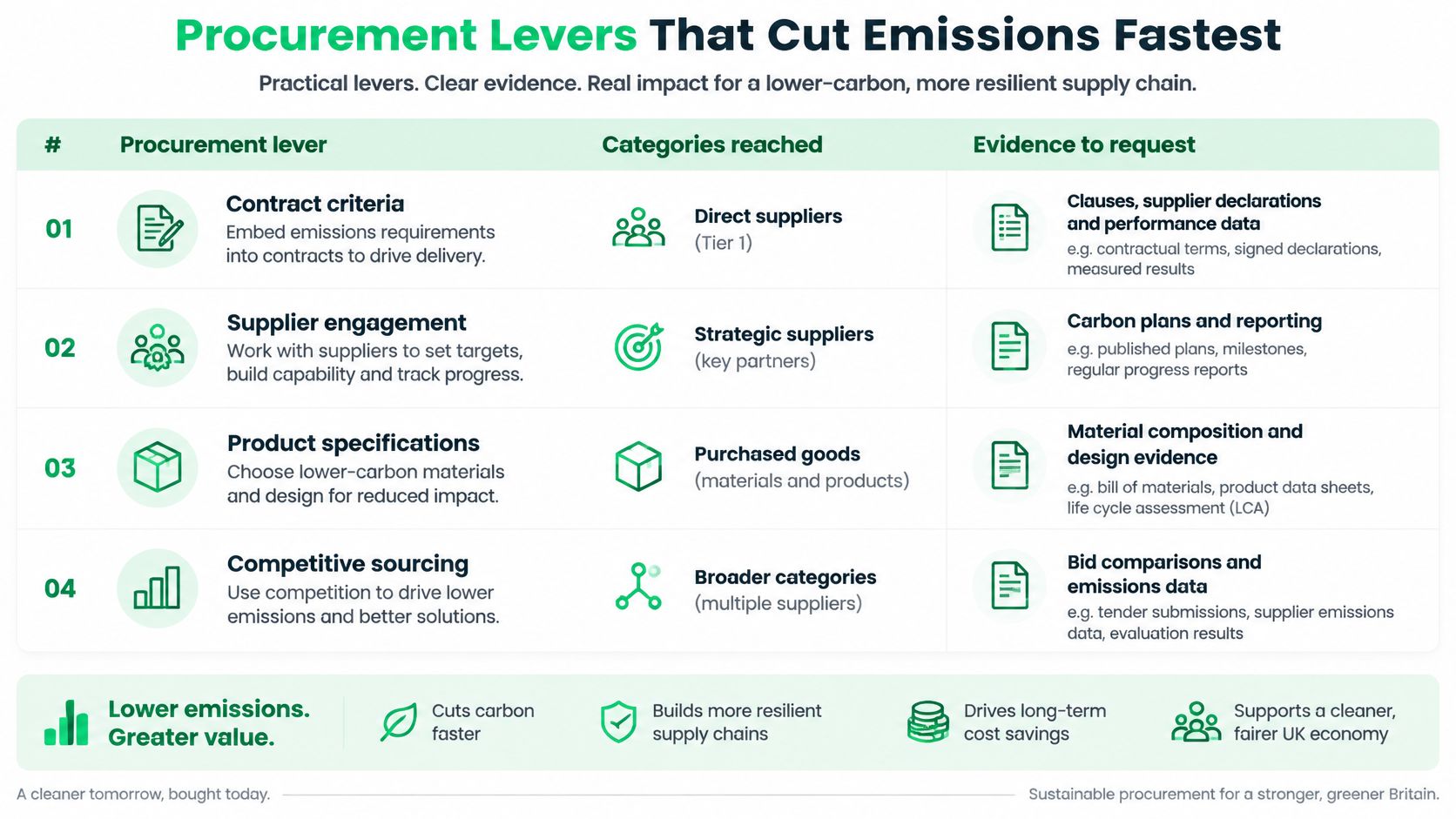
Trade-offs need explicit decisions. Freight consolidation can reduce transport demand but increase inventory; lighter packaging can reduce material use but increase damage if protection deteriorates. Assess the complete change rather than claiming the benefit from one isolated component.
For supplier electricity, connect the evidence to the facility and reporting period producing your purchases. A certificate alone doesn't establish the reduction in your purchased product's footprint, and renewable electricity won't eliminate process emissions or fuel combustion.
Lock delivery into contracts
Under PPN 006 on Carbon Reduction Plans, in-scope major central-government procurement requires a supplier plan confirming commitment to net zero by 2050 for UK operations, describing relevant environmental-management measures and reporting Scope 1, Scope 2 and a defined subset of Scope 3 emissions. The plan must relate to the bidding entity or meet the specified conditions for parent-level coverage.
Private buyers can adopt the underlying discipline without presenting it as a universal legal requirement. Specify deliverables, evidence, review dates, responsibilities and the response to missed milestones.
Choose your first levers by checking:
- Materiality. Does the purchasing stream justify the effort?
- Control. Can your team change demand, specification or sourcing terms?
- Evidence. Can you compare the existing and proposed options fairly?
- Whole-life cost. Can the organisation afford implementation and manage operational consequences?
A carbon clause is useful only when a named buyer checks performance and acts on what the supplier reports.
Tracking Coverage and Abatement Over Time
A more complete inventory and a lower-emission supply chain are different achievements. Report them separately so directors can distinguish improved visibility from changes in materials, energy, transport or product use.
Keep separate scorecards
Use a coverage scorecard for the quality and reach of the inventory:
- Primary-data coverage. The share of emissions supported by supplier-specific or activity-based evidence, using a documented definition.
- Supplier response. Participation among the suppliers you approached, with material non-responders identified.
- Contract integration. The proportion of relevant contracts containing carbon criteria and assigned review responsibilities.
Use an abatement scorecard for physical performance:
- Absolute change. Emissions reduced during the reporting period, distinguishing operational changes from accounting revisions.
- Purchased-unit intensity. Emissions per comparable unit, with the unit and product mix clearly defined.
- Intervention evidence. Changed material quantities, transport activity or product performance, supported by purchasing and operational records.
Review material categories quarterly and recalculate the complete inventory annually. Agree a baseline-recalculation policy for acquisitions, disposals, outsourcing and significant methodological changes; set and document your own significance criteria rather than assuming a universal threshold.
Prevent misleading progress claims
Keep an explicit reconciliation between the previous result and the latest result.
- Better measurement presented as reduction. Classify factor updates and supplier-data replacements as methodological changes unless evidence demonstrates physical abatement.
- Unsupported offsets counted as abatement. Keep purchased credits separate from reductions within the value chain.
- Supplier totals counted wholesale. Attribute emissions to the products or services purchased using a suitable boundary and allocation method, rather than importing the supplier's entire value-chain inventory.
- Methods changed without comparability. Recalculate the baseline when your policy requires it and retain a clear version history.
For boards, show the reported movement alongside changes in purchasing volume, mix, methodology and genuine abatement. For buyers, provide the boundary, calculation method and supporting evidence behind the claimed improvement.
Keep avoided-emissions comparisons separate from inventory reductions where they use a hypothetical alternative. A claim that a redesign performs better than an imagined conventional product isn't automatically a reduction against your organisation's actual baseline.
Your First Three Actions for the Next 90 Days
Treat the next planning period as a delivery programme. The practical outputs are a prioritised map, supplier commitments and a funded set of purchasing changes, not another unowned recommendation list.
Give the work named owners
Confirm applicability before expanding the scope. Have the reporting lead and procurement team check which obligations and customer requirements apply, including relevant central-government tender conditions. Record the conclusion so the team doesn't build unnecessary disclosures or miss a contractual requirement.
Map and rank the principal purchasing streams. Finance should provide the reconciled records, while procurement and operational teams identify the underlying activities. Assign each likely hotspot an intervention, an evidence gap and a decision owner.
Select a small, cross-category action portfolio. For example, choose a material-specification review, a freight-consolidation trial and an equipment-life-extension decision. Give each an owner, approval route, evidence requirement and implementation date rather than leaving it as a sustainability ambition.
Send segmented supplier requests. Set a response deadline and a minimum acceptable data standard, with a named contact for questions. Agree improvement plans where suppliers can provide useful activity records but not yet a complete product footprint.
Put the review into governance. Schedule the coverage and abatement review and include it in the board pack. Ask directors to resolve blocked purchasing decisions, approve justified expenditure and challenge claims that lack evidence.
Keep delivery proportionate
Your team can complete these steps without external help. If capacity is the constraint, ESG Consulting can support the mapping and supplier-engagement work; one senior consultant leads each project from scoping through sign-off, with a written scope and fixed fee agreed before work begins.
Our Scope 3 Emissions Inventory service uses value-chain mapping and supplier engagement to build a footprint your team can report and act on. Visit ESG Consulting to discuss your purchasing hotspots, available evidence and the support needed to turn them into a practical reduction programme.