transition plan, climate transition plan, UK net zero, TPT framework, emissions baseline
How to Write a Transition Plan: A UK Guide for 2026
By ESG Consulting Team · · 15 min read
You've had the email. A customer, a lender or the board secretary wants the transition plan. Not a summary of your net-zero target. The plan, with owners, dates and numbers that hold up when someone asks how you know.
Most organisations answer with a slide deck of targets. It's the natural response and the wrong one. A target with no funded action behind it is a wish, and an assurance provider will read it as exactly that.
A transition plan is an operating document. It says where the emissions come from today, what the organisation will physically do about them, who is accountable for each step, what it costs, how the money gets released, and what happens when the weather or the policy environment moves against you. Get those parts right and the narrative writes itself.
Table of Contents
- What a Transition Plan Must Contain
- How to Draft the Plan Step by Step
- Setting a Baseline and Milestones You Can Defend
- Costing Actions So They Can Be Funded
- Covering Physical and Transition Risk
- Mistakes to Fix and Sign-Off Checks
What a Transition Plan Must Contain
Two sentences decide whether a transition plan survives scrutiny. Can you name the person who signs off each target, and can you point to the source file behind each number? If either answer fails, you've written a communications exercise with a sustainability heading.
The UK government established the Transition Plan Taskforce (TPT) in April 2022 to develop a framework for organisations to communicate transition plans, with that framework intended for publication in October 2023. It has since stated its intention to mandate UK-regulated financial institutions (banks, asset managers, pension funds and insurers) and FTSE 100 companies to develop and implement credible transition plans aligned with the Paris Agreement's 1.5°C goal, as recorded in the government's response to the Climate Change Committee's 2023 progress report. That direction fixes the genre. This is a governance and disclosure document, not a project list.
Six components carry the weight, and each needs an owner and a file behind it.
| Component | What it must state | Evidence to keep |
|---|---|---|
| Governance and accountability | Board or committee that approves the plan, executive owners, decision controls | Board minutes and committee terms of reference |
| Strategic ambition | Net-zero year, 2030 milestone, link to corporate strategy | Board-approved strategy papers |
| Implementation actions | Owner, decision gate, delivery date and expenditure for each action | Project plans and capital approvals |
| Metrics and targets | Scope 1 and 2, material Scope 3 categories, intensity ratios, 2030 and 2050 targets | Calculation methods and source data |
| Financial implications | Capital and operating costs, links to remuneration and procurement | Budget approvals and investment cases |
| Dependencies and assumptions | Grid capacity, technology availability, supplier data, policy support | Assumption log with source and review date |
The line that trips up most first drafts is the boundary between commitments already approved and proposals still waiting on money or a board decision. Put them in one table and every reader, from the non-executive director to the credit analyst, assumes the whole list is committed. Mark approval status against each action from the first draft, not the final review.
For listed companies and financial institutions, tie each target to a reporting control and an evidence trail. That is what makes the document usable by investors, regulators and assurance providers. A target that lives only in a PDF and nowhere in the reporting pack is a target nobody can test.
If your board cannot name who signs off a target, the plan isn't finished. Print the table above and let each drafting step below fill one of its six rows.
How to Draft the Plan Step by Step
TPT's implementation guidance runs in four stages: foundations and governance, ambition through mitigation, adaptation and resilience, then a financed and sequenced implementation strategy, then metrics, targets, controls and reporting, as set out in the TPT implementation guidance. The eight steps below walk through those stages in order.
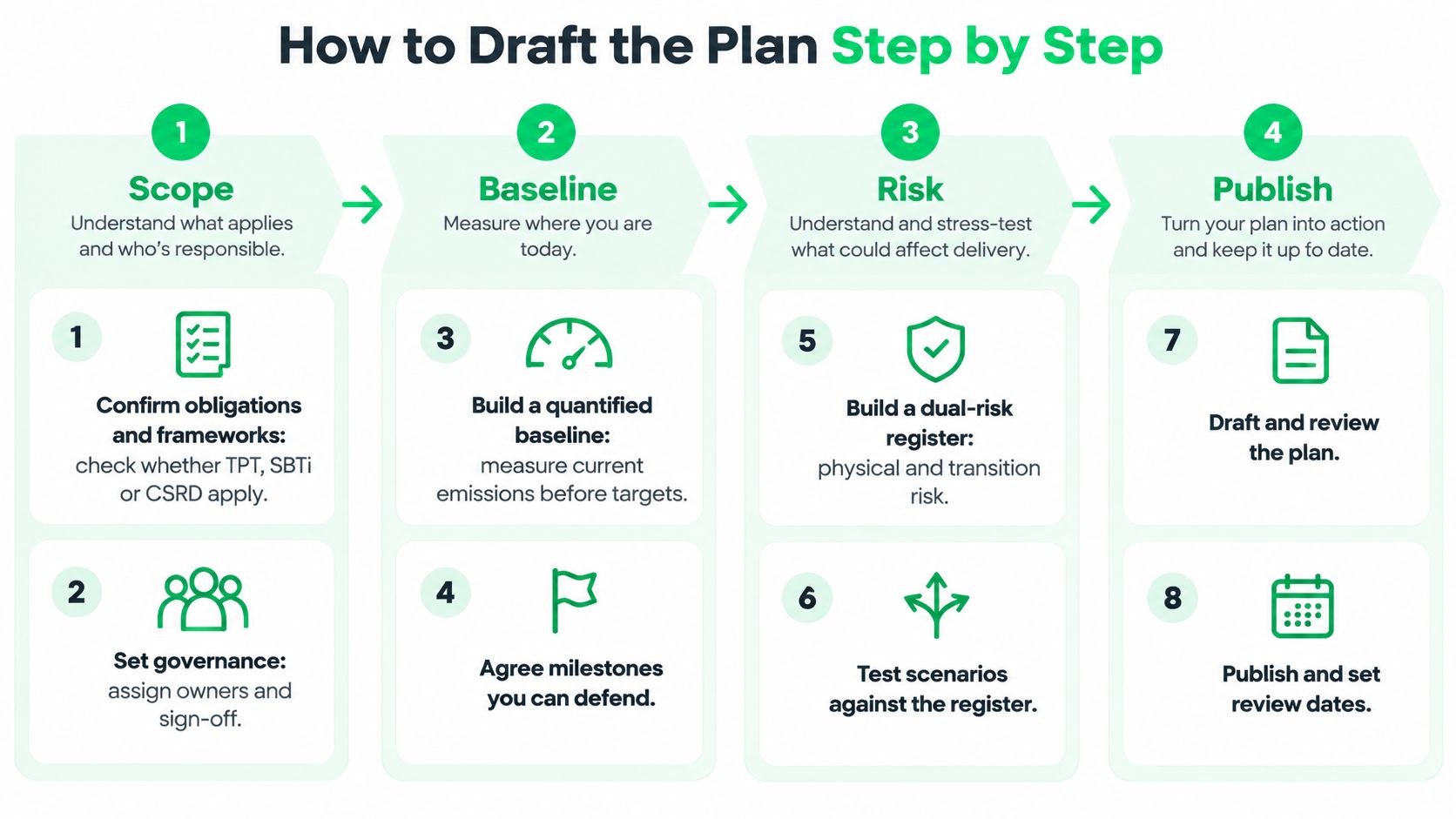
- Confirm which obligations apply. Check TPT, SBTi, CSRD and the UK sustainability disclosure rules before anyone builds a template, because scope decides the depth of work. Skipping this check wastes months and leaves you with a plan built to the wrong structure. We confirm which obligations apply to a client before anything is built or scoped, and financial institutions and FTSE 100 companies should treat the mandate direction as live now rather than later, recording that decision in the evidence register.
- Set governance. Name the committee that approves the plan, the executive owner of each action and the decision controls between them. Actions without named owners don't get delivered, and an assurance provider will ask who approved what and on what date.
- Build the baseline. Scope 1 and 2 first, then the Scope 3 categories that make up a material share of the footprint, keeping the calculation method for every figure. A baseline without a documented method cannot survive assurance, and rebuilding it later costs more than doing it once.
- Set ambition. A 2030 milestone, a 2050 outcome and an explicit line into corporate strategy. If the plan reads as a document sitting beside the strategy, the board will treat it that way and so will your investors.
- Translate ambition into actions. For each action, record owner, decision gate, delivery date, capital or operating expenditure and expected emissions impact. TPT asks for short-, medium- and long-term actions with interim milestones and accountability mechanisms, so the drafting test is whether an operations director could run next quarter from your document.
- Add the dual-risk register and the dependencies behind the pathway. That means grid capacity, technology availability, supplier data, policy support, plus physical and transition risk with owners attached. A pathway with no dependency log is a forecast, not a plan.
- Define metrics, targets and the evidence register. Every baseline, target and financial assumption links to source data, calculation methodology and approval evidence, which matters most where Scope 3 estimates or scenarios are material.
- Draft, test and publish. Take the numbers through finance and assurance before board approval, publish as a standalone plan that integrates with the annual report, refresh it at least every three years or sooner after significant change, and report progress and material updates annually.
Practical test: if a figure in the draft can't be traced to a source file in under five minutes, it isn't ready for the board pack.
Finish when every number traces back to its file. That's the point at which the document becomes usable rather than presentable.
Setting a Baseline and Milestones You Can Defend
A national emissions chart is the easiest thing to hang in the meeting room. It says nothing about your estate, your suppliers or your processes.

Start with the baseline test. Could someone outside the business reproduce your baseline from the evidence register alone, without a call with your team? If not, you have a number, not a baseline.
Use the national context to calibrate ambition, then put it aside. The UK legally adopted a target of net-zero greenhouse-gas emissions by 2050 in 2019, and between 1990 and 2019 UK emissions fell by 43% while the economy grew by almost 80%, with power-sector emissions down by more than 70% and industrial emissions down by more than 50%, according to the Net Zero Review interim report. The grid did much of that work. Your own reductions still have to be built, action by action, against a baseline an assurance provider can trace.
From national trend to your own numbers
Pick a baseline year with complete data you can verify, then build in this order and the rest of the plan gets easier.
- Scope 1 and 2 first. Separate fuel, refrigerant and purchased electricity so each source maps to a specific action with an owner and a delivery date.
- Material Scope 3 categories next. A retailer will usually find purchased goods dominate, which means supplier engagement targets belong in the plan rather than in an appendix.
- Intensity ratios alongside absolute targets. Emissions per unit of output or per million pounds of revenue stop growth from hiding a rising footprint, and they give the board a second check when the absolute figure moves for the wrong reason.
- A review trigger with a named owner. When actual reductions lag the pathway by an agreed margin, the plan should say who reviews it, when, and what corrective action follows. Write the trigger as a threshold and a calendar date, because a trigger without a date rarely fires.
Set a 2030 interim milestone and a 2050 endpoint, both dated and measurable. Tie each milestone to an owner and a funded action list, since a date with nothing behind it slips until someone outside the business asks about it. Then state plainly that past national reductions don't make your future progress automatic. Boards accept that sentence far more readily than a pathway that assumes everything goes right.
A milestone you can defend is one where the board has seen the figure, the method and the person accountable before it appears in public.
Costing Actions So They Can Be Funded
A target is a number. An action is a purchase order, a site survey and an owner with a delivery date. Most plans die in the space between the two.
UK policy increasingly expects transition plans to link capital allocation to investor confidence, treating the plan as a basis for funding decisions rather than a narrative disclosure, a direction reflected in the government's publication on actions to jointly address climate change and biodiversity loss in England.
Read that as a higher bar. Each material action needs an investment case, a funding source, a decision gate, a delivery dependency, an expected emissions effect, an operating-cost effect and an accountable executive.
Build the action register first, then cost it.
| Action | Cost type and scale | Emissions effect | Main dependency | Decision gate |
|---|---|---|---|---|
| Renewable electricity contract | Operating cost, low to moderate | Scope 2 reduction | Supplier contract availability | Procurement approval |
| LED lighting and controls | Capital cost, low | Scope 2 reduction | Site survey and electrical capacity | Facilities budget sign-off |
| Heat pumps replacing gas boilers | Capital cost, high | Scope 1 reduction | Grid connection and planning consent | Board capital approval |
| Fleet electrification | Capital cost and charging operating cost, high | Scope 1 reduction | Charging infrastructure and vehicle supply | Board approval with funding case |
| Supplier data programme | Operating cost, moderate | Scope 3 accuracy and coverage | Supplier response rates | Procurement and finance review |
Three tests before the register goes to the board
Committed versus indicative. Keep approved, funded actions in one block and opportunities awaiting a decision in another. Blur the two and you've told investors you've committed capital you haven't. An assurance provider reading the register should be able to draw a line down it and see which rows have money behind them.
Stress the pathway. Test the 2030 milestone under a higher energy price, a rising carbon cost, tighter financing and a delayed policy measure. If the milestone only works when every assumption holds, say so and show the fallback. A sensitivity row beneath the cost column is a small addition that answers the hardest question a board will ask.
Fund the near term first. Sequence actions by emissions cut per pound spent, clear the grid connection, planning consent and supplier capability dependencies before money moves, and accept that a shorter plan with fully funded near-term actions is more credible than a detailed 2050 pathway with no capital allocated to it.
That last point is the one I'd argue hardest for. Funded, boring and delivered beats ambitious, elegant and unfinanced, especially for listed companies, NHS organisations and government suppliers whose delivery evidence gets read line by line.
Covering Physical and Transition Risk
Picture a site with a strong emissions story: heat pumps fitted, fleet electrified, Scope 1 and 2 down year on year. Now picture it under a week of flooding, with the access road closed and the substation out.
Both facts belong in the same document. UK guidance increasingly frames credible planning as covering the move to a net-zero economy and exposure to physical climate risk together.
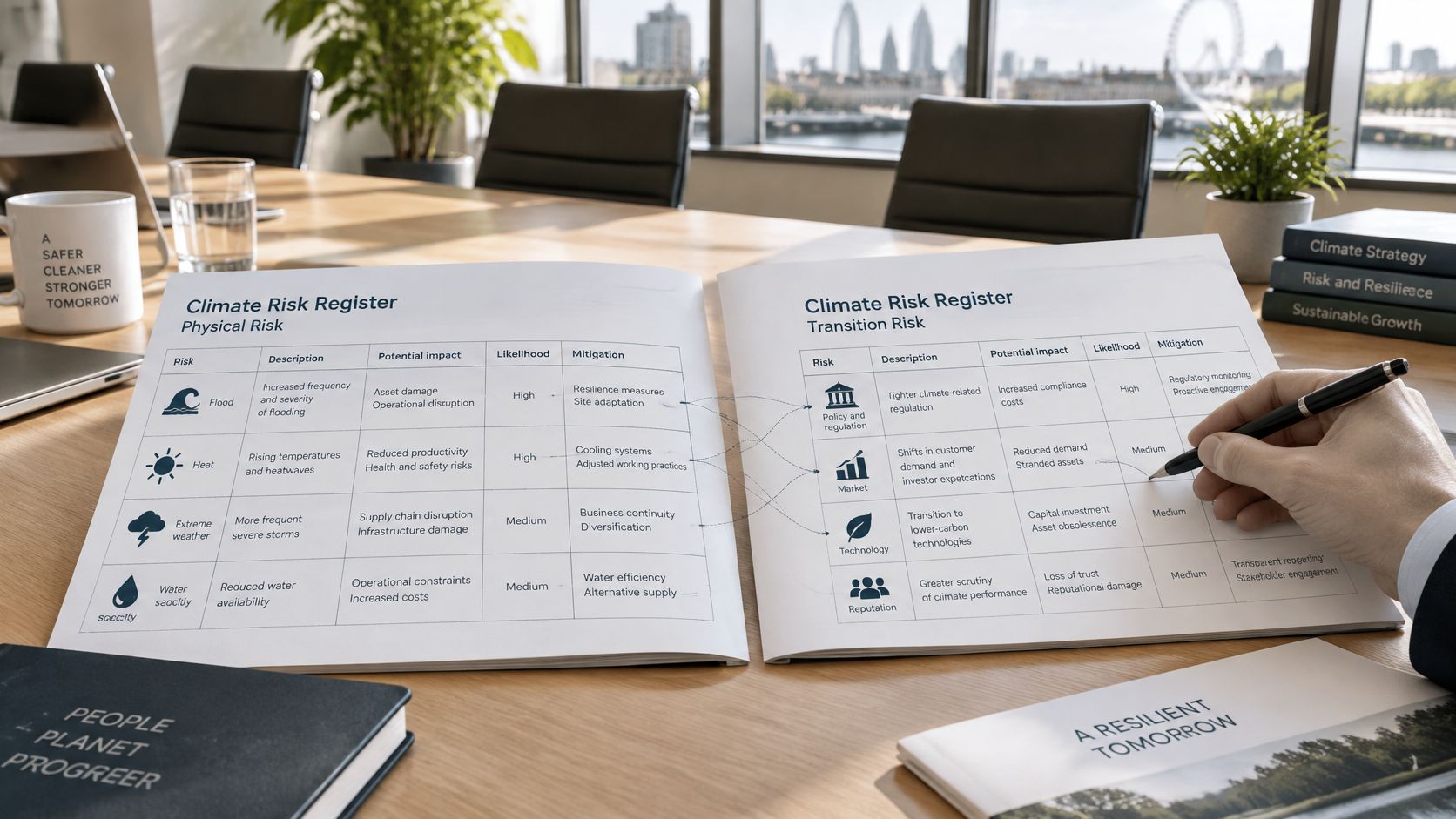
The government's 2025 adaptation response identifies 14 climate-risk systems requiring clear, measurable objectives and delivery plans, and proposes stronger reporting of climate-risk and adaptation plans by generators, network operators and regulators, as set out in the government's response to the Climate Change Committee's 2025 adaptation progress report. Fourteen systems is a useful scope check for your own register.
| Risk type | Example exposure | Measure to track | Typical owner |
|---|---|---|---|
| Transition: policy change | Carbon price rise raises operating costs | Carbon cost per tonne against budget | Finance director |
| Transition: technology change | Equipment reaches end of life before its planned replacement | Asset replacement schedule | Operations director |
| Transition: demand change | Customers shift away from high-carbon products | Share of revenue from low-carbon products | Commercial director |
| Physical: flooding | Site or key supplier located in a flood zone | Number of sites in flood zones | Estates or risk lead |
| Physical: heat | Cooling demand rises and staff working limits are reached | Days above the agreed temperature threshold | Facilities lead |
| Physical: water stress | Process water shortfall in dry periods | Water use against available supply | Operations lead |
| Physical: supply-chain disruption | Critical supplier cannot operate after an extreme event | Share of spend with single-source suppliers | Procurement lead |
Set thresholds where you can. A defined number of days above an agreed temperature triggers a cooling action. A defined share of spend with single-source suppliers triggers a contingency plan. Thresholds turn a register into a control.
Two practical points get missed. Adaptation spend competes with abatement spend for the same capital, so a heat pump programme and a cooling upgrade have to be approved in the same conversation rather than in separate budget cycles. And the scenario assumptions belong in the register itself, so that when a climate projection changes, you can trace the change straight to the action it affects.
A plan can show falling emissions and still leave the organisation financially exposed. Resilience failure undermines transition delivery as surely as a missed target does.
Mistakes to Fix and Sign-Off Checks
Most drafts that come back to the author fail for one of seven reasons, and none of them is a shortage of ambition. They're authoring faults, and they're fixable in a week if you catch them before the board does.
- Narrative only. The document has no owners and no dates. Fix it by attaching an owner, a decision gate and a delivery date to every action, without exception.
- Unlabelled proposals. Approved and proposed actions sit side by side, so readers treat the whole list as committed. Split them into separate blocks with an approval status column.
- An unfunded pathway. There's detail for 2050 and no capital until 2030. Fund the first two to three years properly and label everything beyond that as indicative.
- Scope 3 without a method. The estimates have no calculation note. Add a methodology line and a data-quality rating for each category, so a reviewer can see which numbers are measured and which are modelled.
The three that surface after publication
A mismatch between the plan and the annual report is the most damaging of the remaining three, because it's the one an investor spots first. Reconcile the two documents line by line before either goes out, then keep them reconciled at every reporting cycle.
The second is a plan with no divergence trigger. Progress lags, nobody has said what happens next, and the plan ages out. Name a review owner and the margin that triggers corrective action while the document is still in draft.
The third is a plan that gets published and forgotten. Diarise the refresh and the annual progress report, give both a named owner, and treat the plan as a live document with version control rather than a one-off publication.
Worth noting what the external picture looks like. In 2025, 41% of businesses in England, Scotland and Wales reported no barriers to decarbonising, up from 27% in 2024, based on a survey of 1,002 businesses reported by Ofgem's business and energy sector research. If the barrier isn't cost or access, it's usually the plan's own design.
Before signature, run four checks with the board.
- Frameworks recorded. Which obligations apply, which you're voluntarily adopting, and the date each decision was taken.
- Risk owners complete. Every row in the dual-risk register has a name against it, including the physical risks.
- Board minute in place. The approval is recorded, with the version of the plan that was approved.
- Finance has stressed it. At least one stressed assumption has been modelled, with the result minuted.
Our ESG consulting services include Climate Action Plans built to the Transition Plan Taskforce framework and covering ambition, action and accountability. One senior consultant leads each project from scoping through to sign-off, and the person who scoped the work is the person who delivers it. Prospective clients who prefer email can write to hello@esgconsulting.co.uk.
The single test of a credible transition plan: every number traces to a source, every action has an owner, and every funded action has a date.
If your plan needs to survive a board, an investor and an assurance provider in the same quarter, ESG Consulting builds transition plans and Climate Action Plans to the Transition Plan Taskforce framework, with actions costed, sequenced and owned from the start. Every engagement opens with a written scope and a fixed fee, led by one senior consultant from scoping through to sign-off. Bring your draft or your blank page, and we'll tell you what it needs before it reaches the board.