internal auditors course, internal audit training, CIA qualification, internal audit apprenticeship, audit competency UK
Internal Auditors Course: What to Learn and How to Choose
By ESG Consulting Team · · 15 min read
You've been handed assurance work and told to get up to speed. Perhaps you're a finance manager at an NHS trust who now liaises with internal audit. Perhaps you run sustainability reporting for a listed company and your audit committee has started asking who tested the emissions figures. You open three tabs, one for an apprenticeship, one for a professional qualification, one for a university master's, and all three use the same words to describe different things.
The confusion is worth clearing up early, because an internal auditors course isn't a single product. In the UK it's a set of routes that differ in level, length, funding and, most of all, in what they prove once you finish.
The differences matter most at the point of proof. A workshop proves you attended. A qualification proves you were assessed. An apprenticeship proves both, in a workplace, over years.
Table of Contents
- Internal Auditors Course Routes Compared
- Who Should Take an Internal Auditors Course
- What the Course Should Teach Across the Audit Lifecycle
- Competency Levels and Qualifications to Expect
- Independence, Competence and Proving You Learned It
- Sustainability Assurance and Analytics Modules Worth Checking
- How to Assess a Training Option Before You Enrol
- Choose Your Route and Confirm It Fits Your Role
Internal Auditors Course Routes Compared
Four routes account for almost every UK enquiry. Line them up before reading the detail, because the differences are structural rather than cosmetic.
| Route | Level or recognition | Typical duration | Cost or funding | Outcome |
|---|---|---|---|---|
| Level 7 Internal Audit Professional apprenticeship | Level 7, equivalent to a master's | 36 to 42 months | Maximum funding £17,000 | Eligibility for CIA certification |
| IIA Practitioner-level qualification | Professional qualification | Part-time study alongside the role | Provider fee, confirmed at enrolment | Theoretical knowledge baseline for practice |
| Master's degree in internal audit | Postgraduate, Level 7 | Set by the university's academic calendar | University tuition fee, set per institution | Advanced theory and research |
| Short workshop or online course | Non-accredited | Days to weeks | Day rate or course fee set by the provider | Refresher on a single skill |
The Level 7 Internal Audit Professional apprenticeship carries the firmest published terms, which makes it the easiest route to reason about. The apprenticeship standard published by Skills England classifies it at Level 7, equivalent to a master's degree, and states it typically takes 36 to 42 months depending on prior qualifications and relevant work experience. Employers generally require at least three A levels or equivalent.
What you hold at the end is more than a record of attendance. Completion includes eligibility for Certified Internal Auditor (CIA) certification, and the standard defines the role in a way worth reading twice: independent, objective assurance and consulting activity intended to add value and improve organisational operations. That's the gap between a course that teaches you to check financial records and one that teaches you to test governance, risk management and internal-control systems.
Funding sets the ceiling. The same government listing puts the maximum funding amount at £17,000 for the programme, which tells a board, a trust or a listed company what public support will cover, and the multi-year span tells them how long they're committing a member of staff.
The IIA Practitioner-level qualification is the usual theory baseline for practice, studied part-time around a job. A master's in internal audit suits readers who want advanced theory and research, or whose employer specifies a postgraduate credential by name. A short workshop refreshes one skill in days and carries no formal recognition, which is fine when the gap is narrow and expensive to leave open.
Durations and costs on the non-apprenticeship routes are set provider by provider, so confirm them before you compare anything.
The reading rule: match the route to the role you hold, the time you can give and whether the route ends in a recognised credential. A course that satisfies none of those three is a hobby.
Who Should Take an Internal Auditors Course
Start with your role, not the syllabus. Five groups enrol, and each one is buying something different.
- Finance, risk and compliance staff moving into audit get a repeatable method for planning, testing and documenting controls, instead of assembling one from whatever their predecessor left behind.
- Experienced auditors chasing senior posts get a recognised qualification that answers the competence question from a recruiter or an external quality assessor without a long explanation.
- Board and audit committee members learn to challenge an assurance report properly, starting with which controls were tested and what evidence supports the opinion.
- In-house ESG and sustainability practitioners learn how their emissions and disclosure data will be tested, so records are traceable before fieldwork rather than reconstructed after it.
- Staff at NHS trusts, government suppliers and listed companies get the competency evidence their regulated environment expects them to produce.
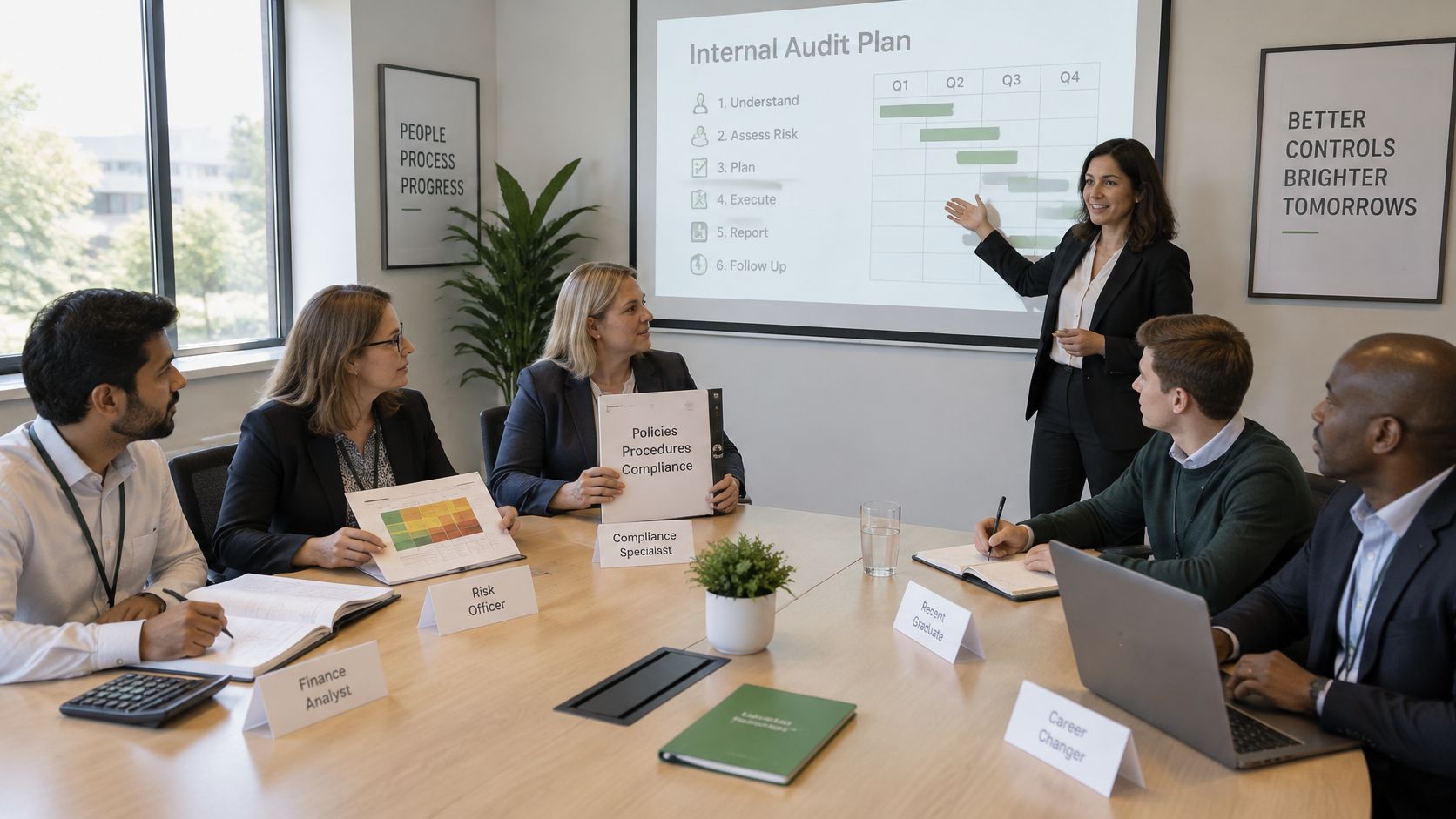
One question sorts the five. Will you be expected to give an independent opinion, or only to support someone who does? If the opinion is yours, you need a full qualification with assessed practice behind it. If you're supplying evidence to someone else's opinion, a targeted module on the specific area may be enough.
What the Course Should Teach Across the Audit Lifecycle
A serious course is built around the whole audit lifecycle, not a set of isolated accounting techniques: risk assessment and planning, control design and evaluation, fieldwork, evidence documentation, reporting, stakeholder engagement and follow-up. The UK Government's Internal Audit Competency Framework treats competency as a blend of behavioural, technical and professional capability, and expects progression across career levels. It also names data analysis as a practitioner-level capability, which means integrating analytics into engagements independently rather than watching someone else run a script.
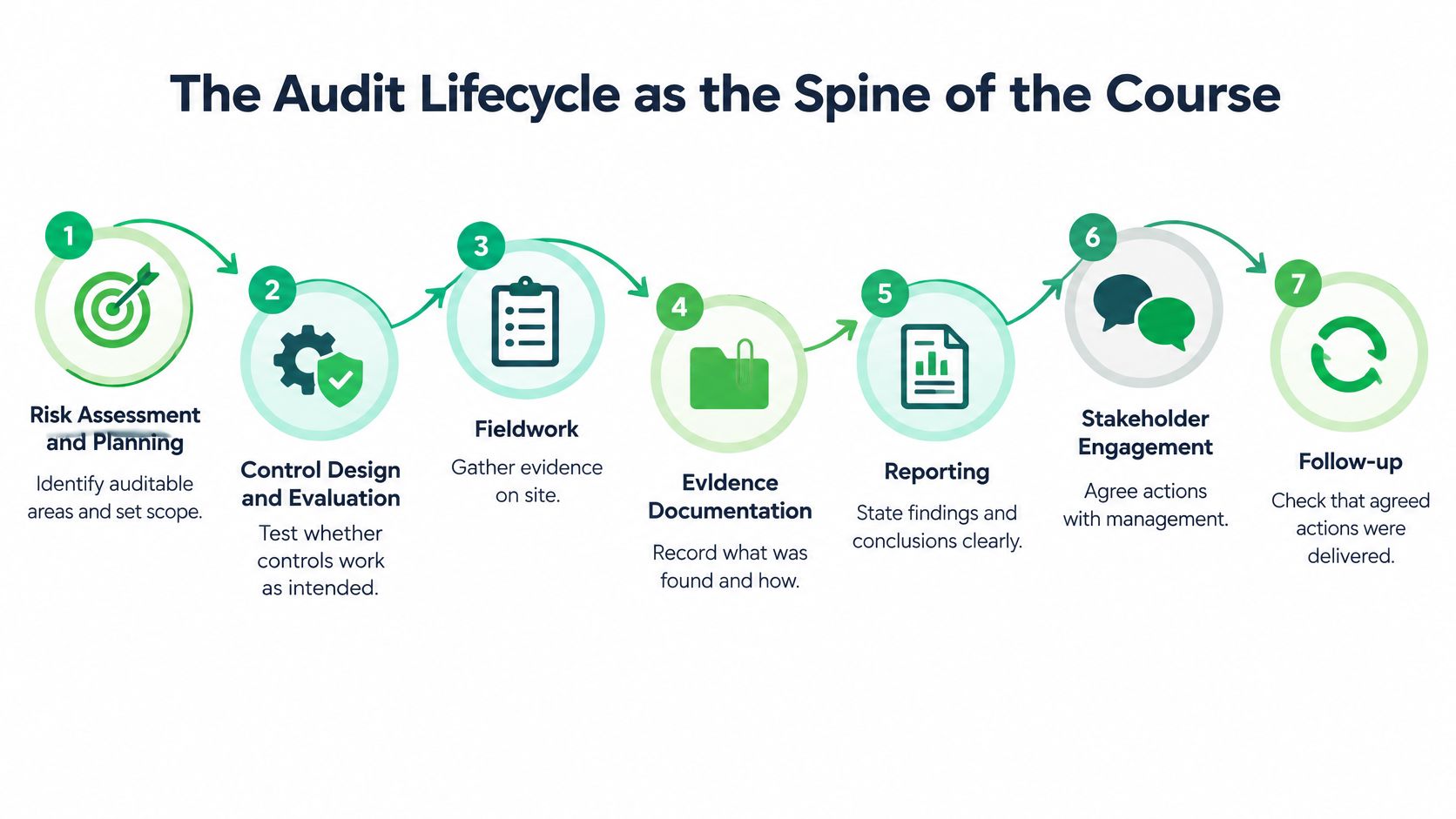
What each stage should force you to produce
A syllabus listing topics proves very little. What counts is the deliverable each stage requires you to hand in and have marked.
- Risk assessment and planning. Identify the auditable areas, score them and set scope. Your task is a risk-based plan that says what you excluded and why.
- Control design and evaluation. Decide whether the control, as written, would prevent or detect the error. Your task is a control matrix with a design conclusion for each key control.
- Fieldwork. Extract the population and test it. Your task is a sampling rationale and an exception log, not a narrative of what you looked at.
- Evidence documentation. Record what you found and how another auditor could reproduce it. Your task is a workpaper a reviewer can follow without calling you.
- Reporting. State the criteria, condition, cause, consequence and corrective action. Your task is a draft finding at audit committee standard.
- Stakeholder engagement. Agree actions with the process owner rather than announcing them. Your task is a management response with a named owner and a date.
- Follow-up. Confirm the action happened and worked. Your task is a closure memo, or a re-raised finding if the risk remains.
Design failure and operating failure are different findings
Learners confuse these constantly, and the confusion changes the conclusion. A control that was never capable of catching the error has a design failure, and the fix is to redesign it. A control that would have worked but wasn't performed consistently has an operating failure, and the fix is usually about ownership, training or oversight. Residual risk, remediation and the assurance opinion all differ between the two.
Say a manufacturer reports Scope 1 and 2 emissions. A credible test starts at the energy invoice, follows the conversion factor and the site boundary into the calculation, and lands on the reported total, with every step reproducible from the workpaper. If the boundary was drawn wrongly from the start, that's design. If the monthly meter readings were skipped in two of twelve months, that's operation.
Sampling logic, completeness and accuracy testing, spreadsheet or system-based analytical procedures, exception evaluation and an auditable workpaper trail belong in every module. A compliance checklist doesn't substitute for any of them.
What a credible course grades: a risk-based plan, a tested population, an exception log with reproducible evidence, a management action with an owner and a date, and a follow-up conclusion. If none of those gets marked, you're buying lectures.
Competency Levels and Qualifications to Expect
UK public-sector guidance treats auditor training as a staged system, not a single generic classroom product. The table below sets out the rungs.
| Career stage | Expected qualification | What it signals |
|---|---|---|
| Minimum for practising in government | Government Internal Audit Certificate (GIAC) | Baseline standard for government audit |
| Internal auditor level | IIA Diploma in Internal Audit Practice or equivalent | Practitioner competence |
| Lead internal auditor | Advanced Diploma in Internal Auditing and Management, or MIIA-level credential | Leadership of audit work |
| Beyond the baseline | MIIA or a master's in internal audit | Advanced professional recognition |
The source for that ladder is the government's Internal Audit Training and Development Handbook, which states that theoretical knowledge is normally gained through a suitable professional audit qualification, typically the Institute of Internal Auditors' Practitioner-level qualification or an equivalent route.
Read the rungs in order. GIAC is the minimum standard for practising internal audit in government, and the handbook treats it as a floor, not a destination. At internal auditor level, the expectation moves to the IIA Diploma in Internal Audit Practice or its equivalent, which is where practitioner competence is assumed rather than developed. A lead internal auditor is expected to hold the Advanced Diploma in Internal Auditing and Management or an MIIA-level credential, because the role now covers leading work rather than performing it. Beyond that baseline, the handbook encourages practitioners towards the IIA's MIIA or a master's degree in internal audit.
Use the table by finding your current stage first, then checking which qualification the course leads to and whether it clears the next rung. A course that lands you at the rung you already occupy hasn't advanced anything.
One caveat keeps this honest. The table reflects government guidance for public-sector audit. Private-sector employers, particularly in financial services and listed groups, may set different expectations and often add sector specialisms on top.
The question to put to any provider: which stage of the framework does this course prepare me for, and under which framework is that stage defined?
Independence, Competence and Proving You Learned It
A certificate doesn't justify an audit opinion, and no course should imply otherwise. The UK Public Sector Internal Audit Standards state that auditors should accept only work for which they possess the necessary knowledge, skills and experience, should continually improve their proficiency, and that the internal audit activity collectively must possess or obtain the competencies needed to fulfil its responsibilities. The obligation sits with the engagement and the team, not with a document in someone's file.

The independence test a course should set
Ask how independence is taught and listen for a scenario rather than a definition. The one to look for runs like this. An auditor is asked to assure a process they helped design in a previous role. The correct response is to decline that engagement, record the conflict in the independence declaration, escalate the scope limitation, and tell the audit committee what residual risk is left uncovered.
A course that defines objectivity on a slide hasn't taught any of that. A course that marks your written response to it has.
The same logic governs specialist knowledge. For an ESG-focused engagement, internal audit technique gets combined with carbon accounting, energy data, procurement and information-systems knowledge wherever the risk sits. Adding a generalist auditor to a specialist risk doesn't discharge the requirement.
Here's a session that walks through what objectivity looks like once an engagement is live and pressure arrives.
Evidence that you learned it, not that you attended
Annual competency mapping and continuing professional development belong in the course, because the knowledge a reliable conclusion depends on keeps moving. Data analytics and climate-related controls are the two clearest examples of methods that have changed what an auditor needs to know within a single career.
Completion is best evidenced three ways: observed performance in a live or simulated engagement, workpapers someone senior has reviewed and challenged, and a documented list of competency gaps with dates attached to closing them. Attendance records show none of that.
The test for any provider is blunt. Does this end in evidence of practice, or in a certificate that says you sat in a room?
Sustainability Assurance and Analytics Modules Worth Checking
Most syllabuses stop at technique. They cover audit planning, ISO-style checks and generic ESG concepts, then leave you without an answer to the question your audit committee will ask: how did you test a number that came out of a supplier's spreadsheet?
What sustainability assurance actually demands
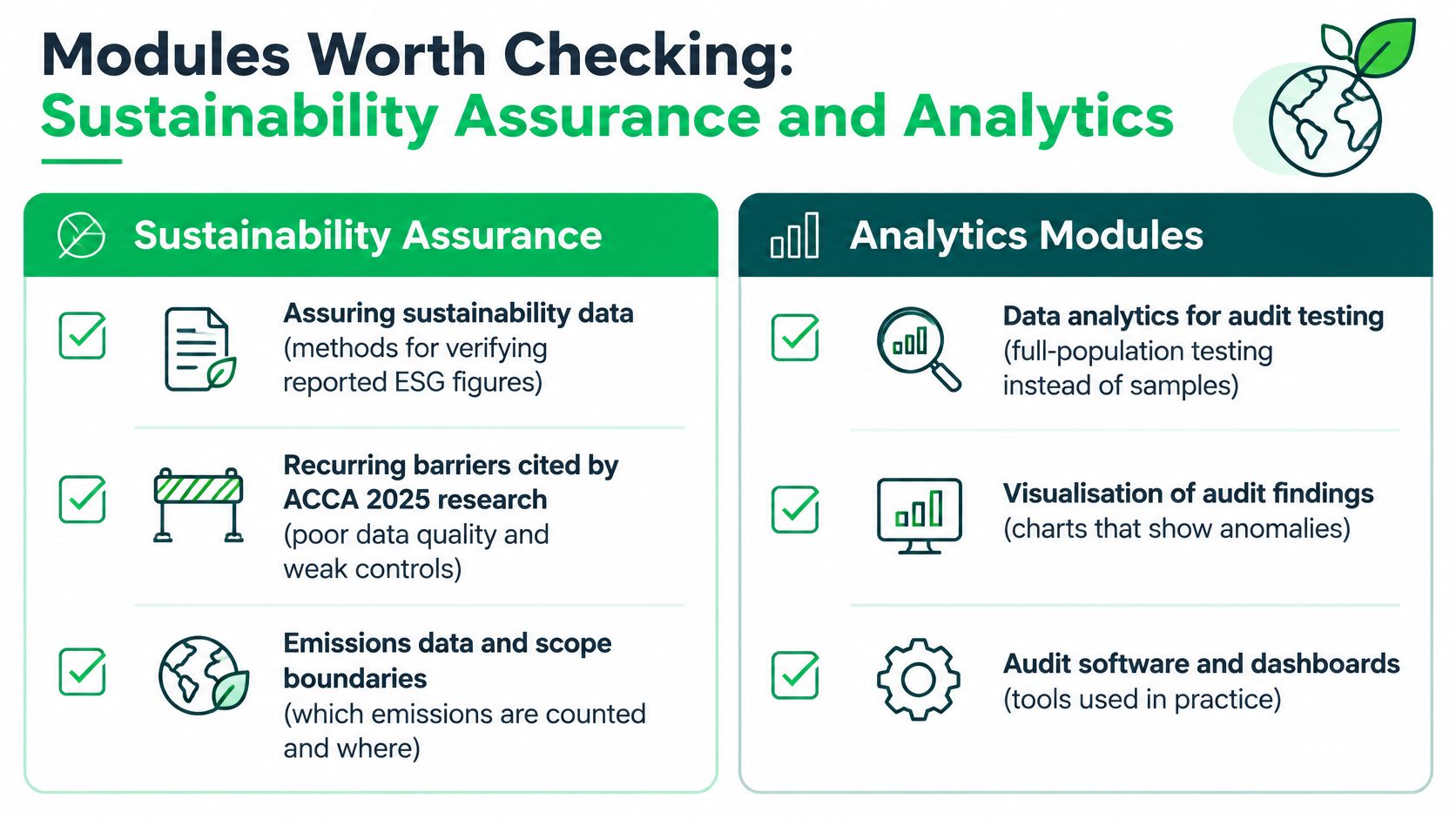
ACCA's 2025 research on controls over sustainability information, referenced in Deloitte's internal audit analytics research, identifies poor data quality and fragmented sources, unclear frameworks, insufficient skills and resources, weak leadership support, and immature processes as recurring barriers. In its survey, 56% of respondents rated lack of skills and knowledge as a high or very high impact challenge, and the same share said the same about lack of resources.
Sustainability assurance isn't financial audit with ESG nouns swapped in. Auditors assess estimates, supplier data, calculation methods and regulatory boundaries that move between reporting cycles, while staying out of management's seat. A strong course uses UK casework across:
- SECR and ESOS, where energy data and site coverage are testable against source records.
- Scope 1 to 3 inventories, where boundary and methodology decisions drive the reported number.
- UK SRS and ISSB readiness, where first-cycle reporting needs a control matrix before it needs a narrative.
- Audit trails and external-assurance hand-offs, where your workpaper becomes someone else's evidence.
The analytics questions a course should answer
Deloitte's 2025 Internal Audit Digital and Analytics Survey reports a strong focus on training and upskilling in both basic and advanced analytics, and its global chief-auditor research says 91% of functions place strong emphasis on training and development because of the digital-skills gap. Useful modules answer specific questions rather than selling software.
- When is Excel sufficient? Usually for a single-site population under a few thousand rows, where the extract can be tied back to the ledger.
- How do you test an emissions data pipeline? Trace one month end to end, then test the reconciliation between meter data, invoice and reported total.
- What controls cover automated calculations? Version control on the factor table, access restrictions on the calculation file, and a documented review before submission.
- How do you use analytics without becoming the process owner? Test and report; never build or maintain the report you'll later assure.
- How do you present the result to an audit committee? One chart, one exception count, one risk statement, one action with a date.
The benchmark underneath all of it is traceability: every figure traces to source data, with the method, boundaries and assumptions documented for whoever signs the opinion. That's how disclosures are built at ESG Consulting's ESG consulting practice, and it's the standard to hold a training provider to as well.
How to Assess a Training Option Before You Enrol
The syllabus matters less than the assessment, so judge every option on six criteria and note the red flag beside each one.
| Criterion | What good looks like | Red flag |
|---|---|---|
| Curriculum | Covers the full audit lifecycle with assessed workpapers | Mostly theory or accounting checks only |
| Assessment | Observed performance and reviewed workpapers | Attendance certificate only |
| Qualification link | Clear route to a recognised credential such as CIA or an IIA Diploma | Vague claims of certified status |
| Sector fit | Public-sector or ESG casework relevant to your organisation | Generic examples only |
| Analytics depth | Data lineage, sampling and exception testing | Software module with no control context |
| Continuing development | Annual competency mapping and CPD support | No support after the course ends |
Run five checks against a real provider. Request the module list mapped to the lifecycle, so you can see whether planning, fieldwork, reporting and follow-up are each taught. Ask for a sample assessment brief and an anonymised workpaper, which tells you more about the expected evidence standard than any brochure. Confirm the named qualification is recognised by the body whose standards you must meet.
Then ask how much observed practice or supervised casework is included, and compare the price or funding against the route table earlier in this article. Write the questions down before the first call so answers from different providers sit side by side.
Choose Your Route and Confirm It Fits Your Role
Decide in three moves. First, place yourself on the qualifications ladder so you know which rung the course has to reach, not just which topics it covers. Second, pick the route that fits your timeline and funding: an apprenticeship suits a multi-year commitment with employer support, while a workshop suits one specific refresh.
Third, shortlist only the courses that survive the criteria checklist, then test that shortlist against your own reporting. If you report emissions or climate data, the course must cover sustainability assurance and analytics, not audit technique alone.
The verdict rule: if you must give an independent opinion, choose a route that ends in a recognised qualification. If you only support audits, a targeted module may be enough.
When you do speak to providers, notice who picks up. At ESG Consulting you get a speaking call with a specialist who knows the subject rather than a sales team, which is the fastest way to find out whether a training plan matches the assurance work you're facing.
Write each provider's answers beside your shortlist, check them against your current role and your budget, and only then enrol.
If your team is preparing for assurance over SECR, ESOS, Scope 3 or UK SRS disclosures, ESG Consulting can review what you have before an auditor does, from scoping through to sign-off, with every figure traced to source data and the method documented. Engagements move through scoping, data collection, drafting and sign-off with one named lead consultant accountable throughout. Visit ESG Consulting to start with a conversation about which obligations apply to your organisation before anything is built.