internal carbon price, shadow carbon price, carbon pricing UK, carbon value appraisal, Green Book carbon
Internal Price of Carbon: How UK Firms Set and Use It
By ESG Consulting Team · · 15 min read
If your company publishes an internal price of carbon but approves exactly the same projects as before, what has the price changed? A number in a sustainability report isn't automatically a financial control. To influence decisions, finance teams need to apply it to project comparisons, procurement criteria and approval thresholds.
The useful starting point isn't “What should we charge per tonne?” It's “Which decision should change when emissions have a value?” That question helps UK organisations distinguish a working investment tool from a disclosure exercise.
Table of Contents
- What an Internal Price of Carbon Really Means
- Four Common Ways to Set an Internal Carbon Price
- Choosing a Price Level from UK Reference Points
- Governance That Keeps the Price Honest
- How to Apply the Price in Investment Appraisal
- Using the Price in Procurement and Supplier Decisions
- Confirm the Purpose of Your Price Before You Set a Number
What an Internal Price of Carbon Really Means
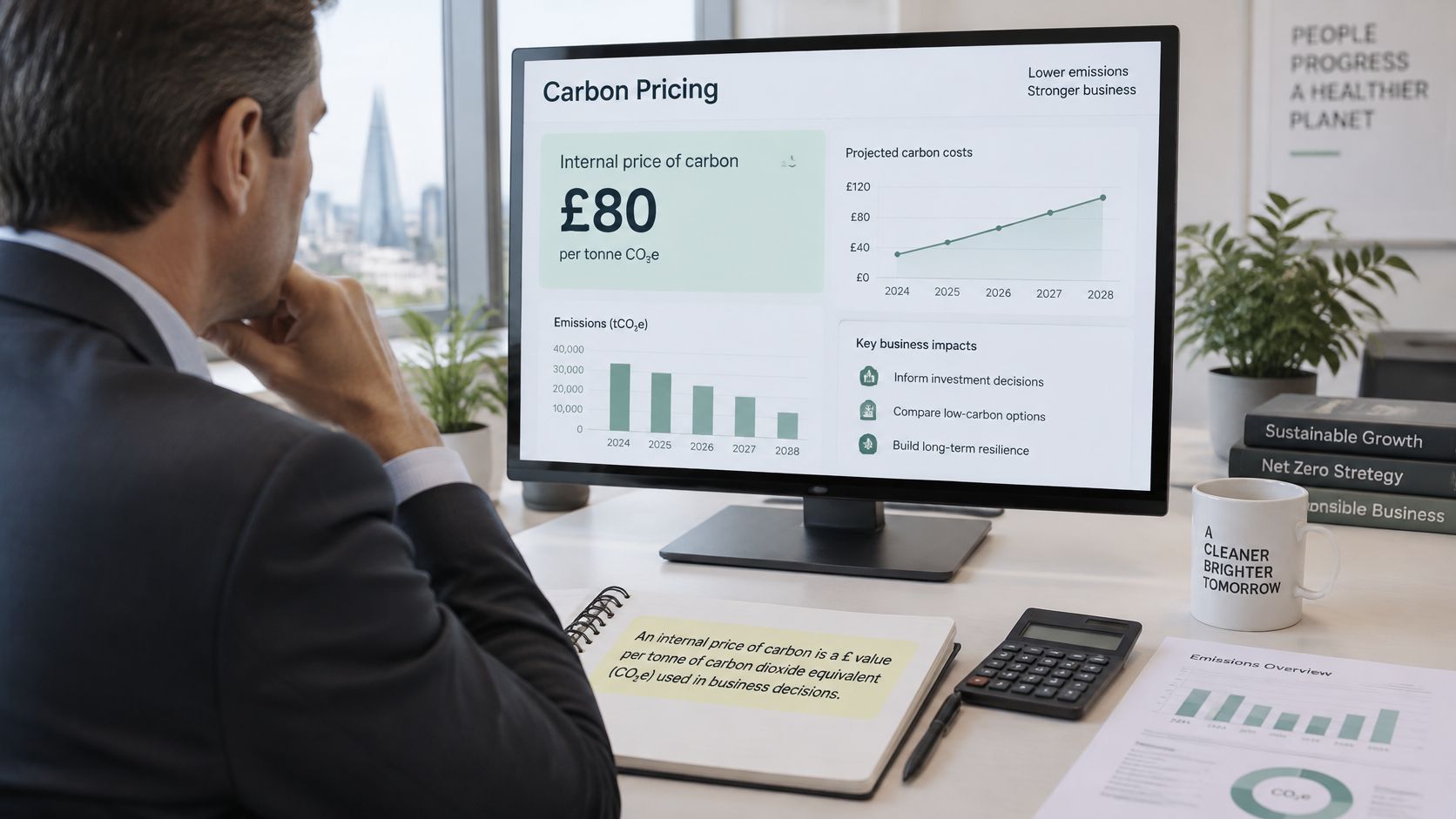
An internal price of carbon is a monetary value per tonne of carbon dioxide equivalent, or tCO2e, that a business applies to emissions inside its own decisions. Carbon dioxide equivalent puts different greenhouse gases on a common measurement basis, so a tonne of methane and a tonne of CO2 can sit in the same appraisal.
A shadow price changes an appraisal without moving money. It works like a traveller mentally converting a foreign price into pounds: no second payment happens at the till, yet the conversion still shapes whether the purchase seems sensible. Finance teams attach a notional carbon cost to competing assets in the same way, without paying that amount to anyone.
A decision value, not a market quotation
An organisation sets its internal price for a defined purpose, such as comparing investments or testing resilience against future policy. That makes it different from a tax paid to government, a traded market price and a forecast of what an allowance will cost, although any of those figures can inform the level chosen.
The UK Government's own public appraisal uses a carbon value derived from a target-consistent marginal-abatement-cost approach, as set out in the HM Treasury Green Book, rather than an observed market price. In plain language, the appraisal asks what it costs to cut emissions in line with climate targets.
The UK Emissions Trading Scheme is a separate traded system covering power generation, energy-intensive industries and domestic aviation. Its allowance price answers a different question: what compliance costs today, rather than what abatement is worth over time.
Practical test: Ask what happens when the carbon-adjusted comparison favours a different option. If nobody must reconsider, explain or approve the original choice, the price isn't functioning as a decision control.
A working price doesn't have to determine every outcome. Safety, affordability and operational requirements still matter. But it should create a documented consequence, even when that consequence is escalation to an investment committee rather than automatic rejection.
Four Common Ways to Set an Internal Carbon Price
Internal carbon pricing approaches compared
| Approach | How it works | Money changes hands | Best for | Typical example |
|---|---|---|---|---|
| Shadow price | Notional £/tCO2e applied in appraisal only | No | Choosing which capital projects to fund | Comparing a boiler upgrade with a fabric retrofit at one agreed £/tCO2e |
| Internal carbon fee | Business units pay a set £ per tonne of emissions | Yes, internal transfer | Changing operational behaviour and funding abatement | Fee proceeds ring-fenced for a decarbonisation fund |
| Abatement cost | Price set at the cost of the cheapest genuine tonne of reduction | No | Sequencing measures in a net-zero pathway | Ranking heat pumps, LED lighting and fleet electrification by cost per tonne |
| Tiered or scenario price | Base shadow price plus a higher sensitivity price for exposed assets | No | Stress-testing transition and regulatory risk | Base price for allocation, higher case for assets exposed to future rules |
These approaches answer different management questions. They can also coexist, provided finance teams distinguish a notional appraisal adjustment from an actual internal payment.
The visual below places internal pricing within a broader family of mechanisms, including implicit costs and internal emissions allowances.
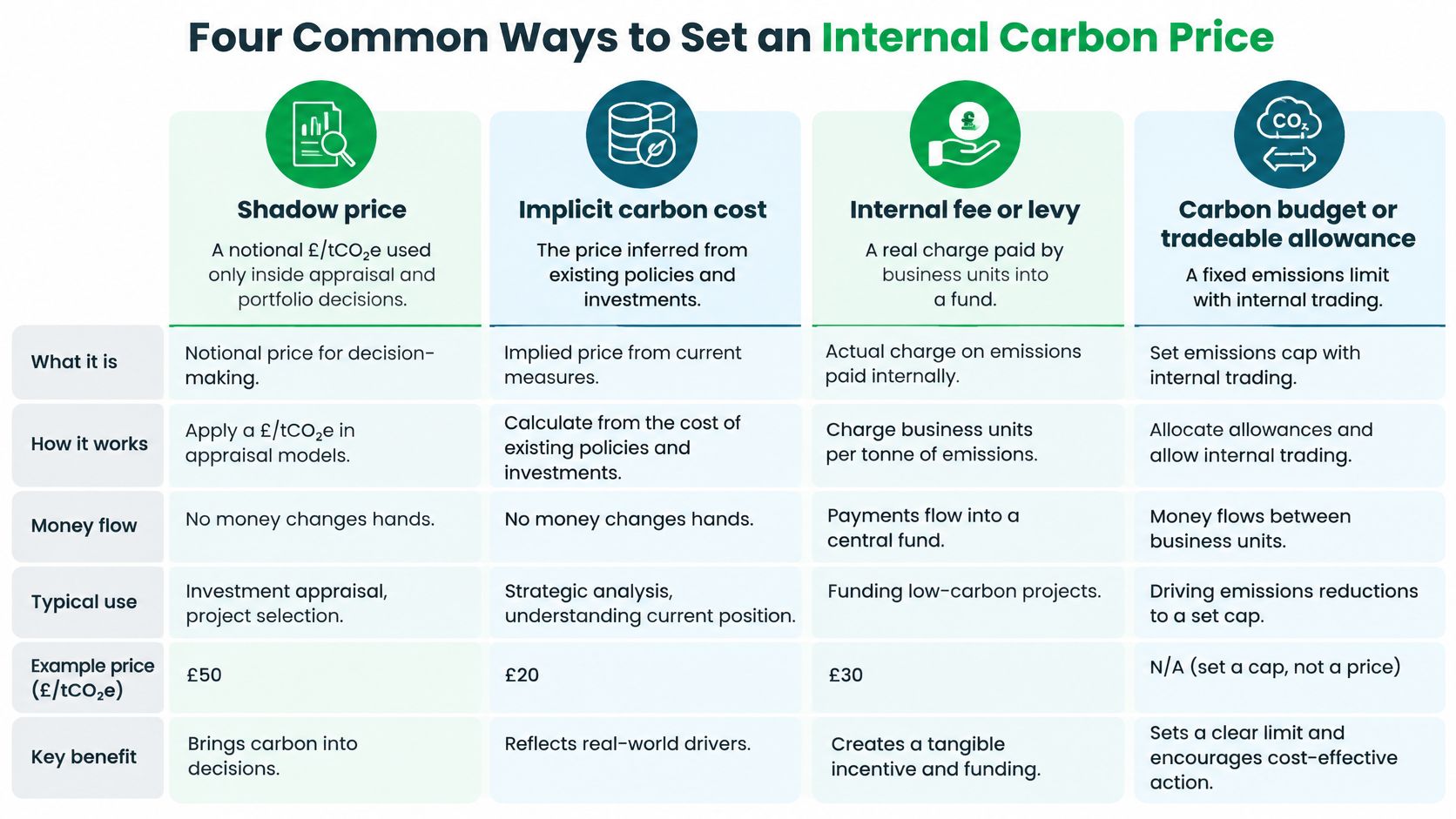
Match the mechanism to the problem
A shadow price suits capital allocation. Apply the same assumptions to competing projects so that a team can't make its preferred option look better by excluding inconvenient emissions. Its limitation is straightforward: it doesn't create a budget for implementation.
An internal fee creates an actual transfer from business-unit budgets. Ring-fencing the proceeds for decarbonisation connects the charge to practical improvements. Define who pays, which emissions they control and how projects receive funding, otherwise managers may see the fee as an overhead they can't influence.
An abatement-cost approach asks what a genuine reduction costs after accounting for relevant investment and operating effects. Begin with the cheapest feasible measures, but don't assume their cost will represent the entire pathway. Dependencies, replacement cycles and operational constraints can change the order.
A tiered price separates the allocation assumption from a more demanding sensitivity. This is useful for long-lived assets exposed to changes in regulation, customer requirements or energy systems. The higher case tests vulnerability; it isn't automatically a prediction.
For an audiovisual introduction to internal carbon pricing, the following video provides another way to approach the topic.
Choose by decision: use a shadow price to compare projects, a fee to establish budget accountability, abatement costs to sequence measures, and scenarios to test transition exposure. Don't choose a fee merely because it looks more ambitious, or a shadow price merely because it's easier to administer.
Choosing a Price Level from UK Reference Points
A reference figure only helps if you know what was being priced. Choosing a carbon price from published sources works like using a comparable in a valuation: two numbers can look similar while measuring entirely different things. Read the basis column before the value column.
UK reference points for choosing an internal carbon price
| Reference point | Value | Basis | Best use |
|---|---|---|---|
| UK ETS price, 2025 determination | £41.84/tCO2e | Prior-year UK allowance-market data, in the government determination | Compliance exposure and market context |
| Observed UK internal figures, 2025 | £45 to £110/tCO2e | Cambridge Ahead report | Peer benchmark for board discussion |
These aren't competing estimates of the same thing. A civil-penalty calculation reflects the cost of failing to surrender allowances, while a peer survey reports what companies happened to disclose. Averaging the two produces a figure that answers neither question. Government appraisal values sit on a different basis again: they estimate the cost of abating a tonne of carbon for public-sector project assessment, so corporate teams can borrow the method while still setting their own level.
Match the reference to the decision it will control. For compliance exposure, examine the allowance-market assumptions and the emissions your operations cover. For investment appraisal, choose a shadow value suited to the ranking decision in front of you. For transition risk, test a range and record which assumption changed the outcome.
Keep the price basis consistent
A value expressed in constant prices uses the purchasing power of a stated base year. A nominal forecast includes the assumed effect of inflation. Finance teams should reconcile that distinction before combining carbon values with future operating costs.
Likewise, don't apply a current-year value unchanged across an asset's life without documenting why. A price schedule and a flat price are different modelling choices, and the investment committee should know which it is approving.
A practical selection sequence is:
- Establish the appraisal benchmark. Take a published appraisal value as an input, then test it against what your own abatement options cost.
- Test the bounds. Check whether a higher or lower carbon assumption changes project ranking or creates a need for further review.
- Compare operational evidence. Use peer figures such as the Cambridge Ahead range to challenge the proposal before seeking approval.
The number alone changes very little. It starts to matter only when it is written into investment thresholds, procurement scoring and the approval paper, so the board paper should explain why the selected reference suits the decision it governs. "Other companies use it" is not sufficient justification, and quoting a market price does not make an internal value objectively correct.
Avoid implying that any selected price represents the organisation's complete climate cost. It is a bounded assumption within a decision process, with a stated scope and a defined use.
Governance That Keeps the Price Honest
The CFO or finance director should sponsor the price alongside the sustainability lead. Give the board responsibility for approval and name the person who maintains the methodology. Sustainability specialists can establish the emissions logic, but finance must own how that logic affects investment decisions.
Shadow pricing is an established mechanism: the CDP technical note on carbon pricing reports that more than 60% of responding companies in its 2022 dataset used a shadow price. That finding describes CDP respondents, not all UK companies, and doesn't demonstrate that every application changed an investment.
What the approval paper should record
- Purpose. State whether the price supports allocation, risk analysis, procurement or internal funding.
- Scope and emissions boundary. Identify direct emissions, purchased-energy emissions and relevant value-chain categories.
- Price by year. Record the approved schedule rather than leaving project teams to choose their own values.
- Inflation basis. Specify the constant-price base or nominal treatment and align it with the financial model.
- Discounting treatment. Explain how future carbon values enter the appraisal and how that treatment relates to financial cash flows.
- Scenarios. State which assumptions change and why each scenario is relevant.
- Review trigger. Assign responsibility for responding to material methodology, policy, business or cost changes.
- Decision rule. Define when carbon changes ranking, triggers escalation or requires an exception.
A decision rule makes governance operational. For example, an investment committee could require a written explanation whenever a team selects a higher-emissions option despite a better carbon-adjusted alternative. That preserves management judgement while preventing silent overrides.
A sensitivity result is useful only if somebody has responsibility for acting on it.
Through our ESG advisory work, we connect sustainability information with the governance narratives that decision-makers need. Every figure we produce traces back to source data, with the methodology, boundaries and assumptions documented for the client's auditor or assurance provider.
Each business case should therefore retain emissions with and without the intervention, the applied price, annual and lifetime carbon values, and the sensitivity range. Keep calculation versions and approval records together. An assurance provider should be able to reproduce the result, not merely inspect a final chart.
How to Apply the Price in Investment Appraisal
The basic calculation is simple: change in emissions multiplied by the applicable carbon value, following the approach in HM Treasury's Green Book. The difficult work lies in defining the change correctly and deciding how the result affects approval.
The process begins with an emissions comparison, not with a preferred price.
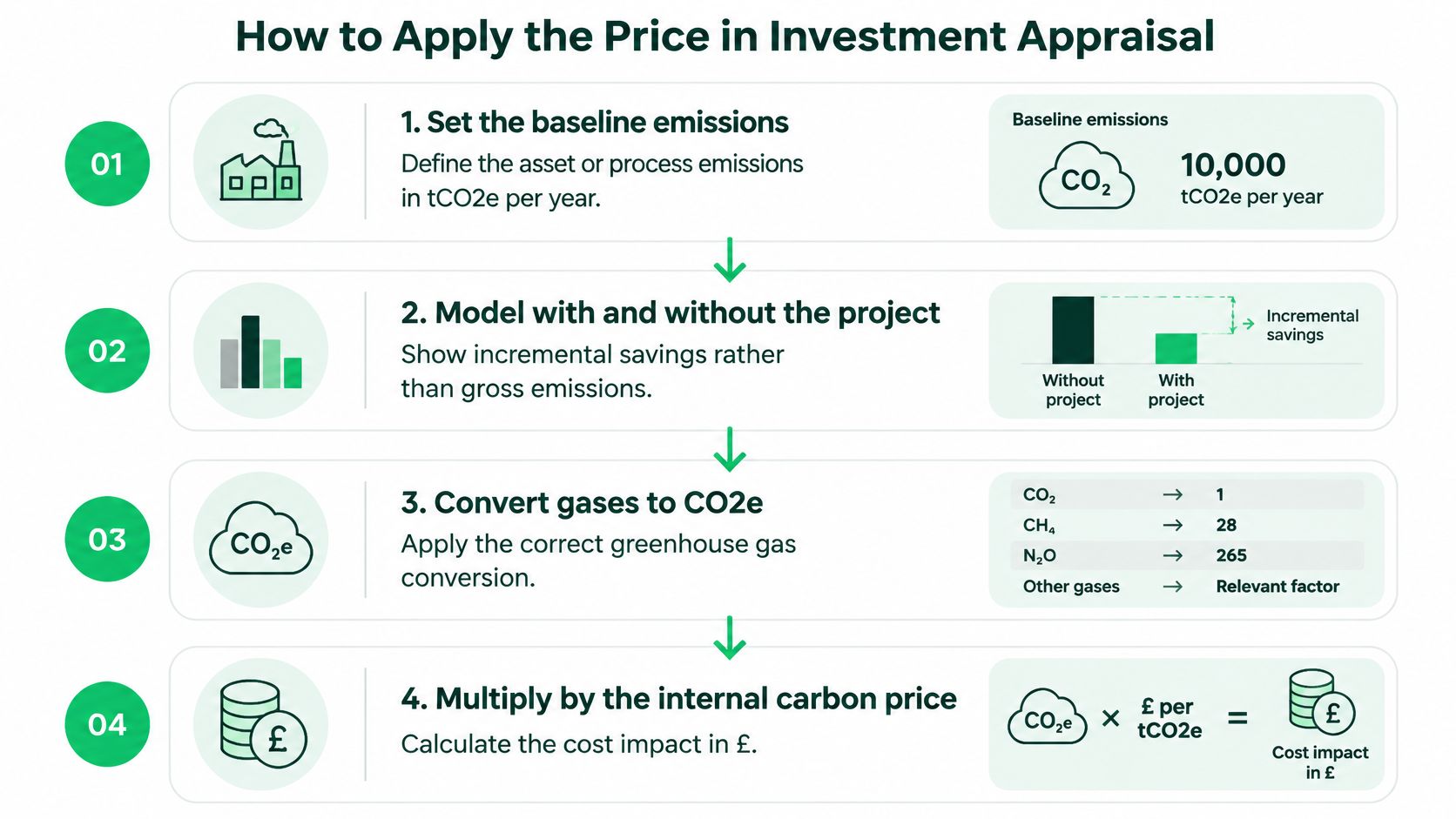
Build a reproducible calculation
Set the baseline. Define the asset or process and its annual emissions in tCO2e. Use a credible without-project case, including planned replacement or operational changes, rather than assuming today's conditions continue indefinitely.
Model both options. Calculate emissions with and without the intervention over comparable service lives. The difference is the incremental change attributable to the project, not the site's entire footprint.
Convert activity into emissions. Apply suitable emissions factors to fuel, electricity and relevant value-chain activities, converting greenhouse gases to CO2e where necessary. Check units and avoid applying a conversion twice when a factor already expresses CO2e.
Apply the approved price. Multiply the incremental emissions in each year by the corresponding internal value. For a clearly hypothetical illustration, avoiding 600 tCO2e annually at an assumed £264/tCO2e produces a notional annual value of £158,400.
Integrate the appraisal. Show the carbon-adjusted comparison alongside capital expenditure, operating savings and risk-adjusted financial returns. Discount future values consistently with the stated methodology, but don't present a shadow benefit as cash available to repay borrowing.
Run the sensitivity cases. Apply the approved lower and higher assumptions to the same emissions model. Identify whether the result remains stable, changes ranking or requires an exception.
Record the decision. State which option passed the agreed rule and who approved any departure. Retain the calculations, emissions evidence and reasons for the final choice.
Separate value from cash
A shadow value doesn't pay an energy bill. Keep a conventional cash-flow appraisal visible beside the carbon-adjusted case so that managers can distinguish affordability from strategic value. Where external carbon costs already appear in operating expenses, explain how the shadow adjustment avoids counting the same valuation twice.
Another error is giving a project credit for emissions it doesn't avoid. Buying more efficient equipment won't necessarily reduce total emissions if operating hours increase enough to offset the improvement. Model the activity assumptions, not just the equipment label.
Approval safeguard: A project that succeeds only under the highest sensitivity hasn't passed an unqualified base-case test.
The same discipline supports pathway planning. Our net-zero strategy service delivers a costed decarbonisation pathway sequenced by what abates emissions in a client's operations. Ranking measures by real reductions, cost and operational dependencies is more useful than selecting whichever initiative is easiest to announce.
Using the Price in Procurement and Supplier Decisions
Equipment with the same purchase price can have different whole-life costs once buyers account for energy use, maintenance and emissions. Add the carbon comparison before selecting a supplier, while specifications and commercial options can still change.
Consider a hypothetical logistics tender in which one supplier emits 40 tCO2e less annually for the same service. At an assumed internal price of £100/tCO2e, the notional difference is £4,000 a year. That adjustment belongs in the documented evaluation method, not in an informal judgement after bids arrive.
Compare the same service and boundary
For lease-versus-buy decisions, compare equivalent service levels, operating periods and lifecycle boundaries. A lease doesn't make equipment emissions irrelevant just because the supplier owns the asset. Include the relevant manufacturing, use and end-of-life effects without counting overlapping activities twice.
Supplier information also needs scrutiny. A measured footprint, an estimated footprint and a marketing claim aren't interchangeable evidence. Record data coverage, allocation methods and uncertainty so procurement colleagues understand the strength of the comparison.
- Publish the scoring method. Tell bidders how emissions affect evaluation and apply the same method consistently.
- Define comparable evidence. Specify the service boundary, reporting period and acceptable calculation basis.
- Check cost overlap. If a supplier passes through its own carbon charge, distinguish that cash cost from the buyer's shadow adjustment.
- Retain the rationale. Document why any higher-emissions bid was selected and who approved the departure.
Keep tender evidence separate
An internal price doesn't replace formal tender evidence or determine whether a supplier meets a buyer's requirements. Treat carbon-adjusted cost assessment and compliance documentation as distinct workstreams.
We prepare Carbon Reduction Plans to the PPN 006 technical standard, with Social Value Model responses for central government contracts. Those documents serve a different purpose from a buyer's internal valuation of competing offers.
Procurement decisions deserve the same documentation standard as investment appraisals. Preserve the price basis, emissions boundary, calculation and decision rule with the tender record, so another reviewer can understand why the chosen supplier offered the preferred overall outcome.
Confirm the Purpose of Your Price Before You Set a Number
The Government's appraisal system offers a public example of carbon valuation tied to a defined process. Corporate applications are more diverse: the Cambridge Ahead carbon-pricing report describes UK organisations using shadow prices and levies, including a portfolio with a £77/tCO2e shadow price derived from its implicit carbon cost and benchmark comparisons. The important feature is the connection between the number and its intended use.
A high price can achieve little if project sponsors can ignore it. A lower fee may support more practical action when managers have budget accountability and the proceeds fund deliverable reductions. Neither the headline number nor the mechanism alone proves effectiveness.
Evaluate outcomes, not ambition on paper
Finance and sustainability leaders should examine whether the process redirected projects, changed specifications or accelerated an operational improvement. Track tonnes avoided, marginal abatement cost and financial return alongside the approval record.
Be candid about attribution. A project may have proceeded because of energy savings, replacement needs or customer requirements even without carbon pricing. Record whether the carbon adjustment changed the decision, strengthened it or merely accompanied it.
Use a compact purpose test before approving the policy:
- Name the decision. Identify the capital, procurement or operational choice that needs a carbon signal.
- Choose the approach. Select the mechanism that fits the people, budgets and authority involved.
- Document the reference. Explain the price basis, boundaries, scenarios and rationale.
- Measure the result. Compare decisions and delivered outcomes with the expectations recorded at approval.
The price isn't a government tax, and copying an allowance quotation doesn't establish an effective internal policy. Its value comes from a consistent method and a consequence that decision-makers understand.
Start with a live investment or tender rather than an organisation-wide announcement. Ask finance, sustainability and procurement colleagues to evaluate the same alternatives, identify where their assumptions differ and agree how the carbon result will affect approval. That produces a usable control before the organisation scales it.
ESG Consulting offers carbon reporting, sustainability disclosure and net-zero strategy support to connect emissions evidence with practical investment decisions. Visit ESG Consulting to discuss your appraisal boundaries, governance requirements and costed decarbonisation pathway. You'll speak with an ESG specialist who knows the subject, not a sales team.