mid market businesses, UK ESG reporting, SECR compliance, UK decarbonisation, carbon baseline
ESG and Decarbonisation for UK Mid Market Businesses
By ESG Consulting Team · · 16 min read
The UK has 37,800 medium-sized businesses. That's 0.7% of the business population, yet those firms employ around 3.7 million people, 13% of private-sector employment, and generate about £0.9 trillion in turnover, 18% of the private-sector total, according to the government's business population estimates.
Concentration like that makes this the segment where a small policy or procurement change moves a large share of the economy. It's also where the ESG conversation gets misfiled. Most mid-market firms sit outside the mandatory reporting perimeter, and a growing number are being asked for carbon data anyway, by customers, lenders and procurement teams who turn up years before a regulator does.
So the useful question isn't whether to "do ESG". It's what evidence to build, in what order, and when a proportionate footprint beats a compliance-style report that nobody funds. That starts with definitions, because a mid market business can be an SME by headcount and a large company by turnover on the same afternoon.
Table of Contents
- How UK Mid Market Size Is Defined
- Which ESG Reporting Rules Apply to Your Business
- Legal Duty, Buyer Demand and Investor Pressure
- Build a Defensible Carbon Baseline Without Common Errors
- Ranking Decarbonisation Projects Worth Funding
- Confirm Your Obligations Before You Build Anything
How UK Mid Market Size Is Defined
There's no single legal definition, so the same firm can be mid-sized in one dataset and an SME in another.
| Source | Measure | Band it uses |
|---|---|---|
| British Business Bank | Annual turnover | £10 million to £500 million |
| Department for Business and Trade | Employees | 50 to 249 employees |
| HM Revenue and Customs | Turnover or headcount | Turnover above £10 million or at least 20 employees |
The British Business Bank's access to finance analysis defines mid-sized businesses by annual turnover of £10 million to £500 million, and its population of 25,102 eligible UK business leads shows most sit close to the bottom of that range. 57% generated £10 million to under £25 million, 21% generated £25 million to £50 million, and only 10% generated more than £100 million.
The finding that matters most for anyone advising this segment is the overlap with the SME world. 81% of those turnover-defined mid-sized businesses had fewer than 250 employees, so they qualify as SMEs on the standard headcount measure despite revenue that puts them alongside far larger corporates in commercial terms.
HM Revenue and Customs draws the line differently again, counting businesses with UK turnover above £10 million or at least 20 employees, a definition that captured approximately 320,000 mid-sized businesses in its 2023 mid-sized business customer survey. The gap between 320,000 and 37,800 is definitional, not economic. It tells you which test a business passes, not how big it really is.
That is how ESG scoping goes wrong. A 120-person manufacturer with £40 million of revenue is an SME to a lender using headcount and a significant supplier to a procurement team assessing spend. The regime may not apply while the expectation does.
Test to run first: pull headcount, turnover and balance sheet total for the last financial year, then check each regime against the measure it actually uses rather than the one your business uses to describe itself.
The rest of this article uses turnover bands when discussing reporting thresholds and headcount when discussing supplier, procurement and energy-audit tests, because that's how the regimes themselves do it.
Which ESG Reporting Rules Apply to Your Business
The rule set is shorter than the acronym list suggests, and the column most mid-market firms land in is the last one.
| Regime | Applies to | Status | Main obligation |
|---|---|---|---|
| SECR | Large unquoted companies and LLPs meeting two of the three large-company tests | Mandatory | Energy use and Scope 1 and 2 emissions in the annual report |
| ESOS | 250+ staff, or turnover above €50m and balance sheet above €43m | Mandatory, four-year cycle | Energy audit of buildings, transport and processes |
| UK SRS S1 and S2 | Any company, unless adopted by a regulator | Voluntary for now | Sustainability-related financial disclosures |
| CSRD | Non-EU groups with large EU turnover, and EU subsidiaries above thresholds | Mandatory only if in scope | Sustainability statement under ESRS |
| Carbon Reduction Plan (PPN 006) | Suppliers bidding for central government contracts above the stated value | Mandatory to bid | Published plan with emissions and reduction actions |
| SFDR | Asset managers with funds marketed into the EU | Mandatory if in scope | Article 8 or 9 fund disclosures |
| Buyer and lender requests | Any supplier or borrower | Voluntary but commercially required | Carbon data in questionnaires and covenants |
The rows most mid-market firms meet first
SECR is the regime finance directors ask about and the one most of them don't trigger. It applies to large unquoted companies and LLPs that meet two of three tests covering turnover, balance sheet total and employee numbers. Meet two and you're in. Meet one and you're out, and no amount of customer pressure changes the statutory position.
ESOS is the regime that catches lean, high-revenue firms, because it tests headcount at 250 or more, or turnover above €50 million with a balance sheet above €43 million. A £40 million-turnover manufacturer with 120 staff sits outside it; a wholesale business with the same headcount and a heavier balance sheet may not. The cycle is four-yearly and the deliverable is an energy audit across buildings, transport and processes.
Carbon Reduction Plans arrive as a bid document rather than a filing. Where a central government contract sits above the stated value under PPN 006, a published plan with emissions and reduction actions becomes a condition of tendering, which puts a deadline on a business that has never measured anything.
Practical rule: work down this table in order of who can stop you trading, not in order of which statute sounds most serious.
Where most firms actually sit
UK SRS S1 and S2 remain voluntary unless a regulator or government adopts them for a given cohort. CSRD reaches a UK business only through EU subsidiaries or large EU turnover, and its thresholds moved under the EU simplification package, so check current figures rather than last year's summary. SFDR applies to asset managers marketing funds into the EU, which matters to a mid-market firm mainly through its lender or its private-equity owner.
That leaves most mid market businesses in the voluntary column, where nothing is legally required and a great deal is commercially expected. Sector decides which row bites first. Public-sector and NHS suppliers meet procurement questions and plan requirements, manufacturers and logistics operators meet customer supplier questionnaires, and firms with a PE owner meet buyer due diligence on the way in and on the way out.
Legal Duty, Buyer Demand and Investor Pressure
A 120-person components manufacturer with £38 million of revenue wins a place on a large customer's supplier list. No statute requires it to report emissions. The onboarding pack asks for Scope 1 and 2 figures by site, a Scope 3 estimate for purchased steel, a reduction target and the method behind each number, within six weeks.

Three pressures land on that business, and they don't share a deadline or a dataset. Legal duty sets a scope, a boundary and a filing date. Buyer expectation sets a questionnaire, a format and a procurement gate. Investor or lender requirement sets covenant data, a diligence pack and a request that arrives with the term sheet.
The demand is already there
This isn't an edge case. The 2025 UK Net Zero Business Census found that 37% of medium-sized businesses with 50 to 249 employees had been asked to provide carbon data, despite being outside requirements such as SECR, according to Grant Thornton's analysis of the UK mid-market. The pressure arrives through procurement and buyer due diligence, most visibly for government suppliers, NHS vendors and private-equity-backed businesses.
The obstacle is capability, not conviction. The same census found 47% of UK organisations cited a lack of expertise and 46% found it difficult to find trusted information. That's an operational gap: people who know what to collect, in what order, and how to defend it.
"Not legally required" is not the same as "no business case". Carbon data now functions as market-access infrastructure, and treating it as a compliance question you can defer is how firms lose bids they never knew they were in.
What a non-regulated supplier should actually build
The mistake is treating this as a binary choice between doing nothing and commissioning an assurance-ready report. A staged evidence model gets a business to a defensible answer in weeks:
- Energy and fuel first. Twelve months of electricity, gas and fleet fuel invoices by site, reconciled to the ledger. This is the foundation for Scope 1 and 2 and the cheapest source of savings.
- Organisational boundary second. Every site, lease, depot and vehicle listed with an owner, so the boundary is a decision rather than an accident.
- Material Scope 3 categories third. Purchased goods, business travel, commuting and waste where they're significant, each with a stated method.
- Documented assumptions last, and continuously. What you estimated, how, and over what period. A buyer can challenge a number; a buyer can't argue with a method you've disclosed.
Watch the short briefing below on how the gap between legal duty and commercial demand plays out for suppliers in practice.
Scoping work like this is the first stage of an ESG consulting engagement: confirming which obligations apply, and which commercially motivated requests are worth answering with data rather than a holding reply, before any inventory is built.
For each request that lands, answer three questions in writing: who is asking, what they will do with the data, and by when they need it. A government buyer asking for a Carbon Reduction Plan needs a published document. A private customer's sustainability team wants a number it can aggregate upwards. A lender wants something it can put in a credit memo. Those are three different deliverables, and only one of them is usually urgent.
Build a Defensible Carbon Baseline Without Common Errors
A baseline isn't a report. It's a dated, sourced set of numbers with a stated boundary, and it can be assembled in weeks rather than quarters when the sequence is right.
Multi-site complexity is the norm in this segment. In a representative sample of UK SMEs, 56% of medium-sized businesses operated from one premises and 41% from two, while 27% used vehicles, according to the University of Bath's study of SME decarbonisation in the UK. Each extra site adds a meter, a landlord relationship and a fuel record. The same body of evidence puts commercial-sector emissions at 8% of UK greenhouse-gas emissions in 2024, down 8% on 2023 mainly because of lower electricity-related emissions, which tells you where the cheapest abatement sits.
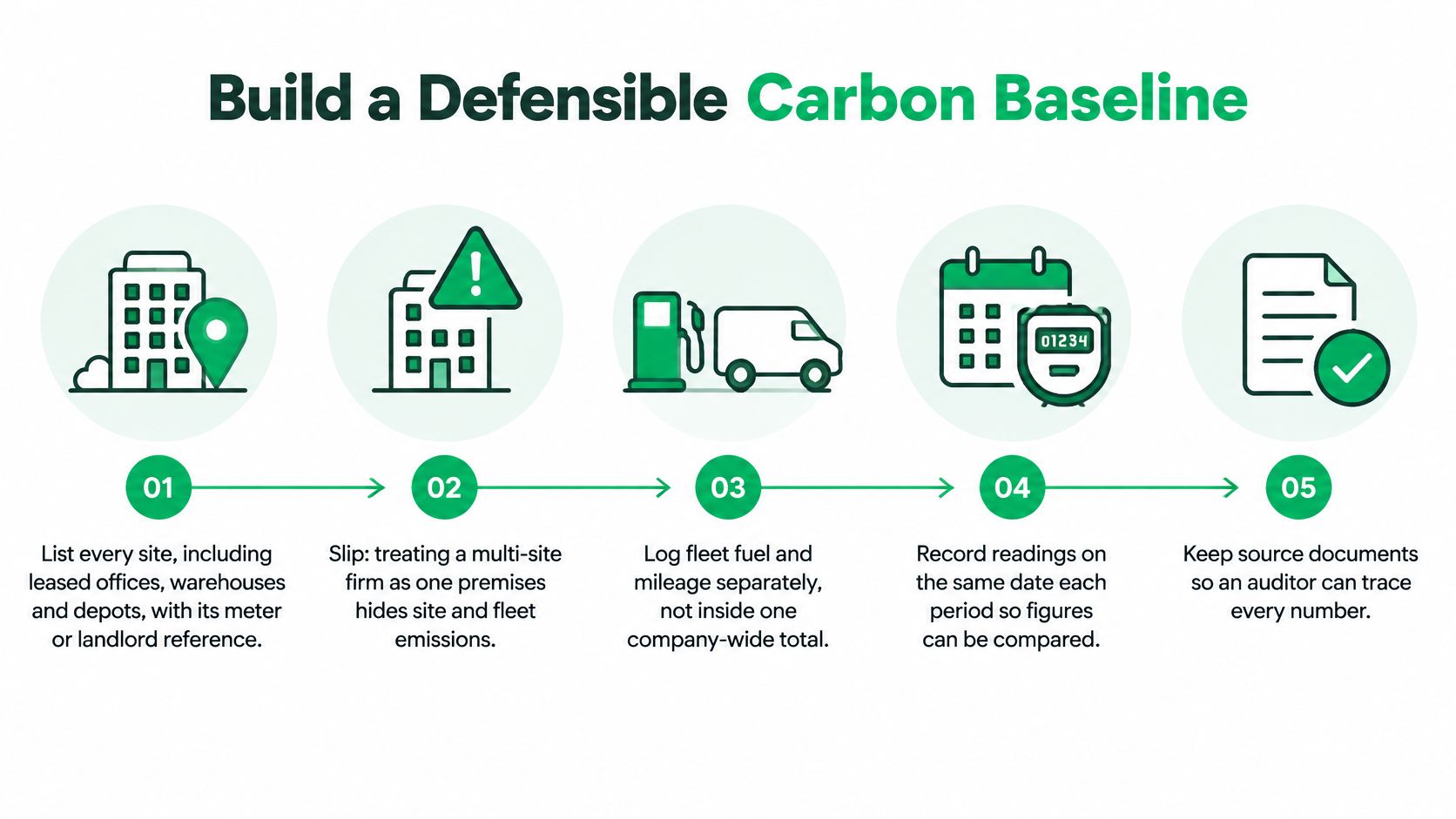
Six steps, and the slip that breaks each one
- List every site, with its meter or landlord reference. Include leased offices, warehouses, depots and yard space you don't think of as operational. The slip: treating a multi-site firm as one premises, which buries site-level and fleet emissions inside an average and makes them invisible to whoever approves the budget.
- Collect twelve months of electricity, gas and fuel invoices for each site and vehicle. Match the period across all sites so the months line up. The slip: using an estimate where an invoice exists, which costs you credibility the first time a buyer asks for evidence.
- Reconcile totals to the financial ledger. Consumption and spend should tell the same story, and the reconciliation is what catches utilities recharged through a service charge. The slip: missing landlord-recharged energy entirely, which can be material in serviced or multi-let buildings.
- Calculate Scope 1 from gas, fleet fuel and refrigerant losses, and Scope 2 from purchased electricity, using the current UK government conversion factors and recording which year's factors you used. The slip: reusing last year's factors, which invalidates every figure downstream.
- Add only the Scope 3 categories that are material, with a stated method for each. Purchased goods, business travel, employee commuting and waste cover most manufacturers and service firms. The slip: attempting to estimate every category before acting, so the work produces a spreadsheet instead of a decision.
- Calculate intensity ratios and record the boundary. tCO2e per employee, per square metre and per £1 million of turnover each answer a different question, and ratios let you compare sites and track progress without waiting for absolute figures to fall. The slip: assigning one recharged meter to two reporting owners, which double counts energy and inflates both totals.
| Mistake | What it causes | Fix |
|---|---|---|
| Boundary built from one meter | Missed site and fleet emissions | Reconcile every site and vehicle to the ledger |
| Full Scope 3 inventory from day one | Months of work with no funded action | Start with material categories and state assumptions |
| Double counting recharged energy | Overstated Scope 1 and 2 totals | Assign each meter to one reporting owner |
| Outdated conversion factors | Figures that fail assurance | Use the current UK government factors and record the year |
| Unsourced figures | Buyer or auditor queries | Keep source data and methodology for every number |
| Ignoring financing | Plan never funded | Rank projects by payback and eligibility |
The one-page review before a number leaves the building
Before any figure goes into a questionnaire, a tender or a board pack, check five things against it: the boundary it covers, the source document, the date or period, the conversion factor and version, and the assumption you've made. Every number should survive that review on its own, without the person who calculated it in the room. That is the difference between data a buyer accepts and data a buyer queries twice.
Where to stop: a partial footprint with a stated boundary is the right answer for a buyer questionnaire and a near-term investment case. A full inventory is the right answer where SECR or a contract clause sets the scope.
Ranking Decarbonisation Projects Worth Funding
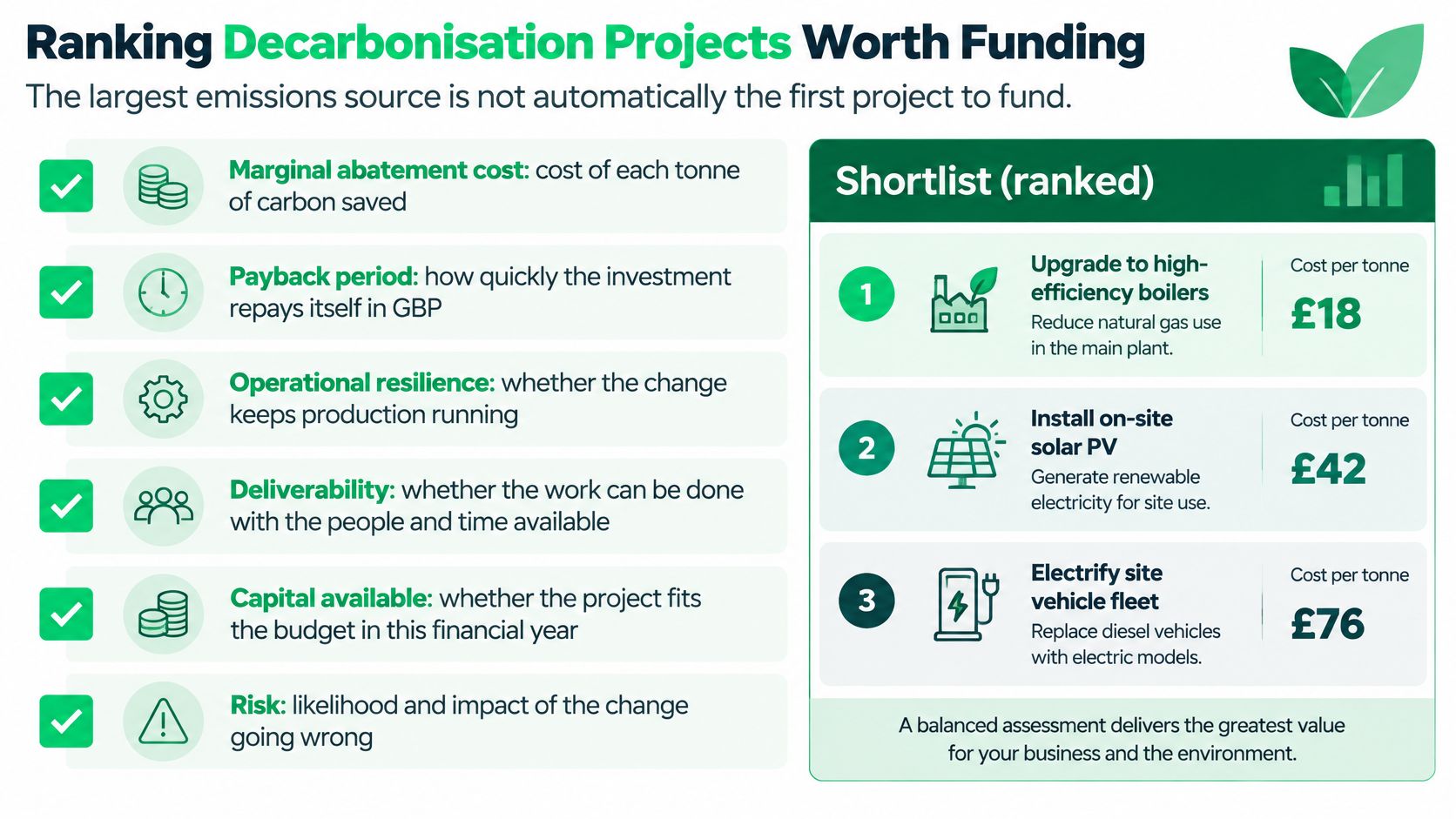
Capital is scarce and boards approve projects, not targets. The largest emissions source rarely wins that argument on its own, and a plan sequenced by tonnage rather than by cash tends to stall at the first budget round.
The six tests a project has to pass
Run every candidate measure through the same six filters and score them, rather than arguing about them one at a time:
- Marginal abatement cost. Cost per tonne of carbon saved. It ranks measures against each other and exposes the ones that only look green.
- Payback period. How quickly the investment returns cash, in pounds and months. This is the number your finance director will ask for first.
- Operational resilience. Whether the change keeps production, logistics or service delivery running through a supply shock or an energy price spike.
- Deliverability. Whether the work can be done with the people, contractors and shutdown windows you have this year.
- Capital available. Whether the project fits the current financial year's budget, or whether it needs a lender or grant alongside it.
- Risk. The likelihood and cost of the change going wrong, including technology maturity and warranty coverage.
Where the funding actually stalls
The constraint is financial, not informational. A Barclays review of how sustainability grants work for SMEs cites the British Business Bank's 2025 UK Business Consensus Report, which found that 83% of SMEs perceived at least one barrier to net-zero progress, with high costs and a lack of finance or grants the leading barriers. The same review reports that 51% of medium-sized businesses had measured a partial carbon footprint and only 26% had reached a full one, and that the Willow Review found 72% of SMEs naming implementation cost or access to finance as key barriers.
Read those together and the sequence becomes obvious. The majority have already started measuring. The binding constraint is turning measurement into an investable proposal that a lender or a board will sign.
Take a lighting and controls retrofit across two warehouses. It usually clears the abatement cost and payback filters early, fits within an annual capital budget, and cuts electricity spend immediately. It scores badly on customer relevance, because no buyer will see it. A supplier engagement programme to reduce purchased-goods emissions scores well on customer relevance and poorly on payback, because the benefit accrues partly to the customer. Approving only the first leaves the buyer's question unanswered. Approving only the second leaves the finance director without a return.
The test that settles most arguments: can this measure be defended to the finance director, the lender, the board and your largest customer at the same time? If it can't, either the scope or the sequencing is wrong.
Confirm Your Obligations Before You Build Anything
Threshold errors are expensive in both directions. Build for a regime that doesn't apply and you've spent money you can't recover. Miss one that does and the gap surfaces during assurance or, worse, during a tender.
- Pull headcount, turnover and balance sheet total for the last financial year. Each regime uses a different measure, and two out of three tests is a different question from any single one of them.
- Check every regime against those figures, plus EU exposure. Include EU subsidiaries and any large EU turnover in the group, because CSRD and SFDR reach UK businesses through those routes rather than through UK law.
- List every buyer, lender and investor request in writing, with its deadline and the exact data it asks for. A verbal request from an account manager and a questionnaire with a submission portal are different obligations with different consequences.
- Classify each one as legally required, commercially required or voluntary. A legal duty sets the scope; a buyer request sets the minimum dataset. Mixing the two produces either an over-engineered spreadsheet or an under-evidenced reply.
- Confirm the position with a specialist before anything is built, because a threshold misread costs either wasted work or a missed obligation, and both are avoidable with one afternoon of checking.
ESG Consulting confirms which obligations apply before any scope is set or data collected, and tells clients when an obligation doesn't apply and when a rating can wait. One senior consultant leads from scoping through to sign-off, so the person who scoped the work is the person who delivers it. A first enquiry needs only a few lines on what the business needs, with no brief or budget required at the start; prospective clients who prefer email can write to hello@esgconsulting.co.uk.
Bring three things to that first conversation: the headcount, turnover and balance sheet figures, the list of requests you've received and who sent them, and an inventory of sites and vehicles. That's enough to establish what's mandatory, what's commercial convention and what can wait.
ESG Consulting confirms which reporting obligations apply to a UK mid market business, then builds the carbon baseline that satisfies buyers, lenders and assurance providers without commissioning work you don't need. If you're holding a supplier questionnaire, a tender with a Carbon Reduction Plan requirement or a lender request and no clear view of scope, bring those documents to a first conversation and we'll tell you what's required and what can wait. Visit ESG Consulting to start that conversation.