modern slavery statement, UK compliance, slavery act 2015, supply chain due diligence, ESG reporting
Modern Slavery Statement Requirements: A UK Compliance Guide
By ESG Consulting Team · · 14 min read
The audit committee paper is nearly ready, the tender response is waiting on procurement, and someone has asked whether last year's modern slavery statement can be refreshed. That question sounds routine. It isn't. A statement that looks complete online may still leave the board unable to explain which entities it covers, what risks were identified, or what the organisation did about them.
The modern slavery statement requirements are best managed as a recurring governance and evidence control, not an annual website task. A defensible statement connects the reporting period's risk assessment, supplier controls, training and outcomes to named owners and records. The distinction matters when a customer, tender evaluator or director asks for evidence behind a claim.
Table of Contents
- Why This Statement Keeps Landing on the Board Agenda
- Who Is in Scope Under Section 54
- What the Statement Must Actually Cover
- Filing Deadlines, Approvals and Public Visibility
- A Real-World Statement Anatomy and What It Tells Us
- A Practical Drafting Checklist for In-House Teams
- Where UK Filings Commonly Fall Down
- Tying the Statement into Your Wider ESG Reporting
Why This Statement Keeps Landing on the Board Agenda
The statement tends to resurface at inconveniently familiar moments: during year-end reporting, when a tender asks for a link, or when a board paper needs approval. Treating it as a document to update at the last minute makes each of those moments harder. The organisation has to reconstruct what happened, chase evidence and resolve disagreements about which entities are covered.
Section 54 of the Modern Slavery Act 2015 established an annual transparency obligation for qualifying organisations. It requires a statement describing the steps taken during the financial year to address modern slavery and human trafficking risks in operations and supply chains, or a statement that no steps were taken. That makes the statement a record of the organisation's approach, not a certificate that risk has been eliminated. The UK government's registry guidance describes the requirement and its governance implications.
Treat the document as a control
A credible process starts before drafting. Legal or the company secretary should own the applicability decision and approval trail. Procurement should provide supplier-risk and due-diligence evidence. Sustainability or ESG should coordinate the narrative and effectiveness measures. Each owner should know which reporting period the evidence covers and where the underlying records sit.
That structure gives the board something more useful than polished prose: a basis for testing whether the account is complete and accurate. It also makes it easier to respond when a customer asks how a commitment in the statement translates into supplier oversight or remediation.
Board test: For every material claim, identify the owner, the source record and the action it describes. If the team can't do that, revise the claim or improve the evidence before sign-off.
The rest of the process follows from this discipline. Confirm who is in scope, build the narrative from evidence, secure formal approval, then publish and retain the records. The key question is not whether the statement looks finished. It's whether the organisation can stand behind it when someone asks for the working papers.
Who Is in Scope Under Section 54
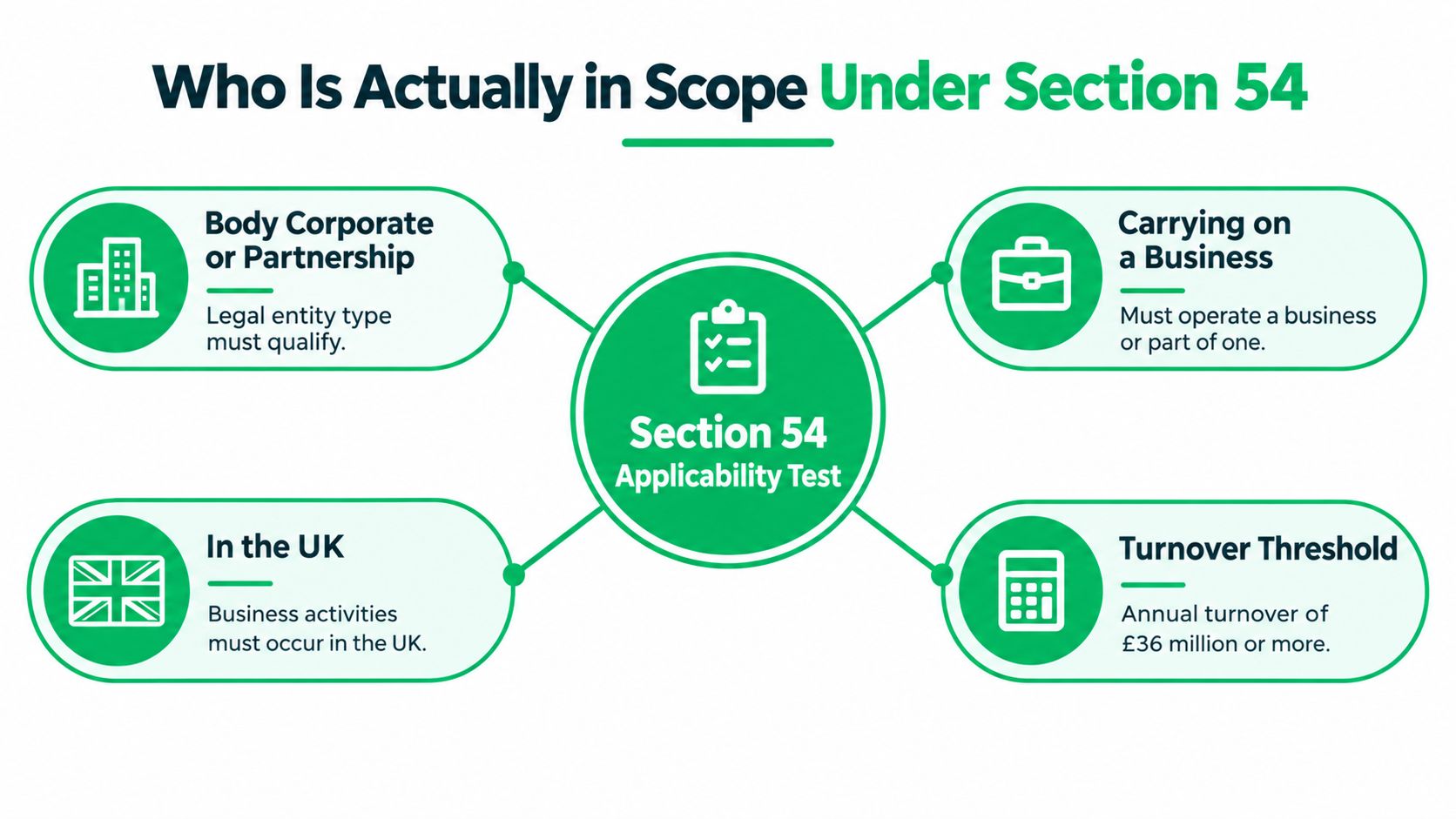
Section 54 of the Modern Slavery Act 2015 sets four conditions. An organisation must be a body corporate or partnership, carry on a business or part of a business in the UK, supply goods or services, and have annual turnover of at least £36 million. Each condition matters. The turnover threshold is not a shortcut that replaces an entity and activity review.
Apply the test to the legal structure
The threshold is based on total turnover, not UK turnover alone. A multinational can be in scope even when its UK operations make up only a small part of the business. Overseas incorporation does not automatically remove an organisation from the rules if it carries on business in the UK and meets the other conditions.
Group structures are where most mistakes happen. Assess each parent, subsidiary, partnership and trading entity on its own facts rather than assuming a group document covers everyone. A consolidated statement should name the entities and operations it covers. Without that, you can end up with a statement that looks complete while leaving a relevant entity's position unclear. That gap is exactly the kind of thing a procurement team or an investor's ESG analyst will probe, and "we assumed the parent covered it" is not an answer that holds up.
Document the applicability assessment rather than relying on memory. Record:
- Entity and group structure: Identify the legal entities, subsidiaries, partnerships and relevant trading arrangements.
- UK activity: Describe what business or part of a business is carried on in the UK.
- Goods or services: Confirm what the organisation supplies.
- Turnover calculation: Document the basis for assessing total annual turnover and which entities are included.
- Reporting boundary: State which entities and operations a consolidated statement covers, or explain why an entity reports separately.
Keep voluntary reporting separate from the legal test. An organisation may publish a statement because customers, investors or procurement teams expect one, even without meeting every statutory condition. That can be a sensible commercial choice, but label it accurately. A voluntary statement does not, by itself, establish that the organisation is legally in scope, and conflating the two creates confusion the first time someone checks.
If the test is unclear, do not resolve it with a website search or last year's statement. Have legal verify the entity boundary and record the reasoning for this financial year.
What the Statement Must Actually Cover
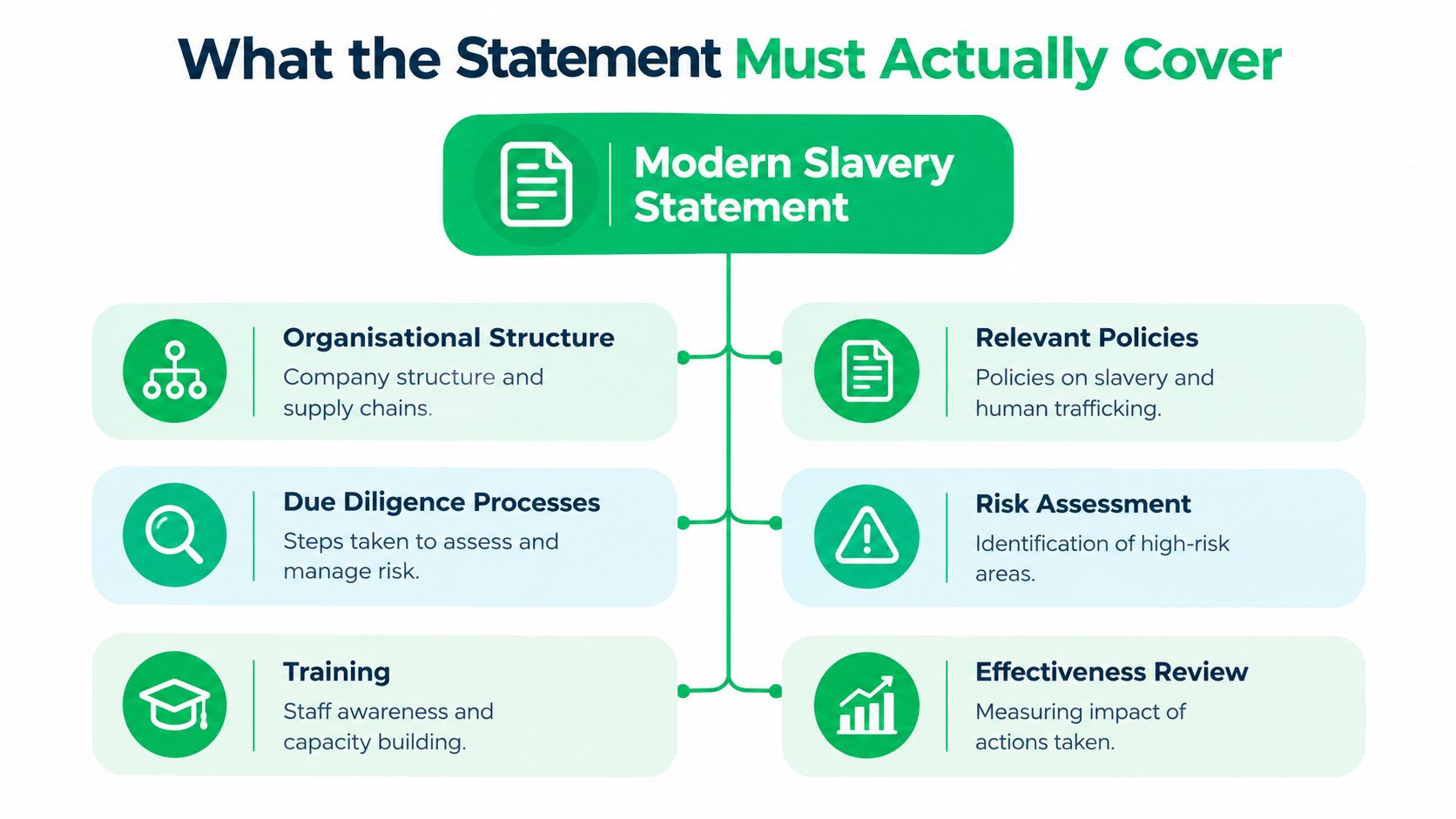
The legal obligation is to describe the steps taken during the relevant financial year to address modern slavery and human trafficking risks, or to state that no steps were taken. Government guidance identifies six reporting areas. Use them as evidence prompts, not as headings to fill with boilerplate. The government's practical guide to transparency in supply chains explains these areas and the nature of the disclosure obligation.
Translate the reporting areas into questions
| Reporting area | Evidence question to ask |
|---|---|
| Organisational structure and supply chains | Which entities, operations, supplier groups and supply-chain activities does the statement cover? |
| Relevant policies | Which policies apply, who owns them, and how are they communicated or enforced? |
| Due-diligence processes | How does the organisation assess suppliers and follow up on identified concerns? |
| Risk assessment and management | Which risks were prioritised, and what actions followed from that assessment? |
| Effectiveness measurement | What indicators show whether the controls are being used or improving the response? |
| Training | Which relevant staff or other groups received training, and what records demonstrate completion? |
A policy is not proof of implementation. A stronger account links supplier segmentation and contractual requirements to actual review activity, worker grievance channels, escalation routes and remediation procedures. It explains what the organisation measured and what it learned. Where there were no steps, say so plainly rather than dressing up an absence of action as a programme.
A disclosure matrix earns its place. For each narrative claim, record the accountable owner, supporting source record, reporting-period date and relevant outcome measure. If a statement says that higher-risk suppliers are reviewed, the evidence file should show how that risk tier was determined, which reviews took place and what happened when concerns emerged.
The aim isn't to publish every internal record. It's to ensure the public account is accurate, proportionate and traceable. A customer or board member should be able to move from a statement of intent to the underlying process and evidence without finding a gap between them.
The following video offers additional context on modern slavery statement preparation and compliance.
Filing Deadlines, Approvals and Public Visibility
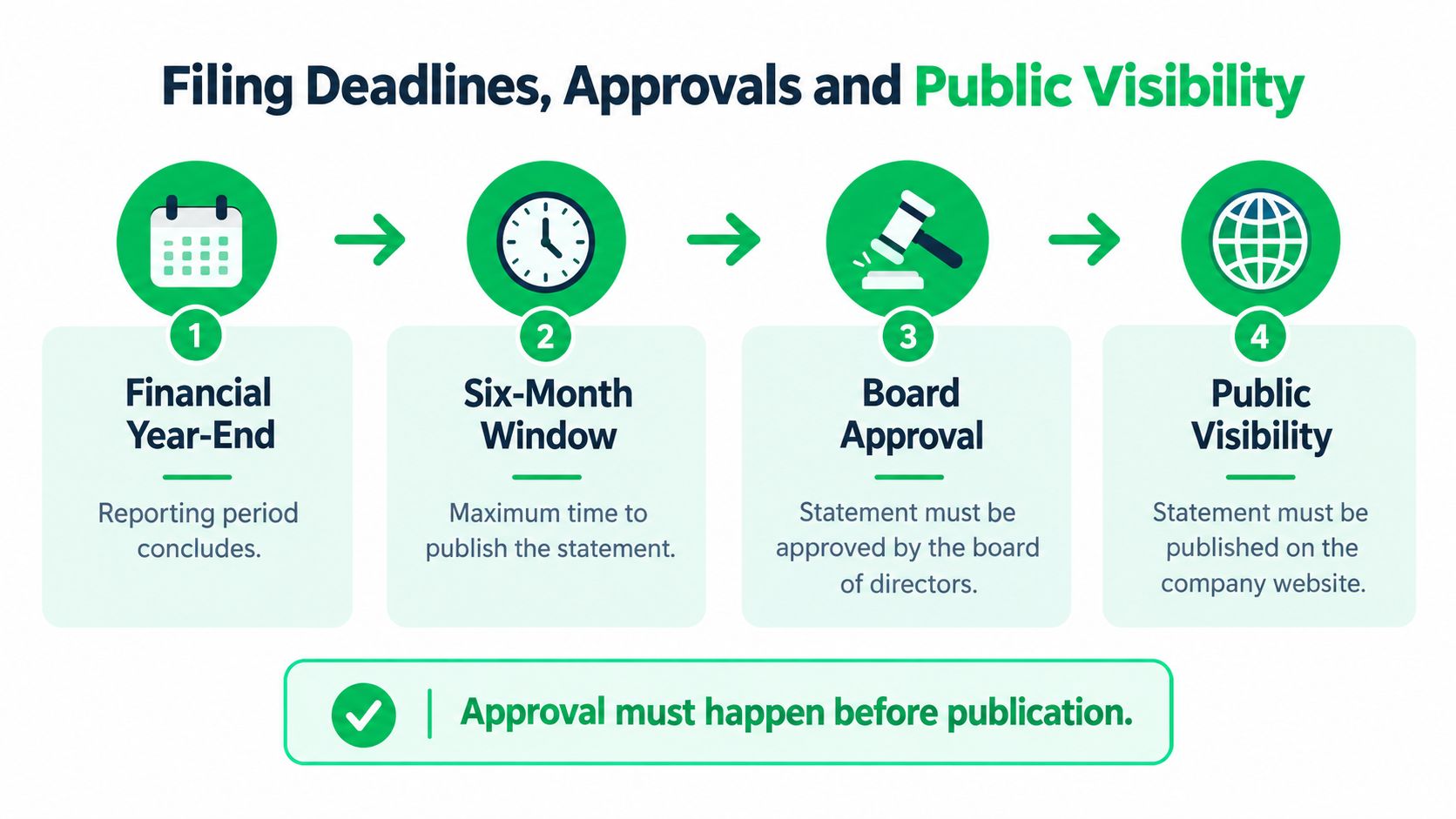
A compliant-looking statement can still fail at sign-off if the approval trail is thin. Build the calendar around the financial year and the evidence owners, not around the week before publication. Government guidance is plain: publish as soon as possible, with six months after year-end as the practical outer limit, covering the most recent financial year. Board or equivalent approval comes before release, with a director signing; for an LLP, a designated member signs.
Run it like a control
Procurement and other evidence owners close their records first. The drafting lead reconciles the narrative to the reporting period, legal tests scope and claims, then the approver gets a final version with enough time to read it. Signature follows approval; it never substitutes for it.
Publish the statement where a tender evaluator will look: prominently on the website, linked from the homepage, current version easy to reach. The UK Modern Slavery Statement Registry adds public visibility and comparability, but it is no substitute for publication on the organisation's own site. Upload there after release if you use it.
Keep a file that proves the process worked:
- Scope file: entity assessment, group boundary and turnover rationale.
- Approval evidence: minutes or written approval plus the signed statement.
- Publication evidence: the released version and where it sat on the site.
- Supporting evidence: records behind each material claim.
- Registry record: upload confirmation and public listing, if applicable.
Name the owner for each step. A deadline without an accountable owner is how a statement becomes a PDF no one can defend.
A Real-World Statement Anatomy and What It Tells Us
Homes England's public statement offers a useful procurement lens because it describes controls including tender requirements, contractual clauses, supplier monitoring and termination provisions, alongside reliance on suppliers' own risk assessments and monitoring. Those details show how a statement can connect policy language to commercial processes. They don't, on their own, establish that every control worked or that all risk has been found.
That distinction is the point. A disclosure-grade statement names processes. A procurement-grade statement helps a buyer understand how those processes are applied, what happens when a supplier raises a concern and how the organisation checks whether action was effective. The Homes England statement summary in the government registry provides a public example to examine.
Read for evidence, not reassurance
A tender evaluator could reasonably ask: Which suppliers are covered by these requirements? How does the organisation decide which suppliers need closer attention? What evidence shows that monitoring took place? If a concern is identified, who escalates it and how is remediation tracked? A statement that stops at “we have contractual clauses” doesn't answer those questions.
The public-sector practice described in the available example also reflects greater integration between procurement and modern slavery controls. Risk-tiered assessments, contractual clauses, audits and the Cabinet Office Modern Slavery Assessment Tool can all be part of a procurement process for medium- and high-risk procurements. The key is to show how the organisation uses its controls in context, rather than listing tools without explaining the decisions they support.
Take this year's draft and test its weakest paragraph. If it says suppliers are monitored, find the monitoring record. If it describes training, locate the completion evidence. If it refers to remediation, identify the process and the records that support the claim. Where the evidence is incomplete, narrow the wording or state the limitation candidly.
A statement isn't a clean bill of health. It is a snapshot of governance and risk-management practice. The question to put to each paragraph is simple: what evidence would survive a customer or board challenge?
A Practical Drafting Checklist for In-House Teams
Hand the work to a cross-functional team with clear outputs. Legal, procurement, sustainability and the company secretary have different information, so one person shouldn't be expected to invent the full account from last year's PDF. The checklist below gives each team a defined role in the cycle.
Scope and narrative
- Confirm applicability: Map the parent, subsidiaries, partnerships and trading entities. Record the UK activity, goods or services supplied and turnover assessment. Decide whether any non-obligated entity will report voluntarily, and label that decision clearly.
- Set the reporting boundary: For a consolidated statement, name the entities and operations covered. Ask each relevant business unit to confirm its position rather than assuming the group narrative captures it.
- Gather evidence by reporting area: Ask owners for structure and supply-chain information, policy records, due-diligence activity, risk assessments, effectiveness measures and training evidence.
- Draft from this year's records: Describe what happened during the reporting period, not just what the organisation intends to do. Where evidence is missing, don't disguise the gap with broad claims.
Sign-off and publication
- Challenge every substantive claim: Ask the owner to provide the record behind it. Check that the evidence supports the wording and relates to the period covered.
- Secure formal approval: Put the final draft before the board or equivalent management body. Retain the approval record and obtain the required signature.
- Publish prominently: Place the statement on the organisation's website with a homepage link. Check that staff and external readers can find the current version without guesswork.
- Complete the registry step: Upload the statement to the government registry after website publication. Keep the registry information aligned with the published document.
- Retain the audit trail: Archive the final statement, source evidence, scope assessment, approval records and publication evidence.
Keep previous statements accessible. A procurement evaluator can compare the current account with earlier disclosures to see whether the organisation explains changes in its approach. Don't overwrite the history or reuse prior-year wording without checking whether it remains true.
Before sign-off, assign one person to run the checklist and list unresolved gaps. The useful output isn't a tick beside every heading. It's a short, owned set of improvements, with clear boundaries around claims the current evidence can support.
Where UK Filings Commonly Fall Down
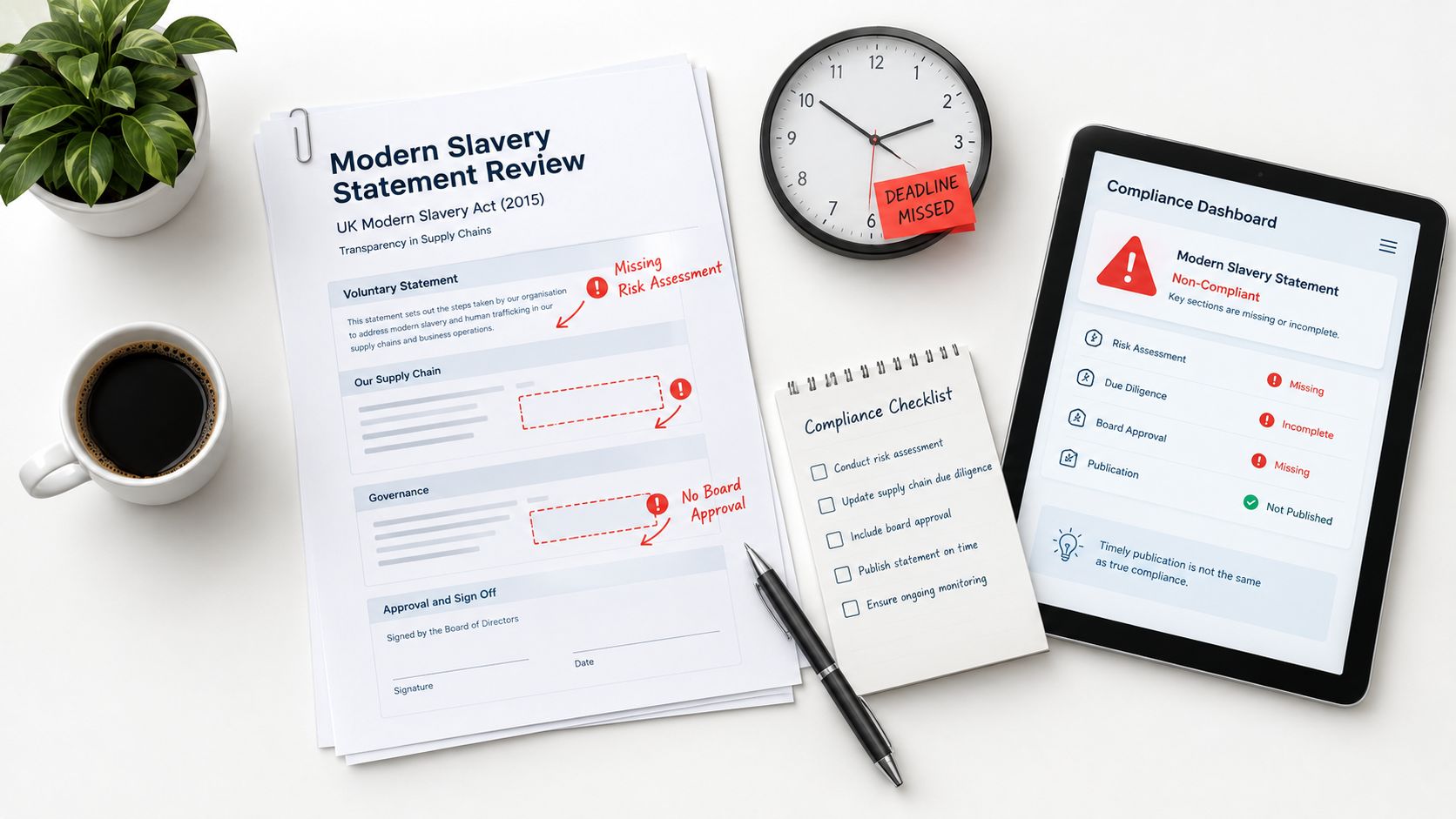
Publishing on time is not the same as producing a defensible statement. A document can be visible, signed and formally complete while offering little evidence that the organisation understands its supply-chain exposure or follows through on its own policies.
Section 54 has historically not prescribed detailed statement content, and the enforcement mechanisms have been limited. That's no reason to treat the work as low-risk. Procurement teams and investors can test the claims directly, and a weak response can undermine confidence in the organisation's controls. The practical pressure often arrives in a tender or customer review rather than as a formal legal challenge.
Fix the evidence gaps, not just the wording
Common weaknesses are usually operational:
- A group statement with unclear coverage: List the entities included and resolve any subsidiary or trading-entity gaps before publication.
- A voluntary statement treated as proof of statutory scope: Separate the legal applicability decision from the organisation's choice to report voluntarily.
- Policies without procurement controls: Show how relevant commitments appear in supplier assessment, contractual requirements or escalation processes.
- Training described without records: Identify the audience and retain evidence that the training took place.
- Remediation promised but unexplained: Set out the escalation and remediation process, then substantiate any claim about action taken.
- Risk assessment without follow-through: Connect prioritised risks to due diligence, monitoring or another documented management response.
Don't respond to a weak draft by adding stronger adjectives. Replace general claims with specific, supportable descriptions. If the organisation relies on supplier self-assessments, say how it reviews or follows up on them. If it hasn't yet developed an effectiveness measure, don't imply that it has.
The standard to use is not “could this pass a quick website check?” It is “can the owner explain the evidence and decision behind this sentence?” If the answer is no, revise the sentence or fix the control before claiming it is in place.
Tying the Statement into Your Wider ESG Reporting
The modern slavery statement shouldn't run on a separate calendar from the organisation's other reporting. Put it alongside work on SECR, ESOS, UK Sustainability Reporting Standards S1 and S2, CSRD scope assessments and Social Value Model responses where relevant. The frameworks differ, but teams can often use shared governance routines for ownership, evidence retention, internal review and approval.
That doesn't mean blending the disclosures. Keep each obligation's scope and evidence distinct, while using one reporting calendar to make responsibilities visible. ESG Consulting, a UK-based consultancy, advises organisations on sustainability disclosure and ESG reporting alongside carbon reporting and net-zero strategy. Its ESG consulting services describe that broader work.
For the next cycle, prioritise the work in this order: confirm entity applicability and reporting boundaries; refresh the narrative against evidence from the financial year; resolve unsupported claims; obtain board or equivalent approval and the required signature; publish prominently within the practical six-month window; then upload the statement to the registry. A well-run process leaves the organisation ready to answer a procurement or investor question without rebuilding the evidence file from scratch.
ESG Consulting supports UK organisations with sustainability disclosure, ESG governance and evidence-led reporting, including work that connects modern slavery statements to wider reporting controls. If you're preparing for board sign-off or need to strengthen the evidence behind your next statement, visit ESG Consulting to discuss your requirements.