NHS Evergreen Assessment, NHS supplier sustainability, Carbon Reduction Plan, NHS net zero, Evergreen Level 1
NHS Evergreen Assessment: What Suppliers Must Prove
By ESG Consulting Team · · 13 min read
In 2025, suppliers completing the Evergreen Assessment covered 94% of NHS procurement spending worth £4.4 billion, according to Economist Impact. For an NHS supplier, that makes Evergreen a procurement-readiness issue, not just a sustainability questionnaire.
The practical challenge is keeping your answers supportable when a bid closes. A completed form won't fix an inconsistent emissions inventory, an unpublished Carbon Reduction Plan or an expired score. Treat the NHS Evergreen assessment as a recurring evidence cycle, with commercial, finance and sustainability teams working from the same documents.
Table of Contents
- What the NHS Evergreen Assessment Measures
- How Evergreen Fits Alongside Carbon Reduction Plans
- Evergreen Maturity Levels and the Evidence Each Needs
- NHS Procurement Deadlines Suppliers Must Track
- How to Prepare Your Evergreen Evidence Step by Step
- Blocking Gaps and Your Next Step Before Tendering
What the NHS Evergreen Assessment Measures
The NHS Evergreen Sustainable Supplier Assessment is an online self-assessment, not an external certification. It sits within the NHS Net Zero Supplier Roadmap and provides a standardised route for suppliers to share sustainability information with NHS organisations.
Suppliers report progress on emissions reduction, modern slavery and wider sustainability criteria. NHS organisations use that information for benchmarking, communication and procurement-related decision-making, so the answers need to reflect what your organisation can substantiate.

According to NHS England's Evergreen guidance, suppliers receive a sustainability maturity score against NHS priorities that is valid for 12 months, with annual completion recommended. The framework connects stronger maturity with evidence such as a published Carbon Reduction Plan, a UK net-zero commitment, emissions reporting, independently validated 2045 net-zero targets and action on supply-chain modern-slavery risks.
Think renewal, not graduation
An annual vehicle MOT is a useful analogy for the renewal discipline, although Evergreen isn't an independent inspection. Passing an exam suggests you've finished; maintaining a vehicle means checking its condition again and addressing what has changed.
Your evidence needs the same attention. Acquisitions, new premises, revised reporting boundaries and supplier changes can affect whether an earlier answer remains accurate.
Practical rule: Keep the assessment result and the evidence supporting it together. A score without its supporting documents is difficult to defend internally.
Don't describe participation as NHS certification or imply that completing the questionnaire guarantees eligibility for every contract. Check current Evergreen guidance before relying on higher-level criteria or assumptions about any completion fee.
Your immediate action: check whether current or planned tenders require a valid assessment, then record your score's expiry date and assign responsibility for renewal.
How Evergreen Fits Alongside Carbon Reduction Plans
Evergreen is a maturity route; a Carbon Reduction Plan can be a bid gate. They serve different purposes, even where they draw on the same emissions workbook.
The Carbon Reduction Plan sets out the emissions position, commitments and reduction measures relevant to the procurement requirement. Evergreen captures a broader sustainability picture, including emissions management, targets and supply-chain controls. A valid assessment therefore doesn't replace a compliant plan when the buyer asks for both.
Evergreen, Carbon Reduction Plans and SECR compared
| Requirement | Applies to | Cycle or validity | What it proves |
|---|---|---|---|
| Evergreen Sustainable Supplier Assessment | Suppliers to NHS organisations, with mandatory participation for specified procurement routes | Renew against the published score expiry and current guidance | Sustainability maturity against NHS priorities |
| Carbon Reduction Plan under PPN 006 | Bidders within the applicable NHS procurement requirement, applied proportionately | Check the current publication and refresh requirements in the tender instructions | Emissions reduction plan and commitments |
| SECR annual disclosure | Large UK companies within SECR scope | Annual report | Energy use and emissions disclosure |
Reuse the evidence, not unchecked totals
SECR is a separate disclosure obligation, not an alternative NHS submission. If your company reports under SECR, reconcile those figures with the inventory supporting your Carbon Reduction Plan and Evergreen answers.
Reconciliation doesn't always mean identical totals. A corporate annual report might cover a different group boundary from the legal entity bidding for a contract. The important control is a documented explanation of which sites, subsidiaries and activities each disclosure includes.
Say a healthcare distributor prepares a group inventory but tenders through a UK subsidiary. Copying the group total into the subsidiary's plan could misrepresent the bidding entity. Instead, keep a controlled workbook that identifies the subsidiary's activities and explains how its figures reconcile to the group position.
Reuse source data wherever possible, but never reuse a total without checking its boundary, reporting period and purpose.
Maintain a reconciliation tab showing the figures used in each submission, their reporting periods and any exclusions. That gives finance reviewers a clear route from published disclosure back to the underlying inventory.
Confirm that a controlled set of emissions records underpins every submission, rather than allowing separate teams to maintain competing versions.
Evergreen Maturity Levels and the Evidence Each Needs
Think of the maturity framework as a ladder of increasingly demanding evidence, not a collection of policies to upload. A commitment establishes intent; an inventory demonstrates measurement; independent target validation addresses a different question again.
NHS Supply Chain states that, from April 2026, suppliers must achieve Evergreen Level 1 at tender close. An assessment submission alone isn't proof that you've achieved the required result.
Build an evidence index
The table below separates the requirement from the material you should prepare. Beyond the confirmed baseline procurement requirement, don't assign the remaining criteria to specific levels without checking the current questionnaire and guidance.
Evergreen requirements and the evidence each needs
| Requirement | Evidence to prepare |
|---|---|
| Evergreen Level 1 | Assessment result showing the required level and a currently valid maturity score |
| Published Carbon Reduction Plan | Publicly available, dated plan checked against the PPN 006 standard |
| UK net-zero commitment | Published commitment with leadership approval and a clearly identified organisational boundary |
| Emissions reporting | Scope 1 and 2 inventory with documented boundaries and source data, plus relevant value-chain emissions evidence |
| Independently validated net-zero target | Independent validation documentation identifying the entity, target and coverage |
| Supply-chain modern-slavery action | Due diligence records, supplier checks and actions addressing identified risks |
For the assessment result, save the submission confirmation and result in an assessment folder. Record the legal entity to which they apply, rather than relying on a screenshot with no organisational context.
For the Carbon Reduction Plan, retain both the approved document and evidence of public availability. A polished draft sitting in an internal folder isn't the same as a published plan.
The net-zero commitment should identify who has committed and what activities the commitment covers. File leadership approval with the statement so reviewers can distinguish an authorised commitment from marketing copy.
Separate measurement from validation
For emissions reporting, retain utility records, fuel data, calculation factors and the workbook used to produce the inventory. Keep a methodology note explaining exclusions, estimates and organisational changes.
For independent target validation, retain the validation decision and its scope. A consultant's involvement in calculating emissions isn't automatically independent validation of the target.
For modern-slavery action, show what happened after the policy was approved. Supplier questionnaires, risk assessments, escalation records and corrective actions provide a more useful evidence trail than a policy alone.
The exact level-to-criterion mapping remains something to verify before submission. List the requirements you can support with dated evidence, identify those still needing work, and avoid assuming that a strong answer in one area compensates for a missing mandatory criterion.
NHS Procurement Deadlines Suppliers Must Track
A bid manager needs a procurement calendar, not just a sustainability calendar. The relevant question is whether the required documents and assessment result will be ready at the point specified by the buyer.
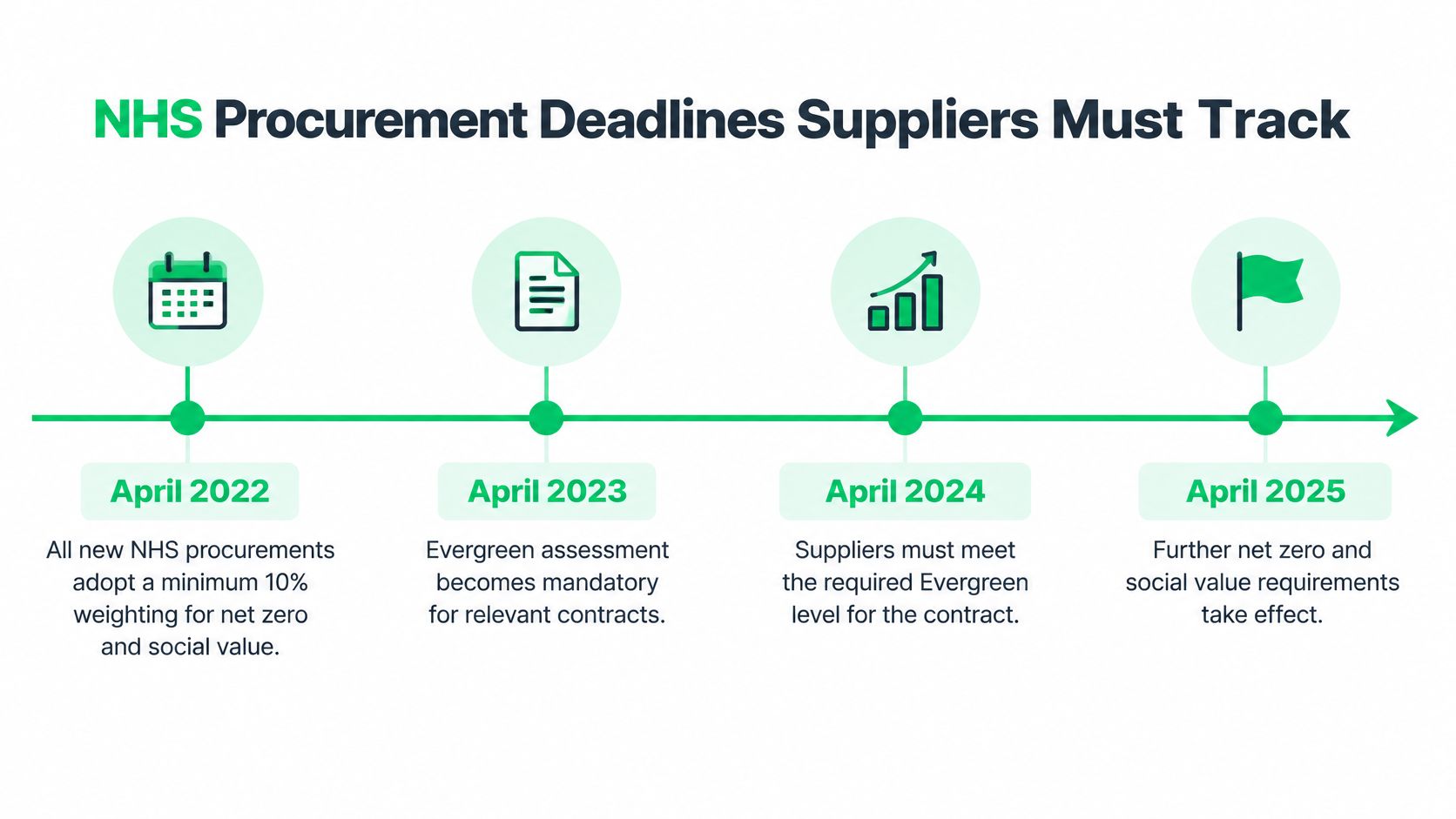
NHS England's supplier roadmap records the milestones below: the minimum 10% net-zero and social-value weighting from April 2022, the Carbon Reduction Plan requirement for new contracts worth more than £5 million per year from April 2023, its proportionate extension from April 2024, and more than 2,000 suppliers signed up by September 2025.
Evergreen and NHS procurement milestones
| Date | Milestone | Who it affects |
|---|---|---|
| April 2022 | Minimum 10% weighting for net zero and social value in all new NHS procurements | Suppliers bidding into new NHS procurements |
| Early 2023 to June 2023 | Supplier launch described differently across NHS documentation | Suppliers to NHS organisations |
| April 2023 | Carbon Reduction Plan requirement for new contracts worth more than £5 million per year | Bidders for larger contracts |
| April 2024 | Carbon Reduction Plan requirement extended proportionately to all new procurements | Suppliers within the applicable procurement requirements |
| September 2025 | More than 2,000 suppliers signed up | NHS supplier base |
| April 2026 | Evergreen Level 1 minimum at tender close | NHS Supply Chain suppliers |
For the launch date, NHS contractual documentation described an intended earlier launch, while NHS Supply Chain dates the launch to June 2023. Don't turn a planned pilot or launch into evidence of a procurement obligation.
The supplied visual is a general orientation aid. Its labels shouldn't be used as evidence of Evergreen becoming mandatory on a particular date; use the procurement milestones and buyer instructions instead.
Apply the deadline to the actual bid
NHS England also requires suppliers tendering for contracts or frameworks administered by Medicines Value and Access to submit both a valid Evergreen assessment and a compliant Carbon Reduction Plan at submission.
Say your commercial team is pursuing a framework while renewing a separate supply agreement. Don't assume identical requirements: record the buyer, bidding entity, required assessment result, plan requirement and submission point for each opportunity.
Map every live tender to its applicable deadline. Keep net-zero and social-value evaluation requirements separate from document gates, so the team prepares both the eligibility evidence and the substantive bid response.
How to Prepare Your Evergreen Evidence Step by Step
Start with the bidding entity and buyer instructions, not the questionnaire. Otherwise, you can spend time assembling a group-level sustainability pack that doesn't support the organisation submitting the tender.
At ESG Consulting, we confirm which obligations apply before anything is built or scoped. That includes identifying obligations that don't apply, rather than treating every disclosure framework as compulsory.
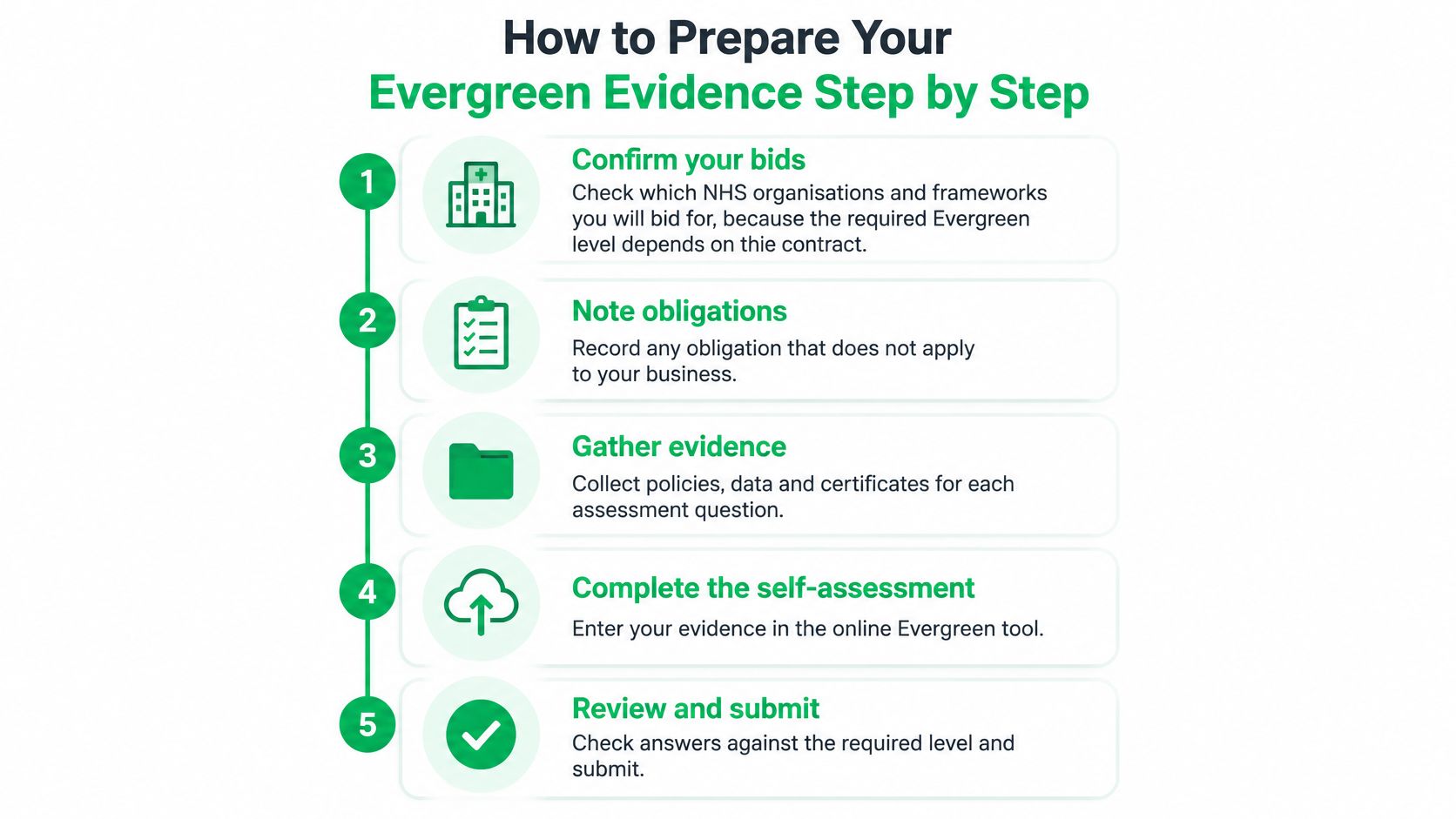
Establish scope and source records
Confirm the bids and responsible entity.
Ask the commercial lead to list the NHS organisations and frameworks being pursued. File the buyer instructions, required assessment outcome, submission route and deadline. Record any non-applicable obligation with the reason for that decision.Prepare the published Carbon Reduction Plan.
Give the sustainability lead responsibility for checking the plan against the applicable technical standard. Confirm publication, approval, reporting period and entity name. Match its boundary to the supporting inventory, or document a clear reconciliation.Build a traceable emissions inventory.
Finance and operations should supply energy invoices, fuel records and other activity data. Include relevant value-chain categories, documenting the source and calculation approach for each. Where estimates are necessary, explain the assumption and retain the calculation, rather than replacing missing records with unexplained totals.Confirm the commitment and target evidence.
Assign leadership approval to a named director and target preparation to the sustainability lead. Check that the commitment, target boundary and reporting entity align. Where independent validation is required for your intended maturity outcome, retain the validation correspondence and decision.
Complete, review and retain
Document modern-slavery due diligence.
Procurement should file the policy, supplier risk-screening method, checks performed and responses to identified concerns. Include decisions about further investigation or corrective action. Don't treat a returned supplier questionnaire as proof that a risk has been resolved.Complete the online self-assessment against the evidence index.
Give each answer an internal document reference, even if the platform doesn't require an attachment. Have someone outside the drafting process check entity names, dates and claims against the evidence. Save the submitted answers and confirmation.Review the result and schedule the next cycle.
Assign an owner to investigate unmet criteria and a due date for each action. Record the result's expiry in the procurement calendar, with an internal review early enough to resolve evidence problems before another bid closes.
Evidence control: Every figure we produce traces back to source data, with the methodology, boundaries and assumptions documented for the client's auditor or assurance provider.
Finish with a submission-ready folder, a named owner and a controlled emissions workbook. Add version numbers and approval status to the evidence index so colleagues don't submit an obsolete document because it appeared first in a shared-drive search.
Blocking Gaps and Your Next Step Before Tendering
The most dangerous assumption is that a completed assessment means the business is tender-ready. Procurement readiness requires the right result, valid supporting documents and evidence that matches the bidding entity.
Don't rank improvements by how impressive they look in a sustainability presentation. Rank them by whether they could prevent a live submission, then by the effort needed to resolve them. The following gaps deserve an explicit decision, rather than an open-ended improvement list.
Separate blockers from improvements
A Carbon Reduction Plan with inconsistent boundaries. A plan may look current while excluding activities included in the inventory, or covering a parent company rather than the bidder. Reconcile the boundary, correct the underlying figures if needed and obtain fresh approval where the change affects the published statement. Re-dating the document without reviewing its content doesn't solve the problem.
Emissions figures without a documented method. A total copied from a spreadsheet gives the reviewer little to test. Retain activity records, conversion factors, calculation logic and explanations for estimates. If the method can't be reconstructed, resolve that weakness before using the figure in another submission.
A target without the required independent validation. Setting a target and validating it are separate tasks. Check whether validation is necessary for the outcome you're pursuing, then establish the submission requirements and availability of the validating body. Don't promise a completion date before those dependencies are understood.
A modern-slavery policy without operational checks. A policy describes your position; due diligence records show how procurement applies it. Prioritise higher-risk suppliers and investigate further supply-chain tiers where the risk assessment warrants it. Record findings, decisions and follow-up actions, not just questionnaire completion.
An assessment result that has expired. Check validity against the tender's required submission point. If the evidence is ready, organise reassessment; if it isn't, identify the missing approvals or records first. Don't assume a buyer will accept a renewal after tender close.
A blocker stops the bid you intend to submit. A deferrable improvement strengthens a later cycle without jeopardising that bid.
None of these fixes has a universal turnaround time. Publication corrections, inventory reconstruction, supplier engagement and independent validation involve different people and dependencies. Build the schedule from those dependencies rather than relying on a generic estimate.
Make a commercial readiness decision
Use these questions at the next bid review:
- Are we pursuing NHS contracts? Identify the actual opportunities and responsible bidding entities, rather than treating NHS supply as a single category.
- Does our assessment outcome meet the buyer's requirement? Check the result against the relevant framework or tender instructions, not an internal assumption.
- Is the evidence dated, approved and traceable? Confirm that another reviewer can follow the claims back to source documents without asking the author to reconstruct them.
If you're not pursuing an applicable procurement route, a higher maturity rating may be deferrable. If you are, assign corrective actions against the actual closing date and deal with publication, boundary and validity issues before optional presentation improvements.
Through our ESG and sustainability advisory work, we tell clients when an obligation doesn't apply and when a rating can wait. Our NHS Green Plans service also provides supplier-side readiness for the NHS net-zero roadmap, including Evergreen.
Before your next submission, name the evidence owner and classify every outstanding action as blocking or deferrable. Give each blocker an approver, a completion date and a clear test for closure.
ESG Consulting offers NHS Evergreen readiness support, Carbon Reduction Plan preparation and traceable emissions inventories to help suppliers assemble defensible tender evidence. Visit ESG Consulting to discuss your bidding entity, buyer requirements and next submission deadline.