NHS net zero, Carbon Reduction Plan, NHS procurement, Scope 3 emissions, supplier decarbonisation
NHS Net Zero Supplier Roadmap: Milestones and Actions
By ESG Consulting Team · · 15 min read
Approximately 90% of NHS non-pay expenditure now falls within Carbon Reduction Plan or Net Zero Commitment requirements, NHS England reports, after the Carbon Reduction Plan rule was extended in April 2024. From April 2022, every new NHS procurement also carried a minimum 10% weighting for net zero and social value. That pairing is what the NHS Net Zero Supplier Roadmap does. It turns climate performance into a tender access gate, not a voluntary pledge you attach to a bid.
The question that matters commercially isn't whether a target exists. It's whether the emissions evidence you submit stays consistent from one NHS bid to the next. A Carbon Reduction Plan that can't be reconciled with your inventory, your boundary and your public figures will fail a buyer who compares this year's answers with last year's.
The rules are staged and cumulative. A bid you submit now already sits under the current Carbon Reduction Plan rule. A bid that starts later will be read against a wider global inventory. Name the start date of the next tender first. The row that governs it follows from that date.
Table of Contents
- NHS Net Zero Supplier Milestones at a Glance
- Why Procurement Teams Now Score Climate Performance
- What Changes for Suppliers in April 2027
- Global Emissions, Boundaries and Existing Contracts
- Build Your Roadmap in Five Phases
- Evidence Buyers and Evergreen Assessors Expect
- Match Each Bid to the Live Rule
NHS Net Zero Supplier Milestones at a Glance
Two NHS bids can sit under different rows of one policy at the same time. The figures still have to match. NHS England's June 2026 Net Zero Supplier Roadmap is the source for the milestones below, including the minimum 10% weighting for net zero and social value on new procurements from April 2022. Each later row is added to the rows already in force.
| Date | Milestone | Who It Applies To |
|---|---|---|
| April 2022 | Minimum 10% weighting for net zero and social value in new NHS procurements | All new NHS procurements |
| April 2024 | Carbon Reduction Plan requirement extended to all new NHS procurements | All new NHS procurements |
| April 2027 | Scheduled global Scope 1, 2 and 3 reporting, targets and public disclosure | In-scope procurements starting on or after 1 April 2027 |
| April 2028 | Product-level carbon footprint requirements planned | Individual products supplied to the NHS; method still being developed |
| 2045 | NHS ambition for net zero across supply chain and operations | Aspirational; suppliers encouraged to align |
Same evidence, successive bids
A Carbon Reduction Plan used on a current tender follows the April 2024 row: a published plan covering the contract you are bidding for. A later procurement, if its start date falls on or after 1 April 2027, is the point at which the same roadmap schedules global Scope 1, 2 and 3 reporting, targets and public disclosure. Buyers can place those two submissions next to each other. A baseline, a boundary or a reduction figure that moves between them, with no documented change in method, is what fails the bid. A named target on its own does not repair that gap.
The April 2022 weighting is already part of the score. It tests the quality of that same evidence, so a plan that clears the entrance can still lose marks if the numbers do not line up with an earlier NHS submission. The April 2028 product-footprint row remains planned, and the method is still being developed, so it does not set the evidence for a tender that starts before then. The 2045 date is the NHS ambition for net zero across supply chain and operations. Citing the year does not meet a milestone that is already in force.
Practical rule: For each bid, apply the latest milestone dated on or before the tender start date, then check that every figure still reconciles with the emissions evidence already submitted on earlier NHS bids.
Why Procurement Teams Now Score Climate Performance
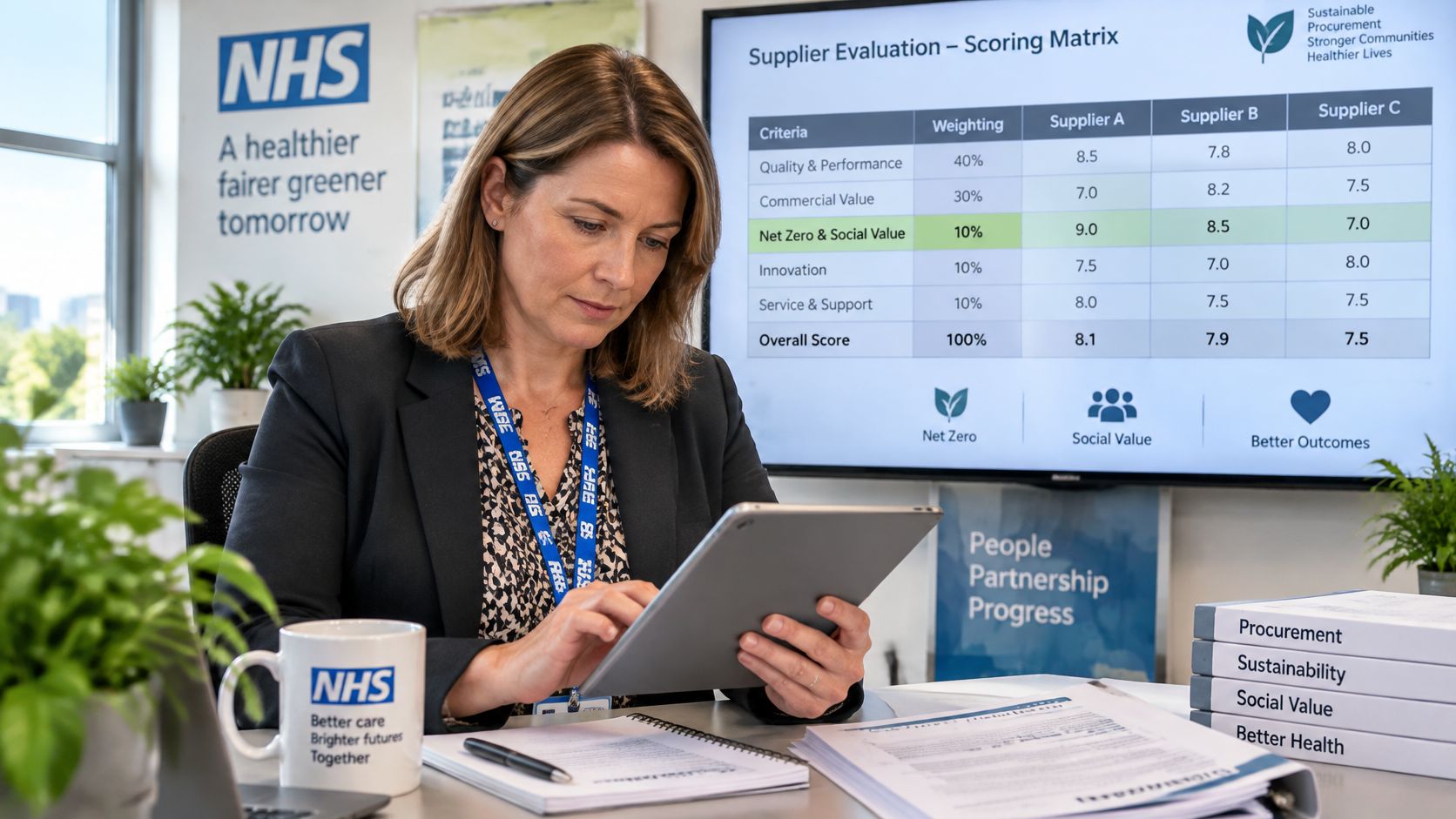
Procurement teams now score climate performance because the roadmap is a commercial access framework. Buyers aren't collecting pledges. They're using emissions evidence to decide who can be appointed.
The entrance check and the score
Think of the Carbon Reduction Plan as a ticket checked at the entrance. The score comes afterwards, from the quality of the evidence behind that ticket. A missing or non-compliant plan can stop a bid before price and quality are compared. A thin plan that scrapes through still loses marks on the net zero and social value weighting, which is large enough to separate two otherwise close bids.
The gate widened in stages. It began with higher-value contracts, then extended to all new NHS procurements. NHS England's wider ambition is net zero across the supply chain and operations by 2045, and the purchasing rules are how that ambition reaches suppliers. Staying procurement-ready means you can show measured emissions, a reduction target and an implementation plan, not a policy statement.
Say two facilities bids carry the same price and the same service levels. One has a published Carbon Reduction Plan with a baseline, a target and named measures. The other has a paragraph on "working towards net zero" and no inventory. The first bid takes the climate marks. The second may not get past the entrance check at all.
A test you can run on a live bid
Apply three questions to the bids you have open now.
- Weighting: Does this procurement score net zero and social value, so climate evidence can move the result?
- Plan: Does the notice require a Carbon Reduction Plan before you can be considered?
- Trace: Could a buyer follow your published totals back to a boundary, a baseline year and the measures you say you will deliver?
If any answer is no, the bid isn't procurement-ready, however strong the commercial offer looks.
What Changes for Suppliers in April 2027
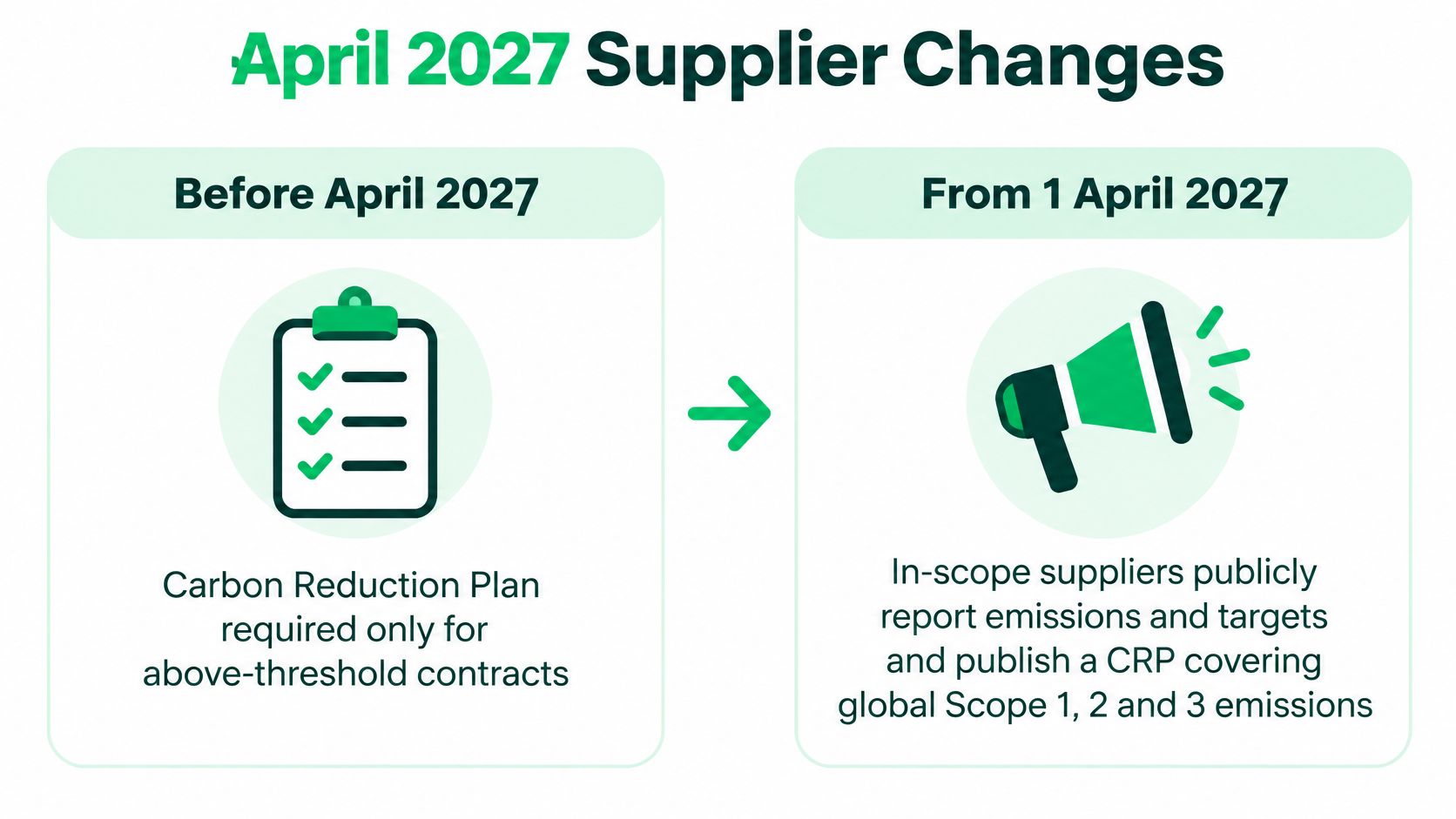
From 1 April 2027, the entrance check on an NHS bid moves from a UK Carbon Reduction Plan to a public account of relevant global emissions. NHS England's 2027 guidance states that these requirements replace the previous Carbon Reduction Plan and Net Zero Commitment requirements for in-scope procurements beginning on or after 1 April 2027. Suppliers must publicly report emissions and targets and publish a Carbon Reduction Plan covering all relevant global Scope 1, Scope 2 and Scope 3 emissions, subject to proportionate requirements.
The earlier rule, in force for all new NHS procurements since April 2024, covered UK Scope 1 and 2 plus a Scope 3 subset. That plan can still clear a tender running under the current rule. It will not, on its own, clear the April 2027 gate. The commercial test is consistency. A baseline, boundary or target that changes between successive bids reads as two accounts, not one inventory a buyer can follow from notice to notice.
| Element | Earlier CRP Rule | From April 2027 | Gap to Close |
|---|---|---|---|
| Emissions coverage | UK Scope 1 and 2, plus a Scope 3 subset, for all new NHS procurements since April 2024 | Relevant global Scope 1, 2 and 3, subject to proportionate requirements | Organisational and value-chain boundary and a global inventory |
| Scope 3 | Defined subset aligned with PPN 006 | Relevant global Scope 3 under proportionate rules | Supplier data collection across the value chain |
| Targets | Not set out as a public requirement in the earlier CRP rule | Published targets with credible reduction measures | Target year and implementation plan |
| Disclosure | Carbon Reduction Plan submitted for the tender | Public reporting of emissions and targets, with the CRP | Figures that can be published and traced to source data |
| Net-zero year | Not applicable as a fixed rule in the earlier CRP | 2050 meets the minimum; 2045 alignment encouraged | Choose a year and justify it against the NHS ambition |
What each gap means on a bid
Coverage is the largest gap. A UK inventory cannot answer a question about relevant global emissions. The bid needs a written organisational and value-chain boundary, then a calculated global baseline that still contains the UK figures already used on earlier tenders.
Scope 3 stops being a short fixed list. Relevant categories across the value chain have to be collected from suppliers, not copied from a UK-site spreadsheet. Targets move from an internal aim to published figures a buyer can test against that baseline. Disclosure moves from a file uploaded with one tender to numbers on a public page, traced to source data, so the next bid uses the same totals.
NHS England has indicated that a 2050 net-zero target satisfies the minimum April 2027 requirement. Alignment with the NHS ambition for 2045 is encouraged. The floor keeps a supplier eligible. Choosing 2045 only helps if that year, and the measures behind it, stay the same on the next submission.
A further milestone is planned from April 2028, when requirements on carbon footprinting for individual products supplied to the NHS are expected. The methodology and scope are to be developed with suppliers and regulators, so the useful preparation is a clean organisational inventory, not a guessed product method. Suppliers are already preparing this evidence, including through the Evergreen Sustainable Supplier Assessment, and the figures used there should match the Carbon Reduction Plan attached to the bid.
Before submission, define the boundaries, calculate global emissions, disclose targets and show reduction measures that do not contradict the last tender. NHS England has set out that direction in its supplier briefing.
Global Emissions, Boundaries and Existing Contracts
A medical-device supplier with a UK distribution site and an overseas factory already has two numbers that a buyer can place side by side. The distribution site stays inside the current UK Carbon Reduction Plan. Bids that start on or after 1 April 2027 bring the factory into the global inventory. The UK disclosure has to be a slice of that global total. If the parent and the UK entity both report the factory, the same tonnes appear twice the moment the documents are compared.
The NHS Net Zero Supplier Roadmap sets the established minimum for contracts above £5 million as UK Scope 1 and 2 emissions plus a subset of Scope 3, aligned with PPN 006. The newer direction is proportionate publication of targets, emissions and a Carbon Reduction Plan covering relevant global Scope 1, 2 and 3. A UK-only plan can therefore pass a current tender and fail the next one. The gap is widest for multinational pharmaceutical, medical-device, logistics and facilities companies, where UK operations are small beside overseas manufacturing or purchased goods.
Three checks decide whether the pack stays consistent across successive NHS bids. The written boundary names the entities, sites and contracts in scope, and states what is excluded and why. A single count means no subsidiary's emissions appear in two group totals. The UK slice adds back to the global total without an adjustment invented for that tender.
Waiting for the final proportionate methodology saves effort this quarter. It also leaves thin data when the requirement expands, because supplier responses and a defensible baseline take longer than a tender window. Reporting globally without a documented boundary creates a different failure: one bid cannot be compared with the next. Build the global baseline now, then apply the proportionate cut once the method is fixed.
Requirements attach to a new procurement by its tender start date, not to every contract already signed. A live NHS contract continues on its existing terms unless the buyer varies them. There is no commercial reason to reopen a signed contract around a future inventory. Evergreen enrolment asks for public reporting in the same direction as the roadmap, so the assessment rehearses evidence a buyer can read, rather than adding a separate standard.
The question that decides access on the next bid is whether the Carbon Reduction Plan, the global inventory and the target evidence can be reconciled and updated from one NHS tender to the next.
Build Your Roadmap in Five Phases
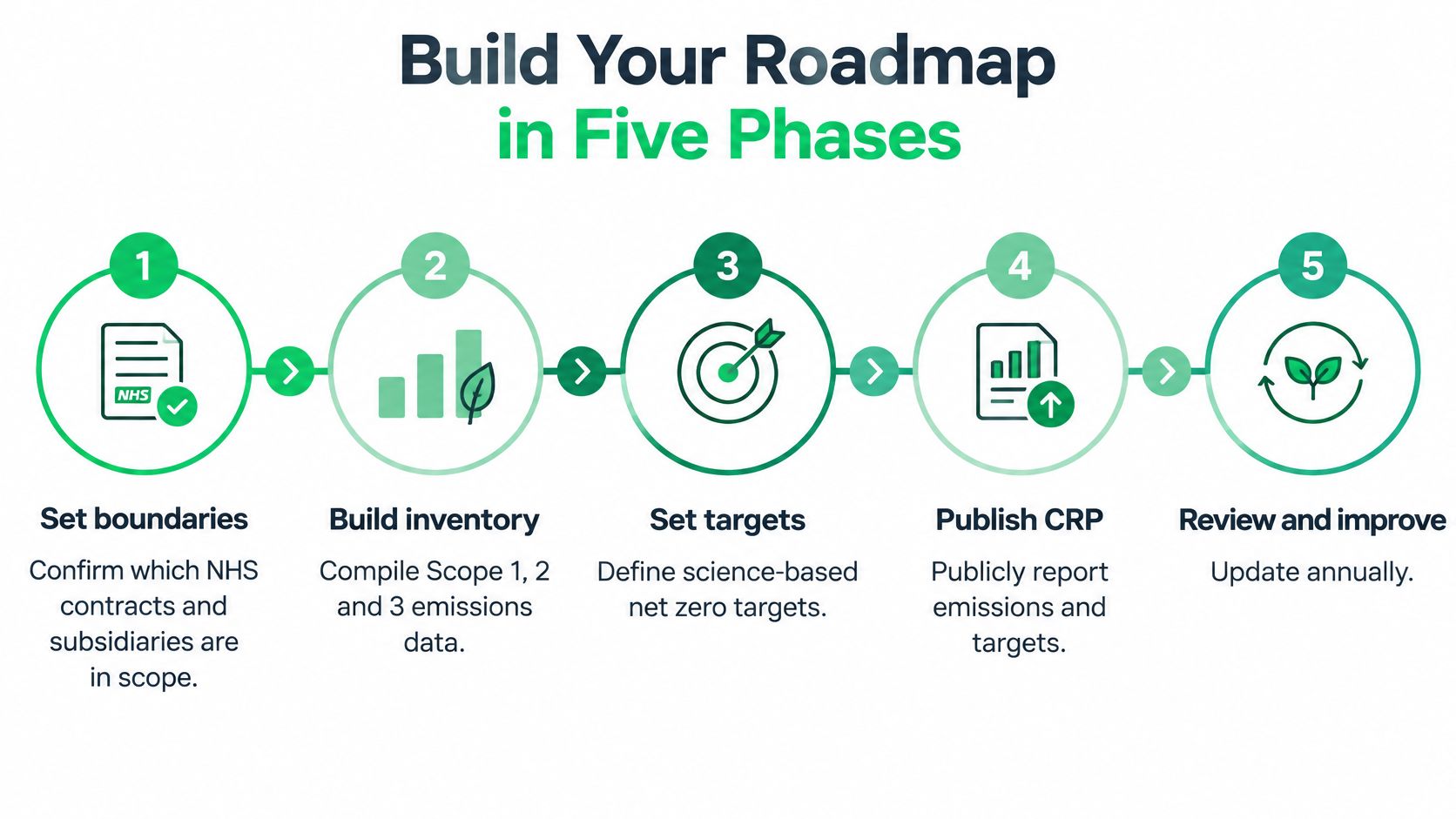
Turn the rules into a sequence a mid-sized supplier can run with reasonable data. Timings below are indicative. Scope 3 usually takes the longest, because it depends on suppliers answering you.
| Phase | Indicative Timing | Output | Check Before Tender |
|---|---|---|---|
| 1. Set boundaries | Weeks 1-4 | Organisational and value-chain boundary memo | Boundary matches legal entities and contracts in scope |
| 2. Build the inventory | Months 2-6 | Global Scope 1, 2 and 3 baseline with method notes | Figures trace to source data and avoid double counting |
| 3. Set targets | 6-8 weeks after the baseline | Targets with a stated year and reduction measures | Target year is justified against the 2045 and 2050 references |
| 4. Draft and publish the CRP | 4-6 weeks after targets | Published Carbon Reduction Plan | CRP matches tender answers and public reporting |
| 5. Maintain | Each year and before each tender | Updated inventory and progress log | Evidence is current for the next NHS tender |
Why the order is fixed
Boundaries come first because every later number inherits them. If the legal entities in the memo don't match the entities named on the bid, the inventory answers a different organisation from the one tendering.
The inventory comes next, with method notes, so a reviewer can see emission factors and data sources. Targets come only after that baseline exists. The common slip is to announce a year before the boundary is fixed, then restate the target when a subsidiary is added or a site is sold. That restatement is what makes successive bids look inconsistent.
The Carbon Reduction Plan is a publication step, not the measurement step. Draft it from the inventory and the measures, then check that the tender answers use the same totals. Our ESG consulting approach to carbon reporting is built so those figures stay traceable when the document is published.
Maintenance is the phase most packs skip. Update the inventory each year, and again before each tender, so the progress log matches the public plan. The roadmap works when each phase output maps to a question in a live tender. If a phase doesn't answer a question a buyer will ask, it isn't finished.
Evidence Buyers and Evergreen Assessors Expect
Buyers and Evergreen assessors aren't looking for a thick PDF. They're looking for a pack they can work through without ringing you. Traceability is the standard. A reviewer should follow any published figure back to its source data in one sitting.
The pack, item by item
- Boundary memo: States which entities, sites and contracts are covered, and which are out. The weak version names "the group" and never lists the companies.
- Emissions inventory: Carries method notes, emission factors and data sources beside the totals. The weak version is a single grand total nobody can rebuild.
- Target statement: Names the year and the reduction measures that sit behind it. The weak version is a year with no baseline year and no actions.
- Published Carbon Reduction Plan: Matches the inventory and is easy to find. The weak version is an internal slide that was never published.
- Scope 3 data trail: Shows which suppliers, spend categories or activity data produced each figure. The weak version is an estimate with no source.
- Senior sign-off: Records that a board or senior lead approved the plan. The weak version is a sustainability manager's draft with no owner.
- Evergreen enrolment: Shows you have already answered the assessment, not that you intend to. The weak version is "we will register if we are shortlisted".
- April 2028 readiness note: Says how you will hold product-level data once the method is set. The weak version promises product footprints you can't yet calculate.
Strong versus weak in practice
A strong Scope 3 line cites the supplier file, the year and the factor. A weak one says "estimated from spend" and stops. A strong target says which baseline year it reduces from, and which measures deliver the cut. A weak target borrows a year from a policy template.
Pick one published number and trace it to its source before the bid goes in. If you can't finish that trace in a single sitting, the buyer won't either.
That self-test is stricter than a completeness check. It catches the plan that looks finished and isn't auditable.
Match Each Bid to the Live Rule
Match each upcoming NHS bid to the rule that is live on its start date. Submit only the evidence that rule asks for. Don't send a global inventory to a tender that still wants the current UK plan, and don't send a UK-only plan to a tender that has moved on.
- List every open and upcoming NHS bid with its start date and annual value.
- Mark bids that start before 1 April 2027 as already under the April 2024 Carbon Reduction Plan rule, with the net zero and social value weighting in place since April 2022.
- Mark bids that start on or after 1 April 2027 as under the replacement rule: public emissions and targets, and a Carbon Reduction Plan covering relevant global Scope 1, Scope 2 and Scope 3. Treat 2050 as the minimum net-zero year and 2045 as the encouraged alignment.
- Leave signed contracts unchanged unless the buyer varies them. Don't rebuild a live contract around the later inventory.
- Before submission, confirm the Carbon Reduction Plan, the global inventory and the target statement use the same boundary and the same baseline year.
If the start date or the entities in scope are unclear, confirm the obligation first and only then extend the baseline. We confirm which obligations apply before anything is built or scoped, and engagements move through scoping, data collection, drafting and sign-off, with the lead consultant on every stage. That order stops a team from measuring the wrong entity.
The output is a one-page bid map, not a second roadmap. One row per bid, the live rule, and the evidence you will attach.
ESG Consulting prepares supplier-side evidence for the NHS net-zero roadmap, including Carbon Reduction Plans and Evergreen assessment readiness, and Green Plans for trusts. We confirm which obligations apply before an inventory is scoped, and the lead consultant stays with the work from scoping through data collection, drafting and sign-off. If your next NHS bid needs a boundary and a plan that will still match the bid after it, talk to ESG Consulting.