PPN 006, carbon reduction plan, PPN 006 guide, Scope 3 reporting, public sector procurement
PPN 006 Carbon Reduction Plan: A Step-by-Step Guide
By ESG Consulting Team · · 14 min read
The bid is due in eleven days when someone finally reads the selection questionnaire line by line and finds the requirement. A published carbon reduction plan, UK operations, current emissions data, signed at board level. The sustainability lead has a group ESG report from last year, a downloaded template with another company's name still in the footer, and no clear answer on whether this contract even crosses the threshold.
Most plans that get marked non-compliant aren't weak on ambition. They're missing a required element, they carry a reporting period that has aged out, or nobody signed them. That distinction changes what you spend the next ten days fixing.
Compliance is procedural. An assessor works through a fixed list. Is the boundary UK? Does the period post-date the procurement by less than a year? Are the required Scope 3 categories present? Is the declaration signed and the plan published? Each item is either evidenced or it isn't, and no amount of well-written narrative substitutes for a missing one.
Table of Contents
- What a PPN 006 Carbon Reduction Plan Must Include
- How to Build Your Plan Step by Step
- Calculating UK Emissions and the Scope 3 Subset
- Building an Evidence Register Your Auditor Can Follow
- Common Pitfalls That Lead to Rejection
- Audit-Ready Checklist and Submit Decision
What a PPN 006 Carbon Reduction Plan Must Include
Before drafting, check whether the procurement requires a Carbon Reduction Plan. PPN 006 is the UK Government mechanism for requiring plans from suppliers competing for relevant major public contracts. It applies to specified procurements by in-scope central government organisations, not to every UK supplier, as set out in the PPN 006 policy note.
The threshold has changed between regimes, so check the tender notice. PPN 06/21 guidance was issued on 5 June 2021 and applied to relevant procurements advertised on or after 30 September 2021, with an anticipated contract value above £5 million per year, excluding VAT, under the Public Contracts Regulations 2015. Under the updated framework, the threshold is contracts above £5 million per year including VAT under the Procurement Act 2023. The advertisement date and VAT basis determine which regime applies.
The policy covers central government departments, executive agencies and non-departmental public bodies. It can also apply to frameworks and dynamic markets where an individual contract exceeds £5 million per year including VAT. If the contracting authority applies the measure, a compliant plan is a condition of progressing in the competition.
The mandatory elements
Use this list to check the plan against the required content and supporting evidence.
| Element | What the plan must show | Evidence to keep |
|---|---|---|
| UK operations boundary | Emissions for UK operations, stated clearly | Site list and entity mapping |
| Scope 1 emissions | Current UK direct emissions from fuel, fleet and refrigerants | Fuel invoices, fleet logs, service records |
| Scope 2 emissions | UK purchased electricity with the method stated | Electricity invoices and meter data |
| Scope 3 subset | The five required categories | Calculation workbook and spend data |
| Net zero commitment | Signed commitment to net zero by 2050 at the latest | Board-approved statement |
| Contract-delivery measures | Environmental measures applying during contract delivery | Action plan with owners and dates |
| Reporting period | No more than 12 months before procurement starts | Period start and end dates in the plan |
| Publication | Plan published on the supplier's UK website | URL and dated screenshot |
| Declaration and sign-off | Self-certification of methodology conformity | Signed declaration and sign-off record |
Each requirement needs evidence. Strong targets do not compensate for a boundary that covers a global group when the plan is meant to report UK operations.
How to Build Your Plan Step by Step
A plan assembled in one frantic afternoon reads like one. Build the document as a controlled workflow you repeat annually, and the tender version becomes a refresh rather than a rebuild. The PPN 06/21 guidance on Carbon Reduction Plans sets out that sequence and names the failure mode directly: treating publication alone as compliance, when authorities may reject a submission that omits the Scope 3 subset, lacks contract-delivery measures, carries stale data or isn't properly signed off.
The workflow, end to end.
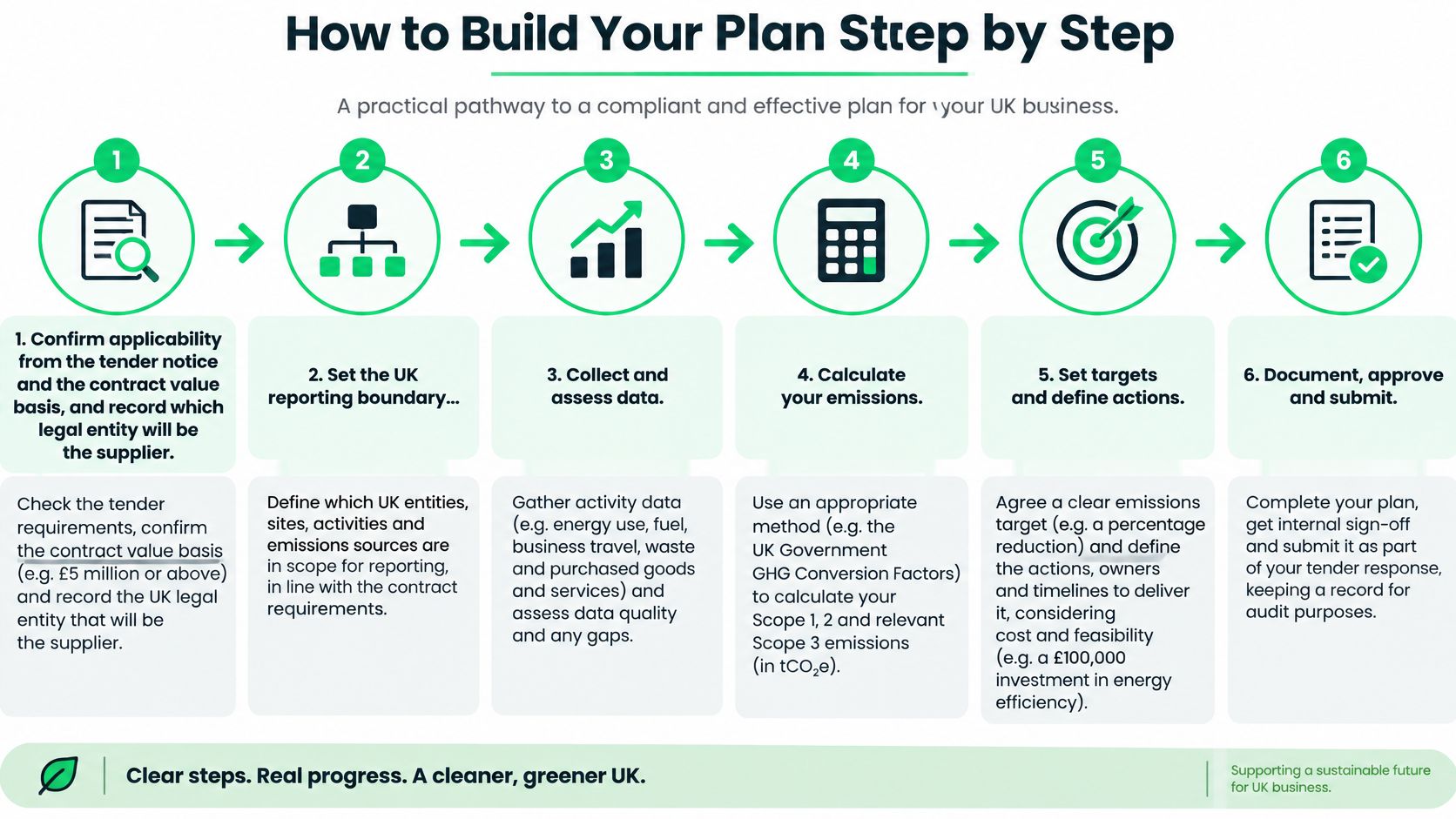
Seven steps, and the slip at each one
- Confirm applicability and name the bidding entity. Read the notice for the value basis and advertisement date, then record which legal entity contracts. Discovering you calculated for the parent group after the numbers are final is an expensive correction.
- Set the UK boundary and a reporting period ending within 12 months of procurement start. A stale period is a pass or fail risk, not a presentational nicety. Print the start and end dates inside the document.
- Calculate UK Scope 1 and Scope 2. Fuels, fleet, refrigerants, purchased electricity, each with the factor version recorded. Where that work sits outside your team, ESG Consulting's reporting team runs the same sequence to the same standard.
- Write the contract-delivery measures with owners and dates. The separate PPN 01/24 Carbon Reduction Contract Schedule, published in 2024, includes a model requirement to target a 10% reduction in the contract carbon footprint per contract year throughout the term, so any measure you promise should be plausible against that trajectory.
- Obtain sign-off and the self-certification declaration. The declaration confirms conformity with the methodology and needs an authorised senior signature. Publishing before sign-off is the classic own goal.
- Publish on the UK website and capture the URL and date. A screenshot with the date visible. A PDF emailed to the buyer isn't publication.
- Diarise the annual refresh and a pre-tender validity check. Acquisitions, closed sites and boundary changes all force a restatement, and you want to find them in May rather than in the week the questionnaire closes.
If a worked example helps more than a list, this walkthrough covers the same ground from the supplier's side.
Before the plan enters the bid, it should still read as four blocks: entity and boundary, figures with the factor version, measures with owners and dates, and the signed declaration. A fifteen-page narrative that buries those four blocks makes an assessor hunt, and hunting is where omissions get noticed.
Calculating UK Emissions and the Scope 3 Subset
Boundary first, spreadsheet second. Decide which UK sites, leased offices, vehicles and subsidiaries are inside the reporting entity, then write the decision into the document so a reader can test the figures against it. The PPN 06/21 Carbon Reduction Plan template and technical standard requires reporting under the specified Carbon Reduction Plan standard, using the GHG Protocol corporate standard and appropriate UK government conversion factors.
UK figures means UK figures. Reporting a global group total where UK figures are required is one of the pitfalls the technical standard flags, alongside mixing market-based and location-based electricity approaches without explanation, changing boundaries without restating the base year, and claiming reductions without measures that apply to the contract. State the electricity method in a sentence, and if you use both approaches, say which figure the headline number uses.
Emission sources, activity data and evidence
| Source | Scope | Activity data | Evidence to keep |
|---|---|---|---|
| Premises gas and heating oil | Scope 1 | kWh or litres by site | Supplier invoices and meter reads |
| Company vehicles and fuel | Scope 1 | Litres of fuel | Fuel card statements |
| Refrigerant top-ups | Scope 1 | kg of gas added | Service records |
| Purchased electricity | Scope 2 | kWh by site | Electricity invoices and half-hourly data |
| Business travel | Scope 3 | Distance or spend by mode | Expense claims and booking exports |
| Employee commuting | Scope 3 | Survey days and distance | Survey responses |
| Waste | Scope 3 | Tonnes by waste stream | Waste transfer notes |
| Purchased goods and services | Scope 3 | Spend by category | Purchase ledger |
| Upstream transport and distribution | Scope 3 | Tonne-km or spend | Carrier invoices |
The required subset is five categories: upstream transport and distribution, waste, business travel, employee commuting, and downstream transport and distribution. Confirm the list against the current template version before you sign, because templates get revised and old copies circulate on bid teams' drives.
The edge cases that decide quality
First-time reporters often have no clean meter history, particularly in serviced or shared buildings. Use spend-based estimates for the missing months, name the method, and state the uncertainty rather than inventing a kWh figure. A site that closed mid-year stays in the base year and comes out of the current year with a note explaining the restatement.
Reconcile before you publish. Total the electricity line and check it against the annual invoice total; do the same for gas and fuel. An assessor's fastest route into your plan is a figure that won't match the underlying records, and once one line fails that test, everything else looks borrowed.
The rule I apply: if a tonne can't be traced back to a source document, it goes in flagged as an estimate with the method named. A labelled estimate survives scrutiny. An unlabelled one presented as measured doesn't.
Building an Evidence Register Your Auditor Can Follow
Say a 60-person professional services firm reports 41 tonnes of business travel. The register row holds that figure, the expense claim export and the rail booking file behind it, the period covered, the owner who pulled the data, the conversion factor used and the workbook tab where the multiplication happens. Anyone can rebuild the number in ten minutes without asking the person who left.
Each row holds one reported figure, its source document, period, owner, factor, calculation location and an estimate flag. The discipline is refusing to add a row until the source document exists, because retrofitting evidence to a number is how plans end up inconsistent between the register and the published page.
The test I apply: if a figure can't be matched to an invoice, a meter read or a booking export, it goes in flagged as an estimate with the method named.
Where the data comes from
- Energy and fuel records: supplier invoices, meter reads and half-hourly electricity data for every UK site, including leased offices where the landlord recharges.
- Fleet and travel: fuel card statements for vehicles, expense claims and booking exports for rail, air and hotels.
- Waste and procurement: waste transfer notes by stream, and purchase ledger extracts by category for spend-based Scope 3 estimates.
- People data: a commuting survey run on a defined sample of days, with the responses kept rather than just the totals.
- Refrigerants: service records showing kilograms of gas added at each top-up, since this is the line most often guessed.
Version control and the annual refresh
Date the register, lock the base year, and record every change with a reason attached. When an acquisition adds 200 staff, the note explains the boundary movement before anyone asks. Name one owner for the register rather than a committee, and give them a review date roughly 30 days before the next relevant tender is expected, so there's time to fix a gap.
Re-check every figure whose period has rolled off the 12-month window. That single routine removes the most common rejection reason in these procurements: not a weak number, an old one.
Common Pitfalls That Lead to Rejection
The worry that keeps suppliers awake is that high emissions will exclude them. That isn't how the assessment works. The PPN 006 frequently asked questions state that emissions data itself must not be used as the basis for assessment, although authorities may use it to track supplier progress over time. A supplier generally isn't excluded because its emissions are high, its target is modest or its Scope 3 data is incomplete, provided the plan meets the reporting standard, carries the declaration and explains the measures that will apply during contract delivery.
Publishing an increase is normal and disclosable. The Crown Commercial Service Carbon Reduction Plan reported a total carbon footprint of 406.5 tonnes covering 2023 and 2024, an increase of 28.5% from 2023. What matters is that the rise appears with an explanation, not that it's absent.
Symptoms and fixes
| Symptom | Likely cause | Fix |
|---|---|---|
| Plan rejected for missing Scope 3 | Only Scope 1 and 2 reported | Add the five required Scope 3 categories with method notes |
| Figures look global, not UK | Group boundary used without UK split | Restate the figures for UK operations and state the boundary |
| Year-on-year figures do not compare | Base year changed without restatement | Restate the base year and explain the change |
| Reporting period flagged as stale | Period older than 12 months before procurement | Update the period and refresh the calculations |
| Declaration missing or unsigned | Sign-off treated as an internal formality | Obtain a signed declaration from an authorised senior person |
| Reductions claimed with no contract measures | Targets stated without actions or owners | Add contract-delivery measures with owners and dates |
Three cases that catch otherwise well-run suppliers
- The group report substitution. A FTSE-listed supplier publishes a polished group ESG report, then lifts it as the PPN 006 document. It covers global operations, uses market-based electricity without explanation, and never mentions the contract. The fix is a UK-level extract, not a rewrite of the group report.
- The undisclosed rebaselining. A divestment changes the boundary, so the base year is recalculated and the trend line looks flat. Restate the base year openly and explain the movement in two sentences.
- The global boundary in a UK tender. Figures include operations in three continents because that's how the carbon tool is configured. Split the UK numbers out, and keep the global total as context if you want it visible.
Deciding between correcting a figure and reissuing the whole plan comes down to whether the boundary or the period changed. A single wrong number gets a correction and a dated note in the document. A boundary or period change means republishing, because the version in the public domain no longer describes the entity bidding.
Audit-Ready Checklist and Submit Decision
Run this against the current document before publication, not after the tender closes. The working file should be the version you'd hand to an external assurance team without a week of tidying first.
The final review, as a single pass or fail sheet.
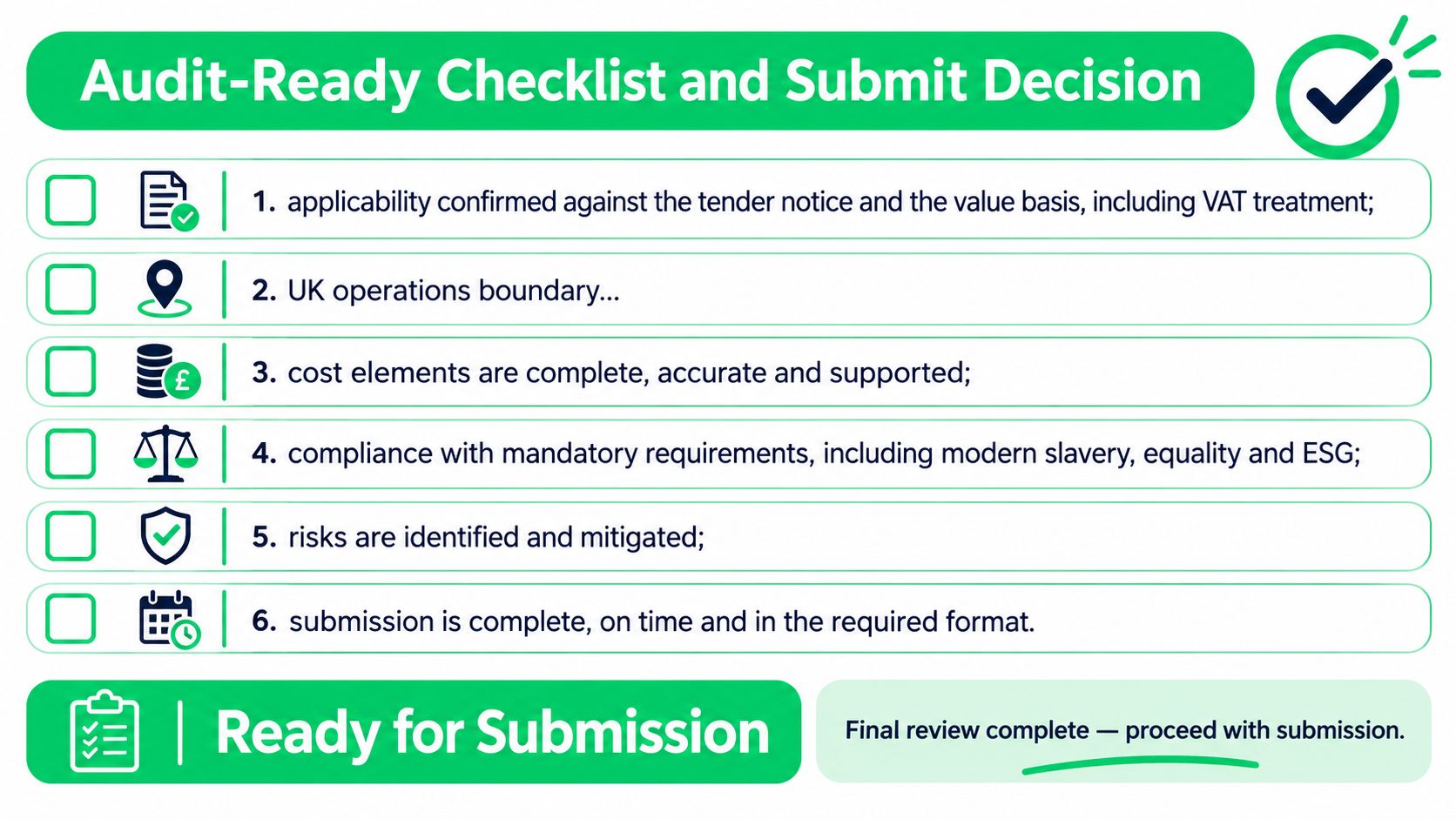
The pre-publication checklist
- Applicability confirmed against the tender notice, including the value basis and VAT treatment.
- UK operations boundary stated in the document.
- Reporting period ending no more than 12 months before procurement starts.
- UK Scope 1 and Scope 2 figures present, with the electricity method stated.
- All five required Scope 3 categories reported, with method notes.
- Base year and current year shown side by side.
- Conversion factor version cited.
- Contract-specific environmental measures with named owners and dates.
- Signed commitment to net zero by 2050 at the latest.
- Declaration of conformity signed by an authorised senior person.
- Plan published on the UK website, with URL and date captured.
- Every figure traced to a row in the evidence register.
- Annual refresh date in the calendar with a named owner.
Decision rule: submit only when every item passes and every figure traces to the register. If any item fails or the boundary is unclear, fix first. A rejected submission costs more time than a delayed one.
Outside help earns its fee in three situations: a first-time supplier with no inventory history, a multi-entity group that needs a clean UK split, and a Scope 3 reconciliation spread across dozens of sub-suppliers. Our Carbon Reduction Plans are prepared to the PPN 006 technical standard, with Social Value Model responses for central government contracts. Each engagement is scoped in a written statement of work, with in-house sustainability and quality assurance teams behind the deliverable.
Take the current document and work through the thirteen items this week, listing every one you can't evidence. That list is your actual to-do list, and it's shorter than the fear that started the process.
ESG Consulting prepares Carbon Reduction Plans to the PPN 006 technical standard, covering the UK boundary, the required emissions data, reduction commitments, governance and contract-delivery measures, with Social Value Model responses for central government contracts and a fixed scope agreed in writing before work starts. If a relevant tender is on the horizon and your existing plan hasn't been tested against an assessor's checklist, our team can build or repair it with the evidence trail behind every figure. Visit ESG Consulting to talk through your next submission.