secr carbon reporting, SECR thresholds, UK emissions disclosure, Scope 1 and 2, annual report carbon
SECR Carbon Reporting: Rules, Thresholds and Disclosures
By ESG Consulting Team · · 14 min read
Could your SECR disclosure contain every required item and still give the board a misleading picture of emissions performance? Yes. A complete annual-report paragraph doesn't, by itself, establish that the underlying figures are comparable, complete or suitable for investment decisions.
SECR carbon reporting combines a legal disclosure obligation with a practical accounting task. You need to establish which entities must report, collect the right energy records, calculate emissions and explain energy-efficiency action. The harder task is maintaining a clear connection between each published figure and the activity it represents, especially when several climate-reporting obligations use the same records.
Table of Contents
- Who Must Report Under SECR and Why
- What Your Annual Report Must Include
- Turning Energy Data into Auditable Emissions Figures
- How to Prepare Your SECR Process Step by Step
- Why a Compliant SECR Report Can Still Mislead
- Integrate Overlapping Duties and Confirm Your Obligations
Who Must Report Under SECR and Why
Could a privately owned business still have to report under SECR? Yes. Scope depends on the entity's legal status and size, not whether its shares are publicly traded.
SECR applies to financial years beginning on or after 1 April 2019. The government's original SECR policy document describes the coverage of quoted companies and the size tests for large unquoted companies and LLPs: more than 250 employees, turnover above £36 million, or a balance-sheet total above £18 million. An unquoted company or LLP generally meets the size test by exceeding at least two of these three thresholds.
SECR applicability by entity type
| Entity type | Test that decides scope | Status |
|---|---|---|
| Quoted company | Qualifying stock-exchange listing | In scope, unless the low-energy-use exemption applies |
| Large unquoted company or LLP | Exceeds at least two of the employee, turnover and balance-sheet thresholds | In scope, subject to applicable exemptions |
| Unquoted company or LLP with high qualifying electricity consumption | Qualifying electricity consumption above 40,000 kWh | In scope if the relevant rules apply, subject to applicable exemptions |
| Smaller unquoted company or LLP | Exceeds fewer than two of the employee, turnover and balance-sheet thresholds | Generally outside SECR, subject to confirming the entity and group position |
Distinguish historical criteria from the reporting decision
The original policy document provides historical context. For a particular reporting year, confirm which rules apply before deciding whether an entity is in scope. The electricity-consumption criterion is not a substitute for assessing an entity's legal status and size.
These tests answer different questions. High electricity consumption alone does not establish that a company must report, and low consumption does not remove the need to assess whether an exemption applies.
Consider a privately owned manufacturer that exceeds the employee and turnover thresholds. The absence of publicly traded shares does not put it outside SECR. Its finance team should document the reporting position and assess whether an exemption applies.
Practical rule: Keep a written applicability decision with the annual-report working papers, including the rules used, the financial year assessed and the person who approved it.
Make the decision for the relevant year
A company close to a size threshold should verify the relevant figures for each reporting year rather than rely on last year's conclusion. Finance should also consider subsidiaries, group reporting and changes in corporate structure before confirming the position.
The decision should state clearly whether the applicable rules require reporting and whether an exemption applies. Resolve uncertainty before commissioning calculations. An accurate emissions inventory cannot correct a mistaken decision about which entities belong within the reporting boundary.
What Your Annual Report Must Include
Required annual report content by company type
| Element | Quoted companies | Large unquoted companies and LLPs |
|---|---|---|
| Energy use | Global energy use | UK energy use from electricity, gas and transport fuel |
| Greenhouse-gas emissions | Global emissions within the reporting boundary | UK emissions from the same energy sources |
| Emissions-intensity ratio | Required | Required, with a stated denominator |
| Energy-efficiency narrative | Required | Required, describing actions taken |
| Methodology | Disclosed | Disclosed, covering boundaries, data sources, estimation and exclusions |
The government's Environmental Reporting Guidelines distinguish quoted companies' global disclosures from the UK minimum for large unquoted companies and LLPs, and require an intensity ratio, energy-efficiency information and disclosure of the calculation methodology.
Energy consumption and emissions aren't interchangeable. Energy tells readers how much electricity or fuel the organisation used. Emissions express the associated greenhouse-gas impact, allowing different gases to be presented on a common carbon-dioxide-equivalent basis.
Define the geographical boundary before collecting totals
A UK-headquartered group might operate overseas offices, factories or distribution centres. The reporting team needs to know whether those activities belong in the statutory disclosure before it combines supplier files.
Keep geography as a field in the underlying ledger rather than creating disconnected UK and overseas spreadsheets. Each activity record should identify the entity, site, energy source and reporting period, making it possible to produce the appropriate view without rebuilding the inventory.
For quoted companies, the disclosure sits within the Directors' Report. Large unquoted companies and LLPs need to follow the reporting arrangements applicable to their entity type, rather than assuming that every organisation uses an identical annual-report format.
Make the intensity ratio understandable
An emissions-intensity ratio relates emissions to a business measure. For example, emissions per employee divide the relevant emissions total by the stated employee measure.
Specify whether the denominator uses an average workforce or another defined measure, and use a consistent approach when comparing periods. If your business changes the denominator, explain the change rather than presenting the resulting movement as operational improvement.
The energy-efficiency narrative should distinguish actions completed, results supported by evidence and future intentions. If the business adjusted heating controls, describe the change and its coverage; if it claims savings, identify how those savings were assessed.
A planned efficiency project isn't an action already taken, and a projected saving isn't a measured result.
Finish the drafting process with a disclosure checklist. Give each required element a named owner, a supporting document and a review status, so the annual-report editor isn't left interpreting an unexplained spreadsheet.
Turning Energy Data into Auditable Emissions Figures
A supplier invoice records activity. A conversion factor translates that activity into a reporting measure. Auditability depends on preserving both, together with the calculation connecting them.
The UK Government greenhouse-gas conversion factors support conversion of activity into kilowatt-hours and tonnes of carbon-dioxide equivalent, with annually updated factors and a methodology explaining their derivation. Select the factor release appropriate to the reporting period and document your selection.
Activity data and evidence by source
| Activity source | Unit to collect | Conversion applied | Evidence to keep |
|---|---|---|---|
| Purchased electricity | kWh from meters | Applicable reporting-year electricity factor | Supplier invoices and meter reads |
| Natural gas | kWh or cubic metres from meters | Where necessary, convert volume to kWh using the billing methodology, then apply the fuel factor | Gas bills and meter readings |
| Petrol and diesel | Litres used | Applicable reporting-year fuel factor | Fuel-card reports and receipts |
| Business travel by car | Distance travelled | Vehicle factor for emissions; relevant distance-to-fuel and net-kWh method for energy | Mileage claims and fleet logs |
Keep the original units
For diesel, the basic calculation is litres consumed multiplied by the applicable emissions factor. Check the factor's output unit before converting the result to tonnes, rather than assuming that every factor produces the final disclosure unit directly.
Retain the original litres even after calculating emissions. If finance corrects a fuel statement or a reviewer identifies the wrong factor category, you can rerun the calculation without reconstructing consumption.
For distance-based travel, emissions and energy may require different calculation paths. Follow the relevant vehicle methodology to derive emissions, then use the appropriate fuel-consumption and net-energy relationship where an energy total is needed.
Maintain linked energy and emissions calculations
Your workbook or carbon-accounting system should maintain separate outputs for energy consumption and emissions, linked to the same activity record. Classify direct fuel combustion, purchased electricity and relevant indirect travel correctly instead of assuming every transport record belongs in direct emissions.
Factor changes also need explanation. A lower calculated emissions total doesn't necessarily mean the organisation consumed less energy, so retain a clear distinction between consumption movements and factor-related movements.
Useful calculation fields include:
- Activity reference: The invoice, meter record or fleet file supporting the input.
- Factor reference: The release, category, unit and factor selected.
- Calculation status: Whether the input is actual, estimated, corrected or awaiting review.
- Reviewer record: Who checked the calculation and resolved exceptions.
Keep invoices, meter records, fleet reports, factor versions and calculation files in a controlled reporting folder. A reviewer should be able to follow a disclosed total back to its component records without relying on the preparer's memory.
How to Prepare Your SECR Process Step by Step
Organise SECR around the financial reporting timetable, not around the date someone starts drafting the sustainability narrative. Resolve scope and ownership early enough to correct missing records before publication.
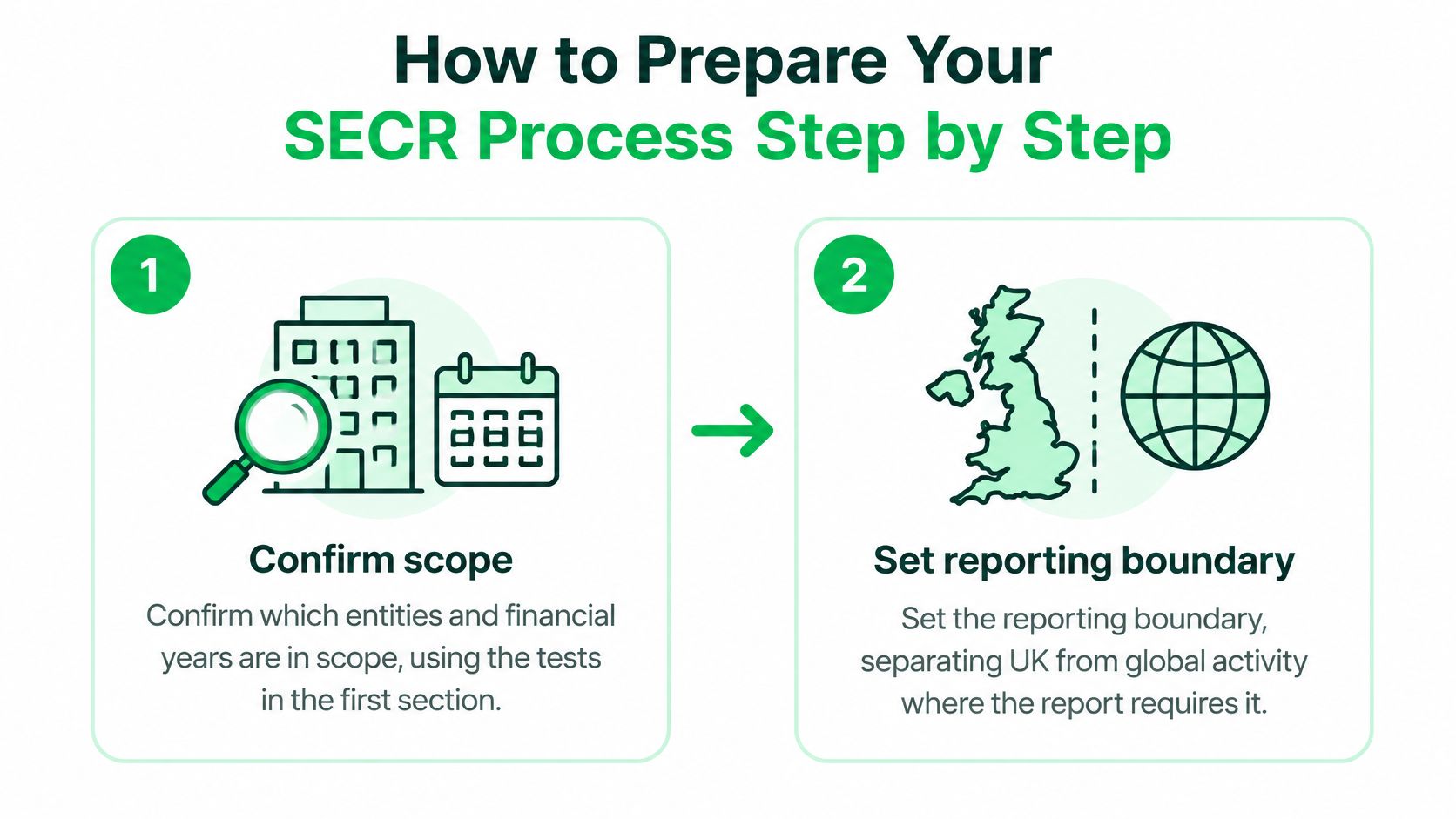
Start with the entity and reporting-boundary decisions.
Establish responsibility before calculation
Confirm the reporting entities and period. Ask finance or the company secretarial team to approve the applicability assessment for each relevant entity. Record the conclusion, including any group-reporting treatment, rather than leaving it implicit in a consolidated spreadsheet.
Approve the reporting boundary. Create a register of entities, sites, vehicles and relevant travel activities, with their geographical location and inclusion status. Explain exclusions so that a missing site can't be mistaken for an intentional boundary decision.
Name the data owners. Allocate electricity and gas records to facilities or energy management, vehicle fuel to fleet management, and mileage claims to finance or travel administration. Give each owner a submission format and an escalation contact for missing information.
Collect records covering the whole financial year. Check the submission against a meter and account register, not just against whatever invoices arrive. Identify estimated supplier readings, overlapping billing periods and accounts opened or closed during the year.
These preparatory checks make the calculation stage easier to review. They also prevent a common mistake: treating a tidy file as proof that every relevant source has been included.
Use the accompanying video alongside the working checklist, while retaining your organisation's own approved methodology.
Calculate, challenge and approve
Run controlled calculations. Apply the selected factors consistently and produce both energy and emissions outputs for each source. Build checks for unit mismatches, duplicate invoices and unexpected negative values before combining totals.
Document estimates rather than hiding gaps. Where records are missing, use a defensible method such as a comparable operating period adjusted for known changes. Set an internal escalation threshold for estimated data, label every estimate and record why the method is reasonable; don't present your internal threshold as a statutory allowance.
Calculate the intensity measure and investigate movement. Obtain the denominator from its responsible business owner and confirm that its period matches the emissions numerator. Examine whether changes reflect consumption, business activity, organisational changes or methodology.
Draft the efficiency narrative from operational evidence. Ask project owners to confirm what was completed and what supporting records exist. Keep expected benefits separate from measured outcomes, especially where production, occupancy or weather also changed.
Reconcile and obtain sign-off. Compare the activity ledger with utility accounts, fleet records and the site register, investigating unexplained differences. Have a reviewer approve the calculations and narrative before the annual report is finalised, then archive the approved version separately from working drafts.
Why a Compliant SECR Report Can Still Mislead
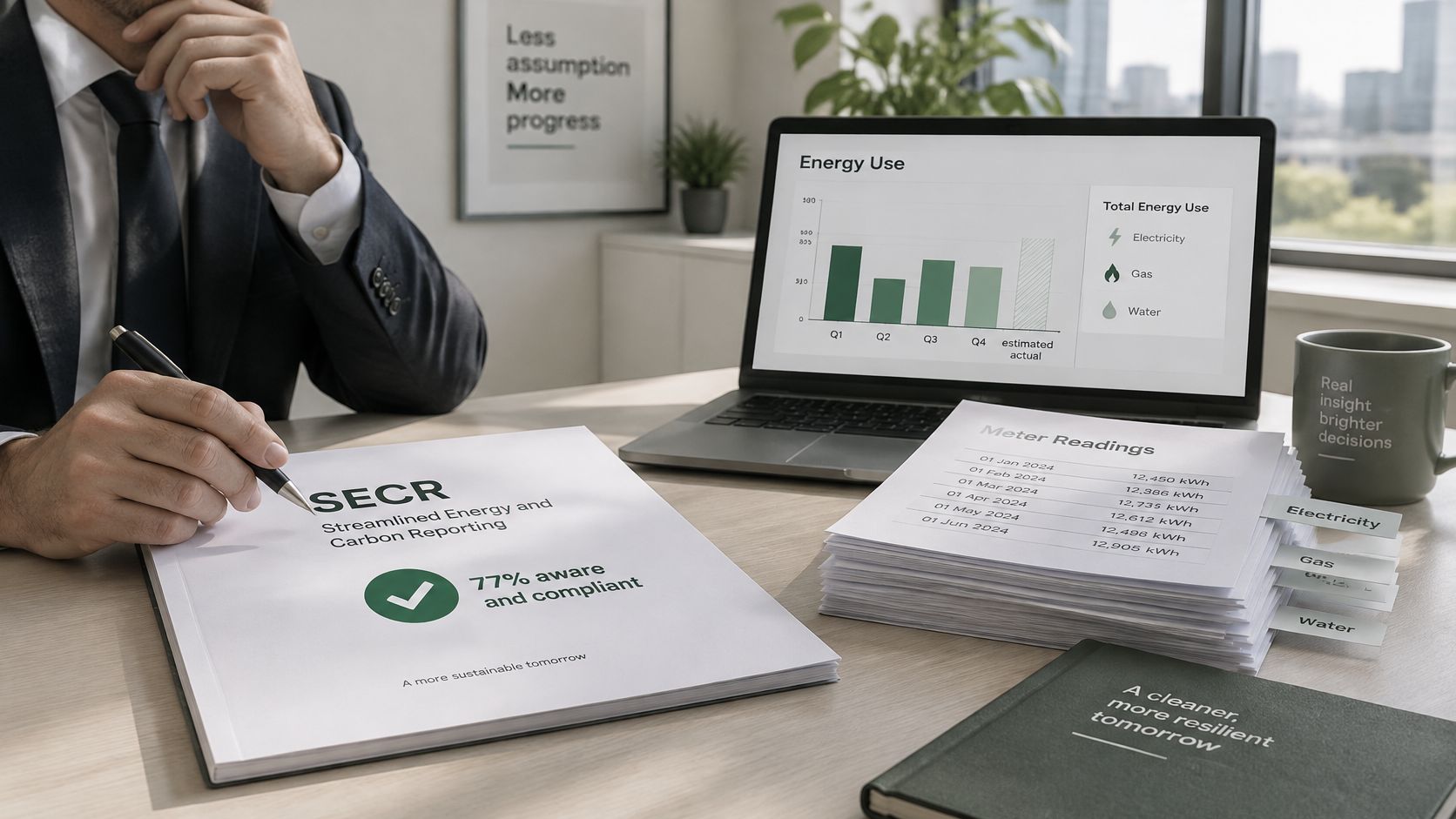
The uncomfortable gap is between confidence and demonstrated compliance. The UK Government's SECR evaluation found that 77% of surveyed in-scope businesses said they were aware of and compliant with the rules, while estimated actual non-compliance remained 14–23%, with gaps more prevalent among private companies and LLPs.
That finding doesn't mean every compliant report is unreliable. It means a company's assertion that it complies isn't enough to establish the quality of its calculations, and even a disclosure containing the required elements may not support a sound performance comparison.
The important review happens behind the published paragraph.
How an apparently improving trend can mislead
Say a company reports falling emissions after an office relocation. If the new landlord supplies electricity within a service charge and the reporting team overlooks it, the published reduction partly reflects a missing record rather than lower consumption.
A different company might report a better turnover-based intensity ratio after raising prices. The arithmetic can be correct while offering little evidence that operations became more energy efficient.
Legitimate methodological changes need equal care. Updating an electricity factor is appropriate, but presenting the resulting emissions reduction as an achievement of an efficiency project confuses the cause of the movement.
Board test: Ask what changed in the business, what changed in the calculation and what remains uncertain before accepting a favourable trend.
Test the figure, not just the paragraph
Use a short control review for each material disclosure:
- Evidence trail: Can the reviewer trace the total through calculations to original activity records?
- Accountability: Has the source owner confirmed completeness, including newly opened or closed accounts?
- Estimation discipline: Are assumptions visible, with an approved threshold for escalation?
- Review sign-off: Has someone other than the preparer challenged unusual movements?
- Reconciliation: Does the inventory agree with relevant financial and operational records after explained adjustments?
At ESG Consulting, every figure we produce traces back to source data, with the methodology, boundaries and assumptions documented for the client's auditor or assurance provider. That documentation allows a reviewer to distinguish an operational improvement from a reporting change.
The board's closing question should be practical: would the year-on-year conclusion still hold if a meter were missing? If nobody can assess the effect, the trend isn't yet decision-grade.
Integrate Overlapping Duties and Confirm Your Obligations
Begin integration with a written applicability assessment, not a software purchase. Establish which entities face which duties, who approves each disclosure and which reporting periods apply.
The administrative case is clear: Bird & Bird's account of the UK Government's SECR review reports an average of 94 internal staff hours annually and mean total ongoing costs of approximately £7,100, including external consultancy and audit fees. It also identifies overlapping frameworks and inconsistent methodologies as continuing problems.
Share records without merging legal duties
Mandatory climate-related financial disclosure regulations apply to accounting periods starting on or after 6 April 2022, according to the UK Government's climate-disclosure announcement, which describes requirements aligned with governance, strategy, risk management, and metrics and targets.
Those disclosures ask different questions from SECR. Energy and emissions records can support them, but a consumption table doesn't explain how directors oversee climate risk or how climate-related developments affect business strategy.
SECR overlap with other climate and energy regimes
| Regime | Who it covers | Shared with SECR | Keep separate |
|---|---|---|---|
| ESOS Phase 3 and 4 | Large undertakings required to assess energy use under the applicable scheme rules | Site energy data and consumption records | Audit scope, Lead Assessor sign-off and notification |
| TCFD-aligned climate disclosures | Qualifying large UK companies and financial institutions | Emissions data and relevant targets | Governance, strategy and risk narrative |
| UK SRS S1 and S2 | Entities preparing sustainability reporting under the UK standards | Emissions metrics and underlying activity records | Standard-specific requirements, applicability and reporting timeline |
| CSRD | Companies within the applicable EU reporting rules | Energy and emissions datasets | Legal scope and applicable ESRS requirements |
Use this as a workflow map, not an eligibility checklist. An organisation's inclusion in SECR doesn't automatically establish its position under another regime, and preparing information voluntarily doesn't by itself create a statutory obligation.
The integration rule is shared source records, controlled factor versions and a common evidence trail, with separate legal assessments and approvals. Reuse the calculation components that match; retain distinct outputs where boundaries, definitions or reporting periods differ.
Turn integration into assigned actions
For practical support with ESG and sustainability reporting, start by defining the decisions that need resolving. At ESG Consulting, we confirm which obligations apply before anything is built or scoped.
Put these actions into the reporting calendar:
- Confirm applicability in writing: Record the position for each entity and each relevant obligation, including the basis for exclusions.
- Appoint owners and coordinate requests: Ask facilities, fleet and finance for a shared submission rather than sending separate questionnaires for every framework.
- Schedule an internal review before year-end: Investigate incomplete coverage while teams still have time to obtain missing records.
Set a fixed calendar date for completing the applicability assessment and assign it to a named owner today. Make that an internal control deadline, clearly distinguished from statutory filing dates, and require approval before the reporting build begins.
ESG Consulting offers SECR support covering Scope 1 and 2 inventories, intensity ratios and the energy-efficiency narrative required in the annual report. Visit ESG Consulting to discuss your reporting obligations and establish a scoped approach to calculations, evidence and sign-off.