SECR exemptions, SECR reporting, low-energy-user exemption, UK energy reporting, carbon reporting thresholds
SECR Exemptions: Thresholds and Who Qualifies in 2026
By ESG Consulting Team · · 19 min read
The two decisive numbers in SECR are 250 employees, £36 million turnover and £18 million on the balance sheet (any two of the three, in both the current and preceding financial year, brings an unquoted company or LLP into scope) and 40,000 kWh of energy in the reporting period, the point at which an in-scope organisation can stop reporting detailed energy and carbon figures and instead explain that it qualifies as a low-energy user.
The common advice is to treat those numbers as an exit sign. Find the threshold, duck under it, omit the disclosures, move on. That advice is wrong in a way that tends to surface at the worst moment, usually in front of an auditor or a reviewer who asks a simple question: show me the calculation.
An exemption under the UK's Energy and Carbon Reporting regime isn't a loophole. It's a reporting position, and like any reporting position it needs three things: a threshold test you can evidence, a statement in the annual report that says what you're doing and why, and an evidence pack that survives someone else checking your work. Where those three exist, an exemption is defensible and cheap. Where they don't, you have a silent omission dressed up as a policy, and that's harder to defend than a short, honest disclosure would have been.
I've filed these reports, reviewed others, and sat through the conversation where a finance director discovers the "low energy user" line was written from memory. The pattern repeats: the arithmetic was roughly right, the documentation was absent, and nobody had written down the perimeter the figure came from. Here's how to run the three routes properly.
Table of Contents
- SECR Scope and Exemption Routes at a Glance
- How SECR Scope Is Decided
- The Two-of-Three Size Test for Companies and LLPs
- The 40,000 kWh Low-Energy-User Exemption
- Omitting Data for Impracticality or Serious Prejudice
- Worked Examples of SECR Exemption Decisions
- Confirm Your SECR Position for 2026
SECR Scope and Exemption Routes at a Glance
SECR is delivered through the directors' report under the Companies Act reporting framework, which means an exemption isn't an internal decision you can make without disclosure. It's a statement in a public document. Whether you need to make that statement at all turns on three levers: quoted status, size and annual energy consumption, applied in that order.
Quoted companies sit in scope at any size, and the only route back out is the global 40,000 kWh test. Large unquoted companies and LLPs enter scope by meeting at least two of three size tests, in both the current and the preceding financial year, and their low-energy test is measured on UK energy use. Smaller private entities fall outside SECR altogether, though the size-test evidence still belongs on file for both years, because a good year doesn't cancel a bad one.
The table below is the whole framework compressed. Everything after it is the working detail.
| Organisation or route | Threshold or condition | Effect on SECR reporting | What you must still do |
|---|---|---|---|
| Quoted company | In scope at any size; quoted status alone creates the duty | Full energy and carbon disclosures required, unless low-energy user | Annual-report narrative; low-energy statement only if 40,000 kWh or less globally |
| Large unquoted company or LLP | At least 2 of 3 tests in current and preceding year: over 250 employees, turnover over £36m, balance sheet over £18m | Full energy and carbon disclosures required | Directors' report with Scope 1, 2 and energy data |
| Smaller unquoted company or LLP | Fails at least 2 of 3 size tests in either year | Outside SECR | Keep two years of size-test evidence on file |
| Low-energy user (in-scope entity) | 40,000 kWh or less in the reporting period; global use for quoted, UK use for unquoted and LLPs | May omit detailed energy and carbon figures | State low-energy-user status in the directors' report; keep meter and fuel records |
| Impracticality (unquoted only) | Information genuinely not practical to obtain | May omit that information | Identify the omitted information and explain why in the report |
| Serious prejudice | Directors judge disclosure seriously prejudicial to the company | May withhold exceptional information | Identify and explain the omission; document board approval |
Read the last three rows together and a pattern appears. None of them removes the narrative. Low-energy status swaps numbers for a statement. Impracticality and serious prejudice swap numbers for an explanation. The report still goes out, still says something, and still has to be true.
That's the distinction that separates a governed exemption from a gap. A gap is an absence. A governed exemption is a stated position with a reason attached, and reviewers treat the two very differently.
The rest of this guide works through scope, the two-of-three arithmetic, the low-energy route in detail, the two narrower omission grounds, worked examples, and a pre-filing routine you can run each year.
How SECR Scope Is Decided
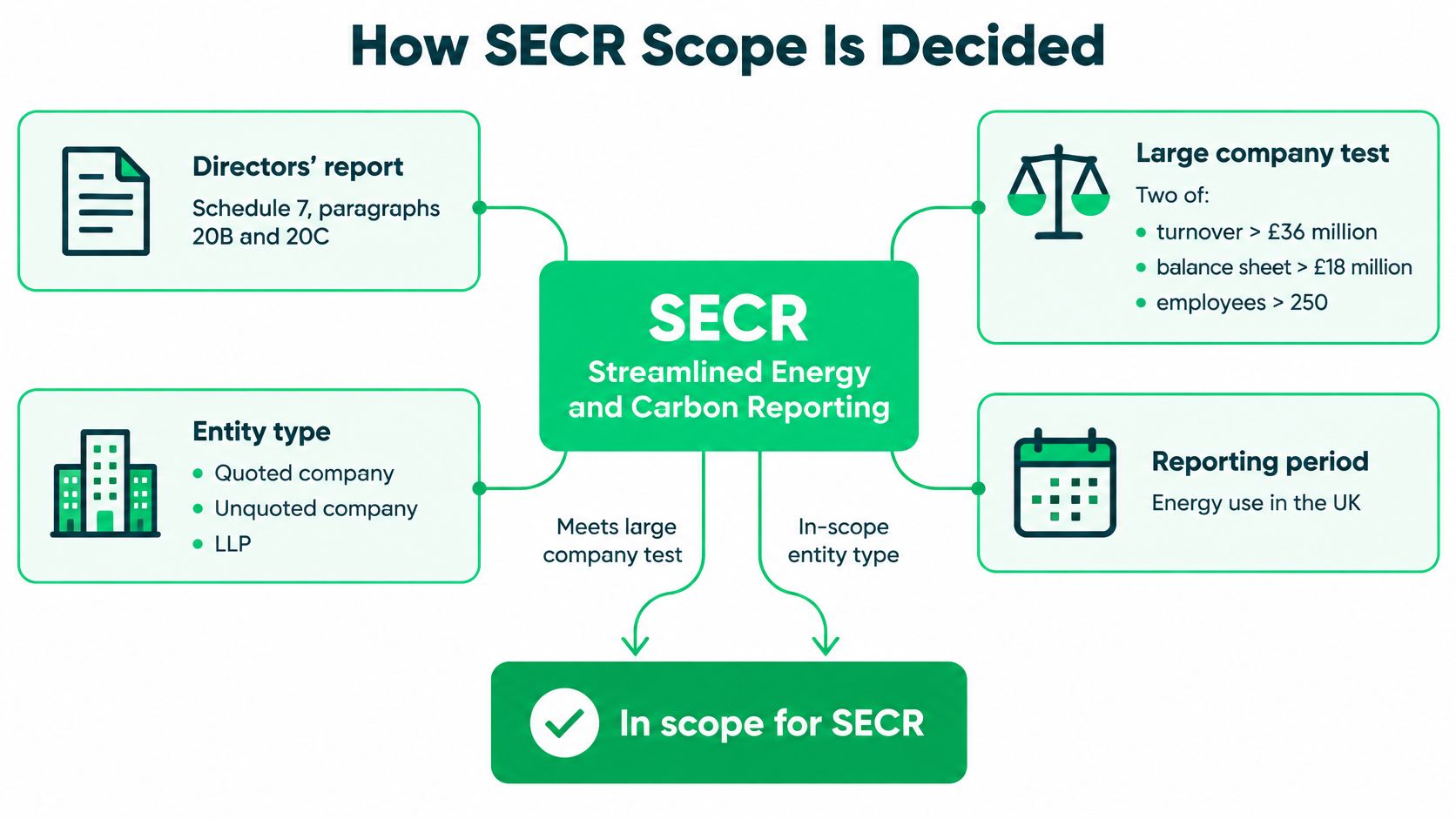
Start with entity type. Before you touch a calculator, decide which of three boxes your organisation occupies: quoted, large private, or smaller private. Getting that wrong makes every subsequent number irrelevant.
The cleanest way to hold the distinction is a toll-road analogy. Quoted status is a toll road: you pay whichever car you drive. A quoted company reports regardless of size, and its size tests are beside the point. An unquoted company or LLP only reaches the toll booth at all if it's big enough, and the size tests are the gate. Two different mechanisms, one destination.
The UK Government's sustainability reporting guidance sets out the framework in these terms: mandatory for quoted companies unless they qualify for the low-energy-consumption exemption, and applicable to unquoted companies and LLPs meeting at least two of three size tests, being more than 250 employees, annual turnover above £36 million, or a balance-sheet total above £18 million. Quoted companies, the guidance notes, generally remain within scope regardless of size.
Why the quoted distinction decides everything downstream
A private company's exemption is decided by numbers. A quoted company's exemption is decided by energy use alone. That's why a UK-listed group with overseas operations can't borrow comfort from a small UK subsidiary's meter reading, and why a private group can't assume its quoted parent's reporting covers it.
Practical rule: classify first, calculate second, and write the classification down with the date it was made. Group structures change during the year, and so do the answers.
There's a second trap in the same guidance. The SECR thresholds are not interchangeable with newer Companies Act definitions of a "large" company, following changes to company-size thresholds. An entity reclassified as medium-sized for its accounts can still be squarely in scope for SECR. So can a recently acquired subsidiary that was scoped under a different regime last year.
The framework itself covers UK-incorporated entities and is implemented through the Companies Act reporting framework and related regulations. Overseas parents, overseas subsidiaries and unincorporated public bodies aren't caught by it directly, though a UK subsidiary of an overseas group is assessed on its own merits.
The Two-of-Three Size Test for Companies and LLPs
Here's the arithmetic. A single company or LLP enters scope by exceeding at least two of: more than 250 employees, annual turnover above £36 million, balance-sheet total above £18 million. Miss two or more and it stays outside, provided that's true in both years.
Group thresholds are scaled up. Both the single-entity and group figures come from the Financial Reporting Council's scoping tables, which link them to paragraphs 20B and 20C of Schedule 7 to the Large and Medium-sized Companies and Groups (Accounts and Reports) Regulations 2008.
| Test | Single company or LLP | Group threshold (gross) | Group threshold (net) |
|---|---|---|---|
| Turnover | Above £36 million | Above £43.2 million | Above £36 million |
| Balance-sheet total | Above £18 million | Above £21.6 million | Above £18 million |
| Employees | More than 250 | More than 250 | More than 250 |
The two-year look-back catches people out
The test isn't a snapshot. It applies in both the current and the preceding financial year. A company that crosses a threshold this year is usually not in scope yet, because the test hasn't been met two years running. Companies spend a fortune on advice in the year they tip over a threshold when the answer is that nothing changes until the pattern repeats.
That cuts both ways. A company that drops below two thresholds in one year doesn't necessarily fall out either. Retain both years' figures as evidence, dated and reconciled to the filed accounts, because the question a reviewer asks is about the pattern, not the latest number.
Run it in four steps, then check the group
- Confirm entity type. Quoted, unquoted company, or LLP. If quoted, stop here: size is irrelevant.
- Collect three figures for two years. Turnover, balance-sheet total and headcount, taken from the filed accounts rather than a management dashboard.
- Aggregate to group level where relevant. Apply both standalone and consolidated figures. A parent-group assessment can extinguish an apparent subsidiary-level exemption, which is why modelling only one perimeter is the most common error in this test.
- Count the tests met in each year. Two or more in both years means scope. Anything less means outside, with the working retained.
The £36 million edge case
Say a company lands at £36.4 million turnover, 240 employees and a £19 million balance sheet. It meets two tests, turnover and balance sheet, and has done for two years. It's in scope. The margin above the turnover line is immaterial to the answer.
Now say the same company is at £35.8 million and £17.9 million with 255 employees. One test met. Outside scope, and no amount of narrative changes that. But the file still needs the numbers, because next year's headcount might hold and the balance sheet might not.
The behaviour that works is boring: a single scoping memo, refreshed at each period end, showing the three figures for two years, the group position, and the count. That memo is what you hand over when someone asks why there's no energy data in the report.
The 40,000 kWh Low-Energy-User Exemption
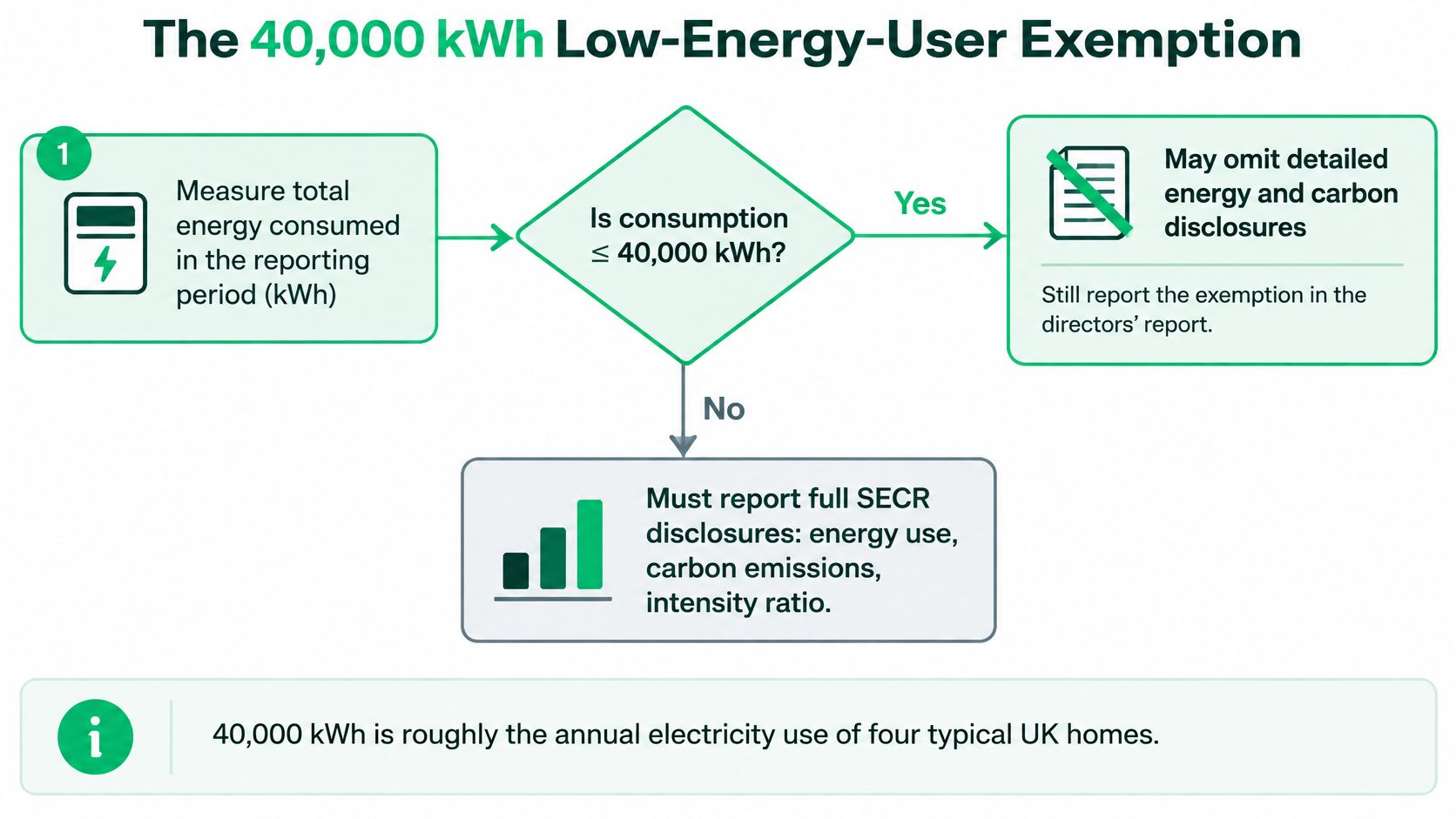
The most-used exemption is also the most casually applied. The rule: an in-scope entity consuming no more than 40,000 kWh of energy during the reporting period may omit the detailed energy and carbon disclosures, but the directors' report must state that the omission is because it qualifies as a low-energy user. The government's guidance for college corporations confirms the threshold and treats consumption above it as disqualifying.
Silence is not compliance. A report that leaves energy data out, with no reference to low-energy status, isn't using the exemption. It's failing to disclose.
What counts toward the 40,000 kWh
Electricity, gas and transport fuel. All of it, across the perimeter, for a full twelve months that matches your financial year.
That means meter records, fuel purchase data and the conversion calculations that turn litres and therms into kWh. Not a landlord's service-charge summary. Not last year's utility invoice extrapolated across a site that has since had a plant room refit. Keep the working, including any estimates and the basis for them.
Practical rule: if you can't show the arithmetic behind the number, you don't have a threshold test. You have an assertion.
The distinction most write-ups skip: the threshold applies globally for quoted companies but to UK energy use for large unquoted companies and LLPs. A UK-listed group with a warehouse in Rotterdam can't net that consumption against a UK site to land under the line for the parent. And a small UK subsidiary of a quoted parent reading 30,000 kWh on its own meter is not a low-energy user in any sense that helps the group.
The awkward cases, and how to handle them
Shared premises and landlord-controlled supply. Whoever consumes the energy reports it. Get sub-meter readings where they exist, written confirmation of the landlord's apportionment method where they don't, and estimate transparently for the remainder.
Multiple meters and site acquisitions. A site bought in month eight contributes eight months of data. Annualising it and calling the result actual consumption is a misdescription; report the part-year with a note.
Leased vehicles and grey fleet. Fuel you reimburse for business mileage in private cars belongs in the transport figure. Commuting doesn't.
Reporting periods that differ from the calendar year. Reconcile to your financial year, not to January to December. A twelve-month window that doesn't match the accounts is a common and avoidable error.
An ESOS exemption is not a SECR exemption. They're different regimes with different tests. Qualifying for one tells you nothing about the other.
The evidence pack
Five items, kept together, refreshed annually:
- Perimeter statement naming every entity and site included, with the group logic.
- Twelve-month consumption reconciliation to meter and fuel records, showing units and conversion factors.
- Correspondence with landlords, managing agents and utility providers on apportionment and missing periods.
- Estimates schedule with the method used and who approved it.
- Board-approved rationale recording the low-energy determination, dated before the report is signed.
Do that and the exemption is a two-line statement backed by a file. Skip it and you've taken on governance risk in exchange for saving an afternoon.
Omitting Data for Impracticality or Serious Prejudice
An exemption is a reporting position to document, not a shortcut around inconvenient data. Two routes may apply when a company cannot provide required information: impracticality and serious prejudice. Neither is the same as the low-energy-user exemption, and each has its own conditions and evidence requirements.
Impracticality applies to unquoted companies. Information may be omitted where obtaining some or all of it is not practical. Landlord-controlled electricity can present this problem when the supply is in the landlord's name, apportionment is delayed and the company cannot access the underlying data.
Serious prejudice is a judgement for directors. In exceptional circumstances, information may be withheld if disclosure would seriously prejudice the company's interests. The company needs a specific rationale and recorded board approval. Inconvenience or the cost of collecting data is not, by itself, a reason to use this route.
The government's SECR policy response describes both routes. For either one, the annual report must identify what information has been omitted and explain why. That statement should be supported by an evidence file showing the threshold for the route was met and how the decision was made.
Yes, you can use it for one source
A company can rely on impracticality for one category, such as landlord-held electricity, while reporting the rest of its information. Partial omission is possible, but it must be limited to the data that cannot practically be obtained.
Be precise about the gap. “Certain energy data was not available” leaves the reader unable to assess the omission. A clearer statement would identify the Bristol site, say that electricity is supplied through a landlord arrangement and apportioned through service charges, and explain that the apportionment was not finalised when the report was prepared. If the company knows the affected share of consumption, it should state that too.
A short, specific explanation is easier to defend than a broad claim of impracticality. Keep the correspondence and supporting records behind it, so the annual-report statement reflects a documented decision rather than an unsupported assertion.
The four-outcome ladder
For each information gap, work through these options in order:
- Report actual data. Request the relevant invoices or meter readings and use them where available.
- Report a transparent estimate. Explain the method and assumptions, and record how the estimate was prepared.
- Omit a narrow category with a clear explanation. Use impracticality only where the information cannot reasonably be obtained, and name the missing category.
- Invoke serious-prejudice grounds. Reserve this for exceptional cases, with a documented rationale and board approval.
An estimate may be less exact than a final figure, but it can give readers more useful information than an omission. The choice should reflect what evidence is available and whether the company can explain its method.
Why repeated reliance becomes a red flag
Oversight has tightened, and thin explanations face greater scrutiny. Repeatedly omitting the same category without showing efforts to obtain the data can undermine the company's position. A recurring gap may point to a reporting control that needs attention, rather than a continuing reason to claim impracticality.
Data unavailability is not automatically a compliance defence. If the same category is omitted year after year, the company should be able to show why it remains unobtainable and what steps it took to resolve the gap.
A practical response is to contact the managing agent early, agree how consumption will be apportioned and review any estimate annually. Keep the resulting evidence with the reporting decision. A concise, honest disclosure backed by records is more defensible than an expansive claim with little support.
Worked Examples of SECR Exemption Decisions
An exemption is a reporting position, not a loophole. Each decision should follow the relevant threshold test and end in an annual-report statement where required, backed by evidence that supports the conclusion. A short, accurate disclosure is easier to defend than a weak exemption claim. The 26-27 sustainability reporting guidance sets the low-energy threshold at 40,000 kWh or less across the relevant twelve-month reporting period and confirms that qualifying entities still state their status in the annual report.
Scenario one: comfortably outside
A private limited company has 210 employees, £28 million turnover and a £15 million balance sheet, with the same figures in the preceding year. It meets none of the size tests in either year, so it is outside SECR. Voluntary reporting remains a choice.
Outcome: no SECR disclosures are required. Keep both years' figures and the scoping memo as evidence of the decision, and reassess if the company's position changes.
Scenario two: crossing the line
The same company grows to 260 employees and £38 million turnover. It meets two size tests this year, but none in the preceding year.
Outcome: it is not yet in scope under the two-year test. Record the calculation and diarise a re-test for the following year end. Building the energy dataset now will make reporting more manageable if the company becomes subject to SECR.
Scenario three: the subsidiary illusion
A quoted plc's small UK subsidiary uses 30,000 kWh. The subsidiary's finance team concludes that the group does not need to report its energy.
Outcome: that conclusion is wrong. Quoted status applies regardless of size, and the low-energy test is measured globally. The parent reports, with the subsidiary's energy included in the group figure rather than treated as an exemption.
Scenario four: above the line with a data gap
A large LLP consumes 45,000 kWh, while the landlord holds roughly half of its meter data.
Outcome: the LLP is above the low-energy threshold, so that exemption is unavailable. The missing data does not, by itself, justify omitting the category. Use a transparent estimate for the landlord-controlled portion, document the apportionment and seek actual data from the landlord for the next reporting period. Treating this situation as an automatic exemption would misstate the reporting position.
Scenario five: a clean exemption
An in-scope company consumes 38,000 kWh across its single leased office.
Outcome: include the low-energy statement in the directors' report. Retain meter records, fuel data and conversion workings in the evidence pack. The company does not publish energy figures under this exemption, but it states and supports its position.
The question that follows every exemption
Should a company that qualifies for low-energy status publish its energy and emissions figures anyway?
Sometimes. A lender, major customer, parent group or voluntary framework may already expect the data. Publishing nothing where figures were previously available can create an inconsistency that needs explaining. A concise quantified disclosure may be easier to manage than a stated omission.
The trade-off is consistency. A low-energy exemption can be repeated annually if the threshold test continues to support it. Voluntary disclosure creates a different expectation: if figures appear one year and disappear the next, readers may ask why. Choose deliberately, record the reasoning and retain evidence for the position taken.
Confirm Your SECR Position for 2026
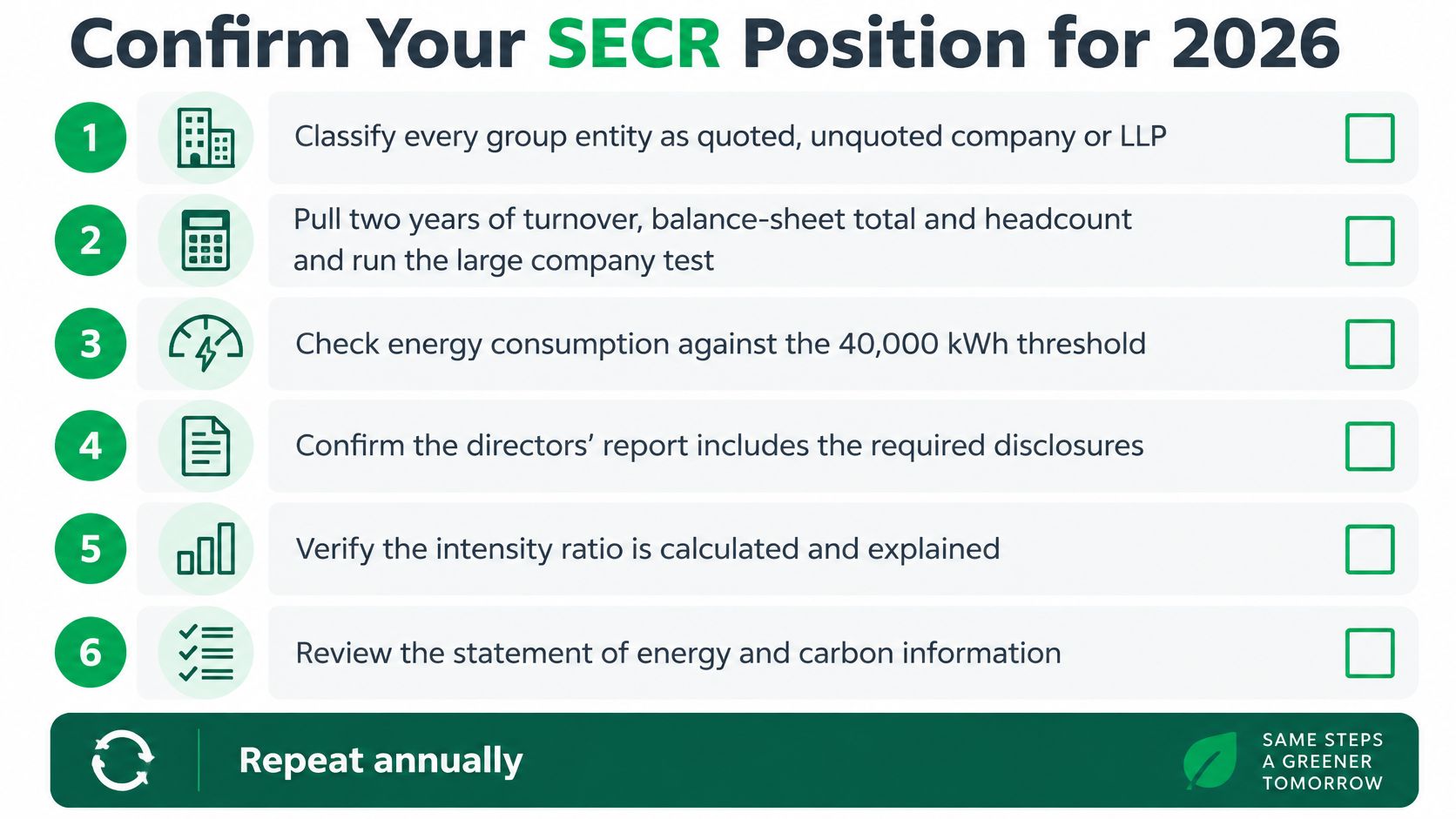
Six steps, run once a year, before the report is drafted rather than after.
- Classify every group entity as a quoted, unquoted company or LLP, with the date of classification recorded.
- Pull two years of turnover, balance-sheet total and headcount and run the two-of-three test standalone and consolidated. The group thresholds are £43.2 million gross or £36 million net turnover and £21.6 million gross or £18 million net balance-sheet total.
- Total twelve months of electricity, gas and transport fuel per entity, reconciled to meter and fuel records, with units and conversion factors shown.
- Where consumption is at or below 40,000 kWh, draft the low-energy statement for the directors' report. Do not omit the statement.
- Assemble the evidence pack: perimeter, reconciliation, meter and landlord correspondence, estimates schedule, board-approved rationale.
- Diarise re-testing at every period end, acquisition and reclassification. Size thresholds and entity types both move.
Where to get a second pair of eyes
Three situations justify an external review before filing: figures sitting close to a threshold, data substantially held by a landlord, and a group spanning multiple jurisdictions or recent acquisitions. In each case the arithmetic is doable, but the judgement about perimeter and method is where positions fail.
A wrong exemption is harder to defend than a short disclosure. If the number is marginal, the cheapest route is often to disclose and explain rather than to claim and defend.
ESG Consulting confirms which obligations apply before anything is built or scoped, and says so when an obligation doesn't apply. The SECR reporting service covers Scope 1 and 2 inventories, intensity ratios and the energy efficiency narrative required in the annual report, with figures traceable to source.
If your organisation is near a size threshold, holding a low-energy position or relying on a data gap for part of its footprint, ESG Consulting can review the position before you file and confirm whether the exemption holds. We build the Scope 1 and 2 inventory, the intensity ratio and the annual-report narrative so every figure traces back to source data, and we tell clients plainly when an obligation doesn't apply. Visit ESG Consulting to start with a scoping review of your 2026 position.