SFDR Article 8, SFDR disclosure, Article 8 fund, UK asset managers, sustainable finance
SFDR Article 8 Requirements: A UK Manager's Guide
By ESG Consulting Team · · 16 min read
You're the compliance lead. Marketing wants the fund live in Luxembourg next month, the prospectus still says "ESG integrated", and nobody can point to the same definition of the characteristic on the website and in the annual report. That's the moment SFDR Article 8 requirements stop being a badge and become a claim you have to evidence from the first investor document through to the last periodic figure.
An Article 8 fund promotes environmental or social characteristics, and the companies it invests in have to follow good governance. It isn't a sustainable-investment product just because the name sounds green. For a UK manager, the EU documents and the UK naming rules don't sit in separate folders. A gap in issuer data, a website that lags the prospectus, or a UK sustainability term used without the right controls can all undo the same claim.
The rules are also moving. A European proposal published in 2025 could replace today's product categories, so what you file now has to be true under the text that applies today and sturdy enough to survive a tighter test later. What follows walks that chain in the order a UK compliance lead builds it.
Table of Contents
- Article 8 Disclosure Requirements at a Glance
- What Article 8 Classification Really Means
- Turning Promoted Characteristics into Measurable Indicators
- How to Build the Pre-Contractual and Website Disclosures
- Evidencing Alignment When Investee Data Is Incomplete
- How Article 8 Fits Alongside UK SDR Labels
- Confirm Your Article 8 Position Before Marketing into the EU
Article 8 Disclosure Requirements at a Glance
An Article 8 fund carries disclosure duties across five documents, and each one is a separate test of the same claim. The promoted characteristic has to read identically wherever an investor or supervisor can open a file. If the pre-contractual text says "lower carbon intensity" and the periodic report switches to "climate aware" without a definition, you have two claims and evidence for only one.
| Document | Timing | What it must show | Key reference |
|---|---|---|---|
| Pre-contractual disclosure | Before the investor invests | How characteristics are promoted, the good governance test, strategy and Taxonomy wording | SFDR Article 8; RTS Annex II |
| Website disclosure | Kept current, with changes dated | Product description, investment strategy, indicators, methodology and data sources | SFDR Article 10; RTS |
| Periodic report | Annually | Extent to which the characteristics were attained, indicator results against reference, and PAI where considered | SFDR Article 11; RTS Annex IV |
| Taxonomy alignment statement | Pre-contractual and periodic | Minimum Taxonomy-aligned share, or a statement that it is zero | Taxonomy Regulation Articles 5 and 6 |
| PAI statement | Annually, if PAI is considered | Consideration of principal adverse impacts at product level, or the reasons for not considering them | SFDR Article 7 |
How to read the set
Start with the pre-contractual disclosure, the version the investor sees before money moves. Read the website next, because that page stays live and updated while the prospectus sits fixed at launch. Methodology, data sources and any stated limitation have to match it word for word. Then read the periodic report, which works like the receipt: it has to show the extent to which the characteristics were attained, measured through the same indicators the first document promised.
For a UK manager the chain doesn't end with the EU file. The words used to promote a characteristic feed straight into how the fund's sustainability claims hold up under the UK regime, so a definition that drifts in the periodic report weakens the claim on both sides of the same product.
The table describes the regime as it applies today. The 2025 reform proposal could replace the Article 8 category, so check every row against the latest legal text before a launch or a material update. A draft RTS annex stops being optional reading the moment the fund is marketed.
Practical rule: Pick one promoted characteristic and find it in all five documents with the same wording and the same definition. If you can't, the fund isn't ready to market.
Run that test on a live fund this week. Open the prospectus, the public product page, last year's periodic report, the Taxonomy line and the principal adverse impact (PAI) wording side by side, and highlight the characteristic in each. Where the words drift, fix the documents before you add a new market.
What Article 8 Classification Really Means
Think of Article 8 the way you'd think of a cereal box that says "low sugar". The front of the pack draws the buyer in. The ingredient list has to back the words up, and a supervisor can open the box.

The FCA consultation CP22/20 describes Article 8 alongside Article 6 and Article 9 as a de facto classification and labelling system. Article 6 covers products that don't integrate sustainability into the investment process. Article 8 covers products promoting environmental or social characteristics. Article 9 covers products with sustainable investment as their objective. For a UK manager or distributor marketing an EU-regulated product into Europe, Article 8 status doesn't merely mean ESG factors are considered. It creates disclosure obligations on which characteristics are promoted, how the strategy delivers them, and how governance safeguards are assessed.
Two features, not a sustainable-investment label
Every Article 8 fund has two defining features. It promotes environmental or social characteristics, or a combination of both. The investee companies have to follow good governance practices. That second limb is easy to wave through in a policy and hard to evidence holding by holding.
Good governance isn't a vibe. Test investee companies for sound management structures, sound employee relations, staff remuneration that is fair, and tax compliance. Keep a dated source for each element. A controversy screen that nobody can reconstruct won't stand up if an investor, or an assurance provider, asks which holdings failed and what you did next.
The common slip is to market the fund as a sustainable fund. It isn't one automatically. The same FCA discussion treats evidence of sustainability characteristics, themes or objectives in the investment policy or strategy as a minimum expectation for sustainability-related product claims, and it expects firms to report on sustainability risks and impacts under SFDR. Calling an Article 8 product "sustainable" without that substance invites greenwashing scrutiny.
An Article 8 fund is a promise with a receipt: a documented policy, an investment process that applies it, portfolio evidence, and disclosures that match the stated characteristics.
If any one of those four is missing, the classification is a story, not a control.
Turning Promoted Characteristics into Measurable Indicators
A characteristic that can't be measured can't be disclosed transparently. Each one needs a sustainability indicator, a named data source and a file you can hand to an auditor. Thresholds are the manager's own choices. Justify them in the methodology. Don't copy a peer's coal cut-off because it looked tidy in their factsheet.
| Characteristic | Example indicator | Data source | Evidence to keep |
|---|---|---|---|
| Lower carbon emissions | Weighted average carbon intensity (tCO2e per £m revenue) | Issuer reports and third-party data | Dated vendor extract with coverage figure |
| Fossil fuel exclusion | Share of revenue from thermal coal, with a 5% threshold | Issuer disclosures and screening vendor | Screening rules, threshold log and override record |
| Good governance | Percentage of women on boards | Annual reports | Dated copy of the source page |
| Social commitment | Share of holdings with a living wage commitment | Engagement records | Engagement log linking each holding to its commitment |
A UK equity fund, worked through
Say a UK equity fund promotes lower carbon intensity and fewer thermal coal exposures.
- It writes a binding element: exclude issuers with more than 5% of revenue from thermal coal. That constraint bites on the portfolio. The manager can't ignore it on a good day for the share price.
- It screens holdings monthly, logs every exclusion, and logs every override with the name of the person who approved it and the reason.
- It reports weighted average carbon intensity against its reference index in the periodic report, using the same unit and the same vendor named up front.
- It keeps engagement, such as letters asking issuers to publish better emissions data, in a separate log. Engagement doesn't constrain the book, so it isn't current alignment.
Binding elements and engagement get confused more often than any other pair in the file. If a portfolio manager can override a screen without a recorded reason, that screen isn't binding, and the pre-contractual text shouldn't present it as one.
Every indicator named before the investor subscribes has to reappear in the periodic report with the same definition and the same data source. A switch from vendor A to vendor B mid-year is fine only if you disclose the break and restate, or clearly explain, the prior figure.
How to Build the Pre-Contractual and Website Disclosures
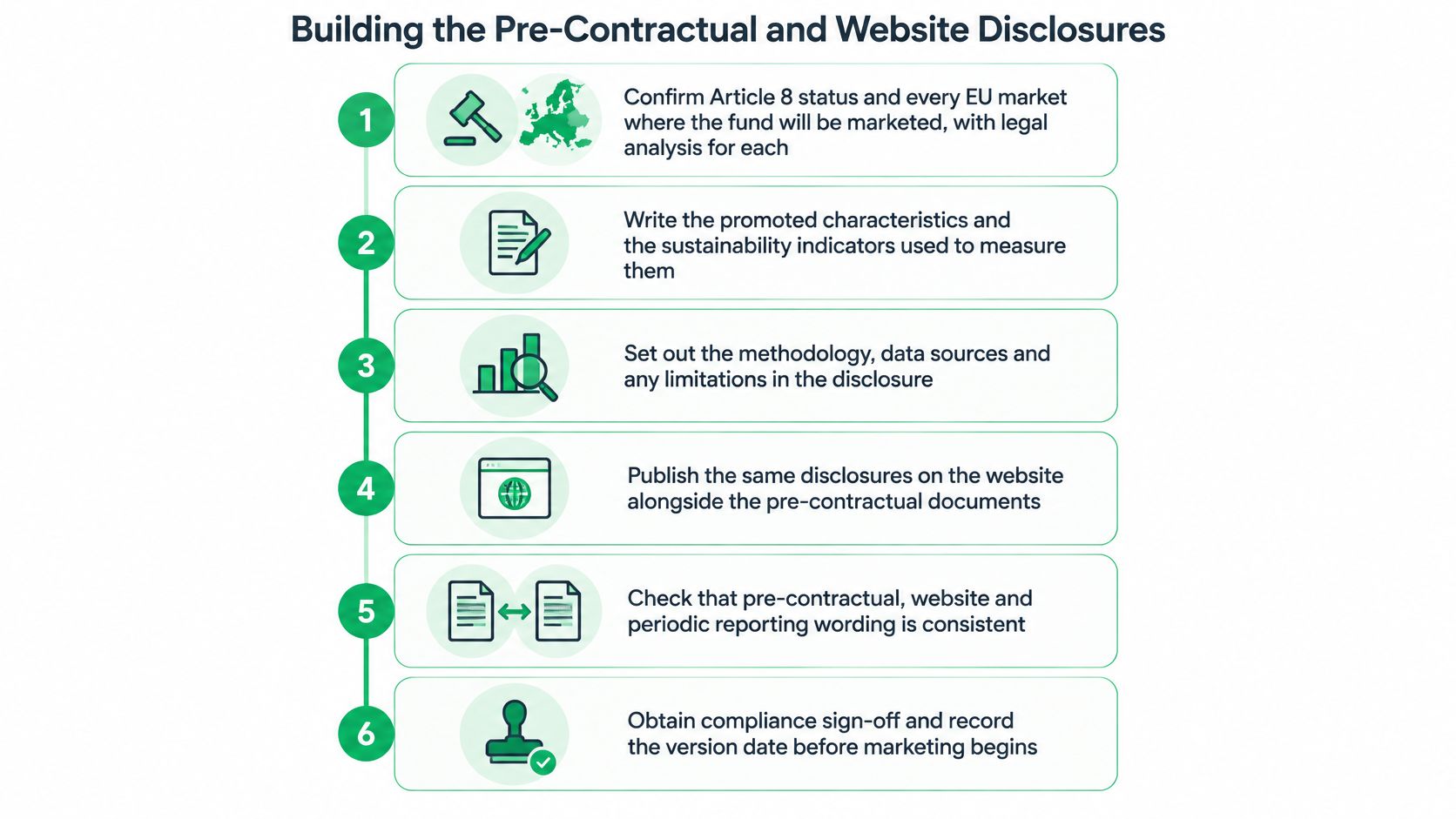
The pre-contractual disclosure and the website page are the same claim stated twice. An investor should be able to read the public summary, open the Annex II template and find the same characteristics, the same indicators and the same data sources in both. So build them in one pass, against one characteristic list, before anyone writes a marketing email. The picture below is the short version. The steps under it are what the file has to contain.
Seven steps, each with a reason
- Confirm Article 8 status and every EU market. Get a short legal note for each country where the fund will be marketed, including any local marketing rule that sits on top of SFDR. The common slip is assuming a Luxembourg notice covers a later German or French registration. A UK manager marketing into the EU should have this note before step 2, because it decides which documents go to which regulator.
- Write the characteristics and binding elements in plain language, one row each. If a non-specialist on the board can't repeat the sentence, investors won't be able to either. The slip is a characteristic so broad, "responsible investing" being the usual offender, that no indicator can ever fail it.
- Map each row to an indicator, a data source and a threshold. Do this before drafting, or the template will invent numbers the portfolio can't produce. The slip is a threshold with no owner and no data feed: it reads well in the prospectus and produces nothing at reporting time.
- Draft the pre-contractual disclosure to the RTS Annex II template, including the good governance test and the Taxonomy statement. State the minimum Taxonomy-aligned share, or state that it is zero. Silence reads as a missing field, not as caution.
- Decide whether PAI is considered at product level. Either explain how, and point to where the periodic report will show it, or explain why it isn't considered. The slip is a PAI paragraph that claims consideration while the portfolio system has no PAI fields at all.
- Publish the website disclosure with the same wording, the same methodology and the same data sources, and date every change. The slip is a public page that still describes last year's strategy after the prospectus was updated.
- Set the periodic-report calendar and name an owner for each indicator. Annual reporting fails when the data owner leaves in November and nobody else can rerun the screen. Put the owner in the control log, not in an email.
Sign-off before marketing
One owner reads every document against the same characteristic list before the fund is marketed. That person ticks wording, indicator, data source, Taxonomy line and PAI statement, then records the version date. If the website and the prospectus disagree, marketing waits. A later "we'll align the site next quarter" is how inconsistent claims reach investors.
This is the end-to-end part of the claim. Step 1 decides where the claim can be made. Steps 2 to 6 write it identically in both documents. Step 7 makes sure someone can still evidence it in twelve months. We check regulatory positions against DBT, FCA, Environment Agency and EU Official Journal sources before that sign-off, so the version date sits on the text in force.
Evidencing Alignment When Investee Data Is Incomplete
Issuer data is often late, partial or restated, so an Article 8 claim can rest on a thinner base than the document implies. You can fill every disclosure field today and still lack the evidence an investor, or a future quantitative test, will ask for. The shortfall is part of the claim itself: the file behind the disclosure has to show how much of the description is measured and how much is inferred.

The European Commission's 2025 SFDR proposal keeps transparency, investor protection and greenwashing prevention as objectives, and points towards more decision-useful, comparable reporting. Reforms discussed for 2025–26 would replace the broad Articles 6, 8 and 9 structure with more defined categories and minimum alignment conditions, including a 70% threshold in the reported proposal. That proposal isn't law. Treat it as a stress test for the file you're building now, because a claim that only holds while alignment goes unmeasured is a claim waiting to be reclassified.
Four practices that survive a data gap
- Show the coverage split. State what share of holdings rests on issuer-reported data, on estimates and on proxies, and put that split in the periodic report. A single portfolio average with no coverage figure hides the weak tail.
- Log every change. Record each exclusion, override and data correction with a date, the holding, the old value, the new value and the person who approved it.
- Keep engagement off the alignment total. A letter asking an issuer to adopt a transition plan is a forward claim about behaviour that hasn't happened yet. It isn't present alignment, and it shouldn't lift this year's indicator.
- Stress the book against a plausible future bar. Run the current portfolio against a 70% alignment condition of the kind in that proposal, and record the headroom. If you would fail it, the claim is fragile before any new rule forces the point.
A worked example makes the split concrete. Say the book is 62% issuer-reported, 25% estimated and 13% proxies. Publish that split and flag the indicator as partly estimated. Folding all three into one clean "aligned" percentage tells an assurance provider nothing about which holdings carry the claim, and it leaves no honest way to show progress when issuer reporting catches up.
Assurance providers ask for the audit trail first: source file, methodology, boundary and assumption. Every figure we produce traces back to source data, with the methodology, boundaries and assumptions documented for the client's auditor or assurance provider. Treat the Article 8 file the same way, as a controlled data process that runs all year rather than a template completed annually. The same evidence base will sit behind any UK label application later, so a thin file narrows your options under both regimes at once.
How Article 8 Fits Alongside UK SDR Labels
A fund can be Article 8 for Europe and still fail a UK label. In Policy Statement PS23/16, the FCA stated that Article 8 funds would generally need to "level up" to qualify for one of the UK SDR labels, because those labels require a defined sustainability objective rather than only the promotion of environmental or social characteristics.
Timing you can diary
Pre-contractual information is required from the date a label is first used. Products using covered sustainability terms without a label had to meet that pre-contractual rule by 2 December 2024, which has now passed. Ongoing product-level disclosures are required annually after 12 months. If a UK product still uses a sustainability term and the pre-contractual text was never updated, that isn't a future task. It's a gap.
| Feature | SFDR Article 8 | UK SDR label |
|---|---|---|
| Core test | Promotes environmental or social characteristics, with good governance at investee companies | Defined sustainability objective |
| Where it applies | Products marketed into the EU | UK-authorised products using a label or covered sustainability terms |
| Disclosure timing | Pre-contractual, website and periodic reports | Pre-contractual from first label use; annual product-level reports after 12 months |
| Overseas funds | Subject to SFDR where marketed in the EU | Outside the UK regime for now |
Two analyses, not one memo
A UK-based manager often needs both. SFDR Article 8 disclosures for products facing the EU, and SDR classification, naming and marketing controls for products offered in the UK. Reusing the EU annex as the UK consumer disclosure usually fails the objective test, because promotion isn't the same as a defined sustainability objective.
Overseas funds remain outside the UK SDR and labelling regime for the time being, although HM Treasury has indicated that extending the regime to overseas recognised funds may be considered. Don't build the UK file as if that extension had already happened, and don't assume it never will. Keep a named owner who re-reads the position when HM Treasury moves.
Confirm Your Article 8 Position Before Marketing into the EU
Don't market into the EU until the claim, the documents and the evidence agree. The checklist below is the go or no-go gate that sits in front of the disclosure procedure's build steps.
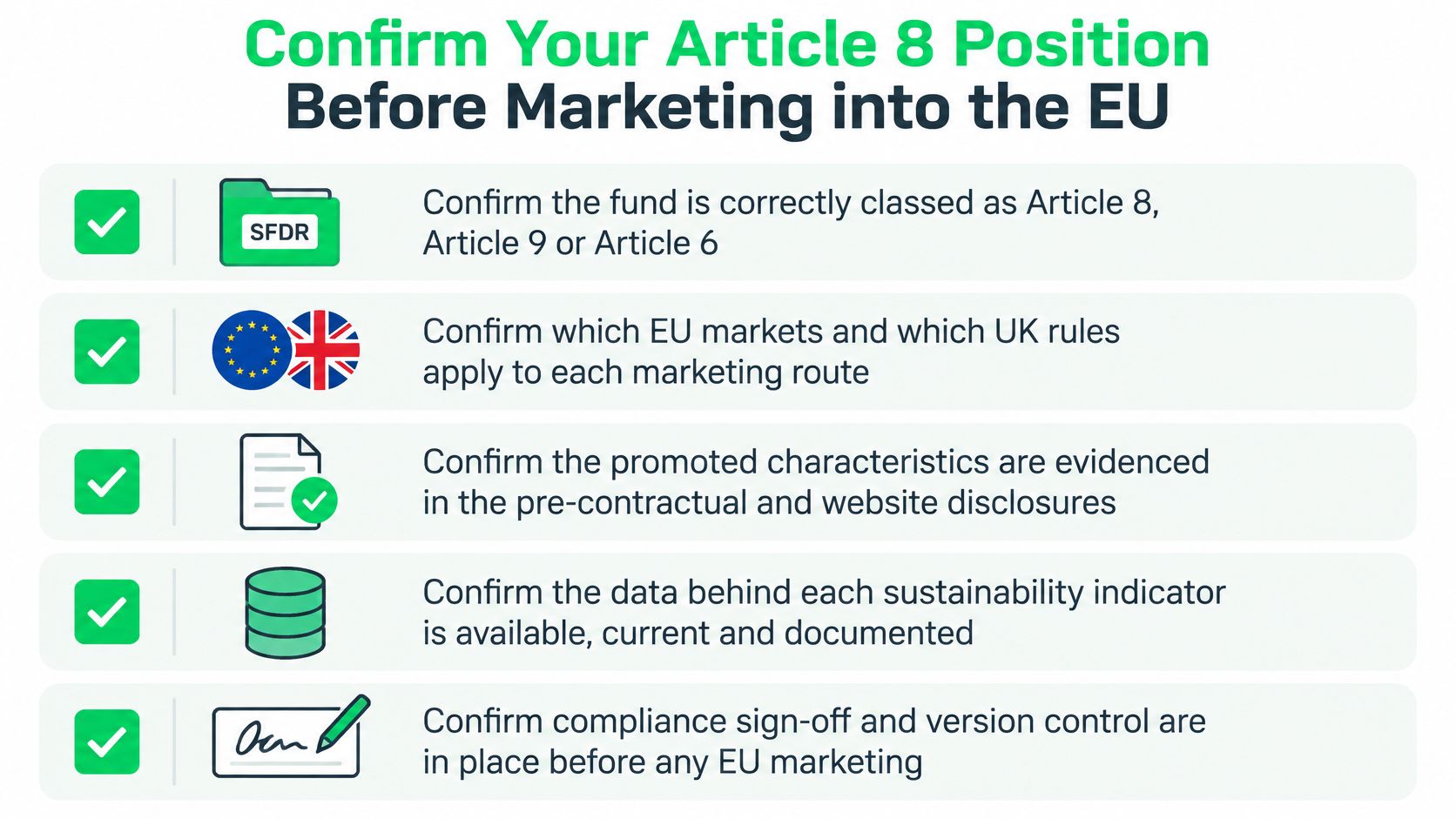
- Classification: The fund is correctly classed as Article 8, Article 9 or Article 6, and someone can say why in one paragraph.
- Routes: You know which EU markets apply, and which UK labels or sustainability terms apply on any UK route.
- Measurement: Each promoted characteristic has an indicator, a data source and a threshold you can justify.
- Wording: Pre-contractual, website and periodic documents use the same words for that characteristic.
- Evidence: The log separates data gaps, overrides and engagement claims, and names an owner for each.
- Reform watch: Someone is tracking the SFDR reform proposal and its status, so a category change doesn't arrive as a surprise.
If any line is unchecked, stop. Resolve it before marketing, and name the person who owns the open item.
Failed lines tend to fail in predictable ways. The classification was never written down, so nobody can defend it in one paragraph. The pre-contractual document promotes a characteristic that the website text describes differently, so one claim reads as two. Or the evidence log lists a data gap without naming who is closing it, blurring the line between a gap, an override and an engagement claim. Each failure points the same way: Article 8 is a claim that has to hold from the first marketing document through to the periodic report, and the checklist exists to catch a break anywhere in that chain.
The practical next step is a scoping review of the fund's status against the current legal text, with a clear go or no-go and an owner for every open item. ESG Consulting classifies Article 8 and Article 9 products and builds the PAI statements and periodic disclosures for funds marketing into the EU. We confirm which obligations apply before anything is built or scoped, and we say when an obligation does not apply and when a rating can wait. Start with a scoping conversation with ESG Consulting.