SECR regulations, energy reporting, UK carbon disclosure, directors report, ESOS
Streamlined Energy and Carbon Reporting SECR Regulations
By ESG Consulting Team · · 19 min read
The most popular SECR advice is still a shopping list: swap the lights, buy a green tariff, and drop a short paragraph in the annual report. That list can look tidy and still leave a reader unable to see whether energy use fell, whether the boundary changed, or whether the saving is real. Energy and Carbon Reporting (SECR) regulations are a statutory disclosure duty, not a net-zero plan and not a certificate that operations got cleaner.
A polished energy paragraph can meet the law and still say almost nothing about abatement. The useful starting point is narrower. What must the directors' report, or the LLP energy and carbon report, contain, for which company, and on which sites and fuels?
Table of Contents
- Where Streamlined Energy and Carbon Reporting Sits
- Who Must Report and What the Minimum Covers
- Required Figures Narrative and Intensity Metrics
- Boundaries for Groups Leases and Overseas Sites
- How to Calculate Emissions Factors and Green Tariffs
- How to Prepare and File the SECR Disclosure
- How SECR Interacts with ESOS and UK SRS
- Separate Compliance from Real Abatement This Year
Where Streamlined Energy and Carbon Reporting Sits
SECR is the statutory energy and carbon statement inside the directors' report, or inside an LLP's energy and carbon report. It sits with the accounts, so it inherits the same discipline: a defined boundary, a consistent method, and figures that reconcile back to invoices, meters and fuel records.
The Companies (Directors' Report) and Limited Liability Partnerships (Energy and Carbon Report) Regulations 2018 brought the regime into force on 1 April 2019 for financial years beginning on or after that date, and extended earlier greenhouse-gas reporting. The disclosure list is fixed: energy consumption, associated emissions, at least one intensity ratio, the reporting methodology, comparative prior-year figures, and the principal energy-efficiency actions taken in the period.
What the annual report has to connect
This is more than a carbon inventory. The annual report has to join activity data, emissions factors, a performance ratio and efficiency measures in one consistent narrative, so a reader can see what changed and what did not. Treat the statement as part of statutory reporting, in the same file as the accounts, with controls that marketing cannot rewrite later.
Decide the perimeter before the size test. For a group, name the reporting parent and the entities included. For leased sites, record who controls the meter and who buys the fuel. For overseas sites, keep them out of a UK unquoted disclosure and inside a quoted company's global total. Large unquoted companies and large LLPs report UK consumption of gas, electricity and transport fuel, with the related greenhouse-gas emissions. Quoted companies report global energy use and associated Scope 1 and Scope 2 emissions, subject to the energy-consumption conditions that apply to them.
A compliant narrative is a floor. It records what was used and what was done. It does not, by itself, prove a pathway to net zero.
That floor still matters in later cycles. The same activity data, factor library and boundary note are what an ESOS audit pack and a UK SRS metrics section will be reconciled to. If those notes are vague in year one, every later framework inherits the vagueness. Boards that want applicability settled before drafting can use an SECR scoping review to confirm which duties apply and which can wait.
Get the location wrong and even perfect factors describe the wrong estate.
Who Must Report and What the Minimum Covers
Pick the row before you collect a single invoice. Under the 2018 Regulations, a UK unquoted company or LLP counts as large when it meets at least two of three Companies Act measures: turnover of £36 million or more, a balance-sheet total of £18 million or more, and 250 or more employees. Quoted companies follow a separate route and are not screened only on those three measures.
Headcount alone settles nothing. A business with 180 staff, turnover above £36 million and a balance sheet above £18 million is still large. A business with 400 staff, but turnover and balance sheet both under the lines, is not.
| Organisation | Size test | Energy in scope | Minimum disclosure | Exemption |
|---|---|---|---|---|
| Quoted company | UK quoted company; not only the two-of-three large test | Global energy use | Global Scope 1 and Scope 2, at least one intensity ratio, methodology, prior-year figures, principal energy-efficiency actions | Only where the applicable low-energy condition is met |
| Large unquoted company | At least two of turnover £36 million or more, balance sheet £18 million or more, 250 or more employees | UK gas, electricity and transport fuel | UK energy and associated emissions, intensity ratio, methodology, prior year, efficiency actions | Low-energy-consumption exemption after use is measured |
| Large LLP | Same two-of-three test as a large unquoted company | UK gas, electricity and transport fuel | Energy and carbon report with the same UK minimum as a large unquoted company | Same low-energy exemption |
| Not large and not quoted | Fewer than two of the three thresholds | No statutory SECR minimum | No directors' report duty under these rules | Out of scope, not an exemption |
| Group company | Duty follows the reporting company, not every subsidiary by default | Quoted parent global; unquoted parent UK | Disclose at the entity with the duty and explain consolidation | Do not apply UK-only or low-energy treatment inconsistently across the group |
How to pick the row
Quoted company. The two-of-three screen stops here. The minimum is global energy use, global greenhouse-gas emissions in Scope 1 and Scope 2, at least one intensity ratio, the methodology, prior-year figures and the principal actions taken in the year.
Large unquoted company or large LLP. Report UK gas, electricity and transport fuel, the associated emissions, an intensity ratio, the calculation methodology, the prior year and the actions taken in that year. The LLP publishes this in its energy and carbon report. The company publishes it in the directors' report.
Not large and not quoted. Fewer than two thresholds means no statutory SECR minimum exists. Out of scope means exactly that: no duty arises, and there is nothing to claim or state in the report.
Group company. The duty sits with the reporting company. A parent's disclosure neither pulls a subsidiary in nor leaves it out automatically. Name the entity that carries the duty and record how consolidation was handled. Which sites, leases and overseas operations fall inside that entity are boundary questions, and they only arise once the row is fixed.
The low-energy test comes after the meters
The framework recognises a low-energy-consumption exemption, measured as annual energy use over the reporting period. The threshold is a fixed quantity of energy set out in the 2018 Regulations, so confirm the current figure against the regulations themselves before relying on it, and keep the consumption workings that support any claim in the file. The test is applied after energy use is measured. Headcount plays no part in it.
These thresholds pull in substantial private companies that never had to publish energy information at the level expected of quoted groups. Record the row you used and the year of the accounts you tested before data collection starts. Everything filed under these rules is a statutory minimum: it states what was used, what was emitted and what was done. A compliant statement on its own does not amount to a transition plan.
Required Figures Narrative and Intensity Metrics
Read the disclosure in the order a user of the accounts will see it. The statutory contents are a short list. They are not a climate strategy.
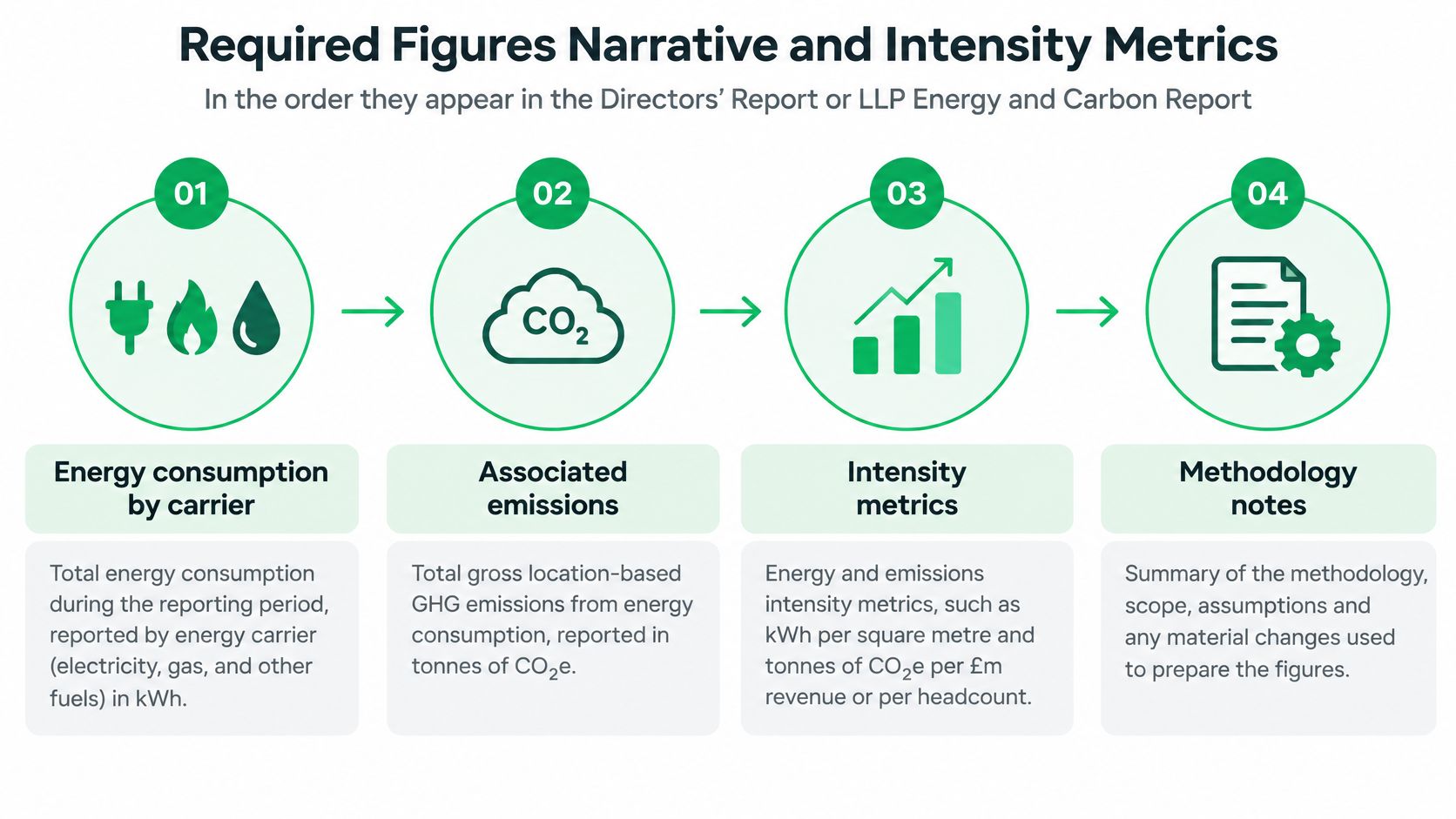
The contents in report order
Energy consumption by carrier. Show gas, electricity and transport fuel in consistent units, usually kWh, with the activity unit you started from still visible in the workings. A litre of diesel and a kWh of grid electricity are not the same line.
Associated greenhouse-gas emissions. Split them so Scope 1 stays distinct from Scope 2. Scope 1 is combustion in boilers, furnaces and owned or controlled vehicles. Scope 2 is purchased electricity. If you blend them into one "carbon" total, a reader cannot see whether a fall came from the fleet, the boiler or the grid factor.
At least one intensity ratio. Lock the denominator and keep it identical next year. Say a manufacturer reports 12,400 MWh and 2,600 tonnes CO2e against £80 million turnover. That is 32.5 tCO2e per £ million turnover. Other choices you can lock in are tCO2e per full-time employee or per square metre of occupied floor. A ratio that switches denominator mid-series is not comparable, even if both versions are arithmetically tidy.
Methodology and factor source. Name the conversion factors, the year of the factor set, and any estimation. Prior-year comparatives sit beside the current figures. If you restate the prior year, say why in the same note.
Principal energy-efficiency actions in the period. Name what was undertaken, such as a boiler replacement or lighting controls, and quantify savings where meter evidence exists. "We continue to invest in efficiency" is not an action.
What this list does not demand
The list does not demand a science-based target, a full Scope 3 inventory, a transition plan, or proof that every claimed saving persisted after the project team left site.
If the meter does not show a saving, describe the project as undertaken. Do not describe it as delivered abatement.
Put voluntary Scope 3 totals, net-zero language and transition-plan claims in a clearly separated paragraph. Label that paragraph voluntary. A reader should not have to guess which sentences are the statutory minimum and which sentences are ambition.
Keep the denominator boring
Write the intensity definition in one sentence you can paste next year: numerator, denominator, and what is excluded. If turnover in the ratio is continuing operations only, say so. If headcount is average full-time equivalents, say so. Changing that sentence is a restatement, not a formatting tidy-up.
Boundaries for Groups Leases and Overseas Sites
The hard question is not "are we large?" It is which energy belongs inside the boundary when the group has subsidiaries, leased premises, shared services, overseas sites or mismatched year-ends.
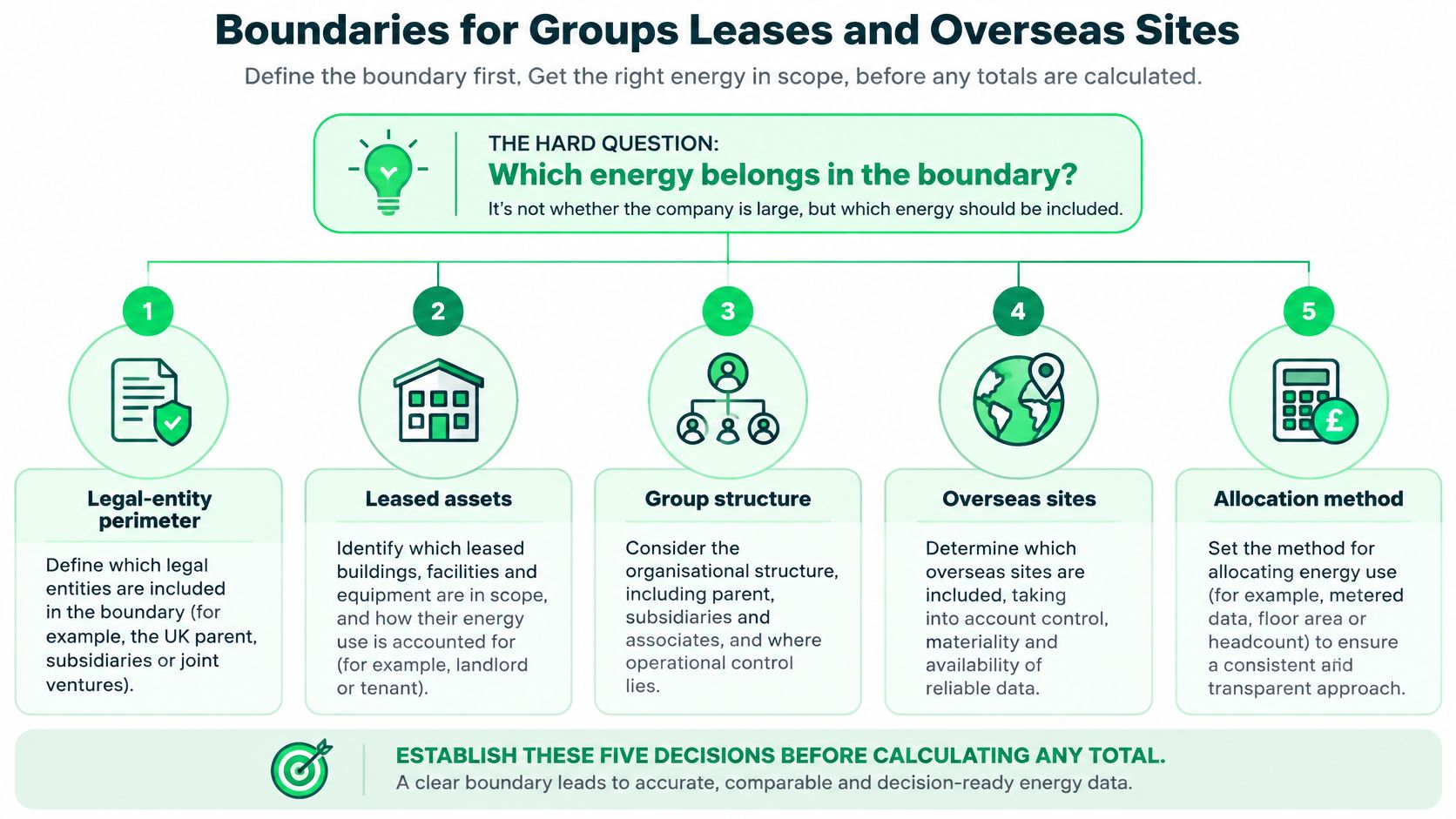
The 2025 to 2026 sustainability reporting guidance expects organisations to explain methodology, boundaries, intensity ratios and energy-efficiency actions. It does not hand you one worked example for a complex estate. Two companies with identical total energy use can publish materially different figures solely because of boundary choices and the evidence behind them.
Five notes before any total
Document these five choices before a spreadsheet produces a number.
Legal-entity perimeter. List every company in the consolidation and mark which ones carry a SECR duty of their own. A dormant subsidiary with no meter is a nil, not a missing file.
Financial-year boundary. Use the reporting company's year-end. If a subsidiary closes its books on a different date, write one line on how you aligned the months.
Responsibility boundary. Choose operational control or financial control and apply it to every site. Do not switch because one landlord is awkward.
Energy-source completeness. Gas, electricity and transport, including grey fleet and fuel cards, not only the supplies that arrive as a neat PDF invoice.
Prior-year comparatives. If the perimeter changed, restate or explain. Silence reads as a performance movement.
Overseas sites and leases
For a quoted parent, overseas operations and overseas subsidiaries inside the reporting boundary fall in global energy use. For a large unquoted parent, the statutory minimum stays with UK energy. Overseas use can be added, but label it voluntary so it is not mistaken for the statutory line.
On leases, follow the meter and say so. A tenant who pays the building's gas and electricity includes that consumption. A landlord who recharges tenants should state whether the disclosure follows the meter in the landlord's name or the tenant's operational control. Do not put the same kWh in both companies' statutory totals without saying that both have reported it.
Shared-service centres and fleet fuel cards need a named owner. If head office buys the fuel card and the subsidiary runs the vans, pick one reporter and keep the choice next year.
Acquisitions, disposals and a subsidiary with a different year-end need a one-line explanation. If the effect is material, restate the prior year rather than leaving a false fall or rise in the intensity ratio.
The file note should say why each site and each fuel was included or left out. That sentence is the defence if two group companies look inconsistent.
A documented decision tree, backed by legal-entity mapping, lease data, meter ownership and a reconciliation to the consolidated accounts, is what lets a board answer an inclusion question without rebuilding the model.
How to Calculate Emissions Factors and Green Tariffs
Start with the boundary already fixed, then do the arithmetic. The statutory electricity line uses one ruler: all grid electricity must be reported using the grid-average emissions factor, including electricity bought on a green tariff. A renewable tariff can support a procurement story, while the location-based grid figure still shows the emissions the annual report has to carry.
The conversion set belongs to the reporting year. Record the factor source, factor year, units, global-warming-potential basis and assumptions beside the workbook. If an activity falls outside neat invoice categories, treat it as an estimation line and state the basis, rather than stretching a product label to cover a missing fuel.
Controls in the order you will be asked
- Keep source data by energy carrier. Gas invoices, half-hourly electricity, diesel litres and petrol litres stay in separate tabs until conversion.
- Convert on one basis. kWh, litres and any other activity unit use the same factor year and unit convention. Keep gross and net calorific values out of the same total.
- Map each line to Scope 1 or Scope 2. Owned boilers and owned transport go to Scope 1. Purchased electricity goes to Scope 2. A green tariff does not create a third, unmarked bucket.
- Freeze the factor library for that reporting year. Save the factor spreadsheet with the accounts file. A later update starts a new year and leaves this year intact unless the prior period is restated.
- State estimates where they occur. If part of transport comes from mileage claims or a standard vehicle assumption, put that share and method in the methodology where a reader can test it.
Reconcile, then narrate
Tie the population to invoices, meter reads, fuel records and the entities in the financial statements. A market-based or tariff-specific figure may sit underneath as extra information; the grid-average number remains the statutory electricity disclosure, and certificates sit beside the consumption data rather than inside it.
Explain movement through cause and meter. “Emissions fell because certificates were bought” describes a purchase. “Electricity fell after the controls went live in June” describes an outcome.
Quoted companies apply the factor set to global statutory energy. Large unquoted companies and LLPs apply it to the principally UK minimum. The tariff can change what was bought; it cannot redraw the floor.
How to Prepare and File the SECR Disclosure
Run this path against the financial-year timetable, not against the week the printers need the annual report.
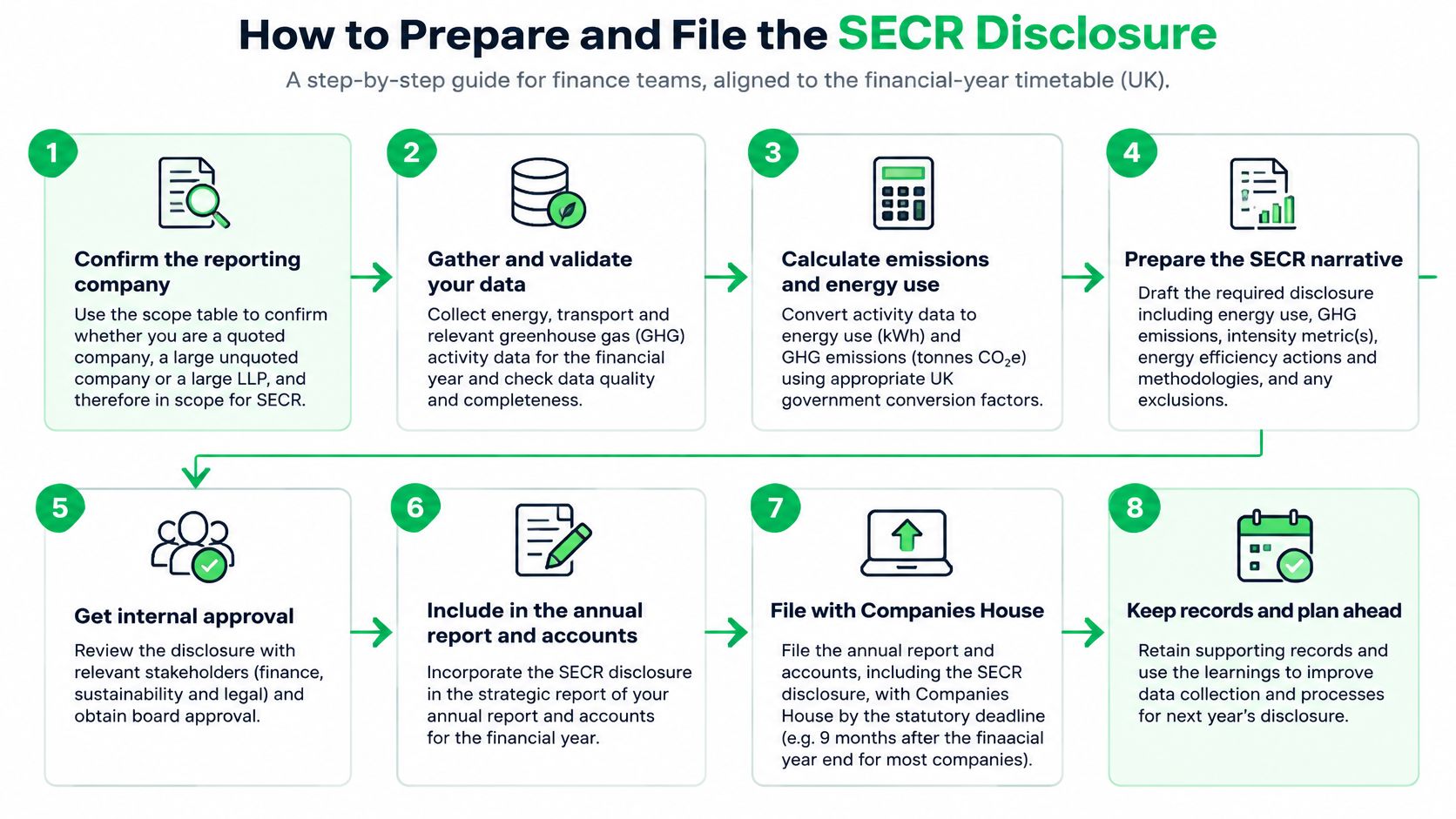
1. Confirm the reporting company. Use the scope table. Mark quoted, large unquoted or large LLP, and note the accounts year you tested.
2. Fix the year-end and the boundary note. Include acquisitions and disposals in that note before anyone totals a fuel.
3. Collect activity data to match the row. Tick off gas, electricity and transport. For a quoted company the tick list is global. For a large unquoted company or LLP it is UK. Missing transport is the usual hole, especially grey fleet paid through expenses rather than a fuel card.
4. Apply the frozen factor library. Produce Scope 1, Scope 2, the intensity ratio and the prior-year comparative from that library, not from a factor someone downloaded on the morning of the draft.
5. Write two short passages. One is the methodology sentence: boundary, factors, estimations. The other is the energy-efficiency actions completed in the year, with quantified results where meters support them. Actions still in procurement do not belong in the "undertaken" sentence.
6. Reconciliation sign-off only. Agree the totals to invoices and to the consolidated entity list, and record estimations. This step is a sign-off, not a second calculation. If the invoice population and the entity list disagree, stop and fix the boundary note.
7. Place the disclosure. It goes in the directors' report, or in the LLP energy and carbon report, in time for board approval of the annual report. There is no separate SECR portal submission for companies. The disclosure travels with the annual report and accounts filing.
8. Keep the working papers with the statutory accounts file. An auditor, or a later assurance provider, should be able to trace each published figure to a meter, an invoice or a documented estimate.
If you claim the low-energy exemption, the same file holds the consumption test that supports it, including the threshold you verified from the regulations and the 12 months of use you measured.
A short walk-through of how reporters assemble that evidence is worth fifteen minutes before you lock the timetable.
Build the file as if someone who was not in the meeting will read it in two years. They will.
How SECR Interacts with ESOS and UK SRS
One regime does not stand in for another. The table is the substitution test. If a column says the framework does not replace something, filing the something else does not close the duty.
| Framework | Core ask | Timing | What it does not replace |
|---|---|---|---|
| SECR | Energy, Scope 1 and 2 minimum, intensity ratio and efficiency narrative in the annual report | Each financial year from 1 April 2019 | ESOS audits, UK SRS or a net-zero target |
| ESOS Phase 3 and 4 | Site audits, 95 per cent energy coverage, Lead Assessor sign-off, Environment Agency notification | Multi-year compliance phases | The directors' report SECR disclosure |
| UK SRS S1 and S2 | Sustainability-related financial information and climate disclosure when the entity is in a reporting cycle | Annual, once the standards apply to that entity | The narrower SECR energy paragraph |
| Climate-related financial disclosures | Governance, strategy, risk management and metrics, including scenario analysis where required | Annual for in-scope companies | A SECR-only metrics note |
| Voluntary SBTi or Scope 3 | Targets and value-chain emissions chosen by the organisation | Multi-year, not set by SECR | Any SECR statutory line |
What cannot be swapped
ESOS is an energy-audit scheme for large undertakings. Phase 3 and Phase 4 work covers site audits, coverage of at least 95 per cent of energy, sign-off by a registered Lead Assessor and notification to the Environment Agency. An audit can supply project evidence for the actions paragraph. The notification does not replace the directors' report. A SECR paragraph does not satisfy the audit duty. Our ESOS assessments are signed off by registered Lead Assessors, and that sign-off is a different artefact from the annual-report note.
UK SRS S1 and S2, where they apply to the entity's reporting cycle, ask for broader sustainability and climate information than an energy minimum. SECR metrics can feed the metrics section. They do not cover governance, strategy or scenario analysis. We check positions against DBT, FCA, Environment Agency and EU Official Journal sources before treating a standard as in force for a given entity.
Climate-related financial disclosures need board governance, strategy, risk management and, where required, scenario analysis. A metrics note copied from the energy statement does not carry those sections. The same is true of a TCFD-style report.
SBTi targets and Scope 3 inventories are voluntary relative to this statutory floor. Label them voluntary. They do not complete a missing SECR line, and a complete SECR line does not complete them.
One activity-data set, three different outputs. Do not delete an output because another was filed.
Confirm which of these duties apply before an inventory is scoped. We will say when an obligation does not apply, which is as useful as building the one that does.
Separate Compliance from Real Abatement This Year
Ask the board one question before the narrative is signed. Publish the statutory minimum only, or keep a project register beside it?
The environmental reporting guidelines show why the question matters. SECR requires specified energy and greenhouse-gas disclosures, an intensity ratio, methodology and information about energy-efficiency action. It does not require a science-based target, a complete Scope 3 inventory, a transition plan, or proof that reported initiatives delivered the claimed savings. A polished narrative can be legally compliant and still be weak evidence of net-zero progress.
What a reader cannot see
A reader can be shown a compliant story built from an accounting change, a one-off project or a green tariff. Listing LED upgrades, renewable electricity or building controls does not explain additionality, persistence, baseline changes, rebound or payback.
For each action named in the report, record six fields.
- Baseline energy: the metered use before the action, on the same boundary as the disclosure.
- Adjustments: weather or occupancy, stated as a method, not as a vibe.
- Measured savings: the meter movement after those adjustments, or a blank if you have not measured.
- Capital cost: the amount spent, so payback is calculable.
- Status: undertaken, in progress, or abandoned.
- Evidence location: the invoice, the meter export, or the project file an assurer can open.
If those fields are empty, describe the action as undertaken, not as delivered abatement. That wording is still lawful. It is also honest.
Keep Scope 3, net-zero and transition-plan claims in a separate voluntary section. Government materials already place this regime alongside wider sustainability reporting, and public-sector guidance tells organisations to assess scope and align methodology with current environmental-reporting guidance. The register is how you stop the statutory paragraph from pretending to be that wider story.
Our SECR work covers Scope 1 and 2 inventories, intensity ratios and the energy-efficiency narrative, and every figure traces back to source data, with methodology, boundaries and assumptions documented for the auditor or assurance provider. We confirm which of SECR, ESOS and UK SRS apply before anything is built. The next step is practical: lock the scope row, the boundary note and the factor year before anyone drafts a sentence of the annual report.
ESG Consulting builds the statutory energy and carbon statement so each figure can be traced, and we separate that statement from voluntary net-zero claims so the annual report does not overstate abatement. If you want the scope row, the boundary and the factor year fixed before drafting starts, talk to the team at ESG Consulting.