supply chain mapping, Scope 3, supplier engagement, value chain, carbon reporting
Supply Chain Mapping for Scope 3 Sources
By ESG Consulting Team · · 15 min read
Only 6% of UK businesses reviewed cyber risks in their wider supply chain, according to the UK government's Cyber Security Breaches Survey 2025/2026. That's a cyber-risk measure, not a carbon assessment, but it exposes a familiar operational problem: organisations struggle to investigate dependencies beyond their direct suppliers. For an ESG lead with a messy purchase ledger, the answer isn't to commission a census of every indirect supplier. It's to build a minimum viable supply chain map, with a reason to investigate each relationship, an explicit stop rule and a record of what remains unknown.
Table of Contents
- The Minimum Viable Map and Where to Stop
- How to Build the Category 1 Screen
- How Far Beyond Tier One to Map
- Data Fields and Evidence Quality Scores
- Engage the Suppliers That Move the Footprint
- Decide What the Map Changes Next
The Minimum Viable Map and Where to Stop
NHS Supply Chain's supplier analysis associated 80% of emissions with only 107 suppliers, while reporting that procured goods and services account for 62% of NHS England's total carbon footprint, according to NHS Supply Chain's account of supplier collaboration. The practical lesson is concentration, not a universal distribution that every organisation should expect to reproduce.
Put the layers below into a workbook before commissioning a mapping platform. Each layer needs a decision it supports and a point at which further investigation stops.
Minimum viable supply chain map layers
| Layer | Question it answers | Stop rule |
|---|---|---|
| Spend and supplier master | Who is paid, and for which goods or services? | Every material purchase has a supplier ID and a spend year |
| Scope 3 Category 1 classification | Which purchases are upstream purchased goods and services? | Pass-through, internal recharges and out-of-boundary spend are excluded where justified, with the treatment logged |
| Spend-based tCO2e screen | Where is the estimated footprint concentrated? | As an initial engagement rule, stop the primary-data chase once the top cohort covers about 80% of estimated Category 1 emissions, subject to risk overrides |
| Criticality and substitutability | Which relationships would halt operations if lost? | Flag single-source or long-lead items even if their emissions rank is mid-table |
| Tier and origin flag | Domestic, imported, or unknown beyond tier one? | Record unknown tiers as unknown; don't infer supplier names |
| Evidence and quality score | Can an assurer retrace the figure? | Each row has a factor source, currency year, allocation rule and quality score |
Supplier count is the wrong sort key
A directory tells you how many relationships procurement manages. It doesn't tell you which purchases drive the inventory or which component could interrupt operations. Thousands of small contracts can distract a team from a short list of material manufacturers.
Rank estimated emissions, procurement value, criticality and substitutability separately. Don't collapse them into an opaque composite score: a low-emissions supplier can still be operationally indispensable, and an expensive professional service needn't deserve the deepest physical traceability.
Practical rule: Stop collecting detail when it won't change the emissions estimate, procurement decision or risk treatment. Record why you stopped.
The emissions cut-off is an engagement budget, not permission to omit the remaining purchases from the inventory. Keep the long tail in the spend-based calculation and retain risk overrides for commodities, human rights, production geography and continuity.
An unknown lower tier is an acceptable recorded limitation only when someone has assessed its consequences. Give it an uncertainty note, the modelling assumption used and a trigger for reopening it. Don't send a supplier questionnaire until this screen exists.
How to Build the Category 1 Screen
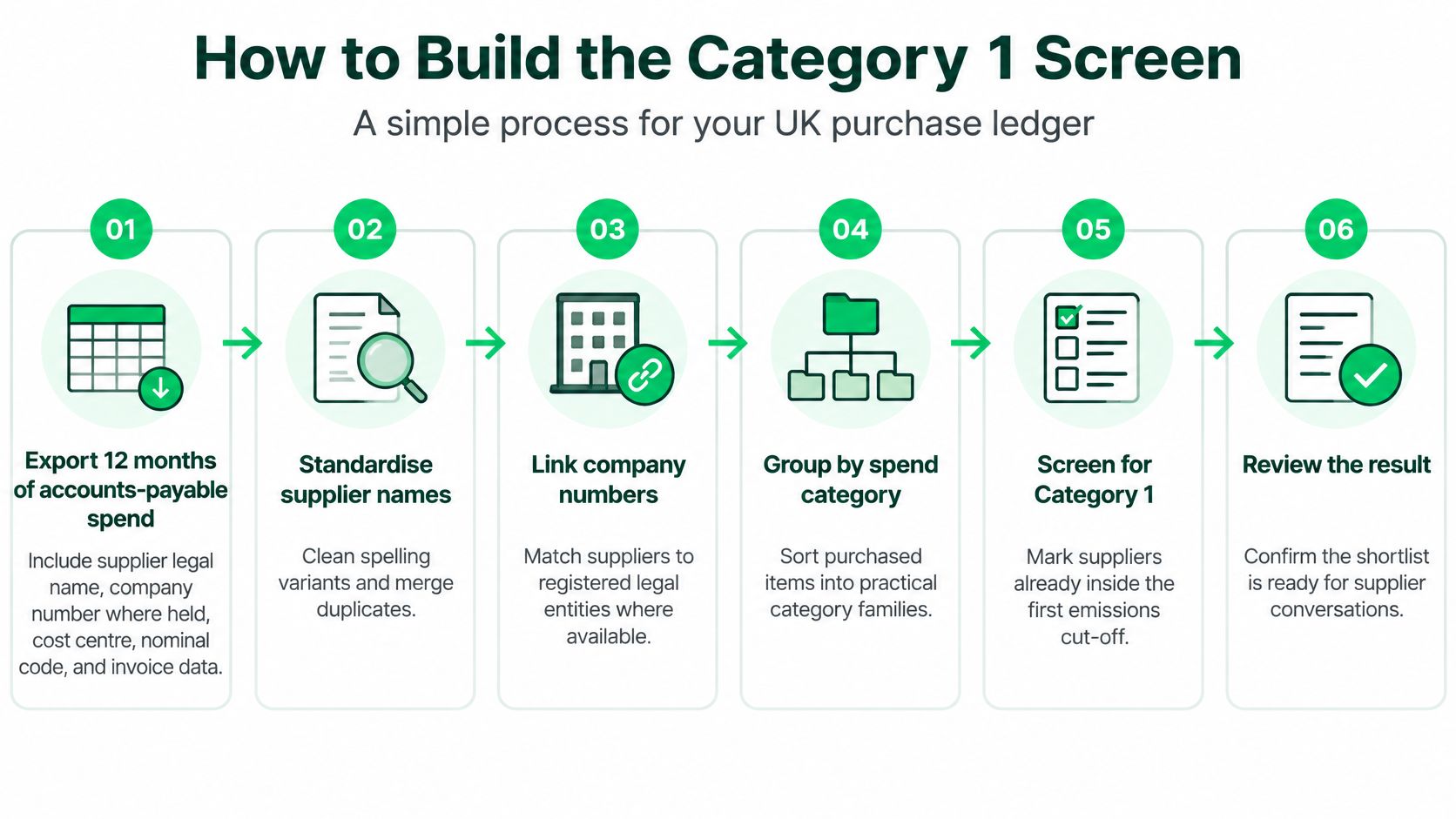
Build the screen in Excel with Power Query, or an equivalent controlled data workflow, before buying specialist software. Keep raw transactions separate from transformations, factor lookups and reporting outputs so another analyst can reproduce the result.
The visual summarises the ledger-to-shortlist workflow.
Turn the ledger into a calculation file
Export a complete reporting period. For an annual inventory, take the full year of accounts-payable transactions, including credits. Include supplier legal name, company number where held, supplier ID, cost centre, nominal code, transaction currency, invoice date, invoice country and purchase description. Save an immutable
AP_rawfile and reconcile its total to finance's agreed purchasing population.Standardise names without destroying the original identifiers. Use a
Supplier_crosswalksheet to connect trading names and spelling variants to the legal entity, checking company numbers where available. Mark intercompany transactions and payment intermediaries explicitly. Don't delete small invoices because each falls below an arbitrary pound threshold: repeated purchases can form a material category, while an inexpensive component can be critical.Create a category decision field. Map nominal codes and descriptions to purchased goods and services or the appropriate alternative Scope 3 category. Park capital goods, upstream transport, business travel and waste in a separate allocation queue rather than forcing them into Category 1. Where a nominal contains mixed purchases, split it using invoice detail or a documented allocation, not the supplier's name alone.
Apply a suitable spend-based emissions factor through a controlled
Factor_lookuptable. Align the factor's currency and price year with the spend, document any inflation adjustment, and convert foreign-currency transactions using a stated exchange-rate source and convention. Produce separate fields for adjusted spend, factor, estimated tCO2e and factor-boundary notes. A factor already expressed per unit of spend must not receive a second currency conversion.
Model dependencies without inventing suppliers
Add industry-level upstream context. The ONS industry-by-industry input-output analytical tables distinguish direct and indirect production relationships, including domestic and imported inputs. Use them to identify upstream industries supporting a purchased output, such as steel, cement or chemicals, when named sub-tier suppliers aren't disclosed. Record these as modelled industry dependencies, not verified commercial relationships. Input-output expenditure relationships aren't, by themselves, emissions factors.
Separate seller location from production origin in
Origin_status. A UK invoice address establishes who billed you, not where the product or its inputs were made. Record confirmed production country where evidence exists; otherwise retain an unknown-origin flag. For UK industry purchases, imported-input shares can inform a modelled dependency assessment, but they don't establish the actual country or factory behind a particular order.Freeze the screening version. Sort suppliers by estimated tCO2e and calculate cumulative emissions divided by total screened Category 1 emissions. Mark the row that reaches the agreed engagement cut-off, include that whole supplier, then add any risk overrides. Save
Category1_screen_frozenwith its reconciliation, boundary, exclusions, factor release and quality notes before replacing estimates with primary data.
Check the result for obvious classification errors before approving the shortlist. A facilities supplier near the top might reflect material purchases, or it might contain energy, construction and services that need different treatment. Investigate the purchase mix rather than adjusting an inconvenient result downwards.
The approved ranked list, including its documented overrides, is the hand-off to supplier engagement. Don't let individual questionnaire responses determine which suppliers enter the assessment.
How Far Beyond Tier One to Map
Full raw-material mapping shouldn't be the default. The defensible question is whether another layer would change a reporting conclusion, reveal a consequential dependency or substantiate a claim you intend to make.
A domestic supplier file isn't a domestic supply chain: the ONS UK trade bulletin for December 2025 records UK goods imports of £630.2 billion in 2025. Use that context to challenge assumptions about origin, not to assign a national import ratio to an individual supplier.
When to stop mapping and when to go deeper
| Situation | Map to | Why this depth | If you cannot see further |
|---|---|---|---|
| Low-spend, easily substituted service | Tier one only | Emissions and continuity risk are both assessed as small | Log the spend-based factor and move on |
| High tCO2e manufacturer with a known process | Tier one plus process or product footprint | Suitable primary data could materially change the inventory | Keep the spend-based figure and score it lower quality |
| Single-source or long-lead component | Tier two, named processor | Failure could stop operations even if emissions are mid-rank | Record a resilience risk and assess dual-sourcing feasibility |
| Imported commodity-heavy category | Country and industry of imported inputs | Imported inputs may be a significant dependency | Use ONS imported-input shares and flag the country gap |
| Processed good that may contain soy, palm, cocoa, rubber, cattle or timber | Origin or chain of custody, not just tier one | Carbon data alone doesn't resolve land-use or deforestation exposure | Escalate; a questionnaire without origin evidence isn't substantiation |
| Supplier refuses sub-tier names | Tier one plus an explicit unknown | A complete name list isn't necessary for every decision | Record uncertainty and the escalation trigger |
Set depth by the decision at risk
Consider a manufactured component purchased through a distributor. Knowing the distributor's emissions won't explain whether production depends on a single processor. Procurement needs the processor, location and substitution options, even if the component isn't a leading carbon contributor.
A small, readily replaceable domestic service is different. If the purchasing category presents no identified heightened risk, investigating its suppliers' suppliers may consume time without improving a decision. Record the rationale and stop.
Forest-risk materials require another route. A furniture purchase calls for material and chain-of-custody evidence; a list of office addresses won't establish timber origin. Likewise, packaged food may require ingredient-level questions rather than a generic supplier declaration.
An unknown is a data limitation until it threatens a material decision or an intended claim. Then it becomes an escalation.
Write the escalation as an action: named owner, evidence required, due date and interim restriction. Where confidentiality blocks disclosure, request an independently supported origin statement, aggregated production information or controlled access under an appropriate confidentiality arrangement.
Approve the tier rule with procurement and sustainability together. That gives an assurer a consistent explanation for why one relationship stops at the contracted supplier while another extends to production origin.
Data Fields and Evidence Quality Scores
Create a calculation table with a separate evidence register linked by a stable row ID. Keep source documents in a controlled folder rather than relying on links to supplier portals that may change.
Use these column groups as a spreadsheet template:
- Identity and period: Supplier ID, legal entity, reporting year and purchase-category reference.
- Financial and boundary: Spend, currency, Scope 3 category, tier assumed and country of last known production.
- Activity and emissions: Activity type, unit, quantity, supplier-reported tCO2e and the calculated figure selected for reporting.
- Method and allocation: Factor name and year, allocation method, and share of supplier output bought where relevant.
- Evidence and control: Data-quality band, nature flag, file reference, uncertainty statement, reviewer and approval status.
Score what the evidence supports
Use the following as an internal evidence classification, not a claim that the bands are an externally prescribed standard. Higher bands indicate more specific evidence, but specificity doesn't repair an incorrect boundary.
Supplier data template and quality bands
| Quality band | What you hold | Typical use | Assurance note |
|---|---|---|---|
| 1 Spend-based | Spend, category and a published factor | Screening and long-tail suppliers | State factor source, currency year and that it isn't supplier-specific |
| 2 Average activity | Tonnes, kWh or km with a generic factor | Purchases where the process is known but supplier carbon isn't | Record the unit, factor and allocation to your purchase |
| 3 Supplier-specific activity | Supplier fuel, electricity and material data allocated to you | Priority suppliers that can replace the screen | Check year, boundary and potential transport double counting |
| 4 Product or facility footprint | Product carbon footprint, environmental product declaration or facility inventory with method stated | Material products and single-source components | Keep the method reference; don't add spend-based emissions for the same purchase |
| Nature add-on | Origin, chain of custody or certification for soy, palm, cocoa, rubber, cattle or timber | Processed goods containing those commodities | Without substantiated origin, the carbon estimate may remain usable but a deforestation claim remains unsupported |
A good row for a purchased component identifies the product, purchased quantity, applicable footprint document, declared unit, reporting boundary and calculation converting purchases into emissions. The evidence register contains the document version and reviewer's compatibility check.
A qualified row for packaged food may have reliable spend and a suitable factor but no substantiated ingredient origin. Keep the carbon estimate, mark the commodity pathway unresolved and prohibit an unsupported low-risk sourcing claim. Don't turn a completed questionnaire into a quality upgrade unless it supplies relevant evidence.
Add nature evidence selectively
Global Investigations Review's UK ESG compliance commentary describes planned mandatory Great Britain deforestation due diligence for forest-risk commodities, with detailed secondary legislation still forthcoming. Treat this as a policy-development issue requiring a current applicability check, not an enacted obligation covering every purchase.
For relevant categories, add commodity, origin, chain-of-custody reference and geospatial or certification evidence where appropriate. Specify the corrective action if origin remains unsubstantiated: a contractual evidence clause, an alternative material specification or exclusion from a sourcing claim.
Every figure ESG Consulting produces traces back to source data, with methodology, boundaries and assumptions documented for the client's auditor or assurance provider. That's the useful assurance test: can someone reconstruct the figure and its limitations without interviewing its author?
Engage the Suppliers That Move the Footprint
Procurement should lead the request, with sustainability specifying the evidence needed. Name the contract, purchasing period and product family so the supplier can route the question to the person who holds the data.
Use the conversation to resolve a defined evidence gap, rather than introducing another general sustainability survey.

Supplier cohort and the ask
| Cohort | Ask | Data accepted | Timing |
|---|---|---|---|
| Strategic suppliers inside the cut-off | Working session to replace the spend-based estimate with activity data or a product footprint | Supplier activity data, product carbon footprint, environmental product declaration or an existing CDP response, subject to boundary checks | Agree a date within a proposed six-week window |
| Mid-tier manufacturers | One-page request on fuel, electricity, material tonnes and allocation to your purchases | Activity data with a suitable generic factor | Offer a six-week window with one reminder at week three |
| Long-tail suppliers | Nothing this cycle unless a risk override applies | Spend-based factor only | Re-screen in the next cycle |
The timings above are a suggested operating cadence, not a reporting requirement. Adjust them to the supplier's data availability and your inventory sign-off date, but agree a deadline rather than leaving requests open indefinitely.
Make the request answerable
For strategic suppliers, share the screened estimate as a provisional model, not an accusation. Explain which purchase boundary you need them to replace and offer a worked allocation example using their product units. Ask who can approve the submission and what supporting document they can provide.
Mid-tier manufacturers need a narrower request. Specify whether you need facility energy, purchased material quantities or a product footprint, and explain the allocation to your orders. Don't ask an SME for a full cradle-to-grave life-cycle assessment when your immediate requirement is a defensible purchased-goods estimate.
Accept existing CDP material, an inventory prepared using ISO 14064 or a product declaration when it contains the required evidence. None automatically supplies a compatible product boundary or allocation, so avoid treating document titles as validation.
Use the video as a discussion prompt alongside the written request.
Validate before replacing the estimate
Check whether the submission covers the organisation, facility or purchased product. Confirm the reporting period, units, exclusions and allocation, then check whether transport overlaps with your upstream transport calculation. A supplier's corporate inventory cannot be inserted into your purchasing row.
If the returned figure is lower but its method is opaque, preserve both values and retain the screened estimate until the method is documented. Record the unresolved question and reviewer decision; don't select whichever number makes progress look strongest.
For NHS organisations and government suppliers, connect the request to an existing applicable buyer process, such as Evergreen or a Carbon Reduction Plan, without assuming that either supplies product-level emissions.
Request discipline: If the answer won't change a material emissions estimate, a procurement decision or a high-risk commodity assessment, don't send the question.
Decide What the Map Changes Next
Choose a decision for this quarter before expanding the supplier file. A bigger map isn't evidence of better management unless someone uses it to change a calculation, purchasing arrangement or public statement.
The same controlled dataset can support different decisions, but each needs its own owner and acceptance criteria. Don't blend operational risk scores into the carbon total or imply that improved data alone represents emissions abatement.
Choose a concrete use
- Improve the inventory: Replace screened estimates for priority purchases only after validating the submitted evidence. Preserve the remaining modelled rows and their quality classifications. Track methodological replacements separately from genuine changes in purchasing or production.
- Reduce procurement exposure: Send high-criticality and import-dependent relationships to the procurement risk owner. Test alternatives, qualification lead times and specifications. Supplier diversification may reduce disruption exposure without reducing emissions, so assess those outcomes separately.
- Control public claims: Qualify or block supplier-specific emissions and deforestation-free statements when the supporting evidence doesn't establish them. A completed map doesn't authorise a claim broader than its documented boundary.
Before widening coverage, confirm which duties and requests the map must serve. SECR, a Carbon Reduction Plan, UK SRS preparation and buyer questionnaires don't have interchangeable boundaries or data needs. Maintain a shared evidence base with purpose-specific outputs rather than allowing each reporting workstream to create a competing supplier list.
Sign off the limitations as well as the result
Prepare a short approval note recording the purchasing boundary, exclusions, engagement cut-off, tier-depth rules, unresolved assumptions and open escalations. Finance should approve the spend reconciliation, procurement the supplier identities and criticality judgements, and sustainability the calculation method.
Keep the frozen version and change log so the next annual screen starts from controlled mappings rather than another manual clean-up. Reopen a stopped investigation when a material purchase, supplier, production location or claim changes.
Outside help is worth considering when the ledger cannot be reconciled in-house or an assurance provider will test a difficult evidence trail. Agree the scope in writing and appoint an accountable lead through sign-off. First choose whether you need a stronger inventory, a procurement intervention or better claim controls, then commission only the work needed to deliver it.
ESG Consulting's Scope 3 Emissions Inventory service uses value-chain mapping and supplier engagement to build a reportable footprint. If your supplier ledger needs a defensible screening method or an assurance-ready evidence trail, visit ESG Consulting to discuss a written scope, with a senior consultant accountable from scoping through to sign-off.