sustainability reporting gri, GRI Standards, GRI reporting guide, materiality assessment, GRI content index
Sustainability Reporting GRI: How to Prepare Your Report
By ESG Consulting Team · · 14 min read
The most common advice on GRI reporting is to collect your ESG metrics, add a content index and arrange external assurance. That's the wrong starting point. You can produce a well-indexed report without identifying your most significant impacts, and an assurance opinion can cover selected figures without covering the report as a whole.
For UK ESG teams, the first decisions are about purpose, boundaries and evidence. You need to establish what GRI asks you to disclose, what separate UK obligations apply, and which claims your records can support. Get those decisions right before drafting, and you'll spend less time repairing gaps at sign-off.
Table of Contents
- What the GRI Standards Are and How They Fit Together
- How to Scope Your Report and Assess Materiality
- Where GRI Ends and UK SRS Begins
- How to Collect Data and Build the GRI Content Index
- Which Metrics Need External Assurance and How Far It Reaches
- Handling Weak Scope 3 and Social Data
- Confirm Your Scope Before Your First Report
What the GRI Standards Are and How They Fit Together
The GRI Standards are a framework for reporting an organisation's significant impacts on the economy, the environment and people, including human rights. They provide a widely used voluntary basis for sustainability reporting, rather than a certificate that an organisation is sustainable.
Founded by the Coalition for Environmentally Responsible Economies, the Tellus Institute and UNEP in 1997, GRI introduced its modular Standards in 2016, following the earlier G-series guidelines, as described in the UK Government's sustainability-reporting guidance. That guidance recognises their use beyond companies, including by public-sector bodies.
Understand the modular structure
You don't select every available disclosure. Start with the Universal Standards, use any applicable Sector Standard to inform your assessment, and select Topic Standards that address your material impacts.
GRI Standards structure
| Standard | What it covers | Examples |
|---|---|---|
| GRI 1: Foundation | Reporting principles and the choice between reporting with reference to or in accordance with the Standards | Reporting principles and requirements |
| GRI 2: General Disclosures | Organisational context, reporting practices, activities, workers, governance and policies | Legal name, reporting boundary, governance body |
| GRI 3: Material Topics | How material topics are identified and managed | Process to determine material topics, list of material topics |
| Sector Standards | Impacts likely to be significant within a sector | Sector-specific topics to assess during materiality |
| Topic Standards | Disclosures about particular economic, environmental and social impacts | Waste, occupational health and safety, supplier assessment |
The familiar economic, environmental and social Topic Standard groupings help teams find relevant disclosures. They don't determine materiality for you: having an environmental dataset doesn't automatically make that topic more significant than a poorly measured labour impact.
Choose a reporting claim you can support
Reporting with reference to the Standards allows an organisation to use selected GRI disclosures. It still requires the appropriate statement of use and content index requirements; it isn't permission to imply full application.
Reporting in accordance with the Standards requires the organisation to satisfy the applicable GRI reporting requirements as a whole. Completing the disclosures you happened to select isn't enough. Where omissions are permitted, the prescribed explanation must accompany them.
Practical rule: Decide which reporting claim you intend to make before commissioning the report design.
For a quick starting check, sort your likely material topics into economic, environmental and social impacts. Then identify any applicable Sector Standard and distinguish the organisational disclosures everyone needs from the topic disclosures your assessment must justify.
How to Scope Your Report and Assess Materiality
A useful scope connects the reporting purpose to the organisation's operations and value chain. It shouldn't reproduce the entities in last year's spreadsheet.
Make the scope decisions in order
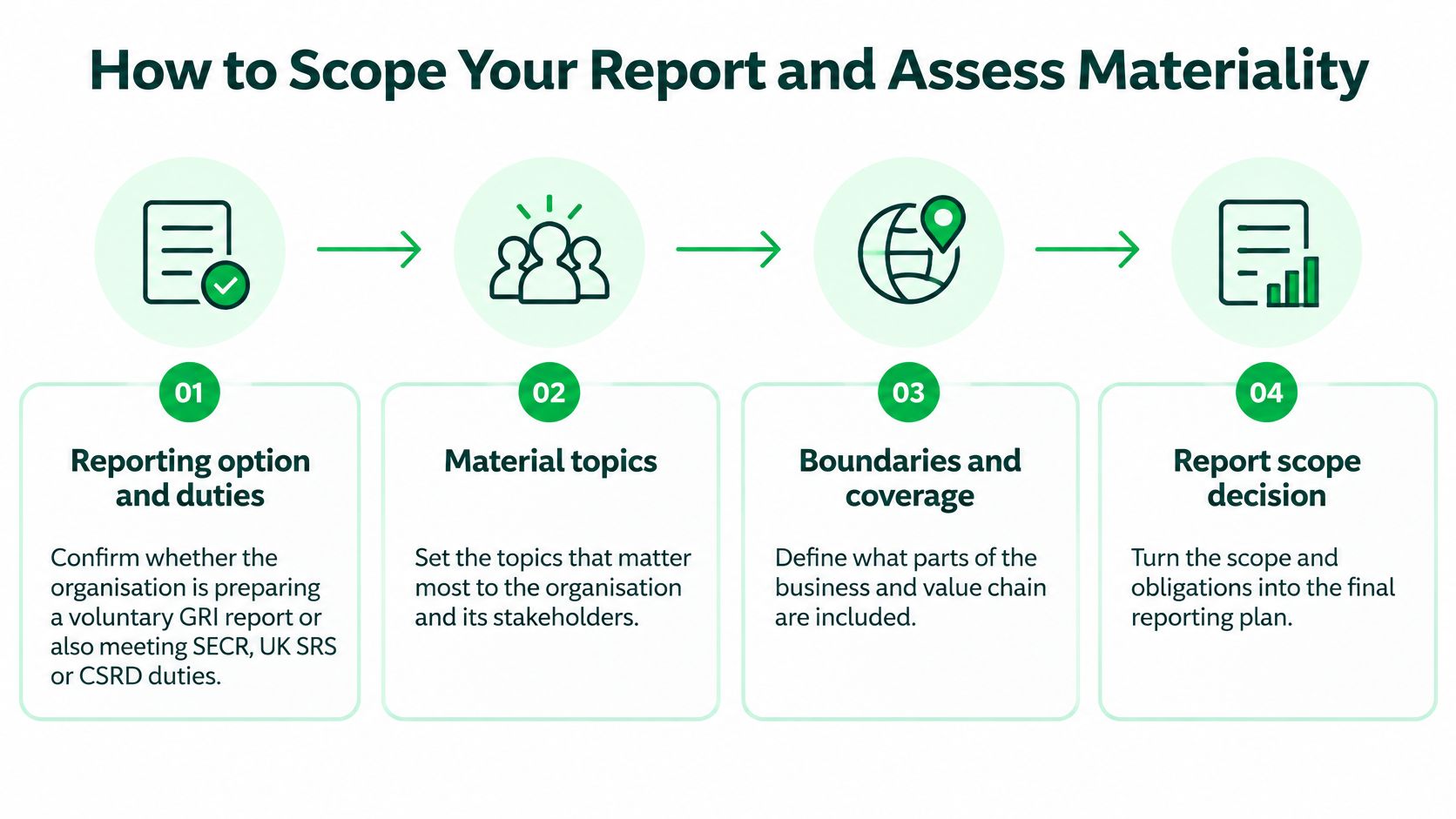
Confirm the reporting option and applicable duties. Establish whether you're preparing a voluntary GRI report alongside obligations such as SECR, UK SRS or CSRD, checking applicability rather than assuming each applies. At ESG Consulting, we confirm which obligations apply before anything is built or scoped; the common mistake is commissioning a combined report before resolving those differences.
Set the organisational boundary and period. List subsidiaries, joint ventures, sites and operations, then document the consolidation approach used for relevant metrics, including financial or operational control where appropriate. Don't apply an emissions consolidation method indiscriminately to every social disclosure, or change coverage mid-cycle without explaining the effect on comparisons.
Identify and assess impacts. Examine actual and potential impacts across operations and business relationships, using employee feedback, supplier assessments, community concerns, customer information and regulatory input. Assess negative impacts through severity, including scale, scope and irremediability, and consider likelihood for potential impacts; don't score only what you already measure or let a stakeholder popularity survey replace impact assessment.
Agree material topics and map disclosures. Document the assessment process, approve the resulting topic list and connect each topic to relevant disclosures and management information. A food retailer, for example, might need supplier social assessment and waste disclosures, rather than selecting standards because those datasets are easiest to obtain.
Use the scope flow as a decision aid, with the topic list and boundary refined together.
Common material topics mapped to GRI Topic Standards
| Material topic | GRI Topic Standard | Disclosures to report |
|---|---|---|
| Energy use | Energy | Consumption, relevant intensity measures and reductions |
| Water withdrawals | Water and Effluents | Withdrawals by source and relevant water-stress context |
| Greenhouse gas emissions | Emissions or applicable Climate Change Standard | Relevant emissions scopes, methods and reductions |
| Waste | Waste | Waste generated, diverted from disposal and directed to disposal |
| Supplier labour risks | Supplier Social Assessment | Supplier screening, negative impacts and actions taken |
| Workplace safety | Occupational Health and Safety | Management arrangements, coverage, injuries and ill health |
| Workforce diversity | Diversity and Equal Opportunity | Diversity of governance bodies and employees |
Treat this table as a starting map, not a complete disclosure checklist. Check the applicable standard edition and transition provisions before fixing disclosure identifiers. Your approved output should be a manageable topic list with reasons for inclusion, relevant value-chain coverage and a clear record of significant exclusions.
Where GRI Ends and UK SRS Begins
Say a supplier's activities seriously affect a local community, but your financial assessment finds no material effect on your organisation's prospects. That impact may belong in your GRI report even if it doesn't meet the financial-materiality test for investor-focused disclosure.
The reverse can also occur: a sustainability-related dependency may matter financially even where your organisation's own external impact is limited. The Debevoise worldwide sustainability-reporting overview distinguishes impact-focused reporting from investor-focused requirements and reinforces that minimum disclosures don't settle every material reporting question.
GRI and UK SRS S1/S2 compared
| Question | GRI | UK SRS S1/S2 (ISSB-aligned) |
|---|---|---|
| Whose perspective | Significant impacts on people, the environment and the economy | Risks and opportunities that could affect enterprise value |
| Materiality test | Impact materiality, based on the significance of actual or potential impacts | Financial materiality, including information that could reasonably influence investor decisions |
| Primary audience | Broad stakeholders, including employees, communities and suppliers | Primary users such as investors and lenders |
| Financially immaterial but socially significant topic | Reportable where the external impact is significant | Not required on financial grounds alone |
| Shared evidence | Direct and purchased-energy emissions, energy, water and waste data | The same metrics where financially relevant, with associated governance and financial analysis |
Use one evidence system with separate judgements
Start with a shared sustainability-topic register, but give each topic separate impact and financial assessment fields. Don't use a single combined score that conceals why a topic qualifies for one reporting purpose.
For each topic, record:
- Impact conclusion: Who or what is affected, how the organisation is involved, and why the impact is significant.
- Financial conclusion: The relevant risk or opportunity, its potential financial effects and the basis for the materiality judgement.
- Reporting destination: GRI, investor-focused disclosure, both, or neither, with an explanation.
- Shared evidence: The controlled dataset and methodology that each report will reference.
A water-intensive site illustrates the distinction. Its withdrawals may be significant because of effects on local water availability; potential production interruptions may also create a financial risk. You can reuse the underlying withdrawal records, but each disclosure needs its own explanation.
Shared evidence doesn't mean interchangeable materiality assessments.
UK SRS, ISSB and CSRD shouldn't be treated as alternative names for GRI. CSRD-related reporting introduces its own requirements, including a double-materiality approach where applicable, while UK applicability and reporting expectations need separate confirmation.
Before drafting either report, create the two-column topic register. It's the simplest way to expose unsupported exclusions and avoid asking operations teams for the same evidence twice.
How to Collect Data and Build the GRI Content Index
Give data owners a reporting specification, not an empty spreadsheet labelled ESG. Each request should state the disclosure, covered entities, period, unit, calculation method and supporting records.
Turn disclosures into controlled data requests
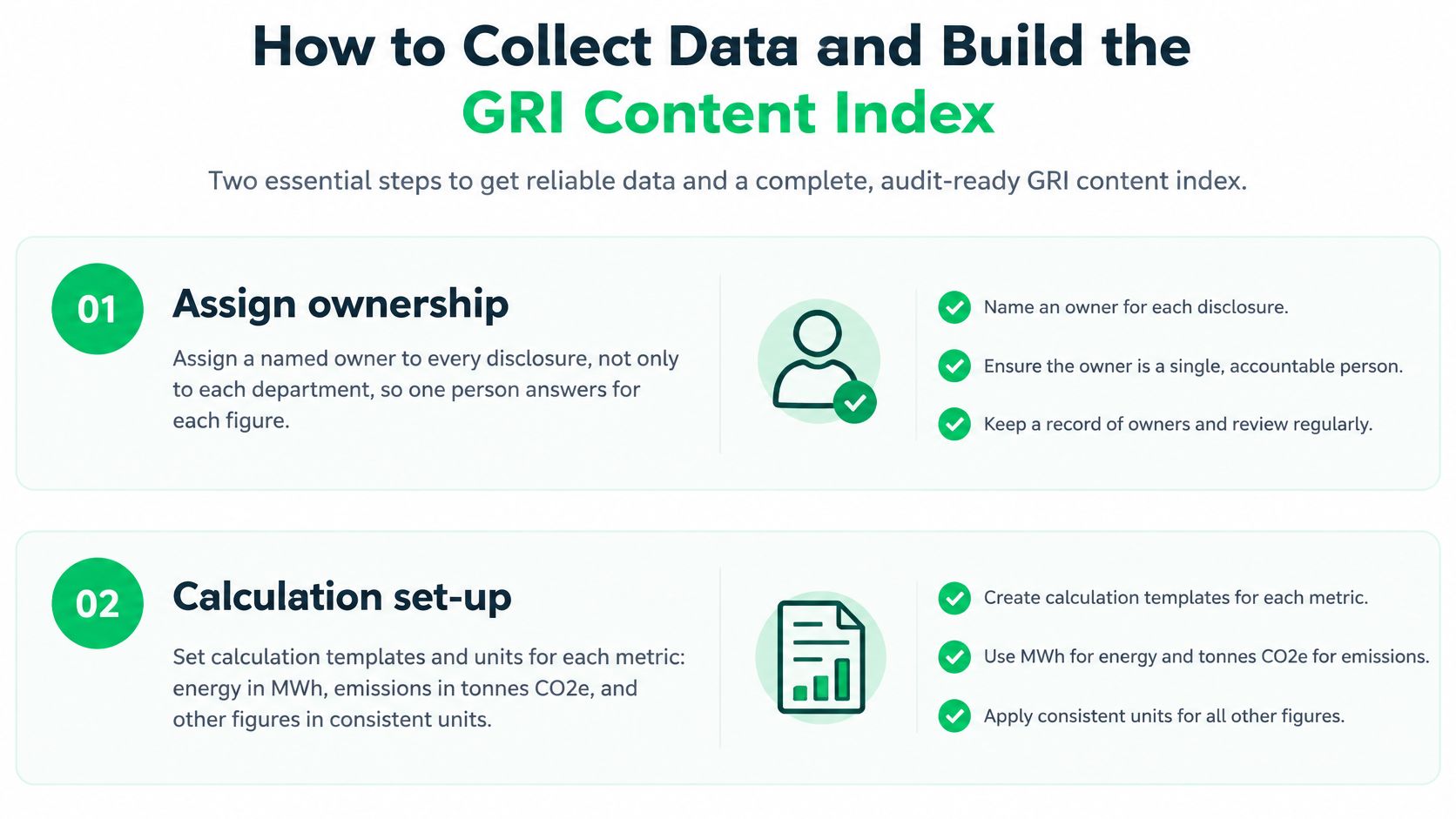
Assign a named owner to every disclosure. A department can contribute information, but an individual must answer for the submission and resolve exceptions. Separate preparation from review wherever practical, and name a deputy so staff absence doesn't leave an indicator unsupported.
Set controlled calculation templates. Specify energy in MWh, emissions in tonnes of CO₂e, water in cubic metres and waste by treatment or disposal route, retaining the original source units and conversion workings. For emissions, record the factor source, applicable version, activity data and any assumptions rather than pasting a total into the reporting workbook.
Use the following checklist when setting up ownership and calculations.
Store evidence alongside the calculation. Retain invoices, meter readings, HR extracts, contractor returns and incident records in controlled folders with stable references. Keep the original submission and approved revisions, so a reviewer can reconstruct the published result rather than relying on someone's explanation months later.
Build the content index while drafting. Record each disclosure used, its precise location and any permitted omission with the required explanation. A reference to the entire annual report isn't useful when the reader needs a particular policy, metric or management disclosure.
Review differences before sign-off
Set an internal variance-review threshold and investigate changes that exceed it. A movement may reflect operational performance, an acquisition, missing records, a revised factor or a corrected calculation; the explanation should distinguish these causes.
For example, lower reported waste isn't necessarily an improvement if a contractor's return excludes a site. Require the owner to resolve the coverage issue before approving the narrative.
The index should also distinguish information published elsewhere from information that remains unavailable. Linking to a policy doesn't satisfy a request for performance outcomes.
Before publication, check:
- Ownership: Every disclosure has a preparer and reviewer.
- Boundary: Coverage matches the approved scope, with changes explained.
- Consistency: Units, methods and totals agree across publications.
- Navigation: Index references lead directly to the relevant information.
- Approval: Sign-off records identify the approver and approval date.
Which Metrics Need External Assurance and How Far It Reaches
An assurance statement should identify the reporting period, selected indicators, criteria, organisational boundary, procedures and assurance level. Read that scope before describing any report or figure as assured.
Keep the assurance schedule beside the report during review.

The HS2 Environmental Sustainability Report for 2024–25 was prepared with reference to GRI and received BSI reasonable assurance over key environmental performance data, while its GRI content index and UN Sustainable Development Goal mapping were outside verification scope. That's a useful boundary: disclosure coverage and independent verification are different things.
Reasonable assurance involves more extensive testing than limited assurance, but it isn't absolute assurance. Limited assurance uses less extensive procedures. Neither description tells readers which indicators were tested unless the statement identifies them.
Put evidence effort where misstatement risk is greatest
Rank proposed indicators by stakeholder and financial significance, estimation uncertainty, dispersed ownership and likelihood of error. External assurance isn't automatically required for every GRI metric; the appropriate scope also depends on applicable obligations and the engagement's purpose.
Indicators that need the strongest evidence
| Indicator | Why it is high risk | Evidence to keep |
|---|---|---|
| Scope 3 purchased goods | Estimates depend on supplier data and emission factors, with high uncertainty | Supplier spend records, factor sources and a method note stating uncertainty |
| Waste generated and diverted | Several disposal routes and contractor-reported tonnages | Waste transfer notes, disposal-route tonnages and contractor reports |
| Water withdrawals | Inconsistent meter coverage and estimated bills | Meter readings, supplier invoices and site-level calculations |
| Safety rates | Inconsistent definitions and risk of under-reporting | Incident register, HR absence records and agreed injury definitions |
For these indicators, require named owners, controlled calculations, retained evidence and documented variance review. Include denominator checks for rates: a correct injury count can still produce a misleading result if working hours exclude contractors covered by the numerator.
This video can support your team's discussion of the reporting process.
Don't extend an assurance conclusion to nearby narrative claims. Label contextual information outside the engagement as not externally assured, rather than letting page layout imply verification.
Ask the assurance provider to confirm the selected indicators and criteria before drafting starts. That gives owners time to repair missing evidence instead of discovering exclusions at publication.
Handling Weak Scope 3 and Social Data
In Deloitte's UK corporate-reporting insights, 77% of surveyed companies reported challenges obtaining Scope 3 data, while 90% obtained external assurance over selected sustainability metrics. Those findings can coexist because selected-metric assurance isn't a test of every figure or claim in a report.
The practical response isn't to abandon imperfect datasets. It's to distinguish what you know, what you've estimated and what you can't yet support.
Apply clear evidence labels
Use an evidence-status field beside each metric, with a separate field for assurance coverage.
| Label | When to use it | What to disclose |
|---|---|---|
| Verified | The figure has undergone the specified verification procedure | Who checked it, the procedure and whether external assurance applies |
| Estimated with stated uncertainty | A defensible calculation exists, but direct measurement is incomplete | Method, sources, assumptions, coverage and uncertainty |
| Not yet available | There's no defensible basis for a figure | The gap, applicable omission explanation and improvement action |
Don't use verified as shorthand for externally assured unless that's what occurred. Likewise, an estimate can fall within an assurance engagement: estimation status and assurance status answer different questions.
Prioritise primary evidence for metrics that drive targets or major decisions. Where estimation is necessary, document why the method fits the activity and test how sensitive the result is to its main assumptions.
An acknowledged gap is more useful than a precise-looking number with no defensible basis.
Repair fragmentation at the source
Supplier and workforce information may sit across procurement systems, agency records, payroll platforms and local operational files. An NHS trust, for example, should resolve whether a workforce measure includes bank staff, agency workers and contractors before combining returns.
Give the disclosure owner responsibility for reconciling those populations. Governance reviewers should approve unresolved limitations and the plan to improve them, rather than leaving local teams to make incompatible assumptions.
Every figure we produce at ESG Consulting traces back to source data, with the methodology, boundaries and assumptions documented for the client's auditor or assurance provider.
A useful worked label is: Estimated with stated uncertainty. Purchased-goods emissions calculated from supplier spend, mapped to documented categories and emission factors. The method note identifies excluded transactions, currency treatment and the uncertainty created by spend-based averages not reflecting individual suppliers' production methods.
That's more informative than an unexplained total, and it gives procurement a specific improvement task: replace the most consequential estimates with better supplier evidence.
Confirm Your Scope Before Your First Report
Don't approve drafting while the reporting claim, boundary, period, applicable obligations or initial material-topic list remain unresolved. A short sponsor-approved decision note is more useful than a polished draft built on competing assumptions.
Put the decisions into writing
- Record the reporting option and boundary. Include the reporting period, applicable obligations and sponsor approval.
- Complete the topic register. Put impact and financial conclusions side by side, with the initial material-topic list attached.
- Name high-risk disclosure owners. Confirm that each owner can access the records needed to support the proposed metric.
- Confirm assurance scope. Obtain agreement on selected indicators, assessment criteria and expected evidence before drafting.
If you're considering external ESG consulting support, use the initial discussion to test these decisions against your actual systems and records. Clients speak with an ESG specialist who knows the subject, not a sales team.
Before work begins, we agree the scope, deliverables, timeline and fees in a written statement of work. That makes the responsibilities and reporting boundaries explicit before anyone commits to production.
Once the sponsor has signed the scope note and owners understand their evidence responsibilities, the report can move into drafting.
ESG Consulting helps UK organisations prepare materiality-led GRI reporting with clear boundaries, controlled calculations and traceable evidence. Visit ESG Consulting to arrange a speaking call with an ESG specialist and test your reporting scope before committing to a full report.