sustainable finance disclosure regulation, SFDR, SFDR Article 8, SFDR disclosure requirements, UK SDR
Sustainable Finance Disclosure Regulation Explained
By ESG Consulting Team · · 15 min read
Your fund's prospectus describes environmental screening. Its website calls the strategy sustainable. A distributor wants to use impact in a UK factsheet, while your compliance team is preparing disclosures for EU investors. You're looking at the same portfolio, but you may be dealing with different regulatory obligations and claims that don't quite match.
The Sustainable Finance Disclosure Regulation (SFDR) helps investors understand sustainability claims, but it isn't a passport through the UK's separate rules. For asset managers and compliance teams, the practical task is to establish which requirements apply, make the documents consistent and keep enough evidence to substantiate what investors read.
Table of Contents
- What the Regulation Asks of Fund Managers
- Article 6, 8 and 9 Funds Compared at a Glance
- Disclosure Documents Every Fund Manager Publishes
- How SFDR Interacts with UK Sustainability Disclosure Rules
- Timelines for EU and UK Disclosure Duties
- How to Build and Sign Off a Compliant Disclosure Process
What the Regulation Asks of Fund Managers
SFDR works rather like a nutrition label for investment funds. Investors need to look beyond an attractive name and understand the ingredients: what the manager considers, what the strategy commits to and what the portfolio delivers.
The analogy has a limit. A disclosure category isn't a regulator's endorsement of investment quality, sustainability performance or likely returns. Managers remain responsible for explaining their approach accurately.
SFDR addresses financial market participants and financial advisers within its scope. Managers outside the EU also need to assess their position when making funds available to EU investors. Being based in London doesn't, by itself, settle whether a fund has EU disclosure obligations.
The framework tackles related problems: greenwashing and sustainability information that investors can't readily compare across documents. A polished factsheet is little help if the prospectus describes a materially different strategy.
Core principle: Describe the investment commitment accurately, then make the disclosures and evidence support that commitment.
Follow a fund from strategy to claim
Say a manager runs an equity fund that excludes fossil fuel producers. The investment team treats the exclusion as a binding environmental characteristic, and the marketing team promotes it to investors.
That requires more than a generic statement that climate change could affect returns. The manager must explain the characteristic, how the investment process delivers it and how performance against it will be assessed.
But an exclusion doesn't automatically make the fund a sustainable-investment-objective product. Calling the strategy sustainable in a brochure doesn't establish that either. Compliance needs to examine the substance of the commitment, not match an adjective to a category.
Use these questions to structure the initial assessment:
- Promoted characteristics: Does the fund promote environmental or social characteristics through binding features of its strategy?
- Investment objective: Does it have sustainable investment as its objective, supported by a corresponding methodology?
- Risk integration: Is it instead explaining how sustainability risks could affect investments, without making those additional commitments?
These questions distinguish risk management, promoted characteristics and an investment objective. Confusing them at the outset creates problems throughout the disclosure process.
Article 6, 8 and 9 Funds Compared at a Glance
Article 6, 8 and 9 requirements compared
| Feature | Article 6 | Article 8 | Article 9 |
|---|---|---|---|
| Sustainability claim | Sustainability-risk disclosure without the additional characteristics or objective described alongside | Promotes environmental or social characteristics | Sustainable investment is the objective |
| Good governance test | No additional category-specific test of the kind applicable alongside | Investee companies must follow good governance practices | Sustainable investments in companies must meet good-governance requirements |
| Principal adverse impacts (PAI) | Assess applicable product disclosure duties separately | Explain the approach where PAIs are considered; sustainable investments need additional assessment | Consider adverse impacts within the sustainable-investment assessment and address applicable disclosures |
| Typical example | Conventional fund with a sustainability-risk statement | Equity fund promoting a binding fossil-fuel exclusion | Fund with a sustainable-investment objective focused on renewable energy projects |
The examples illustrate possible approaches. Neither an exclusion nor a renewable-energy holding determines classification on its own.
Risk disclosure isn't a sustainability promise
An Article 6 fund can consider climate risk, labour disputes or governance failures because they might affect investment value. That doesn't necessarily mean it promotes environmental or social characteristics.
Its documents should explain how sustainability risks are integrated and address their likely effects on returns, or explain why the manager considers them irrelevant. Treating this category as permission to say nothing about sustainability risks misses the distinction.
Article 8 adds a promoted environmental or social characteristic. The manager needs to identify what's binding, rather than describe optional preferences that portfolio managers can disregard.
For example, an exclusion policy should specify the activities covered, the information used to assess issuers and how exceptions are handled. A broad statement about favouring responsible businesses doesn't tell investors what constrains investment decisions.
An objective needs more than stronger wording
Article 9 concerns a sustainable-investment objective. Managers need a defensible methodology for assessing contribution, avoiding significant harm and addressing good governance where relevant. Investing in a green sector doesn't remove those assessment tasks.
Principal adverse impacts, often shortened to PAI, concern adverse effects of investment decisions on sustainability factors. They aren't another name for sustainability risks, which concern potential effects on investment value. Nor can a compliance team settle every PAI obligation by checking the fund's category alone.
Suppose an Article 8 fund's marketing team changes its description from promoting environmental characteristics to pursuing sustainable investment as its objective. That change requires an immediate classification and disclosure review. The manager must either substantiate the new objective and make the necessary changes or remove the unsupported claim.
A stronger marketing claim creates a review problem, not an automatic upgrade. The strategy, methodology and disclosures must substantiate the category.
The verdict is consistency, not category shopping. A manager can't select Article 9 because it sounds more ambitious while leaving the prospectus and investment process at the level of promoted characteristics.
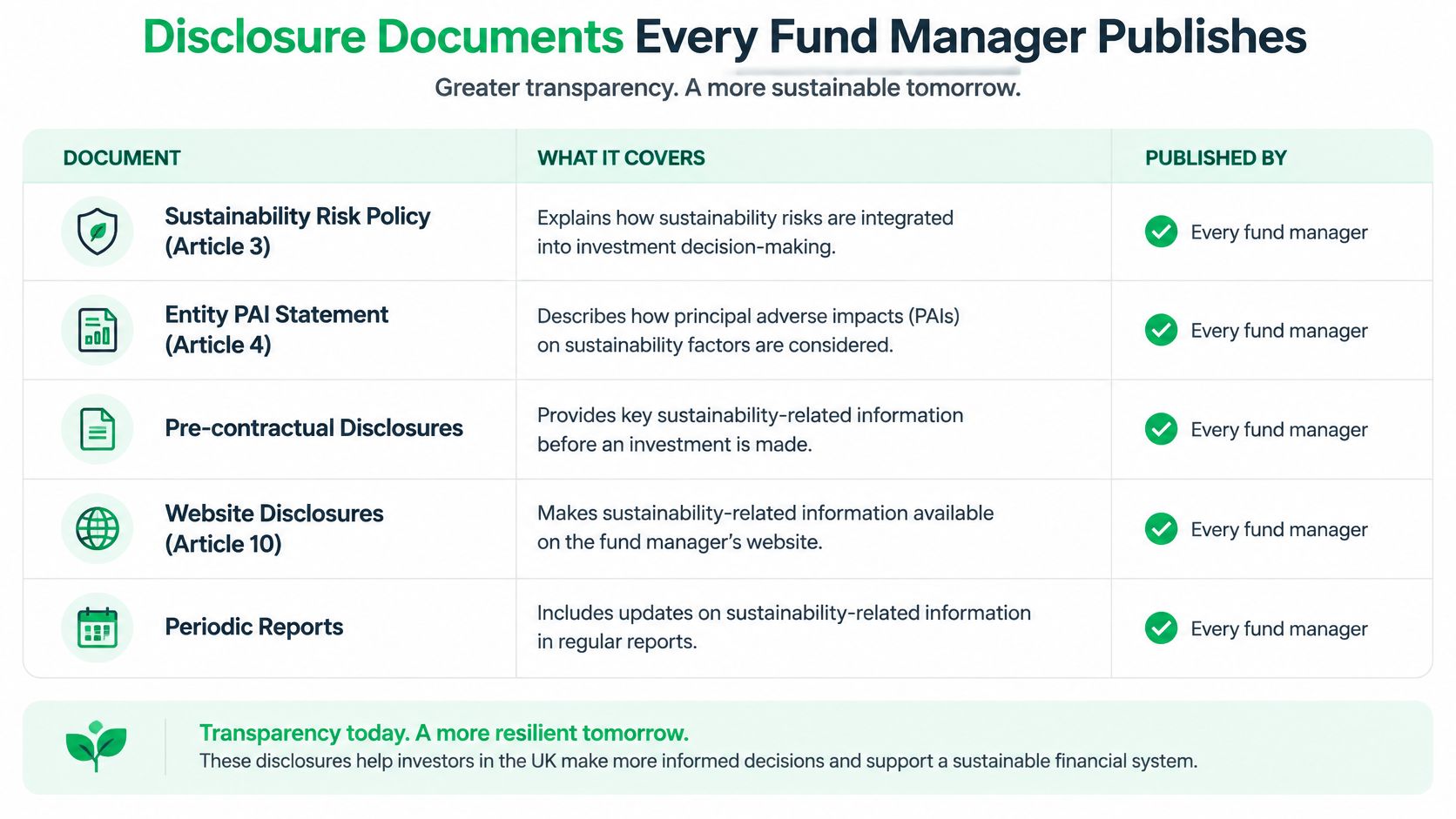
Disclosure Documents Every Fund Manager Publishes
Disclosure documents by level and location
| Document | Level | Frequency or trigger | Where published |
|---|---|---|---|
| Sustainability risk policy (Article 3) | Entity | Kept current | Firm website |
| PAI statement or explanation (Article 4) | Entity | Reporting cycle where impacts are considered; maintain the explanation where they aren't | Firm website |
| Pre-contractual disclosure (Articles 6 to 9) | Product | Before investment, with updates when relevant commitments change | Prospectus or pre-contractual documents |
| Website disclosure (Article 10) | Product | Kept current for relevant sustainability products | Fund website |
| Periodic report (Article 11) | Product | Relevant periodic reporting cycle for applicable products | Periodic investor reporting documents |
The documents aren't universally identical obligations. Product category, entity characteristics and the manager's approach determine which content is required. A useful document register distinguishes a mandatory statement, an explanation of non-consideration and a product-specific disclosure.
Turn the document register into publishing controls
Start with an approved classification assessment for each product. Record the commitments that support it and identify the person authorised to approve changes. Without that record, teams can produce individually plausible documents that describe different funds.
Then check the firm's sustainability-risk policy. It should describe how investment teams work, including where they obtain information, how they assess material risks and how those assessments influence decisions.
Resolve the entity's PAI position separately. Some entities must consider adverse impacts; others may explain why they don't. Don't assume an explanation is available without checking the applicable entity and group tests, or confuse an entity statement with product-level information.
A practical publishing checklist should cover:
- Pre-contractual accuracy: State the strategy, binding elements, relevant indicators and methodology before investors commit.
- Website maintenance: Assign an owner to update product explanations when approved commitments or methods change.
- Reporting readiness: Decide how the team will demonstrate delivery before making the initial commitment.
- Publication evidence: Retain approved versions, publication dates and the rationale for material amendments.
Report results, not recycled intentions
Pre-contractual documents explain what the manager intends and commits to do. Periodic disclosures explain what happened during the reporting period.
That distinction matters when a portfolio misses an indicator, an issuer breaches an exclusion or a data provider revises its methodology. Repeating the prospectus doesn't explain the outcome. The reporting team needs a record of results, limitations and relevant actions.
Keep separate fields for commitment, measurement method, observed result and explanation. This makes it harder to present an aspiration as an achieved outcome.
Consider a prospectus describing exclusion screens while the website calls the same fund impact-driven. An investor could reasonably understand the website as promising something beyond exclusions. Review the documents together, identify whether the investment process supports the additional claim and correct the inconsistency before publication.
How SFDR Interacts with UK Sustainability Disclosure Rules
A UK manager can face a dual-control problem: EU obligations for cross-border business and domestic requirements for UK-facing activities. The FCA's letter to chairs of authorised ESG and sustainable investment funds reinforces the need to treat applicable EU obligations as complementary to UK requirements, not substitutes for them.
EU SFDR and UK SDR compared
| Dimension | EU SFDR | UK SDR |
|---|---|---|
| Legal basis | EU sustainable-finance disclosure legislation and supporting measures | UK statutory framework and FCA rules |
| Product classification | Disclosure categories based on risk disclosure, promoted characteristics and sustainable-investment objectives | Sustainability Focus, Sustainability Improvers, Sustainability Impact and Sustainability Mixed Goals |
| Anti-greenwashing | Disclosure consistency and applicable marketing requirements | Explicit FCA anti-greenwashing requirement |
| Entity reporting | Entity-level sustainability-risk and applicable PAI disclosures | Sustainability entity reporting for in-scope firms |
| Scope | Assess the manager, product and route into EU markets | Assess the firm, product domicile, activity and UK distribution route |
The tempting shortcut is to assume an EU classification carries over. It doesn't. The UK hasn't adopted SFDR under a different name, and the table isn't a conversion chart.
Separate permission to label from obligations to disclose
The FCA's SDR regime guidance explains that UK labels are available to in-scope UK UCITS and UK AIFs meeting the relevant criteria, while sustainability-related terminology can engage naming and marketing requirements without a label.
That creates separate questions:
- Must disclose: Which communications and disclosures are required for this product and distribution route?
- May label: Is the product eligible, and can the manager substantiate the chosen label's criteria?
- Must not imply: Could the wording suggest a UK label, regulatory endorsement or investment outcome the product doesn't have?
Fund domicile matters. So do investor type, the distributing entity and the particular activity. An overseas fund's UK marketing needs a perimeter assessment, not an assumption that every rule for a domestic retail product applies identically.
How a single word changes the review
Say a manager markets an EU Article 9 fund to UK investors. A distributor proposes adding impact to the UK campaign because the word sounds more accessible than the formal investment objective.
That word should trigger a compliance review even if nobody plans to seek a UK label. The team must establish which UK provisions apply, whether the claim is supported and whether the communication could imply label status. EU classification doesn't answer those questions.
Practical rule: Review the words investors will see, not just the classification stored in the fund register.
The main danger isn't duplicated paperwork. It's publishing inconsistent claims, classifications or metrics across jurisdictions. Keep the legal assessments distinct while requiring a coherent explanation of what the fund does.
Timelines for EU and UK Disclosure Duties
Key EU and UK disclosure dates
| Date or status checkpoint | Regime | Milestone |
|---|---|---|
| Confirm applicable commencement and transitional provisions | EU SFDR | Establish the disclosure obligations applicable to the entity and product |
| Confirm applicable technical standards | EU SFDR | Check the reporting templates and methodology in force |
| 31 May 2024 | UK SDR | Anti-greenwashing rule took effect |
| 31 July 2024 | UK SDR | Firms could begin using sustainability labels |
| 2 December 2024 | UK SDR | Naming and marketing requirements applied |
| Check legislative status before changing the implementation plan | EU SFDR | Distinguish proposed reform from adopted and applicable requirements |
| 2 December 2025 | UK SDR | Initial entity-reporting deadline for the larger-firm cohort |
| 2 December 2026 | UK SDR | Initial entity-reporting deadline for the smaller in-scope cohort |
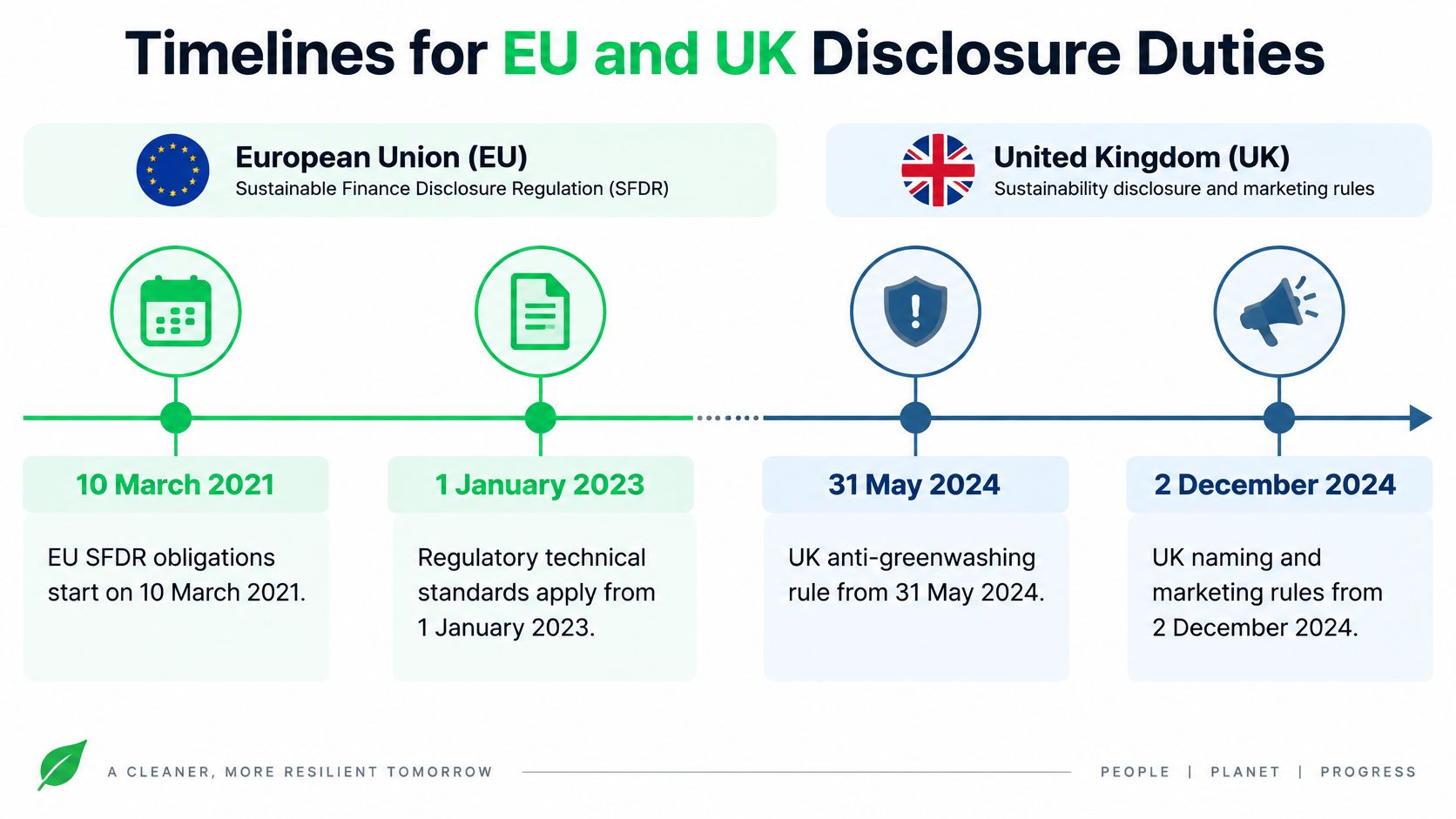
The Treasury's SDR implementation update records the UK anti-greenwashing commencement on 31 May 2024, label availability from 31 July 2024 and naming and marketing requirements from 2 December 2024.
The FCA's reporting requirements guidance identifies annual sustainability entity reporting for firms with more than £5 billion in assets under management, with initial reports phased between 2 December 2025 for larger firms and 2 December 2026 for smaller in-scope firms. Don't read the overall reporting threshold as meaning every firm above it belonged to the earlier cohort.
Plan around evidence and legal status
The entity report covers governance, strategy, risk management, metrics and targets. Product reporting serves a different purpose: explaining the investment approach and relevant sustainability performance. Don't assume completing the entity narrative supplies the product evidence.
Treat EU reform as a legal-status checkpoint. Before changing templates or removing disclosures, confirm adoption, publication in the Official Journal, application provisions and any transition arrangements. A proposal isn't an operative deadline.
For an approaching reporting deadline, work backwards from approval and publication. Set a data freeze, reserve legal-review time and establish who can authorise late changes. If the intended freeze has already passed, set a realistic replacement immediately rather than reducing the review period.
How to Build and Sign Off a Compliant Disclosure Process
A defensible disclosure process connects each material sentence to an investment commitment, a measurement method and retained evidence. Writing comes after those foundations, not before them.
At ESG Consulting, we confirm which obligations apply before anything is built or scoped. That starting discipline prevents teams from preparing unnecessary documents while overlooking requirements attached to a particular fund or distribution route.
Establish accountability before drafting
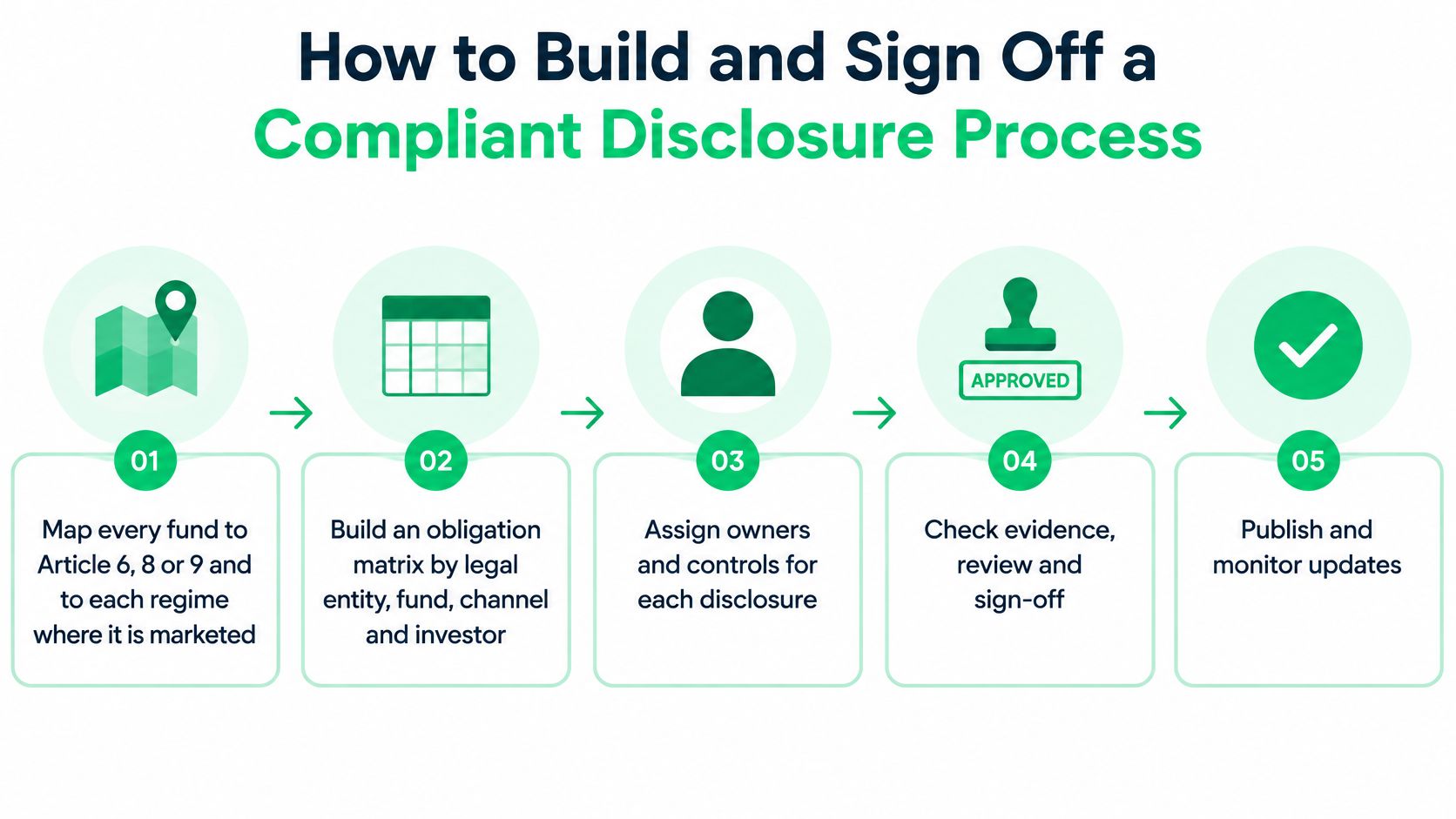
Map each fund and its markets. Record the EU disclosure assessment, UK perimeter assessment, domicile and distribution permissions. Capture the investment rationale supporting each conclusion, rather than leaving a category dropdown without an explanation.
Build an obligation matrix. Use a controlled spreadsheet or governance system with fields for legal entity, fund, channel, investor location, document, owner, approval route and publication trigger. Map shared data fields across regimes while retaining separate legal conclusions.
Assign KPI ownership. Name the person responsible for each indicator's definition, calculation, refresh and approval. Document estimation methods and keep holdings, exclusions and stewardship records under version control. Portfolio managers should understand which data changes could affect an investor-facing commitment.
Avoid assigning ownership only to the reporting team. Investment, risk, stewardship and compliance colleagues control different parts of the evidence, and the publishing team can't repair missing investment records at sign-off.
Make incomplete information visible
- Create a claim-to-evidence register. For each material claim, retain the supporting dataset, methodology, reporting boundary, assumptions and approved wording. Record a data hierarchy showing when the team uses issuer-reported information, provider data or estimates.
Suppose an issuer's emissions information is lagged and a provider supplies an estimate. Preserve that distinction through the calculation and disclosure process. Don't allow an estimated input to become an apparently measured result when it reaches the factsheet.
Our ESG consulting approach starts with applicability and accountable delivery. Every figure we produce traces to source data, with methodology, boundaries and assumptions documented for the client's auditor or assurance provider.
- Review the complete document set together. Compare the prospectus, website, periodic report and marketing against the same approved claims register. Search for consequential wording such as impact, aligned, sustainable and transition, then inspect the evidence behind each use.
This review should catch changes in meaning, not merely inconsistent numbers. A website promise about delivering real-world outcomes may be unsupported even when every portfolio statistic matches.
Define what happens when evidence falls short
- Set escalation and remediation rules. The FCA's sustainable investment labels good-practice guidance explains that Focus and Improvers products must invest at least 70% of gross asset value in line with their sustainability objective, using an evidence-based and absolute sustainability standard, and identify relevant progress indicators.
Document how the team identifies a shortfall, who assesses its cause and how it decides on remediation and disclosure. Don't wait for a breach to agree who owns the response.
For an Improvers strategy, establish baseline performance, interim milestones and escalation points. Meeting an issuer isn't evidence that the issuer improved. Retain records connecting engagement requests, issuer actions and measured progress, while being candid about attribution.
- Reassess before material changes. Review the control framework regularly and before changing a name, label, objective or significant marketing wording. Use fund-specific explanations rather than borrowing a peer's language.
Transition strategies can demand substantial measurement work because the manager must explain progress over time, not just describe present holdings. Budget for that evidence work alongside document production.
Sign-off test: Give a reviewer a material website sentence and ask them to locate its approved meaning, supporting calculation and source records without help from the author.
If they can't follow that chain, improve the evidence or narrow the claim before publication.
Our SFDR service covers Article 8 and 9 classification, principal adverse impact statements and periodic disclosures for funds marketing into the EU. Visit ESG Consulting to discuss your fund's disclosure and cross-border applicability questions with an ESG specialist who knows the subject, not a sales team.