TCFD reporting, UK climate disclosure, climate-related risk, strategic report climate, TCFD metrics targets
TCFD Reporting Requirements UK: Scope, Pillars and Steps
By ESG Consulting Team · · 14 min read
Your finance director thinks climate reporting is a listed-company issue. Then the annual report timetable arrives, someone checks the group's headcount and turnover, and the sustainability team is asked to produce a TCFD disclosure with little time to establish who owns the evidence.
The challenge with TCFD reporting requirements in the UK isn't filling four headings. It's proving which obligations apply, who made the decisions and whether the published statements can be traced back to reliable records. Start with accountability, not the report template.
Table of Contents
- Who Must Report Under UK TCFD Rules
- The Four Pillars Every Disclosure Must Cover
- How to Run Scenario Analysis and Link It to Risk
- Metrics and Targets You Must Disclose
- Public Bodies and What Comes After TCFD
- Explain Gaps and Plan Your First Disclosure
Who Must Report Under UK TCFD Rules
A private company isn't automatically outside mandatory climate reporting. Say a finance director runs a privately owned group and assumes that no stock-market listing means no TCFD obligation. The correct starting point is the company's legal classification and size, not whether it publishes a glossy sustainability report.
The explanatory note to the Companies (Strategic Report) (Climate-related Financial Disclosure) Regulations 2022 sets out the statutory categories and thresholds below, with the disclosures placed in the strategic report to address material climate-related risks and opportunities.
Who must report under UK TCFD-aligned rules
| Entity type | Size or listing test | Statutory or guidance basis |
|---|---|---|
| UK-traded companies | More than 500 employees | Companies (Strategic Report) (Climate-related Financial Disclosure) Regulations 2022 |
| Banking companies and authorised insurers | More than 500 employees | Companies (Strategic Report) (Climate-related Financial Disclosure) Regulations 2022 |
| AIM-listed companies | More than 500 employees | Companies (Strategic Report) (Climate-related Financial Disclosure) Regulations 2022 |
| Large private companies | More than 500 employees and turnover above £500 million | Companies (Strategic Report) (Climate-related Financial Disclosure) Regulations 2022 |
| Central government bodies | Separate phased mandate | Government TCFD-aligned application guidance |
Map the group beside this table. The statutory assessment concerns qualifying companies, not an assumption that every subsidiary has the same obligation as its parent. Record parent and subsidiary positions separately, and check the available group-reporting treatment before commissioning duplicate disclosures.
The government's climate-reporting announcement explains that mandatory requirements began for accounting periods starting on or after 6 April 2022, with more than 1,300 of the largest UK-registered companies and financial institutions expected to be captured.
Build an applicability matrix before commissioning work
Use a spreadsheet with a row for each legal entity. Include the registered name, employee assessment, turnover, company classification, securities admission, applicable reporting regime and proposed reporting location.
Keep the supporting records alongside it. Finance should confirm turnover, HR should validate the employee assessment, and the company secretary or legal team should confirm listing and entity classifications. Don't let the sustainability team infer these from the corporate website.
- Separate statutory routes. Companies Act obligations and FCA requirements need their own assessment.
- Record the reporting route. Identify which entity publishes what, and where any group-level treatment needs confirmation.
- Name the decision owner. Give someone responsibility for approving the applicability conclusion and revisiting it when the group changes.
At ESG Consulting, we confirm which obligations apply before anything is built or scoped. Your first action should be equally disciplined: establish the perimeter, retain the rationale, then agree the reporting work.
The Four Pillars Every Disclosure Must Cover
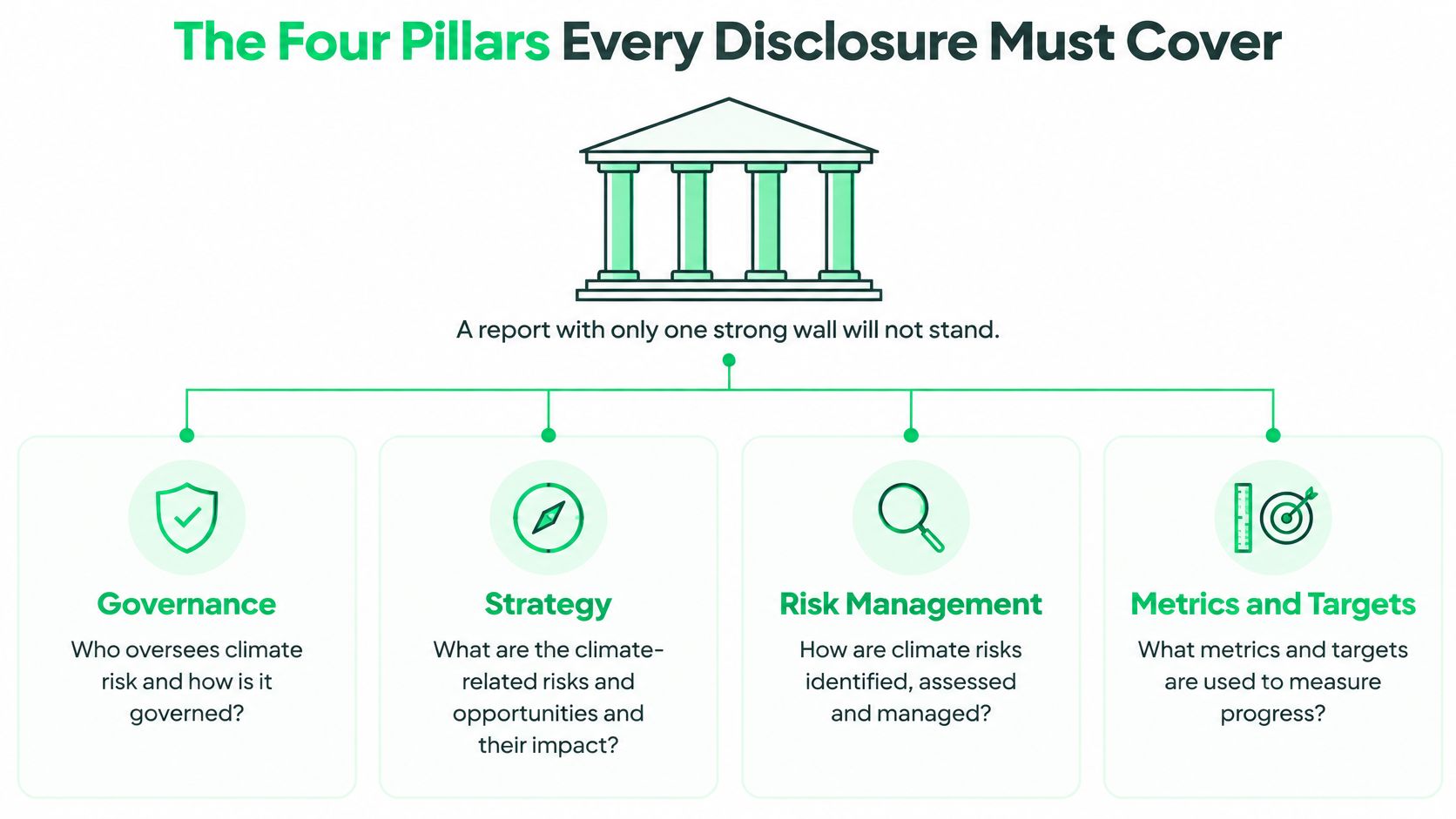
The pillars are like the walls of a building. Strengthening the emissions section won't compensate for unsupported governance statements or a strategy discussion that never reaches an investment decision.
The UK government's TCFD-aligned application guidance distinguishes minimum disclosures on governance, risk management and Scope 1 and Scope 2 emissions from materiality-tested strategy and selected metrics disclosures, and requires prior-year information so users can assess historical performance. Apply that guidance within its proper reporting context: it isn't a substitute for checking the specific Companies Act or FCA requirements governing your entity.
Four pillars and their disclosure status
| Pillar | Core board question | Minimum or materiality-tested |
|---|---|---|
| Governance | Who on the board oversees climate risks and opportunities? | Minimum requirement under the application guidance |
| Strategy | How do climate risks and opportunities affect the business model and plans? | Materiality-tested under the application guidance |
| Risk management | How are climate risks identified, assessed and managed? | Minimum requirement under the application guidance |
| Metrics and targets | What are Scope 1 and 2 emissions and the targets against them? | Scope 1 and 2 minimum; other metrics materiality-tested under the application guidance |
Use the building analogy to check whether the report is balanced.
Turn each pillar into a controlled record
For governance, retain terms of reference, reporting lines, board papers and minutes showing what directors considered. A statement that the board oversees climate risk is weak if nobody can identify the relevant discussion or decision.
For strategy, connect material physical and transition risks to the business model. Explain which operations, markets or investment assumptions could change. Avoid presenting a sustainability ambition as evidence of strategic resilience.
For risk management, document how colleagues identify, assess, escalate and review climate risks. Show how that process works within the organisation's existing risk arrangements, rather than describing an isolated annual reporting exercise.
For metrics and targets, establish a controlled dataset rather than a collection of figures copied into a draft. Keep methodology decisions and review records with the calculations, so the next reporting team can reproduce the result.
A carbon total on its own is not a TCFD report.
Before drafting, test every pillar against a short checklist:
- Owner identified. Someone can approve the underlying information, not merely edit the wording.
- Evidence available. Each substantive statement has a supporting record.
- Materiality addressed. The team has documented why relevant information is included or omitted.
- Review completed. Finance, risk and governance colleagues have challenged the statements within their responsibilities.
This turns a familiar reporting framework into a practical accountability system.
How to Run Scenario Analysis and Link It to Risk
Scenario analysis is a testing method, not a prediction. Its value lies in showing how different climate conditions could affect the organisation and what management would do in response.
The UK government's climate and sustainability reporting best-practice guide recommends evaluating financial and operational impacts across different climate futures, including a 2°C-or-lower scenario. Use that recommendation to challenge business assumptions, not to decorate a report with climate terminology.
The process should connect analytical work to the risk register and strategy.
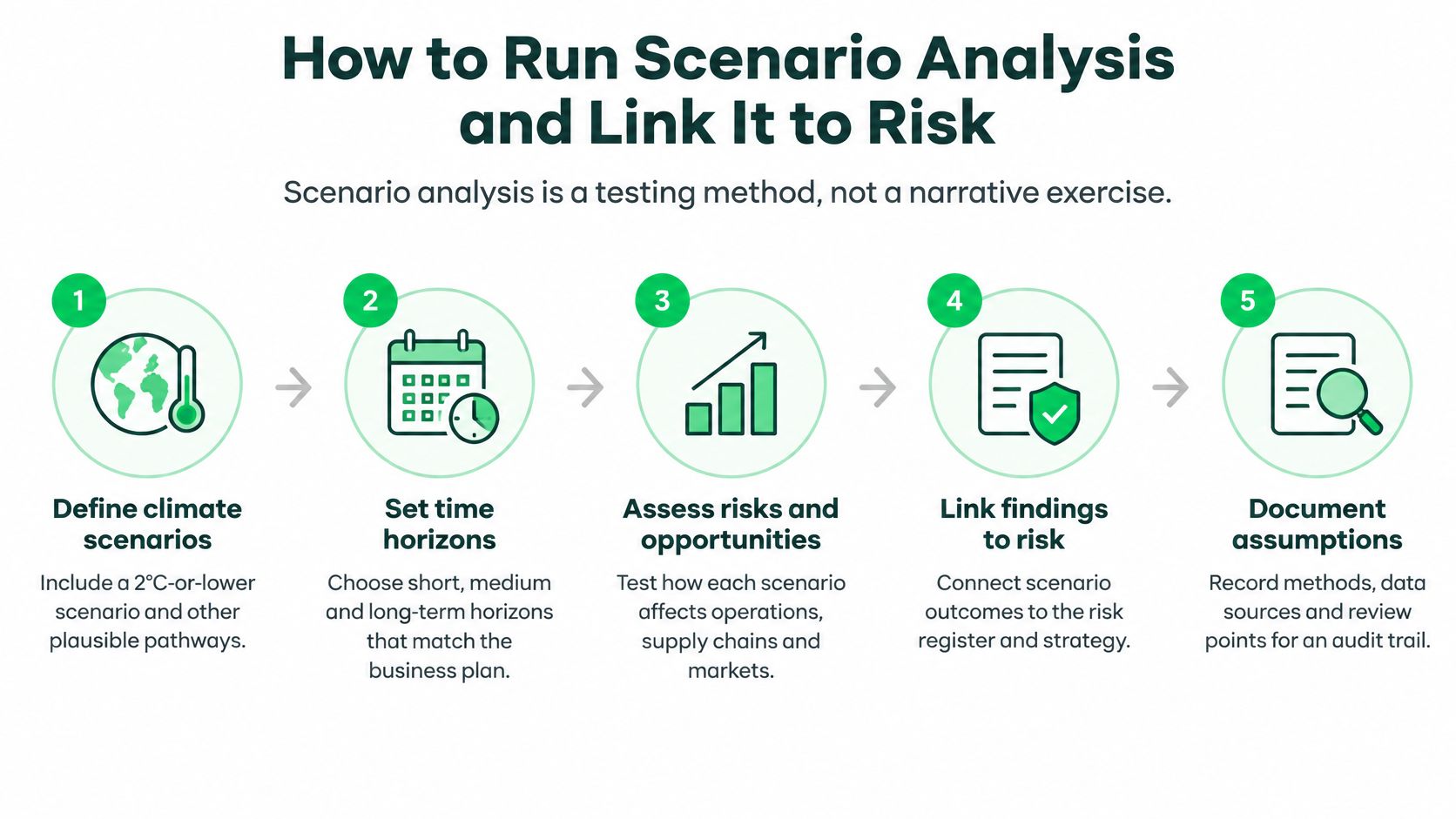
Build the analysis in a practical sequence
Define the climate scenarios. Document the pathways, assumptions and sources used, including the lower-temperature pathway described in the guidance. The common mistake is choosing a scenario label without specifying the conditions the business will test.
Set the time horizons. Match the assessment to the business plan, financing decisions and asset lives. Don't stop at the planning cycle if the organisation is buying buildings or equipment that will operate well beyond it.
Map transmission channels. Explain how climate conditions reach the business through physical damage, supply disruption, carbon pricing or demand shifts. A generic statement about rising temperatures doesn't tell a procurement director which dependency needs attention.
Identify affected assets and activities. Connect the channels to sites, products, suppliers, customer groups or services using the asset register and operational records. Avoid assessing a whole group at a level that conceals a vulnerable location or critical service.
Estimate financial sensitivities. Test implications for revenue, operating costs, capital expenditure and asset values, recording uncertainty and calculation assumptions. Don't present a precise-looking estimate when the underlying exposure remains poorly understood.
Record management responses and controls. Identify actions, responsible executives, dependencies and review triggers. Distinguish an approved response from an option that management hasn't assessed or funded.
Make the findings usable by risk owners
Apply the organisation's existing prioritisation criteria, such as financial-impact thresholds or service-impact ratings. Where climate horizons don't fit the current risk process, document the adjustment rather than forcing long-term exposure into an unsuitable short-term score.
Say flood exposure threatens a distribution site. A useful output identifies the affected activity, operational consequences, financial sensitivity, proposed protection measures and the executive responsible for deciding whether to invest.
For additional context on the analysis, use the accompanying video.
Board-ready test: Can a director trace the disclosed risk from its assumptions to a management decision, a control and a monitored indicator?
Keep an analysis log containing source versions, judgement calls and review comments. The board needs to understand what would change its decision, not receive confirmation that scenario analysis has been completed.
Metrics and Targets You Must Disclose
Every reported figure needs a traceable source, a stated boundary and an audit trail. Use the schedule below to organise the evidence, applying the disclosure status required by your organisation's own regime rather than treating public-sector guidance as a universal corporate rule.
Metrics, targets and evidence to retain
| Metric or target | Disclosure requirement | Evidence to retain |
|---|---|---|
| Scope 1 and 2 emissions | Minimum for mandated entities under the government application guidance | Activity data and calculation method |
| Scope 3 emissions | Under the public-sector framework, required where climate change is material or a principal risk; assess commercial requirements separately | Reporting boundary and rationale for omissions |
| Measurement base year | State for each target | Base-year dataset |
| Target timeframe and KPIs | State with each target | Target approval records |
| Progress against target | Report with explanations of under- or over-performance | Year-on-year data and variance notes |
| Prior-year comparatives | Provide so users can assess performance over time | Archived prior-year figures |
Keep the calculation pack separate from the narrative
For the operational emissions inventory, archive meter readings, fuel records, invoices and the emission factors used. Preserve the calculation workbook with its formulas intact and record who reviewed it. A final PDF isn't sufficient evidence of how the figure was produced.
For value-chain emissions, retain the category assessment, supplier information, estimation methods and exclusions. Explain the boundary in terms that procurement and finance colleagues can verify. Don't assume that unavailable supplier data automatically justifies leaving an exposure unexamined.
The reporting document should be the output of this controlled process.

Protect comparability before publishing targets
Freeze an approved base-year dataset and document the organisational and operational boundaries. Establish how acquisitions, disposals, methodology corrections and improved information will be assessed, with a change log explaining any revisions.
Keep target approvals separate from the emissions workbook. Record the target's coverage, timeframe, KPI definitions, responsible executive and implementation assumptions. When reporting progress, distinguish operational improvements from changes caused by the boundary or calculation method.
Our figures trace back to source data, with methodology, boundaries and assumptions documented for the client's auditor or assurance provider. Apply the same standard internally: someone outside the reporting team should be able to follow the calculation without reconstructing it through emails.
Set the base year and boundary before launching the target series. Otherwise, the team risks publishing progress that readers can't compare on a consistent basis.
Public Bodies and What Comes After TCFD
Central government follows a separate implementation path from commercial companies. Don't apply a private-company threshold to a department or assume that every government supplier inherits the department's reporting mandate.
The National Audit Office's summary of climate-related reporting implementation describes HM Treasury's three-year phase-in from 2023–24, with 2025–26 identified as the first full disclosure year for organisations with material climate risks. It distinguishes the baseline governance, risk-management and operational-emissions disclosures from strategy, other metrics and targets, and value-chain emissions required where climate change is a principal risk or otherwise material.
Make materiality a documented decision
For public bodies, the practical question isn't whether a dataset exists. It's whether climate exposure could materially affect service delivery, assets, expenditure or the organisation's objectives.
- Identify the exposure. Assess affected services, locations and dependencies.
- Explain the judgement. Record the criteria, evidence and people involved in deciding materiality.
- Connect the response to resources. Show how significant findings affect budgets, capital planning and transition actions.
A decision to omit information needs a reasoned basis. Organisation size alone won't settle the treatment of value-chain emissions.
Prepare for decision-useful disclosure
The practical direction is towards quantified impacts, response timelines and the costs of managing significant climate risks. Treat readiness for successor reporting frameworks as a review of information and controls, not a change of labels.
NHS organisations should connect climate assessments to estates and service continuity planning. Government suppliers should distinguish their own statutory duties from contractual information requests. Large private companies should involve finance in translating exposure into investment choices.
The useful test is straightforward: can management explain what climate risk could cost, when it could matter and which response it has authorised? A generic statement that climate risk is material doesn't answer those questions.
Explain Gaps and Plan Your First Disclosure
Comply or explain does not mean optional. The FCA's technical note on TCFD-aligned disclosures requires in-scope issuers to state whether their disclosures are consistent with the recommendations and, where they aren't, explain why, describe planned remediation and provide relevant timeframes. Where information is located outside the annual financial report, the disclosure must also explain why.
A company can't turn an unsupported assertion that information is unavailable into a credible improvement plan. It needs to identify the missing disclosure, establish the cause and commit to work that someone is accountable for completing.
Replace vague explanations with executable commitments
Consider a weak draft explanation:
Scenario analysis isn't available and will be considered in future.
That gives the board no completion point, no accountable executive and no basis for judging whether the omission is temporary. It also leaves readers unable to distinguish a genuine analytical constraint from a decision not to undertake the work.
A stronger illustrative draft would say:
Physical flood-risk scenario analysis remains incomplete because the site-level asset records require validation. The Group Risk Director owns the assessment, using the validated asset register and the approved climate pathways. The board-approved reporting timetable sets the completion deadline, with the findings scheduled for the next strategic report.
Before publication, replace the timetable reference with the actual approved completion date. Keep the supporting workplan, resource decision and progress checkpoints in the evidence file. Stronger wording doesn't repair a plan that management hasn't authorised.
Practical rule: If an explanation contains no accountable owner and no dated route to completion, send it back for revision.
Keep overlapping obligations distinct
Listed groups may need to manage SECR, Companies Act climate disclosures and FCA requirements together. Reuse controlled information where appropriate, but don't assume an emissions inventory satisfies the wider climate-risk reporting obligation.
Create a requirements register with separate entries for each applicable rule. Map the proposed disclosure location, evidence, reviewer and sign-off against each entry. This makes omissions visible before the annual report reaches its final review.
The highest-risk weakness can sit inside an apparently complete report. A governance paragraph may name a committee that hasn't reviewed the analysis; a target may lack approved implementation assumptions; an explanation may promise work that nobody has budgeted for.
For organisations considering external support, our ESG consulting approach starts with a defined reporting perimeter and accountable delivery. The immediate priority is to make the required work clear, not to commission a broader exercise than the obligation warrants.
Set up the first disclosure in a controlled order
- Confirm scope. Have finance and legal approve the size, classification and listing assessment before drafting begins.
- Map the group. Record the reporting position of each entity and resolve parent-and-subsidiary treatment.
- Allocate the pillars. Assign an owner, evidence source, reviewer and materiality basis to each relevant disclosure.
- Commission the analysis. Agree scenario assumptions, business inputs and the decisions the assessment needs to inform.
- Approve the measurement basis. Lock down the target boundary, baseline and calculation controls.
- Resolve or explain gaps. Give each outstanding item a justified explanation, named executive and dated remediation plan.
Book board and committee review into the reporting timetable early. Directors need time to challenge the analysis and approve consequential decisions, not merely endorse polished wording at sign-off.
ESG Consulting supports TCFD-aligned disclosures through scope assessment, scenario analysis and board-governance narratives, with evidence prepared for scrutiny. Visit ESG Consulting and send a few lines about your organisation and reporting needs through the contact form, with no brief or budget required at the start. We reply to contact-form enquiries within one working day.