UK sustainability reporting, UK SRS, IFRS S2, climate disclosure, ESRS TCFD mapping
UK Sustainability Reporting Standards: A Practical Guide
By ESG Consulting Team · · 16 min read
The most common advice on UK Sustainability Reporting Standards is to reuse your TCFD report and leave the difficult disclosures until the transition reliefs expire. That's a risky starting point. Existing reporting can help, but a deferral still needs an accountable owner, a defensible explanation and a plan to close the gap.
Finance and ESG teams should treat UK SRS readiness as a reporting-controls project, not merely a writing exercise. The central question isn't how much sustainability content you already publish. It's whether the board can support each disclosure, omission and compliance statement with evidence.
Table of Contents
- What UK SRS Are and How S1 and S2 Fit Together
- Who Must Report Under UK SRS and When
- Year-One Disclosure Matrix and the Reliefs That Apply
- Transition Plan Statements and the Evidence Behind Them
- Readiness Checklist for First-Cycle Reporting and Assurance
- How UK SRS Maps to ESRS, TCFD and GRI
- Confirm Your Scope Before Committing Budget
What UK SRS Are and How S1 and S2 Fit Together
UK Sustainability Reporting Standards (UK SRS) are the UK-endorsed versions of the International Sustainability Standards Board's IFRS S1 and IFRS S2. They preserve the international baseline while adapting it for UK application, rather than creating a separate reporting architecture.
The UK Government's standards publication traces that baseline to the ISSB standards published in June 2023 and the subsequent 12-week UK consultation, which ran from 25 June 2025 to 17 September 2025 and proposed six minor amendments. The Government subsequently endorsed the standards and issued UK SRS S1 and S2 for voluntary use, with mandatory application determined separately through regulation and listing requirements.

The general rulebook and the climate chapter
S1 establishes the general requirements for material sustainability-related financial information. It concerns risks and opportunities that could reasonably affect an organisation's prospects, not every environmental or social issue associated with its activities.
S2 addresses climate-related risks and opportunities, including physical risks such as flooding and transition risks such as changing technology or customer demand. The Government's UK SRS guidance explains that S2 incorporates the TCFD architecture and operates alongside S1, rather than as a standalone climate report.
Think of S1 as the general notes supporting a financial report and S2 as a specialist climate note. The specialist note must use consistent materiality judgements, reporting boundaries and governance evidence.
- Governance: Who oversees climate risks, and what information do they receive?
- Strategy: How could those risks affect operations, investment and resilience?
- Risk management: How does management identify, assess and monitor them?
- Metrics and targets: What does the organisation measure, and how does it assess progress?
Practical rule: A climate disclosure isn't connected merely because it appears beside the financial statements. Its assumptions should be reconcilable with financial planning.
Start by marking where your annual report addresses each pillar. Then distinguish statements of intent from evidence: a committee's terms of reference describe responsibility, while its papers and minutes demonstrate oversight.
Who Must Report Under UK SRS and When
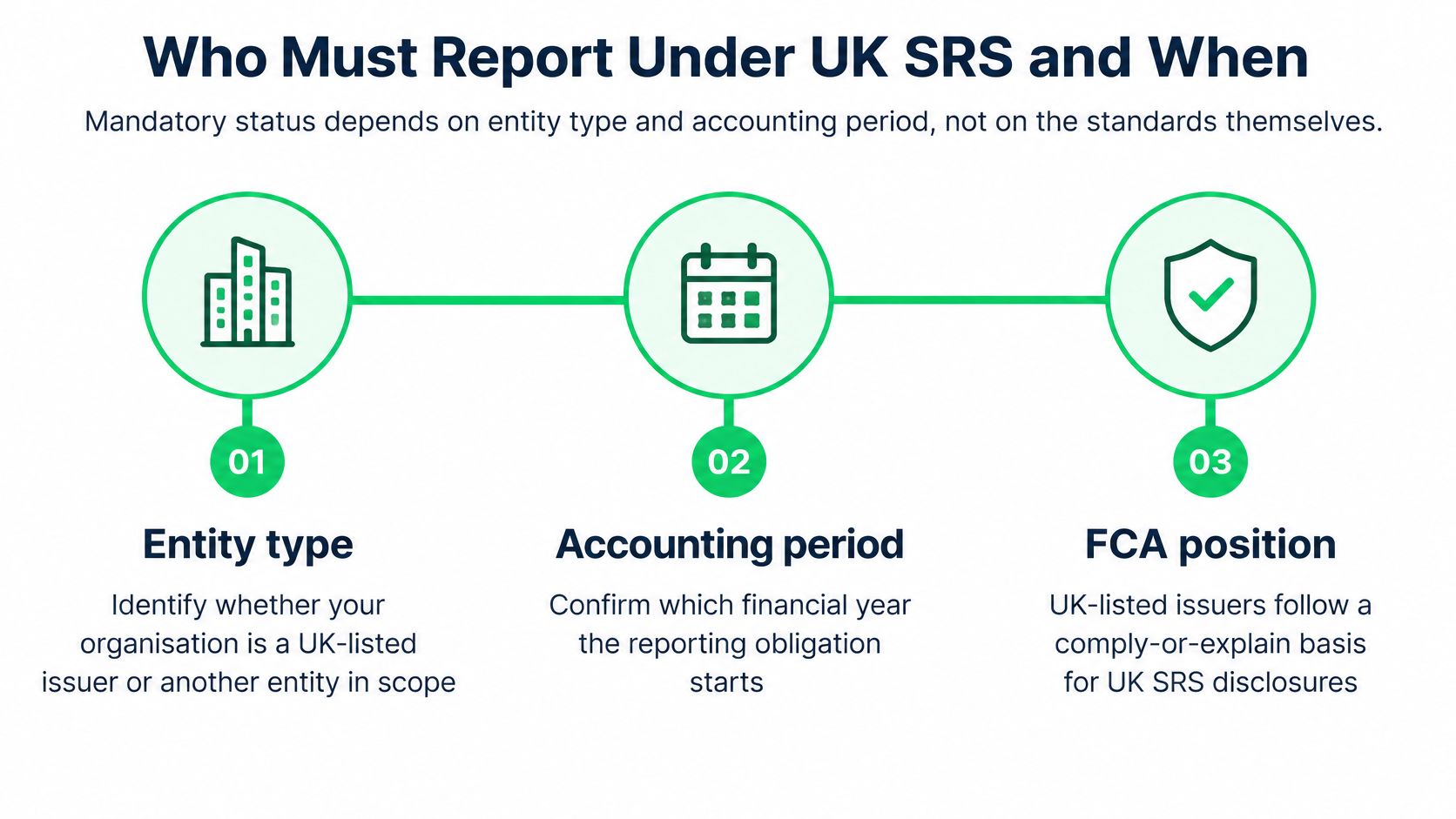
For UK-listed issuers, mandatory status turns on the applicable FCA rules and the accounting period. Publication of the standards alone doesn't make every UK organisation subject to them.
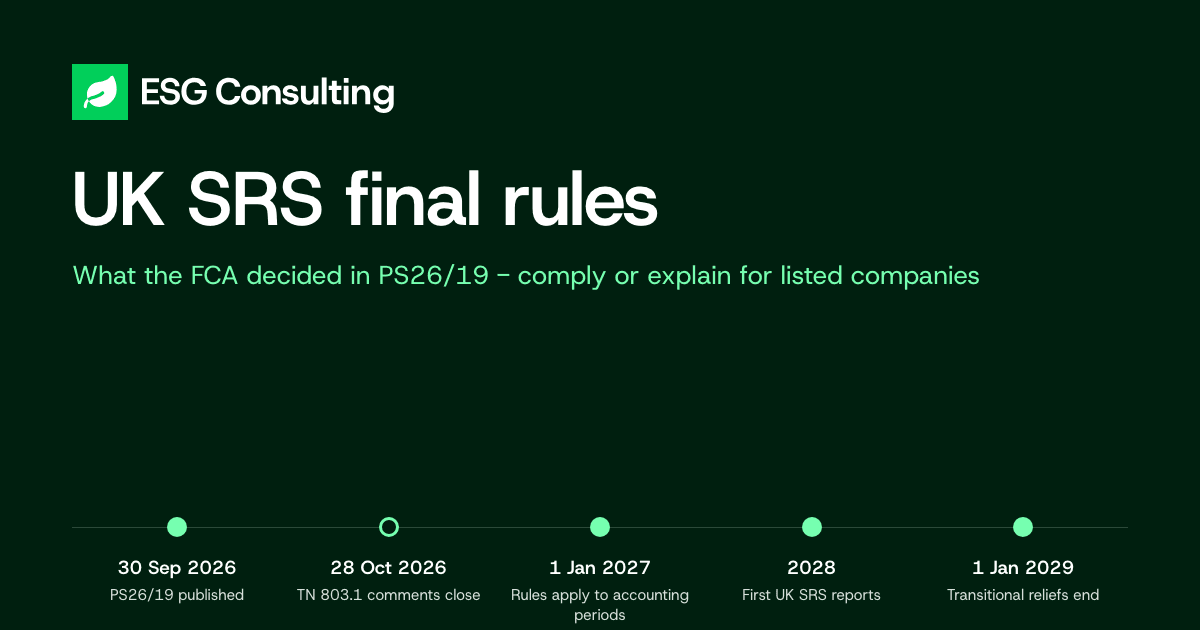
The FCA's reporting requirements set out a comply-or-explain framework for UK-listed issuers for accounting periods beginning on or after 1 January 2027, with first reporting expected in 2028. Issuers must provide the relevant climate and sustainability disclosures or identify unmet requirements, explain why they weren't met and describe the steps towards compliance.
The scope assessment should follow this sequence.
UK SRS applicability and first reporting period by entity group
| Entity group | Status | First period in scope | What must be provided |
|---|---|---|---|
| UK-listed issuers | Comply-or-explain under FCA final rules | Accounting periods beginning on or after the FCA commencement date | S2 climate and S1 sustainability disclosures, or an explanation of gaps |
| Other UK entities named in Government or FCA consideration | Not yet decided | To be set by any subsequent legislation or rules | Monitor the outcome and prepare controls in advance |
| Organisations adopting voluntarily | Voluntary | Any period chosen | UK SRS S1 and S2 as adopted, with the version stated |
| Organisations with EU-linked reporting duties | Separate regime under CSRD and ESRS | Set by the applicable EU rules | Assess EU obligations separately and reconcile relevant disclosures to UK SRS |
An NHS trust, private company or government supplier shouldn't infer a UK SRS obligation just because it already reports energy or emissions information. Equally, an organisation outside mandatory scope may face investor, lender or customer requests that make voluntary preparation useful.
Check the period start, not just the year-end
A calendar-year reporter and a company whose financial year begins in April won't necessarily publish their first reports together. Apply the commencement test to the actual start date of each accounting period, then identify when the corresponding annual report will be issued.
Don't confuse a January year-end with a January period start. A scope record should show both dates explicitly, particularly where subsidiaries have different reporting calendars or the group has changed its accounting reference date.
For voluntary adoption, record the standard version, reporting boundary and any reliefs used before drafting a compliance statement. Calling selected disclosures UK SRS-aligned isn't the same as establishing compliance with the applicable standards.
Your finance or company-secretarial team should maintain the entity register. Give each scope conclusion a named owner and retain the legal or listing-rule basis, rather than allowing the reporting team to inherit an undocumented assumption.
Year-One Disclosure Matrix and the Reliefs That Apply
The starting distinction is between core S2 climate content, Scope 3 emissions and wider S1 sustainability information. Under the intended implementation approach, core climate content is mandatory, while the other categories have specified comply-or-explain reliefs.
The Government's consultation response distinguishes mandatory S2 information excluding Scope 3 from the comply-or-explain categories, alongside optional FCA reliefs described as a one-year Scope 3 deferral and a two-year wider S1 deferral. These are implementation provisions, not a general permission to omit information that's inconvenient to collect.
Year-one disclosure matrix for UK SRS
| Disclosure area | Year-one status | Relief available | Evidence to hold |
|---|---|---|---|
| S2 governance over climate risks and opportunities | Mandatory core climate content | No category-wide deferral | Board and committee minutes, named accountable committee |
| S2 strategy including climate scenario analysis | Mandatory core climate content | No category-wide deferral | Scenario assumptions, resilience assessment, link to financial planning |
| S2 climate risk management | Mandatory core climate content | No category-wide deferral | Climate entries in the risk register and review records |
| S2 Scope 1 and 2 greenhouse gas emissions | Mandatory core climate content | No category-wide deferral | Inventory, methodology and source-data trail |
| S2 Scope 3 greenhouse gas emissions | Comply-or-explain | Initial-period deferral | Boundary, data-quality limits, improvement milestones and written explanation |
| Wider S1 sustainability disclosures | Comply-or-explain | Extended initial-period deferral | Documented omission reason and remediation plan |
| Assurance status of UK SRS information | Statement envisaged under the FCA proposal | External assurance isn't mandated under that proposal | Assurance statement or a clear statement that none was obtained |
Mandatory doesn't mean every conceivable climate detail is material. Teams still need to apply the standards' requirements and judgements, rather than treating the matrix as an exhaustive checklist.
Keep the proposed assurance-status statement separate from the decision to commission assurance. Likewise, maintain a distinct transition-plan statement identifying whether a plan has been disclosed, where it can be found or why it hasn't been published.
Make relief a controlled decision
A useful decision rule asks whether the information is sufficiently complete, supportable and controlled for publication. If it isn't, management should assess whether an applicable relief permits deferral and what it will take to remove the underlying limitation.
Say an engineering group has weak supplier emissions information. It can support its direct fuel and purchased-energy inventory, but its purchased-goods estimates rely on inconsistent procurement classifications and suppliers using incompatible boundaries.
The reporting team shouldn't just remove the value-chain table. It should document the intended boundary, explain the weaknesses, assign procurement responsibility for supplier engagement and agree a milestone for testing the revised calculation.
A deferral changes what you publish. It doesn't remove the need to understand what you've left out.
The board paper should distinguish missing source information from unresolved methodology. Those problems need different remedies: supplier outreach won't fix an inconsistent consolidation boundary, and a new calculation tool won't establish who approves assumptions.
Produce these artefacts for every deferral:
- Decision log: Record the requirement, applicable relief, alternatives considered, approver and approval evidence.
- Omission explanation: Tell readers what's absent and why, without implying that the topic is immaterial.
- Remediation plan: Assign deliverables, dates and accountable owners, including the review needed before publication.
Reassess progress during the reporting cycle. Otherwise, the next disclosure deadline arrives with the same limitation and a much weaker explanation.
Transition Plan Statements and the Evidence Behind Them
An issuer may be able to meet the applicable disclosure framework without publishing a formal transition plan. That isn't the same as being able to leave its position unstated.
Baker McKenzie's analysis of the FCA proposal explains that listed companies would state whether they have disclosed a climate-related transition plan, identify its location or explain its absence; the proposal also requires disclosure of external-assurance status without mandating external assurance. These proposed statements should not be confused with an unconditional obligation to create a plan or obtain assurance.
Existing practice makes an absent plan conspicuous: in 2024, 90% of the FTSE 100 companies analysed referenced a climate transition plan, according to LexisNexis UK's corporate-reporting analysis. Referencing a plan, however, doesn't establish that its assumptions are funded, internally consistent or ready for scrutiny.
The minimum viable evidence set
A net-zero presentation isn't necessarily a transition plan. To assess whether your existing documents support a credible account of transition, assemble:
- Baseline and targets: The emissions baseline, target boundary, methodology and explanation of changes.
- Investment decisions: Approved or proposed capital expenditure linked to specific decarbonisation measures.
- Scenario assumptions: Energy prices, technology availability, demand expectations and other assumptions supporting the pathway.
- Board accountability: A named board or committee owner, reporting arrangements and a review cycle.
- Financial connections: Links to risk management, budgets and relevant financial-statement assumptions.
Keep distinctions visible. Approved expenditure is different from an unfunded option, and an aspiration dependent on future technology shouldn't read like a committed operational measure.
When existing material falls short
An organisation might publish an emissions target without identifying how equipment replacement will be funded. Its disclosure then needs to explain the dependency, rather than imply that management has approved a deliverable pathway.
A second warning sign is a plan that no board committee has reviewed. A third is using one energy-price assumption for the transition pathway and another for financial planning without explaining the difference.
Evidence test: Could finance, sustainability and the board tell the same story about what the company intends to do, what it has approved and what remains uncertain?
This month, check each evidence category against current documents. Record the document owner and approval status, then identify which gaps prevent a clear transition-plan statement.
Readiness Checklist for First-Cycle Reporting and Assurance
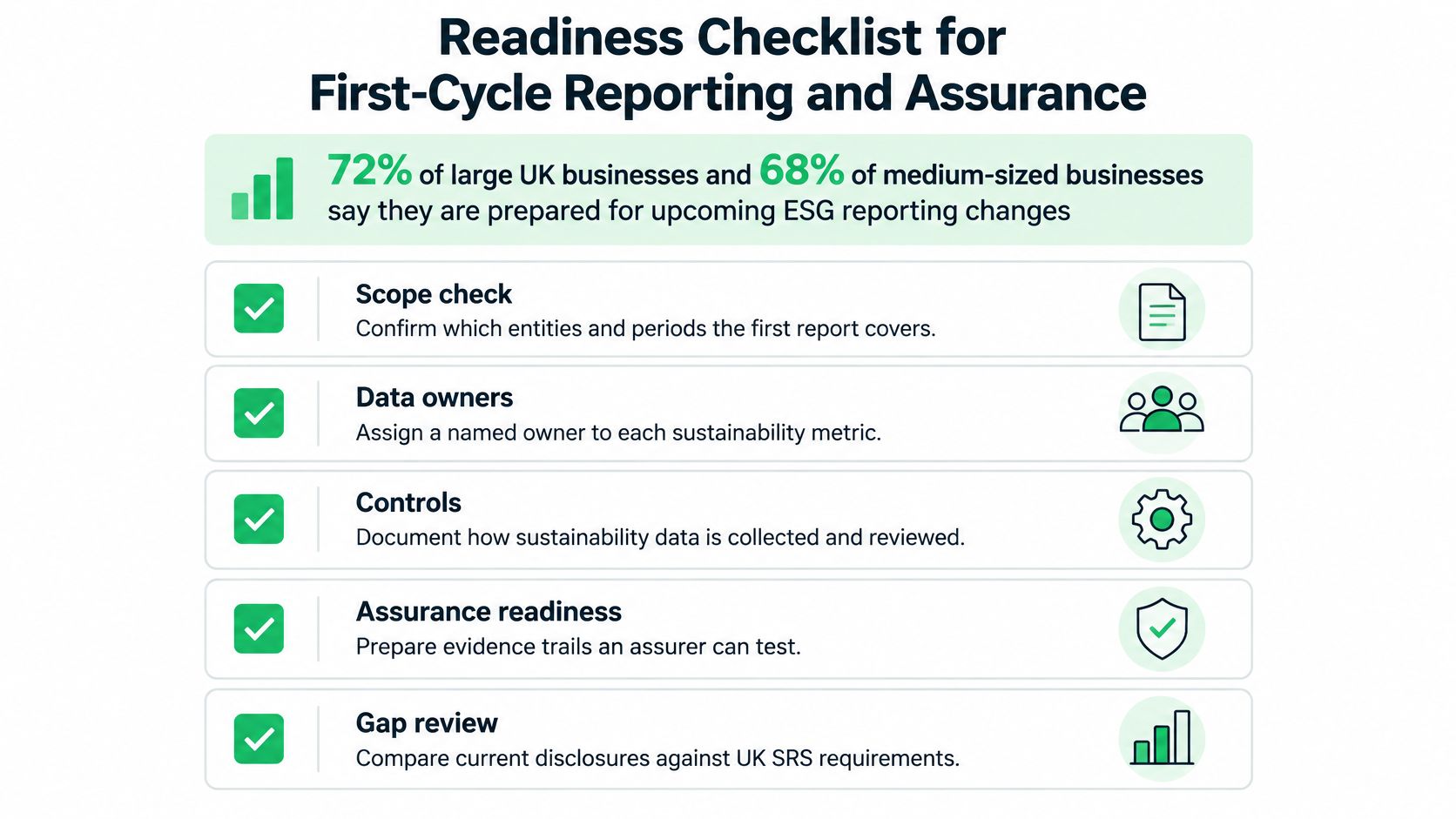
Confidence isn't an evidence trail. In a 2025 survey of 520 Great Britain business decision-makers, 72% of large UK businesses and 68% of medium-sized UK businesses said they were prepared to comply with upcoming ESG reporting changes, according to YouGov.
Test that confidence against records someone outside the preparation team could inspect. Use the following overview to organise responsibilities before examining individual disclosures.
Build an inspectable reporting process
Confirm entity scope and reporting periods. Retain the entity register, listing assessment and approved scope conclusion. A group-level assumption without subsidiary analysis is a common weakness.
Build the boundary and data inventory. List sites, assets, fuels, purchased energy and consolidation decisions across the full reporting period. An assurer will need to understand exclusions, acquisitions and missing meter records.
Assign source and metric owners. Use a responsibility matrix covering collection, calculation, review and approval. Naming a department rather than an accountable person leaves queries unresolved when staff change.
Control the calculations. Protect calculation cells, maintain version history and record reviewer approval in Excel, SharePoint or the reporting platform. A spreadsheet isn't unsuitable by nature; an uncontrolled spreadsheet is.
Document materiality judgements. Keep the risk assessment, supporting evidence and rationale for including or excluding matters. A topic list copied from a previous sustainability report doesn't explain financial relevance.
Preserve board oversight evidence. Retain papers, minutes and action logs that show what directors considered. Standard agenda wording alone won't demonstrate challenge or follow-up.
Record scenario assumptions. Document sources, modelling choices, limitations and management's interpretation. A consultant's presentation without the underlying assumptions leaves the company unable to reproduce its conclusions.
Run a dry-run disclosure. Allocate each matrix row to a draft disclosure, supporting evidence or approved omission. Watch for inconsistent boundaries between narrative, emissions calculations and financial reporting.
Prepare the assurance trail. Trace each reported figure through calculations to invoices, meter exports or other source records. Preserve correction logs so reviewers can distinguish errors from approved methodological changes.
Resolve gaps before external review
Ask someone who didn't prepare the inventory to trace a selected disclosure back to its source. If they need repeated verbal explanations, improve the documentation before commissioning formal testing.
Teams can manage this internally or use specialist sustainability reporting support for boundary reviews, control design and dry-run challenge. Keep management responsibility explicit whichever delivery model you choose.
Use the accompanying video as a discussion prompt, then apply the checklist to your own reporting files.
How UK SRS Maps to ESRS, TCFD and GRI
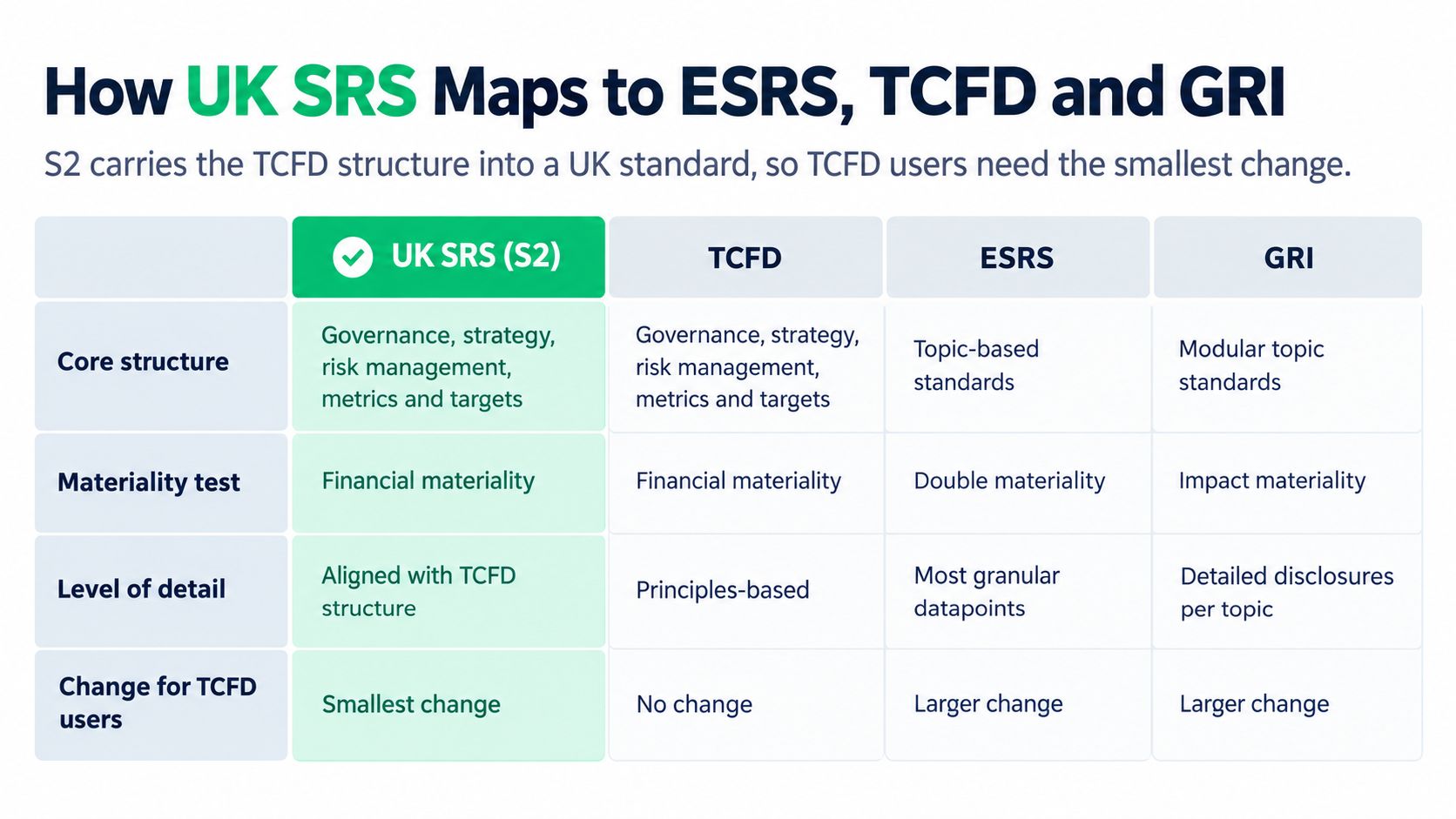
S2 carries the TCFD structure into a UK reporting standard, so existing TCFD users have a useful organisational starting point. They still need to test disclosure detail, calculation methods and financial connections rather than merely replace the cover page.
Familiarity shouldn't be mistaken for application: in 2025, 63% of UK companies analysed referred to UK SRS or ISSB standards, while 7% explicitly stated that ISSB standards had been considered, according to Deloitte UK's Corporate Reporting Insights analysis. A reference to a framework says little about whether the reporting process meets it.
The comparison below highlights the main architectural differences.
UK SRS, TCFD, ESRS and GRI compared by key requirement
| Area | UK SRS S1 and S2 | TCFD | ESRS climate and general disclosures | GRI |
|---|---|---|---|---|
| Materiality basis | Financial materiality of risks and opportunities | Financially relevant climate information | Double materiality | Significant impacts |
| Climate governance | Board oversight and management responsibilities | Governance pillar | General and topic-specific governance disclosures | General governance disclosures |
| Scenario analysis | Supports climate-resilience assessment | Recommended within strategy | Climate-resilience and scenario-related disclosures | No equivalent standalone climate-scenario requirement |
| Scope 3 emissions | Applicable disclosure with transitional relief | Recommended | Value-chain emissions, subject to applicable provisions | Indirect emissions under the applicable topic standard |
| Transition plan | Disclose relevant transition information; separate FCA statement must be checked | Strategy and transition-related information | Climate transition-plan disclosure | Relevant management and topic disclosures, not a direct equivalent |
| Assurance | Separate regulatory position from the standard | Framework itself doesn't mandate assurance | Assurance obligations arise through CSRD implementation | Framework itself doesn't mandate assurance |
Choose the primary framework before mapping
Financial materiality asks whether sustainability-related risks and opportunities could affect the organisation's prospects. Double materiality also examines the organisation's impacts on people and the environment, while GRI centres reporting on significant impacts.
That distinction changes the assessment, not merely the final wording. Say a manufacturer identifies a serious environmental impact in its supply chain. The impact may warrant disclosure under an impact-focused assessment even where management hasn't identified a corresponding financially material risk under UK SRS.
Use a practical routing rule:
- Within CSRD scope: Organise the ESRS assessment and reporting process, then reconcile the financially material information to UK SRS.
- UK-listed without EU reporting duties: Build around the applicable UK SRS requirements and use existing TCFD headings to organise evidence.
- Already reporting under GRI: Reuse compatible source records, but reassess boundaries, definitions and materiality before transferring disclosures.
A shared database can support several frameworks. A single undifferentiated disclosure checklist usually can't, because the same underlying activity may require different explanations for different reporting audiences.
For emissions, maintain a mapping register covering organisational boundary, value-chain categories, methodology, reporting period and calculation owner. Treat apparent matches as candidates for reuse, not proof of equivalence.
Don't assume that assurance over one report automatically covers another. Check the engagement scope, assured metrics, criteria and exclusions before describing any reused information as assured.
Confirm Your Scope Before Committing Budget
Approve the scope decision before the reporting budget. It establishes which entities need work, which disclosures matter and whether the immediate priority is data collection, governance or drafting.
A platform procurement won't resolve an unclear obligation. Nor will a polished climate narrative fix missing ownership of the underlying calculations.
Turn the assessment into an approved work plan
Validate the entity register. Confirm listing status and accounting-period starts with finance and company secretarial. Record who approves changes when the group acquires, disposes of or reorganises an entity.
Set the voluntary-adoption position. Decide whether voluntary reporting serves a defined investor or stakeholder need. Record the version and intended compliance wording before commissioning additional disclosures.
Classify reporting gaps. Mark each disclosure area ready, partial or missing, with a link to supporting evidence. Separate drafting gaps from missing calculations and unapproved management judgements.
Check EU obligations independently. Assess whether any group entity has CSRD duties and establish a reconciliation workstream where necessary. Don't infer scope solely from having European customers.
Approve deferral decisions. Require an accountable owner and remediation date for each proposed omission. Include the work needed to obtain approval, not just the work needed to calculate a figure.
Schedule a rehearsal. Leave enough time before the first applicable reporting deadline to test collection, review and board approval. Include a process for correcting errors found during the exercise.
For organisations that need external support, ESG Consulting offers UK SRS readiness assessments and first-cycle reporting, with a senior consultant leading from scoping to sign-off and evidence trails designed for assurance. Internal teams should retain ownership of assumptions, decisions and approvals.
Complete the scope decision and evidence-based gap assessment before approving reporting expenditure. That gives procurement a defined brief and gives the board a clear basis for allocating resources.
UK SRS preparation needs a clear applicability assessment, controlled disclosures and documented decisions on reliefs. Visit ESG Consulting to discuss readiness assessment or first-cycle reporting support, including the controls and evidence needed to support sign-off.