
climate scenario analysis, TCFD disclosures, UK SRS S2, ESG reporting, transition planning
Climate Scenario Analysis for UK Disclosures
By ESG Consulting Team · · 14 min read
Most advice on climate scenario analysis starts in the wrong place. It assumes the challenge is picking the “right” climate model, when regulatory test is whether your organisation can explain, govern and evidence how it used uncertain futures to make better decisions.
UK guidance points to a more disciplined standard. Climate scenario analysis is a process of identifying and assessing a range of future outcomes under uncertainty, and it is meant to test resilience to both physical risks and the transition to a low-carbon economy, not to predict a single outcome (UK government guidance on TCFD-aligned disclosure). For boards, that changes the job from “find the perfect forecast” to “build a defensible process that can survive scrutiny”.
That distinction matters because the FCA expects TCFD-aligned firms to explain their scenario-analysis approach and how it informs investment and risk decision-making, with quantitative examples where reasonably practicable (UK government guidance on TCFD-aligned disclosure). A narrative-only report may look polished, but it won't convince an auditor if the board can't trace assumptions, data gaps and decision points back to a clear governance trail.
Table of Contents
- Rethinking Climate Scenario Analysis for UK Boards
- Selecting Proportionate Scenarios and Temperature Pathways
- Navigating Data Gaps and Methodological Uncertainty
- Modelling Long-Dated Financial and Operational Impacts
- Drafting Defensible Board Governance Narratives
- Preparing Your Disclosure for External Assurance
Rethinking Climate Scenario Analysis for UK Boards
Stop treating it like a prediction exercise
Boards often ask for climate scenario analysis to “show what happens in 2050”. That instinct creates bad work. The UK government's guidance defines the exercise as assessing a range of future outcomes under uncertainty, which is closer to stress testing than forecasting (UK government guidance on TCFD-aligned disclosure).
The useful question is not whether a scenario is true. It is whether the organisation can explain how different pathways affect strategy, assets, funding and operational resilience across time horizons. Once that shift happens, the board stops asking for a perfect model and starts asking for decision-useful comparisons.
Practical rule: if a scenario can't change a capital allocation discussion, it's probably too abstract for board use.
The FCA expectation raises the bar further. TCFD-aligned firms are expected to explain not just the scenarios they used, but how those scenarios influenced investment and risk decision-making, with quantitative examples where feasible (UK government guidance on TCFD-aligned disclosure). That means the analysis has to be repeatable, not a one-off slide deck assembled late in the reporting cycle.
For boards, the practical implication is simple. Climate scenario analysis should sit inside governance, risk appetite and planning, not beside them. If the result doesn't shape transition planning, capex prioritisation or resilience actions, the exercise has not done enough work.
What regulators actually want to see
The default UK reporting approach in the guidance is to use pathways from the Climate Change Committee's CCRA methodology, including 2°C and 4°C end-of-century warming cases for CCRA3, with updates at least every 5 years (UK government guidance on TCFD-aligned disclosure). That tells you something important. UK policymakers want continuity, comparability and a clear refresh cadence, not a bespoke model every reporting cycle.
The Bank of England's own disclosures show how this is being operationalised in prudential work. It published key elements of its 2021 Biennial Exploratory Scenario, reported in 2024 that the value of its sovereign bond holdings could fall by up to 10% in the most adverse climate scenario, and by 2025 said its analysis considered shocks to the risk-free component of interest rates and risk premia out to 2050 (Bank of England climate scenario analysis and stress testing). That is a long-dated, balance-sheet-aware approach, not a storytelling exercise.
The message for boards is clear. Scenario analysis is a governance control, a planning input and a disclosure discipline. It works when it is treated as part of the organisation's decision architecture, with named owners, refresh cycles and documented assumptions.
Selecting Proportionate Scenarios and Temperature Pathways
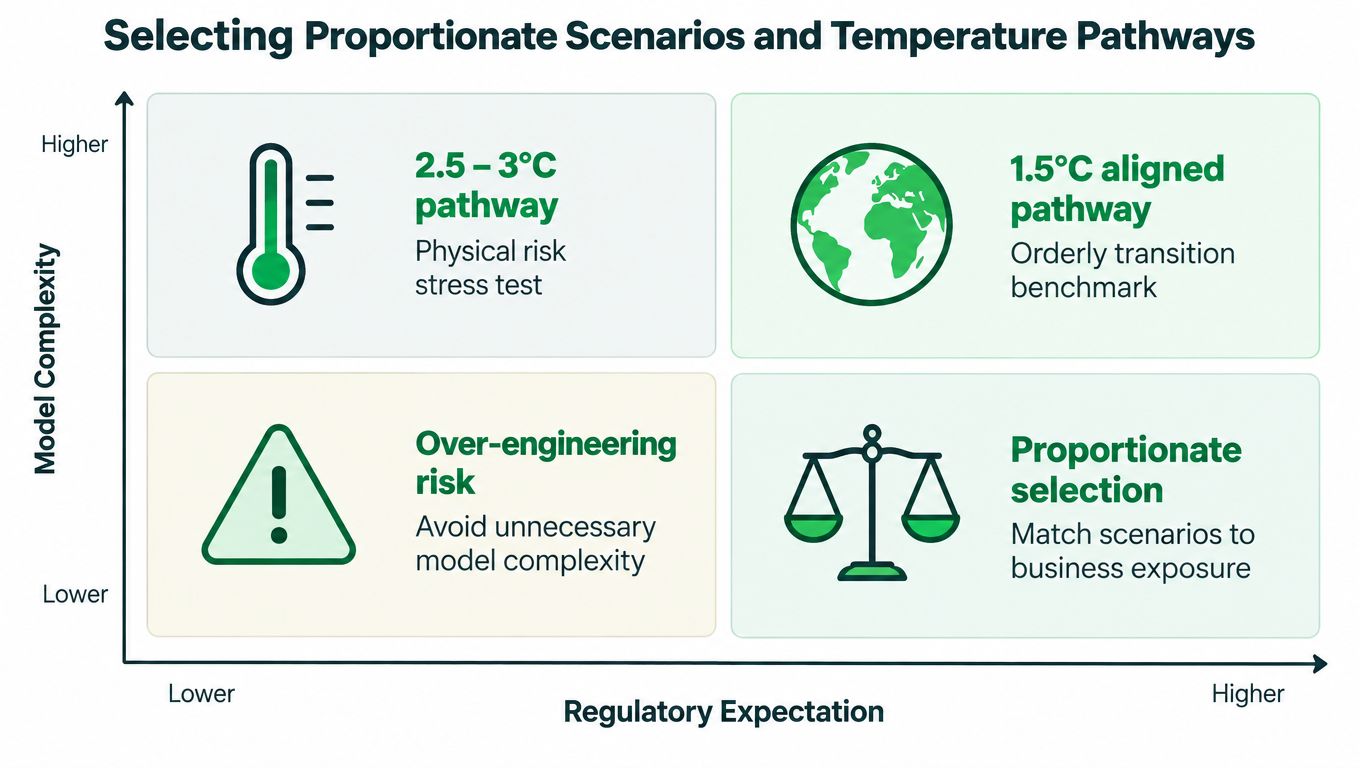
The right scenario set is the one that matches your exposure, not the one with the most impressive slides. UK guidance says climate scenario analysis is not mandatory for all entities, should be proportionate, and should use reasonable and supportable inputs under UK SRS S2 (UK SRS climate scenario analysis guidance). That gives boards room to avoid over-engineering, but it also removes the excuse for vague, under-explained choices.
Use the scenario set to answer a business question
Start with the exposure profile. If transition risk is the main issue, the chosen pathway should help management test policy tightening, carbon cost pressure, technology shifts and demand changes. If physical risk is material, the scenario needs to surface location-specific consequences, especially for assets or operations exposed to end-of-century impacts (UK government guidance on TCFD-aligned disclosure; UK SRS climate scenario analysis guidance).
That is where teams often get stuck. They either use too many named scenarios and bury the board in output, or use one generic pathway and miss the very risks they are supposed to test. A proportionate approach usually means fewer scenarios, better justified, and tied directly to the most material risks.
If you need a practical filter, use this sequence:
- Map the business question first. Decide whether the disclosure is testing resilience, informing transition planning, or supporting risk appetite.
- Match the pathway to the exposure. Broader global pathways can work for strategic planning, while UK-specific downscaled data can sharpen physical-risk assessment where geography matters.
- Keep the model explainable. If the team cannot explain the inputs to an auditor or board committee, the scenario set is too complex.
- Document why alternatives were not used. That matters as much as the chosen scenarios under assurance.
Choose between global and UK-specific inputs deliberately
Official UK guidance says UKCP18 and UK Met Office data are useful, but the process remains exploratory and the choices still need explanation (UK SRS climate scenario analysis guidance). That means there's no automatic win in choosing the most local dataset available. The better choice is the one that is credible for your footprint, your assets and your reporting boundary.
For globally diversified organisations, international pathway frameworks may be needed to keep the strategic picture coherent. For organisations with concentrated UK operations, UK-specific downscaled data can improve relevance for physical risk. The mistake is mixing both without a clear hierarchy or reason.
Use UK-specific data where it sharpens the decision, not where it merely adds detail.
The UK SRS guidance also says entities materially exposed to physical risk should consider end-of-century analysis, which should stop teams from stopping too early on short-term horizons (UK SRS climate scenario analysis guidance). That does not mean every metric needs a 2100 value. It means the board should understand whether long-dated exposure is being ignored.
Navigating Data Gaps and Methodological Uncertainty
The hardest part of climate scenario analysis is usually not scenario selection. It is the data. UK guidance explicitly tells firms to map the data they have and identify and address gaps, which is exactly where many programmes become defensible or fall apart (UK government guidance on internal data collection).
Build the methodology around what you can evidence
A sound process starts with an inventory of available data, then moves to gap classification. You need to know which gaps are inconvenient and which ones are material, because not every missing field deserves the same level of attention. Missing supplier information is a different problem from missing asset-level location data, and both are different again from incomplete portfolio mapping.
The PRA has found important data gaps that prevent firms from linking climate projections to assets and lending portfolios, and it has also noted limited use of scenario outputs in real decision-making (UK government guidance on internal data collection). That is the governance issue at hand. If the model cannot connect to the portfolio, it will never become a management tool.
A defensible methodology does four things well:
- Identifies gaps early. Missing data should be documented before modelling starts.
- Prioritises by materiality. Focus first on the assets, sites or suppliers that drive the largest exposure.
- Uses proxies transparently. Reasonable estimates are acceptable if the logic is clear.
- Keeps an audit trail. Every assumption needs an owner, rationale and review date.
Treat proxies as controls, not shortcuts
Proxy data is not the problem. Undocumented proxy data is. In practice, teams often need to rely on industry averages, regional assumptions or mapped equivalents while they improve data quality. That's fine if the limitations are explicit and the organisation can explain how the proxy affects the output.
Assumptions become acceptable when they are visible, reviewed and bounded.
Internal governance matters more than model sophistication. If a board committee can see which assumptions are provisional, which ones are persistent, and which ones need remediation, the disclosure becomes more credible. If it can't, the report reads like a polished estimate with no control environment behind it.
The best practice is to separate methodology choices from data limitations in the documentation. That way, assurance providers can review what the organisation decided, what it knew, and what it still needs to fix. For a practical comparison of how value-chain data issues show up in reporting, see ESG Consulting's Scope 3 emissions guidance.
Modelling Long-Dated Financial and Operational Impacts
Climate scenario analysis becomes useful when it reaches the balance sheet and the operating model. The Bank of England's disclosures show the direction of travel clearly, with analysis extending out to 2050 and considering shocks to the risk-free component of interest rates and risk premia (Bank of England climate scenario analysis and stress testing). That is not just prudential theory, it is a sign that long-dated climate assumptions are now part of financial judgement.
Translate physical and transition risk into decision variables
The practical task is to convert climate pathways into consequences the CFO can use. Physical risk may affect downtime, repair costs, insurance availability and the reliability of collateral. Transition risk may alter demand, pricing power, operating margins and the cost of capital.
Those effects don't sit in separate silos for long. A site exposed to flooding can reduce output, tighten working capital and weaken financing terms. A carbon-intensive product line can face declining demand while capital is needed elsewhere. The value of scenario analysis is that it shows those interactions before management locks in the wrong investment plan.
The Bank of England's reported 10% potential fall in sovereign bond holdings under the most adverse scenario is useful because it shows how climate stress can affect asset values directly, not just in theory (Bank of England climate scenario analysis and stress testing). Boards do not need identical modelling. They do need a method that can show where the greatest sensitivity sits and what strategic response follows.
Keep the financial model decision-led
Do not build a giant spreadsheet just because the data exists. Start with the decisions the board needs to make, then define the variables that matter. For many organisations, that means linking scenario outputs to capital allocation, risk appetite, impairment, liquidity planning or long-term asset strategy.
The same principle applies to operational impacts. Model the business interruption channels that matter most, then stop. If the organisation doesn't own critical infrastructure, it probably does not need a laboratory-grade climate engine. It needs a credible, well-documented estimate of where resilience is thin.
The most useful model is the one management can explain without notes.
For firms looking for a service-led route to scenario analysis, board governance narratives and disclosure support, ESG Consulting is one option, alongside internal risk teams and specialist advisers. The key is not who builds the model, but whether the output is traceable, reviewable and usable in governance.
Drafting Defensible Board Governance Narratives
The board narrative is the section most likely to be read by investors, auditors and regulators in the same sitting. That's because it reveals whether scenario analysis is embedded in governance or just appended to a report after the numbers are done. The strongest disclosures are explicit about who owns the process, how often it is reviewed, and how the outputs affect strategy.
Write for challenge, not for comfort
Boilerplate fails because it avoids accountability. Phrases like “the board considers climate risk material” say very little if they do not explain what the board reviewed, what changed in response, and how management followed through. The narrative has to show challenge, not just awareness.
A defensible version usually covers three things. First, how the board oversees scenario choice and refresh cadence. Second, how management translates outputs into risk management and investment decisions. Third, how exceptions, limitations or data gaps are escalated and tracked. That combination tells a reader there is a real governance loop.
The Bank of England's own long-dated scenario work helps here again, because it shows that climate analysis is now a cross-functional prudential issue rather than a specialist sustainability topic (Bank of England climate scenario analysis and stress testing). Boards should reflect that same integration in their language.
Make the linkage to strategy explicit
The board narrative should not sit apart from transition planning. Under UK guidance, the scenario-analysis approach needs to be explained in the context of investment and risk decision-making, with quantitative examples where practicable (UK government guidance on TCFD-aligned disclosure). That means the disclosure should show how scenario results informed choices on capex, portfolio reshaping, supplier strategy or physical adaptation.
A useful test is whether a non-executive director could read the section and answer four questions:
- What did the board review?
- Which scenario outputs were material?
- What did management change as a result?
- What remains unresolved and how is it being tracked?
If the narrative can answer those without generic phrasing, it is doing its job. If not, the report is probably too polished and not concrete enough.
For organisations aligning governance and disclosure work, CSRD reporting support in the UK context can help keep scenario analysis, transition planning and reporting language consistent across frameworks.
Preparing Your Disclosure for External Assurance
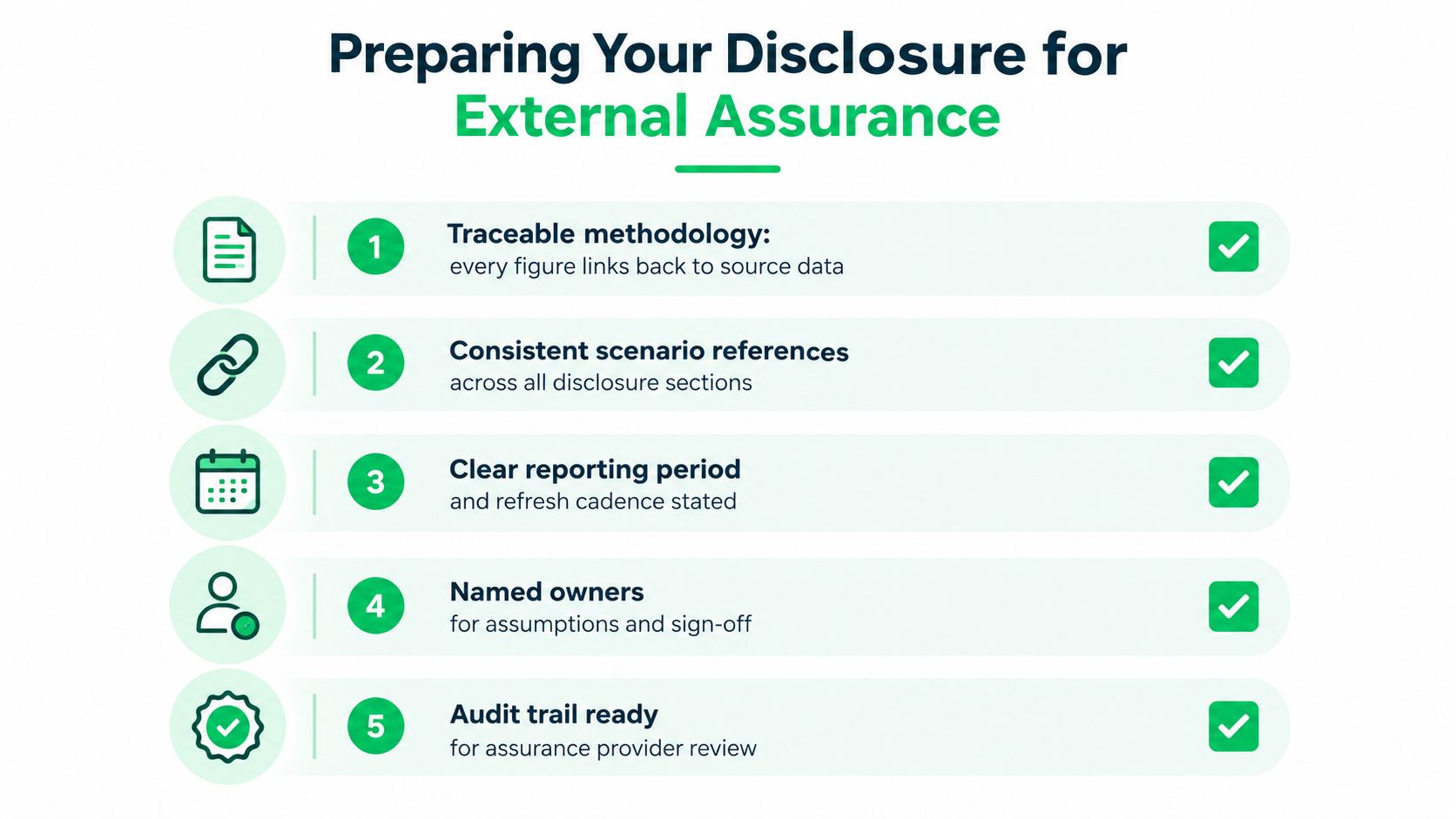
Assurance exposes weak climate scenario analysis very quickly. The control environment either exists or it doesn't, and the fastest way to find out is to trace the numbers back to their source, the assumptions back to their owner, and the narrative back to the modelling package. UK guidance already points firms towards a repeatable, auditable process, so the final disclosure should be designed with that test in mind (UK government guidance on TCFD-aligned disclosure).
Run a final assurance check before publication
The most useful pre-assurance review is practical, not theoretical. Confirm that every figure in the disclosure links back to source data, every scenario label is used consistently, and every reporting period is stated clearly. Then check that named owners exist for assumptions, methods and sign-off.
The disclosure also needs to be internally coherent. If one section says the analysis is exploratory, another section should not present it as predictive. If the board says it used a certain pathway for strategy, the risk section should not shift to a different basis without explanation.
For UK organisations navigating overlapping obligations, ESG Consulting's UK CSRD reporting guidance is a useful reference point for aligning narrative consistency and evidence trails across disclosure regimes.
A short assurance checklist helps:
- Traceability. Every metric and assumption links to a source or documented proxy.
- Consistency. Scenario names, time horizons and boundaries match across sections.
- Refresh discipline. The review cadence is stated and followed.
- Ownership. Someone is accountable for each judgement call.
- Rationale. Exclusions and limitations are explained, not hidden.
The strongest disclosures treat assurance as a design constraint from the beginning, not as a proofreading exercise at the end. That is the difference between a report that gets filed and a process that can be used again next year.
If your board needs climate scenario analysis that stands up to UK assurance, ESG Consulting can help you turn uncertain pathways into a traceable governance process, with evidence trails that are built for review. Visit ESG Consulting to discuss scenario analysis, board narratives and disclosure support that fit your reporting obligations.
More from the blog
· 12 min read · Regulation
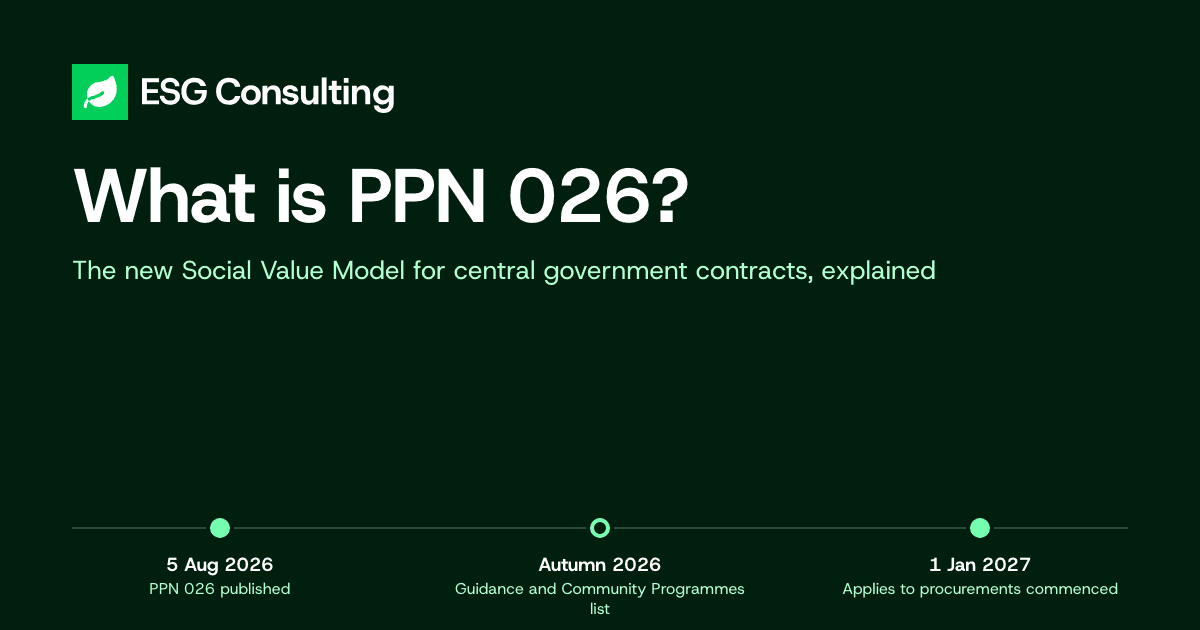
What is PPN 026? The new Social Value Model
PPN 026 replaces PPN 002 as the Social Value Model for central government contracts from 1 January 2027. Scope, the 10% and 20% weightings and the six criteria.
Read article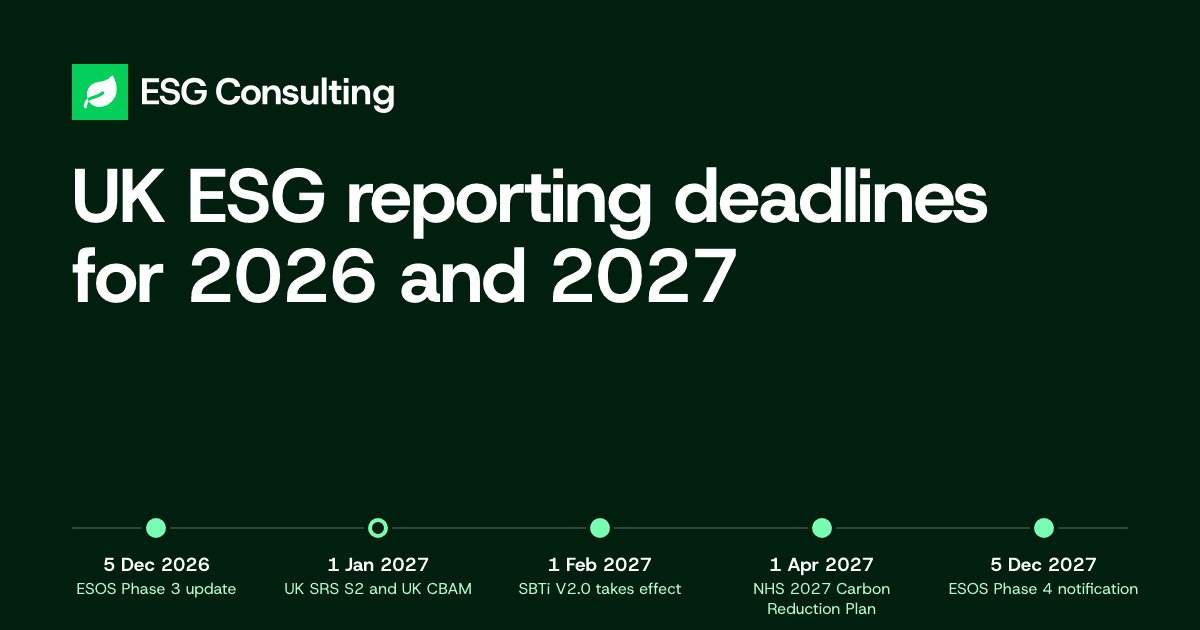
· 14 min read · Regulation
UK ESG reporting deadlines for 2026 and 2027
Every UK ESG reporting date to December 2027 - UK SRS, ESOS, SECR, UK CBAM, CSRD, SBTi, PPN 026 and the NHS - each marked mandatory, proposed or voluntary.
Read article