
csrd reporting uk, esrs alignment, double materiality, uk srs, esg compliance
CSRD Reporting UK: A Practical Compliance Roadmap
By ESG Consulting Team · · 12 min read
If you're staring at a board pack, a half-finished data map, and a question no one wants to answer, you're in the right place. The question is simple enough, does CSRD reporting UK apply to your group, and if it does, what has to happen before the first assurance-ready filing? The answer is usually not “because we're UK-based”. It's because your structure, listing venue, EU subsidiary, or EU branch puts you in scope through one of the directive's specific routes, while purely domestic UK groups are dealing with the separate UK reporting regime instead.
Table of Contents
- Why CSRD Matters for UK Groups
- The Four Routes That Catch UK Entities
- Running Double Materiality the Right Way
- Getting Data and Controls Audit-Ready
- Governance and Assurance from Day One
- CSRD vs UK SRS vs SECR Side by Side
- A 24-Month First-Cycle Roadmap
Why CSRD Matters for UK Groups
A UK registration number does not, by itself, bring a company into CSRD. UK incorporation alone does not trigger CSRD, because the regime is an EU directive, not a UK law. UK groups are caught only through specific EU routes, such as a listing on an EU regulated market, consolidation into an EU parent, an in-scope EU subsidiary, or the third-country undertaking route for large non-EU groups with EU activity Grant Thornton's UK guidance.
That distinction matters because the reporting burden is heavier than many teams expect. Where CSRD applies, the report sits in the management report, uses ESRS, is digitally tagged, and needs limited assurance from the outset UK SRS and CSRD reporting guidance. In practice, sustainability data stops being a narrative exercise and becomes a controlled reporting process with board oversight, audit trail discipline, and a hard dependency on source data quality.
Practical rule: if your EU touchpoints are weakly mapped, scope decisions will be challenged before you ever get to wording.
The timetable also shapes the work. The CSRD rollout originally phased in from 2024 through 2028, with later stop-the-clock changes pushing some starts back by two years in Europe Grant Thornton sustainability reporting guide. For UK teams, that can make the deadline feel distant, but the control build is not. If you are caught, you need evidence, not intent.
Market pressure is the other reason this matters now. EU customers, lenders, and group audit committees increasingly want sustainability data that can survive assurance. In practice, CSRD can become a procurement gatekeeper long before any formal penalty question arises.
The Four Routes That Catch UK Entities
A UK entity should test itself against four routes, not one. That is the quickest way to avoid spending time on a scope discussion that was never real, or discovering a reporting obligation too late in the cycle.
| Route | Threshold Condition | Trigger Event | Worked UK Example |
|---|---|---|---|
| UK parent with EU market listing | Securities admitted to an EU regulated market | Listing venue, including dual listings and other market admissions | A FTSE-listed parent with a dual listing on an EU regulated market |
| UK subsidiary in an EU group | Included in an EU parent's consolidated reporting perimeter | Group consolidation and downstream reporting instructions | A private UK manufacturing subsidiary of a German group |
| UK branch of an EEA firm | Branch structure plus relevant EU branch activity thresholds | Branch operations within an EEA-regulated structure | A UK sales branch of a French insurer |
| EEA-headquartered group with UK operations | Non-EU presence and UK reporting perimeter tested against size thresholds | Standalone or group-level size test, depending on structure | A UK operating business inside an EEA-headquartered group |
The first route catches UK parents that have chosen an EU market presence. The key question is not where the board sits, but where the securities are admitted. A UK-listed group can therefore fall into scope if the capital markets footprint reaches into the EU, even where day-to-day operations stay in London.
The second route is the one private groups often miss. If a UK company sits inside an EU-headquartered consolidated group, the parent can bring that company into its CSRD perimeter even when the UK entity has no direct EU listing. A German parent asking for ESRS data from a Manchester plant is not being difficult, it is building a consolidated sustainability statement.
The third route is more operational than strategic. A UK branch of an EEA firm can be caught where the branch structure and turnover conditions are met, so branch managers need legal and finance input early. The fourth route is the most misunderstood, because third-country rules look at the non-EU group's EU footprint, not just at the UK entity in isolation, as explained in Grant Thornton's UK exposure guidance.
Self-test checklist: confirm your listing venue, consolidation status, branch structure, and standalone threshold position before anyone drafts disclosures.
Running Double Materiality the Right Way
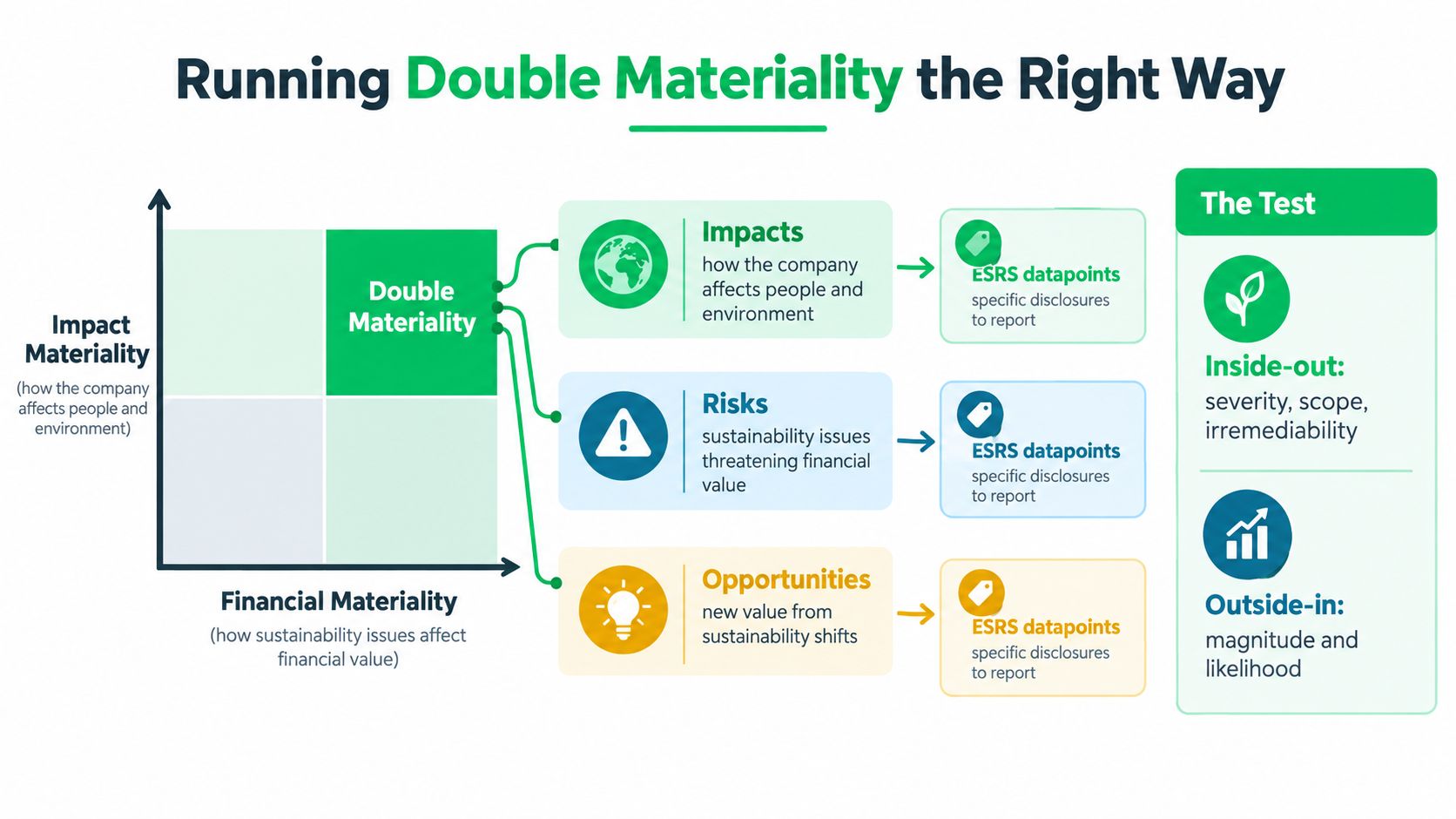
Double materiality is a two-part test, and UK groups need to treat it as such from the start. Under CSRD, you assess both impact materiality, the significance of your effects on people and the environment, and financial materiality, the effect of sustainability matters on enterprise value, cash flows, and cost of capital. A topic can qualify under either axis, and once it does, disclosure follows.
Start with scope and context
Begin with the business model, operating footprint, and value chain. Then map the stakeholders who can affect, or be affected by, the issue. That means employees, suppliers, local communities, customers, and finance stakeholders where the issue links to risk or capital.
From there, identify impacts, risks, and opportunities, often abbreviated as IROs, using the ESRS framing and the relevant implementation guidance. Score severity, scope, and irremediability for impact materiality, and magnitude and likelihood for financial materiality. That process needs discipline, because limited assurance testing will probe whether the scoring logic is defensible rather than convenient.
Turn the output into disclosures
The output is not just a matrix. It determines which standards apply, which datapoints you need, and which narrative disclosures sit under ESRS 2, including governance, strategy, and IRO-related statements. A single-axis process, where a team only tests financial risk, usually fails under review because it misses impacts that are material on the inside-out axis.
Auditor's lens: if you cannot show how a topic entered, moved through, and exited the assessment, the conclusion will be challenged.
Keep the reasoning for every exclusion. The absence of a topic matters as much as the inclusion of one, and the evidence trail should show that management reviewed the boundary, challenged the assumptions, and signed off the final materiality decision.
ESG Consulting's materiality assessment note is a useful reference if your team wants to compare its current process with a more formal approach.
Getting Data and Controls Audit-Ready
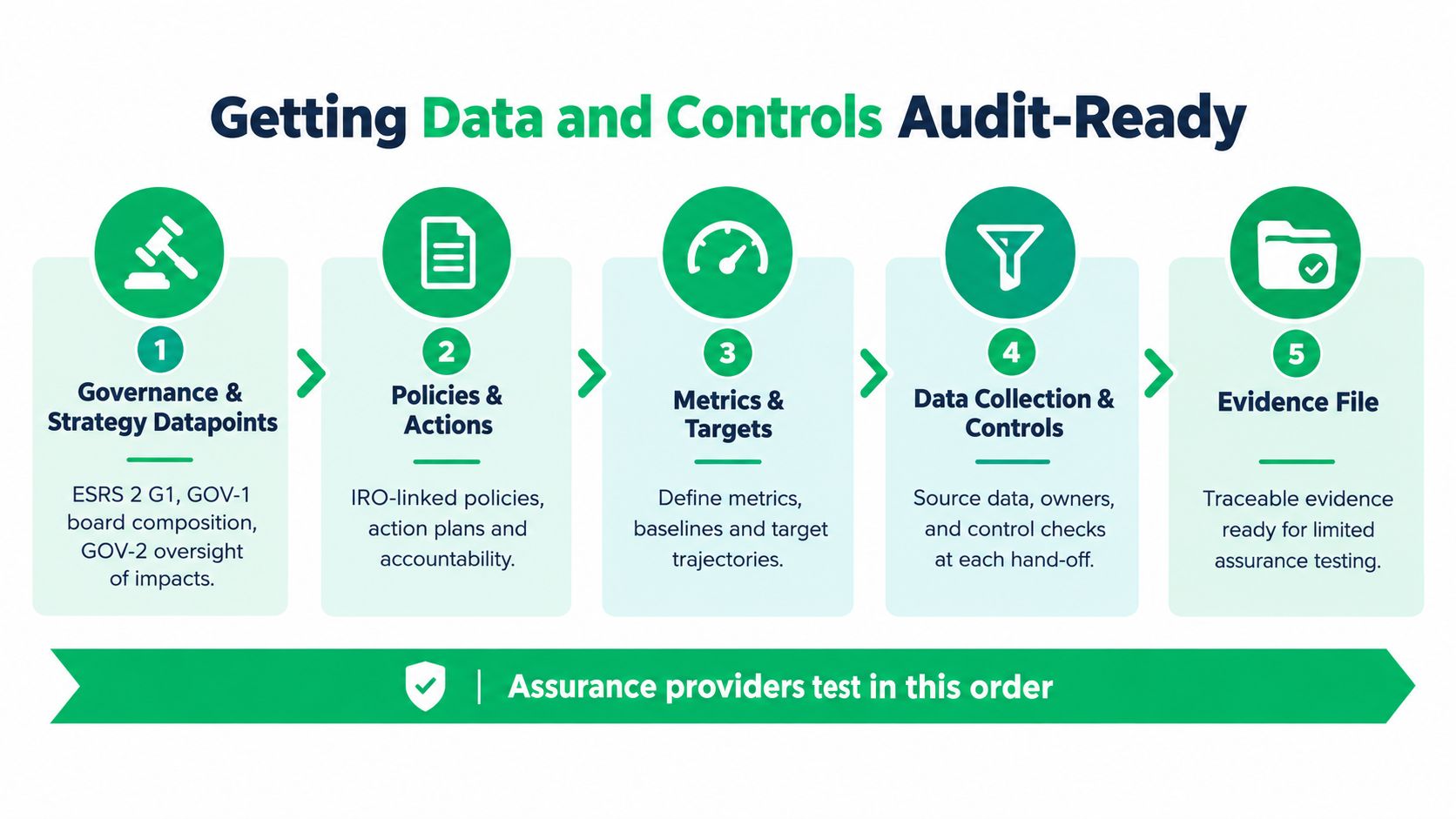
Assurance teams do not audit sustainability reporting in the same order that many preparers build it. They start where the risk of unsupported judgement is highest, and the cheapest fixes are often the ones that get deferred. The sensible sequence is governance first, then data ownership, then metrics, then controls, then the evidence pack.
Build from governance data outward
Start with ESRS 2 governance disclosures, including board oversight, management roles, and policy accountability. These are the first places auditors look because they show whether the organisation has a reporting system or only a collection of worksheets. If board composition, oversight, and policy ownership are vague, every downstream disclosure becomes harder to trust.
After that, move into entity-level sustainability disclosures and only then into environmental, social, and topical standards. For environmental metrics, energy data usually starts in utility invoices and energy management systems. Workforce headcount and diversity data should come from HRIS extracts. Scope 3 data often begins with supplier questionnaires, procurement records, or proxy factors where primary data is unavailable.
Tie the numbers back to finance
The control question is not just whether the metric exists, but whether it can be reconciled. Auditors will ask for a tie-out to financial statements where relevant, a documented basis of preparation, and explanations for any restatement where methodology changed. If the same cost centre feeds both finance and sustainability reporting, the reconciliation should be visible, not implied.
What works: a signed calculation memo, source document references, and a named owner for every reported figure.
A clean evidence trail is usually the difference between a limited-assurance process that moves smoothly and one that turns into rework. Keep signed data lineage sheets, version-controlled working papers, and supporting files that show where the data came from, who checked it, and when it changed. A single spreadsheet without source references is not evidence, it's a risk register.
The Scope 3 overview from ESG Consulting is relevant if your biggest gap sits in supplier and value-chain data, because that's where the most expensive control failures arise.
Governance and Assurance from Day One
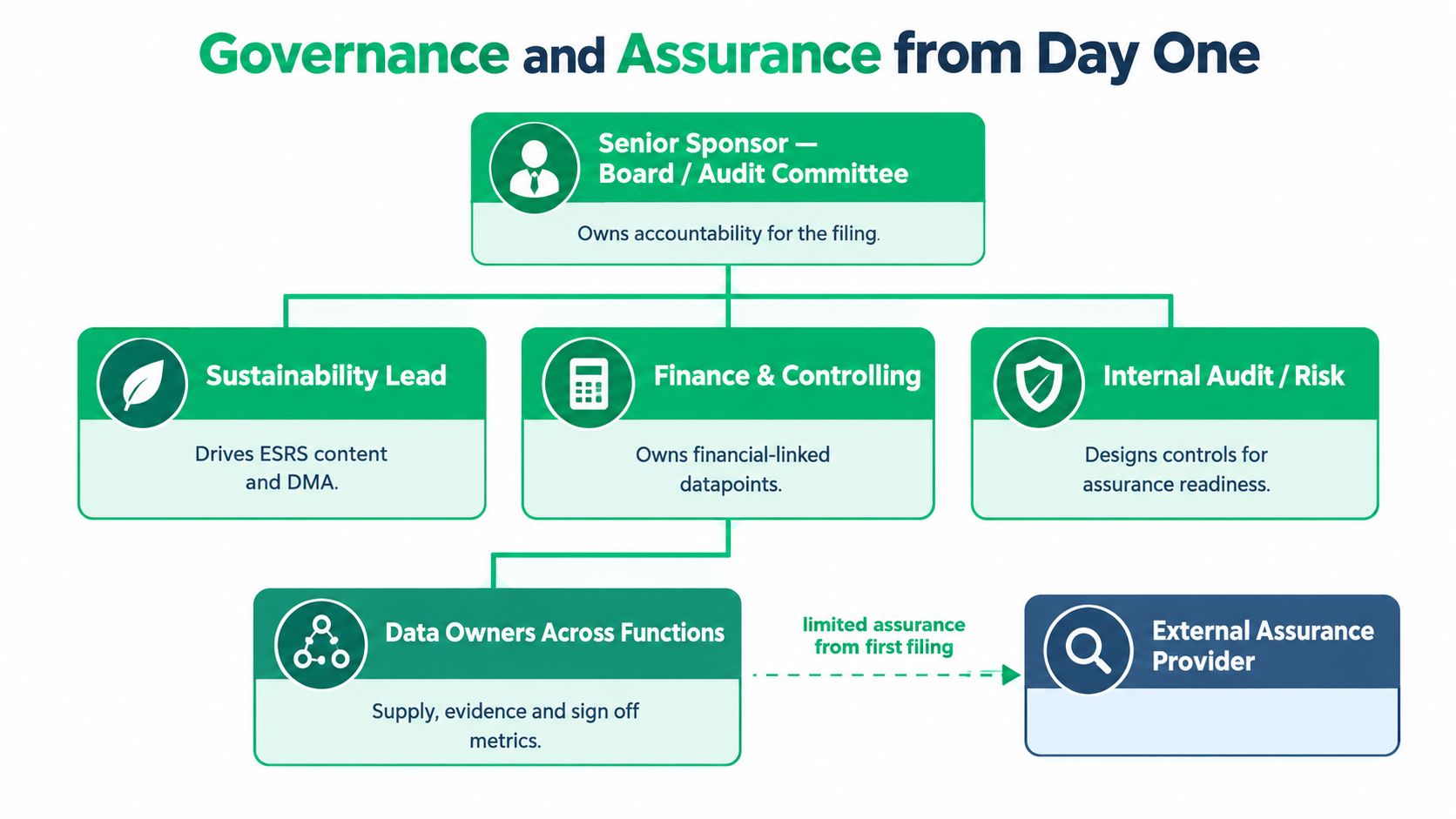
CSRD changes the reporting culture because limited assurance starts with the first filing. That means the operating model needs to exist before the year-end scramble, not after it. If the sustainability team builds the numbers and finance only appears at sign-off, the assurance relationship will feel improvised.
Put the right people in the room
The core team should include a senior sponsor at board or audit committee level, a CSRD programme lead, finance or controlling for numeric tie-outs, HR for people data, operations for environmental inputs, and legal for scoping decisions. Internal audit or risk should be involved early enough to shape controls, not just review them after the fact. The external assurance provider also needs to come in early, because materiality assumptions and control design are much easier to improve before evidence is frozen.
The audit committee should own the assurance relationship. Sustainability can coordinate the work, but it shouldn't be the final approver of its own evidence. That separation matters because assurance providers will look for clear segregation between preparer and reviewer roles.
Run the cadence like a reporting cycle
A board should see progress regularly, not just at launch and pre-sign-off. Quarterly reporting works best in practice, with materiality findings minuted, scope changes documented, and restatement rationales retained alongside the data pack. If a decision can't be traced through meeting minutes or an approval trail, it's likely to come back as a challenge point.
The document set should be boring in the best way. It needs named owners, dated approvals, and a consistent folder structure that matches the way assurance testing is performed. If the team can't show who challenged the numbers, auditors will assume nobody did.
ESG Consulting's sustainability reporting support is relevant where a team needs outside help shaping the cycle, but the internal governance still has to belong to the company.
CSRD vs UK SRS vs SECR Side by Side
UK preparers often have three reporting regimes in play, and they do not line up neatly. CSRD is the most demanding where it applies, because it uses double materiality, ESRS structure, digital tagging, and limited assurance from the first filing. UK SRS is different, because it is aligned to ISSB and focuses on financial materiality for investors. SECR sits alongside both and is narrower, with carbon and energy disclosure in the strategic report.
| Regime | Scope | Materiality lens | Assurance | First UK reporting year | Primary obligation |
|---|---|---|---|---|---|
| CSRD | UK groups caught through EU routes | Double materiality | Limited assurance from day one | Depends on route and timetable | ESRS-aligned sustainability statement |
| UK SRS | UK-listed and large UK-registered groups on the proposed route | Financial materiality | Phased UK approach | Indicative start from 1 January 2027, subject to FCA finalisation, as signalled in current UK government guidance UK government guidance on UK SRS | ISSB-aligned sustainability and climate disclosure |
| SECR | Quoted companies and qualifying LLPs | Carbon and energy reporting focus | No CSRD-style sustainability assurance regime | Already in force | Strategic report carbon and energy narrative |
The sequencing question saves time. Build the CSRD gap first if you are in scope, because that route usually requires the broadest data set, including governance, value chain, and non-climate topics. Then layer UK SRS on top, because much of the climate governance and emissions work can be reused. SECR should sit underneath both as a narrower disclosure set, not as a separate project.
That order avoids duplication. It also stops teams from gathering the same evidence three times in three slightly different formats. A single core data model, with regime-specific outputs built on top, is usually the only way to keep the work manageable.
A 24-Month First-Cycle Roadmap
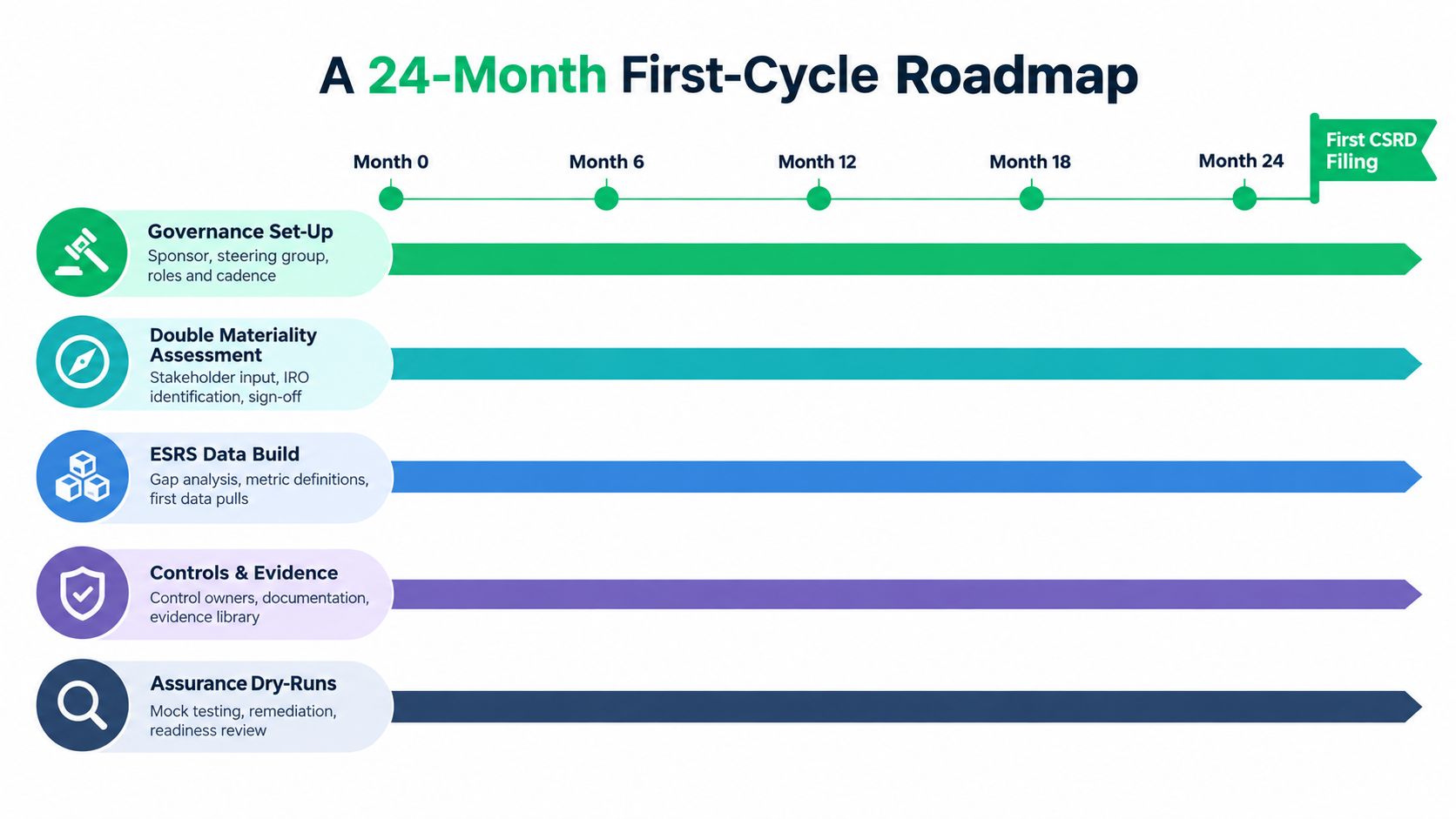
The first cycle works best when it is treated like a programme with gates, not a loose compliance exercise. Start at month -24 with a scoping decision and board mandate, because if scope is unclear, every other workstream becomes guesswork. The governance team should own that first decision, with legal and finance supporting the boundary test.
By month -16, the double materiality assessment should be signed off. That is the point where the business stops debating what matters and starts building around the result. If materiality is still open at that stage, the data build will drift and the evidence trail will fragment.
The practical sequence
At roughly month -8, ESRS datapoint population should be well underway, with data owners collecting the first full set of metrics. By month -4, run a limited-assurance readiness test, ideally with the assurance provider reviewing sample evidence and control design. Month 0 should be filing, not discovery.
The main pinch points are predictable. Payroll and procurement data often arrive late because no one linked those systems to the reporting timetable. Materiality thresholds are sometimes undocumented, which makes the assessment hard to defend. Controls walkthroughs happen after data is already reported, which defeats the point of testing them.
A workable 24-month plan usually has five workstreams running in parallel:
- Governance set-up: sponsor, steering group, roles, cadence.
- Double materiality assessment: stakeholder input, IRO identification, sign-off.
- ESRS data build: gap analysis, metric definitions, first data pulls.
- Controls and evidence: control owners, documentation, evidence library.
- Assurance dry-runs: mock testing, remediation, readiness review.
Escalation trigger: if any workstream slips by more than eight weeks, move it to formal risk review and reset the filing plan.
The YouTube briefing below is a useful visual supplement for teams planning their first-cycle timeline.
ESG Consulting supports UK organisations that need a CSRD scope assessment, ESRS-aligned reporting, or a cleaner route through the evidence and control work that limited assurance will test. If you're mapping whether your group is in scope, or you need to turn an existing draft into an audit-ready filing, visit ESG Consulting and start the conversation with a senior consultant.
More from the blog
· 12 min read · Regulation
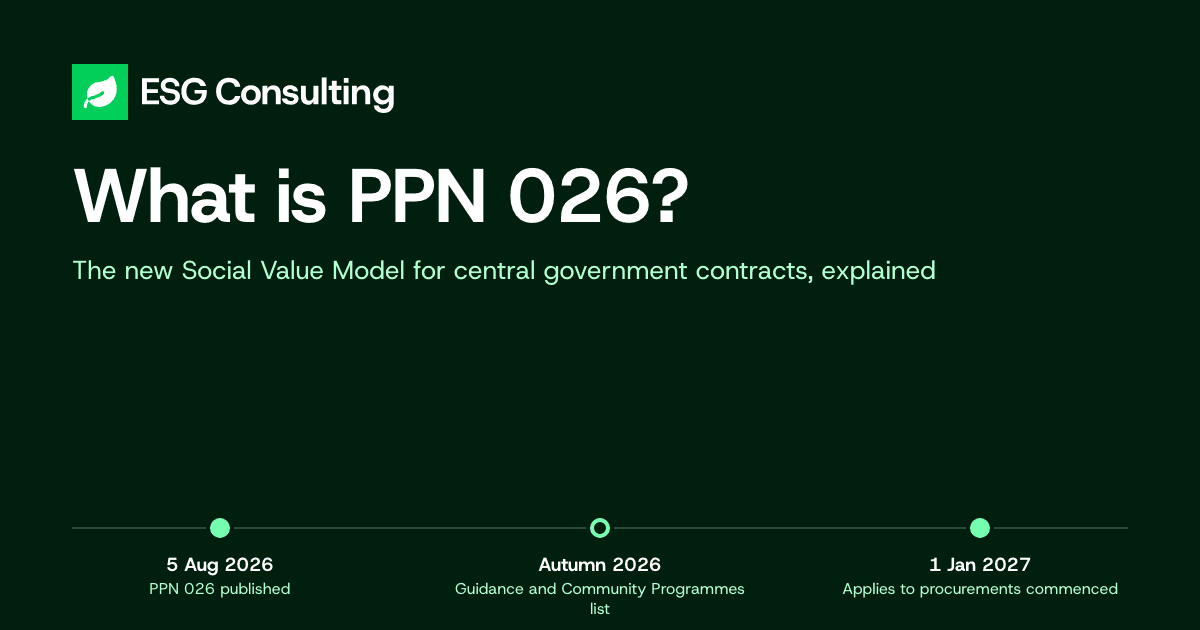
What is PPN 026? The new Social Value Model
PPN 026 replaces PPN 002 as the Social Value Model for central government contracts from 1 January 2027. Scope, the 10% and 20% weightings and the six criteria.
Read article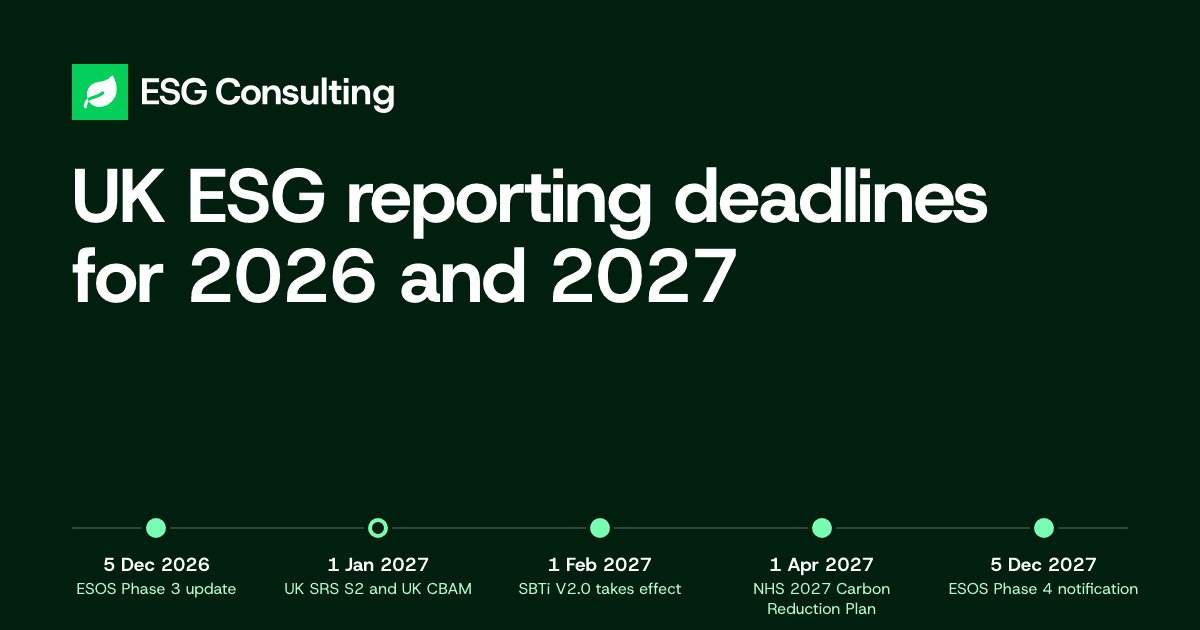
· 14 min read · Regulation
UK ESG reporting deadlines for 2026 and 2027
Every UK ESG reporting date to December 2027 - UK SRS, ESOS, SECR, UK CBAM, CSRD, SBTi, PPN 026 and the NHS - each marked mandatory, proposed or voluntary.
Read article