
Scope 3 emissions, carbon reporting, ESG, sustainability, UK net-zero
What Is Scope 3 Emissions: A UK ESG Guide
By ESG Consulting Team · · 12 min read
Scope 3 stood at 33,252 tCO2e, with purchased goods and services alone at 29,861 tCO2e in the Bank of England's 2026 climate transition plan, and that's the clearest proof that value-chain emissions often dominate a UK organisation's footprint. If you're reviewing a sustainability report, a supplier pack, or a board paper right now, the question is rarely whether Scope 3 matters, it's how to define it, measure it, and defend the method you chose.
For many UK organisations, that choice sits at the centre of carbon reporting, procurement, and net-zero planning. Scope 3 is no longer a side note for sustainability teams. It's the part of the inventory that usually forces the hardest decisions about data quality, assurance, and supplier engagement.
Table of Contents
- Why Scope 3 Matters for UK Organisations
- Defining Scope 3 Emissions
- The 15 Categories of Scope 3 Emissions
- Approaches to Calculating Scope 3
- Common Misconceptions About Scope 3
- Real-World Examples from UK Reporting
- Next Steps for Your Scope 3 Strategy
Why Scope 3 Matters for UK Organisations
A board member usually notices the issue in a familiar place, the annual report. Operational emissions may look manageable, but the wider footprint reaches suppliers, logistics, product use, and disposal. In the UK, that matters because Scope 3 now sits inside the live policy conversation, not on the edge of it, as shown by the government's UK environmental legislation overview.
The Bank of England example covered earlier shows how concentrated value-chain emissions can be. That is the practical lesson for UK boards, audit committees, and procurement leaders. Scope 3 is often where the biggest reduction opportunities sit, and it is also where the hardest evidence questions begin.
Why the pressure is rising
UK reporting frameworks already draw a line between direct emissions, purchased energy, and the broader value chain. Buyer expectations are pushing that line further. FTSE 100 companies ask for stronger supplier evidence. NHS trusts need visibility across supply chains. Government suppliers face more structured disclosure through procurement rules and carbon reduction plans.
A simple rule helps here. If most of your emissions sit outside your own sites, the annual report is no longer the whole story. Procurement, product design, and finance become the control points that matter most.
That changes the boardroom conversation. Leaders are no longer just asking, “What did we emit?” They are asking, “What did we buy, what did our suppliers emit, and how defensible is our estimate?” Scope 3 sits between compliance and commercial resilience, which is why UK net-zero planning increasingly depends on it. It is the part of the inventory where reporting expectations, supplier relationships, and carbon strategy meet, and where weak assumptions quickly become a business problem.
Defining Scope 3 Emissions
A UK board can know its own fuel use and electricity bills, yet still miss most of the emissions tied to the business. That is the point of Scope 3 emissions. They are the other indirect emissions in a company's value chain, the ones not owned or controlled by the reporting entity. The UK government's Sustainability Reporting Guidance for 2025–26 says there is no minimum reporting requirement for Scope 3, but organisations must disclose it where it is material. The practical test is therefore not ownership alone, but whether the emissions are relevant to the business and its reporting duties. UK Sustainability Reporting Guidance 2025 to 2026
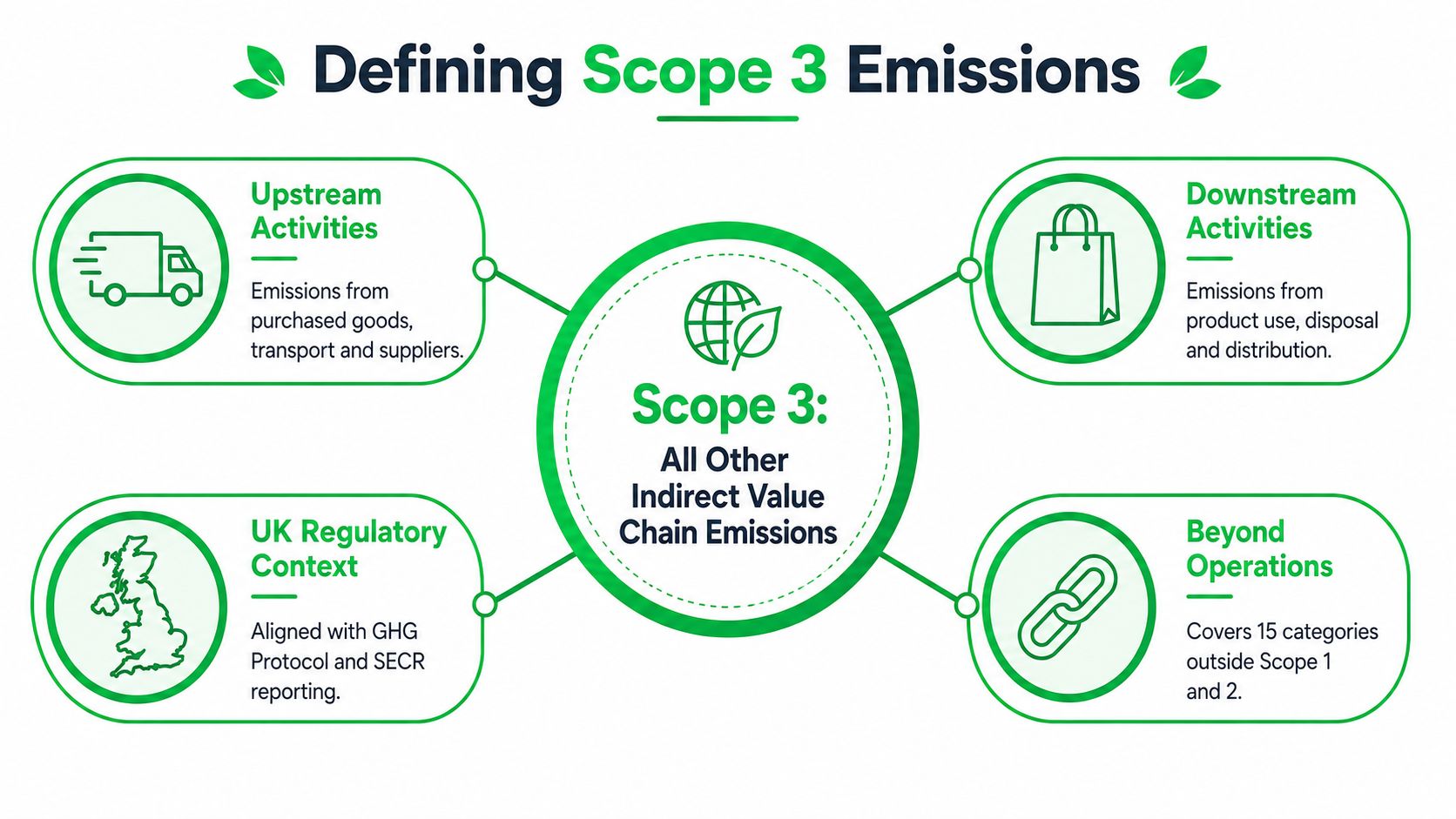
The boundary becomes clearer beside the other scopes. Scope 1 covers direct emissions from assets you own or control. Scope 2 covers purchased energy. Scope 3 covers everything else in the chain, including upstream purchases and downstream use or disposal. For that reason, Scope 3 is usually the broadest category, and the hardest one to calculate cleanly.
Why the boundary is based on the value chain
Confusion often starts here. A supplier's emissions can sit in your Scope 3 inventory even though the same emissions are already counted in the supplier's own Scope 1 and Scope 2 disclosures. That is not double counting in the reporting sense. It is how value-chain accounting shows where your business decisions create emissions, even when the source sits outside your own operations.
That is why Scope 3 needs value-chain mapping and materiality screening, not just a list of sites or utility bills. UK organisations also need to keep the method defensible, especially where public-sector style disclosure is involved. If boundaries, methods, and source data are unclear, the inventory will struggle under audit-grade scrutiny. In practice, the key question is often whether to start with spend-based estimates or supplier data, because that choice changes both the picture and the quality of the result.
The 15 Categories of Scope 3 Emissions
The GHG Protocol defines 15 Scope 3 categories, and that framework matters because it turns a vague idea into a map. The UK's PPN 0621 carbon reduction plan technical standard requires suppliers to disclose five Scope 3 categories, which is a practical baseline for public procurement. UK government guidance on environmental impact assessments
How the categories cluster
You don't need to memorise all 15 at once. It helps more to group them by direction of flow.
Upstream categories usually include purchased goods and services, capital goods, fuel and energy related activities, upstream transport and distribution, waste generated in operations, business travel, employee commuting, and upstream leased assets. These are the categories most UK organisations start with because they're tied to procurement, travel, and facilities data.
Downstream categories usually include downstream transport and distribution, processing of sold products, use of sold products, end-of-life treatment of sold products, downstream leased assets, franchises, and investments. These matter most for manufacturers, retailers, financial institutions, and organisations with long-lived products or asset portfolios.
A useful way to think about the 15 categories is this:
- Purchased inputs: bought materials, services, and capital items often drive the first hotspot analysis.
- Operational movement: transport, travel, commuting, and waste show how the business runs day to day.
- Product life cycle: use and disposal become critical when the organisation sells physical products or funds asset-heavy activity.
Organisations usually find the biggest data gaps where finance, procurement, and operations meet, not where the emissions are easiest to count.
That is why PPN 0621 is such a useful anchor for UK suppliers. It doesn't solve the whole problem, but it forces a first pass at the categories that public buyers want to see. For most businesses, the first inventory is less about perfection and more about identifying which categories are material, which ones are estimated, and which ones need supplier follow-up later.
Approaches to Calculating Scope 3
The hardest practical choice is rarely whether Scope 3 exists. It is whether to begin with spend-based estimates or move toward primary supplier data. For UK organisations, that choice matters because the official UK greenhouse gas reporting conversion factors 2026 sit behind activity-based calculations, including category-specific updates such as transmission and distribution losses, which are Scope 3 emissions.
Spend-based estimates first
Spend-based estimation starts with financial data and applies emission factors to turn spend into emissions. It is quick, so it works well for a first inventory, a hotspot screen, or an interim figure for board reporting. It also suits categories with thin supplier coverage or lots of small purchases spread across the business.
The trade-off is precision. Spend-based methods can flatten differences between suppliers, materials, and contract terms. Two purchases with the same value can carry very different emissions profiles, so the output is directional rather than exact. That makes the method useful for triage, but weak as a final answer.
Primary supplier data later
Primary data comes directly from suppliers, usually through emissions factors, product declarations, or reported activity data. It takes more time and more supplier coordination, but it improves assurance quality and gives a firmer base for year-on-year reduction work. It also helps when buyers need to challenge assumptions about high-emission categories or justify procurement choices.
The Bank of England's 2026 climate transition plan shows the mix in practice. It uses spend-based EXIOBASE factors where primary data are unavailable, which is a practical model for many organisations. The lesson is simple. Good Scope 3 work often starts wide, then becomes more specific as supplier data improves.
A practical way to choose is straightforward.
- Use spend-based estimates when speed matters, when you need a first-pass hotspot view, or when supplier data is weak.
- Move to primary data when a category is material, procurement can influence supplier behaviour, or assurance risk is high.
- Combine both when you need coverage now and better quality later.
For UK reporters, the issue is not method purity. It is whether the method fits the decision in front of you, whether it reflects the UK reporting context, and whether the evidence trail can stand up to scrutiny.
Common Misconceptions About Scope 3
A supplier replying to a tender often learns the first lesson quickly. Scope 3 is not a side topic reserved for sustainability teams. In UK reporting and procurement, it can shape whether a business is seen as credible at all. The 2025–26 guidance cited earlier frames disclosure through materiality, so the practical question is whether the emissions sit close enough to the decision in front of you to matter, for example in a carbon reduction plan, a bid response, or a contract review.
Myth 1 and myth 2
The second myth is that only large corporates need to worry about it. Smaller suppliers feel Scope 3 through procurement questionnaires, carbon reduction plans, and tender conditions. If a hospital trust, a central department, or a large private buyer asks for emissions data, the supplier may need to respond regardless of size.
The third myth is that accurate measurement is impossible. It is difficult, but the problem is usually not the idea of Scope 3 itself. The main blockers are incomplete boundaries, weak data governance, and uncertainty over which source to trust. Spend-based estimates can help a team get a first view, while supplier data gives a firmer basis where the category is material. That choice matters in the UK because buyers, auditors, and procurement teams will usually ask how the figure was built, not just what the number is.
What usually goes wrong
Useful test: if you can't explain how the number was built, you probably can't defend it in assurance.
Weak Scope 3 inventories fail for familiar reasons. Teams rely on one spreadsheet and leave assumptions undocumented. Procurement and finance work separately, so activity data never reaches the people calculating emissions. Suppliers are asked too late, or not at all. The result is a tidy headline figure that looks convincing until someone asks which categories are estimated, which are supplier-backed, and which still need review.
A better method is more disciplined. Set the boundary first, test materiality, map the categories, and then choose the data method that fits each hotspot. In UK reporting, that usually means deciding where spend-based estimates are good enough for now and where supplier data is worth the effort. That approach is less polished than a single number, but it gives boards a trail they can trust.
Real-World Examples from UK Reporting
A large UK institution's climate transition plan shows the practical choice facing every Scope 3 team. The Bank of England reports Scope 3 through spend-based factors where primary data is not available, which makes the method decision part of disclosure quality, not a side note. For UK organisations using supplier data, this is the same judgement call that sits behind UK ESG reporting deadlines guidance, because timing, evidence, and method all have to line up.
The public-sector picture points in the same direction. PPN 0621 pushes supply-chain disclosure into procurement, so suppliers cannot treat emissions as something only the sustainability team sees. The question becomes practical very quickly. Which parts of the chain can be supported by activity data, and which still need estimates because the underlying records are incomplete?
A good NHS-style example is a trust looking at purchased goods, catering, estates services, and waste. Finance may have the spend records, procurement may know the suppliers, and estates may hold the activity data, but none of those sources is enough on its own. The reporting exercise works only when those teams compare notes and decide where supplier engagement will improve the inventory more than another round of spend-based approximation.
The same pattern appears in major corporate supply chains. An FTSE 100 supplier may start with broad estimates to cover the full inventory, then move to supplier-specific data for the categories that are most material or most exposed to assurance questions. That is why official conversion factors still matter, as noted earlier, but they are only one part of the job. The true test is whether the company can explain why a category is estimated, why another is data-backed, and how the method will hold up as reporting expectations tighten.
Next Steps for Your Scope 3 Strategy
Start with a value-chain map, not a carbon target. Then screen the categories for materiality, because the goal is to focus effort where the footprint and the business risk are both highest. After that, decide which categories can stay spend-based for now and which ones need supplier engagement or more granular activity data.
A practical sequence is straightforward:
- Map the chain: identify upstream and downstream activities tied to the business.
- Rank the hotspots: focus on the categories most likely to carry material emissions.
- Choose the data route: use estimates for coverage, then improve to supplier data where it matters.
- Document the method: keep the boundaries, assumptions, and source data clear enough for assurance.
If you need external support, a sustainability reporting consultant can help structure the inventory, align it with UK requirements, and make the evidence trail audit-ready.
ESG Consulting helps UK organisations build Scope 3 inventories that stand up to board review, procurement scrutiny, and assurance. If you need practical support with value-chain mapping, supplier engagement, or reporting under UK frameworks, visit ESG Consulting to discuss a scoped approach for your organisation.
More from the blog
· 12 min read · Regulation
What is PPN 026? The new Social Value Model
PPN 026 replaces PPN 002 as the Social Value Model for central government contracts from 1 January 2027. Scope, the 10% and 20% weightings and the six criteria.
Read article
· 14 min read · Regulation
UK ESG reporting deadlines for 2026 and 2027
Every UK ESG reporting date to December 2027 - UK SRS, ESOS, SECR, UK CBAM, CSRD, SBTi, PPN 026 and the NHS - each marked mandatory, proposed or voluntary.
Read article