
esg, sustainability, uk reporting, corporate strategy, net zero
ESG and Sustainability: A UK Corporate Guide 2026
By ESG Consulting Team · · 11 min read
UK territorial emissions have fallen by 50.4% versus 1990, when industrial aviation and shipping are included. That makes ESG in the UK a question of measurable national progress, not just policy intent.
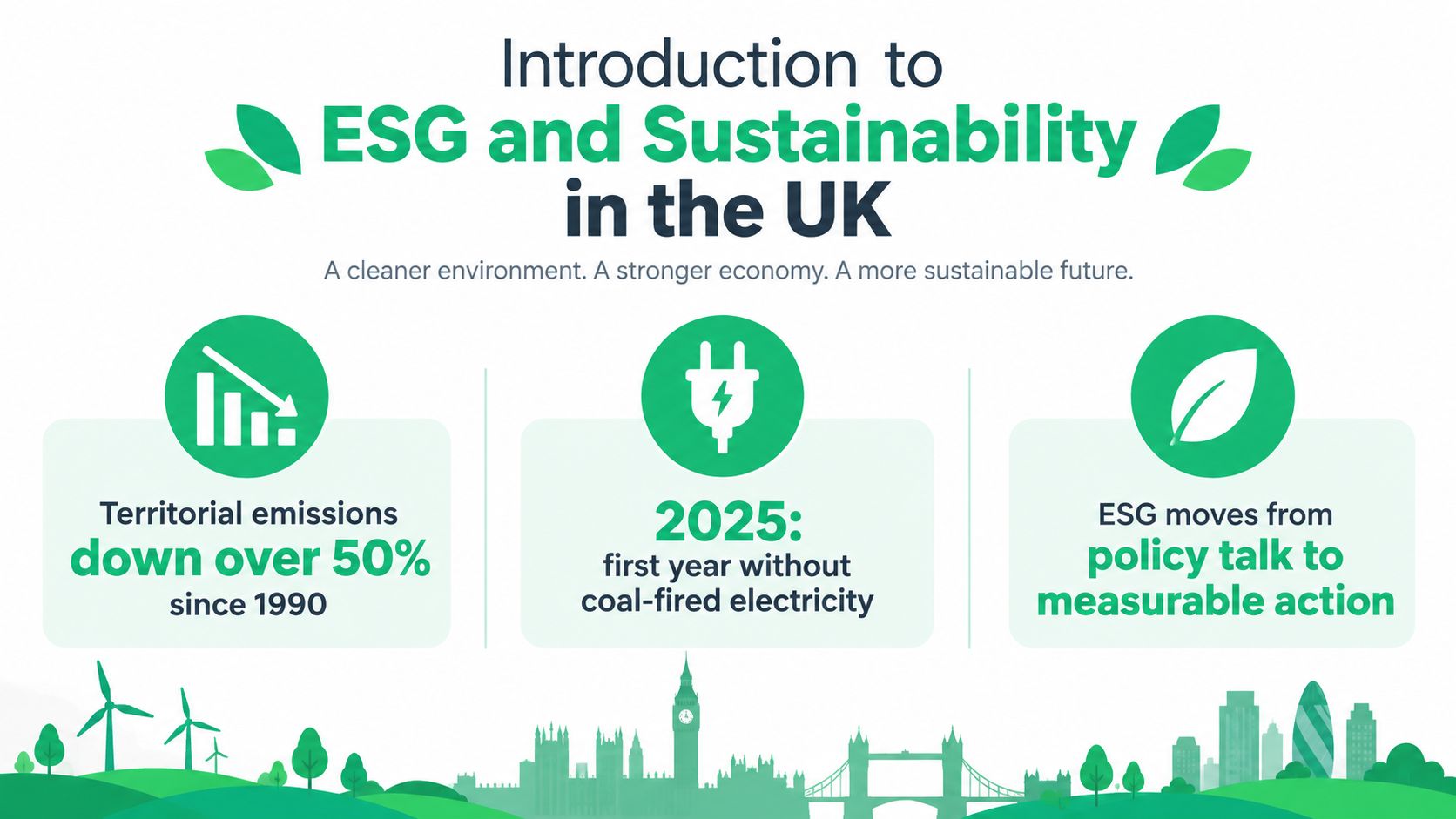
The shift matters because the UK's reporting regime has moved in step with the emissions story. Government dry-runs began in 2010, ESOS has required large organisations to audit energy use on four-year cycles since 2014, SECR became mandatory from 2019, and TCFD-aligned climate disclosure for large companies and LLPs arrived in April 2022. By June 2023, the ISSB had published IFRS S1 and S2, which became the foundation for UK Sustainability Reporting Standards development. Those milestones show a clear pattern, energy, carbon and climate governance have moved into annual reports and strategic reporting.
Practical rule: If your ESG work still sits in slide decks and side projects, it's already behind the UK compliance curve.
The hardest part for many organisations is no longer deciding whether ESG matters. It's deciding what has to be measured, which disclosures are mandatory, and how to keep the evidence trail clean enough for assurance. That is where sustainability stops being a slogan and becomes an operating discipline.
Table of Contents
- Understanding the Core Concepts
- The UK Regulatory Landscape
- Practical Use Cases for Corporates and Investors
- Reporting Requirements and Technical Details
- Benefits and Common Misconceptions
- Moving Forward with Confidence
Understanding the Core Concepts
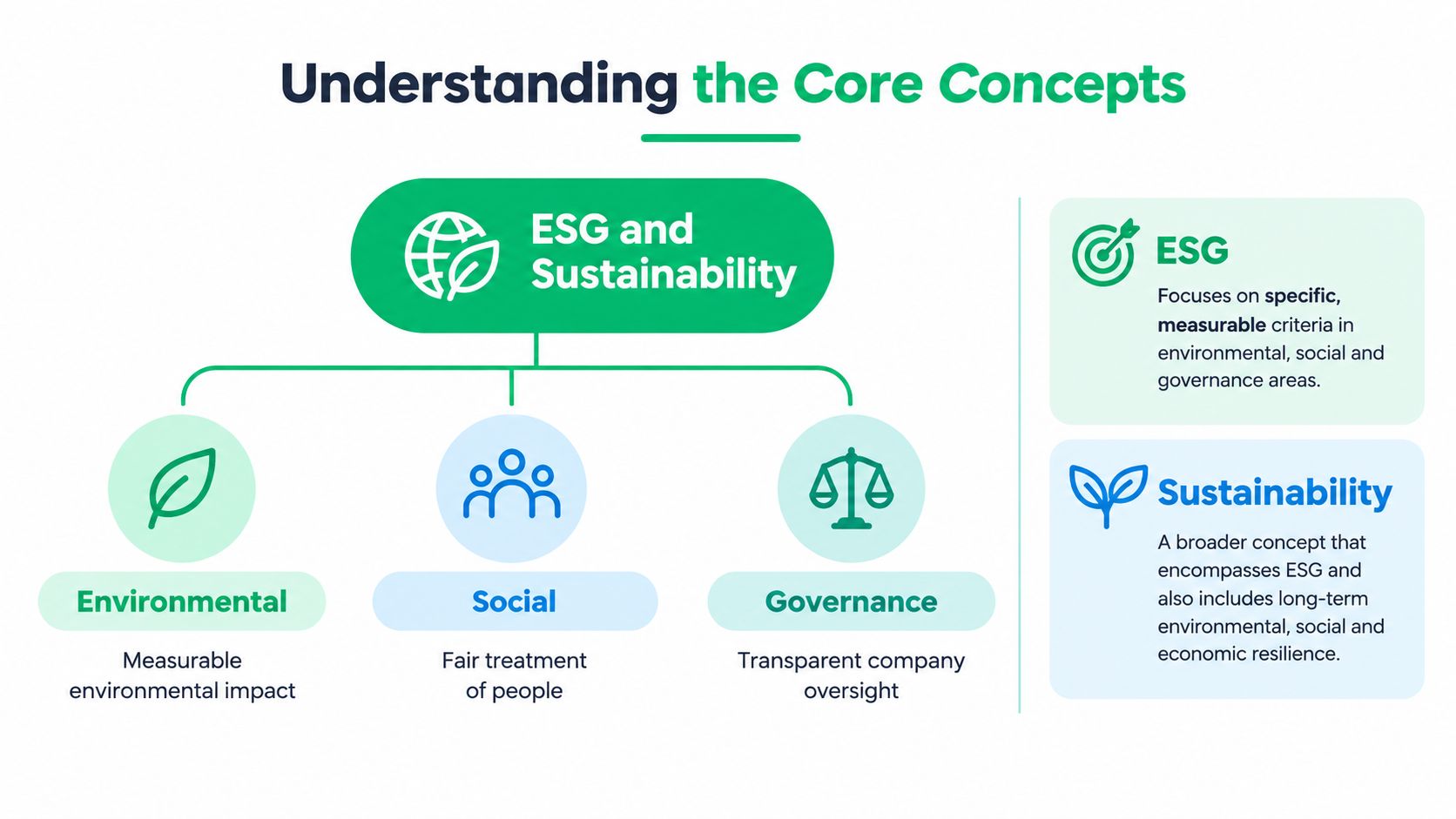
ESG and sustainability are related, but they're not the same thing. ESG is the measurement framework, sustainability is the destination. In practice, ESG gives boards, investors and regulators a way to test whether an organisation is moving towards long-term resilience without relying on vague language.
ESG is the scoreboard
Environmental, social and governance factors break the topic into parts that can be tracked, challenged and assured. Environmental measures cover things like emissions and energy use, social measures cover people, fairness and supply-chain behaviour, and governance covers oversight, accountability and control. The point is not to sound responsible, it's to show what's happening in the business with evidence.
Sustainability is broader. It asks whether the business model can keep operating without degrading the systems it depends on, including energy, labour, natural capital and public trust. That's why sustainability can inform strategy, while ESG often becomes the reporting and control layer that proves whether strategy is real.
Why the distinction matters in the UK
UK organisations often use the words interchangeably, then get stuck when disclosure requirements start asking for different outputs. A sustainability ambition might be broad and long-term, while an ESG disclosure needs defined boundaries, repeatable data and a clear owner inside the business. If those two things are confused, reports become polished but weak.
A useful way to think about it is this, sustainability is the journey, ESG is the dashboard. If the dashboard is inaccurate, the journey may still be genuine, but nobody can prove it. That gap is where assurance failures, board challenge and inconsistent public claims usually start.
Simple test: If a statement can't be traced back to a source system, policy, contract or calculation method, it isn't ESG-ready yet.
The next practical implication is that ESG work should be designed around verifiable indicators, not broad intent. That is especially true in UK reporting, where readers increasingly expect consistency between climate claims, operational data and governance controls.
The UK Regulatory Landscape
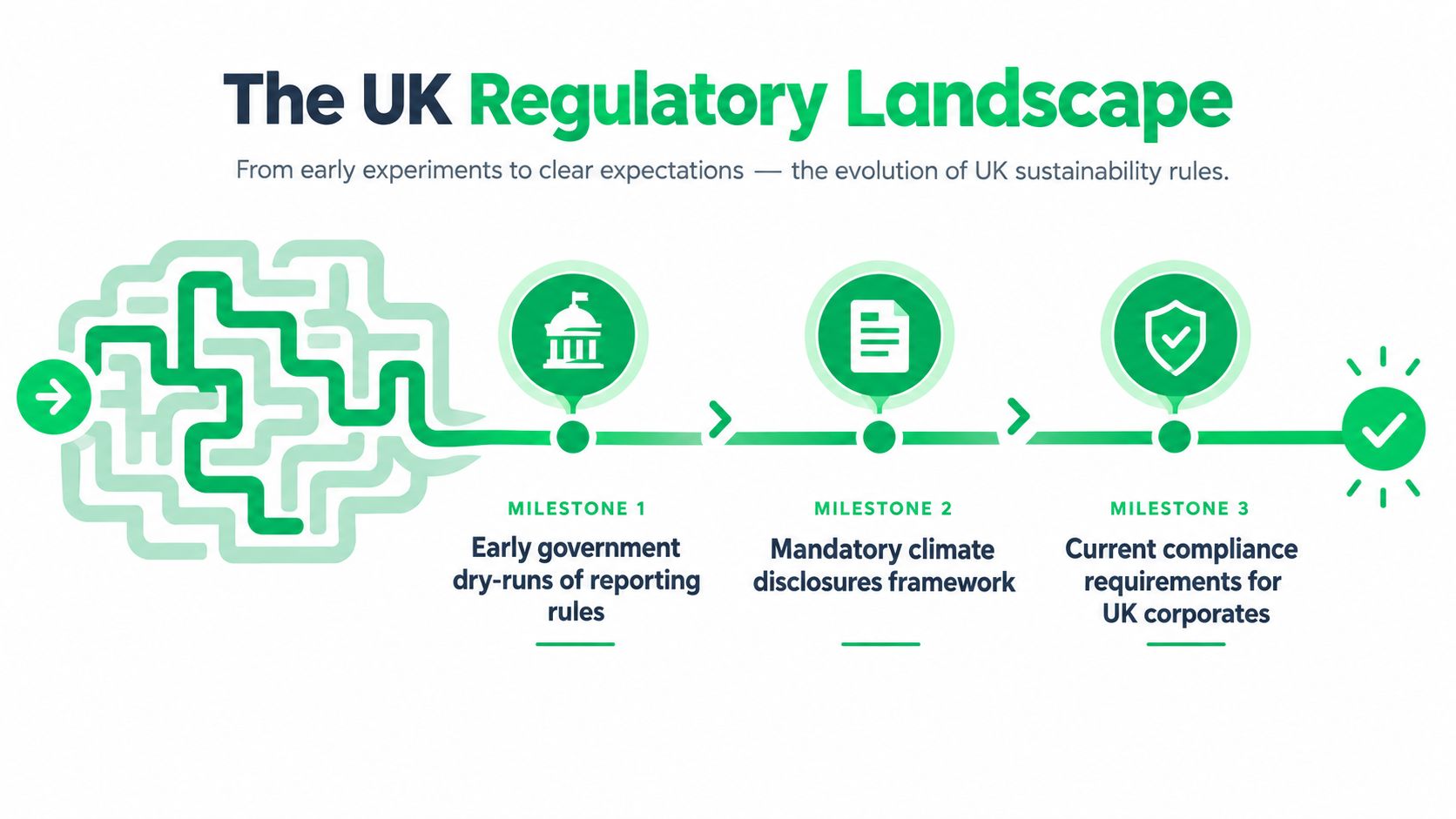
UK sustainability rules now work more like a layered system than a single regime. The practical task is to identify which layer applies to your organisation, which disclosures are already mandatory, and where you only have a voluntary or transitional requirement.
What applies now
The legacy framework still matters. ESOS continues to require energy audits for large organisations on four-year cycles, SECR remains mandatory for in-scope businesses, and TCFD-aligned disclosure still sits inside UK listing and reporting expectations for the organisations that fall within scope. The current UK Sustainability Reporting Standards guidance sits on top of that structure, but it doesn't wipe it away.
The common mistake is to assume one new framework replaces everything else. It doesn't. Most corporates are dealing with overlapping duties, so the right question is not “Which single standard do we follow?” It's “Which disclosures do we already have, which ones need reformatting, and which ones will need new controls?”
How to plan without wasting effort
Start by mapping three things:
- Your existing reporting outputs, including SECR, climate statements and board reporting.
- Your evidence sources, such as energy bills, procurement records and supplier data.
- Your likely future obligations, especially where the FCA's proposed 2027 direction may affect listed entities.
That approach matters because the UK government has now published final UK SRS S1 and S2 for voluntary use, while the FCA has consulted on mandatory climate reporting for in-scope listed entities from 1 January 2027. The consultation also points to mandatory S2 climate disclosure, with Scope 3 and wider sustainability topics handled through comply-or-explain rather than hard mandate. In other words, the direction of travel is stricter on climate, but not every sustainability topic is being treated the same way.
A good compliance programme therefore avoids blanket rework. It builds one evidence base that can support the present regime and the likely next one.
The regulatory picture is easiest to see when the technical detail is treated as a project plan, not as legal wallpaper. This deadline guide is useful for mapping timing, but the bigger point is that the work has to be sequenced across reporting, controls and sign-off.
Practical Use Cases for Corporates and Investors

A listed company and an NHS trust can both talk about ESG, but they usually need very different operating models. One is building market credibility and capital-market readiness, the other is trying to align service delivery, procurement and a Green Plan without creating extra administrative load. The shared challenge is the same, poor data gets in the way of useful decisions.
A listed company that needs a defensible climate story
For a UK-listed issuer, the most useful ESG work usually starts with controls, not messaging. If the company wants to align climate strategy with the Transition Plan Taskforce approach and support Science Based Targets initiative work, the key task is to connect board oversight, emissions boundaries and source data before the narrative is drafted. That is what turns a strategy slide into something investors can trust.
A useful internal link in that process is materiality assessment work, because it helps separate what is material from what is merely fashionable. A materiality exercise done well prevents teams from chasing every ESG topic at once.
An NHS trust building for operational readiness
NHS organisations often approach ESG through practical delivery. Green Plan development, supplier readiness and auditability matter more than branding, because teams need to show how environmental work fits with service pressures, procurement rules and governance expectations. The Evergreen assessment angle makes this more operational, since supplier evidence and delivery discipline matter as much as ambition.
Good ESG programmes don't begin with a slogan. They begin with a list of decisions, owners and data sources.
Why investors care
Investors rarely want more generic ESG language. They want to know whether the organisation can explain its risks, maintain boundaries and evidence its claims. That's why ESG assessment influences capital allocation, covenant conversations and diligence, while stronger reporting can also support procurement and market access for corporates that sell into public and private supply chains.
The practical lesson is simple. ESG is most valuable when it improves decision-making, reduces ambiguity and makes the organisation easier to assess. If it doesn't do those three things, it's probably just adding process.
Reporting Requirements and Technical Details
UK Sustainability Reporting Standards S2 is where the reporting discipline gets exact. It requires absolute gross greenhouse gas emissions in metric tonnes of CO2e, split into Scope 1, Scope 2 and Scope 3, and it also requires a location-based Scope 2 figure plus contractual-instrument information. That means the emissions inventory has to be built so it can withstand reconciliation, not just presentation.
What the technical problem really is
The hardest issue is not formatting. It's consistency between procurement claims and emissions calculations. If a business uses contractual instruments to support a market-based electricity claim, the systems still need to reconcile that with grid-average factors and retain auditable evidence at reporting-period level. The UK SRS S2 guidance makes the technical expectation clear, the trail has to hold up if someone asks how a figure was derived.
That is where many organisations struggle. Finance may own part of the data, operations may own another part, and procurement may hold the contract evidence. If those pieces are not connected, the report may look complete while the audit trail is fragile.
What tends to work
The strongest approach is usually to build one emissions control framework with clear ownership. That means defined boundaries, version-controlled factors, named approvers and a process for handling estimates where source data is incomplete. It also means knowing when a disclosure should be delayed until the underlying data is credible enough to survive assurance.
Some organisations jump straight to software before they define the control model. That often creates a prettier version of the same problem. The system still reflects inconsistent inputs, only faster.
Practical rule: Estimate when you must, but label the estimate, explain the method and preserve the evidence for later correction.
For corporates, the choice is often between a fast but weak first pass and a slower, more durable reporting structure. For asset-heavy or multi-entity groups, durability wins. The point of ESG reporting is not to create more paperwork, it's to produce a record that management, auditors and stakeholders can rely on.
The TCFD framework guide is still useful for organisations that need to connect climate governance with disclosure controls, especially where existing reporting already sits inside annual accounts or strategic reports.
Benefits and Common Misconceptions
ESG is often sold as a reputation exercise, which is why so many teams treat it as an external communications task. That's the wrong starting point. The benefit shows up when the organisation gets better at risk management, operational discipline and decision-quality.
What value looks like in practice
Better ESG work usually tightens weak spots that management already knows exist. Energy data gets cleaner, supplier data gets more traceable, and board reporting becomes easier to challenge because the evidence is easier to test. Those improvements don't just support disclosure, they support procurement, budgeting and transition planning.
It also changes how outsiders view the organisation. Buyers, lenders and investors are less interested in polished language than in whether the entity can prove what it says. That's why strong ESG performance often matters most when it is boring, repeatable and easy to audit.
The common mistake
The biggest misconception is that more reporting always means better ESG. It doesn't. For many UK organisations, the first material value comes from fixing boundaries, controls and source-data traceability so that the disclosures survive assurance and avoid unnecessary work where obligations don't apply.
That distinction matters because disclosure can become a trap. Teams add more narratives, more labels and more charts, but the underlying emissions data remains inconsistent. In that situation, the business has produced more output without improving the actual decision basis.
More reporting is not the same as more control.
The better question is whether the organisation can explain its numbers cleanly, repeat them consistently and use them to direct decarbonisation effort. If not, the issue is usually data quality or scope design, not ambition.
A disciplined ESG programme therefore does two things at once. It keeps the public story honest, and it forces internal decisions to rest on evidence rather than assumptions. That combination is where value starts to compound.
Moving Forward with Confidence
The UK has moved ESG and sustainability out of the abstract and into measurable business practice. Emissions are falling, reporting standards are tightening, and the operational question is no longer whether to engage, it's how to do it without wasting time on the wrong work.
The organisations that will handle this best are the ones that treat ESG as a control system with strategy attached. They will define boundaries properly, build auditable data trails, and focus decarbonisation effort where it can change performance. That is what turns compliance pressure into resilience.
If your reporting still feels fragmented, the right next step is not more narrative, it's a clearer map of your obligations, data sources and sign-off process. Once those pieces are aligned, ESG becomes easier to manage and far more useful to the business.
ESG Consulting helps UK organisations turn ESG and sustainability obligations into workable reporting, carbon accounting and net-zero plans. If you need support with SECR, UK SRS readiness, TCFD, ESOS or decarbonisation strategy, visit ESG Consulting to see how the team approaches evidence, controls and sign-off in practice.
More from the blog
· 12 min read · Regulation
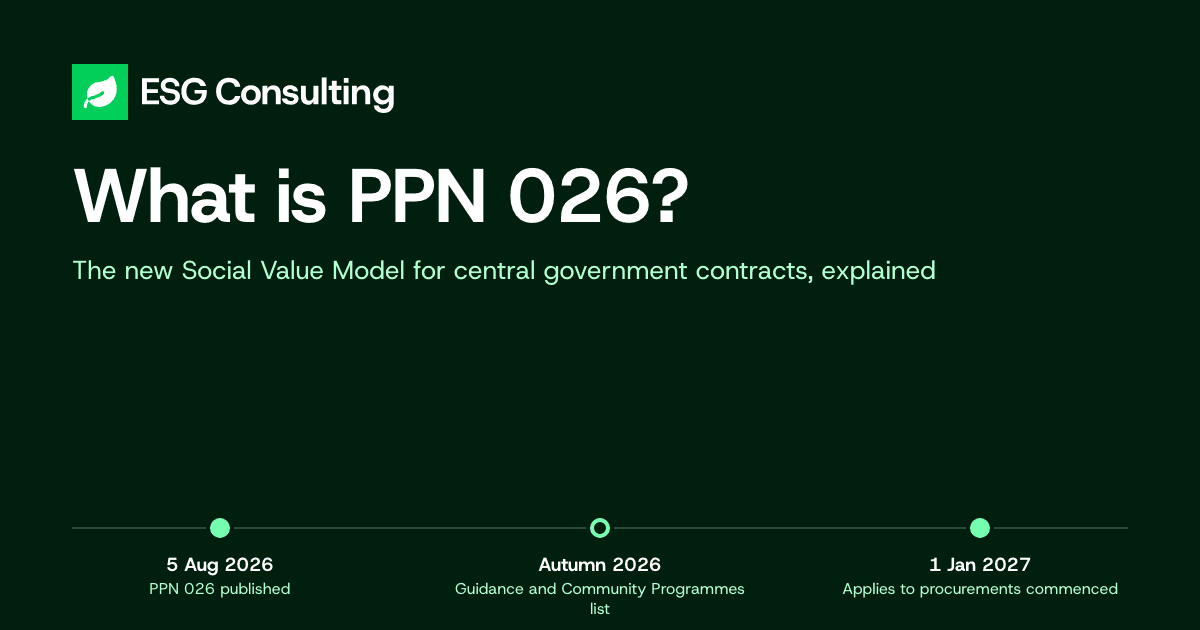
What is PPN 026? The new Social Value Model
PPN 026 replaces PPN 002 as the Social Value Model for central government contracts from 1 January 2027. Scope, the 10% and 20% weightings and the six criteria.
Read article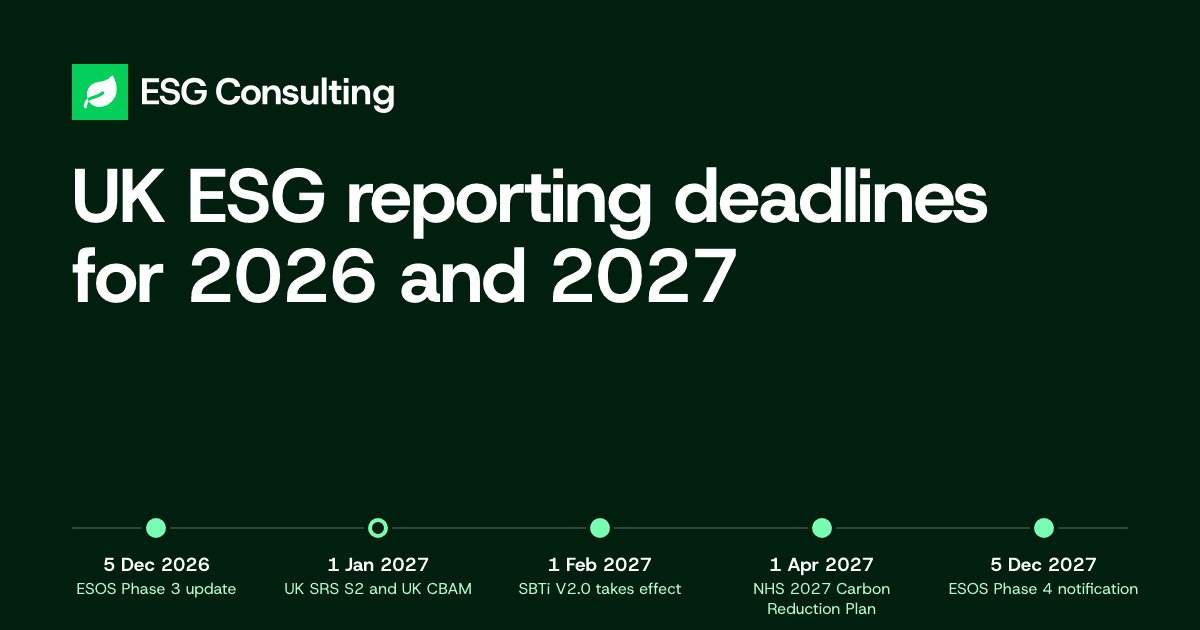
· 14 min read · Regulation
UK ESG reporting deadlines for 2026 and 2027
Every UK ESG reporting date to December 2027 - UK SRS, ESOS, SECR, UK CBAM, CSRD, SBTi, PPN 026 and the NHS - each marked mandatory, proposed or voluntary.
Read article