
what is tcfd, tcfd explained, uk climate disclosure, tcfd reporting, esg consulting uk
What Is TCFD and Why It Shapes UK Climate Disclosure
By ESG Consulting Team · · 15 min read
TCFD is the Task Force on Climate-related Financial Disclosures, a 2017 framework that became the backbone of mandatory climate disclosure for UK listed companies, large private companies, financial firms and central government. In practice, it is the language many UK boards now use when they explain how climate risk affects finance, strategy and reporting.
You may be sitting on a draft annual report, a disclosure schedule or a board pack that still treats climate as a separate sustainability topic. That's usually where the confusion starts, because TCFD is not just a policy label. In the UK, it sits inside a live reporting regime that has changed the way directors, finance teams and investment teams have to talk about climate-related financial information.
Table of Contents
- Why TCFD Matters for UK Companies Today
- The Origins and Purpose of the TCFD
- The Four Pillars and Eleven Recommended Disclosures
- How TCFD Became UK Law and FCA Rules
- Who Is in Scope Across the UK Market
- Scenario Analysis, Materiality and Emissions Reporting
- Is TCFD Still the Rule, or Is It Being Replaced
- Practical Next Steps for UK Organisations
Why TCFD Matters for UK Companies Today
A finance director in London is finishing the annual report, an investment team is reviewing a portfolio note, and a public-sector finance lead is drafting climate disclosures for the year end. They are all facing the same question, even if their organisations look very different, how do we explain climate-related risk in a way that investors, lenders and oversight bodies can effectively use?
That is where TCFD comes in. It is the Task Force on Climate-related Financial Disclosures, and in the UK it has become more than a voluntary framework. It is the basis for how climate-related financial information is structured in annual reports, regulatory filings and, for some bodies, public-sector accounts. The purpose is simple, publish climate information in a form that links directly to financial value, rather than leaving it buried in narrative ESG commentary.
Why boards keep coming back to it
The pressure is coming from several directions at once. Banks want to know how lending exposures could change. Investors want comparable reporting across companies. Procurement teams want evidence that suppliers understand transition risk. Directors, meanwhile, need enough clarity to sign off disclosures that are consistent, defensible and repeatable.
Practical rule: if climate could affect cash flow, asset values, insurance costs or access to capital, it belongs in the board's disclosure conversation.
TCFD matters because it gives that conversation a common structure. It asks organisations to explain governance, strategy, risk management, and metrics and targets in a way that people outside the business can read without a decoder ring. That makes it useful for credibility as well as compliance.
The UK context matters too. TCFD is now embedded in mandatory reporting for many entities, so this is no longer a question of whether sustainability teams want to add a climate section. It's a recurring board-level obligation that shapes annual reporting, lender discussions and investor confidence. For organisations trying to keep pace with the wider UK reporting transition, it also helps to understand how TCFD sits alongside newer disclosure directions, rather than treating it as a one-off exercise.
The Origins and Purpose of the TCFD
TCFD was created to solve a market problem, not to add extra paperwork for its own sake. Investors, lenders and insurers needed a consistent way to understand climate risk, and they needed organisations to explain that risk in financial terms. Without that, two companies with similar exposure could look very different on paper just because they described the issue in different ways.
What the framework was designed to fix
Think of a lender pricing a mortgage. If one property is exposed to flooding, subsidence or a costly retrofit requirement, but the risk is not described in a comparable way, pricing becomes inconsistent. TCFD tries to reduce that inconsistency by standardising the information decision-makers receive.
The framework was built around four disclosure areas, governance, strategy, risk management, and metrics and targets. That structure matters because it moves climate from a general statement of concern into the areas boards already use for financial oversight. The logic is direct. If management understands the risk, the board should oversee it. If strategy is exposed, that exposure should be tested. If risk is real, it should sit inside enterprise risk management. If progress matters, it should be measured.
Why the market adopted it
TCFD gained support because it answered a practical need. Central banks, supervisors and other market participants wanted disclosure that could travel across sectors and jurisdictions. Over time, that made TCFD the foundation layer for later reporting developments, including the standards now shaping the UK's wider transition.
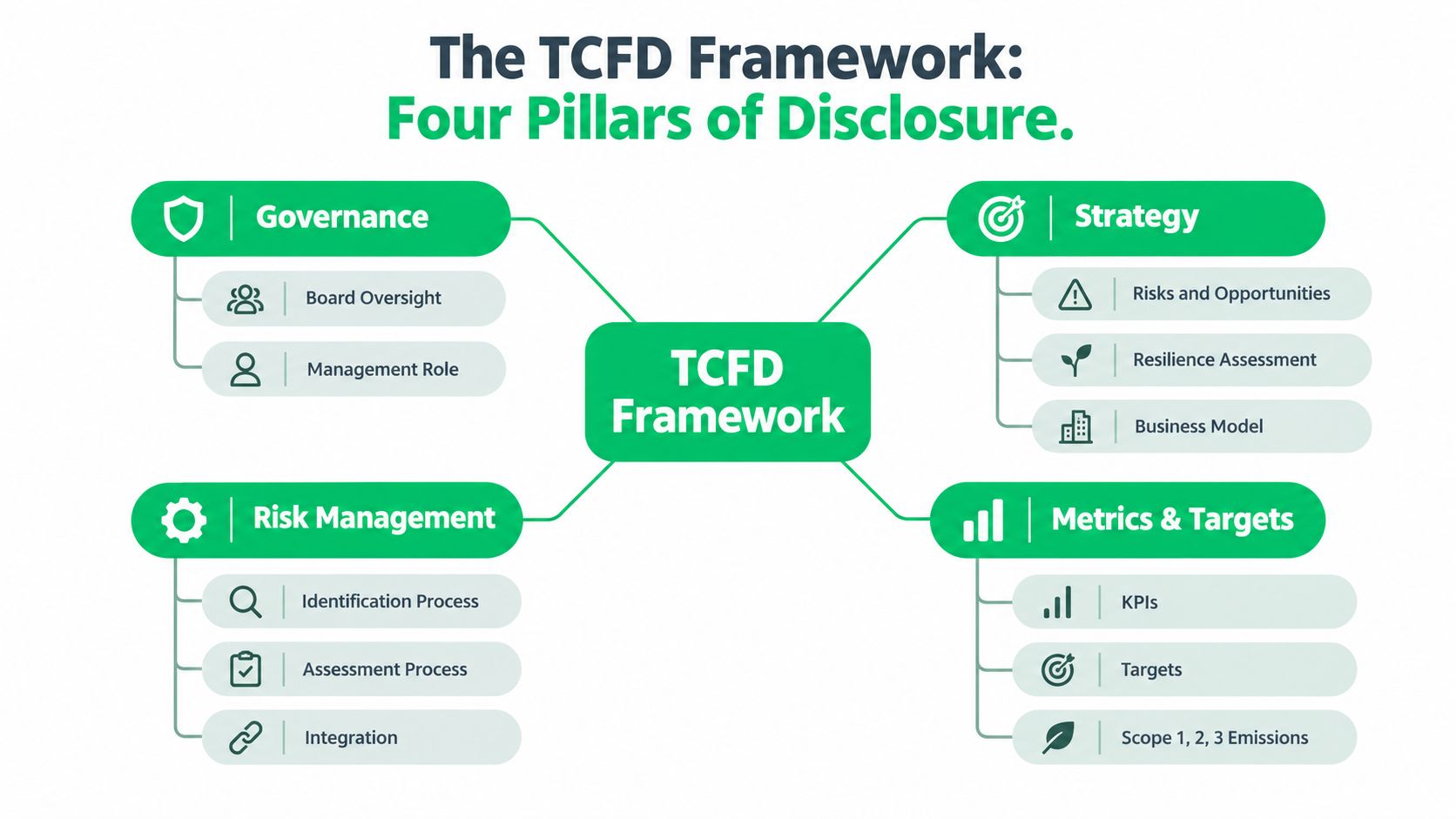
A useful way to read TCFD is as a reporting discipline. It does not tell a company what strategy to choose. It tells the company to show how climate risk was considered, who signed off the analysis, and how that thinking affects financial decisions. That is why it has remained so influential, even as the wider reporting environment changes.
The Four Pillars and Eleven Recommended Disclosures
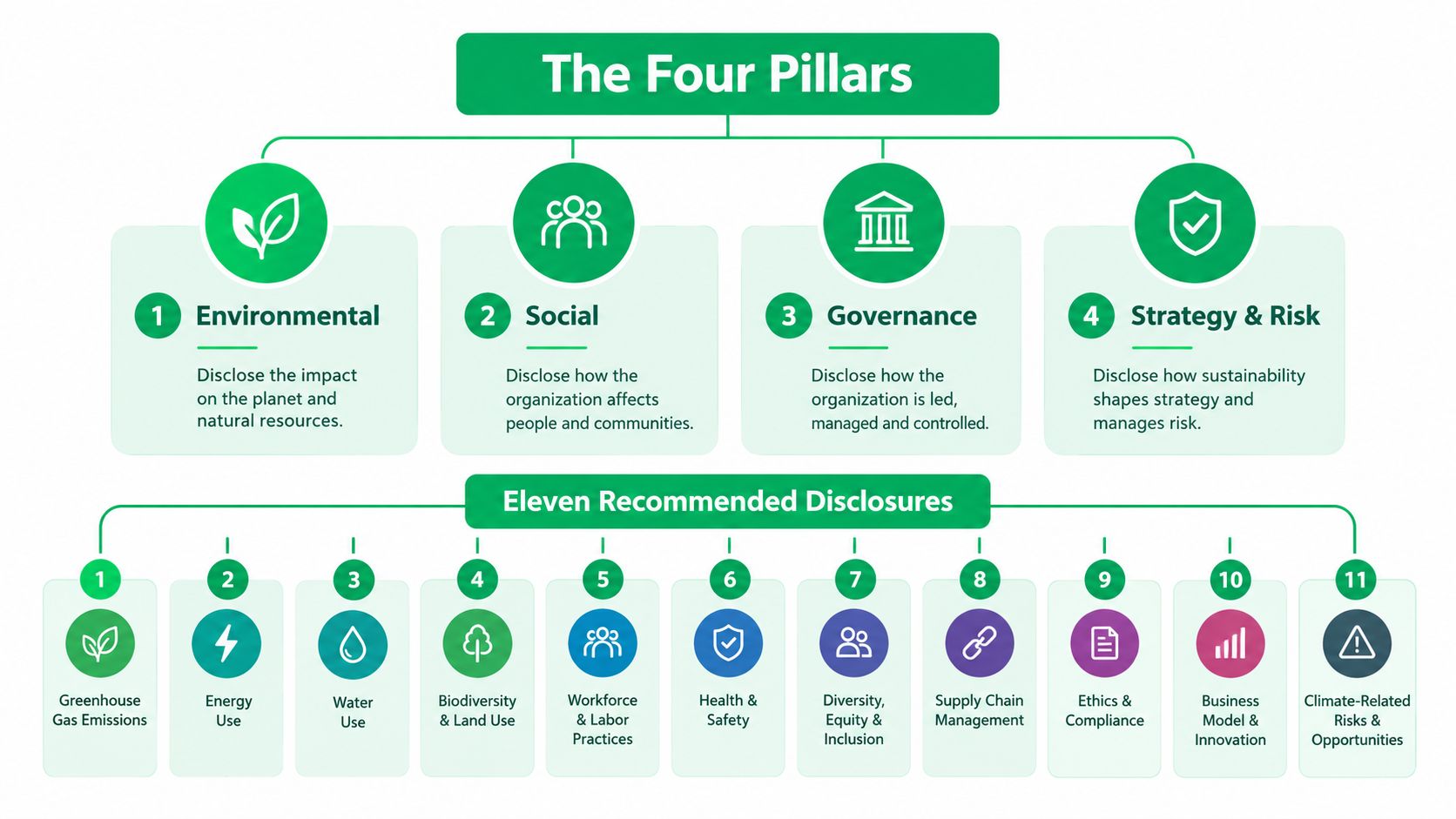
TCFD is organised around four pillars and eleven recommended disclosures. That combination is what turns a broad idea into a usable checklist for preparers. The pillars are the headings, and the eleven disclosures are the detailed prompts underneath them.
Governance and strategy
Under Governance, companies explain board oversight and management's role. That means showing who receives climate information, who challenges it, and who is accountable for decisions. The point is not to create a formalistic committee chart. The point is to show that climate risk is reviewed with the same seriousness as other financial risks.
Under Strategy, the disclosure asks how climate issues affect the business model, strategy, and planning horizon, including through scenario analysis. Boards are expected to think about short, medium and long-term exposure, and to test how resilient the business would be under different climate pathways, including a lower-carbon transition.
Risk management and metrics
Risk Management asks how climate risks are identified, assessed and integrated into the wider risk framework. A good disclosure shows the process, not just the conclusion. It should be clear whether climate issues sit inside existing enterprise risk processes, separate sustainability reviews, or both.
Metrics and Targets is where companies show the numbers and measures they use. In UK practice, this usually includes Scope 1 and Scope 2 greenhouse gas emissions, and Scope 3 where appropriate or material. It also includes the targets the organisation is using and progress against them.
Boards often get stuck by treating the eleven disclosures as optional commentary. They're better understood as the questions a reviewer expects to see answered, even where proportionality means some disclosures are lighter than others.
That distinction matters. TCFD is not a free-form essay, but it also isn't a rigid one-size-fits-all form. The disclosure should be proportionate to the organisation's circumstances, while still covering the core questions. If those questions are left unanswered, the report may look polished and still fail the basic purpose of climate disclosure.
How TCFD Became UK Law and FCA Rules
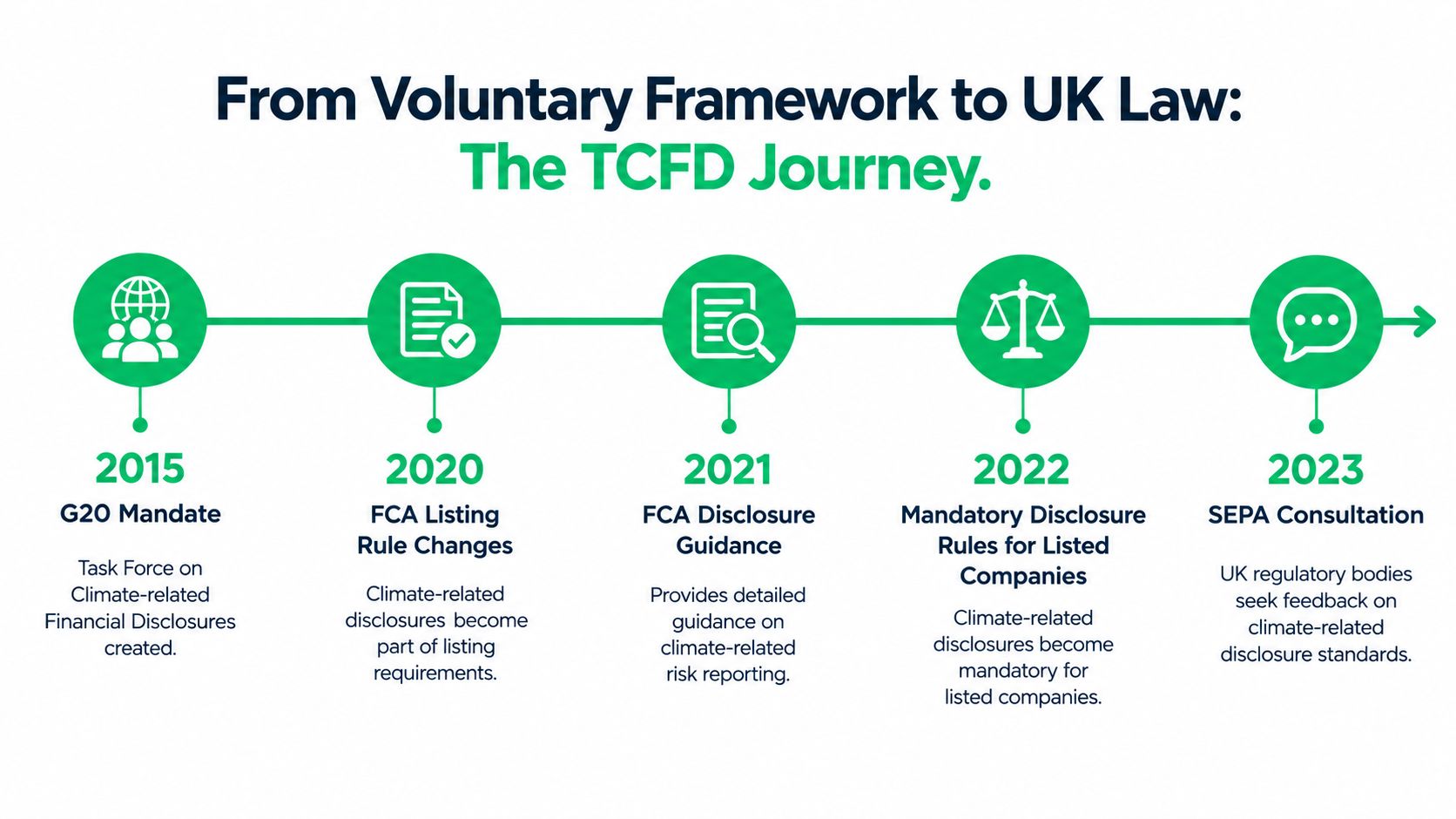
The UK turned TCFD from market guidance into a reporting regime in stages. That phased approach is important, because many organisations still assume there was a single start date. There wasn't.
The move from framework to regulation
The first key step was the FCA's rule for premium listed commercial companies, which applied to accounting periods beginning on or after 1 January 2021. That meant climate disclosure had already become part of the annual reporting cycle for a defined group of listed issuers. The broader UK rollout then expanded the regime so that by 6 April 2022, publicly quoted companies, large private companies and LLPs in scope had to disclose climate-related financial information in annual reports, making the UK the first major economy to mandate TCFD-style disclosure across a wide corporate base.
That matters because it changed the baseline. Climate reporting was no longer just about signalling good practice. It became part of the mandatory reporting architecture for large parts of the UK market.
Financial services and public bodies
The financial services regime runs alongside that company reporting route. The FCA introduced mandatory annual TCFD-aligned disclosures for certain asset managers, asset owners, life insurers and regulated pension providers, with both entity-level and product or portfolio-level reporting required in the rules. The public-sector side also moved in the same direction, with government guidance extending TCFD-style reporting into public-sector annual reports.
Compliance insight: many groups now need to coordinate company reporting, regulated financial-services reporting and public-sector alignment at the same time, even though the rules are not identical.
For a UK compliance lead, the practical point is that TCFD is not one regime. It is a family of reporting obligations with different scopes, different dates and different reporting locations. That is why timeline management matters as much as content quality.
Who Is in Scope Across the UK Market
The easiest mistake is to think TCFD only applies to premium listed companies. That was the starting point, but it is not the full picture now. UK scope reaches across listed issuers, large private companies, LLPs, financial institutions and, in some areas, public bodies.
The main populations
| Entity type | Rulebook | First reporting year | Disclosure location |
|---|---|---|---|
| Premium listed issuers | FCA listing rules | 2021 | Annual report |
| Publicly quoted companies, large private companies and LLPs in scope | UK company reporting regulations | 2022 | Annual report |
| Asset managers, asset owners, life insurers and FCA-regulated pension providers | FCA climate disclosure rules | Phased, depending on firm type | Entity-level and product or portfolio-level statements |
| Public-sector bodies | Government guidance for aligned reporting | Phased | Annual reports and accounts |
The first two rows are the ones many boards recognise from the company reporting side. The third row matters because regulated financial firms have to think in terms of portfolios, products and entity disclosures. That makes the evidence base more demanding, especially where investment teams need consistent metrics across multiple funds.
Why scope is more than a legal label
The reason scope matters is that the reporting burden changes depending on what you do. A listed company may focus on the strategic report. An asset manager has to think about portfolio data and product-level narratives. A public body may need to connect climate risk to service delivery and financial planning.
For organisations trying to map their obligations, a current deadlines overview can help them see where TCFD overlaps with newer sustainability work, especially if they are also tracking transition planning, annual report cycles and assurance needs. One useful starting point is the UK ESG reporting deadlines overview from ESG Consulting, which can help teams place TCFD in a broader reporting calendar.
That is the practical takeaway. Scope is no longer just a tick-box about whether you are listed. It is a question of which legal perimeter you sit in, what documents you publish, and who depends on the information.
Scenario Analysis, Materiality and Emissions Reporting
Three parts of TCFD usually cause the most friction in board discussions, scenario analysis, materiality and emissions reporting. They sound technical because they are technical, but the logic behind them is straightforward once the terms are unpacked.
Scenario analysis and materiality
Scenario analysis is not a forecast. It is a structured way to test whether the organisation's strategy still works under different plausible futures. A board might look at a lower-carbon transition and compare it with a more delayed transition, then ask what that means for demand, capital expenditure, supply chains and operating costs.
Materiality in UK TCFD-style reporting is mainly about financial materiality. That means the question is whether climate information could influence decisions made by investors or lenders. If a risk is not financially material, it may not need the same level of disclosure. That is different from broader impact-based reporting models, where the organisation also reports on its effect on the environment or society.
Emissions and evidence
On emissions, TCFD expects organisations to report Scope 1 and Scope 2 emissions, with Scope 3 where appropriate or material. Scope 1 is direct emissions from sources owned or controlled by the company. Scope 2 is indirect emissions from purchased energy. Scope 3 covers the value chain, which is where the data often gets hardest.
Boards need more than a number on a page. They need to see the assumptions behind the scenarios, the governance sign-off on the analysis, and the data lineage that makes the emissions inventory auditable. Without that, the disclosure can't really support decision-making or assurance.
If the board can't explain the model, the disclosure is probably not ready.
One practical way to pressure-test the pack is to ask whether each metric can be traced back to source data, who reviewed the calculation methodology, and whether the scenario outcomes led to a real strategic conversation. That test catches a lot of weak reporting early.
For teams already working on Scope 3, the distinction between value-chain data and direct emissions becomes central. A focused explainer on Scope 3 emissions can help frame that work before it enters the annual report.
Is TCFD Still the Rule, or Is It Being Replaced
Yes, TCFD is still the current legal basis for UK climate disclosure during the 2025 reporting cycle, but it now sits inside a transition. That is the part many generic explainers miss, and it is why so many boards ask whether they should keep treating TCFD as the main framework or move straight to UK SRS.
What changed in the UK
The FCA has confirmed that listed companies, asset managers, life insurers and FCA-regulated pension providers still have TCFD-linked reporting obligations, while also updating the rules to reflect the direction of travel set in July 2024. The effect is not a clean break. It is a managed transition, with TCFD still functioning as the operative reporting basis while UK sustainability standards are developed.
That matters because organisations can't assume the old framework has vanished. They still need to report against the existing requirements, while preparing for the next version of the rules.
How TCFD connects to UK SRS and ISSB
UK sustainability reporting is being built on ISSB standards, and TCFD has been formally incorporated into that wider architecture. So the question is not whether climate disclosure disappeared. It is how the existing TCFD-style reporting shifts into a new standard-set.
For in-scope entities preparing FY2025 reports now, that means two things. First, they should keep current disclosures aligned with the existing UK requirements. Second, they should design the next cycle so the same data, governance and scenario analysis can support UK SRS preparation when the timetable lands.
The clean answer for boards is this, TCFD is not over, but it is no longer the end point. It remains the live legal basis in the UK today, and it is being folded into a broader sustainability reporting regime rather than thrown away. That is why the best disclosures now are built to survive the transition, not just the present filing season.
Practical Next Steps for UK Organisations
The next board meeting is the right place to turn TCFD from a reporting headache into a managed workstream. Start with scope, then move to evidence, then decide what needs strengthening before the next reporting cycle.
A practical sequence for the next quarter
- Confirm your perimeter: check whether you sit inside the FCA premium-listing rules, the large company and LLP regime, or the financial-services perimeter.
- Map each disclosure point: compare current reporting against the eleven recommended disclosures and mark where the evidence is thin.
- Test governance: make sure the board, audit committee or risk committee can show how climate issues are reviewed and signed off.
- Refresh scenario analysis: use at least two temperature pathways and document the assumptions, limitations and strategic implications.
- Tighten emissions data: improve Scope 1 and Scope 2 inventories first, then document the material Scope 3 categories that matter most.
- Prepare for transition: align data and governance so the same work can support UK SRS readiness later.
Where teams are still wrestling with how to judge significance, a structured ESG materiality assessment can help separate what is material from what is merely interesting. That is often the missing link between climate ambition and a report that can stand up to challenge.
Common failure points are predictable. Boilerplate risk language gives the impression of movement without showing it. Scenario work gets published before the board has challenged it. Metrics appear without baselines, so no one can tell whether performance is improving or not.
If your disclosure is already in place, use the next cycle to make it more decision-useful. If it isn't, get the governance, data and scenario work under control before trying to polish the narrative.
ESG Consulting helps UK organisations with climate-related financial disclosures, including TCFD-style reporting, scenario analysis and board governance narratives. If you need support turning climate data into a report that is clear, defensible and ready for the next UK reporting cycle, visit ESG Consulting and review how its disclosure and sustainability services can fit your team's work.
More from the blog
· 12 min read · Regulation
What is PPN 026? The new Social Value Model
PPN 026 replaces PPN 002 as the Social Value Model for central government contracts from 1 January 2027. Scope, the 10% and 20% weightings and the six criteria.
Read article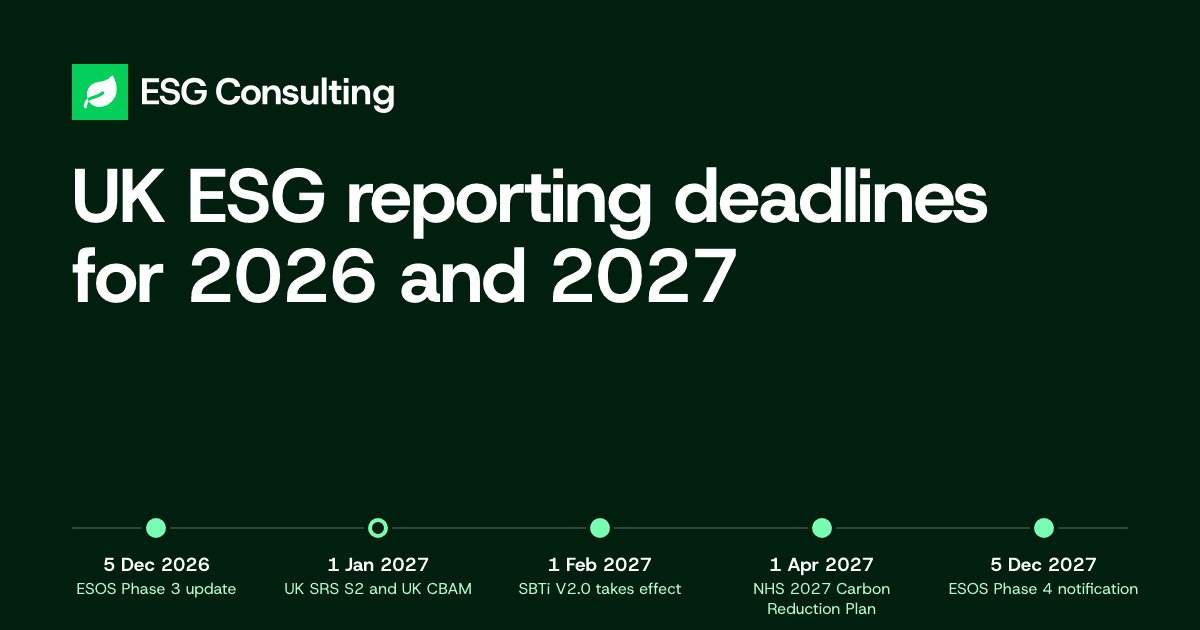
· 14 min read · Regulation
UK ESG reporting deadlines for 2026 and 2027
Every UK ESG reporting date to December 2027 - UK SRS, ESOS, SECR, UK CBAM, CSRD, SBTi, PPN 026 and the NHS - each marked mandatory, proposed or voluntary.
Read article