
esg materiality assessment, materiality assessment, double materiality, csrd materiality, sustainability strategy
How to Run an ESG Materiality Assessment That Stands Up
By ESG Consulting Team · · 17 min read
You're usually not short of ESG data. You're short of a decision that will survive the next board paper, the next assurance review, and the next question from finance about why one topic was raised while another was left out. That's pressure point in an esg materiality assessment in the UK now, because materiality is no longer a loose sustainability exercise, it sits inside statutory reporting judgement.
The shift is clear in UK climate reporting rules and the government's sustainability guidance. Mandatory climate-related financial disclosures for certain quoted and large private companies under the Companies (Strategic Report) (Climate-related Financial Disclosure) Regulations 2022 brought TCFD-aligned reporting into annual reports, and UK guidance ties materiality to whether omitted or misstated information could reasonably influence decisions made on annual reports and accounts, including whether climate-related risks or opportunities are a principal risk or a significant component of one as set out in the government's regulations guidance. In practical terms, that means the output has to stand up as a regulated judgement, not a consensus workshop note.
The method that works is usually the same five-stage sequence, even if the language changes by framework. Map stakeholders, build a long-list of topics, score them through impact and financial lenses, validate the result with evidence, then embed the final matrix into strategy and reporting cadence. The deliverable that survives assurance is not the meeting minute, it's the evidence trail that shows why a topic was included, excluded, merged, or escalated.
For a broader compliance context, it helps to keep the wider UK reporting context in view, including environmental and carbon obligations that can sit alongside materiality work, as outlined in this UK environmental legislation guide.
Table of Contents
- Why ESG Materiality Is Now a Regulated Judgement
- Mapping Stakeholders and Building the Influence-Impact Matrix
- Building the Long-List of ESG Topics
- Scoring Topics Using Impact, Financial and Double Materiality
- Validating the Matrix and Capturing Audit-Ready Evidence
- Embedding Materiality into Strategy and Ongoing Reporting
- Quick Reference Checklist for Your Next Assessment
Why ESG Materiality Is Now a Regulated Judgement
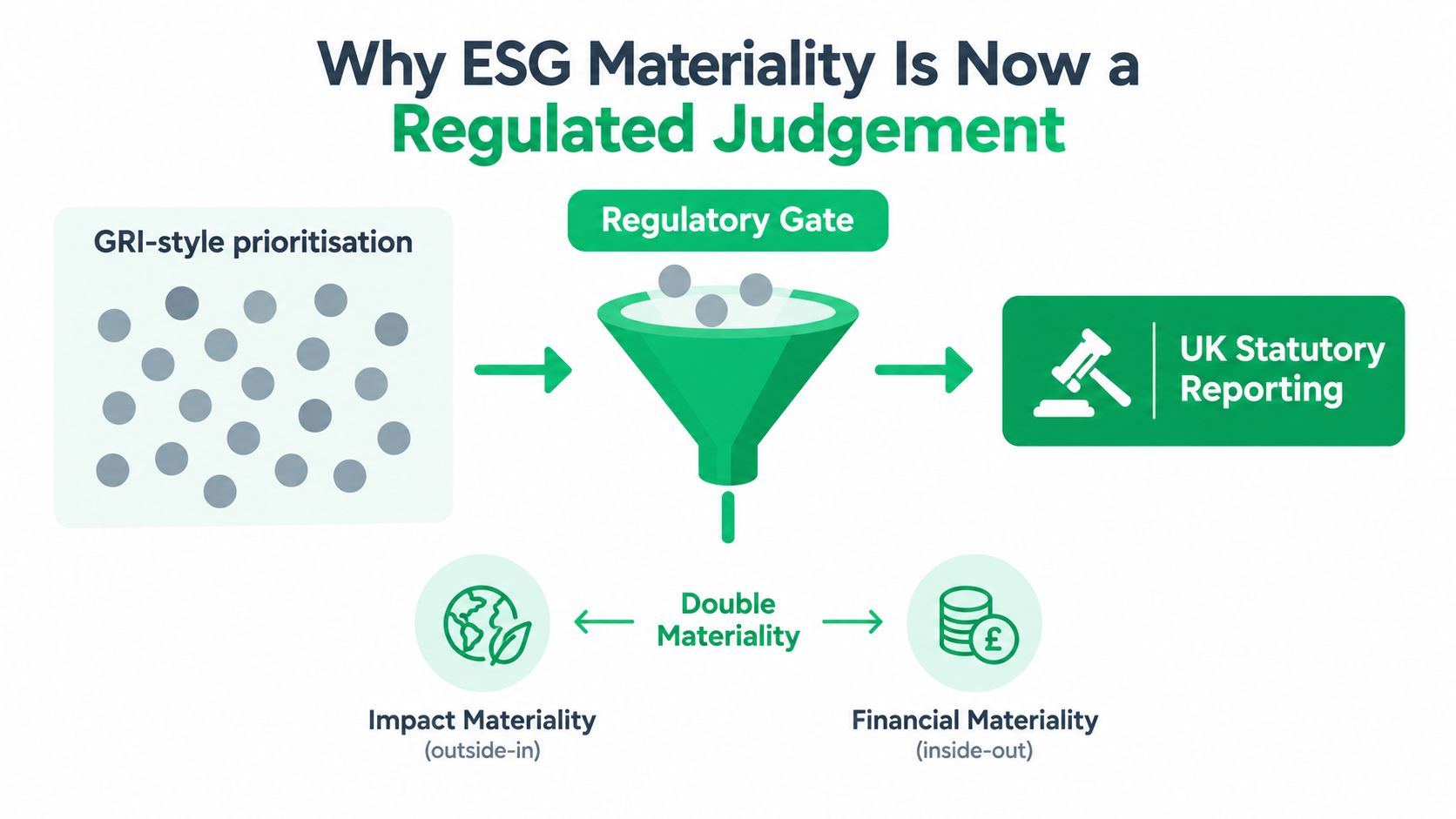
A board can still treat materiality assessment like a workshop output, but that approach will not survive UK reporting scrutiny. In practice, the question is whether a judgement can be defended within the statutory reporting boundary, including omission tests and principal-risk analysis, as set out in the UK disclosure framework.
Why the legal context changes the method
GRI-style prioritisation still has a place. It helps compare topics across operations, stakeholders and the value chain. The difference is that UK statutory reporting places the judgement inside annual reporting, board accountability and audit review. Under the 2025-26 guidance, materiality applies beyond the minimum content and companies must explain non-compliance, so the exercise becomes a formal filter rather than a loose sustainability narrative.
That matters because a weak judgement can leave a report exposed. If a company leaves out a topic that later proves material to strategy, risk or stakeholder decisions, the problem is not just reputational. It can trigger restatement pressure, qualification risk and questions from the board about why the framework missed it. The FRC's advice on a materiality mindset is useful because it and stresses connected judgement across reporting inputs. Silos are where material issues get missed.
Practical rule: if you cannot show who decided, against what criteria, and with which evidence, the assessment is not finished.
What the assessment must produce
A credible UK assessment should end with five outputs, even if they sit in separate working papers.
- Stakeholder map showing who was considered and why.
- Topic long-list with source-to-source traceability.
- Scoring matrix that separates impact and financial judgement.
- Validation record showing dissent, challenge and sign-off.
- Reporting mapping that links material topics to disclosures, KPIs and risk registers.
That is the standard that survives board scrutiny. Consensus helps, but it is weak evidence on its own. Auditors and reviewers need criteria, challenge points and a clear evidence trail.
For the wider compliance picture, keep the broader UK reporting context in view, including environmental and carbon duties that can sit alongside materiality work, as set out in this UK environmental legislation guide.
Mapping Stakeholders and Building the Influence-Impact Matrix
A weak stakeholder map usually fails for one simple reason, it reflects internal convenience instead of external relevance. The organisations that do this well build the map around who can shape decisions, who carries the impact, and where friction is most likely to surface in reporting or operations.
Who needs to be in the room, or at least in the evidence pack
The UK categories that should normally be considered are shareholders and asset owners, lenders and insurers, employees and trade unions, customers and supply-chain partners, regulators, NGOs and local communities, and sector peers via industry bodies. The regulator set should be named explicitly where relevant, including the FCA, FRC, HSE and Environment Agency. If a group is excluded, the rationale needs to be recorded, not assumed.
Auditors will normally expect to see different sources for each category. AGM voting records and stewardship letters make sense for shareholders. Workforce engagement statements, consultation notes and trade union correspondence matter for employees. FCA consultations, risk correspondence and section 172(1) compliance documentation help demonstrate that regulatory and director-duty perspectives were considered. For customers and supply-chain partners, contracts, supplier questionnaires and complaint trends are usually more defensible than broad claims about “market expectations”.
A weighted matrix that is easy to explain
A simple approach is to use three lenses, influence, dependency and tension or attention. Keep the weighting fixed and transparent so people can't move the goalposts after seeing the result. One workable structure is influence at 0.33, dependency at 0.33 and tension or attention at 0.34. That slight tilt towards tension helps surface issues that are disruptive even when they are not the loudest in the room.
| Stakeholder | Influence (0.33) | Dependency (0.33) | Tension (0.34) | Weighted Score |
|---|---|---|---|---|
| Regulators | 5 | 4 | 5 | 4.67 |
| Shareholders and asset owners | 5 | 3 | 4 | 4.00 |
| Customers and supply-chain partners | 4 | 5 | 4 | 4.31 |
| Employees and trade unions | 3 | 5 | 4 | 4.01 |
| NGOs and local communities | 2 | 4 | 5 | 3.35 |
The point of the table is not mathematical precision. It is to force a reasoned ranking of engagement priority and to show why some voices are central even if they don't hold formal voting power. If NGOs rate modern slavery or biodiversity higher than investors do, that divergence should remain visible in the working papers rather than being smoothed away.
Assurance tip: omitted stakeholder groups are one of the most common findings in practice, so keep an exclusion log beside the matrix from the first draft.
A lot of teams get trapped by “stakeholder outreach” that is really a series of ad hoc interviews. That rarely holds up well. The better method is to define the universe first, score the groups, then invite challenge where the score or the exclusion looks weak.
Building the Long-List of ESG Topics
The long-list should come from more than one framework, otherwise it reflects the bias of a single standard and misses issues that matter to the business model. A defensible list usually draws from ESRS topical standards, the GRI Universal Standards topic library, relevant SASB metrics, TCFD recommended disclosures, peer reports from two or three listed comparators, and horizon-scanning outputs from regulators and public bodies.
How to collect and clean the topic universe
The safest approach is to start broad, then reduce carefully. Build the first pass from source lists, company risks, prior-year disclosures, supplier issues, and sector-specific obligations. Then deduplicate where two labels point to the same issue. For example, “climate transition planning” and “climate adaptation” might belong in one ESRS E1-aligned entry if the business has treated them as inseparable in risk management and strategy. Every merge decision should be logged with the source references that justified it.
That log matters because later reviewers will ask why one topic was rolled up and another was kept separate. If the answer is “they felt similar”, the file is weak. If the answer is “they are treated together in risk ownership, metrics and disclosure”, the logic is much stronger.
Keep the list usable, not endless
A long-list that grows without restraint becomes unusable. In practice, 25 to 35 topics is usually enough to keep scoring manageable while still covering material risk and impact. Every topic should be framed as a statement of impact, risk or opportunity, because that wording makes later scoring against both materiality dimensions much cleaner.
Examples include:
- Scope 3 emissions from purchased goods and logistics.
- Packaging waste and circularity.
- Worker health and safety.
- Human rights due diligence in the value chain.
- Biodiversity net gain or land-use impacts where relevant.
Some topics need legal review before they reach scoring, especially human rights obligations linked to the Modern Slavery Act and biodiversity-related commitments where planning or land-use duties may be in play. If you need a clean reference point for Scope 3 framing, this Scope 3 emissions guide is a useful internal benchmark for how value-chain topics are usually structured.
Discipline is restraint. More topics do not make the assessment better, they often make it harder to defend.
Scoring Topics Using Impact, Financial and Double Materiality
A score is only as good as the judgement behind it. Materiality reviews go wrong when teams compress several decisions into one number and then present the result as if it were objective. A better approach separates impact materiality from financial materiality, then shows how double materiality brings the two into one decision trail.
Two lenses, two kinds of judgement
Impact materiality asks how severe the organisation's effects are on people and the environment. In practice, that means testing severity, scope and irremediability. Financial materiality asks whether the issue could reasonably affect enterprise value through likelihood, magnitude and time horizon. The questions are related, but they are not the same.
Write the thresholds down before scoring starts. A consistent 1 to 5 scale works well if the team agrees what each point means in advance. Without those definitions, scoring becomes instinct dressed up as method. With them, the matrix can show why one topic sits high enough to require action while another remains on watch.
A worked example from a UK retailer
Take a UK retailer assessing Scope 3 emissions and packaging waste. Scope 3 emissions often score strongly on impact because of their value-chain reach, and they can also score strongly on financial materiality if customer expectations, procurement cost, supplier access or transition risk are in play. Packaging waste may look similar on the impact side, but its financial score will depend on regulation, format-change costs and brand sensitivity.
| Dimension | Impact Materiality Criteria | Financial Materiality Criteria | Worked Example, Scope 3 Emissions |
|---|---|---|---|
| Scope | Breadth of people or ecosystems affected | Breadth of financial exposure across operations or value chain | Broad, because purchased goods, logistics and use-phase effects can extend across the chain |
| Severity or magnitude | How serious the harm or benefit is | How large the financial effect could be | Potentially high because emissions cuts can affect strategy, supplier selection and reporting quality |
| Time horizon | Current and future impacts | When the financial effect could emerge | Both near and longer term, because transition pressure and reporting obligations are ongoing |
| Irremediability | How hard it is to reverse the impact | How hard it is to unwind the financial consequence | Hard to reverse if supplier and logistics systems are locked in |
| Outcome | Material on impact grounds if threshold is met | Material on financial grounds if threshold is met | Often material under both lenses |
The common error is letting finance veto a social or environmental topic because the immediate P&L effect looks small. That weakens the method. The FRC's guidance on materiality points in the opposite direction. Quantitative thresholds, qualitative financial aspects and sustainability information need to be considered together, in one connected judgement process, not in separate silos. The FRC's guidance on the materiality mindset reinforces that broader approach.
Useful discipline: write the threshold before you score the topic, not after you have seen where it lands.
What to record in the working papers
Each score needs a clear rationale, the assumptions behind it, any dissenting view and the evidence used. If the issue is borderline, say so. If the team demoted a topic because controls are strong, record the control basis and identify who reviewed it. Assurance teams do not need perfect certainty, but they do need a traceable judgement chain that can survive challenge.
Validating the Matrix and Capturing Audit-Ready Evidence
A draft matrix is not a finished product until someone outside the core drafting team has challenged it. Validation is where weak assumptions get exposed, especially when different stakeholders do not agree on what is most material.
How to run the challenge process
A good validation panel mixes internal functions with external perspective. It usually includes finance, legal, procurement, operations, sustainability and relevant business leaders, with a separate route for stakeholder feedback where needed. Weighting votes by stakeholder group can help, but the value is in the disagreement. If NGOs rank modern slavery higher than investors do, or operations push back on the practicality of a topic, that tension should be logged, not averaged away.
Board-level sign-off should be a formal minute item, not an email approval buried in a thread. In practice, the CFO and Sustainability Director should co-sign the matrix, because that shows the issue has been tested against financial reporting logic and sustainability judgement together. If the board asks why a topic was excluded, the answer must be in the pack, not reconstructed later.
What the evidence trail needs to contain
For assurance, the file should contain source documents for each topic score, the scoring rubric, attendee lists, meeting minutes, challenge notes and a clear rationale log for every inclusion, exclusion and merge decision. That is the minimum standard that turns the exercise into an auditable process rather than a slide deck. A useful internal reference point on how advisory support can be structured is this sustainability reporting consultant guide, especially where the assessment needs to connect reporting method, controls and sign-off.
The failure modes are predictable:
- Undated scoring sheets, which make it impossible to prove when the judgement was made.
- Missing threshold rationale, which leaves the score looking arbitrary.
- Unsigned matrices, which break the accountability chain.
- No dissent log, which hides challenge and weakens the defence.
- Source gaps, where the score cannot be traced back to evidence.
Why this matters for assurance
Both reasonable and limited assurance depend on traceability, consistency and documented judgement. The assurance provider is not just checking whether the conclusion looks sensible. They're checking whether the process was repeatable, controlled and anchored in evidence. If the matrix can't survive that review, it doesn't matter how polished the final report looks.
Embedding Materiality into Strategy and Ongoing Reporting
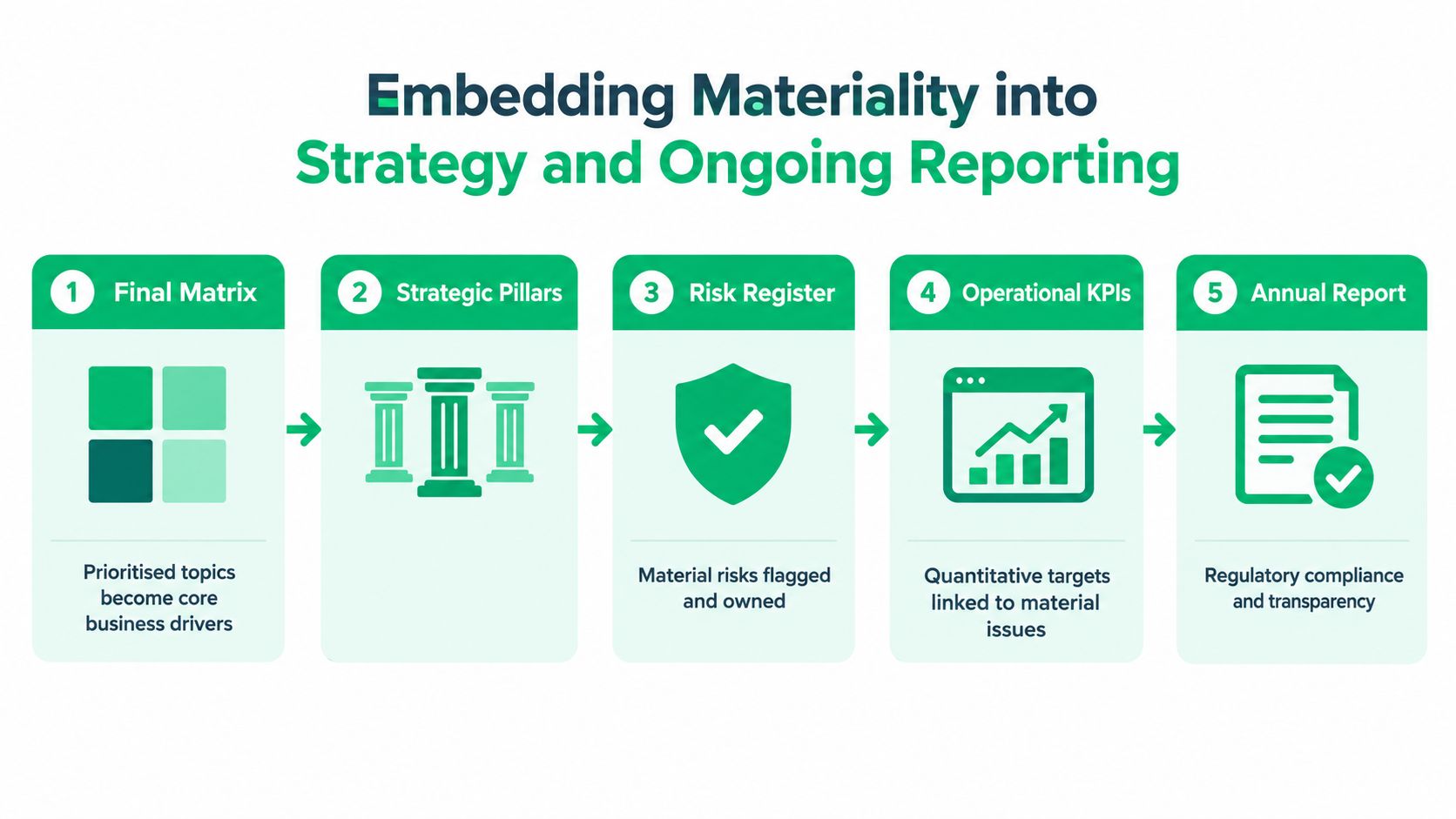
The best matrix in the world is useless if it sits in a sustainability appendix and never reaches the operating model. Material topics need to move into strategy, risk, performance management and reporting, otherwise the assessment becomes a compliance artefact with no business use.
How the matrix should cascade
Start by turning each material topic into a strategic pillar or a defined management theme. Then push it into the risk register, assign ownership, and attach KPIs that management reviews. Where remuneration is tied to ESG metrics, the connection should be explicit, because otherwise the board can't show that the materiality outcome affected decisions.
The mapping to reporting frameworks should be direct. Under the UK government's sustainability guidance, materiality applies to information beyond the minimum requirements, while the minimum disclosures themselves still have to be reported, including Scope 1 and Scope 2 emissions in the 2025-26 guidance and a materiality-based approach to Scope 3 as set out in the guidance. That means the matrix should tell you what is mandatory, what is material enough to expand, and what stays out of scope for narrative detail.
Keep the review rhythm live
Materiality changes. Business models change, regulation changes, and stakeholder pressure changes. A yearly review is the minimum sensible cadence, with a fuller refresh every two to three years. Interim updates should happen after a major regulatory change, a significant acquisition or disposal, or a reputational incident that alters risk perception.
The organisations that drift usually don't fail on the first assessment, they fail because nobody owns the refresh cycle.
A practical 12-month rhythm keeps the work live:
- Q1, strategy refresh. Reconfirm business priorities, risk appetite and boundary assumptions.
- Q2, stakeholder re-engagement. Test whether the stakeholder map still reflects reality.
- Q3, KPI review. Check whether the reporting metrics still align with the topics ranked as material.
- Q4, audit preparation. Lock the evidence pack, sign-off chain and disclosure mapping before year-end reporting.
The process only works if the matrix stays connected to operating decisions. When it does, the assessment stops being a one-off exercise and becomes part of how the organisation manages risk and tells its story.
Quick Reference Checklist for Your Next Assessment
Use this as a boardroom handout, not a poster. The point is to catch the mistakes that make a materiality file fall apart under review.
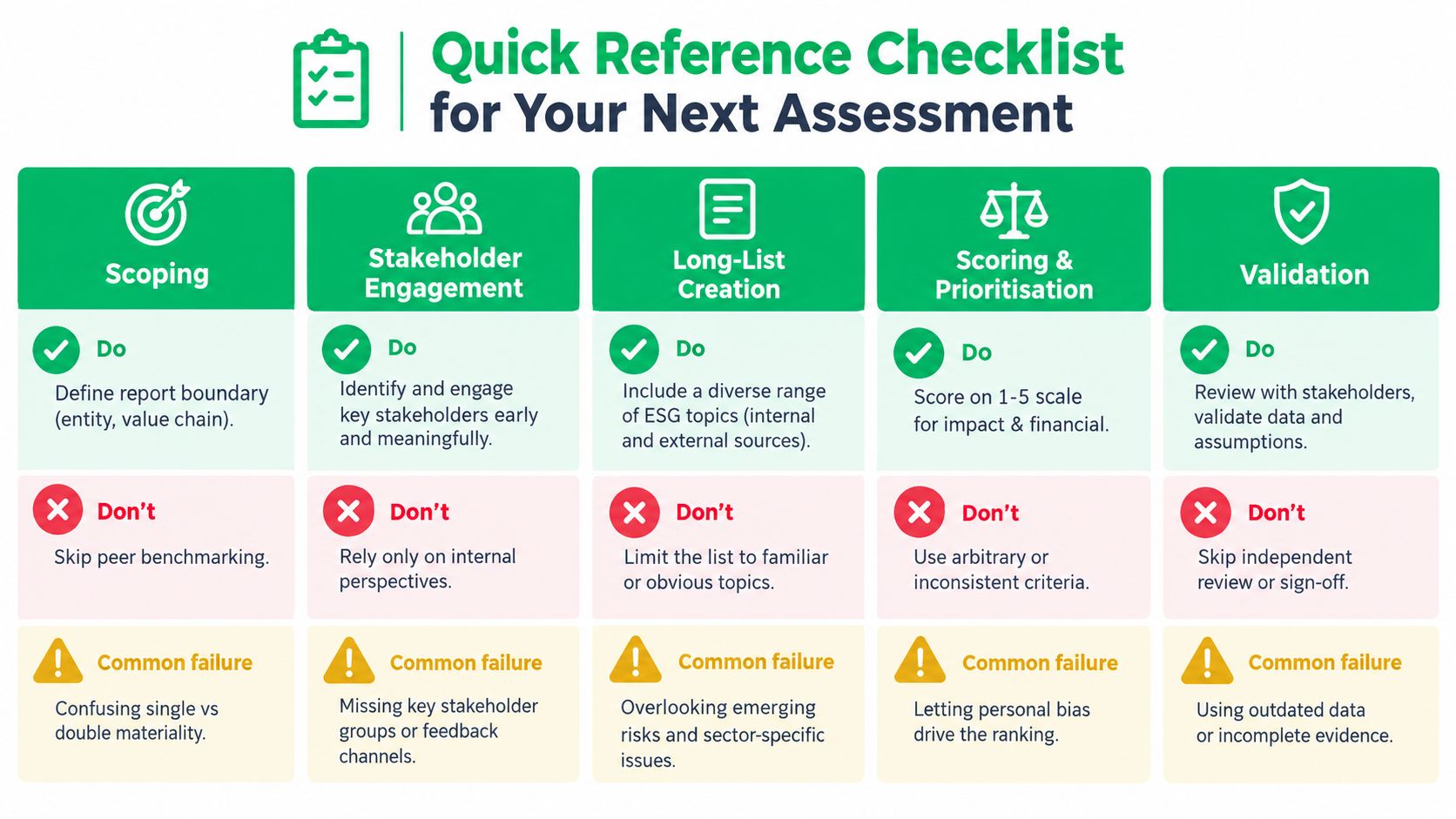
Scoping and stakeholder engagement
- Do: Secure board sponsorship before topic mapping starts.
- Do: Define the reporting boundary, entity and value chain before any workshop is held.
- Do: Engage assurance and legal early if the assessment will feed statutory reporting.
- Don't: Treat materiality as a PR exercise or a one-off annual survey.
- Don't: Rely only on investor views and ignore workers, suppliers and communities.
- Common failure: A stakeholder map with no exclusion rationale and no evidence trail for who was considered.
Long-list creation and scoring
- Do: Build the long-list from ESRS, GRI, SASB, TCFD, peers and regulatory horizon scanning.
- Do: Deduplicate overlapping issues and record each merge decision.
- Do: Review the matrix against sector standards where they apply.
- Don't: Let one function write the topic list in isolation.
- Don't: Mix impact and financial judgement into a single vague score.
- Common failure: Undocumented threshold rationale, single-source scoring and no distinction between single and double materiality.
Validation and embedding
- Do: Run a challenge session with finance, legal, operations and sustainability.
- Do: Record dissenting views and keep them in the working papers.
- Do: Co-sign the final matrix and link it to KPIs, risk controls and disclosure drafting.
- Don't: Leave the matrix unsigned or approved only by the sustainability team.
- Don't: Disclose KPIs that don't match the final material topics.
- Common failure: A clean-looking report that cannot be tied back to source documents, minutes and sign-off.
Review the matrix after any material event, regulatory change or M&A, and refresh stakeholder weights at least once a year. If the evidence pack would be hard to defend in front of an auditor, it needs another pass before the report goes out.
If you need a materiality process that holds up in UK statutory reporting, ESG Consulting can help you structure the assessment, tighten the evidence trail and prepare it for assurance. Visit ESG Consulting to discuss a board-ready ESG materiality assessment that links strategy, disclosure and controls without leaving weak points in the file.
More from the blog
· 12 min read · Regulation
What is PPN 026? The new Social Value Model
PPN 026 replaces PPN 002 as the Social Value Model for central government contracts from 1 January 2027. Scope, the 10% and 20% weightings and the six criteria.
Read article
· 14 min read · Regulation
UK ESG reporting deadlines for 2026 and 2027
Every UK ESG reporting date to December 2027 - UK SRS, ESOS, SECR, UK CBAM, CSRD, SBTi, PPN 026 and the NHS - each marked mandatory, proposed or voluntary.
Read article