rules and regulations, esg compliance, sustainability reporting, uk secr, esos phase 3
UK ESG Rules and Regulations: A Compliance Guide for 2026
By ESG Consulting Team · · 15 min read
You've been asked to confirm whether your organisation falls within SECR, ESOS, climate-related financial disclosure rules, UK Sustainability Reporting Standards, or perhaps an EU regime as well. The difficulty isn't finding the acronyms. It's deciding which legal entities, activities, reporting periods and evidence records matter to your group.
A checklist can tell you that a rule exists. It won't tell you whether a subsidiary is captured, how a group-wide denominator should be calculated, or whether your reported figure can survive review by finance, the board, an auditor or a regulator. Good compliance starts with interpretation, then turns that interpretation into controlled data and defensible disclosure.
Table of Contents
- Navigating the ESG Alphabet Soup
- Mapping the UK Regulatory Landscape
- How to Determine Scope and Applicability
- Key UK Sustainability Frameworks Explained
- A Practical 5-Step Compliance Process
- Future-Proofing Your Strategy for Upcoming Regulations
Navigating the ESG Alphabet Soup
A new Head of Sustainability often inherits a reporting calendar that looks more like a bowl of alphabet soup than a management system. SECR concerns energy and carbon reporting. TCFD-style requirements bring governance, strategy and climate risk into the annual report. ESOS focuses on energy assessment. UK SRS may be voluntary for now, while customer, lender and investor requests can still make the underlying information commercially important.

The common mistake is to treat each framework as a separate questionnaire. That creates duplicate work, inconsistent boundaries and data that nobody can explain. A better approach starts with four questions:
- Which entity is regulated? The answer may differ between a quoted company, an unquoted parent, a limited liability partnership and a subsidiary.
- What activity is covered? Energy use, emissions, climate risk, financial planning and product claims require different evidence.
- What period and publication route apply? A disclosure may belong in the annual report, a regulatory notification, a fund document or a customer response.
- What proof supports the conclusion? A spreadsheet total isn't enough if the organisation can't trace it to invoices, meters, contracts, calculations and approvals.
Practical rule: Don't begin by asking, “What ESG reports should we produce?” Begin by asking, “Which legal entities and business activities create obligations for us?”
That distinction prevents two expensive errors. Under-reporting leaves gaps that emerge during audit, board review or stakeholder scrutiny. Over-reporting consumes scarce resources on frameworks that don't apply, while distracting the team from mandatory requirements.
A useful starting point is this plain-English explanation of what ESG means, but the operational work begins with a scope register. Record each entity, ownership relationship, listing status, UK activity, overseas exposure, reporting period and potentially relevant framework. Then document why each rule applies, doesn't apply, or needs monitoring.
Mapping the UK Regulatory Landscape
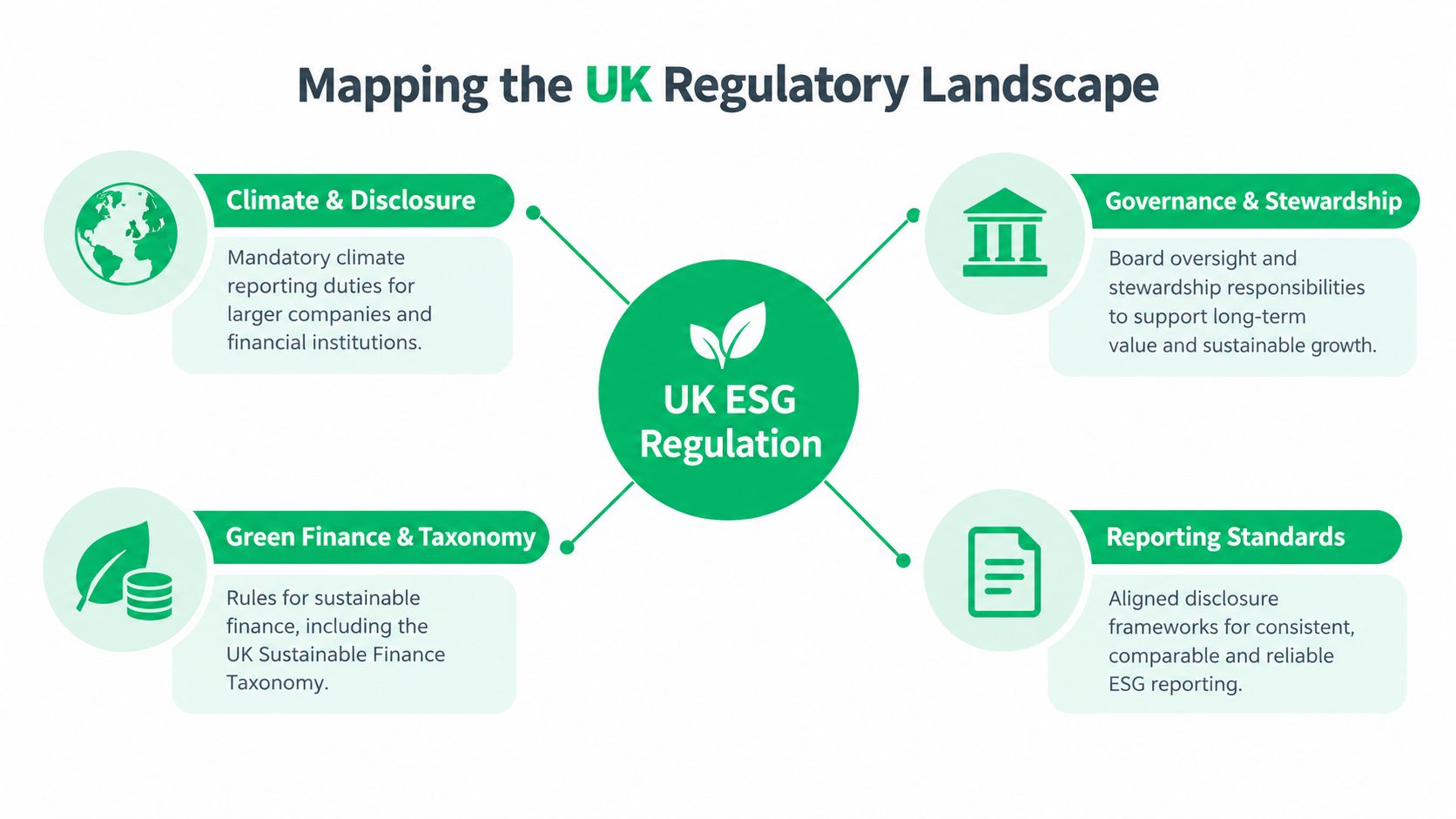
A new Head of Sustainability can lose weeks by sorting UK ESG rules according to acronyms instead of decision type. The faster route is to group them by the question they ask management to answer, and by the evidence each one expects.
Energy and carbon reporting
The first group is about resource use and emissions. SECR asks in-scope organisations to disclose energy consumption, associated greenhouse-gas emissions, an intensity ratio, energy-efficiency actions and the calculation methodology. In practice, that means more than assembling a year-end table. The reporting team needs source data that can be traced back to meters, invoices, fleet records and calculation decisions, because weak audit trails are where confidence usually breaks down.
ESOS works differently. It requires qualifying groups to assess energy use and identify opportunities for savings. Its focus is the energy baseline, the audit method and the quality of the recommendations, rather than the narrative that appears in annual accounts. The same utility data may support both exercises, but the compliance test is different, so teams should not assume that one piece of work satisfies the other.
Climate-related financial disclosure
The second group deals with how climate issues affect the organisation's business model, strategy and financial planning. UK climate-related financial disclosure rules were introduced through regulations that came into force on 6 April 2022, applying to financial years beginning on or after that date under the UK legislation.
The TCFD structure is built around governance, strategy, risk management, and metrics and targets. That matters because climate disclosure is judged partly on whether the organisation can show how decisions are made. Boards need clear oversight. Finance teams need to explain assumptions. Risk owners need to show how climate issues enter existing processes. Sustainability teams often coordinate the work, but they cannot carry the whole obligation alone.
Broader sustainability and market expectations
The third group covers wider sustainability information. That includes emerging UK reporting standards, investor expectations, supply-chain requirements and, where relevant, European reporting obligations. The legal trigger may be listing status, entity size, jurisdiction, product type or customer relationship.
Interpretation becomes more important than labelling at this stage. A UK company may receive information requests because of an overseas operation, an EU customer, a lender covenant or a product-level disclosure requirement, even if a specific UK standard is still voluntary. A useful starting point is this overview of sustainability reporting frameworks, but the actual task is to separate mandatory disclosures from market expectations and then assign ownership accordingly.
A practical grouping usually looks like this:
- Measure operational performance, such as energy and emissions.
- Explain strategic and financial exposure, including governance and risk.
- Address wider sustainability expectations, where legal, contractual or market conditions require it.
Different rules may use overlapping data, but each one tests a different management process.
How to Determine Scope and Applicability
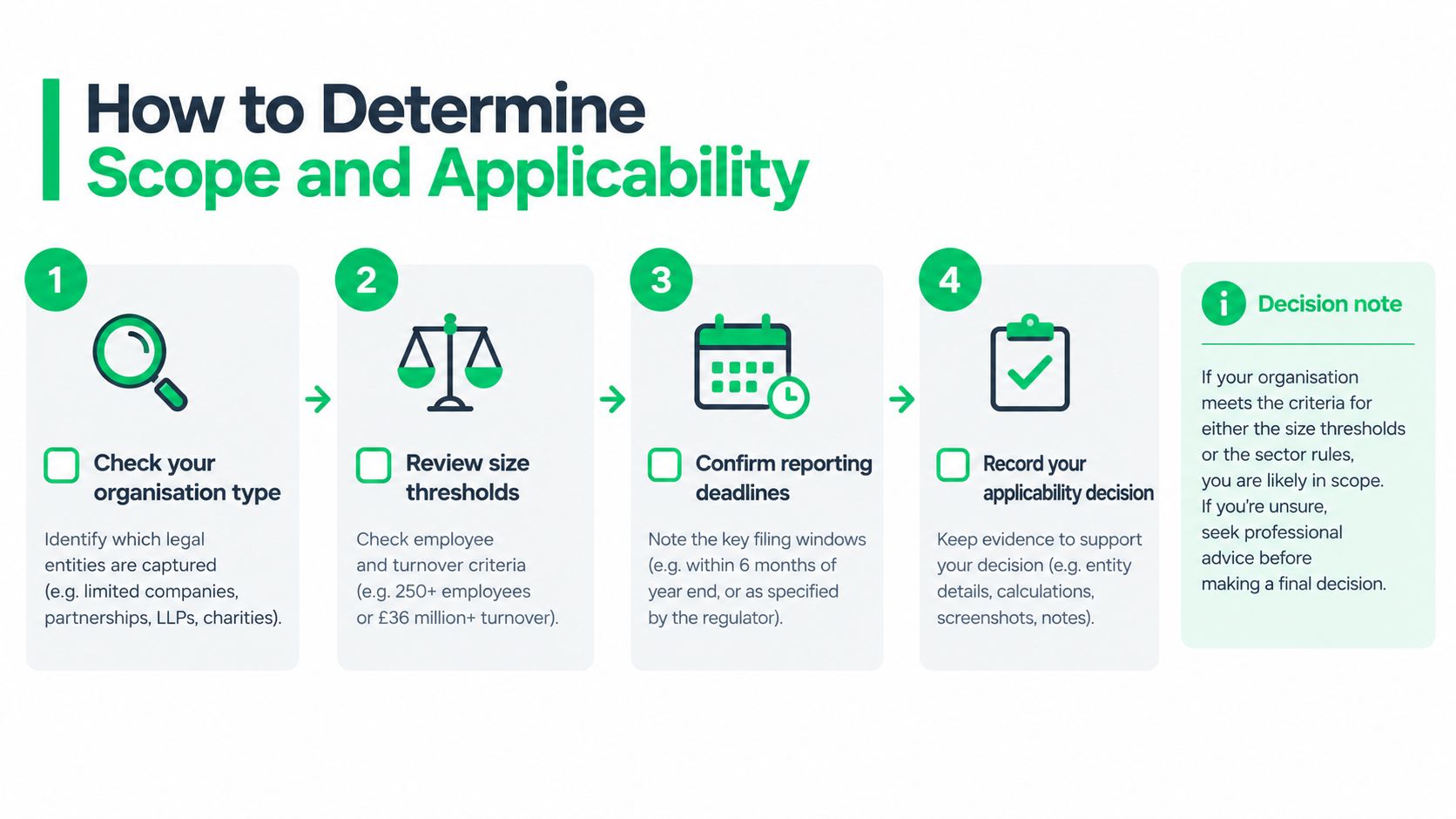
A new Head of Sustainability often inherits a reporting calendar before they inherit a clear view of what belongs in scope. That is usually where errors start. The practical job is to trace each requirement back to the legal entity, the reporting boundary, the activity set and the evidence file that supports the decision.
Start with the entity and group structure
Build the legal-entity population first. Do that before reviewing energy data, emissions factors or narrative disclosures. Include the parent, subsidiaries, LLPs, branches and any entity preparing separate accounts, then record which companies are quoted, which are unquoted, which entities consolidate and who owns the reporting decision.
For SECR, an unquoted company or LLP is generally in scope when it meets at least two of three thresholds: more than 250 employees, turnover above £36 million, or a balance sheet total above £18 million under the UK government's sustainability reporting guidance. The framework became mandatory on 1 April 2019.
Apply that test to the right reporting entity, not to a rough group estimate or to the trading brand people use internally. In practice, I usually see confusion where one finance team works at group level while the legal filing obligation sits with a specific company or LLP. Keep the accounts, board papers and working files that support the employee, turnover and balance-sheet conclusion, because the judgement matters almost as much as the answer.
Test the activity and denominator
After the entity test, check what the organisation consumes, controls, leases, operates or reports. A threshold may bring an entity into scope, but it does not define the full operational population. For energy rules, that usually means reviewing offices, warehouses, manufacturing sites, vehicles, industrial processes and utilities supplied through landlords or management companies.
ESOS Phase 3 is the clearest example of why this matters. Where a qualifying corporate group exists, it must assess its entire UK operation, and the ESOS audit or another permitted compliance route must cover at least 95% of the participant's total energy consumption. Only up to 5% may be excluded according to the ESOS Phase 3 compliance guidance.
Work out the denominator before selecting sites for audit or deciding what looks material. Reconcile utility invoices, meter reads, fuel records, landlord schedules and transport data. If a leased site has weak metering, treat that as an evidence gap to fix. It is not a sound basis for excluding the site from the population.
Confirm the date and reporting mechanism
The last test is timing and route to compliance. Some requirements attach to a financial year. Others hinge on a compliance period, filing deadline or notification date. Record that date in a scope register, together with the person responsible for filing, review or sign-off.
For each conclusion, retain:
- The legal basis, including the entity and threshold tested.
- The population calculation, including included and excluded activities.
- The data sources, such as invoices, meters, contracts and accounting records.
- The decision owner, with evidence of review and approval.
- The next review date, especially where a threshold or voluntary standard could change the work required.
A defensible scope decision explains why a requirement applies, what population it covers and what evidence would support that conclusion under scrutiny.
Use the same method for other frameworks. Climate disclosures, for example, require a different interpretation exercise. Test the entity type, financial reporting status, governance arrangements and whether climate risk is relevant to the business model. Voluntary standards need a separate assessment of investor, customer, lender and supply-chain expectations, so teams do not confuse market pressure with legal obligation.
Key UK Sustainability Frameworks Explained
A new Head of Sustainability often inherits a reporting calendar where SECR, ESOS and climate-related financial disclosures sit in the same workstream. That is manageable, but only if the team treats them as related requirements with different legal tests, boundaries and evidence standards. If they are handled as one exercise, the same dataset gets reused in the wrong place and assurance questions start quickly.
SECR asks: what energy use and emissions belong in the strategic report, which intensity ratio best reflects the business, and which energy-efficiency actions are credible enough to describe publicly. The threshold detail sits in the scope section above. The practical point here is different. Apply the test to the entity preparing the strategic report, then make sure the narrative on efficiency actions can be traced to actual projects, decisions or operational changes, not a generic list drafted at year end.
ESOS asks: has the qualifying group examined enough of its total energy use to identify worthwhile savings opportunities, and can it prove that approach? The evidence standard is more operational than many teams expect. You need the energy baseline, the coverage calculation, the audit work or alternative compliance route, the recommendations, and the Lead Assessor sign-off to line up. That sign-off matters in practice because it tests whether the analysis behind the recommendations is defensible, not whether the wording sounds polished. A business can publish a tidy SECR disclosure and still fail to show a complete ESOS population.
Climate-related financial disclosure asks: how climate risk and opportunity affect governance, strategy, risk management, metrics and targets. The reporting discipline is different again. The question is not only what happened in operations, but how directors considered climate in oversight, planning and decision-making. For teams comparing standards, this guide to sustainability reporting frameworks helps distinguish corporate reporting frameworks from energy compliance obligations.
| Framework | Primary Purpose | Who It Applies To, Typical | What Is Reported |
|---|---|---|---|
| SECR | Transparent energy and carbon reporting | Quoted companies and qualifying large unquoted companies or LLPs | Energy use, associated emissions, intensity ratio, efficiency actions and methodology |
| ESOS | Identify energy-saving opportunities | Qualifying corporate groups with UK operations | Energy baseline, assessment coverage, audit or alternative route, recommendations and compliance evidence |
| Climate-related financial disclosures | Integrate climate risk into corporate reporting | Qualifying companies and LLPs within the relevant reporting rules | Governance, strategy, risk management, metrics and targets |
The overlap is useful, but only with control over definitions. SECR data may support climate metrics. ESOS findings may inform efficiency actions or transition planning. Shared data doesn't mean shared conclusions.
Set up a reporting matrix that records the source dataset, owner, boundary, calculation method, approval route and wording required for each framework. That is usually where confusion clears. Teams can then see whether one figure is being reused appropriately, or whether it needs to be recalculated, re-explained or left out.
A Practical 5-Step Compliance Process
A reliable compliance programme behaves like an annual control cycle. It doesn't begin with drafting and end with publication. It starts with scope, builds evidence, tests the analysis and records approval.
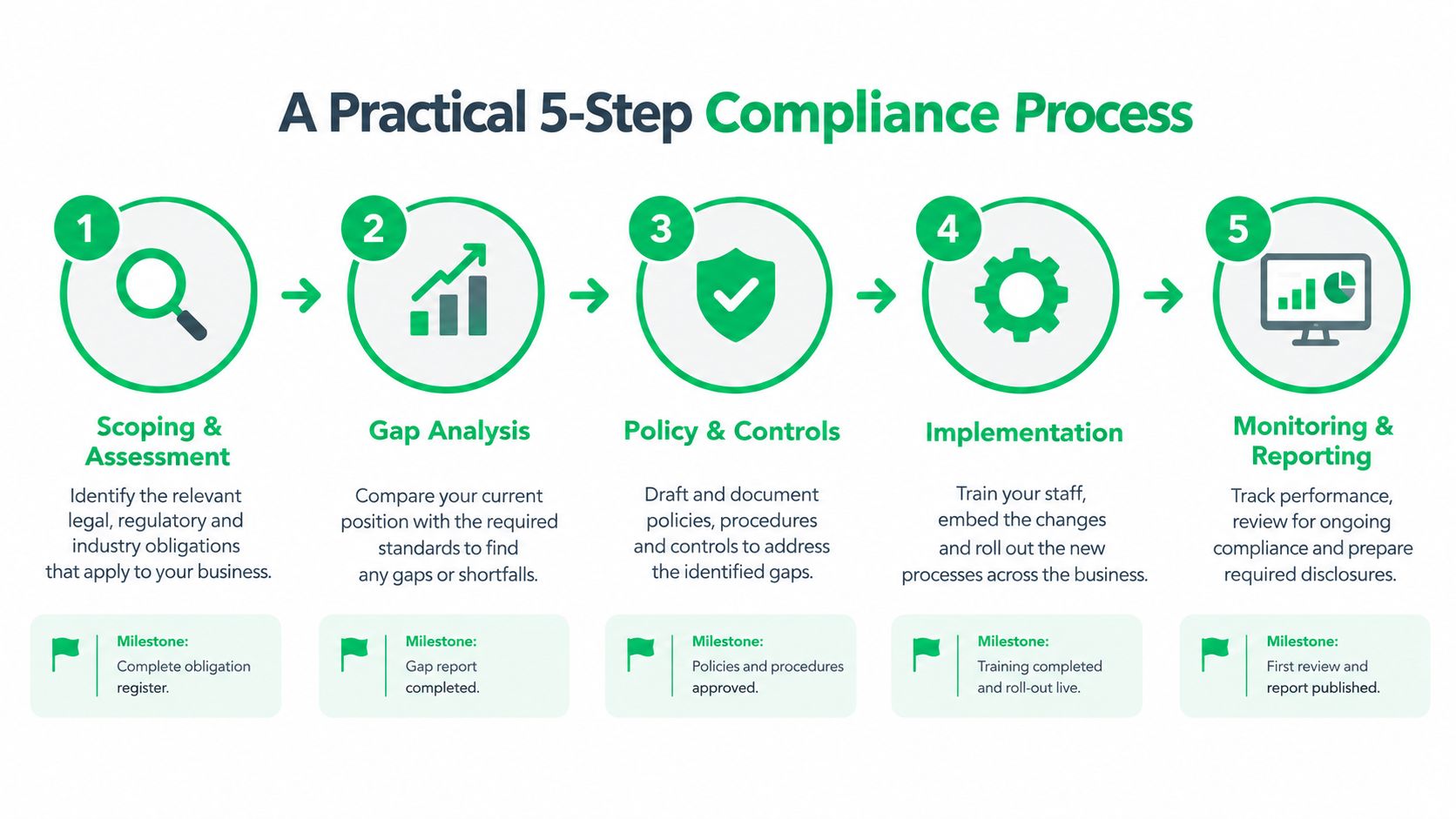
1. Scope and assess
Build the entity and obligations register. Test legal status, size, activities, reporting periods, group relationships and relevant jurisdictions. Mark each obligation as applicable, not applicable, voluntary, or requiring further legal review.
The output should be a written scope memo, not a meeting recollection. It should name the decision-maker and list the records supporting every material conclusion.
2. Set up data systems and controls
Assign each metric to a data owner. Define the source, unit, boundary, conversion method, review check and retention location. A controlled workbook can work for a smaller population, while a larger group may need an ESG data platform connected to finance, facilities and procurement systems.
The tool matters less than the control design. If nobody can explain who checked a landlord estimate, why a site was included, or which factor was used, the organisation doesn't have an auditable process.
3. Analyse and develop the narrative
Calculate the required measures only after confirming the boundary. Investigate unusual movements, missing records and changes in organisational structure. Keep a reconciliation between source data, working calculations, final figures and the published statement.
Narrative should explain decisions, not decorate the numbers. For example, describe the energy-efficiency actions taken, the methodology used, the limitations in the dataset and the actions planned to improve the next cycle.
4. Establish governance and sign-off
Give finance, risk, operations, legal and sustainability clear review roles. The board or relevant committee should understand the principal assumptions, material estimates, unresolved gaps and implications of the disclosure.
Evidence standard: If a reviewer asks, “How do you know?”, the answer should lead to a source record, calculation, control check or approval.
Create a sign-off pack containing the scope assessment, data-control log, calculation files, methodology statement, narrative draft, review comments and final approval. This is more useful than a last-minute email confirming that everyone is comfortable.
5. Prepare assurance and disclosure
Run an internal challenge before publication. Sample invoices, test aggregations, compare current boundaries with the prior period, review intensity-ratio calculations and confirm that exclusions are documented.
Then publish through the correct route and archive the final version with its evidence trail. Treat lessons learned as inputs to the next cycle. Repeated missing data, late approvals and unclear ownership are control weaknesses, not merely administrative inconveniences.
Future-Proofing Your Strategy for Upcoming Regulations
The hardest strategic decision is often what to do before a standard becomes mandatory. Waiting for certainty can appear efficient, but it may leave the organisation without the governance, data architecture or internal capability needed when requirements arrive.
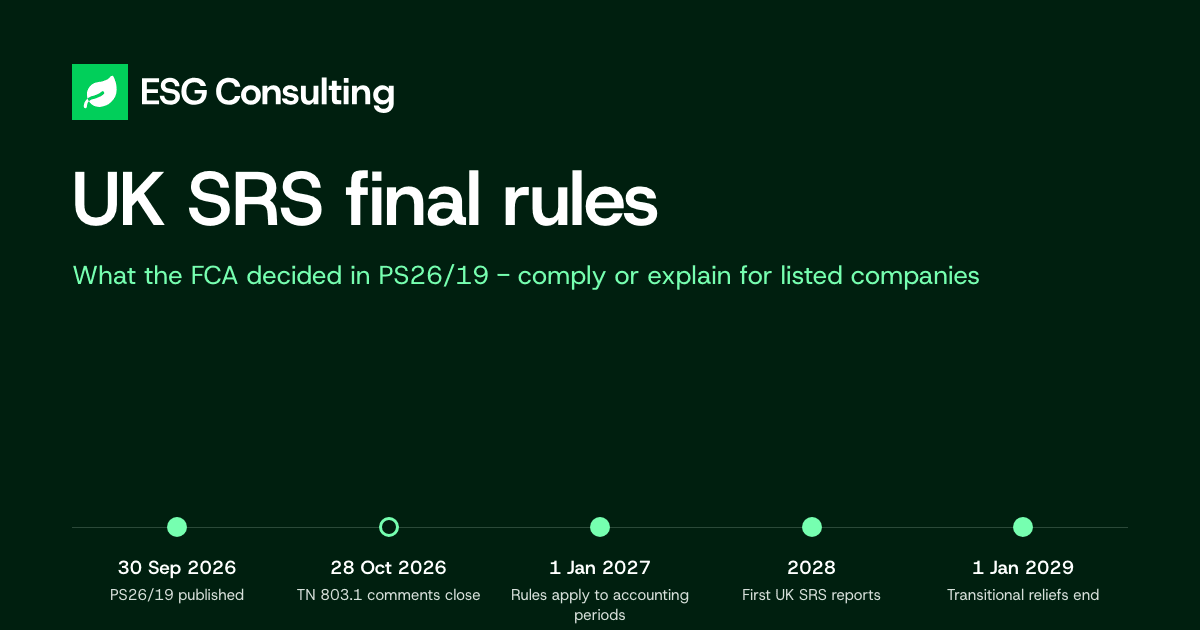
The UK Sustainability Reporting Standards, UK SRS S1 and S2, are currently available for voluntary use while the government and the FCA consider whether to mandate them for certain entities as described in the UK government's guidance. That creates a genuine choice, not a simple instruction to adopt everything immediately.
Separate legal obligation from decision-useful preparation
Use a three-part decision test:
- No current obligation: Maintain a watchlist, monitor stakeholders and avoid building controls that have no clear owner or use.
- Voluntary early adoption: Adopt where investors, lenders, customers or internal decision-makers need more structured information now.
- Preparation for probable requirements: Build reusable governance, definitions, controls and evidence without prematurely producing every possible disclosure.
The best preparation is modular. A board climate-risk register, clear accountability, documented assumptions and controlled metrics can support SECR, TCFD-style reporting, UK SRS and assurance. A rushed report built around untested estimates can create more risk than a transparent statement of limitations.
Build reusable evidence, not excessive paperwork
Prioritise the foundations that remain valuable under different reporting outcomes:
- Entity and boundary records, including ownership and operational control.
- Metric definitions, with units, methodologies and change logs.
- Source-data controls, linking figures to invoices, meters, contracts or approved estimates.
- Governance records, showing who reviews risks, targets and disclosures.
- Narrative discipline, separating verified facts from assumptions, forecasts and management judgement.
This approach also helps companies exposed to EU customers, investors or value-chain requests. The relevant question isn't whether a distant framework appears on a generic compliance list. It's whether a jurisdiction, customer contract, financial product, group structure or reporting relationship creates a specific requirement.
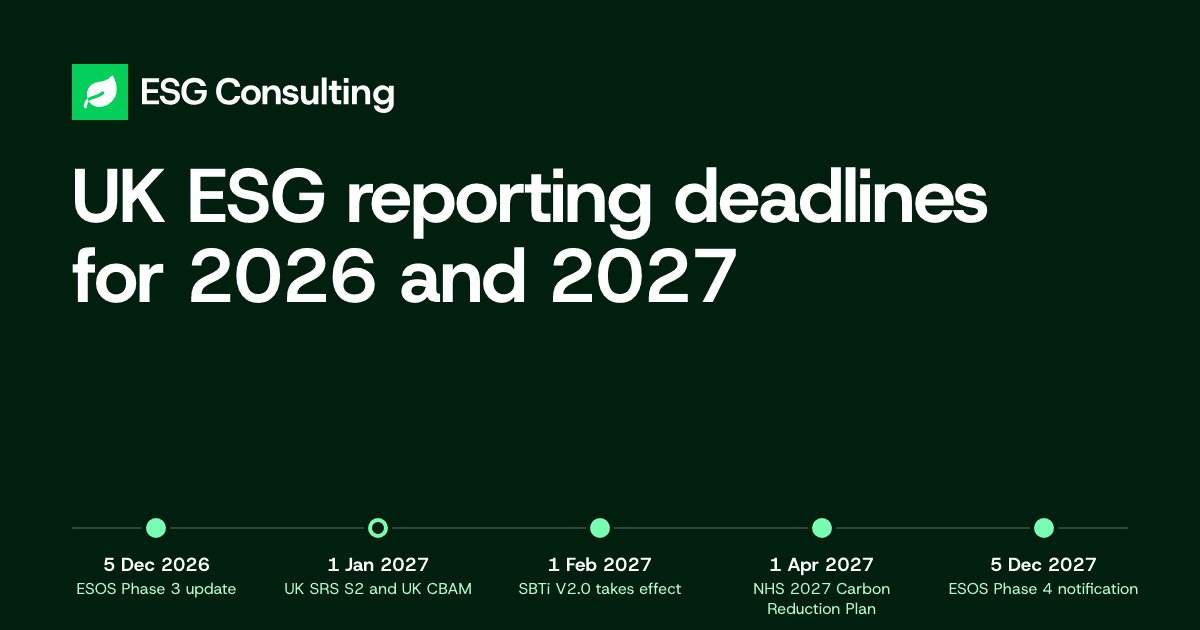
Review the UK ESG reporting deadlines and preparation considerations alongside your own reporting calendar, then assign an owner to each decision. Good preparation doesn't mean predicting every future rule. It means creating information and governance that can be reused when the applicable rule becomes clearer.
The new Head of Sustainability should aim for controlled readiness. Know what is mandatory, know what is voluntary, record what is uncertain, and invest first in evidence that supports more than one credible reporting need.
ESG Consulting helps UK organisations determine whether SECR, ESOS, climate-related financial disclosure, UK SRS or CSRD requirements apply, then builds the data controls and evidence trails needed for defensible reporting. Visit ESG Consulting to discuss your regulatory scope, reporting process and next compliance cycle with a senior consultant.