sustainability reporting framework, ESG reporting, UK SRS, CSRD ESRS, TCFD disclosures
Sustainability Reporting Framework Guide
By ESG Consulting Team · · 21 min read
Your board meeting is tomorrow, and the sustainability reporting pack still sits across spreadsheets, utility invoices, procurement portals and an external consultant's working papers. Finance wants figures that reconcile to the annual report. Procurement wants a Carbon Reduction Plan. Customers want questionnaire responses. Investors want climate-risk information. Everyone is using the word “framework”, but nobody is working from the same controlled dataset.
That situation is common, and it creates a more serious problem than administrative inconvenience. A sustainability disclosure can be well written and still fail scrutiny if the underlying emissions boundary, calculation method, approval trail or restatement history can't be evidenced. Treat sustainability reporting as a financial-grade data control exercise, not a communications project, and the apparent maze of frameworks becomes manageable.
Table of Contents
- How Sustainability Reporting Frameworks Layer Together
- UK Mandatory Baseline and Regulatory Shifts
- Global and Voluntary Frameworks Explained
- Choosing the Right Framework Combination
- Building Auditable Data Trails for Assurance
- Unifying Your Sustainability Data Architecture
- Meeting Procurement and Supply Chain Demands
- Establishing Board Governance and Oversight Controls
- Strategic Implementation Checklist for ESG Practitioners
How Sustainability Reporting Frameworks Layer Together
A sustainability reporting framework converts environmental, social and governance matters into information that stakeholders can assess. It sets expectations for disclosures, material risks and opportunities, metrics, organisational boundaries and calculation methods. Its value depends on traceability. Each reported statement should connect to a named owner, an underlying source and an approval decision.
Start by separating legal obligation from market expectation. SECR and FCA requirements create specific UK duties for organisations within scope. UK SRS is currently available for voluntary use, while customers, lenders, asset managers and public-sector buyers may set information requirements through contracts or assessment processes. A private company may therefore face substantial reporting pressure without falling directly under every regulation referenced in a request.
Frameworks layer rather than replace one another
A listed group might maintain a UK regulatory baseline, apply ISSB-aligned thinking to investor disclosures, respond to CDP and provide GRI-style impact information for wider stakeholders. A supplier could need SECR data internally, a buyer-specific carbon questionnaire commercially and a Carbon Reduction Plan for public procurement. The outputs share data, but each serves a different audience and purpose.
Assigning every request to a separate project team creates avoidable cost. Teams may calculate different emissions totals, apply inconsistent organisational boundaries and repeatedly contact the same suppliers. Assurance then becomes harder because nobody can explain why documents use different figures or why one version superseded another.
Practical rule: Build one controlled evidence base, then produce framework-specific outputs from it.
Begin with a requirements inventory. Record each obligation or request, reporting period, responsible owner, required metrics, audience and supporting evidence. Map the common data beneath those requirements, then document where definitions differ. Energy consumption, Scope 1 emissions, purchased electricity, value-chain activity, governance approvals and transition actions should have one defined source wherever possible.
Add implementation cost to the inventory. Identify manual collection, supplier follow-up, calculation reviews, system changes, management approval and assurance preparation. These activities often sit outside the published framework wording, yet they determine whether the organisation can reproduce a figure and defend it under scrutiny.
The board can then ask practical questions: which disclosures apply, which data is reliable, which controls are missing and which commercial requirements could affect revenue? That creates a defensible sustainability reporting strategy, with disclosures built from controlled evidence rather than assembled as disconnected communications.
UK Mandatory Baseline and Regulatory Shifts
A board can approve a sustainability report and still lack the evidence needed to defend its figures. Start with the UK baseline, then test every additional request against the same controlled records. The first practical question is whether SECR applies.
Quoted companies generally must report specified energy and greenhouse-gas information, regardless of size. Large unquoted companies and limited liability partnerships generally fall within scope when they meet at least two thresholds: more than 250 employees, turnover above £36 million, or a balance sheet above £18 million. The rules came into force on 1 April 2019 and apply to financial years beginning on or after that date, as set out in the UK government's SECR evaluation.
SECR usually covers UK energy consumption, Scope 1 emissions, selected Scope 2 emissions, intensity ratios and an explanation of energy-efficiency action. Department for Energy Security and Net Zero analysis estimates that approximately 19,900 UK quoted companies, large private companies and large LLPs report directly or through a parent undertaking. About 14,000 are expected to report the information themselves, according to the same evaluation.
What the implementation evidence tells boards
A compliant-looking report is not enough. A post-implementation review found Scope 1 and at least one Scope 2 figure in 67% of entities that appeared to be required to report in their own accounts. Survey evidence suggested that 77% to 86% of in-scope firms considered themselves compliant. The difference between perceived compliance and observable reporting should concern audit committees.
Use SECR to test the quality of the underlying control environment:
- Applicability screening: Record the legal-entity structure, thresholds, parent reporting position and financial-year scope.
- Boundary control: Define the sites, fuels, vehicles and purchased electricity included, and document every exclusion.
- Reconciliation: Tie invoices, meter data and supplier information to finance or facilities records.
- Narrative evidence: Connect energy-efficiency claims to approved projects, implementation records and measured outcomes where available.
These controls expose implementation costs that framework comparisons often hide. Someone must collect source documents, resolve supplier gaps, review calculations, approve estimates and preserve the version used in the final disclosure. Build those responsibilities into the reporting timetable. A number without a traceable source, owner and review history is a future assurance problem.
Listed companies face a second regulatory layer. The FCA introduced TCFD-aligned requirements for premium-listed commercial companies for financial years beginning on or after 1 January 2021, with comparable requirements for standard-listed companies for accounting periods beginning on or after 1 January 2022, according to the FCA's review of early reporting. More than 90% of companies self-reported consistency with the Governance and Risk Management pillars, while consistency fell below 90% for Strategy and Metrics and Targets. The pattern shows why governance wording alone is insufficient. Scenario analysis, transition planning and controlled targets require stronger evidence.
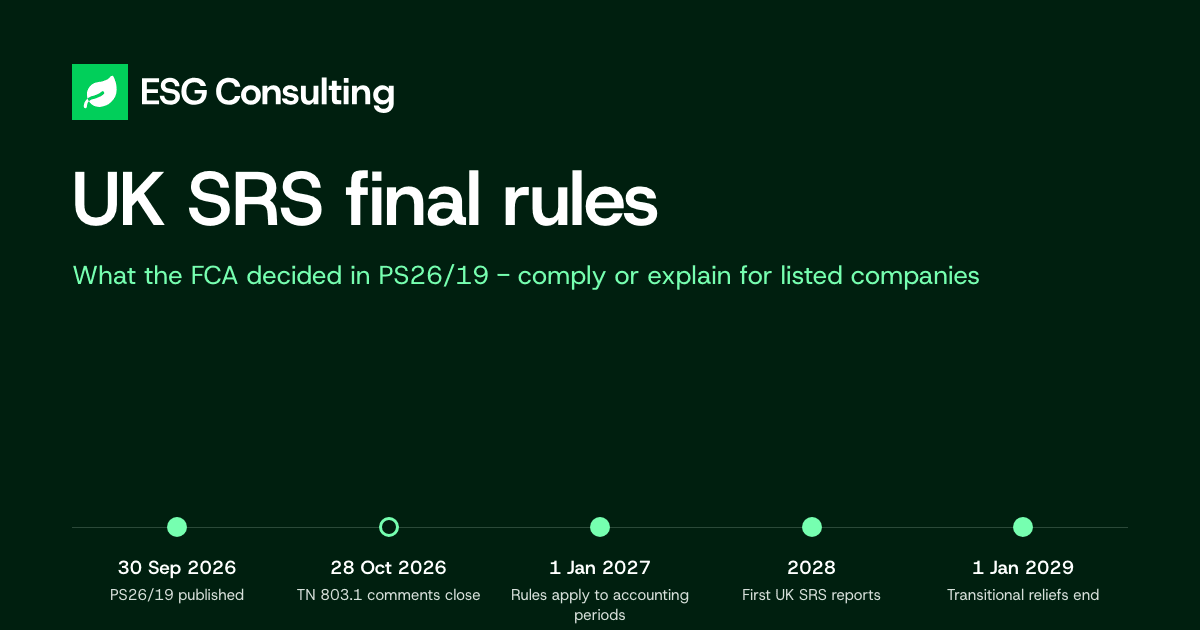
The FCA has indicated that, from accounting periods beginning 1 January 2027, the TCFD-based regime is expected to be replaced by UK SRS requirements under a comply-or-explain model. In-scope issuers will need UK SRS S1 and S2 disclosures, or a transparent explanation of omissions, reasons and remediation steps. Transitional reliefs allow Scope 3 disclosures to be omitted for one year and UK SRS S1 disclosures for two years, as explained in the FCA reporting requirements.
For organisations assessing European exposure, this guide to CSRD reporting in the UK helps distinguish direct obligations from customer-driven requests. Fix the UK data baseline before adding another reporting framework.
Global and Voluntary Frameworks Explained
International frameworks matter because commercial relationships don't stop at the UK border. A private manufacturer may not have a direct legal duty to produce ESRS information, yet an EU customer may request value-chain data. An asset manager may not require every portfolio company to publish a complete climate report, but it may expect credible targets, emissions information and evidence of progress before allocating capital.
The practical question is not, “Which framework should we adopt?” Ask instead, “Who is requesting this information, what decision will it support, and which underlying data will satisfy several requests at once?”
ESRS and GRI serve different materiality questions
The European Sustainability Reporting Standards support reporting under the EU's CSRD regime. Their defining feature is double materiality, which considers both how sustainability matters affect the organisation and how the organisation affects people and the environment. A UK company supplying an in-scope European customer may therefore receive requests that go beyond financially material climate risks. The buyer may need information about impacts, policies, actions and value-chain dependencies.
GRI is also impact-oriented, but it operates as a voluntary reporting framework for communicating an organisation's economic, environmental and social impacts to a broad stakeholder audience. It can be appropriate where employees, communities, customers and civil-society stakeholders need a fuller account than an investor-focused disclosure provides. GRI shouldn't be treated as a substitute for UK regulatory reporting, and UK regulatory reporting shouldn't be presented as a complete impact account.
The implementation decision is straightforward:
- Identify the audience. Investors and lenders usually prioritise financially relevant risks and opportunities. Customers, communities and employees may seek impact information.
- Map the trigger. A contract, lender process, investor request or group reporting instruction should be recorded as the reason for adopting a particular output.
- Separate required data from presentation. The same energy, workforce, supplier or emissions records may support different reports, but each framework may require different explanations and boundaries.
CDP and SBTi create commercial discipline
CDP is a disclosure platform used by companies responding to investor, customer and supply-chain requests. Its value lies less in producing another document and more in exposing whether the organisation can answer questions about governance, risks, opportunities, emissions, targets and action with evidence. Treat a CDP response as a controlled submission, not an annual questionnaire delegated to whoever has the most historic knowledge.
SBTi focuses on the credibility and alignment of emissions-reduction targets. Companies often pursue validation because customers, lenders or investors want a target methodology that is more rigorous than a broad net-zero statement. The SBTi net-zero standard guidance is relevant when the organisation needs to turn ambition into defined boundaries, milestones and decarbonisation actions.
A target without an inventory, baseline method, ownership and delivery plan is an aspiration, not a control.
Keep framework selection proportionate. If a customer asks for a CDP score, don't automatically commission a full impact report. If an investor asks for ISSB-compatible information, don't assume a GRI report will answer the same question. Build the common dataset first, then produce the output that the decision-maker needs.
Choosing the Right Framework Combination
No organisation should adopt every framework just because it appears in a customer questionnaire. The correct combination depends on legal scope, stakeholder pressure, reporting purpose, group structure and the organisation's ability to support evidence. A board should approve a reporting stack that is broad enough to protect access to capital and contracts, but controlled enough to remain credible.
| Organisation Profile | Mandatory Core | Commercial / Investor Driven | Optional / Deferred |
|---|---|---|---|
| UK-listed group preparing for UK SRS | FCA requirements currently applicable, then UK SRS S1 and S2 readiness | ISSB-aligned investor reporting, CDP, SBTi where targets matter to capital providers | Broader GRI disclosures where stakeholder impact reporting isn't yet required |
| Large UK private company | SECR where thresholds and conditions apply | Customer questionnaires, lender requests, CDP, SBTi and buyer-specific carbon requirements | Full voluntary UK SRS adoption if no stakeholder trigger exists |
| Government supplier | SECR where applicable and contract-specific reporting duties | Carbon Reduction Plans aligned to public procurement expectations, PPN 026 preparation, NHS Evergreen readiness where relevant | Investor-oriented reporting that doesn't support contracts or financing |
| UK group with EU operations or customers | UK baseline plus any direct group or entity obligations | ESRS-aligned data for customer and group reporting, GRI for impact-focused stakeholders | Duplicate standalone reports using different source figures |
| Asset manager or lender marketing into the EU | Applicable financial-market disclosure obligations | ISSB, SFDR, PRI and portfolio-company data controls | Corporate reporting frameworks unrelated to products or investment decisions |
Apply three filters before adding a framework
Financial materiality asks whether a sustainability risk or opportunity could affect the entity's prospects, financial position, performance or cash flows. This is central to UK SRS S1 and S2 readiness.
Impact materiality asks how the organisation affects people and the environment. This matters when ESRS, GRI, customer due diligence or stakeholder reporting drives the request.
Supply-chain relevance asks whether a buyer, public-sector contract or lender needs information beyond the organisation's operational boundary. Scope 3 activity, supplier practices and transition plans often determine whether a contract process succeeds.
Use those filters with a deferral rule. A framework can safely wait when there is no legal obligation, no material stakeholder demand and no strategic decision that depends on its information. It shouldn't wait when the organisation has unresolved boundary questions, supplier data gaps or a forthcoming reporting transition.
The board should approve the matrix, assign an owner to every mandatory core item and record the rationale for optional work. That creates a defensible position when a stakeholder asks why the organisation reports one framework and not another.
Building Auditable Data Trails for Assurance
A polished sustainability narrative won't protect an organisation when its figures can't be reconciled. Assurance providers and regulators will look for evidence of completeness, accuracy, consistency, ownership and change control. They'll want to understand what was measured, what was estimated, which factors were used, who approved the calculation and what changed from the previous reporting period.
The UK assurance regime is developing, but organisations shouldn't wait for every rule to become mandatory. The government's January 2026 response tasked the Financial Reporting Council with establishing an interim regime and register for third-party sustainability assurance by mid-2026, as set out in the government consultation response on sustainability assurance. The same policy direction indicates that assurance status and practitioner quality will receive greater market attention.
Build an evidence hierarchy
Start with direct source records. Utility invoices, meter exports, fuel records, travel systems, procurement data and supplier declarations should sit above unsupported estimates. Estimates aren't automatically unacceptable, but the organisation must document why they were necessary, which assumptions were applied and how the estimate will be replaced or improved.
Create a metric register for every reported data point. It should include:
- Definition and boundary: What the metric includes, excludes and represents.
- Source system: The originating platform, file, invoice set or supplier submission.
- Methodology: Emission factor source, unit conversion, allocation method and calculation formula.
- Control owner: The person accountable for preparation, review and approval.
- Evidence status: Direct, reconciled, estimated, management-approved or unresolved.
- Change history: Restatements, revised boundaries, methodology changes and reasons.
Financed emissions require particular discipline because portfolio and counterparty data can be incomplete, estimated or revised. The same applies to Scope 3 categories where activity data may come from suppliers, procurement classifications or spend-based calculations. Define estimation thresholds and escalation rules before the reporting cycle becomes urgent.
Make assurance scope match disclosure scope
Don't select an assurance provider by reputation alone. Match its proposed scope to the metrics, entities, periods and methodologies in the report. Ask whether the provider can test source records, review controls, assess estimates and challenge restatements rather than just read the final narrative.
A practical pre-assurance review should sample reported metrics back to source, test whether approvals occurred before publication, check that the emissions boundary agrees with the financial reporting boundary where relevant, and verify that every unexplained change has an owner. The output should be a remediation log with severity, action, deadline and accountable executive.
For a deeper treatment of evidence trails and control testing, use this sustainability audit guidance. The objective isn't to make every estimate disappear. It is to ensure every estimate is visible, justified and governed.
Unifying Your Sustainability Data Architecture
Separate workstreams for SECR, CDP and customer questionnaires create predictable control failures. Facilities teams hold energy records, procurement manages supplier information, finance controls organisational data, and ESG teams assemble the final submission under deadline pressure. If these sources use different periods, boundaries or conversion factors, several figures can appear reasonable while remaining impossible to reconcile.
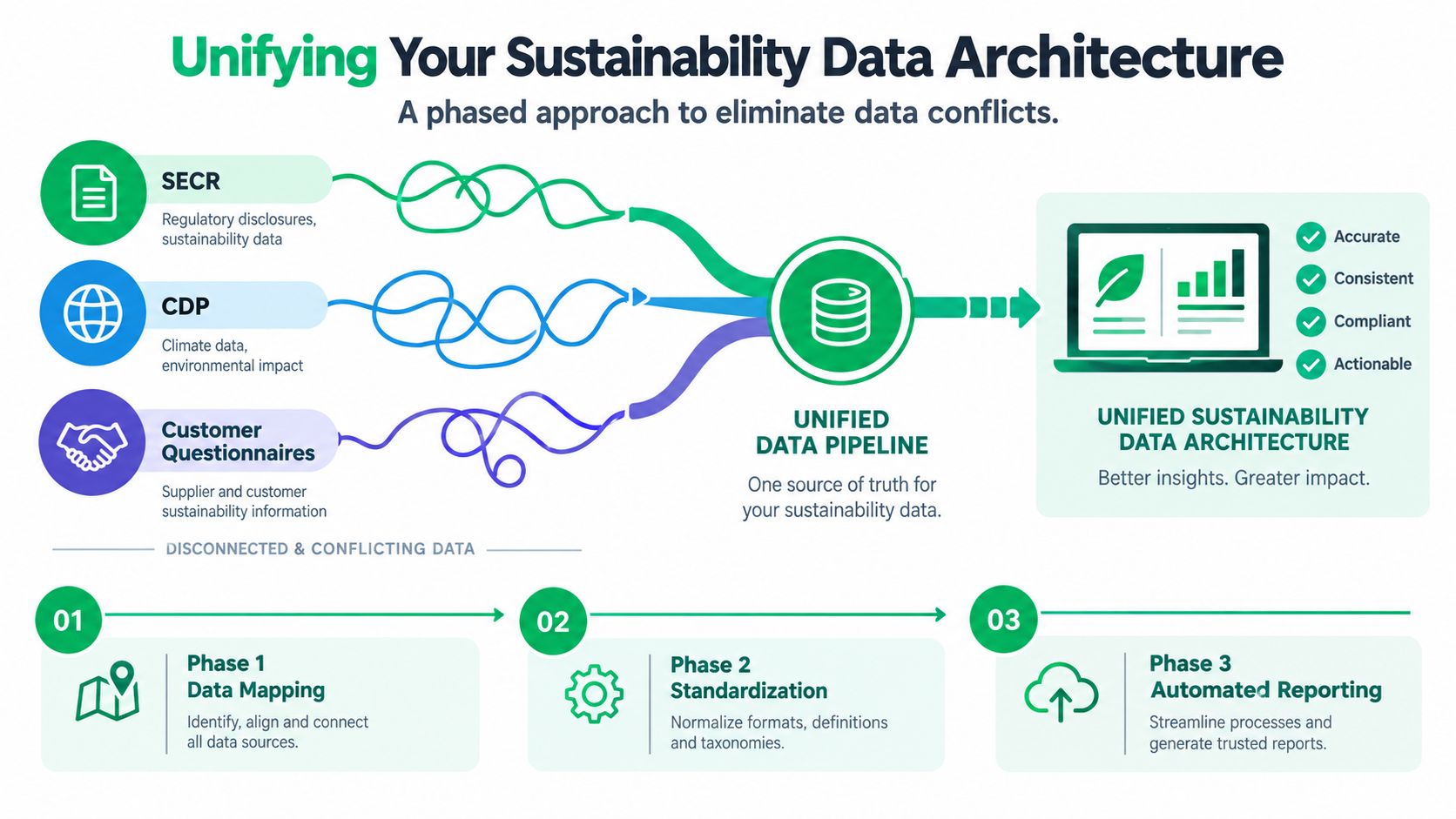
Phase one maps the actual data flows
Start with a controlled inventory before evaluating any software. List each required metric, its source system, accountable owner, reporting period, unit, boundary and evidence quality. Include spreadsheets and manual processes. Removing them from the inventory produces a cleaner diagram but conceals the control environment the organisation must directly govern.
Trace every metric from source to disclosure. An electricity invoice may pass through facilities, a spreadsheet, an emissions-factor calculation, an ESG platform and the annual report. Each hand-off can introduce an error or an unapproved change. Record the reconciliation completed at each stage, together with any missing approval and the person responsible for resolving it.
Phase two standardises definitions
Set definitions before automating collection. Agree how sites are grouped, how acquisitions and disposals are treated, which Scope 2 method applies, how missing supplier data is estimated and who approves restatements. Software will apply an inconsistent definition efficiently, so governance must come first.
A workable data model separates:
- Activity data: Kilowatt-hours, litres, kilometres, tonnes, headcount or spend.
- Factors and assumptions: Emission factors, conversion rates, allocation rules and estimation methods.
- Calculated outputs: Scope 1, Scope 2, Scope 3, intensity ratios and target progress.
- Narrative evidence: Policies, actions, governance minutes, risk assessments and remediation records.
Phase three connects reporting outputs
Connect ERP, facilities, procurement and ESG tools only after definitions and controls are stable. The objective is a repeatable pipeline rather than dashboard complexity. One approved metric should feed the UK SRS data inventory, a customer response, a CDP submission and an internal management report without manual rekeying.
The pipeline must preserve version history and prevent unauthorised changes. It should flag missing periods, unexpected movements, duplicate records and values outside defined thresholds. Automation does not remove accountability. It makes ownership, exceptions and unresolved data issues visible before publication.
A short visual explanation of how disclosure work fits into operational controls is available below.
The right architecture is deliberately boring. Finance, ESG, procurement and the board receive the same approved answer, with a clear route back to the underlying evidence. That traceability is what turns a reporting process into a defensible control system.
Meeting Procurement and Supply Chain Demands
For many private companies, the immediate reporting pressure arrives through procurement rather than the FCA. A public-sector tender can ask for a Carbon Reduction Plan, a major customer can request Scope 3 information, and an NHS-related opportunity can depend on environmental readiness evidence. The buyer may not care whether the supplier is directly in scope of a particular reporting law. It cares whether the supplier can demonstrate credible, current and contract-relevant information.
That changes the priority order. A supplier should map the reporting requirements embedded in its revenue pipeline, not wait for a legal notice. Contract owners, bid teams and sustainability practitioners need a shared register of buyer requirements, submission dates, data owners and evidence status.
Turn procurement requirements into operating controls
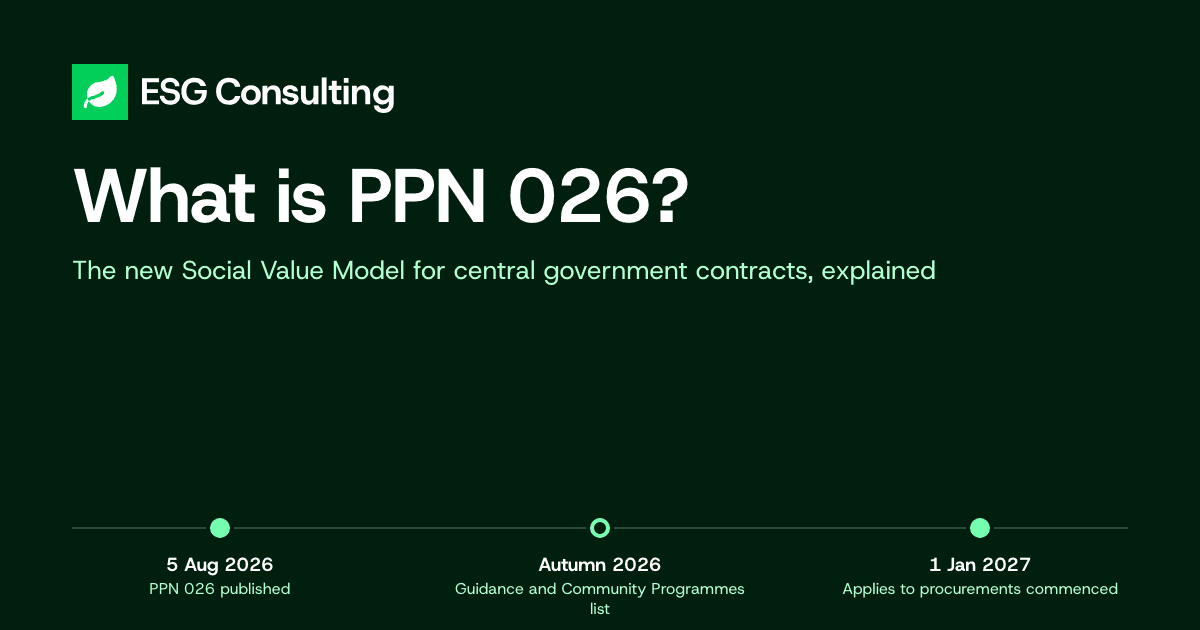
A Carbon Reduction Plan aligned to PPN 06/21 should be treated as a managed business document, not a generic sustainability statement. The organisation needs a credible emissions inventory, a net-zero pathway, accountable actions and evidence that the plan reflects actual operations. Preparation for PPN 026 and NHS Evergreen readiness may add further requests around environmental management, targets, governance and delivery.
Supplier engagement becomes essential when the organisation can't calculate meaningful value-chain emissions from internal systems alone. Procurement should segment suppliers by spend, emissions relevance, geography, service type and data maturity. Then assign a proportionate request:
- Strategic suppliers: Request activity data, methodology, boundaries, targets and supporting evidence.
- Material but less mature suppliers: Provide a structured template, acceptable estimation options and a deadline for improvement.
- Low-risk suppliers: Use a consistent proxy or category approach, document the limitation and avoid false precision.
Protect the bid pipeline
The most damaging supplier-data gap is the one discovered after a tender has opened. Build a standing evidence pack containing the latest approved emissions inventory, boundary statement, reduction plan, governance approval, supplier engagement approach and methodology notes. Refresh it through the normal reporting cycle rather than rebuilding it for every bid.
Procurement teams should also challenge customer requests that use incompatible definitions. Ask which organisational boundary, reporting year, Scope 3 categories, assurance level and evidence format the buyer expects. A controlled clarification can prevent a bid team from submitting an unsupported number that later conflicts with the annual report.
Commercial test: If a sustainability metric can affect contract eligibility, assign it the same ownership and review discipline as a financial bid assumption.
A unified sustainability reporting framework earns its value here. One approved evidence base can support public procurement, customer questionnaires and investor conversations without creating three competing versions of performance.
Establishing Board Governance and Oversight Controls
Board oversight must connect sustainability reporting with finance, risk and remuneration decisions. Treat the disclosure process as a financial-grade control system, with documented ownership, review evidence and escalation. As noted earlier, the FCA found governance disclosures outrunning quantified strategy and metrics reporting. That gap points to a practical board priority: approving policies is insufficient unless management can evidence their strategic effects and measurable delivery.
Four control layers belong in existing governance
Governance and oversight should specify which board committee receives sustainability information, which executive owns the reporting process and how disagreements are escalated. Minutes should record decisions, challenge and follow-up actions, not just confirm that a presentation took place.
Strategy and scenario analysis should link climate assumptions to products, assets, markets, capital expenditure and business continuity. Require management to state which decisions changed as a result. A scenario exercise with no decision consequence is a report-writing exercise.
Risk management should place sustainability risks within the enterprise risk framework, with causes, controls, indicators, owners and responses. A separate climate register creates an assurance gap if the audit committee cannot see how those risks interact with principal risks and controls.
Metrics and targets should define boundaries, methodologies, baselines, milestones and restatement rules. Assign every target an accountable owner, evidence standard and escalation route when performance falls behind. Record changes to methods and boundaries so reported movement can be explained rather than defended after publication.
Put the audit committee close to the numbers
The audit committee should review material judgements, estimation methods, data limitations, boundary changes and assurance findings. Finance should test whether sustainability metrics have a defined period close, reconciliation process and sign-off path. The committee does not need to calculate emissions, but it must challenge the evidence supporting them and understand where management relies on estimates.
Board papers should place unresolved data gaps beside their business consequence. A missing supplier dataset may weaken Scope 3 confidence, affect a customer contract and alter a transition plan. State the owner, remediation date and reporting impact. A green status indicator without that context provides little control evidence.
Use UK SRS preparation as part of financial reporting governance. UK SRS S1 and S2 address sustainability-related risks and opportunities that could reasonably affect an entity's prospects. Management should therefore route material judgements through the same strategic and financial oversight that governs other information capable of influencing decisions, rather than leaving them solely with corporate affairs.
Strategic Implementation Checklist for ESG Practitioners
The next reporting cycle should produce more than a completed document. It should leave the organisation with clearer ownership, reconciled data, documented judgements and a shorter path to assurance. Sequence the work so that legal scope and data controls come before voluntary expansion.
- Screen applicability. Confirm SECR status, listing position, group reporting arrangements, customer obligations and any UK SRS readiness requirement. Record decisions not to report as carefully as decisions to report.
- Map the data gap. Trace Scope 1, Scope 2, Scope 3, energy, target, governance and risk metrics from source to proposed disclosure. Mark every unsupported estimate and missing approval.
- Set control ownership. Give finance, facilities, procurement, HR, risk and ESG clear responsibilities. Define who prepares, reviews, approves and signs off each metric and narrative.
- Choose the reporting stack. Use the organisation profile and stakeholder triggers to prioritise UK requirements, investor disclosures, customer outputs, procurement submissions and voluntary frameworks. Defer work that has no legal, commercial or decision-use case.
- Test assurance readiness. Select potential assurance providers early, match their competence to the intended scope, run sample testing and maintain a remediation log. Don't wait until publication to discover that a key figure can't be reconciled.
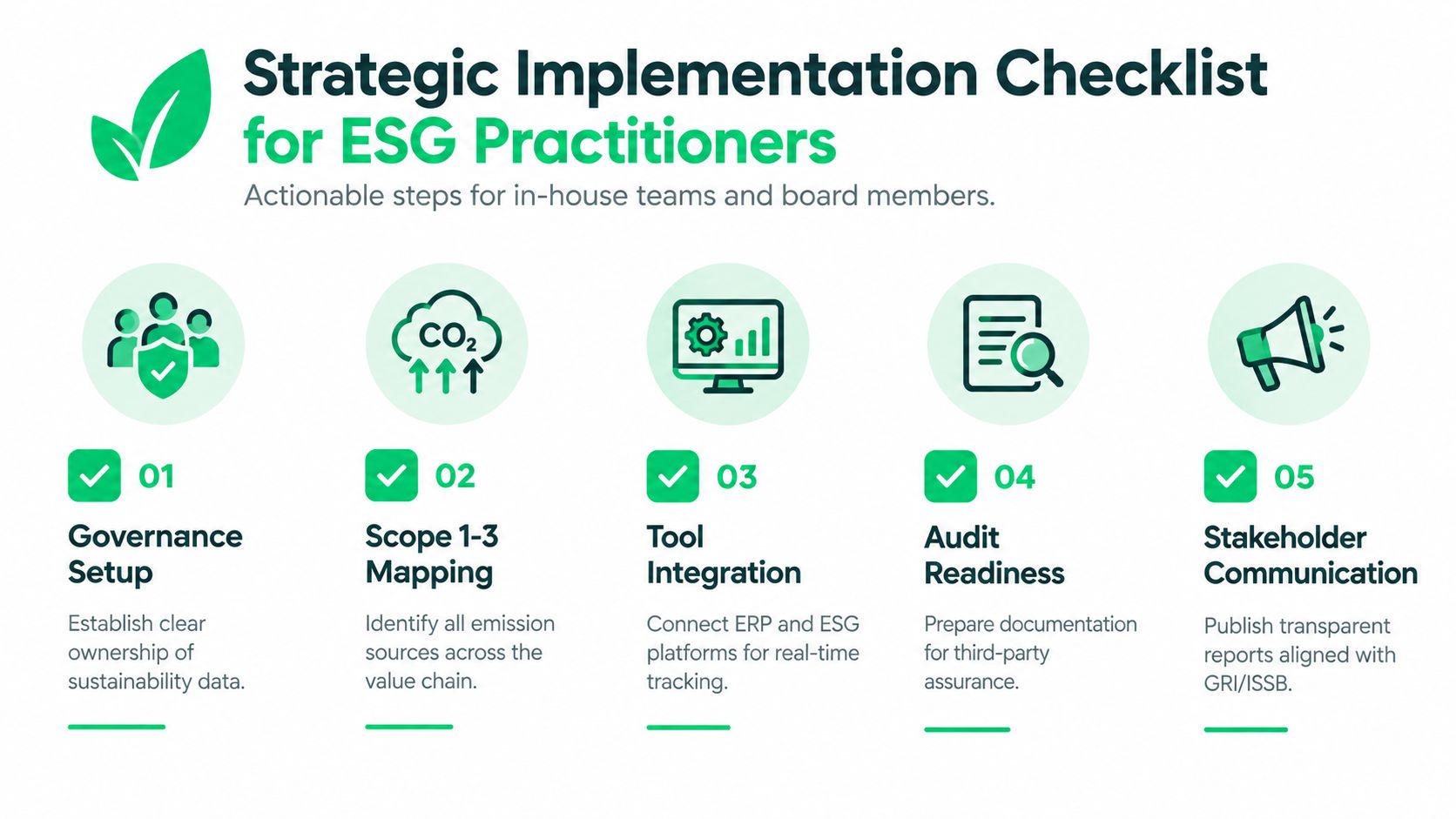
The board should receive a concise implementation dashboard showing applicability decisions, data completeness, unresolved judgements, assurance findings, supplier response quality and upcoming stakeholder deadlines. That dashboard turns sustainability reporting from an annual scramble into a managed control cycle.
The practical priority is to build once and reuse responsibly. A common dataset can support UK regulatory reporting, UK SRS readiness, customer questionnaires, procurement submissions and investor communication, but only if each output preserves its own boundary, methodology and explanation.
ESG Consulting advises UK organisations on SECR, UK SRS S1 and S2 readiness, TCFD and climate-related financial disclosures, CSRD and ESRS assessment, GRI and CDP responses, Scope 3 inventories, supplier engagement and assurance-ready evidence trails. Speak with ESG Consulting to scope your reporting obligations, reconcile your sustainability data and build a controlled framework that can withstand board, buyer and assurance scrutiny.