
SBTi net zero standard, SBTi v2.0, Scope 3 targets, net zero pathway, UK ESG consulting
SBTi Net Zero Standard Guide: Requirements and Submission
By ESG Consulting Team · · 14 min read
Your board doesn't need another climate slogan. It needs a decision before the next capital cycle locks in, because the CEO wants a credible claim for a contract bid, the CFO doesn't want to commit to the wrong version of the SBTi Net Zero Standard, and Legal is already asking where the Scope 3 evidence will come from. That's the 2026 problem, not whether net zero sounds good in principle.
For a UK company, the choice is blunt. Submit now under v1.3.1, wait for v2.0, or run both in parallel and accept the extra work. The right answer depends on how good your supplier data is, whether you already have removals sourcing lined up, and whether your assurance process can survive scrutiny.
Table of Contents
- The Boardroom Question Driving SBTi Commitments in 2026
- What the SBTi Net Zero Standard Actually Is
- Core Requirements Every UK Company Must Meet
- v1.3.1 Versus v2.0 and the Transition Window
- Choosing a Modelling Approach for Your Targets
- Scope 3 and Carbon Removals the Hard Parts
- The Submission Process From Commitment to Validation
- A Practical Decision Framework for UK Boards
The Boardroom Question Driving SBTi Commitments in 2026
A mid-cap FTSE-listed manufacturer is preparing for a major procurement bid. The buyer wants validated targets and a defensible transition plan. The CEO wants the climate position ready. The CFO must decide whether to submit under v1.3.1 now or wait for v2.0, knowing that a later standard could require changes to the target and supporting evidence.
The General Counsel is focused on exposure. Supplier contracts are already requesting validated Scope 3 evidence, not a promise to address emissions eventually. Procurement, finance, sustainability, and Legal therefore need one decision, supported by an agreed emissions boundary, documented assumptions, a credible removals approach, and an assurance trail.
The three live options
The board has three practical choices. Submit now under v1.3.1 if the company has a usable inventory, can defend its Scope 3 boundary, and needs external credibility for customers, investors, or bids. Waiting for v2.0 is the better choice if supplier data, emissions factors, or governance approvals are too weak to support a credible submission. Running both pathways in parallel makes sense only where the company has enough capacity to prepare for v2.0 without abandoning the current window.
The decision should follow evidence, not impatience. A target submitted quickly but supported by weak Scope 3 data, uncertain removals sourcing, or incomplete assurance records can create more scrutiny than value.
Practical rule: if the company cannot explain its Scope 3 boundary, removals plan, and board approval trail in one sitting, it is not ready to treat submission as a paperwork exercise.
Timing still matters. Customer and investor expectations are already shaping decisions, while the standard is changing. For a UK company, SBTi remains voluntary rather than a legal requirement, so the case for acting now comes from market and disclosure pressure. UK sustainability commentary also frames the transition window as a board-level timing decision, not a reason to postpone preparation (SBTi FAQs, UK SRS commentary on the transition window).
What the SBTi Net Zero Standard Actually Is
A UK board considering an SBTi commitment is choosing a governed emissions pathway, not adopting a climate slogan. The Corporate Net-Zero Standard sets the framework for reaching net zero by 2050 at the latest, with defined emissions boundaries, target dates, and review expectations (SBTi FAQs). That distinction matters when directors must defend the target to customers, investors, lenders, or assurance providers.
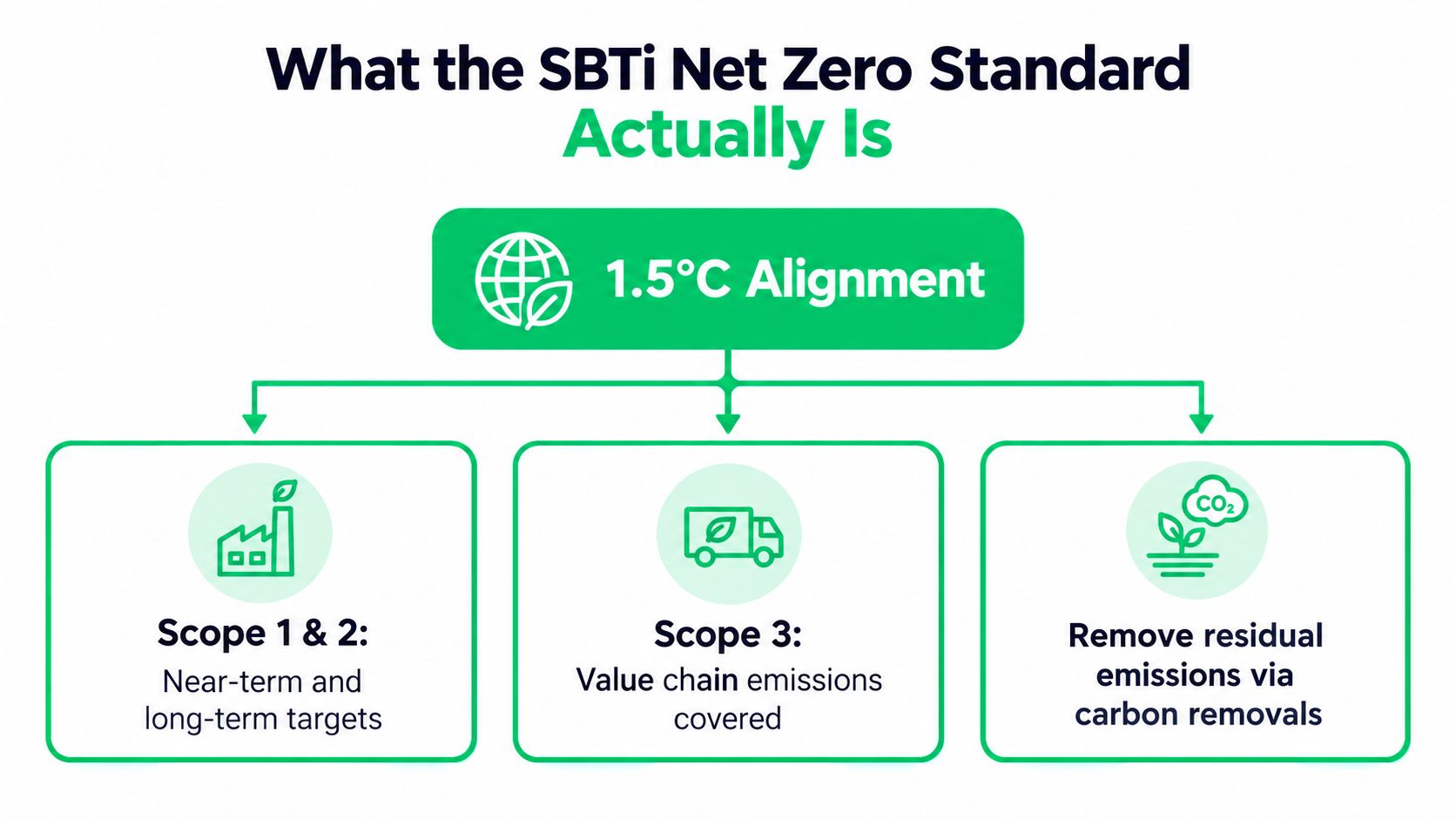
The standard has two linked stages. A near-term target sets the reductions the company must deliver within a 5- to 10-year window from submission. The long-term target takes the business to net zero by 2050 at the latest, requiring substantial emissions cuts before carbon removals address what remains.
What “net zero” means here
The arithmetic is demanding. Long-term targets must cover at least 95% of Scope 1 and 2 emissions and 90% of Scope 3 emissions, as set out in the SBTi Net-Zero Standard criteria. The residual balance cannot be handled through a broad offsetting programme. It must be addressed through permanent carbon removal after the company has reduced emissions as far as practicable.
The Environment Agency's January 2024 net-zero update expresses the same principle in practical terms: companies should deliver a substantial emissions reduction by 2050 and use removals only for the residual balance. Boards should apply one rule throughout the business: reduce first, remove last.
The standard is designed to force real decarbonisation, not a polished offset story.
The Corporate Net-Zero Standard also differs from the FLAG standard for land-intensive sectors and the Financial Institutions standard. Manufacturers, service firms, and diversified UK groups generally need to establish whether the Corporate standard fits their activities before they commit, particularly where Scope 3 evidence and removals sourcing remain immature.
Core Requirements Every UK Company Must Meet
A UK board should test four requirements before approving an SBTi submission: boundary, base year, target year, and recalculation. These are evidence and governance tests, not wording exercises. If the company cannot defend one of them, procurement teams, auditors, and investors can challenge the target.
Boundary and coverage
Companies with more than 500 employees must account for all relevant greenhouse gases under the GHG Corporate Standard. Where Scope 3 represents 40% or more of the inventory, it must also feature in near-term targets. Scope 3 targets require at least 67% coverage, as outlined in The Pensions Regulator climate change and net zero report.
The board should require a consolidated group boundary, a category-level Scope 3 map, and an inventory approved by management. A target built on incomplete supplier, customer, logistics, or financed-emissions data will be difficult to defend. Scope 3 belongs in the submission plan from the start, not in a later workstream.
Base year and target year
Choose a base year that is recent, representative, and supported by reliable records. The company must explain material changes in the inventory and apply a clear restatement policy. A weak baseline creates avoidable questions when acquisitions, disposals, operational changes, or improved measurement alter reported emissions.
The near-term target uses a 5- to 10-year horizon. The long-term target must reach net zero by 2050 at the latest, consistent with the SBTi Net-Zero Standard criteria. Align both targets with the budget cycle, capital plan, operating assumptions, and public communications. Finance should be able to reconcile the target pathway with the investment required to deliver it.
Recalculation and governance
Targets require recalculation and revalidation at least every 5 years, as set out in the SBTi FAQs. Establish the process before submission. It should cover acquisitions, disposals, restructuring, methodology changes, boundary adjustments, and corrections to historical data.
| Requirement | SBTi threshold | UK evidence expected |
|---|---|---|
| Coverage | Scope 1 and 2 included, Scope 3 included when material, with long-term coverage of 95% for Scope 1 and 2 and 90% for Scope 3 | Consolidated boundary, category-level Scope 3 map, board-approved inventory |
| Base year | Stable reference year with quantified reductions | Historical emissions data, methodology notes, restatement policy |
| Target year | Near-term over 5- to 10-year window, long-term by 2050 | Budget alignment, capital plan linkage, public target statement |
| Recalculation | Revalidation at least every 5 years | Change-control process, M&A treatment, assurance trail |
The decision rule is simple: submit only when finance can trace every material figure to source systems and owners. Until then, the target is not ready for board approval.
v1.3.1 Versus v2.0 and the Transition Window
A UK board choosing an SBTi submission has three credible options: submit under v1.3.1, wait for v2.0, or prepare both routes in parallel. The right choice depends on the quality of Scope 3 evidence, the availability of credible removals, and the company's assurance readiness.
v2.0 was published on 11 June 2026. Validations under v2.0 are scheduled to open in Q1 2027, while v1.3.1 is expected to remain available until 31 January 2028, according to the UK SRS transition note. Treat those dates as the current transition plan, not as a reason to delay work.
What changes in practice
Under v1.3.1, companies follow the established Corporate Net-Zero Standard structure, including a long-term pathway, deep emissions reductions, and neutralisation of residual emissions. v2.0 places more emphasis on delivery discipline and ongoing recalculation. It also sets out the treatment of Scope 1, Scope 2, Scope 3, and carbon removals in more operational terms, as discussed in the Carbon Gap analysis of v2.0.
| Criterion | v1.3.1 | v2.0 |
|---|---|---|
| Validation timing | Available during the transition period | Scheduled to open in Q1 2027 |
| Submission logic | Best for companies with decision-ready evidence | Best for companies using the transition to strengthen controls |
| Scope 3 pressure | Demanding and central to the target | Greater focus on delivery and operational scrutiny |
| Removals treatment | Residual emissions still require neutralisation | Expectations become more structured, particularly in later phases |
Submit under v1.3.1 if the emissions inventory is complete, material Scope 3 categories have defensible evidence, and finance can support the reduction pathway. Wait for v2.0 if those foundations are incomplete and the business can tolerate delay. Run both in parallel when the board needs near-term readiness but expects v2.0 requirements to shape the final submission.
Removals sourcing also affects timing. Do not approve a target that assumes future removal capacity without documented suppliers, quality criteria, and procurement ownership. For UK boards, assurance readiness should decide the timetable, not the appeal of a newer label.
Choosing a Modelling Approach for Your Targets
A UK food manufacturer deciding whether to submit under v1.3.1 or prepare for v2.0 should test the modelling route against its evidence, not choose the easiest story for the board. Start with absolute contraction, then assess whether a sector method produces a more credible operational pathway. Use a specific benchmark where the standard expects one.
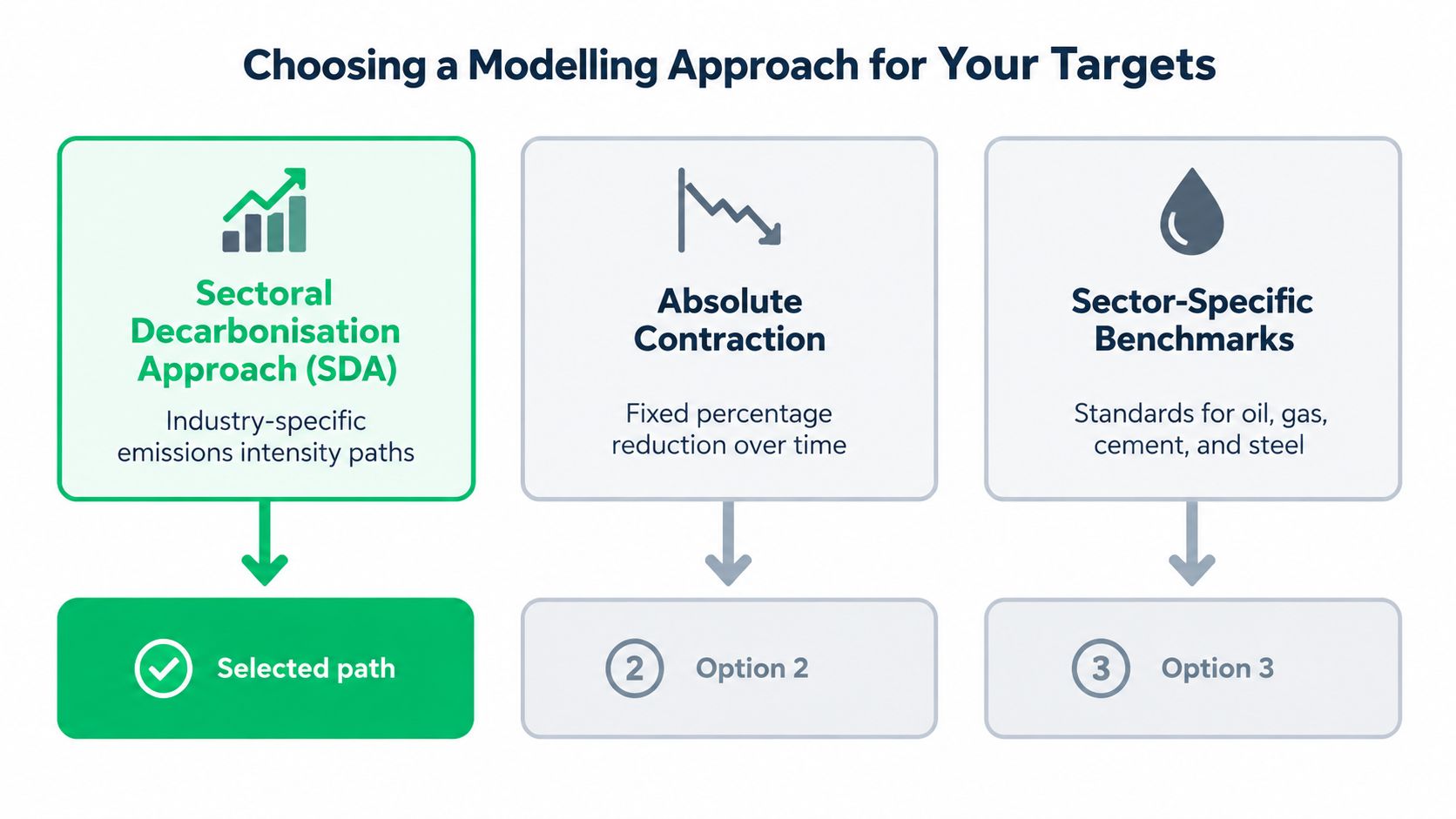
A mid-cap UK food manufacturer may have Scope 1 refrigeration emissions, Scope 2 electricity use, and Scope 3 agricultural inputs. An SDA approach can fit where the sector has a recognised intensity pathway, because it connects the target to operational output and sector decarbonisation. Absolute contraction is easier for finance teams to budget and explain, since it converts the baseline into a direct emissions reduction trajectory.
What to test first
- Sectoral Decarbonisation Approach, when a credible sector intensity pathway exists and operational performance is the main driver.
- Absolute contraction, when the board needs a clear reduction path aligned with total emissions.
- Sector-specific benchmarks, when the company falls within a pathway for which the standard expects a more precise method.
Run the comparison before selecting the submission template. Test absolute contraction against the FY23 base year, then run SDA for the food-manufacturing intensity pathway. Compare which method produces the tighter Scope 3 budget for agricultural inputs and which one the company can support with supplier data. That result should guide the board decision.
The method changes how the target becomes tonnes of carbon dioxide equivalent. It also affects internal budgets, supplier engagement, procurement commitments, and the evidence required for validation. A model that looks credible on paper but depends on unverified purchased-input data will slow submission.
ESG Consulting's SBTi modelling and submission service under the Corporate Net-Zero Standard v2.0 can support this comparison, including scenario testing and target documentation, alongside wider net-zero strategy planning that connects the emissions pathway to capital allocation rather than reporting alone.
Scope 3 and Carbon Removals the Hard Parts
A UK board deciding whether to submit under v1.3.1 or wait for v2.0 should start with evidence, not preference. If supplier data, removals sourcing, and assurance controls are weak, waiting may be sensible. If those foundations are ready, delaying a credible submission creates no strategic advantage.
What UK buyers and investors are asking for
Procurement teams want category-level Scope 3 mapping and suppliers are increasingly asked to provide emissions data. Investor questionnaires also expect a removals strategy connected to the 90% abatement before offsetting requirement, rather than a promise to consider credits later (SBTi Net-Zero Standard criteria).
The board should require a documented position on removals before approving the target. That file should cover project vintage, additionality, durability, ownership, and accounting treatment. It should also show how the company will source removals for residual emissions instead of treating them as a future communications exercise.
Treat removals as a procurement and assurance file, not a branding line.
Why Scope 3 is the bottleneck
For larger UK companies, Scope 3 commonly sits inside the target boundary rather than being added later, a point reflected in The Pensions Regulator report. Supplier engagement, category mapping, estimation methods, and data-quality controls must withstand questions from investors, auditors, and pension stakeholders.
The practical question is what Scope 3 emissions are and how they flow through purchased goods, logistics, use of sold products, and downstream categories. what is Scope 3 emissions provides the necessary explanation, but the board needs more than a definition. It needs an evidence register showing source data, assumptions, owners, review controls, and planned improvements.
Run the decision in three ways: submit now under v1.3.1, wait for v2.0, or prepare both pathways in parallel. Choose parallel work when the transition window overlaps with a major reporting cycle and the company can maintain two evidence sets. Choose submission now when assurance readiness is strong. Wait when Scope 3 evidence or removals supply remains materially unresolved.
The Submission Process From Commitment to Validation
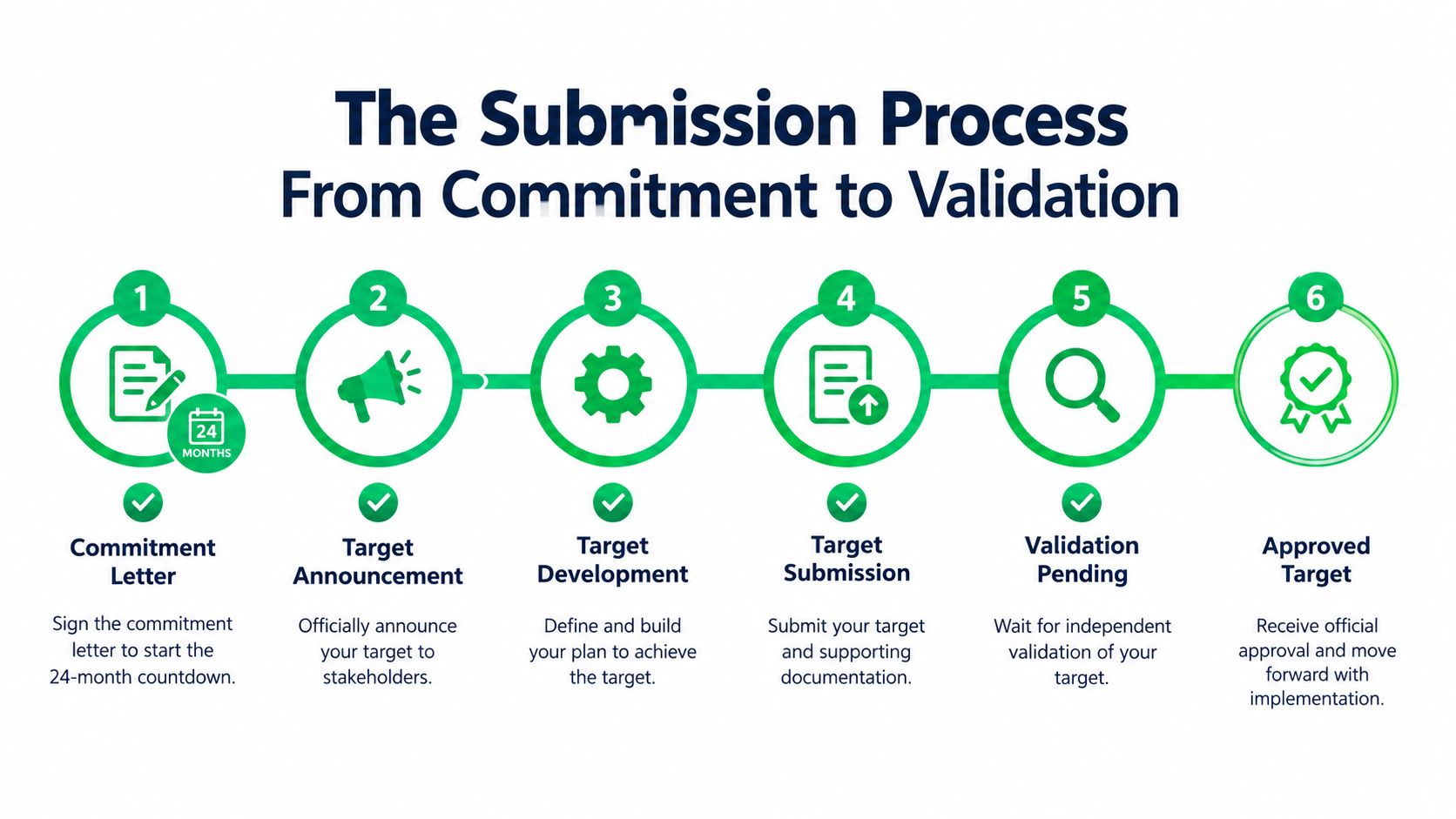
A board can approve an SBTi commitment and still lose months through weak preparation. The working sequence is commitment, boundary, base year, target design, validation, and communication. Signing the commitment letter starts the timetable. It does not complete the work.
The practical flow
- Commitment letter. The company submits through the SBTi portal, and the 24-month validation countdown begins.
- Boundary setting. Define the group boundary, including subsidiaries, joint ventures, and recent acquisitions.
- Base-year selection. Select an inventory that is coherent, documented, and suitable for target setting.
- Target development and submission. Complete the official template and connect the pathway to the chosen modelling approach.
- Validation pending. SBTi reviews the submission against its criteria.
- Approved target. Treat the target as externally validated only after approval.
A mid-cap UK company should allow four weeks for commitment paperwork, six to ten weeks to align its inventory, and additional time for the validation queue. Build this schedule into the board calendar rather than treating submission as an administrative task.
Rejection points are familiar: Scope 3 below the coverage threshold, an outdated base year, undocumented boundary decisions, or near-term and long-term targets that do not align. These are evidence failures, not presentation problems.
Before submission, the board should require three items: a GHG inventory aligned to ISO 14064, documented board approval, and communications reviewed against public disclosure expectations. The evidence file should also show who owns each assumption and control. If those materials are incomplete, choose a later submission or maintain v1.3.1 and v2.0 workstreams in parallel. The version choice matters less than proving that the target can withstand validation and assurance review.
A Practical Decision Framework for UK Boards
The decision is less about ideology than readiness. If the company has strong Scope 3 data and real removals contracts, it should move now under v1.3.1 and stop pretending that waiting automatically improves quality. If the evidence is only middling, the board should use the transition period properly, keep the commitment process active, and rebuild the data room before validating.
Which path fits which company
- Path A, submit now under v1.3.1. Use this if the company already has solid Scope 3 mapping, supplier engagement records, and removals sourcing it can defend.
- Path B, wait for v2.0. Use this if data quality is still weak and the business would only be signing up to rework the target later.
- Path C, run both in parallel. Use this if the company is already mid-process and can keep near-term work moving while building v2.0-ready disclosures.
If the company can't support its target with evidence, the version number won't save it.
The checklist before commitment is straightforward. Inventory maturity has to be good enough for assurance. Supplier engagement has to be documented, not anecdotal. Removal offtake, if used, needs real contractual substance. Governance has to be live, not delegated to one sustainability manager. If those pieces are in place, the board should sign before March 2026. If they aren't, pause and use the window to fix the evidence rather than forcing a weak submission.
If your board is weighing SBTi timing, target modelling, or Scope 3 evidence, ESG Consulting can help you build a submission that holds up in procurement, assurance, and investor review. Visit ESG Consulting to discuss SBTi modelling, Scope 3 inventory work, and net-zero strategy support for UK organisations.
More from the blog
· 12 min read · Regulation
What is PPN 026? The new Social Value Model
PPN 026 replaces PPN 002 as the Social Value Model for central government contracts from 1 January 2027. Scope, the 10% and 20% weightings and the six criteria.
Read article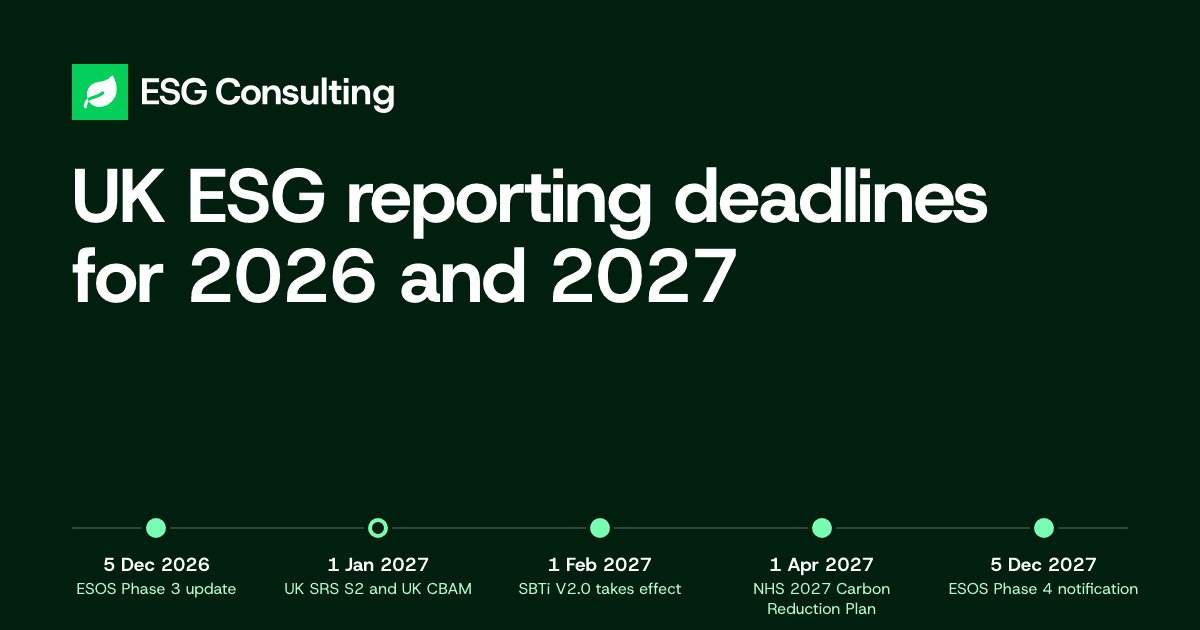
· 14 min read · Regulation
UK ESG reporting deadlines for 2026 and 2027
Every UK ESG reporting date to December 2027 - UK SRS, ESOS, SECR, UK CBAM, CSRD, SBTi, PPN 026 and the NHS - each marked mandatory, proposed or voluntary.
Read article