
SECR, UK reporting, carbon emissions, energy efficiency, ESG compliance
SECR Reporting Requirements: UK Guide 2026
By ESG Consulting Team · · 12 min read
You're staring at a draft annual report, a stack of fuel invoices, and a spreadsheet that doesn't quite tie. The board wants to know whether the SECR section is complete, finance wants the numbers reconciled, and sustainability wants the narrative to hold up if anyone questions it later. That's the challenge with SECR reporting requirements in 2026, not just knowing what to file, but proving that every figure in the filing can be traced back to a source document and defended under scrutiny.
Table of Contents
- Who Must Meet SECR Reporting Requirements in 2026
- Building Scope 1 and Scope 2 Emissions Inventories
- Calculating Required Intensity Ratios and Metrics
- Writing Annual Report Narratives That Meet SECR Standards
- Producing Assurance-Ready SECR Filings
Who Must Meet SECR Reporting Requirements in 2026
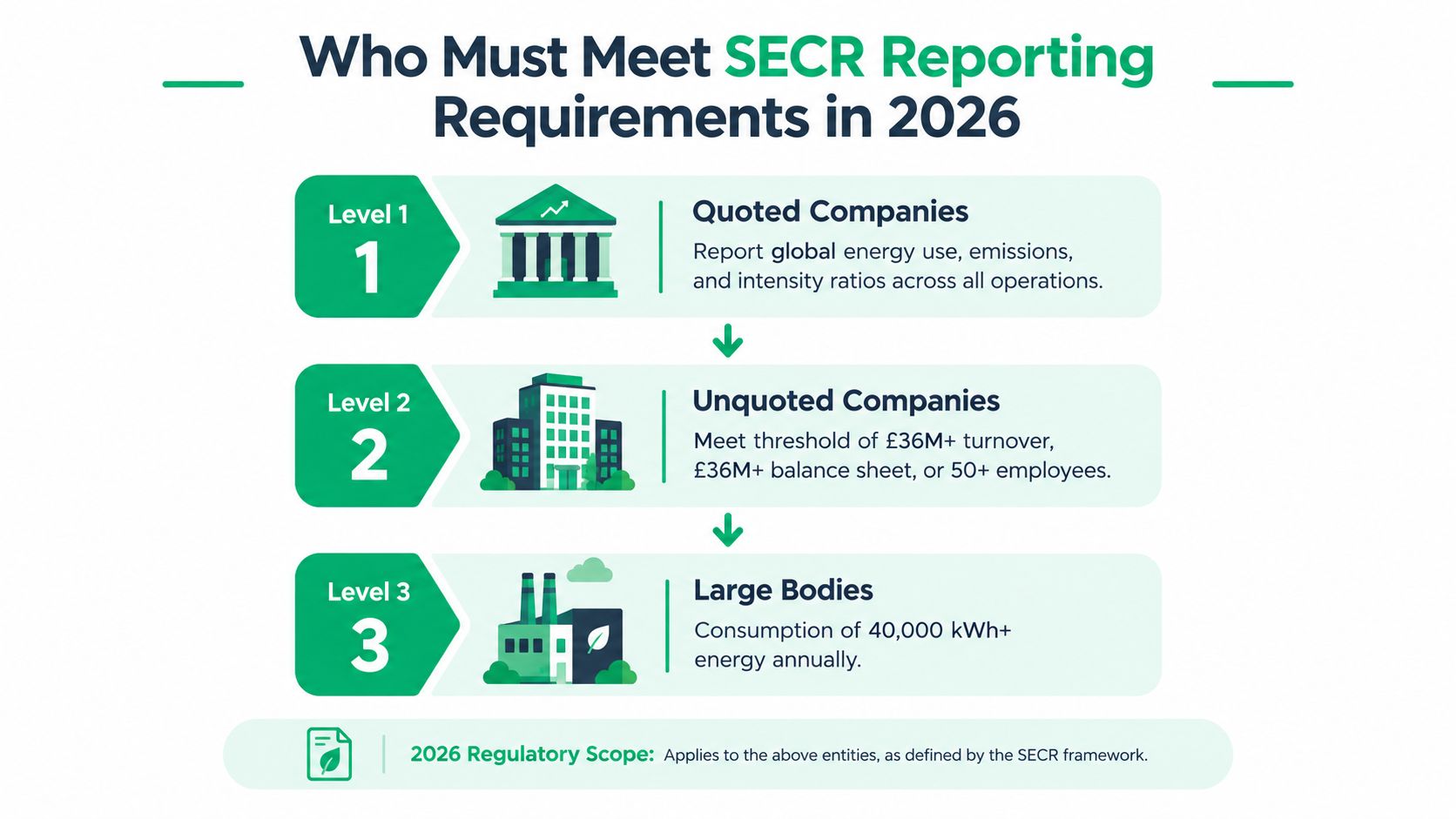
SECR applies first on scope, because if the organisation is out of scope, the rest of the work changes completely. The mandatory regime covers all quoted companies, plus large unquoted UK companies and LLPs that meet at least two of three size thresholds, more than 250 employees, turnover above £36 million, or balance sheet total above £18 million. The framework became mandatory for reporting periods starting on or after 1 April 2019, and it created a statutory baseline for annual energy and carbon disclosure that sits inside the directors' report. The UK government's SECR announcement sets out that shift clearly.
The first boundary decision boards need
Quoted companies and large unquoted entities do not file the same boundary. Quoted companies report global energy use and emissions, while large unquoted companies and LLPs report UK energy use and associated emissions, plus the transport-related Scope 3 category for employee-owned vehicles and rental cars where the organisation purchases the fuel. That distinction matters because the same group can contain entities with different reporting logics, so you need a boundary rule before you touch the workbook.
Practical rule: decide the organisational boundary before you collect data, not after. If the legal entity list changes during the year, the reporting line needs to be rechecked against the filing scope.
The low-energy exemption is narrower than many teams assume
UK guidance still recognises a 40,000 kWh low-energy threshold. Entities using 40,000 kWh or less in the reporting period can avoid full SECR disclosure, but they must still state in the annual report that they are a low-energy user and that detailed SECR figures have been omitted on that basis. The current sustainability reporting guidance keeps that de minimis rule in view, while also showing how the final regime was tightened from an earlier consultation idea that had pointed to a much higher 6 GWh threshold, which materially broadened the number of businesses expected to report. See the 2025 to 2026 sustainability reporting guidance for the current official framing.
The compliance question is therefore not just, “Are we in scope?” It is also, “Can we legitimately reduce disclosure granularity, and if so, how do we say that clearly without weakening comparability?”
UK ESG reporting deadlines and filing milestones become much easier to manage once that boundary is fixed. The filing calendar then stops being a guessing game and becomes a controlled process.
Building Scope 1 and Scope 2 Emissions Inventories
The inventory starts with raw evidence, not carbon factors. In practice that means collecting fuel invoices, electricity meter reads, business travel records, and any supplier statements that describe what was purchased and when. The government's post-implementation review makes the technical risk plain, the biggest problem is usually not whether a company reports, but whether the figures are built on a coherent method with enough verification to trust them. The review also notes that quality is uneven, which is why a reconciliation trail matters as much as the final totals. The SECR post-implementation review is the right anchor for that point.
Start with source documents, then map each fuel stream
Scope 1 covers direct emissions from sources the organisation owns or controls, such as gas combustion or company vehicles. Scope 2 covers purchased electricity, and for quoted companies the boundary extends globally, while for large unquoted companies and LLPs it stays tied to UK operations. That sounds simple on paper, but the practical challenge is that one site can contain several fuels, several meters, and several cost centres, each with different evidence quality.
A typical workflow usually follows this order:
- Collect the source documents. Pull invoice PDFs, meter files, fleet fuel records, and travel reports into one controlled folder.
- Tag each line item. Mark whether it is gas, electricity, or transport fuel, and whether it belongs in Scope 1 or Scope 2.
- Tie each line to a site or entity. That stops duplicated or missing consumption from creeping in.
- Reconcile totals. Compare the inventory workbook back to purchase records and meter data before any emissions factor is applied.
That last step is where fragile filings usually fail. If the workbook total does not reconcile to the evidence pack, the reporting team is guessing, even if the spreadsheet looks polished.
How to handle estimates without losing control
Estimates are sometimes unavoidable, especially when a supplier invoice is late or a meter read is missing. The mistake is to treat estimates as a shortcut rather than a controlled method. Every estimate should state what was missing, what proxy was used, and how the proxy relates to the underlying evidence. If the method changes mid-year, note that in the audit trail so the reviewer can understand the impact.
The strongest inventory is not the one with the most decimal places. It is the one where every figure can be followed back to a document, a meter, or a clearly described estimate.
A practical site example
A UK manufacturing company with several locations can separate gas heating from electricity by treating each site as its own source stream. Gas invoices are coded to Scope 1, electricity meter data is coded to Scope 2, and any transport fuel bought for company use is kept in a third stream. The team then reconciles those totals against purchase invoices and meter records before mapping each fuel line to a source document, so the final figure is not just calculated, it is explainable.
For teams that need a formal carbon reduction planning process alongside the SECR work, a carbon reduction plan framework can help align the evidence pack with broader decarbonisation actions. That doesn't replace SECR, but it does make the data architecture more disciplined.
Calculating Required Intensity Ratios and Metrics
SECR doesn't just want totals. It wants at least one intensity ratio, which is why the denominator choice matters so much. If you pick a metric that reflects how the business operates, the ratio becomes useful to the board. If you switch denominators every year, the number turns into noise and reviewers immediately lose confidence.
Choose one denominator and keep it stable
Common choices include emissions per unit of revenue, per employee, or per square metre of floor space. The right option depends on the business model, not on what looks best in a presentation. A service company may prefer a revenue-based ratio because it tracks activity more naturally, while a property-heavy business may find floor space more meaningful.
The important discipline is consistency. Pick one denominator, document why it fits the business, and keep it stable across reporting periods unless there is a strong governance reason to change it. If a change is unavoidable, record the old and new approaches side by side so the shift is obvious.
Document the calculation method so it can be reproduced
A reviewer should be able to rebuild the ratio from the workbook, not just trust the conclusion. That means the methodology note should identify the numerator, the denominator, the period covered, and any special treatment such as estimates or exclusions. If the ratio uses gross emissions, say so. If it uses net figures after a specific adjustment, say exactly what was removed and why.
A simple internal control works well here:
- Definition control: state the exact formula used for the ratio.
- Source control: identify the source for both emissions and the denominator.
- Change control: log any alterations to methodology from the prior year.
That discipline matters because SECR guidance requires the methodology to be disclosed, and because inconsistent intensity metrics are one of the most common reasons filings feel fragile.
A service company example
A service company that chooses revenue-based intensity can keep the same denominator across several years while improving the underlying data quality underneath it. The ratio stays comparable, even if meter coverage or cost coding gets cleaner over time. That is the right sequence, stabilise the metric first, then improve the inventory feeding it.
If the board wants a simple rule, use this one. A single consistent ratio beats several inconsistent ones, every time. Multiple ratios can be useful internally, but the public filing needs a clear logic, not a dashboard.
Writing Annual Report Narratives That Meet SECR Standards
The narrative section is where many otherwise decent filings get weak. The rules require disclosures on energy-efficiency actions taken during the year and the methodology used to calculate emissions and energy use, which means the prose has to match the numbers, not sit beside them as a generic sustainability paragraph. The wording also needs to reflect what happened, because the government's review shows that weak verification and inconsistent metric design do more damage than simple non-reporting.

What the board expects from the narrative
Directors care about three things. First, that the narrative doesn't conflict with the inventory. Second, that the explanation of methodology is precise enough to survive challenge. Third, that the action section shows the organisation did more than measure its impact, it acted on it.
A good narrative therefore links each claim to evidence. If the filing says lighting controls were upgraded, there should be a project note, commissioning evidence, or an internal approval record. If the narrative says an estimate was used, the basis for the estimate should be visible in the working papers.
Practical rule: every narrative sentence should answer a reviewer's next question before they ask it.
Write for statutory filing and assurance at the same time
The best SECR narratives are short, factual, and specific. They name the action, the scope of the action, and the period in which it happened. They also explain whether the underlying data was measured or estimated, because that distinction matters when the filing is reviewed later.
A quoted company with several energy-efficiency projects can structure the narrative around separate actions, each with its own evidence trail. One section can describe site equipment changes, another can cover controls or process optimisation, and a third can explain how the team reviewed energy data for ongoing opportunities. The point is not to make the narrative long. It is to make it defensible.
Use omission language carefully
If any data is excluded, the narrative needs to say why. That is especially important where boundary decisions or unavailable records affect comparability. Omission without explanation is one of the easiest ways to create doubt in an assurance review.
ESG Consulting can support that narrative work as part of a controlled SECR package, but the same principle applies whichever adviser or internal team owns the filing, the working papers have to support the words on the page. For wider sustainability disclosure work, a sustainability reporting consultant can help align the narrative with the evidence pack and the board paper.
Producing Assurance-Ready SECR Filings
If there is one principle that separates a compliant filing from a fragile one, it is this, data governance matters more than perfect emissions factors. You can refine conversion factors later. You cannot rescue a filing that lacks a reconciliation trail, a version-controlled workbook, or a clear explanation for exclusions. The post-implementation review already points to weak verification and inconsistent metrics as the actual technical risks, so the control environment is the core product here.
Build one controlled evidence pack
The inventory workbook should have one owner, one current version, and one clear link to the source folder. If multiple people edit separate copies, the audit trail fragments immediately. A clean process keeps invoices, meter reads, estimates, and working papers in one place, with each line item traceable to a file reference.
That evidence pack should also contain an exclusion register. If something is omitted, note what it was, why it was excluded, and whether the omission affects the reported totals or only the narrative.
Reconcile before sign-off
The final review should test three things. Are the fuel streams complete. Do the totals reconcile to the source documents. Does the narrative match the numbers exactly. If any of those answers is unclear, the filing isn't ready.
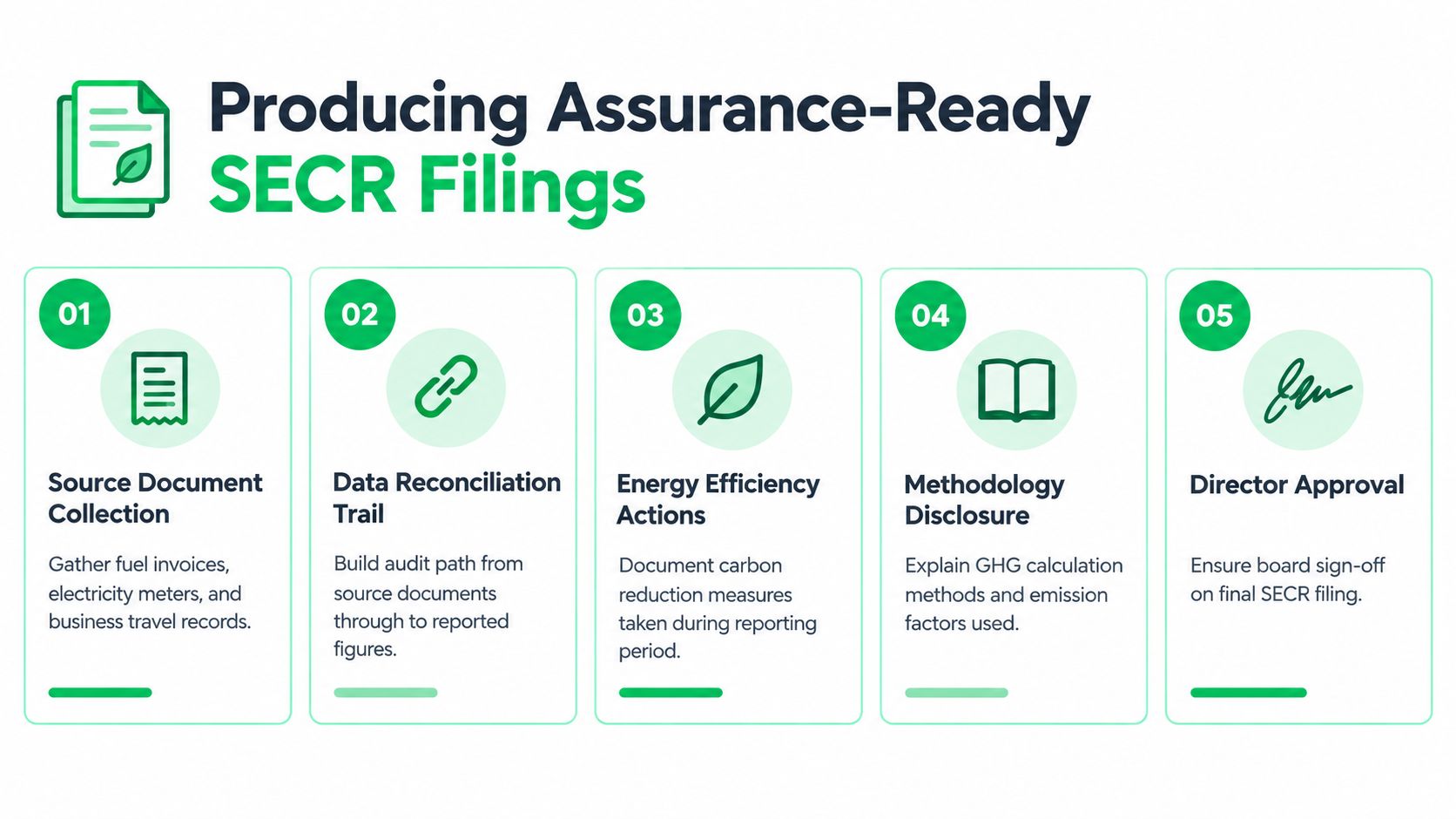
A simple pre-submission review can catch most avoidable problems:
- Source document collection: confirm the invoice and meter set is complete for the period.
- Reconciliation trail: trace reported totals back to the evidence pack.
- Methodology disclosure: check that the calculation approach is described clearly.
- Director approval: make sure the board or relevant sign-off body has reviewed the final version.
Why the submission fails when controls are weak
Most assurance issues come from avoidable inconsistencies. One report uses a different intensity ratio from the previous year without explanation. Another omits a fuel stream because nobody could find the invoice. A third says the numbers are actuals, when part of the inventory was estimated. Those problems are governance failures, not carbon-accounting failures.
The final filing should feel like a controlled record, not a marketing document. If the working papers can survive an external review, the annual report usually can too.
If your team needs help turning SECR requirements into an assurance-ready filing, ESG Consulting can support the inventory build, the evidence trail, and the annual report narrative as one controlled process. Visit ESG Consulting to discuss SECR reporting support that's built around source documents, reconciliations, and board-ready sign-off.
More from the blog

· 12 min read · Regulation
What is PPN 026? The new Social Value Model
PPN 026 replaces PPN 002 as the Social Value Model for central government contracts from 1 January 2027. Scope, the 10% and 20% weightings and the six criteria.
Read article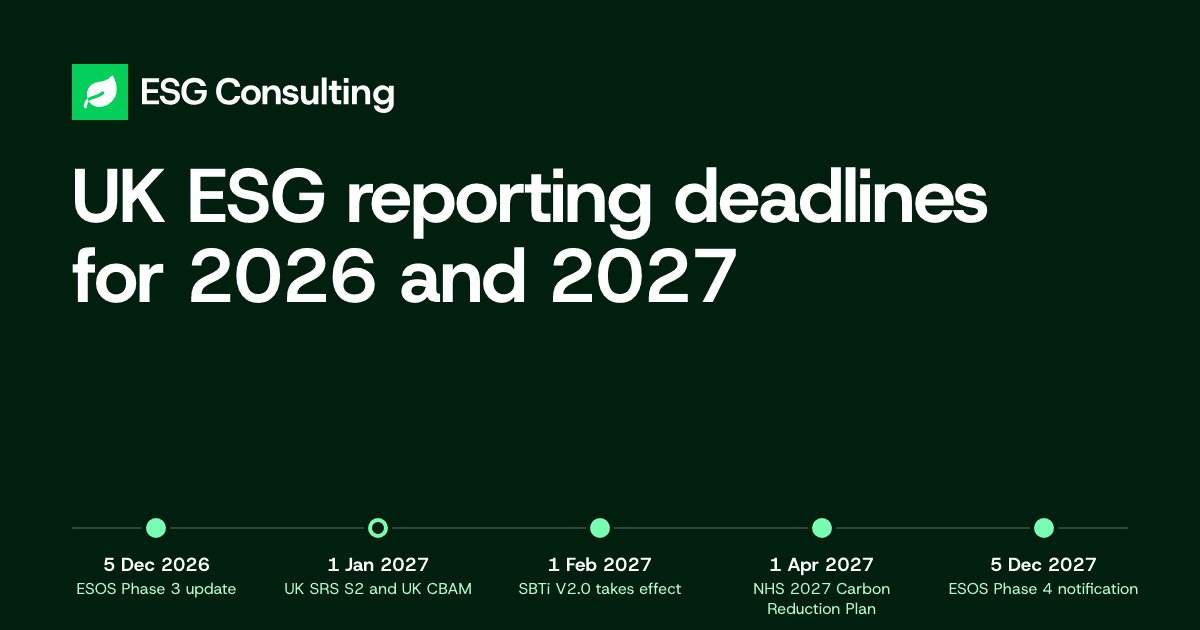
· 14 min read · Regulation
UK ESG reporting deadlines for 2026 and 2027
Every UK ESG reporting date to December 2027 - UK SRS, ESOS, SECR, UK CBAM, CSRD, SBTi, PPN 026 and the NHS - each marked mandatory, proposed or voluntary.
Read article