
carbon reduction plan uk, PPN 006, net zero procurement, Scope 3 reporting, UK sustainability
Carbon Reduction Plan UK: A Practical Compliance Guide
By ESG Consulting Team · · 18 min read
You've got a tender deadline approaching, the commercial team has uploaded a Carbon Reduction Plan from last year, and procurement has come back with clarification questions you didn't expect. Which conversion factors did you use. Why has Scope 3 moved between versions. Who approved the plan, and was that approval within the required window. That's usually the moment a supplier realises the document isn't being treated as a website formality.
A Carbon Reduction Plan UK submission now sits much closer to financial reporting discipline than most guidance admits. Buyers read it, compare it to other disclosures, and use it to test whether your emissions story is controlled, current and proportionate to the contract. The template matters. The evidence behind it matters more.
Table of Contents
- Why the Carbon Reduction Plan Has Become a Live Procurement Document
- PPN 006 Scope, Thresholds and the Procurement Act 2023
- Scope 1, Scope 2 and the Five Mandatory Scope 3 Categories
- Baselines, Reporting Periods and Rebasing Decisions
- Target Setting From Net Zero by 2050 to SBTi-Aligned Pathways
- Sign-Off, Publication and the Annual Update Discipline
- A Practical Checklist and Where Specialist Support Fits
Why the Carbon Reduction Plan Has Become a Live Procurement Document
The shift happened when government procurement stopped treating carbon as a policy statement and started treating it as a participation condition. The original Procurement Policy Note 06/21 was published on 5 June 2021 and applied to new procurements launched from 30 September 2021. It requires suppliers bidding for major central government contracts above £5 million per year excluding VAT to submit a published Carbon Reduction Plan with a signed commitment to reach Net Zero by 2050, emissions details and environmental management measures, and it must be updated at least annually and signed off at an appropriate level within 12 months of the procurement date, according to the government's PPN 06/21 guidance.
That annual update point is what changes the job. A CRP isn't a one-time disclosure that sits untouched in the footer. It's a recurring compliance document that can be checked at selection stage, queried during clarification, and revisited later if the contract authority wants to test whether your published position still holds.
What buyers are actually looking for
In practice, buyers don't only check whether a PDF exists. They look for signs that the plan was built from a real emissions inventory and maintained with control. Common review points include:
- Approval discipline: Was the plan signed at the right level, and is the approval date current enough for the procurement?
- Method consistency: Do the reported emissions line up with the methodology stated in the document?
- Traceable updates: If figures changed from the prior version, can the supplier explain why?
- Public availability: Is the plan published on the supplier's website for verification?
A tidy plan with weak records behind it tends to fall apart in clarification.
That is why stronger suppliers now handle the CRP like a controlled reporting output. Sustainability prepares it, finance or operations validates key source data, legal or bid teams check publication, and a senior owner signs a version that can survive external reading.
Why this matters beyond central government
Even where a buyer applies the requirement with some discretion, the discipline has spread across public procurement more widely. That's one reason carbon reporting expectations now show up in sectors already dealing with contract-level environmental scrutiny, including the sustainability pressures shaping the construction industry.
The practical takeaway is simple. If your team still treats the CRP as a static template exercise, you're likely underestimating how it will be read.
PPN 006 Scope, Thresholds and the Procurement Act 2023
The current PPN 006 guidance keeps the public procurement anchor firmly tied to a 2050 net zero commitment and applies the requirement to relevant public contracts for goods, services and works above £5 million per year, with suppliers expected to publish the plan on their website and confirm emissions information for Scope 1, Scope 2 and selected Scope 3 categories, as set out in the updated PPN 006 guidance. That makes carbon performance a selection-stage issue, not a nice-to-have narrative.
The more interesting development is the shift in how contracting authorities judge relevance. The updated policy position introduces a practical proportionality question. Buyers should apply the requirement where it is relevant to the nature, complexity or cost of the procurement, and there is room to drop it where that test is not met, according to the current PPN 006 policy note.
What stays fixed and what changes
PPN 006 still does the operational heavy lifting. It tells buyers and suppliers what a compliant plan needs to contain. The wider procurement regime changes the context around it, including how conditions of participation are applied and evidenced.
That matters because many teams still assume the old answer is always “contract over threshold equals CRP required”. In reality, the threshold is only part of the decision. Relevance and proportionality now matter more in edge cases, especially where lots are low-risk, operationally narrow, or weakly connected to material carbon impact.
| Dimension | PPN 006 Position | Procurement Act 2023 Position |
|---|---|---|
| Core purpose | Uses the Carbon Reduction Plan as a participation condition in in-scope procurement | Frames procurement conditions through a stronger proportionality lens |
| Contract scope | Relevant public contracts for goods, services and works above £5 million per year | Allows authorities to consider whether the requirement is relevant to the procurement |
| Supplier obligation | Publish a CRP on the supplier website and include required emissions content | Evidence still needs to stand up, but buyers can judge whether to apply the requirement |
| Practical risk | Non-compliant CRP can remove a bidder at selection stage | Over-applying the requirement can itself become a procurement judgment issue |
The pass or fail reality
A weak award submission can sometimes be recovered elsewhere in the score. A weak CRP usually can't. If the requirement applies and the plan is missing, outdated or materially incomplete, the supplier risks failing the selection stage before price or delivery strengths are considered.
That's why legal, procurement and sustainability teams should read the requirement together rather than in sequence. The policy sits within a broader UK compliance framework, not in isolation, and that wider context is part of what makes UK environmental legislation for businesses increasingly operational rather than purely declarative.
Scope 1, Scope 2 and the Five Mandatory Scope 3 Categories
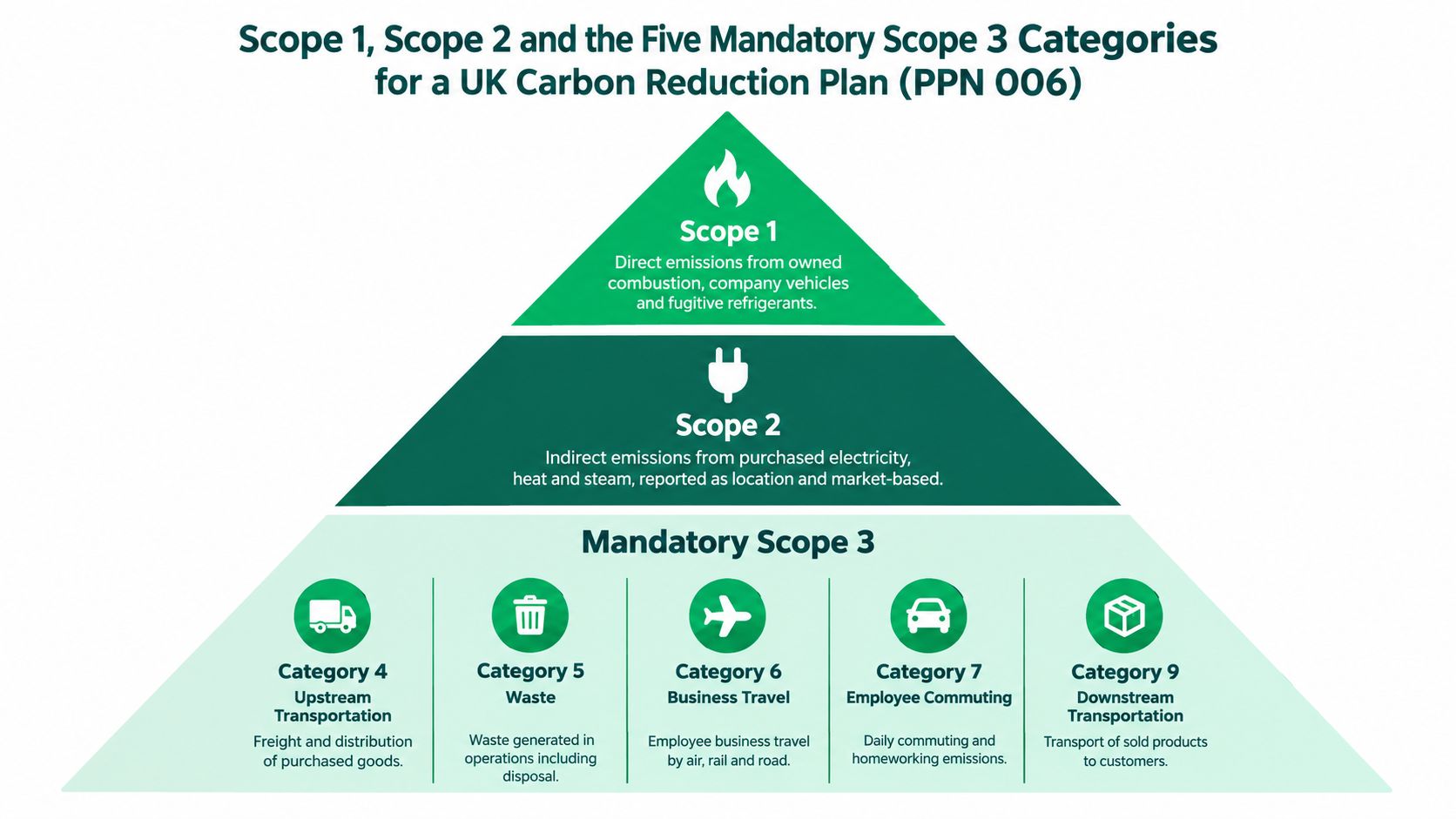
Most rejected or challenged plans fail on scope before they fail on ambition. The government technical standard is specific about what must be reported. A compliant UK Carbon Reduction Plan must include full Scope 1 and Scope 2 emissions plus five Scope 3 categories: business travel, employee commuting, waste generated in operations, upstream transportation and distribution, and downstream transportation and distribution, using CO2e, the GHG Protocol and UK government conversion factors, with a consistent reporting period and a clearly stated baseline year, according to the PPN 006 technical standard.
The required boundary in practice
Scope 1 covers direct emissions from owned or controlled sources. For most suppliers, that means fuel combustion, company vehicles and refrigerant leakage if relevant.
Scope 2 covers purchased electricity and other imported energy. In larger disclosures, I'd usually encourage both location-based and market-based electricity reporting where the wider inventory supports it, but the first test in a CRP is simpler. Can the supplier clearly evidence what they bought, over what period, and how the conversion was done.
The five mandatory Scope 3 categories often create the workload because they pull in data from travel, HR, waste contractors and logistics providers. If those functions aren't aligned, the plan quickly turns into a patchwork.
What works and what usually doesn't
The most reliable method is straightforward:
- Set one reporting year that aligns to the rest of your corporate reporting.
- Collect activity data first for fuel, electricity, travel, freight and waste.
- Apply the correct DESNZ or DEFRA factors for the reporting year.
- State assumptions openly where estimates were needed.
- Check for double counting across transport and supply chain records.
A useful technical explainer on value-chain reporting sits in this guide to understanding Scope 3 emissions.
The common failure mode is publishing a Scope 3 total with no explanation of what sits inside it. Buyers notice that quickly. If business travel comes from expense claims, say so. If commuting is estimate-based, say so. If waste is incomplete because one landlord-controlled site hasn't supplied tonnage data yet, say so and note how it will be updated.
This short video is a useful visual primer before drafting your own categories and evidence map.
Practical rule: If a reviewer can't tell where a Scope 3 number came from, they will assume it is fragile.
Baselines, Reporting Periods and Rebasing Decisions
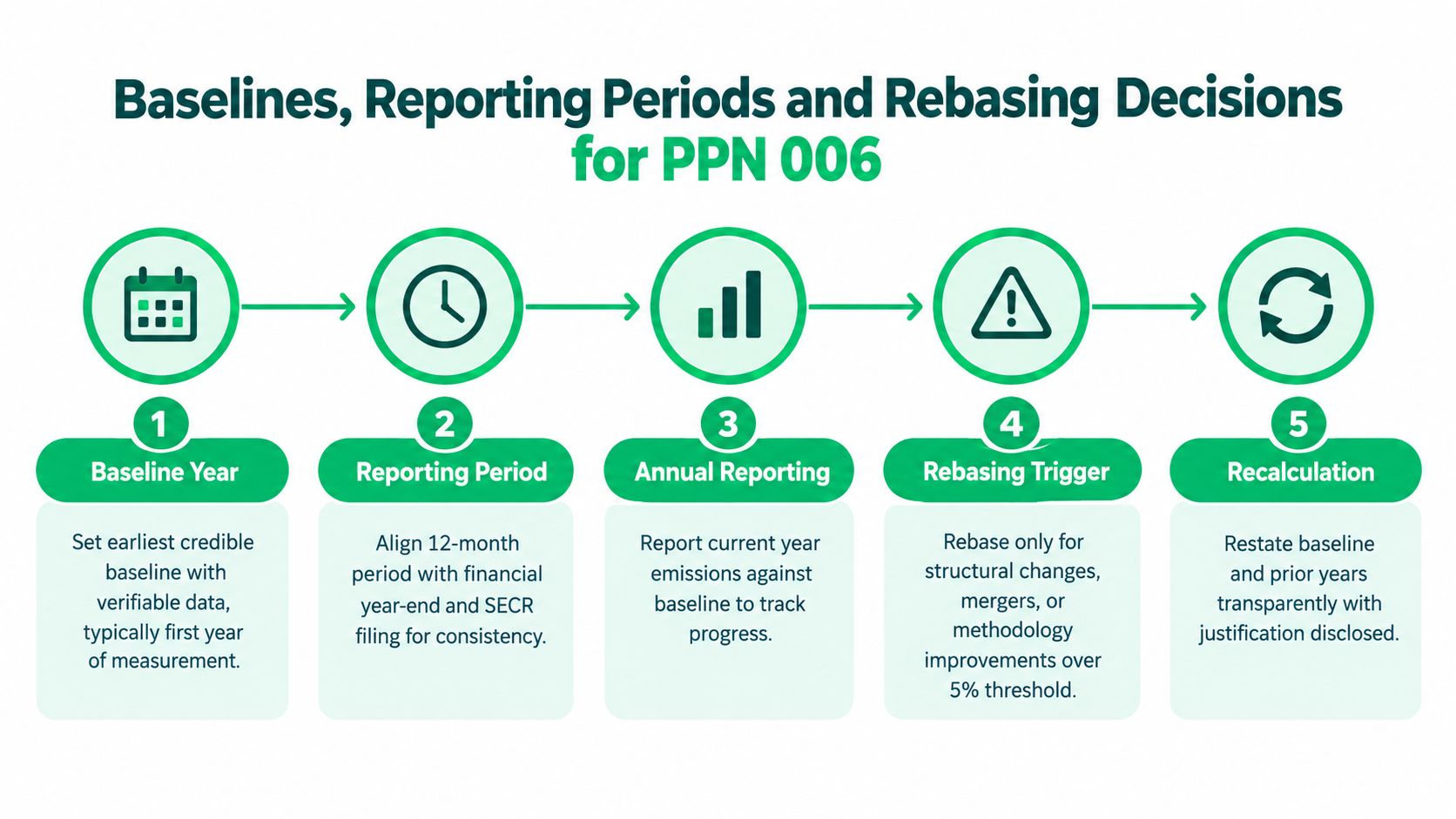
A baseline is where a Carbon Reduction Plan starts to show whether the organisation is reporting transparently or reporting conveniently. The best baseline is usually the earliest year for which you have a complete, defensible footprint built on records you can still retrieve. It should be credible, not flattering.
Choosing the reporting period
The technical standard expects a consistent reporting period and a clearly stated baseline year, again using the GHG Protocol and UK government conversion factors, as set out in the technical standard for Carbon Reduction Plans. In practice, that usually means aligning the CRP period to your financial year if that is where your utility, fleet and travel data are already governed.
Calendar-year reporting can work. So can a fiscal year. What matters is consistency and traceability. If your CRP uses one period, your SECR uses another, and the bid narrative references a third, questions will follow.
When rebasing is legitimate
Rebasing is justified when the structure or method changes in a way that makes comparison unfair. A genuine acquisition is a common example. If a supplier buys another operating company and takes control of its sites, fleet and staff, the historic baseline may need restating so the trend remains meaningful.
What doesn't survive scrutiny is a cosmetic reset. Replacing a difficult baseline year with a cleaner one because it improves the reduction story is exactly the kind of move buyers and assurance reviewers dislike.
A sound rebasing note usually does three things:
- Explains the trigger such as acquisition, disposal or material methodology improvement.
- Restates prior figures transparently rather than hiding the change in a footnote.
- Preserves comparability so the reader can still understand progress over time.
If you have to explain a baseline choice defensively, it was probably the wrong choice.
Another point often missed is conversion factor drift. UK government conversion factors are revised periodically, so comparability requires care. If you restate one year and not another, trend lines can become method artifacts rather than operational change. The discipline is less about mathematical perfection and more about keeping a clean, documented line of sight between baseline, current year and any recalculation decisions.
Target Setting From Net Zero by 2050 to SBTi-Aligned Pathways
PPN 006 requires a published commitment to Net Zero by 2050. That is the compliance floor. It is not the same thing as a fully developed transition pathway, and it doesn't stop a supplier from adopting more demanding internal targets.
The tension appears when organisations try to merge procurement language with science-based target language without deciding what each is for. A CRP needs a clear public commitment that procurement reviewers can recognise. An SBTi-aligned pathway is a more detailed decarbonisation architecture with its own logic, terminology and validation expectations.
Where the two approaches fit together
Used properly, the two frameworks can complement each other rather than conflict.
| Element | PPN 006 Default | SBTi 1.5°C-Aligned |
|---|---|---|
| Core commitment | Net Zero by 2050 in the Carbon Reduction Plan | A science-based pathway built around near-term and long-term decarbonisation |
| Validation | No SBTi validation requirement in the policy itself | External validation may be sought for target credibility |
| Procurement role | Supports eligibility and buyer review | Strengthens confidence where buyers assess credibility more deeply |
| Target style | Public commitment plus reduction measures | Structured target architecture across scopes and time horizons |
| Offsetting narrative | Should not replace actual emissions reduction in the plan | Residual emissions logic is separated from avoidance-style claims |
What buyers usually read between the lines
A contracting authority may not require SBTi validation. But informed buyers often treat validated or clearly modelled targets as a sign that the supplier understands the route from headline commitment to operational delivery.
That means your CRP target section should avoid two common mistakes.
First, don't rely on intensity metrics alone if absolute emissions are available and decision-useful. Intensity can be useful internally, especially in growing businesses, but it should not obscure whether real emissions are falling.
Second, don't blur abatement with offsetting. A PPN-compliant plan should show the emissions reductions the organisation is pursuing in its own operations and value chain. If residual emissions and credits are part of the wider strategy, keep that narrative separate and clearly secondary to reduction.
A sensible hierarchy is:
- Absolute reductions first where the business has direct control and measurable activity data.
- Interim milestones next so the 2050 commitment doesn't look remote.
- Intensity metrics as supplementary context where growth or service mix would otherwise distort interpretation.
The strongest plans don't sound grand. They sound implementable.
Sign-Off, Publication and the Annual Update Discipline
This is the part most templates underplay and most procurement reviewers care about. A Carbon Reduction Plan becomes credible when governance is visible. Without that, it is just an emissions summary with a signature block.
The government position is clear. Suppliers must publish the plan on their website, use a recent footprint, apply the GHG Protocol and current UK conversion factors, and keep the document current enough to support buyer verification, as reflected in the PPN 006 frequently asked questions.
What sign-off needs to prove
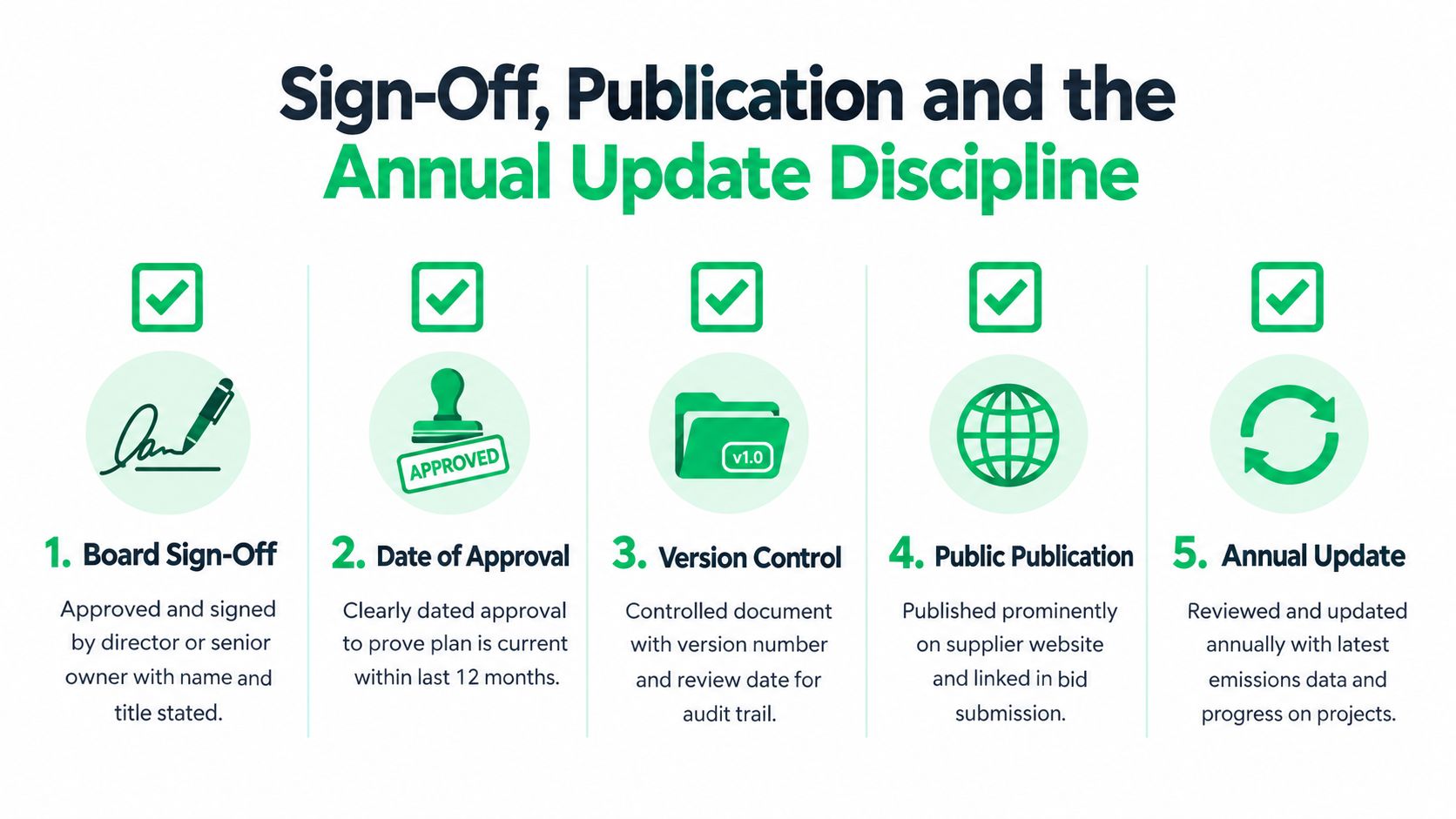
A proper sign-off tells the reader several things at once. It shows the organisation has assigned ownership. It shows the plan was approved recently enough to be relevant. It shows someone senior is willing to stand behind the content.
In practical terms, a review-ready sign-off section should include:
- Named senior approver: Director, board member or equivalent responsible owner.
- Approval date: Clear and visible, not buried in metadata.
- Version identifier: So procurement teams can match the submitted document to the published one.
- Publication location: A stable page on the supplier's website, not a temporary file share.
A CRP that is technically accurate but unsigned, undated or impossible to match to a public version creates avoidable procurement risk.
What annual updating really means
Annual update discipline is not just replacing one emissions total with another. A useful refresh should show continuity between versions. If the baseline changed, explain why. If the methodology changed, log it. If the business acquired sites, expanded fleet operations or switched data sources, note the effect.
The organisations that handle this well usually keep a simple internal control pack behind the public document. It doesn't need to be glamorous. It needs to be retrievable. That pack commonly includes utility invoices, meter schedules, mileage data, waste reports, travel exports, calculation files, methodology notes and a change log.
A buyer won't always ask for all of it. But if they do ask, you need to answer quickly and consistently.
The evidence trail that survives scrutiny
One of the strongest UK-specific technical benchmarks in practice is the hybrid accounting approach used in larger disclosures: primary supplier activity data where available, supplemented by secondary data and spend-based or EEIO methods for gaps, particularly in purchased goods and capital goods, with conversion through the latest UK Government GHG Conversion Factors and retention of source documents, factor-year records and estimation logic, as described in the Balfour Beatty Carbon Reduction Plan.
That's valuable because it reflects what many procurement teams now expect. Not perfection, but an auditable trail. If travel figures come from a travel management company, retain the export. If freight data comes from logistics contractors, retain the supplier file and note whether weights, distances or spend proxies were used. If estimates fill data gaps, explain the estimation logic in a way another reviewer could reproduce.
The questions buyers tend to ask
Clarification questions usually fall into three buckets.
Data integrity questions test whether the numbers are controlled:
- Why do the CRP emissions differ from another public disclosure?
- Which conversion factor year was used?
- Are any Scope 3 categories estimated rather than activity-based?
- Can the supplier evidence the underlying source records?
Credibility questions test whether the plan is more than rhetoric:
- Is there a visible route from baseline to target?
- Do stated projects match the emissions hotspots?
- Has someone senior approved the plan?
- Are operational changes reflected in the reduction narrative?
Procedural questions test whether the plan meets the procurement condition:
- Is the approval recent enough?
- Is the current version published publicly?
- Was the document updated after a material business change?
- Can the supplier point to version history if challenged?
A good-looking PDF won't rescue a weak control environment.
What to build before the tender, not after
The right time to fix evidence quality is before submission. Waiting for clarification is expensive because the bid team starts reconstructing decisions under pressure.
A practical pre-submission review should cover the following:
Document control
Confirm the title, version, approval date and publication date all align.Method file
Keep a calculation workbook or software export that shows source activity data, conversion factors and assumptions.Source archive
Store invoices, meter records, fleet logs, travel exports, waste records and supplier correspondence in one controlled location.Change log
Record structural changes, methodology updates and any rebasing decisions between annual versions.Governance note
Capture who reviewed the numbers, who approved the plan and who owns the next refresh cycle.
Where internal teams are stretched, some organisations use external support to structure the calculations and approval workflow. That can include specialist advisers such as ESG Consulting, internal finance controls, carbon accounting platforms, or assurance providers depending on the complexity of the group and the buyer scrutiny expected.
Many CRPs either mature into live governance documents or remain one-step-above-template submissions.
A Practical Checklist and Where Specialist Support Fits
If you need a Carbon Reduction Plan UK process that holds up in procurement, keep it sequential and controlled. Most problems come from jumping straight to the template before checking whether the requirement applies, what boundary is being reported, and whether the evidence exists.
A working checklist
- Check applicability first: Confirm whether the procurement is in scope and whether the CRP requirement is proportionate to the contract.
- Set the reporting boundary: Decide which entities, sites and operations sit inside the plan and make sure that boundary matches the data you can support.
- Collect activity data before drafting: Pull fuel, electricity, travel, freight, commuting and waste records into one working file.
- Apply current UK conversion factors: Record the factor year and keep the calculation trail.
- Complete the mandatory categories: Don't leave the required Scope 3 items vague or rolled into a single unexplained total.
- Choose a defensible baseline: State it clearly and define what would trigger rebasing.
- Write targets that can be defended: Include the required net zero commitment and at least one meaningful interim checkpoint.
- Secure senior approval and publish properly: The public version should match the submitted version.
- Schedule the next review immediately: Annual updating works better as a diary-controlled process than a tender emergency.
Where specialist input earns its keep
External support is usually most useful in three situations.
One is boundary scoping in group structures with subsidiaries, shared services and mixed operational control. Another is Scope 3 estimation where supplier data is incomplete and assumptions need to be documented carefully. The third is target architecture, especially where the business wants a procurement-compliant CRP while also moving toward a more formal science-based pathway.
The common thread is judgement. The technical rules are published. What tends to separate a solid plan from a fragile one is knowing when to simplify, when to estimate, when to rebase, and when a buyer is likely to challenge the narrative rather than the arithmetic.
A strong Carbon Reduction Plan is not the prettiest document. It's the one your team can still defend six months later when procurement, audit or contract management asks to see what sits behind it.
If you need help with a first-time submission or an annual refresh, ESG Consulting supports UK organisations with CRP scoping, emissions modelling, target design and director-level sign-off governance. That includes plans built to the PPN 006 technical standard with evidence trails that are designed to stand up in tender clarification and later assurance.
More from the blog
· 12 min read · Regulation
What is PPN 026? The new Social Value Model
PPN 026 replaces PPN 002 as the Social Value Model for central government contracts from 1 January 2027. Scope, the 10% and 20% weightings and the six criteria.
Read article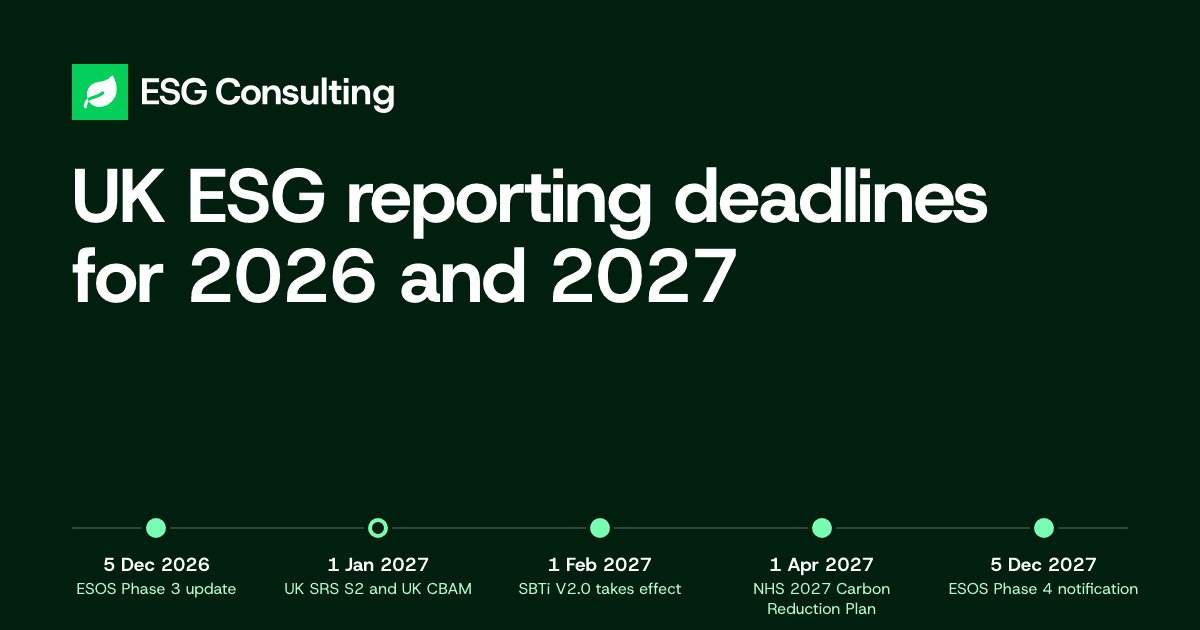
· 14 min read · Regulation
UK ESG reporting deadlines for 2026 and 2027
Every UK ESG reporting date to December 2027 - UK SRS, ESOS, SECR, UK CBAM, CSRD, SBTi, PPN 026 and the NHS - each marked mandatory, proposed or voluntary.
Read article