social value uk, uk procurement, ppn 002, social value model, supplier guide
Social Value UK: A Practical Guide for Suppliers
By ESG Consulting Team · · 16 min read
For UK central government contracts covered by PPN 002, social value must carry a minimum 10% weighting in evaluation from 1 October 2025. Suppliers therefore need more than a polished promise. They need measurable commitments, named owners, delivery milestones and evidence that can withstand contract management.
Your bid team may already know the situation. The technical response is strong, the price is competitive, and then the social value question asks how your organisation will improve communities, skills, employment or the environment. A few broad paragraphs about volunteering and local jobs rarely provide enough confidence. Buyers increasingly need to see exactly what will happen, who will deliver it, how progress will be measured and what evidence will be available after award.
That changes the task for suppliers. Social value in UK procurement isn't a corporate charity paragraph added at the end of a tender. It is a commercial commitment connected to the contract, the buyer's priorities and the performance controls that follow.
Table of Contents
- Understanding the Shift in UK Procurement
- The Legislative Backbone and Legal Duties
- Navigating the Social Value Model and PPNs
- Translating Promises into Auditable Outcomes
- Measuring Impact - Monétisation vs Qualitative Evidence
- The Economic Case for Local and SME Procurement
- Building a Practical Implementation Roadmap
Understanding the Shift in UK Procurement
A supplier can lose a tender despite offering a sound service and acceptable price because its social value response is vague. The bid might promise to support local communities, create opportunities and reduce environmental impact, but it doesn't explain which opportunities, for whom, by when or with what proof. The buyer is left to score intention rather than delivery confidence.
The practical meaning of social value UK procurement is wider than charitable activity. It concerns the additional economic, social and environmental wellbeing that public spending can help secure. The relevant question is not whether a supplier operates responsibly. It is how the contract can produce beneficial outcomes in the area affected by the work.
From transaction to wider outcomes
The statutory foundation is the Public Services (Social Value) Act 2012. Its operative provisions came into force on 31 January 2013, requiring in-scope public authorities to consider, before commissioning certain services, how procurement could improve the relevant area's economic, social and environmental wellbeing. The Act also requires authorities to consider how those improvements might be secured and whether consultation is needed. The UK Government's Social Value Act guidance sets out that framework.
That was a meaningful change in procurement thinking. Authorities had to consider wider community outcomes during planning, rather than treating procurement only as a price-and-service transaction. The Act applies principally to covered procurements for services, including qualifying service frameworks, and doesn't automatically apply to every public contract.
Practical rule: Treat the social value question as part of service design, not as a final piece of bid decoration.
For suppliers, this means looking at delivery capacity before writing commitments. A construction contractor may have genuine routes into apprenticeships and local supply chains. A professional services firm may have stronger opportunities around skills transfer, inclusive recruitment or community access. The credible response depends on the contract's subject matter and the needs identified by the buyer.
The shift also affects internal ownership. Commercial teams may write the response, but operational managers, HR, procurement, sustainability and delivery partners must be able to fulfil it. A promise that exists only in the tender document can become a liability once it enters the contract.
The Legislative Backbone and Legal Duties
The UK social value framework developed from a broad statutory duty into more specific central-government procurement requirements. The Public Services (Social Value) Act 2012, operational from 31 January 2013, asks in-scope public authorities to consider how certain service procurements could improve economic, social and environmental wellbeing. It also asks them to consider how those improvements might be achieved and whether consultation is appropriate. The legislation and supporting government information provide the starting point for understanding the duty.
The Act doesn't mean every public contract has identical social value obligations. Its principal application is to covered services and qualifying frameworks, while later procurement rules and policy determine the precise scope of individual exercises. Suppliers should therefore read the tender documents and applicable procurement policy rather than assume that a generic response will fit every buyer.
What changed for central government suppliers
The important operational development is PPN 002, used with the Procurement Act 2023 framework for relevant central-government procurements. For procurements commenced on or after 1 October 2025, in-scope organisations must include social value in evaluation and apply a minimum 10% weighting of the total available score, or an equivalent 10% share of non-price criteria where an absolute scoring method is used. The PPN 002 Social Value Model guide states that the weighting must remain proportionate to the contract's nature, complexity, cost and the importance of the relevant outcome.
That requirement has a direct consequence for bid teams. Social value is now a scored commercial issue, not merely a policy signal. A supplier needs to connect its commitments to the evaluation method and then to the contract-management arrangements.
The same discipline should apply to related environmental evidence. For example, a supplier preparing a UK carbon reduction plan should make sure its carbon commitments don't sit separately from the social value response when the tender asks for linked environmental and community outcomes.
The compliance chain
The legislation establishes the direction. PPN 002 makes the buyer's process more structured by requiring relevant outcomes to be selected, evaluated and monitored. The supplier's task is to make its offer traceable across four points:
- Need: Identify the contract requirement and relevant local or national priority.
- Commitment: State the activity, beneficiary, timeframe and responsible team.
- Control: Convert the promise into a KPI, performance indicator or agreed reporting requirement.
- Evidence: Retain records that show delivery, variance and corrective action.
Most bidders focus heavily on the second point and neglect the other three. That is why attractive promises often weaken under scrutiny.
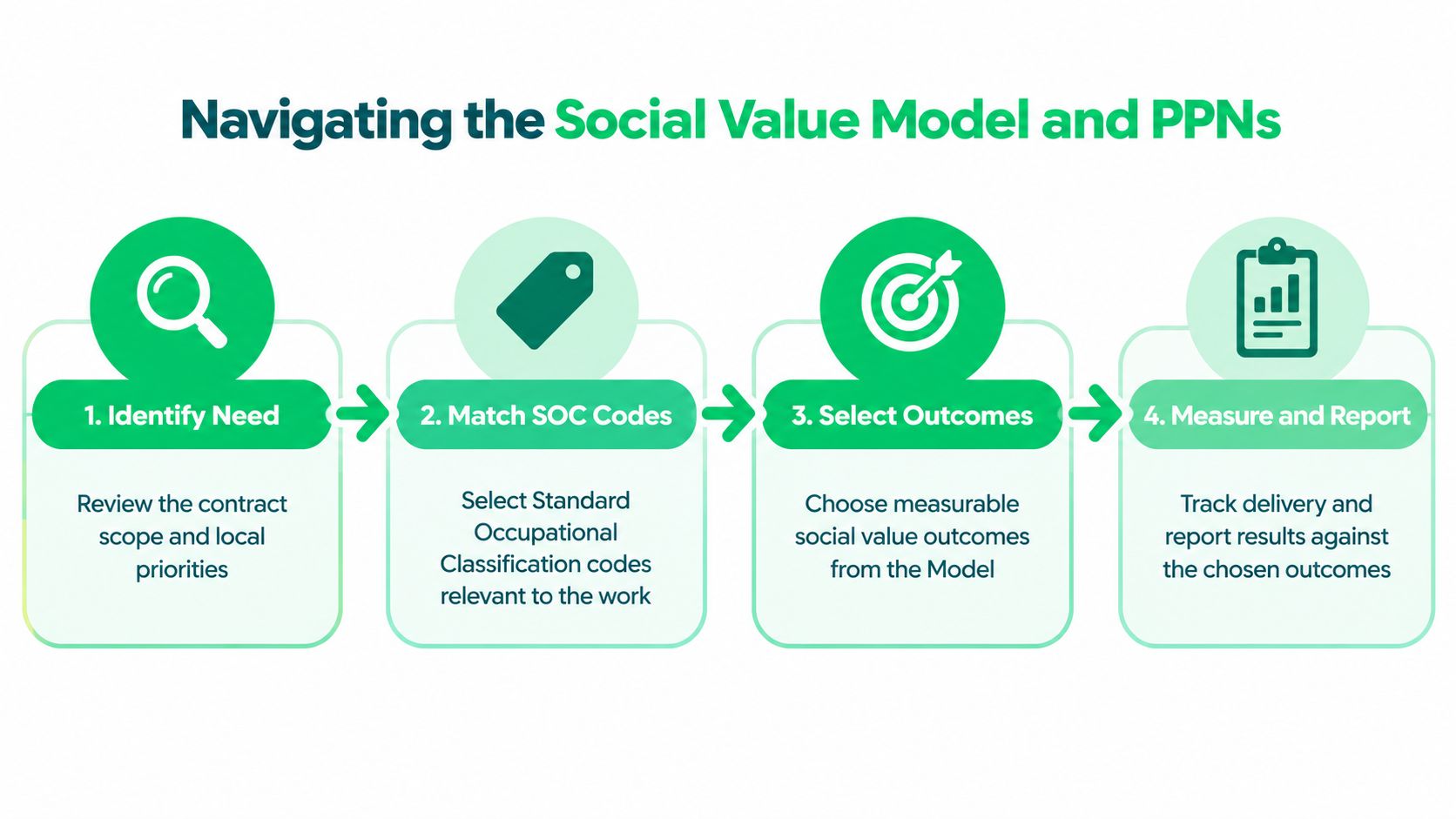
Navigating the Social Value Model and PPNs
A strong response starts with the buyer's question, not the supplier's favourite programme. PPN 002 expects outcomes to be relevant and proportionate to the contract, so a bid should show a clear connection between the work being purchased and the proposed benefit.
Step one, read the contract through an outcomes lens
Map the scope, delivery locations, workforce profile, supply chain and likely community interfaces. A facilities contract may create opportunities through recruitment, training, fair work and local purchasing. A technology contract may have a stronger case for digital inclusion, skills transfer, accessible services or responsible supply-chain management.
Don't choose an outcome because it appears impressive in isolation. Choose it because the supplier can explain why the contract creates a credible route to that outcome.
Step two, use occupational relevance
The Social Value Model uses Standard Occupational Classification codes to help buyers and suppliers connect employment and skills outcomes to the roles involved. Review the occupations required for delivery, then identify commitments that match those roles. A training promise becomes more credible when it relates to the actual skills shortages, entry routes or progression opportunities associated with the contract.
The same logic applies to subcontractors. If a specialist partner will deliver most of the work, its workforce and evidence systems may determine whether the prime supplier can fulfil the promise.
Step three, select outcomes and define proportionality
Use the selected Model outcomes as a framework, then adapt the offer to the contract. Avoid multiplying commitments to make the response look ambitious. A smaller offer with a realistic delivery route can be stronger than a large headline pledge that depends on unconfirmed partners, uncertain recruitment or funding that hasn't been approved.
The practical explanation of PPN 026 can also help teams understand how procurement policy notes may connect environmental and supplier requirements, but each tender's instructions remain decisive.
Step four, write for evaluation and delivery
A scorer needs to find the proposed outcome, method, beneficiary, timing and evidence quickly. A contract manager later needs the same information in a usable format. Use a simple internal matrix before submission:
| Tender element | Supplier question |
|---|---|
| Outcome | What benefit will the contract create? |
| Relevance | Why is this connected to the work? |
| Delivery | Which team or partner will act? |
| Measurement | What record will demonstrate progress? |
| Control | What happens if delivery falls behind? |
This approach prevents the common mistake of treating the Social Value Model as a catalogue of attractive phrases. It turns policy into a delivery design.
Translating Promises into Auditable Outcomes
The difference between a weak and strong social value response often comes down to the distinction between an output and an outcome. An output is an activity or immediate result, such as training delivered, jobs advertised, supplier events held or volunteering hours recorded. An outcome concerns the change that activity is intended to support, such as improved access to employment, sustained skills development or stronger participation in the local economy.
Neither should be ignored. Outputs are usually easier to evidence, while outcomes provide the reason for the commitment. The mistake is presenting an output as if it automatically proves the wider benefit.
The old response pattern versus the PPN 002 approach
A traditional response might say that the supplier will create local employment, support SMEs and provide training. The PPN 002 approach requires a more complete evidence chain. The buyer selects relevant outcomes and converts them into award criteria and contractual KPIs or performance indicators. The supplier must be ready to explain how the commitment will be delivered and monitored throughout the commercial lifecycle. The government guidance on PPN 002 describes this shift towards planning, evaluation and contract management.
| Vague promise | Auditable commitment |
|---|---|
| Create local jobs | Define the recruitment route, role type, eligibility, owner and evidence record |
| Provide training | Specify the subject, participant group, delivery method, attendance record and review point |
| Support SMEs | Identify the relevant spend or engagement activity and retain purchasing evidence |
| Reduce carbon | Set out the activity, data source, responsible owner and reporting method |
Before writing the tender, establish the baseline. Record what the organisation already does, what the contract will add and what depends on future recruitment or subcontracting. Then assign a delivery owner, agree milestones and decide how frequently progress will be reported.
Evidence beats enthusiasm: A modest commitment with a named owner and reliable records is more defensible than a large pledge built on assumptions.
A complete file might contain recruitment records, training attendance, anonymised workforce information, purchase-order data, supplier certifications, carbon records, meeting notes and beneficiary feedback. Personal data should be handled lawfully and proportionately. Evidence must demonstrate delivery without exposing information the buyer doesn't need.
The contract response should also define escalation. If a partner withdraws or recruitment proves difficult, who identifies the variance, who approves an alternative and when does the buyer receive an update? Those controls make the promise operational rather than rhetorical.
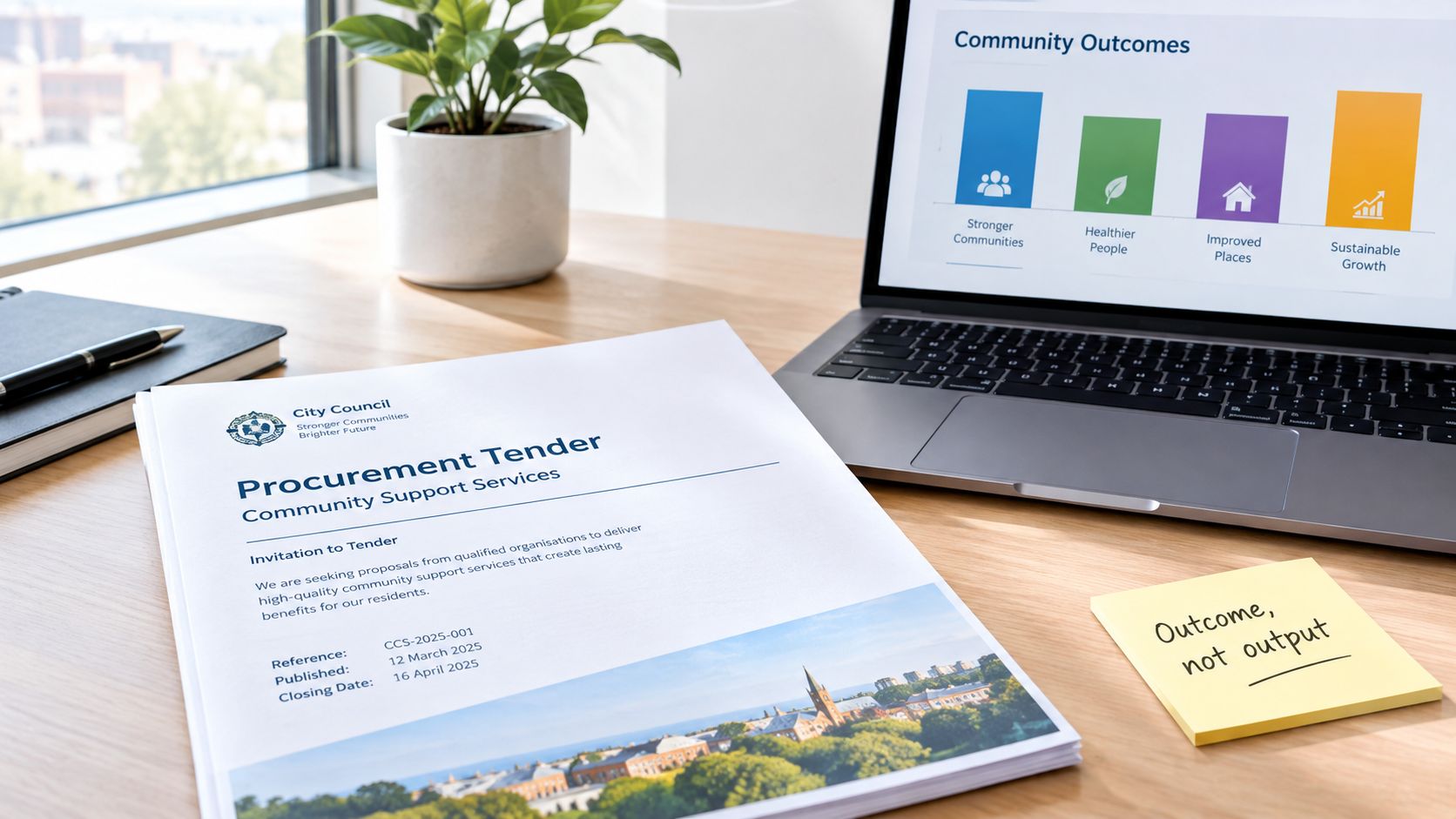
The supporting media below illustrates the kind of procurement and community-outcome relationship that bid teams should be able to explain in their own evidence plan.
Measuring Impact - Monétisation vs Qualitative Evidence
Suppliers often face pressure to express social value in a single monetary figure. That can help a buyer compare different interventions, but only when the calculation is transparent and decision-useful. A large claimed value isn't automatically a large outcome.
UK practice commonly draws on the Social Value Model, National TOMs and the National Social Value Standard. These frameworks include numerous national and local metrics, with some measures monetised and others evidenced through qualitative or operational data such as anonymised workforce information, carbon data, certifications, activity records and testimonials. Academic analysis of these approaches highlights the importance of understanding what each metric measures and how its assumptions operate. The analysis of social value measurement frameworks is useful for that comparison.
A defensible evidence hierarchy
Start with relevance. Explain why the proposed intervention belongs in the contract and responds to a real need. Then report direct outputs and outcomes using records that the delivery team can maintain. Only after that should monetisation be considered.
Monetisation can become misleading when bidders use different assumptions about deadweight, attribution, duration and proxy values. Two suppliers may report very different totals for interventions that are difficult to compare because one includes benefits that might have occurred without the contract, while the other applies a narrower calculation.
A practical hierarchy looks like this:
- Contract relevance: The intervention relates clearly to the purchased service.
- Direct evidence: Delivery records show what happened and who benefited.
- Outcome evidence: The supplier can explain the change supported by the activity.
- Transparent valuation: Any monetary proxy identifies assumptions and limitations.
- Decision use: The result helps the buyer choose or manage the offer.
Qualitative evidence isn't a fallback for poor measurement. A beneficiary account, certification, workforce record or delivery narrative can explain context that a monetary figure hides. The strongest submissions combine records and narrative without presenting either as proof of more than it can demonstrate.
For contract management, the key question is not only “How much value was created?” It is also who benefited, what changed and what would probably have happened without the intervention? Suppliers that answer those questions will usually provide more credible evidence than bidders chasing the largest possible valuation.
The Economic Case for Local and SME Procurement
Social value is sometimes treated as an unavoidable cost premium. That assumption can distort both bid strategy and procurement design. Local and SME participation may require effort, market engagement and proportionate controls, but it doesn't follow that buyers must accept weaker value for money.
A study of 105,133 contracts issued by 248 lower-tier local authorities in England between 2016 and 2023 found that contracts awarded to local suppliers were associated with slightly lower monthly contract costs. After controlling for authority, goods or services, supplier size and local economic characteristics, the cost difference wasn't statistically significant even at the 10% level. The study of local procurement and contract costs supports a measured conclusion, not a promise that local sourcing always saves money.
What suppliers should argue for
The strongest supplier position is not “local is always cheaper”. It is that buyers should test local and SME participation through procurement design while measuring both cost and additional benefit.
Useful design choices include:
- Proportionate qualification: Avoid requirements that exclude capable smaller suppliers without protecting delivery.
- Lotting: Structure opportunities so that specialist or regional businesses can bid for suitable portions.
- Early engagement: Ask the market what delivery models and partnership arrangements are realistic.
- Prompt payment controls: Reduce cash-flow barriers that can prevent smaller suppliers from participating.
- Outcome measurement: Distinguish gross local spend from incremental benefit attributable to the contract.
A supplier can strengthen its response by showing where local partners add capability, resilience or access to relevant communities. It should also explain how those partners will be managed, paid and monitored. Local presence alone isn't evidence of social value.
Broader ESG due diligence matters here. A supplier should understand the labour, environmental and governance risks in its supply chain before promising local economic benefits. A local subcontractor that cannot provide basic delivery or compliance evidence can create a commercial problem rather than a social value advantage.
The buyer's test remains value for money. A credible bid demonstrates that social value is integrated into delivery, not purchased through an unexplained price increase.
Building a Practical Implementation Roadmap
A repeatable social value process begins before a tender appears. Suppliers that wait for the questionnaire usually discover that their evidence sits across disconnected systems, commitments depend on informal relationships and nobody owns the numbers. Build the operating model first, then tailor it to each procurement.
Start with a contract opportunity map
Review the services, locations, workforce, supply chain and environmental impacts associated with likely public-sector work. Identify which outcomes the organisation can deliver directly and which depend on partners. Keep the assessment grounded in actual capability, because a promise that cannot survive mobilisation will damage both performance and future bids.
Create a short opportunity register covering:
- Employment and skills: Recruitment routes, training capacity and progression support.
- Local economy: SME engagement, purchasing controls and payment practices.
- Community benefit: Relevant access, inclusion or participation activity.
- Environment: Carbon reduction, resource efficiency and place-based improvements.
- Governance: Owners, approvals, records and escalation routes.
Build an evidence system
Create a standard social value response library, but don't reuse commitments without checking relevance. Each proposed measure should have a definition, baseline, data source, owner, reporting frequency and quality check. Store supporting evidence in a controlled location that delivery managers and bid teams can access.
A simple register can include:
| Control | Required detail |
|---|---|
| Commitment | Exact activity and intended beneficiary |
| Baseline | Existing position before contract delivery |
| Milestone | When progress will be reviewed |
| Owner | Named internal lead or accountable partner |
| Evidence | Record, system output or verification source |
| Remedy | Action if delivery falls below expectation |
Link this system to carbon reporting, supply-chain engagement and procurement governance. A carbon commitment should use the same underlying data discipline as the social value response. Organisations preparing for wider disclosure should also consider how their evidence may support relevant UK Sustainability Reporting Standards readiness, without assuming that every reporting framework applies to every organisation.
Test the response before submission
Run a bid review with commercial, operational, HR, procurement and sustainability colleagues. Ask each person to challenge a different failure point:
- Can the delivery team fulfil the commitment with existing resources?
- Is the outcome relevant to the contract?
- Can the supplier produce evidence at the requested frequency?
- Does the proposal rely on an unconfirmed subcontractor?
- Is the calculation transparent and proportionate?
- What happens if the original delivery route fails?
ESG Consulting is one option for organisations preparing Social Value Model responses alongside carbon reporting and broader sustainability evidence. Its stated services include support for central-government procurement responses and PPN-related requirements, with work built around traceable evidence and defined controls.
Review performance after award
Treat the tender response as the starting point of contract governance. Review delivery against the agreed KPI or performance indicator, record variance and agree corrective action with the buyer. Capture lessons while the evidence is still available, then update the response library and operational controls.
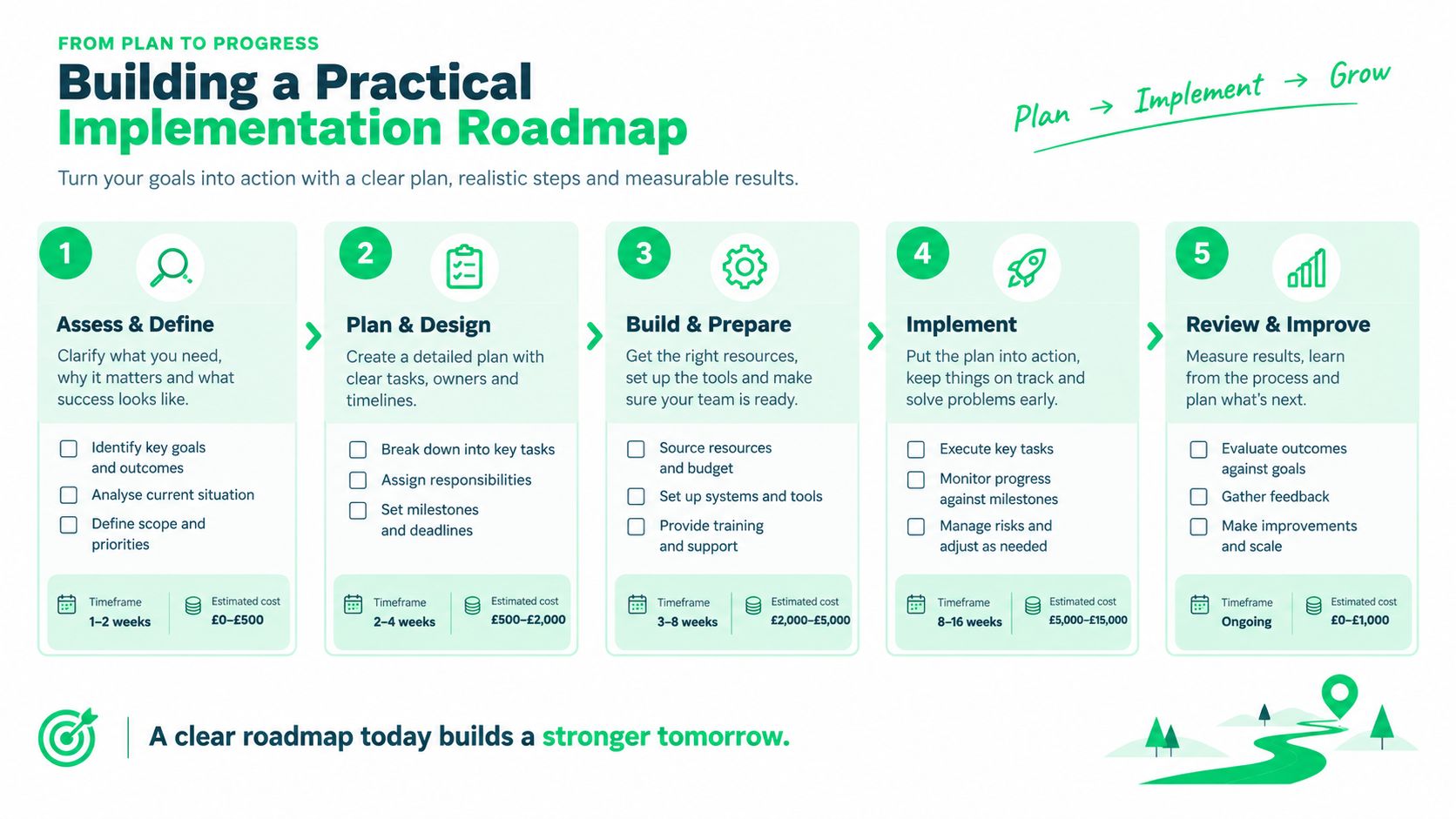
The supplier that performs well under PPN 002 won't necessarily make the biggest promise. It will make a relevant promise, resource it properly, measure it consistently and give the buyer confidence that the result can be verified.
If your team needs to turn social value commitments into contract-level KPIs, evidence trails and a defensible central-government tender response, ESG Consulting can support the preparation alongside carbon and wider ESG requirements. Visit ESG Consulting to discuss the scope of your upcoming procurement and the evidence needed to deliver it.