
sustainability construction industry, embodied carbon, UK construction ESG, net zero buildings, PPN 06 compliance
Sustainability Construction Industry UK Guide
By ESG Consulting Team · · 17 min read
Most advice on the sustainability construction industry is too comfortable. It tells contractors to improve site recycling, install smarter plant, and publish a net-zero statement as if that will satisfy buyers, planners, lenders, and future assurance checks. It won't.
A UK main contractor's board needs to deal with a harsher truth. Operational energy improvements matter, but they no longer cover the exposure. Embodied carbon is rising, public procurement expects better evidence, and disclosure standards are moving towards assurance-ready reporting. If your carbon story depends on voluntary initiatives and broad claims, you're already behind.
Table of Contents
- The Reality of UK Construction Emissions
- Navigating the Embodied Carbon Benchmarking Gap
- Sequencing Practical Decarbonisation Interventions
- Winning Tenders Through Robust Procurement Evidence
- Connecting Site Data to Corporate Disclosures
- Building Assurance-Ready Evidence Trails
The Reality of UK Construction Emissions
Boards should stop taking comfort from broad claims that UK building emissions are falling. That reading misses where the pressure now sits and where clients, procuring authorities, and future assurance reviews will look first.
The built environment still accounts for roughly a quarter of UK greenhouse gas emissions, according to the UKGBC whole-life carbon roadmap technical report. The Climate Change Committee also reports that direct emissions from buildings remain a material share of the national total, and rise further once indirect emissions are counted (Climate Change Committee 2026 progress report to Parliament).
This is not an ESG side topic. It affects bid credibility, client risk assessments, financing conversations, and the quality of the evidence your business will need to stand behind public claims.
Headline declines are being overstated
Recent reductions in building emissions do not prove structural progress. The Climate Change Committee reports lower buildings emissions in 2025, but UKGBC has warned that recent declines were driven in large part by higher energy prices suppressing demand, not by permanent decarbonisation measures. The same CCC report says the UK still needs sustained annual cuts in buildings emissions to stay aligned with the Sixth Carbon Budget path (Climate Change Committee 2026 progress report to Parliament).
Treat that properly. Lower consumption during a price shock is cost pressure, not a decarbonisation strategy.
If your reported gain disappears when occupancy, output, or grid demand returns to normal, the board should not present it as progress.
Construction operations are still exposed
The sector's own operational footprint also undercuts the idea that the job is well in hand. BCIS reporting on ONS-based data found that UK construction sector emissions in 2023 were materially above 1993 levels, with year-on-year growth and large contributions from specialised construction and civil engineering activity (BCIS reporting on construction emissions).
That matters for one reason above all. Buyers are getting less interested in polished net-zero language and more interested in whether a contractor can prove that emissions reductions came from specific commercial and operational decisions.
For a UK main contractor, the immediate test is simple:
- Activity-adjusted performance: show emissions intensity against output, not just total tonnes in a quieter year.
- Plant and fuel evidence: tie reductions to fleet replacement, temporary power changes, logistics planning, and metered site controls.
- Purchased materials: account for the categories that sit inside Scope 3 emissions from construction supply chains, because that is where procurement scrutiny is heading.
- Evidence quality: keep records that can survive PPN 06 evaluation, client due diligence, and future UK sustainability reporting assurance.
Voluntary effort still has value. Voluntary effort without an evidence trail does not.
Navigating the Embodied Carbon Benchmarking Gap
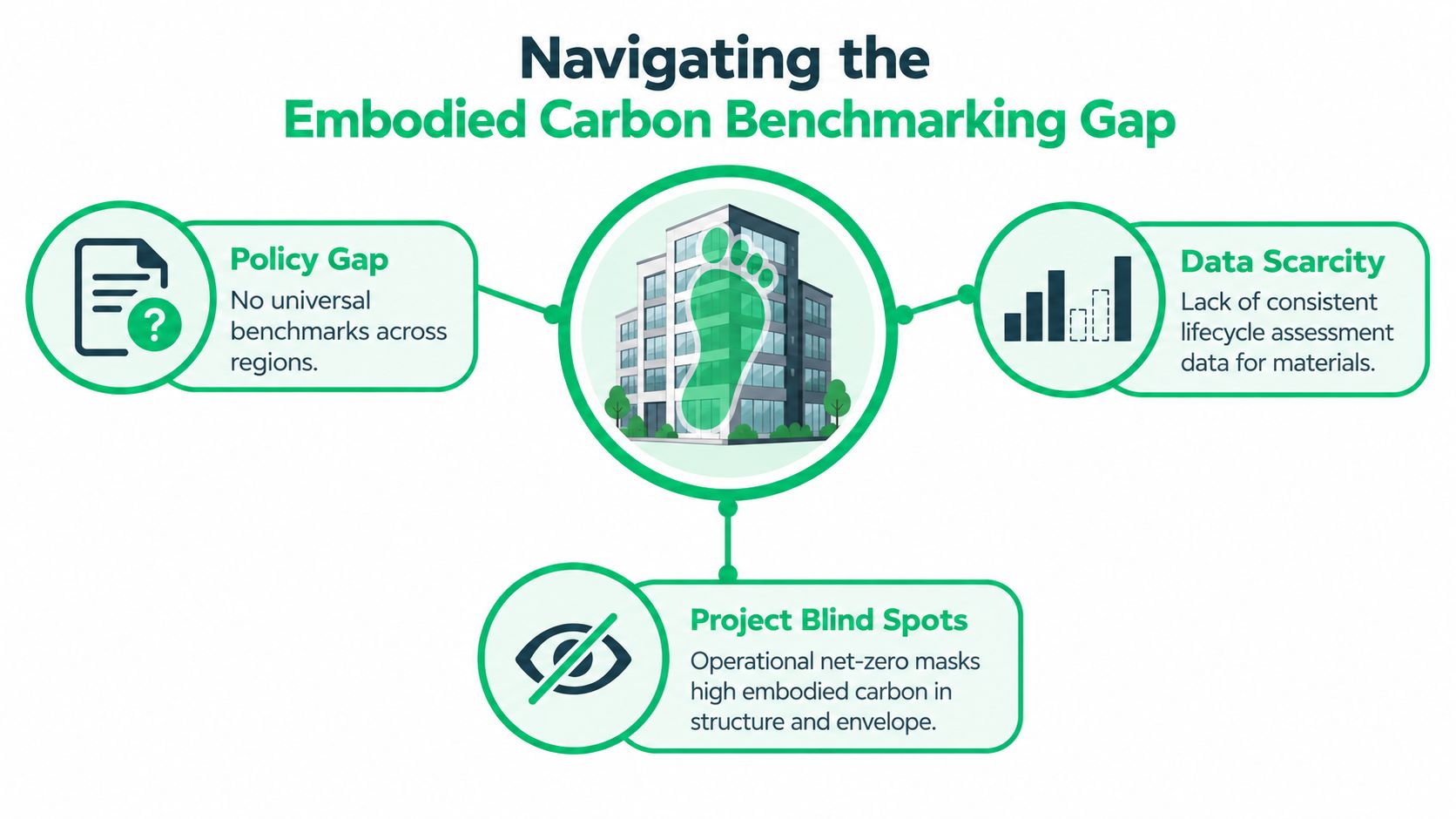
A contractor can deliver a building with strong operational performance and still lock in a serious carbon burden before handover. That's the central mistake in much of the sustainability construction industry conversation. Too many teams still talk as if efficient operation equals low-carbon delivery. It doesn't.
The UK evidence base is clear that embodied carbon can account for up to half of a new building's life-cycle emissions, yet it is not currently regulated through building regulations. Parliament's built-environment inquiry found there is no standard embodied-carbon assessment tool in the UK, which creates inconsistent outputs across projects, while the Construction Playbook expects whole-life carbon assessments on public works (BCIS analysis of whole-life carbon assessment).
Why project comparisons keep failing
Most contractors already know how this goes. One bid team uses one calculator. A design partner uses another. A planner asks for a different format. Then procurement tries to compare outputs that were built on different assumptions, scopes, databases, and cut-off rules.
That isn't a technical nuisance. It destroys comparability.
Two apparently similar schemes can show different carbon outcomes simply because the teams measured them differently.
The problem is methodological drift. If you let the method shift from concept to planning to tender to delivery, your evidence trail becomes weak and your reported reductions become arguable.
A better board instruction is simple. Pick one method. Freeze it early. Force everyone to use it.
What good governance looks like
You don't need a perfect national benchmark to build a workable internal one. You need discipline.
Use this decision framework:
| Decision point | Board-level requirement |
|---|---|
| Assessment method | Lock one whole-life carbon methodology at concept stage |
| Data boundary | Fix what is in and out, including major materials, temporary works, and key site activities |
| Benchmark basis | Compare against a relevant typology, not a random mix of previous jobs |
| Version control | Record every design change that affects quantity, specification, or replacement assumptions |
| Tender evidence | Require subcontractors and suppliers to submit carbon data in one agreed format |
That last point matters more than most contractors admit. Procurement teams often ask for sustainability responses, then accept evidence in whatever format turns up. That's how weak data gets normalised.
What boards should insist on now
The UKGBC says embodied carbon from construction and refurbishment makes up 20% of UK built-environment emissions, while the built environment overall accounts for 25% of UK greenhouse gas emissions. It also notes that the UK Net Zero Carbon Buildings Standard is emerging as the first broad, measurable framework for almost all buildings, with formal verification expected in 2026. Local planning pressure is also hardening, including London's proposed 605 kgCO2e/m2 cap (UKGBC embodied carbon overview).
That combination changes how boards should govern bids and design approvals.
Insist on these controls:
- One benchmark family: Compare offices with offices, sheds with sheds, schools with schools.
- One evidence trail: Design assumptions, quantities, EPDs, substitutions, and construction-stage updates must all connect.
- One approval gate: No late material change without a carbon impact note signed by the commercial and sustainability leads.
If you don't govern embodied carbon this way, your project team will still produce a number. It just won't be a defensible one.
Sequencing Practical Decarbonisation Interventions
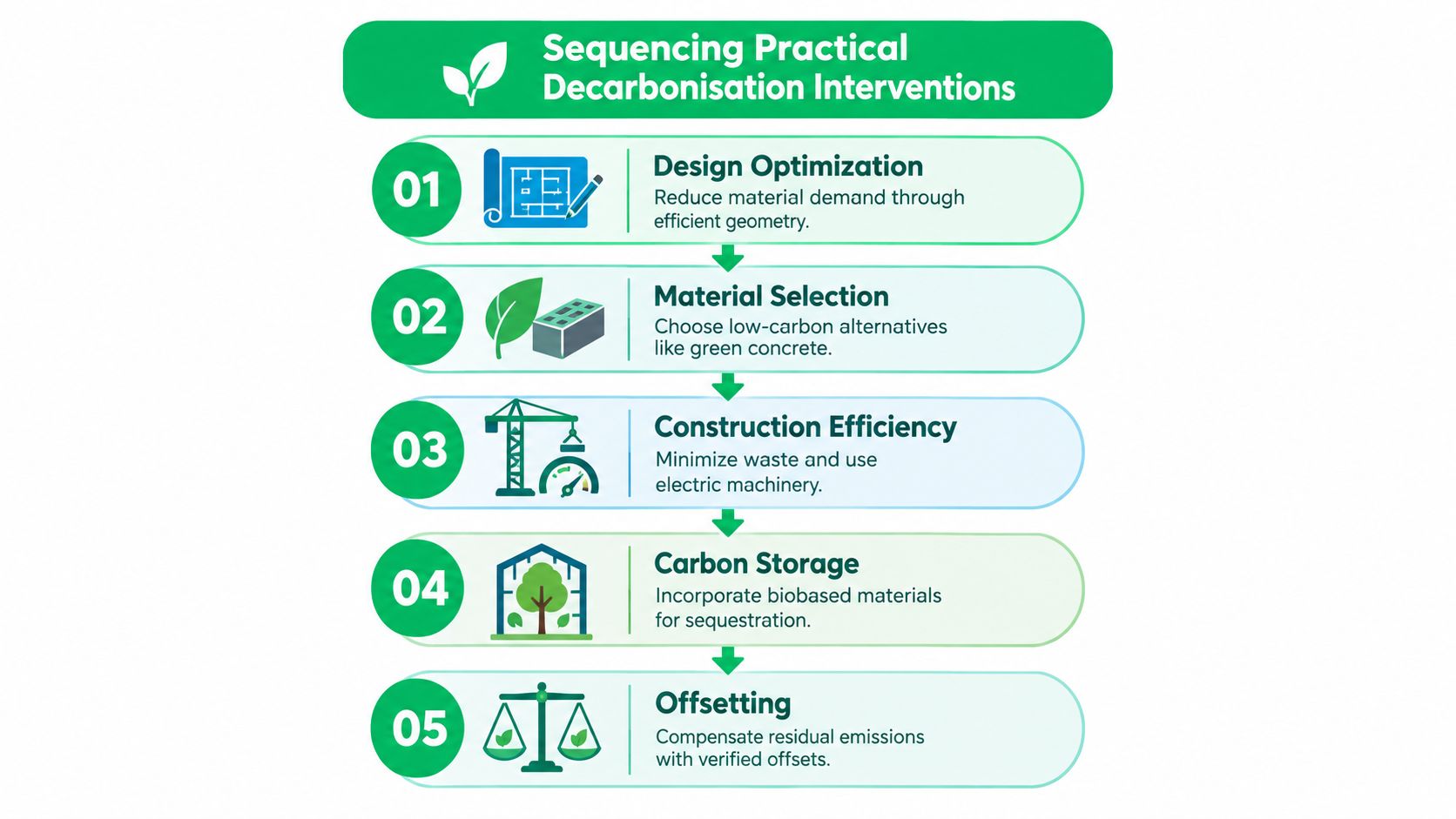
Contractors lose carbon performance at the start, not the end. The problem is not a lack of low-carbon products. It is poor sequencing. Teams still chase product swaps and offset language before they have tested whether the asset, scope, structure, and fit-out were oversized from day one.
UKGBC reports that built-environment emissions fell by only 14% from 2018 to 2024, against a 24% reduction required by its roadmap, while embodied carbon increased by 5% over the same period (UKGBC 2025 whole-life carbon progress report). The clear implication for contractors is that operational improvements alone will not close the gap. Embodied carbon is rising while many board reports still focus on energy and diesel.
That is why intervention order matters.
Start with scope and demand reduction
Ask harder questions earlier. Does the client need a new asset, or can the existing one be retained, extended, reconfigured, or refurbished? If new build is fixed, challenge the brief anyway. Excess floor area, inflated loading assumptions, façade complexity, high-spec finishes, and short replacement cycles all add carbon before procurement has even started.
This is the board-level sequence worth enforcing:
Cut unnecessary demand
Review floor area, grid efficiency, performance margins, fit-out churn, and design life assumptions before the design hardens.Optimise the form and structure
Simplify spans, standardise components, reduce transfers, and remove bespoke geometry before discussing material swaps.Retain existing assets where viable
Structure, substructure, and envelope retention usually produce larger savings than late-stage specification changes.Substitute materials after whole-life review
Use lower-carbon concrete, revised steel specifications, timber, or other alternatives only after checking durability, quantity effects, logistics, maintenance, and replacement cycles.
The order is strict for a reason. Product substitution cannot rescue an over-designed scheme.
Board test: If the team can show a revised concrete mix but cannot show what floor area, tonnage, finishes, or retained elements were cut first, the carbon strategy is weak.
Treat substitutions as quantified decisions
Material substitution still matters. The mistake is treating it as the first move instead of the fourth. The UK government's resource and waste evidence says better material efficiency and substitution can reduce embodied emissions materially over time, but only where teams assess whole-life effects rather than isolated product claims (Defra construction sector resource efficiency evidence).
A familiar failure pattern looks like this:
- A design team swaps one headline material to support a bid or planning narrative.
- The revised design increases weight, thickness, transport distance, or replacement frequency.
- The carbon model is not updated in step with the design change.
- The contractor reports a saving that does not survive audit.
That is not decarbonisation. It is a documentation problem waiting to become a commercial one.
Construction carbon should sit inside board-approved business priorities, not inside a separate sustainability workstream. A clear ESG materiality assessment for construction and procurement risk helps boards rank where carbon affects margin, bid eligibility, client retention, and disclosure exposure.
Use site controls to protect, not invent, savings
Site teams can protect a good design. They cannot recover carbon locked in by poor early decisions.
Plant selection, logistics planning, temporary works, rework prevention, waste segregation, and commissioning discipline all matter. So does the evidence trail behind them. If your project cannot show measured fuel use, waste movements, delivery profiles, and as-built specification changes, claimed savings will fail procurement scrutiny and will not feed cleanly into corporate reporting.
A practical hierarchy for contractors looks like this:
| Stage | Priority action | What to avoid |
|---|---|---|
| Brief and feasibility | Test need, scale, and retention options | Accepting the brief without carbon challenge |
| Design development | Reduce quantities and simplify systems | Cost-led value engineering that ignores carbon effects |
| Specification | Substitute after quantified whole-life review | Product swaps based on brochure claims alone |
| Construction | Control waste, rework, logistics, plant use, and commissioning | Assuming site efficiencies can repay embodied carbon already designed in |
The message for boards is blunt. Decarbonisation is a controlled sequence tied to design approvals, change control, and evidence quality. Voluntary good intentions are not enough.
Winning Tenders Through Robust Procurement Evidence
Tender success now turns on proof, not intent. UK clients, especially in the public sector, need submissions they can score, defend, and audit later. A polished net zero statement will not rescue a bid if your evidence trail breaks under basic procurement review.
The gap is usually operational. Boards approve climate commitments, bid teams paste them into responses, and project teams are left to deliver promises they did not shape. That is exactly how contractors lose marks, create delivery risk, and expose themselves when client assurance checks start after award.
What procurement teams actually need from you
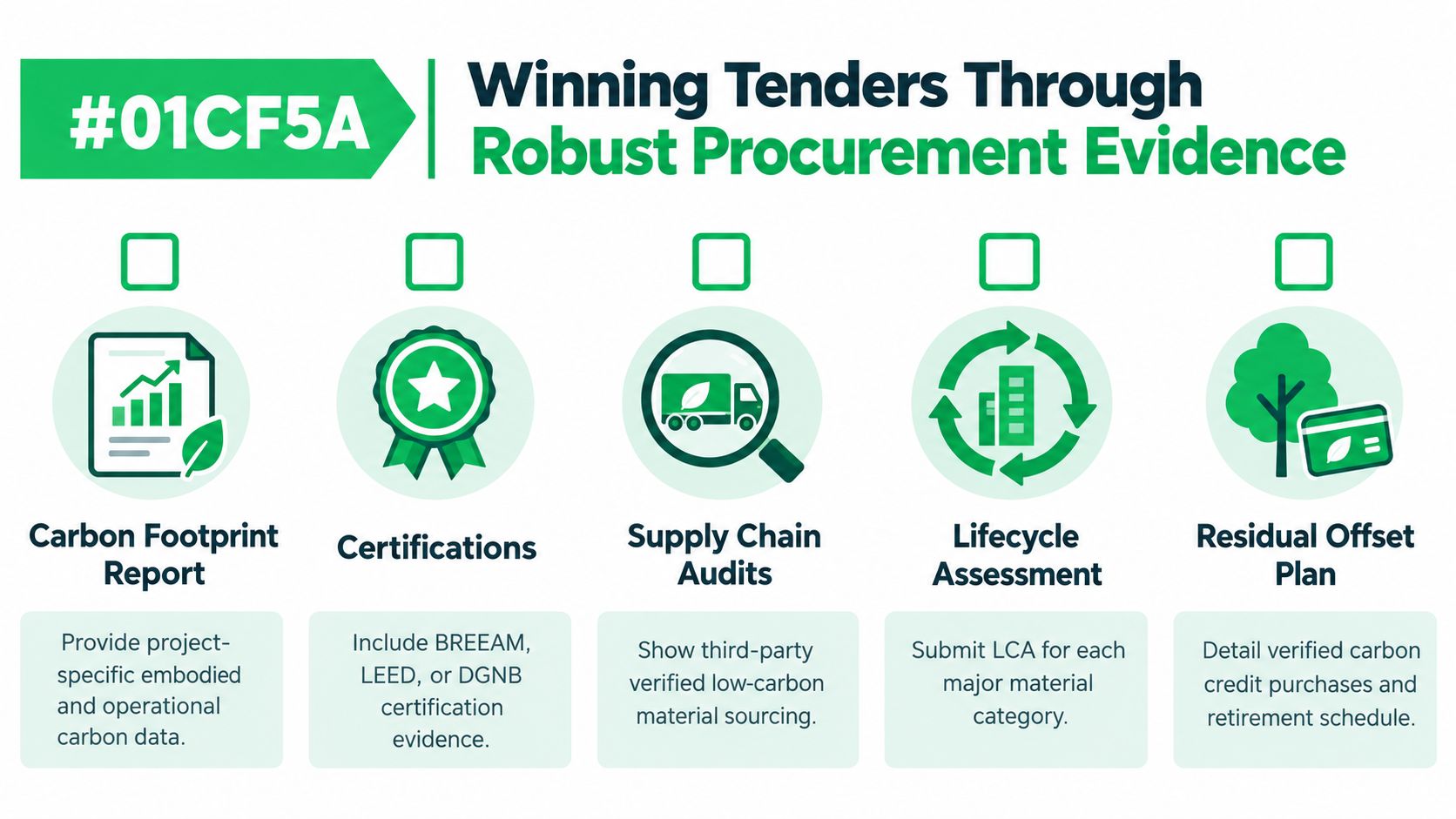
For UK public contracts, a Carbon Reduction Plan is only the starting point. Buyers want to see whether your stated emissions position matches how you buy, manage, and deliver the contract. They also want evidence that your supply chain can support the answer.
Your submission should tie together four evidence layers:
Corporate baseline evidence
A current Scope 1 and Scope 2 inventory, clear organisational boundary, board accountability, reduction measures already in place, and a defined annual review cycle.Contract-specific delivery evidence
A bid-specific plan showing what will be different on this job. Cover plant strategy, temporary power, logistics controls, material selections, waste handling, and reporting frequency.Supply-chain evidence
Data requests, prequalification outputs, and supplier commitments for trades and products that drive embodied carbon, transport impacts, or significant site fuel use.Governance evidence
Named owners, sign-off points, change control, and escalation routes if procurement choices or delivery conditions shift during the contract.
Many bidders still miss the point. Buyers are not just checking whether you have a policy. They are checking whether commercial, procurement, and project controls can produce the result you have promised.
The documents that separate serious bidders from weak ones
A credible tender file should include documents that procurement can trace back to live business controls:
- Carbon Reduction Plan: Aligned to current procurement rules, consistent with published emissions reporting, and signed off at the right level.
- Contract delivery method statement: Set out what will be measured, who owns each data point, how often performance is reviewed, and what triggers intervention.
- Supplier engagement record: Show requests for product data, fuel assumptions, logistics commitments, and carbon-related delivery constraints before mobilisation.
- Social value response: Link carbon actions to contract outcomes the client can monitor during delivery, not generic benefits stated at award stage.
- Assumptions and exclusions log: Record where data is estimated, where supplier evidence is pending, and what contractual dependencies affect delivery.
Boards should already be preparing for tighter procurement expectations under PPN 06/26 guidance for Carbon Reduction Plans. Waiting for the next tender deadline is poor governance. By that point, stronger competitors will already have standard templates, cleaner scope boundaries, and supplier evidence they can submit without rework.
Procurement rewards claims that survive challenge.
Where contractors still lose marks
The common failures are procedural, and fixable.
| Weak practice | Procurement consequence |
|---|---|
| Generic carbon plan reused across bids | Evaluators see no contract relevance |
| Scope boundaries that do not match annual reporting | Credibility drops immediately |
| Supplier claims with no request trail or supporting documents | Evidence is treated as unverified |
| Sustainability response written without commercial and delivery input | Commitments become unrealistic on cost or programme |
| Operational energy actions described without any embodied carbon controls | Bid looks incomplete against current client priorities |
The commercial point is simple. Operational energy savings still matter, but they no longer cover for weak embodied carbon evidence. Clients are starting to separate the two. If your tender can describe efficient generators and waste segregation but cannot show product data, supplier questionnaires, or substitution controls for carbon-intensive packages, your answer is behind the market.
One external support option can help if internal capacity is thin. ESG Consulting provides Carbon Reduction Plans to PPN 006 and Social Value Model responses, with preparation for PPN 026, alongside Scope 3 mapping and supplier engagement. That support is useful where boards need procurement evidence tied back to corporate disclosures, rather than stand-alone bid documents built in isolation.
Healthcare supply chains raise the bar further. NHS buyers increasingly expect suppliers to be ready for Evergreen requirements and wider net zero scrutiny. If you serve that market, supplier-readiness evidence belongs in your live tender process now, not in a future improvement plan.
Connecting Site Data to Corporate Disclosures
Most contractor disclosures break down at the handoff between project teams and corporate reporting. Sites record activity one way. Finance records energy another. Sustainability tries to stitch the two together at year-end. The result is slow, inconsistent, and hard to assure.
That approach won't hold up as reporting expectations tighten.
Build the inventory from site reality
A main contractor needs site data collection that starts with operational facts, not reporting templates. Focus first on what the business directly owns or controls and what it can reliably evidence through invoices, meter data, fuel records, and plant logs.
For construction operations, the core categories usually include:
- Owned or controlled fuel use: Plant, generators, vehicles, and other directly managed combustion sources.
- Purchased electricity: Site cabins, temporary power, offices, and depots where the contractor controls the account or bears the energy cost.
- Activity records: Hours run, fuel issue logs, temporary power periods, and site opening and close-out dates.
Those records feed corporate obligations such as SECR and ESOS. They also form the operational backbone for broader climate disclosures. If boards want credible climate narratives, they start here.
Turn project records into reporting controls
The data itself isn't enough. You need controls around it.
A workable system usually includes:
A defined owner for every data stream
Site manager, commercial lead, plant manager, finance, and sustainability each need named accountability.Monthly rather than annual capture
Year-end reconstruction produces gaps and guesswork. Monthly capture produces evidence.A standard source hierarchy
Primary invoice or meter data first. Logs and estimates only where necessary, with sign-off.A reconciliation process
Site totals should reconcile to ledger entries, purchase records, or approved internal reports.
If site data can't be reconciled to a source document, treat it as management information, not disclosure-grade evidence.
Why this matters for UK SRS and assurance
Upcoming UK SRS expectations will push companies to connect emissions numbers to governance, risk, and transition planning. Boards won't just need totals. They'll need confidence that site-level changes support the statements made in annual reports, transition plans, and climate-related disclosures.
ESOS also rewards this discipline. A contractor that already understands where energy sits across sites, depots, and support functions can move faster from compliance into action planning. A contractor without that visibility usually ends up treating audits as one-off exercises.
The practical lesson is straightforward. Don't let project sustainability data sit in project folders. Build it so it can move into the corporate reporting perimeter without being reworked.
Building Assurance-Ready Evidence Trails
The era of impressionistic sustainability reporting is ending. Boards need to assume that more claims will be tested, more disclosures will be checked, and more statements will need to reconcile across procurement, annual reporting, and transition planning.
That changes how evidence should be built. It also changes who owns it.
Assurance starts at project brief, not report draft
Most reporting failures begin early. A team makes an unqualified “low-carbon” claim in a bid, repeats it in delivery materials, and later tries to justify it in corporate reporting. By then, the evidence gaps are already baked in.
An assurance-ready approach needs three foundations:
Traceable source data
Every figure should link back to a clear source. Invoice, meter record, supplier submission, quantity schedule, approved assessment output, or controlled worksheet.Documented methodology
Your organisation should be able to show how it measures, converts, consolidates, reviews, and updates sustainability data.Controlled approvals
Material claims should have named review and sign-off before they leave the business.
That last point matters more than most boards think. A single named account lead, accountable from brief to sign-off, reduces the fragmentation that causes inconsistent disclosures.
Build controls around the risky claims
Not every statement carries equal risk. Prioritise the ones most likely to be challenged:
| Claim type | Evidence needed |
|---|---|
| Carbon reduction against baseline | Consistent baseline method, source data, and change log |
| Low-carbon design claim | Whole-life carbon assessment, version control, design approval record |
| Supply-chain improvement claim | Supplier data request trail, responses, and inclusion criteria |
| Net-zero pathway statement | Governance approval, assumptions, milestones, and dependency register |
Boards should also stop tolerating language that cannot be evidenced. Terms like “green”, “sustainable”, and “net zero aligned” need an internal definition or they should be removed from formal submissions.
Strong sustainability reporting is usually less dramatic and more disciplined. That's a good sign.
The board's role is governance, not slogan-writing
The board doesn't need to calculate emissions factors. It does need to set the control environment.
That means asking management for:
- A single reporting rulebook used across bids, projects, finance, and disclosure teams.
- Escalation triggers when data is incomplete, estimated, or late.
- Consistency checks across Carbon Reduction Plans, annual reports, climate disclosures, and client submissions.
- Readiness for external assurance before it becomes compulsory in practice.
Voluntary efforts have taken the sector as far as they can. The next phase belongs to firms that can prove what they did, how they measured it, and who signed it off. In the sustainability construction industry, evidence is no longer a support function. It's part of market access.
If your board needs cleaner carbon data, stronger tender evidence, or reporting that will stand up to UK SRS and procurement scrutiny, ESG Consulting can help build the underlying methodology, controls, and disclosures. It supports UK organisations with carbon reporting, net-zero strategy, Scope 3 mapping, PPN-compliant plans, and assurance-ready evidence trails. Visit ESG Consulting to see how that support applies to construction and built-environment reporting.
More from the blog
· 12 min read · Regulation
What is PPN 026? The new Social Value Model
PPN 026 replaces PPN 002 as the Social Value Model for central government contracts from 1 January 2027. Scope, the 10% and 20% weightings and the six criteria.
Read article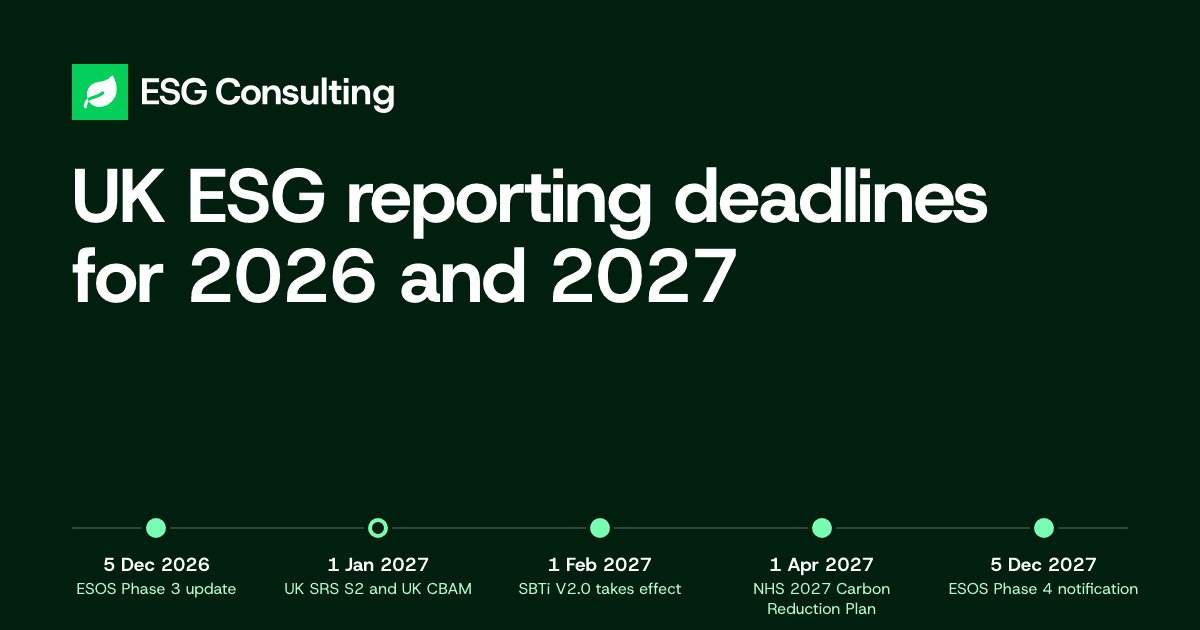
· 14 min read · Regulation
UK ESG reporting deadlines for 2026 and 2027
Every UK ESG reporting date to December 2027 - UK SRS, ESOS, SECR, UK CBAM, CSRD, SBTi, PPN 026 and the NHS - each marked mandatory, proposed or voluntary.
Read article