
uk environmental legislation, environmental compliance, esg reporting, secr, environment agency
UK Environmental Legislation: A Business Guide for 2026
By ESG Consulting Team · · 16 min read
You're probably dealing with the same problem most UK boards face right now. One inbox lands with an Environment Agency request for operational data, another carries a reporting reminder, and a third flags a supplier or procurement gap that no one had budgeted for. The mistake is to treat these as separate fires. UK environmental legislation works like a sequencing problem, and if you don't map the order of obligations, you end up paying for the same evidence three times.
The right way to approach this is simple. Start with the governance framework that sets the long-term direction, then move to reporting rules, then operational permits and planning duties, and only then stress-test the evidence trail that sits underneath everything. That sequence matters because regulators don't care which team owns the problem internally. They care whether the business can prove what it did, when it did it, and on what basis.
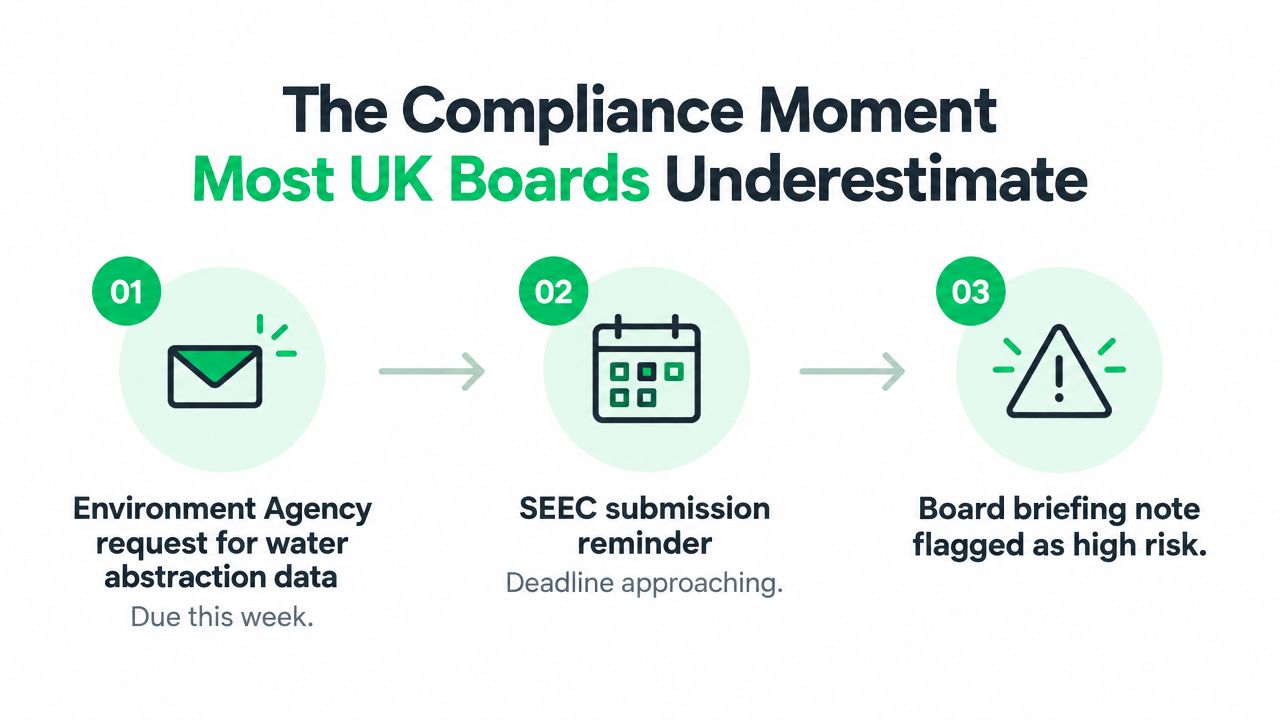
Table of Contents
- The Compliance Moment Most UK Boards Underestimate
- The Two Statutes That Anchor the Whole Rulebook
- Reporting and Disclosure Regimes That Catch Businesses Out
- Permitting, Biodiversity and Waste Rules That Hit Operations
- How the Obligations Stack for One Mid-Sized UK Business
- Why Evidence Quality Matters More Than the Headline Law
- Practical Next Steps for Mapping Your Exposure
The Compliance Moment Most UK Boards Underestimate
A finance director opens the inbox on a Tuesday morning and finds three separate requests waiting. One is from the Environment Agency for water abstraction data. One is a reporting reminder that needs a sign-off path. Another is a note from procurement flagging a Tier 2 supplier disclosure gap. None of them looks dramatic on its own. Together, they show the shape of UK environmental legislation, which is scattered across functions even when the legal duties connect.
Stop treating the rulebook as a list
The first mistake is organisational, not legal. Most companies assign environmental reporting to sustainability, permitting to operations, and supplier evidence to procurement, then assume someone senior will stitch the whole thing together later. That approach breaks down fast because the obligations arrive on different clocks and with different evidence standards. A board briefing that ignores sequencing usually underestimates both the workload and the risk.
Practical rule: If three different teams would answer the regulator's questions differently, you don't have a compliance system. You have three partial files.
The second mistake is thinking one statute drives the whole agenda. It doesn't. The core climate and environment statutes sit underneath a much wider set of reporting, permitting, planning and evidence obligations. A strong response starts by deciding which legal trigger lands first, which team owns the data, and what proof the regulator will ask for next.
Use the rest of the rulebook in the right order
This guide follows the order that obligations usually bite. First, the two statutes that anchor the system. Next, the disclosure regimes that catch businesses out. Then the operational rules for permitting, biodiversity and waste. After that, a worked example of how the stack lands on one mid-sized company. The final step is evidence quality, because that's where weak compliance usually surfaces.
The point is not to memorise every law. The point is to build a working sequence so the business knows which duty comes first, which evidence file must be cleanest, and where to bring in outside support before deadlines force the issue.
The Two Statutes That Anchor the Whole Rulebook
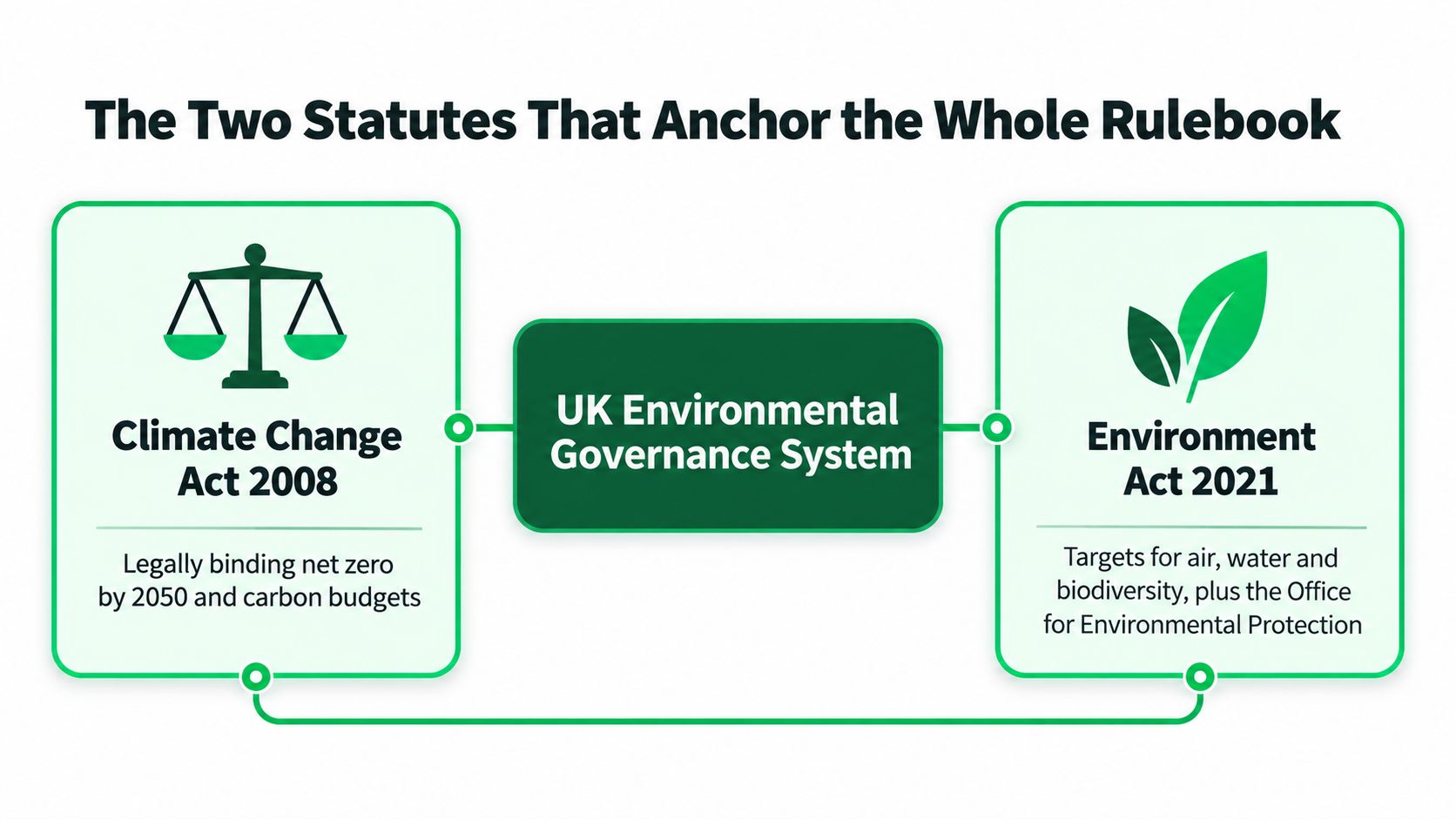
The UK system looks fragmented until you put the Climate Change Act 2008 and the Environment Act 2021 side by side. Then the structure becomes obvious. One statute sets the long-term climate destination. The other builds the post-Brexit environmental governance and enforcement architecture that now sits around business operations, planning, and public accountability. The result is not two separate agendas. It's one framework with different levers.
The climate statute gives the country its backbone
The Climate Change Act 2008 received Royal Assent on 26 November 2008 and created the legally binding framework that originally required the UK to cut net greenhouse gas emissions by 80% below 1990 levels by 2050. That target was later strengthened to a 100% reduction, net zero, through the Climate Change Act 2008 (2050 Target Amendment) Order 2019, which came into force on 27 June 2019, and the Act also established five-year carbon budgets as a statutory pathway rather than relying on annual political promises alone. The Act's structure is widely treated as the UK's foundational climate governance model because it combines a distant endpoint with enforceable interim milestones, and it is often described as the world's first legally binding national climate target, which made it a landmark precedent for later net-zero laws. See the Act text on legislation.gov.uk.
For business, the practical lesson is blunt. Climate obligations in the UK are no longer about aspiration. They sit in law, and board decisions have to show how the organisation is aligned to that legal direction of travel.
The environment statute gives regulators teeth
The Environment Act 2021 became law on 9 November 2021 and was announced the next day by the UK Government as a “world-leading” law to protect and enhance the environment for future generations. It covers targets, plans and policies for environmental improvement, the Office for Environmental Protection, waste and resource efficiency, air quality, water, nature and biodiversity, chemicals, and conservation covenants. It also gave the Secretary of State a duty to set at least one long-term target in each of four priority areas, air quality, biodiversity, water and waste, which is a major shift away from fragmented sector rules toward legally directed outcomes. The statute created a new enforcement and accountability architecture through the Office for Environmental Protection, which is one reason it matters so much to ESG and compliance teams after 2021. The enacted text is available on legislation.gov.uk.
That matters because the Environment Act doesn't just set goals. It reshapes how government and public bodies are held to account, and it feeds directly into planning, biodiversity, waste and wider environmental compliance work. If the Climate Change Act is the long-term backbone, the Environment Act is the operating system now sitting underneath the day-to-day rules businesses feel.
The board-level question is not whether both statutes matter. It's whether your data, controls and approvals are aligned to both at once.
Reporting and Disclosure Regimes That Catch Businesses Out
Most businesses get into trouble on environmental disclosure because they assume every reporting regime works the same way. It doesn't. Some duties are triggered by size, some by listing status, some by sector, and some by a project or supply-chain event. The better way to think about it is by who has to file, what evidence they need, and what gets checked if the numbers are challenged.
The main regimes sit on different triggers
SECR is the clearest example of a mandatory regime with a precise scope. It applies to quoted companies and to large unquoted companies and LLPs that meet at least two of the thresholds, more than 250 employees, turnover above £36 million, or balance sheet total above £18 million. Under the current 2025 to 26 guidance, UK public sector bodies also need to check scope and align methodology with the Environmental Reporting Guidelines. Affected entities must disclose global energy use and greenhouse gas emissions in annual reports, so the regime works as both a compliance mechanism and a board-level data quality test. The current guidance is on GOV.UK environmental reporting guidelines.
For listed businesses, climate disclosure expectations often go beyond SECR. Premium-listed issuers have had to align with FCA listing requirements and TCFD-style expectations, and many groups are now checking readiness for IFRS S1 and S2. Unlisted groups also need to understand whether investor pressure is making voluntary frameworks de facto mandatory in practice. That's where people get caught out, because the reporting logic is not just statutory anymore, it's contractual and capital-market driven too.
Use a decision table, not a memory test
| Regime | Who it applies to | Trigger | Deadline | Evidence typically requested |
|---|---|---|---|---|
| SECR | Quoted companies, and large unquoted companies and LLPs meeting the size thresholds | Company size and listing status | Annual report cycle | Global energy use, greenhouse gas emissions, methodology notes, board sign-off trail |
| TCFD-aligned disclosure | Premium-listed and in-scope listed entities | Listing and disclosure rules | Annual reporting cycle | Governance narrative, risk management process, scenario analysis, data controls |
| IFRS S1 and S2 readiness | Organisations preparing for sustainability reporting alignment | Investor and reporting readiness | Preparatory cycle before formal adoption | Materiality process, climate metrics, internal controls, assurance-ready data |
| Modern Slavery Act statement | Larger organisations above the statutory scope | Supply-chain and turnover triggers under the Act | Annual publication cycle | Supplier due diligence, policy statement, governance evidence |
| Sustainability Disclosure Standards | Organisations tracking future reporting alignment | Readiness and scope assessment | Dependent on adoption path | Mapping to reporting boundaries, governance and evidence architecture |
If you need a fuller deadline map, the practical planning note at UK ESG reporting deadlines for 2026 and 2027 is the sort of internal checklist teams should use before they draft another board paper.
The failure points are usually boring, which is why they matter
The same issues keep recurring. People miss SEEC-style internal sign-off steps. Publication windows slip because legal and finance are not aligned. Scope 3 boundaries get drawn differently across teams, then no one can explain the discrepancy to an auditor or buyer. Voluntary frameworks such as CDP and SBTi don't replace statutory duties, they increase the need for consistent source data. If the company can't trace the figures back to a named system and a named owner, the disclosure is fragile.
Permitting, Biodiversity and Waste Rules That Hit Operations
Once you move from reporting into operations, the legal question changes. It's no longer, “what do we disclose?” It becomes, “what can this site do, and what evidence does the regulator need before it lets the activity proceed?” That's why permitting, planning and waste rules land hardest on estates, development, procurement and facilities teams.
Site control starts with permits
Environmental permitting is the operational gateway for site-level activity. If a process, discharge or emission sits within the permitting regime, estates and operations can't treat it as a background legal issue. They need the permit conditions, the monitoring regime, the renewal timeline and the variation strategy in one place. If those are split across folders or held by contractors, the business loses control the moment the regulator asks for proof.
Biodiversity is now a quantified planning condition
England's biodiversity net gain framework is no longer a soft expectation. Schedule 7A of the Town and Country Planning Act 1990, as inserted by the Environment Act 2021, requires in-scope schemes to deliver at least 10% biodiversity net gain, measured using Defra's biodiversity metric, and secured for at least 30 years. The practical shift is huge. Environmental assessment has moved from a one-off impact check to a quantified habitat accounting exercise, which means developers must establish baseline biodiversity units, evidence the uplift, and lock in on-site or off-site habitat management before permission is granted. The official guidance is on biodiversity net gain.
The planning team can't run this on instinct. It needs survey data, metric calculations, land-control evidence and a legal route to securing management for the required period.
Waste duties sit closer to procurement than most people admit
The Waste Duty of Care under section 34 of the Environmental Protection Act 1990 reaches into procurement, transport and facilities. So do the packaging waste obligations under the Producer Responsibility Obligations framework. The control point is not the waste contractor invoice. It's the chain of evidence showing what left site, who handled it, and whether the paperwork was retained properly. Waste transfer notes need to be kept for at least two years, and if that sounds basic, that's because it is, yet basic evidence is still where many businesses fail.
- Permits: Estates and operations need current conditions, monitoring logs and variation files.
- Biodiversity net gain: Planning teams need baseline units, metric outputs and habitat management commitments.
- Waste: Procurement and facilities need transfer notes, contractor details and a clear audit trail.
How the Obligations Stack for One Mid-Sized UK Business
Take a 350-employee food manufacturer in the Midlands with two sites, a fleet and a small investor on the cap table. It doesn't look like a giant corporate compliance machine, but it touches several regimes at once, and the order matters. The first thing that lands is usually SECR, because the company size puts it in scope for mandatory energy and carbon reporting under the Companies (Directors' Report) and Limited Liability Partnerships (Energy and Carbon Report) Regulations 2018. That means finance has to assemble the annual data set, and operations has to trust the source numbers.
The operational stack arrives in layers
If one site needs a permit variation for emissions or discharges, estates and operations take the lead, but the downtime risk lands on production. If the group is planning an extension, biodiversity net gain becomes a planning condition and development has to bring in survey evidence before the application is ready. If the business sells packaged goods, procurement has to pull packaging data from suppliers and map it cleanly enough to support producer responsibility obligations. The work doesn't happen in one line. It happens in parallel, and that's what creates the cost.
Practical rule: The real expense is rarely the headline law. It's the time lost when finance, procurement and operations all need different evidence from the same supplier.
Investor pressure can add another layer. If a small investor or lender pushes for climate-related disclosure, the company may need to check whether TCFD-style reporting expectations apply at group level or through contractual covenants. That should not be left until year-end. By then, the evidence chain is already fragmented.
Map the business against the legal trigger, not the department
A company like this should build one register showing which sites are permitted, which projects trigger planning duties, which packaging and supply-chain data sit with procurement, and which disclosures finance owns. That register should also show where external support is cheaper than internal rework. The discussion in consulting for financial services is useful here, not because the sector is identical, but because it shows how regulated organisations need a clean division between legal scope, data ownership and assurance-ready output.
If the group waits until the reporting deadline to ask these questions, the business will be forced into shortcuts. That's where errors start, especially when operational changes and disclosure cycles overlap.
Why Evidence Quality Matters More Than the Headline Law
Boards like to ask whether they are “covered” by a law. That's the wrong question. Regulators, auditors and buyers care whether the evidence behind the claim can survive challenge. A policy statement without a traceable data trail is weak. A neat annual report with inconsistent assumptions is weak. A supplier file that can't explain where the numbers came from is weak.
The data trail is where compliance lives or dies
SECR is a good example because it looks straightforward until someone checks the source data. If emissions factors are misapplied, if scope boundaries shift without explanation, or if the board sign-off is disconnected from the underlying spreadsheet, the disclosure becomes vulnerable. The same is true for environmental monitoring data held by an operator. If the meter readings, sampling records or waste notes are incomplete, the business may be able to say it complied, but it won't be able to prove it cleanly.
That is the point of evidence-led compliance. It forces a company to use auditable sources, consistent methodologies and supplier assurance, rather than relying on a polished narrative at the end of the year.
Treat suppliers as part of the control environment
Supplier evidence is not a procurement afterthought. It's part of the company's compliance architecture. If a supplier can't support the boundary assumptions in a Scope 3 inventory, the business needs a decision, not a guess. If waste transfer notes are missing, facilities needs to close the gap before the records get audited. If a contractor is handling a permitted process, the business has to know exactly where responsibility shifts and where it doesn't.
Many tender responses fall apart. The company says the right thing, but the records don't line up. Buyers and regulators notice that quickly.
A compliance programme that can't trace a number back to source data is a presentation deck, not a control system.
Practical Next Steps for Mapping Your Exposure
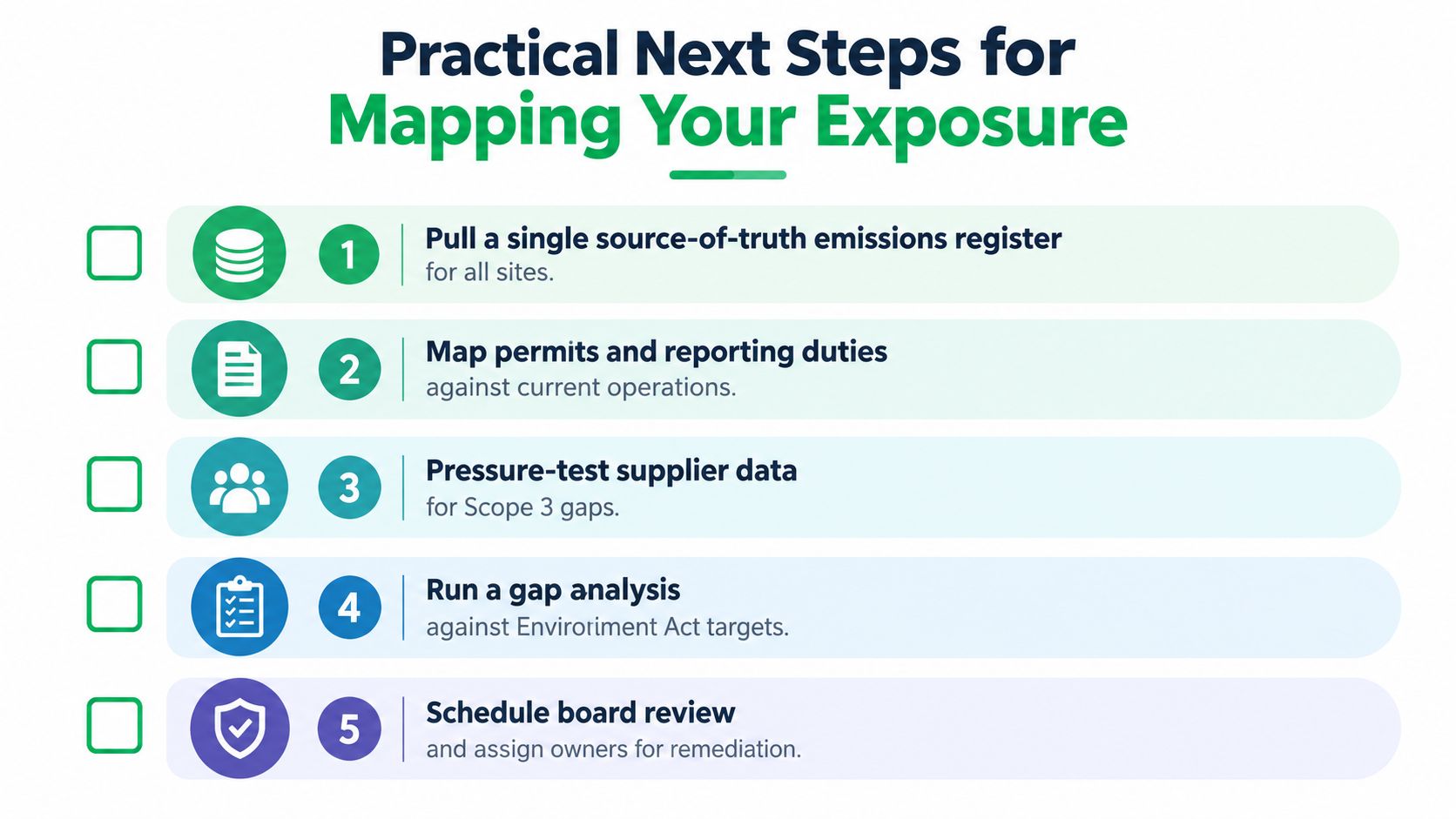
Start with one source of truth. Pull together emissions, permits, planning triggers, waste records and supplier evidence in a single register, even if the first version is messy. Then assign each duty to one named owner, because a duty with no owner is a deadline waiting to happen. After that, pressure-test the data against what the reporting team needs, not what the spreadsheet happens to contain.
Run the work in this order
- Pull the core register. Build one list of sites, reporting entities, projects and suppliers.
- Map the triggers. Check which activities fall under SECR, permitting, biodiversity net gain, waste and investor disclosure obligations.
- Test the evidence. Look for missing meter data, weak supplier backup and gaps in waste records.
- Fix the decisions. Decide who signs off scope, methodology and variations before the deadline arrives.
- Set a review cycle. Tie the evidence review to board reporting, then repeat it before the data goes stale.
Two decisions usually justify specialist help. The first is whether a business can credibly scope full-versus-part TCFD or wider climate disclosure on its own. The second is whether in-house teams can manage a permit variation without slowing operations or missing a material condition. If the answer is doubtful, bring in a consultant and a specialist lawyer early. That is cheaper than repairing a flawed submission later.
For teams that need a structured benchmark, the guidance at sustainability reporting consultant support is the sort of reference point worth using before the next board pack is locked. Keep the evidence review on a six-monthly cycle tied to board reporting, so an Environment Agency or DESNZ review doesn't expose a stale file. The last question to take into the next leadership meeting is simple. Who owns the register, and by what date will we sign off the evidence trail?
ESG Consulting helps UK organisations turn overlapping environmental duties into a clean evidence process, from SECR and carbon reporting through to planning, disclosure and board-ready sign-off. If you need a practical map of your exposure and a control set that can survive scrutiny, visit ESG Consulting and speak to a senior consultant about the next filing, permit review or reporting cycle.
More from the blog
· 12 min read · Regulation
What is PPN 026? The new Social Value Model
PPN 026 replaces PPN 002 as the Social Value Model for central government contracts from 1 January 2027. Scope, the 10% and 20% weightings and the six criteria.
Read article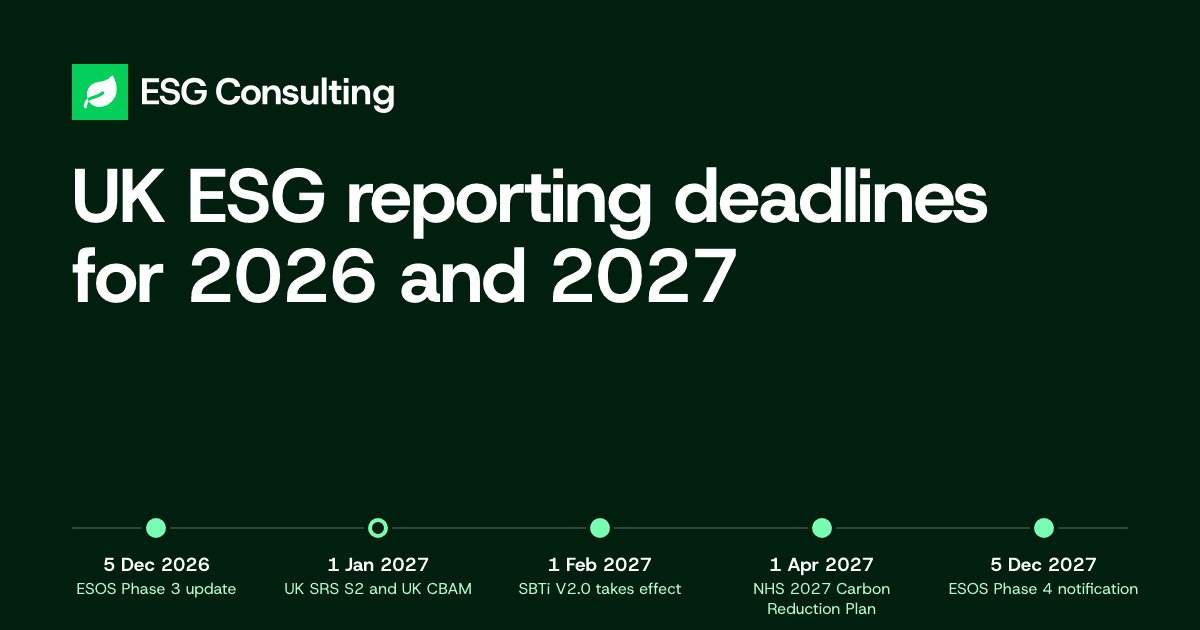
· 14 min read · Regulation
UK ESG reporting deadlines for 2026 and 2027
Every UK ESG reporting date to December 2027 - UK SRS, ESOS, SECR, UK CBAM, CSRD, SBTi, PPN 026 and the NHS - each marked mandatory, proposed or voluntary.
Read article