
what is csrd, csrd explained, esrs standards, uk csrd, sustainability reporting
What Is CSRD and Why It Matters for UK Companies
By ESG Consulting Team · · 17 min read
CSRD is an EU directive that requires in-scope companies to publish standardised sustainability disclosures under the European Sustainability Reporting Standards, or ESRS. For UK groups, the practical test now centres on an EU connection and, after the 2026 changes, often more than 1,000 employees and more than €450 million turnover, with separate tests for EU subsidiaries, branches and EU-listed securities.
A finance director may first encounter the acronym in a board paper, a customer questionnaire or a request from an EU subsidiary. The instinctive response is often, “We're a UK company, so this is an EU problem.” That conclusion can be wrong. CSRD isn't a UK statute, but it can reach UK-headed groups through EU turnover, an EU regulated-market listing, an EU subsidiary or an EU branch.
The practical questions are straightforward, even when the directive isn't. Are we in scope? What do the ESRS standards require? When does our reporting wave begin? Which UK disclosures can share the same evidence? The answer depends on the group structure, the relevant financial year, the location of securities and the effect of the 2026 Omnibus changes.
CSRD is best understood as an EU disclosure mandate with a long UK tail.
Table of Contents
- What CSRD Actually Means in Plain English
- How CSRD Came to Replace the Old Reporting Regime
- Understanding ESRS as the Reporting Backbone
- Which UK Companies Fall Inside CSRD Scope
- Phased Timelines and What Each Wave Requires
- Where CSRD Overlaps With UK Sustainability Rules
- Practical Steps for UK Groups Responding to CSRD
- Making a Clear Decision on Your CSRD Path
What CSRD Actually Means in Plain English
CSRD stands for the Corporate Sustainability Reporting Directive. It requires companies within its scope to publish structured information about sustainability matters in a dedicated management-report section, using common technical standards rather than an entirely self-selected ESG format. For UK organisations, the directive's practical reach comes from the group's EU activities, not merely from the address of its head office.
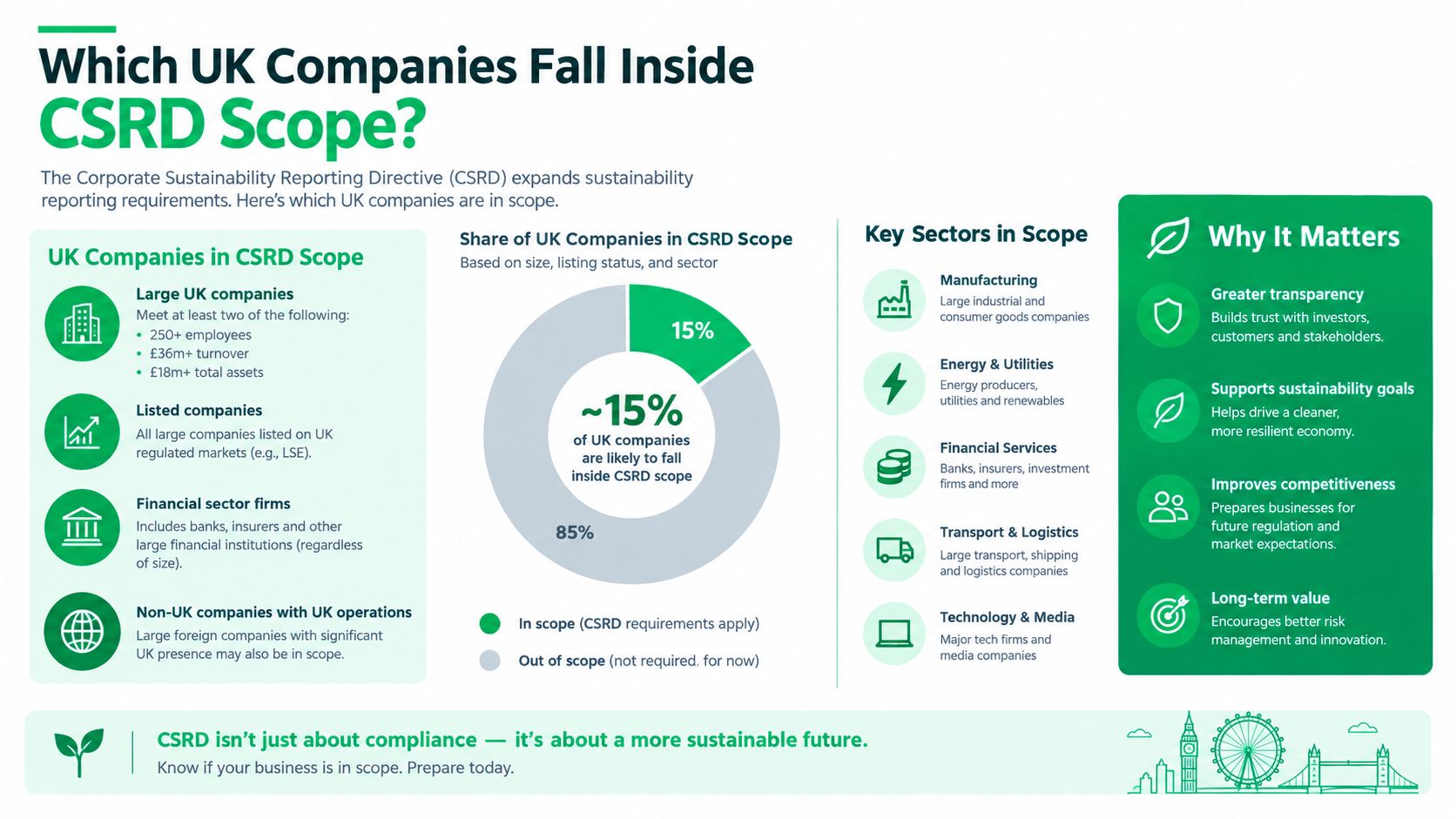
The original directive was adopted in EU law as Directive 2022/2464, published in the Official Journal on 16 December 2022, and entered into force on 5 January 2023. Its original design used thresholds such as more than 250 employees, more than €50 million net turnover and more than €25 million balance-sheet total, which is why UK groups with EU links began reviewing their exposure soon after publication. These milestones are recorded in the official EU directive text.
For a UK board, the scope assessment should answer four questions:
- Does a group entity have securities listed on an EU regulated market?
- Does the group have an EU subsidiary or branch that meets the relevant conditions?
- Does the wider group generate enough turnover in the EU to trigger parent-level reporting?
- Which financial year and reporting wave apply after the 2026 changes?
The answer isn't always visible in the consolidated accounts. A UK parent might be outside the rule while an EU subsidiary has its own reporting obligation. Alternatively, the EU footprint may bring the wider non-EU group into consideration once the applicable turnover and subsidiary or branch tests are met.
Practical rule: Treat CSRD as a group-structure and market-access question before treating it as a reporting question.
The directive also changes the quality expected from sustainability information. The ESRS create a common language for environmental, social and governance disclosures, so the work involves policies, metrics, controls, evidence and governance, not just polished narrative. A UK group that falls outside mandatory CSRD may still face requests from EU customers, lenders, investors or subsidiaries, but those requests shouldn't be confused automatically with a legal reporting obligation.
How CSRD Came to Replace the Old Reporting Regime
The older European non-financial reporting regime gave companies wide discretion over frameworks, definitions and presentation. That flexibility produced reports that were difficult to compare and often disconnected sustainability information from management controls and annual reporting. CSRD was introduced to create a more consistent system, with the ESRS providing the technical rulebook.
The shift became formal when the EU adopted Directive 2022/2464 in late 2022. It established a phased timetable, starting with financial years beginning on or after 1 January 2024 for companies already covered by the older regime. For UK groups, the practical effect was clear: headquarters outside the EU did not remove the need to assess exposure, data ownership or assurance readiness.
A UK group may now need to read CSRD alongside the incoming UK SRS regime. The two frameworks should not be treated as interchangeable, but the same governance, controls and underlying evidence may support both. That makes early design work useful even where the final CSRD position remains uncertain.
The 2026 Omnibus changes narrow the practical scope for later reporting waves. Current guidance describes a test based on more than 1,000 employees and more than €450 million turnover, together with separate conditions for non-EU groups carrying out significant activity in the EU. The changes do not undo the first reporting wave or remove the need to assess EU listings, subsidiaries and branches. They do mean that earlier scoping conclusions may need to be revisited.
The transposition timetable is also changing. Recent updates indicate that revised CSRD provisions are currently proposed to be pushed towards March 2027, subject to final transposition, while the ESRS remain subject to revision and consultation. A UK group therefore faces a practical choice: maintain useful controls and evidence now, while keeping the reporting system flexible enough to reflect the final scope and technical requirements.
The relationship between CSRD and TCFD reporting for UK organisations provides a useful comparison. TCFD-style reporting can support governance and climate-risk disciplines. CSRD places those disciplines within a wider, standardised reporting architecture.
The board-level lesson is practical. Sustainability reporting has moved from a flexible European regime towards narrower, more structured obligations. UK groups should reassess scope, retain reliable evidence and build systems that can adapt to both the final CSRD position and the developing UK SRS regime.
Understanding ESRS as the Reporting Backbone
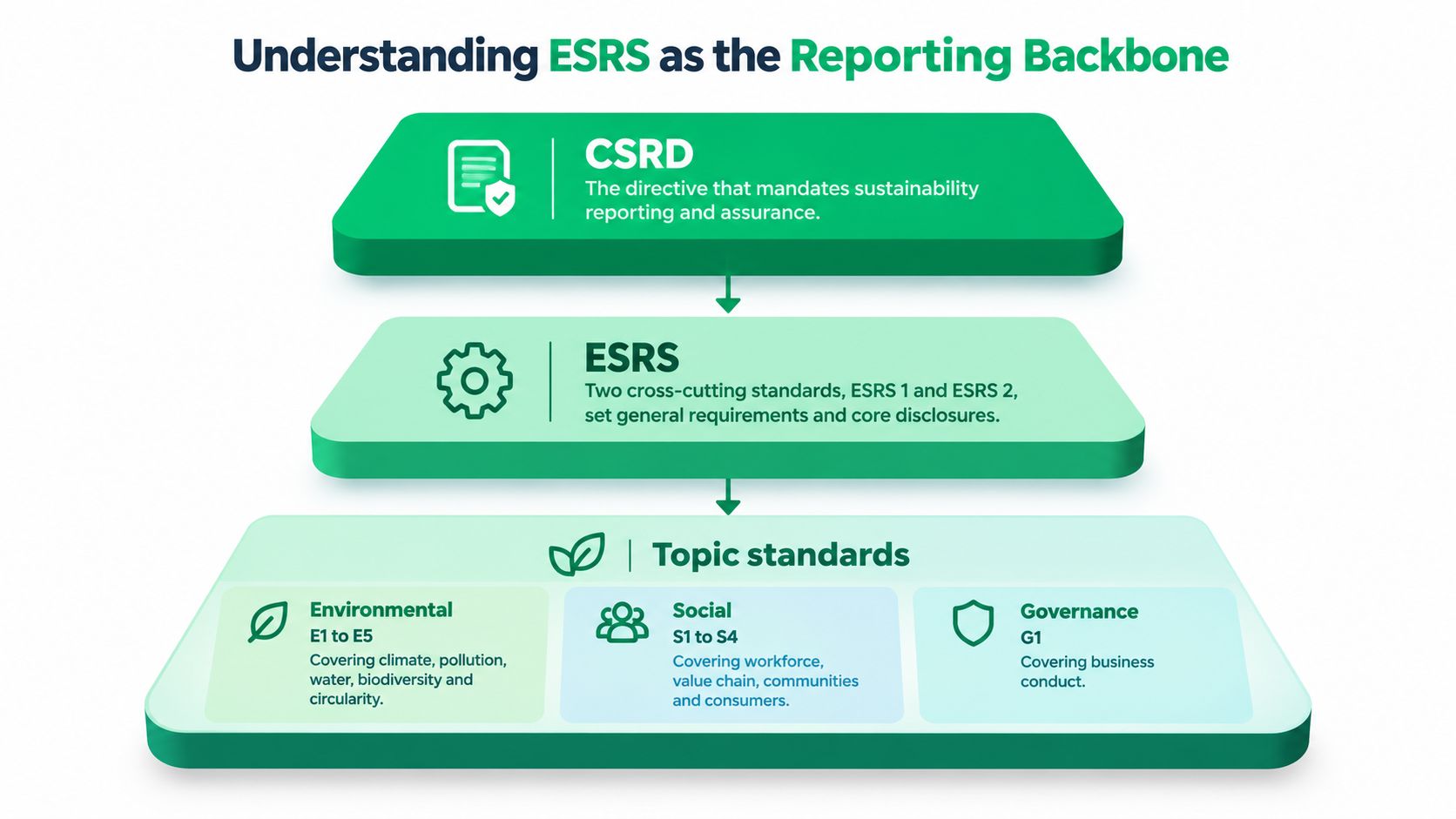
Think of CSRD as the legal roof over a reporting building. The European Sustainability Reporting Standards are the structure underneath. They tell an in-scope company what information to consider, how to organise it and which disclosures need to connect to governance, strategy, impacts, risks, opportunities, metrics and targets.
The foundation is made up of the cross-cutting standards. ESRS 1 provides general principles, including the logic of double materiality and the boundaries of the reporting exercise. ESRS 2 sets general disclosures covering governance, strategy, impact, risk and opportunity management, and metrics. These standards apply across the reporting exercise, rather than to only one environmental or social issue.
The next layer contains topic standards:
- Environmental standards, covering climate, pollution, water, biodiversity and resource use.
- Social standards, covering the workforce, value-chain workers, affected communities, and consumers or end-users.
- Governance standards, including business conduct.
That structure helps companies move from a general assessment to a focused disclosure set. A company doesn't report every topic in the same depth just because a topic exists in the ESRS. It first assesses which impacts, risks and opportunities are material, then connects the conclusion to policies, actions, targets and metrics.
One datapoint through the structure
Take Scope 1 greenhouse-gas emissions. The number itself sits within climate reporting, but its meaning depends on the wider ESRS architecture. The company needs to define the reporting boundary, explain relevant governance and controls, describe its climate-related approach, and provide the metric in the appropriate climate disclosure.
This is why an emissions spreadsheet on its own isn't a CSRD reporting system. The board needs to know who owns the data, how the boundary was determined, which evidence supports the figure and how the figure relates to the company's transition planning. The same principle applies to a social or governance metric.
Mandatory disclosures and voluntary datapoints also need to be distinguished carefully. The applicable ESRS version and the outcome of the materiality assessment determine what the company must provide, while some information may be useful voluntarily for investors or customers. Sector-specific requirements and proportionality arrangements are also subject to regulatory development, so teams shouldn't assume that an early draft is the final requirement.
The benefit of the layered model is comparability. Two companies may have different business models, but the same standards give investors and other users a more consistent basis for understanding their impacts, risks and responses.
Which UK Companies Fall Inside CSRD Scope
A UK group should run the EU nexus test in a set order. Start with securities and legal entities, then assess the wider group thresholds. Don't begin with the sustainability report. Begin with the organisation chart, listing status, EU turnover and branch structure.
Start with the direct EU connections
A UK company may be affected if it has securities listed on an EU regulated market. An EU subsidiary can also have its own reporting position, particularly where it qualifies as a large undertaking or is listed. The fact that the parent is incorporated in the UK doesn't cancel an obligation attached to an EU entity.
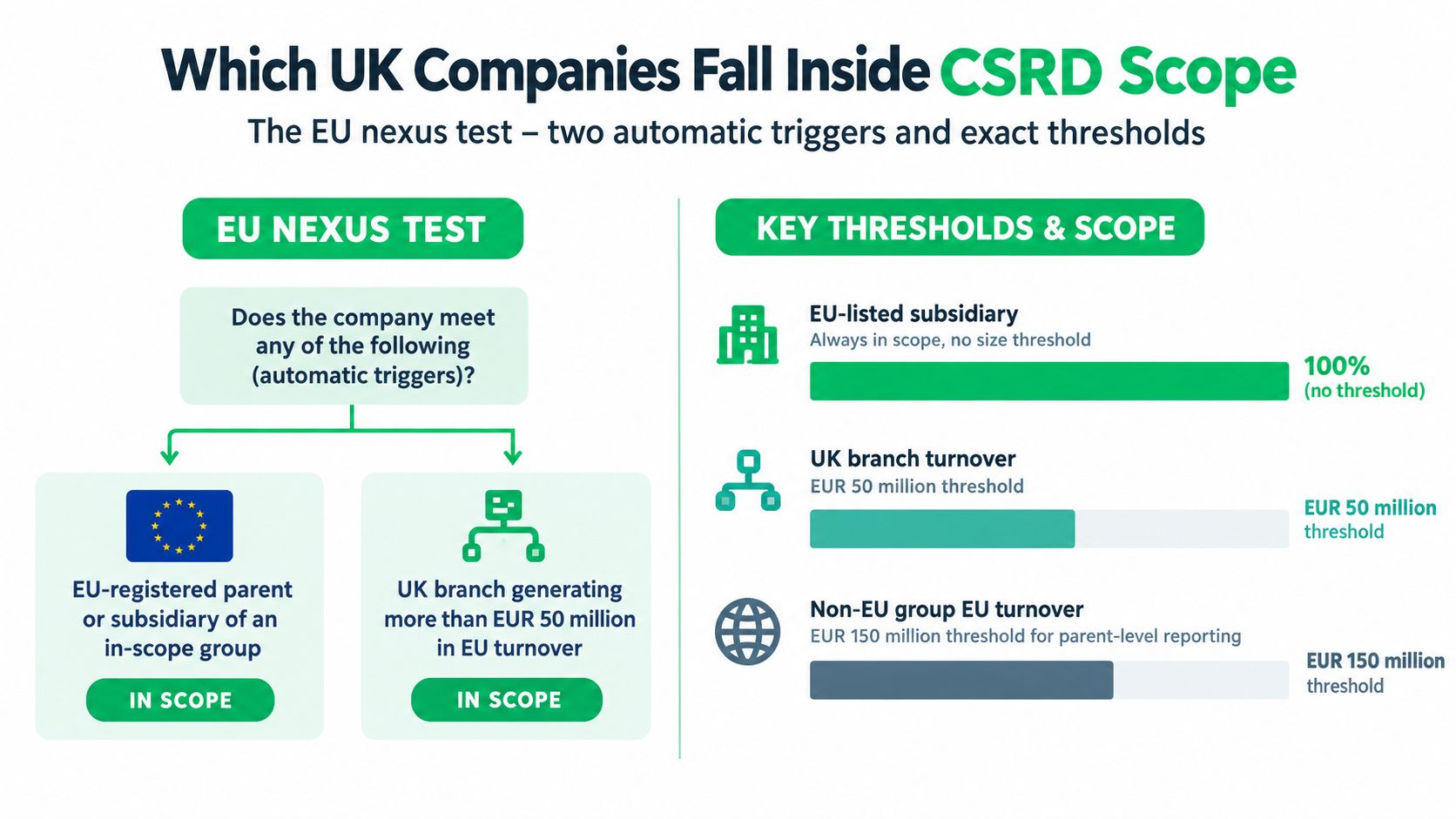
The second route is the non-EU group test. Under the current guidance, a UK-headed group can be brought into scope where it generates more than €150 million net turnover in the EU for each of the last two consecutive financial years, and has either a qualifying EU subsidiary or an EU branch with more than €40 million net turnover in the preceding financial year. The ESRS technical guidance for non-EU groups explains how this test connects to the dedicated management-report section and ESRS disclosures.
Then apply the Omnibus test
The 2026 changes narrow the general size test to more than 1,000 employees and more than €450 million turnover. For non-EU groups, current coverage also refers to EU turnover above €450 million, together with an EU subsidiary or branch above €200 million. These revised tests matter most to groups entering later reporting waves, while the position of companies already in the first wave needs separate review.
A mid-sized UK manufacturer with a German subsidiary therefore shouldn't ask only whether the UK parent exceeds the new employee and turnover criteria. It should check the German entity's size, its listing status, the group's EU turnover, the branch position and the relevant reporting year. If no EU entity, branch or regulated-market listing creates a nexus, the UK group may fall outside mandatory CSRD, although commercial data requests can still arise.
The honest scope conclusion can be “CSRD doesn't apply to this group.” Documenting that conclusion is still a useful control.
Scope decisions should be dated and approved. The rules are changing, and a group that was outside scope after the Omnibus changes may still need to monitor an acquisition, a new EU listing or a change in group turnover.
Phased Timelines and What Each Wave Requires
The original CSRD timetable is easier to understand when separated into financial years and publication years. The first wave covers financial years beginning on or after 1 January 2024, with the first reports published in 2025. Later waves begin with financial years starting on or after 1 January 2025 and 1 January 2026, depending on the entity category.
| Wave | Financial Year | Publication Year | In-Scope Entities | Assurance Level |
|---|---|---|---|---|
| Wave 1 | 2024 | 2025 | Companies already subject to the older non-financial reporting regime | Assurance-ready ESRS disclosures |
| Wave 2 | 2025 | 2026 | Other large companies under the applicable scope test | Assurance-ready ESRS disclosures |
| Wave 3 | 2026 | 2027 | Listed SMEs and certain other entities under the applicable scope test | Assurance-ready ESRS disclosures |
The European Commission's CSRD timetable confirms the staged entry points. The 2026 Omnibus changes mean that the table should be treated as a reporting framework, not as a substitute for a current entity-by-entity scope review. A later wave may now be narrower than the original directive suggested.
The reporting year is the year in which the underlying activity occurs. The publication year is when the information appears in the relevant report. That distinction affects budgets, audit committee calendars, data freezes, management sign-off and the period available to correct control weaknesses.
What the changing timetable means
The extension of the revised transposition timetable towards March 2027 creates uncertainty for member-state implementation. UK groups with EU entities should monitor the law in each relevant jurisdiction rather than assume that one national implementation answer applies across the group.
The safest response is to prepare the foundations before the final deadline is clear. That means confirming the scope decision, assigning data owners, testing the materiality process and retaining evidence for key metrics. A practical review of UK ESG reporting deadlines for 2026 and 2027 can sit alongside the group's own EU jurisdiction calendar.
Where CSRD Overlaps With UK Sustainability Rules
A UK group might prepare climate disclosures for a listed parent, energy and carbon information under SECR, and ESRS reporting for an EU subsidiary. After the 2026 Omnibus narrowing, the first question is which entities still have a relevant EU connection. The second is which evidence can support several obligations without treating the regimes as identical.
The UK Sustainability Reporting Standards are currently voluntary, while the FCA is consulting on proposals for phased adoption for UK listed companies from 1 January 2027, subject to final policy decisions. The current UK and EU regulatory overview illustrates why a UK group should map the requirements separately. Governance, climate information and sustainability risks may appear in more than one framework, but the definitions, scope tests and report outputs can differ.
| Regime | Scope | Structure | Climate Depth | Social and Biodiversity | Assurance |
|---|---|---|---|---|---|
| CSRD and ESRS | EU entities and UK groups with the relevant EU nexus | Standardised ESRS disclosures | Broad climate, risk, metrics and transition information where applicable | Wider environmental, social and governance coverage | Prepare evidence for applicable assurance |
| UK SRS | Currently voluntary, with proposed phased adoption for UK listed companies | UK framework influenced by international sustainability reporting practice | Focused on financially relevant sustainability information | Depends on the applicable standard and materiality | Depends on the final UK requirements |
| SECR | UK entities subject to the applicable energy and carbon reporting rules | Annual energy and carbon information | Useful operational energy and emissions evidence | Limited compared with CSRD | Existing controls may support review |
| CFD or TCFD-style reporting | UK organisations subject to the relevant climate disclosure expectations | Governance, strategy, risk and metrics | Climate-centred | Doesn't provide the full CSRD topic range | Depends on the applicable UK obligation |
One evidence base can support several reports. Energy and emissions records, governance approvals, materiality assessments, supplier information and control evidence can be retained once, then mapped to CSRD, UK SRS, SECR or climate-related disclosures.
The shared base needs separate rule layers. CSRD may require a broader value-chain assessment, different materiality records and more detailed topic disclosures. UK reporting may apply different definitions, filing locations or scope criteria. A UK SRS report cannot replace an ESRS report for an EU obligation, just as an SECR schedule will not cover every CSRD datapoint.
For example, a supplier emissions record might support a CSRD value-chain disclosure and a UK climate report. The group still needs to document the calculation boundary, owner, approval and intended reporting use. That prevents finance, procurement and site teams from supplying the same evidence through separate, uncontrolled requests.
Build one evidence trail where the facts overlap, then create separate report outputs where the rules diverge.
Practical Steps for UK Groups Responding to CSRD
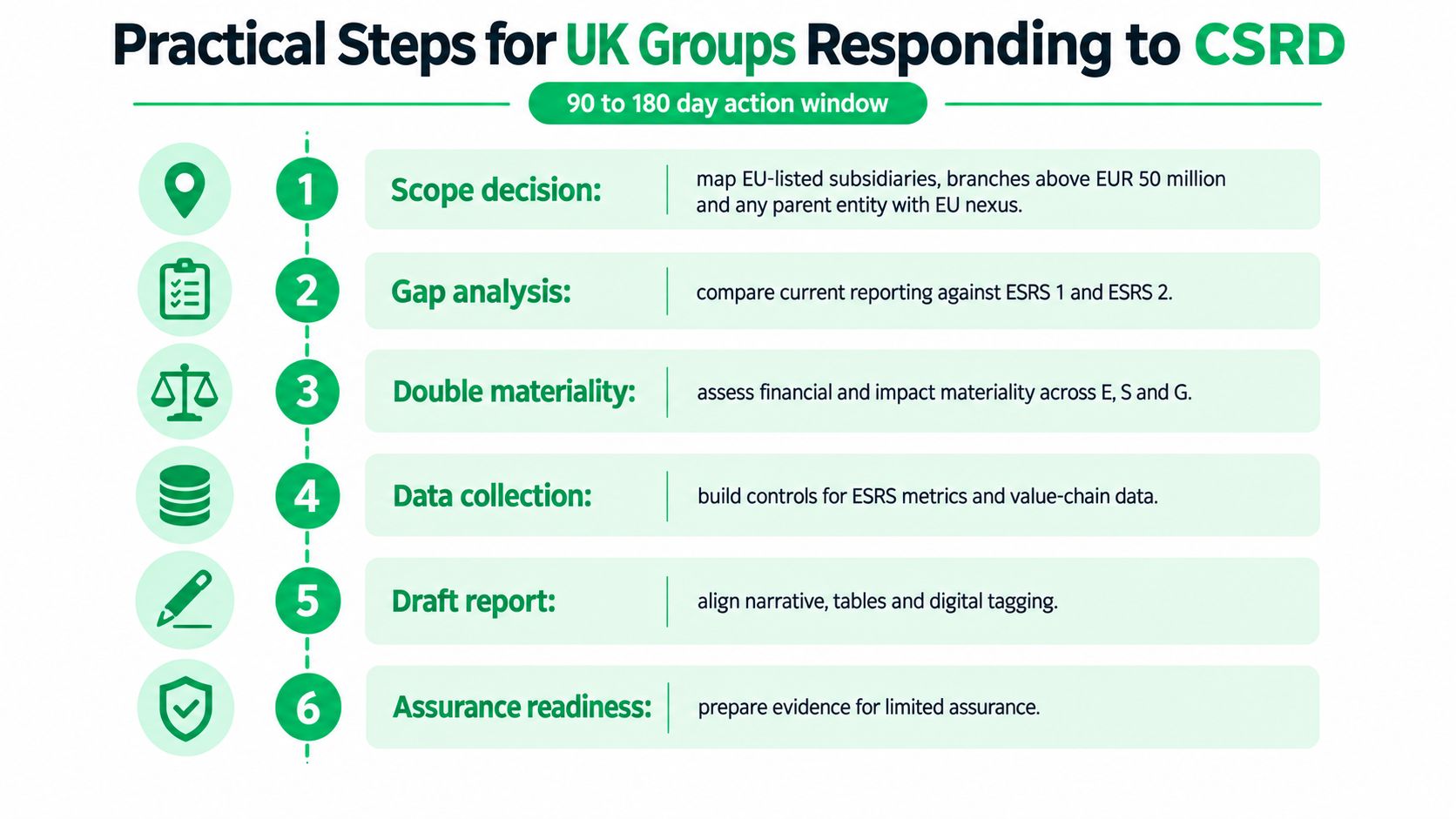
A group can make useful progress during a 90-to-180-day readiness programme without assuming that every current proposal is final. The sequence below keeps legal scope, reporting design and governance connected.
Establish the scope decision
Map every EU-registered subsidiary, EU regulated-market listing, EU branch and relevant turnover stream. Record the legal entity, reporting year, employee population, EU turnover and ownership relationship. If the outcome is that CSRD doesn't apply, retain the analysis and the assumptions behind it.
Test materiality properly
Run a double materiality assessment across environmental, social and governance topics. The assessment should consider both sides of the question: how the business affects people and the environment, and how sustainability matters affect the business. Keep stakeholder input, scoring logic, evidence and approval records together.
Build the data model
Create a register of ESRS datapoints and assign each one to a source system and owner. Link emissions data to operational records, workforce information to human-resources controls, and governance disclosures to board and committee documentation. Plan for digital tagging and structured reporting rather than leaving those tasks until the report is complete.
Prepare assurance evidence
Test whether another person can reproduce important figures from source data to final disclosure. Keep calculation files, definitions, boundary decisions, approvals and exception logs. Limited assurance readiness depends on traceability and control evidence, not on the visual quality of the report.
Give the board a defined role
The board or audit committee should know who owns the scope conclusion, materiality assessment, data controls and final sign-off. A concise governance paper should explain unresolved estimates, value-chain limitations, major judgements and the effect of regulatory changes.
Choose the reporting architecture
Most groups should compare two options: a consolidated ESRS and UK SRS data spine with separate outputs, or parallel systems for distinctly different information. The first option reduces duplicated controls, but it still requires a clear mapping of definitions and omissions. The second may be justified where entities have separate systems, reporting boundaries or legal owners.
The decision to defer should be evidence-based. If the group has no EU nexus, no relevant listed entity and no applicable threshold exposure, it may prioritise UK reporting readiness instead. If the group remains in scope, deferral should mean controlled preparation, not inactivity.
Making a Clear Decision on Your CSRD Path
A UK group that has recently changed its ownership, listing status or EU presence may need to reassess its CSRD position. The 2026 Omnibus narrowing makes that review more important, because some groups may no longer fall within the same scope assumptions. A decision should be recorded, dated and linked to the facts that could change it.
| Track | Profile | Primary Action | Reporting Year Focus |
|---|---|---|---|
| Act now | EU-listed entity, qualifying EU subsidiary or group with the applicable EU nexus and thresholds | Confirm scope, establish ESRS controls and prepare assurance evidence | Relevant current or next financial year |
| Monitor and prepare | UK group with planned EU expansion, changing turnover or significant customer requests for ESRS information | Maintain a documented gap assessment and build reusable data controls | Next likely reporting wave |
| Prioritise UK readiness | UK group with no relevant EU nexus or listed subsidiary | Track UK SRS developments and retain core sustainability evidence | UK reporting timetable as it develops |
The first track requires senior ownership because CSRD affects the annual reporting calendar, governance timetable and assurance process, rather than only the sustainability team. The board should approve the scope conclusion and understand the assumptions behind it.
The second track is a controlled holding position. A group planning EU expansion can map its entities, identify likely ESRS data gaps and preserve evidence without building a full reporting system before a scope trigger exists. That preparation also helps if a customer, lender or investor requests ESRS-shaped information.
The third track does not mean ignoring CSRD. UK groups outside the directive's scope may still receive information requests from suppliers, lenders and investors. A reliable emissions inventory, documented governance and a repeatable materiality process can support those requests and reduce duplicated work if the group later enters the EU regime.
Keep the forward calendar visible. The EU transition continues into 2027, while UK SRS adoption remains subject to the UK policy and regulatory process. The board's decision should state what is known, what remains uncertain, which events require a reassessment and who owns the next review. It should also explain how the group will handle overlapping EU and UK obligations if both apply.
For practical help with scope assessment, ESRS-aligned reporting and UK SRS readiness, a sustainability reporting consultant can review your group structure, map overlapping obligations and build a proportionate reporting plan. ESG Consulting can use your organisation chart, EU footprint and current sustainability disclosures to help determine whether the group should act now, prepare for a later wave or document why CSRD does not apply.
More from the blog
· 12 min read · Regulation
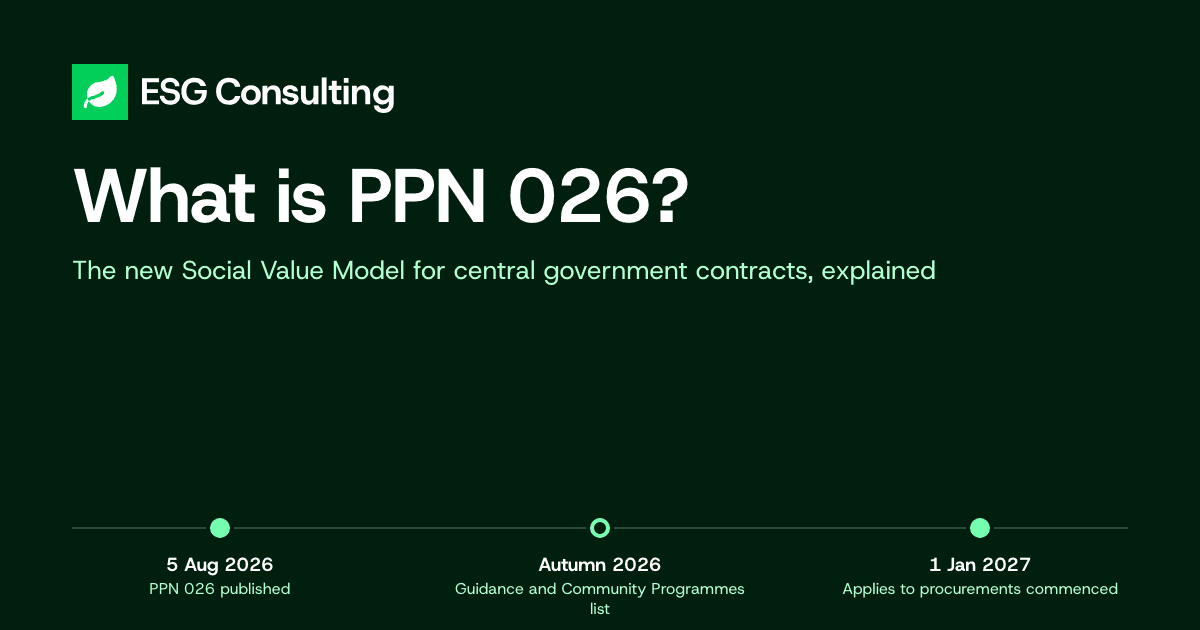
What is PPN 026? The new Social Value Model
PPN 026 replaces PPN 002 as the Social Value Model for central government contracts from 1 January 2027. Scope, the 10% and 20% weightings and the six criteria.
Read article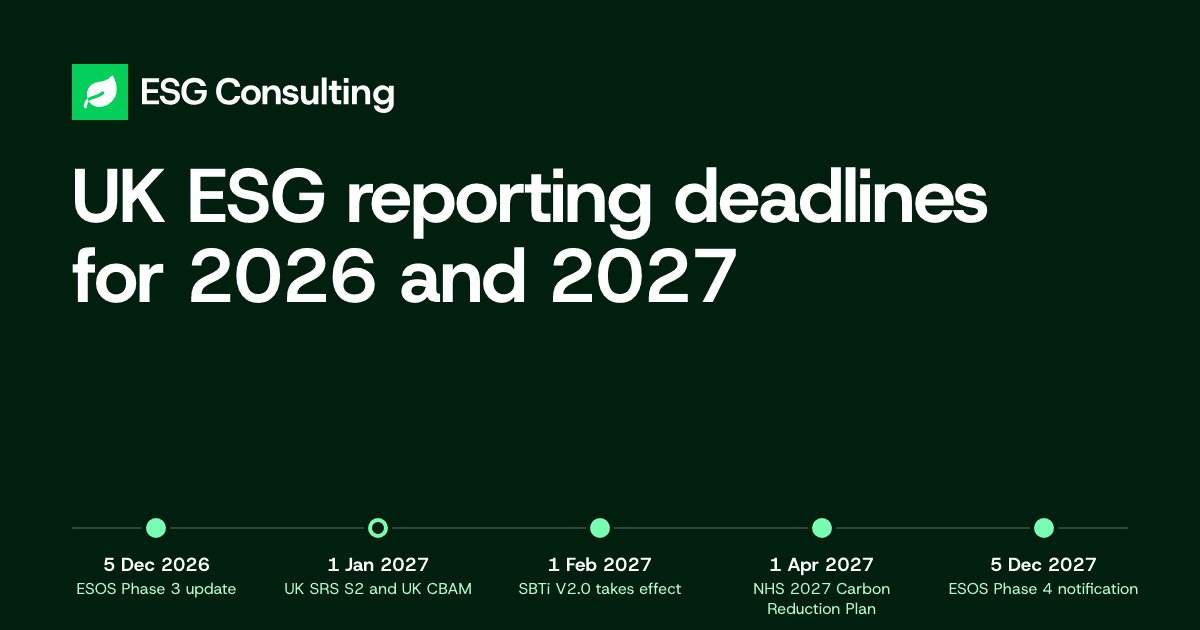
· 14 min read · Regulation
UK ESG reporting deadlines for 2026 and 2027
Every UK ESG reporting date to December 2027 - UK SRS, ESOS, SECR, UK CBAM, CSRD, SBTi, PPN 026 and the NHS - each marked mandatory, proposed or voluntary.
Read article