
ESG consulting, UK sustainability, net-zero strategy, SECR reporting, CSRD readiness
What Is ESG Consulting and How UK Firms Use It
By ESG Consulting Team · · 16 min read
ESG consulting is specialist advisory work that helps organisations measure, disclose and decarbonise under overlapping UK and EU sustainability rules. In the UK, it exists because companies now have to work through a patchwork of seven regimes, while the domestic ESG industry already represents £3.7 billion in turnover and is growing at 11.2% per year.
Most advice on this topic is too soft. It treats ESG consulting like a reporting admin task. That misses the problem.
If you're a finance director, board adviser or company secretary, what is ESG consulting in practice? It's not a glossy strategy deck, a few carbon numbers in the annual report, or a junior team building a maturity matrix. It's a recurring reporting and operating model that has to survive board scrutiny, external challenge and, increasingly, assurance. The consultant earns their fee when the data reconciles, the scope is right, and the final disclosure can be traced back to source evidence without a scramble two days before sign-off.
Table of Contents
- The Real Job ESG Consulting Does for UK Organisations
- Why the UK Regulatory Patchwork Creates Demand for Specialists
- Core ESG Consulting Services UK Firms Buy
- How a Typical ESG Consulting Engagement Runs
- Why Senior-Led Delivery Changes the Value
- When ESG Consulting Is Actually Necessary and When to Defer
- Choosing an ESG Consultant and What Good Output Looks Like
The Real Job ESG Consulting Does for UK Organisations
Boards often ask for an ESG strategy when the business problem is reporting discipline. That is the mistake.
For UK organisations, ESG consulting earns its keep by building a reporting and operating model that can be run year after year, across finance, operations, procurement and legal, without a panic before sign-off. The point is not to produce a deck. The point is to produce numbers, statements and decisions that can be traced back to source evidence and defended under scrutiny.
What clients are buying
Most UK buyers pay for three things.
- An evidence-grade emissions baseline: a carbon inventory tied to invoices, utility data, fuel records, meter reads, travel logs and supplier information.
- A defensible disclosure: a SECR note, UK SRS readiness pack, CSRD workstream or climate disclosure that stands up to challenge from auditors, legal teams and the board.
- A transition plan a CFO can back: sequenced actions, named owners, capital implications and operational dependencies. No slogans. No vague target-setting theatre.
That is where consultants earn their fee. If a reported figure cannot be traced to source evidence, the work is incomplete.
Why one-off ESG projects fail
A one-off project rarely solves the problem. Once reporting obligations, lender questions, customer due diligence or procurement demands start landing, the work becomes cyclical.
That changes the brief. You need reporting boundaries set correctly. You need data controls, version discipline and a method for estimated data, missing supplier inputs and landlord-controlled energy use. You also need clear calls on what sits outside scope, because finance teams waste plenty of money doing work no rule, lender or customer has asked for.
What good consultants do all day
The strongest UK ESG consultants spend less time on abstract advice and more time on the work that prevents weak disclosures and year-end scrambles.
- Setting scope: legal entities, operational control and reporting perimeter.
- Testing evidence: checking whether activity data will hold up in an annual report or assurance sample.
- Aligning outputs: using one underlying dataset across several reporting requirements.
- Forcing decisions: assigning ownership, agreeing methodologies and setting sign-off routes.
This is why the market keeps growing. Analysts at The Data City's UK ESG industry analysis found that the UK ESG sector has reached significant scale, with strong investment and continued growth in sustainability consulting demand.
The practical point is simple. ESG consulting is not a tidy compliance add-on. It is recurring reporting infrastructure with operational consequences. Done properly, it turns obligations such as SECR, ESOS, UK SRS and CSRD into auditable evidence rather than slideware.
Why the UK Regulatory Patchwork Creates Demand for Specialists
The UK issue is not understanding ESG in principle. The issue is that the rules sit in different places, hit different entities, and ask for different evidence. Boards usually spot the problem late, when one disclosure request turns into three separate data exercises.
That is why firms bring in specialists. Not for generic strategy decks. For judgement on scope, reporting architecture, and evidence that can survive audit, assurance, lender scrutiny, and regulator questions.
One widely used UK summary sets out the current patchwork across multiple regimes, including UK SRS S1 and S2, FCA climate rules, Companies Act climate-related financial disclosure rules, SECR, ESOS Phase 4 and FCA anti-greenwashing requirements, each with its own scope and timetable in the UK ESG reporting requirements summary.
Why this becomes specialist work
A general corporate adviser often treats ESG as one programme. That misses the problem. The work splits by legal test, reporting perimeter, evidence standard, and sign-off route.
| Regime | Who it applies to | Current status | Key deadline driving consulting demand |
|---|---|---|---|
| SECR | Quoted companies and large unquoted companies or LLPs in scope | Mandatory | Annual report cycle and year-end disclosures |
| Companies Act climate-related financial disclosures | UK companies with more than 500 employees and more than £500 million turnover | Applies from April 2022 | Annual reporting timetable |
| FCA climate disclosure rules | Listed companies in scope of FCA rules | In force since 2021 | Listed company reporting cycle |
| UK SRS S1 and S2 | Currently voluntary users, with likely future listed market relevance | Published on 25 February 2026 and currently voluntary | Readiness work ahead of possible future mandatory adoption |
| ESOS Phase 4 | Qualifying organisations under ESOS | Mandatory for those in scope | Qualification is scheduled for 31 December 2026, notification for 5 December 2027 and action plans for 5 December 2028 |
| FCA anti-greenwashing rules | FCA-regulated firms in scope | Took effect on 31 May 2024 | Immediate claims review and governance work |
| CSRD spillover | UK groups with relevant EU presence or listed securities | Depends on structure and EU exposure | First reporting cycle for the in-scope undertaking |
The pressure comes from overlap, not volume alone. The same energy data can sit inside SECR and ESOS. A climate governance statement drafted for one reporting expectation may need different wording, controls and board evidence for another. A UK subsidiary may also find itself answering group requests driven by EU reporting obligations, even where the UK entity is not the formal filer.
Consultants earn their fee. They stop teams building parallel processes for each regime and create one reporting method that can produce repeatable outputs across several obligations. That means clear entity mapping, agreed calculation rules, documented assumptions, and an evidence file that someone else can test.
The handoff that matters now
The live transition is from TCFD-style narrative reporting to UK SRS-style disclosure architecture. The FCA's January 2026 consultation proposes mandatory UK SRS S2 reporting for UK-listed issuers from accounting periods beginning on or after 1 January 2027, with some broader S1 obligations proposed later on a comply-or-explain basis, as set out in the FCA consultation on sustainability disclosures.
Proposed is the key word. Boards should still prepare now.
Once finance teams grasp that point, the buying decision becomes obvious. They do not need more slideware. They need controlled inputs, approval routes, and workpapers that support recurring disclosures. For a practical timetable, use this guide to UK ESG reporting deadlines for 2026 and 2027.
One dataset now has to serve several masters. If it cannot support reporting, board sign-off and assurance from the same evidence base, it is not fit for use.
Core ESG Consulting Services UK Firms Buy
Ask ten firms what they do and you'll get ten inflated service lists. Strip the marketing out and buying pattern is simpler. UK organisations buy ESG consulting from the inside out. They start with disclosure pressure, then they fix data, then they tackle decarbonisation and governance.
Reporting and assurance-readiness
Most engagements start because the immediate risk sits.
Typical services include:
- SECR preparation: Scope 1 and 2 inventories, intensity ratios, methodology notes and annual report narrative.
- UK SRS readiness: gap assessment against S1 and S2, control design, draft disclosure architecture and board-ready papers.
- CSRD scoping and readiness: entity mapping, gap analysis and double materiality work where the group is in scope.
- Assurance support: workpapers, sample packs, evidence indexing and auditor Q&A support.
If you're buying this work, ask for the underlying methodology note, not just the report output.
Data and systems work
Reporting quality is downstream of data quality. Poor providers get exposed.
A proper consultant will map activity data, identify ownership, and build a workable register across finance, operations, facilities, travel, fleet and procurement. For many service businesses and light manufacturers, the pain point isn't Scope 1 or 2. It's the Scope 3 categories that are material enough to matter and messy enough to fail on first pass.
Common delivery items include:
- Emissions baselining: organisational boundary definition, source mapping and carbon calculation registers.
- Supplier engagement: chasing primary activity data for purchased goods and services where estimates are weak or commercially risky.
- Platform configuration: building reporting logic in tools such as Watershed, Persefoni, Greenstone, or a tightly controlled Excel model where the estate is still small.
- Audit trail design: source file naming, version control, assumptions logs and evidence folders.
One option in this market is ESG Consulting's sustainability reporting consultant support, which focuses on UK reporting, carbon disclosure and assurance-ready evidence trails. That's the right shape of service if the work is tied to a live reporting need rather than broad brand positioning.
Decarbonisation and transition planning
Once the numbers are credible, the next question is obvious. What are you going to do with them?
A good engagement moves beyond inventory work:
- Target setting: deciding whether the organisation is ready for formal target frameworks such as SBTi.
- Abatement planning: ranking practical levers such as energy efficiency, fuel switching, procurement changes and supplier engagement.
- Transition planning: sequencing those levers into a plan that fits capex cycles, lease events and operational constraints.
- Scenario work: climate risk and resilience analysis where the board or listing context requires it.
Buy the roadmap only after the baseline is stable. A transition plan built on poor data just gives you a better-formatted mistake.
Strategy, governance and capacity
This is the layer boards tend to discuss first, even though it should usually come later.
Useful services here include board briefings, ESG committee terms of reference, policy drafting, supplier code work, and secondment-style training for in-house finance or sustainability staff. Materiality assessments can also be valuable, but only if they feed a real decision. If you're assessing materiality in the abstract, you're probably too early or too vague. A sharper explanation of that sits in this guide to ESG materiality assessments.
The firms worth hiring don't pad the scope. They tell you which frameworks apply, which can wait, and which marketing-led extras have no bearing on your legal or commercial exposure.
How a Typical ESG Consulting Engagement Runs
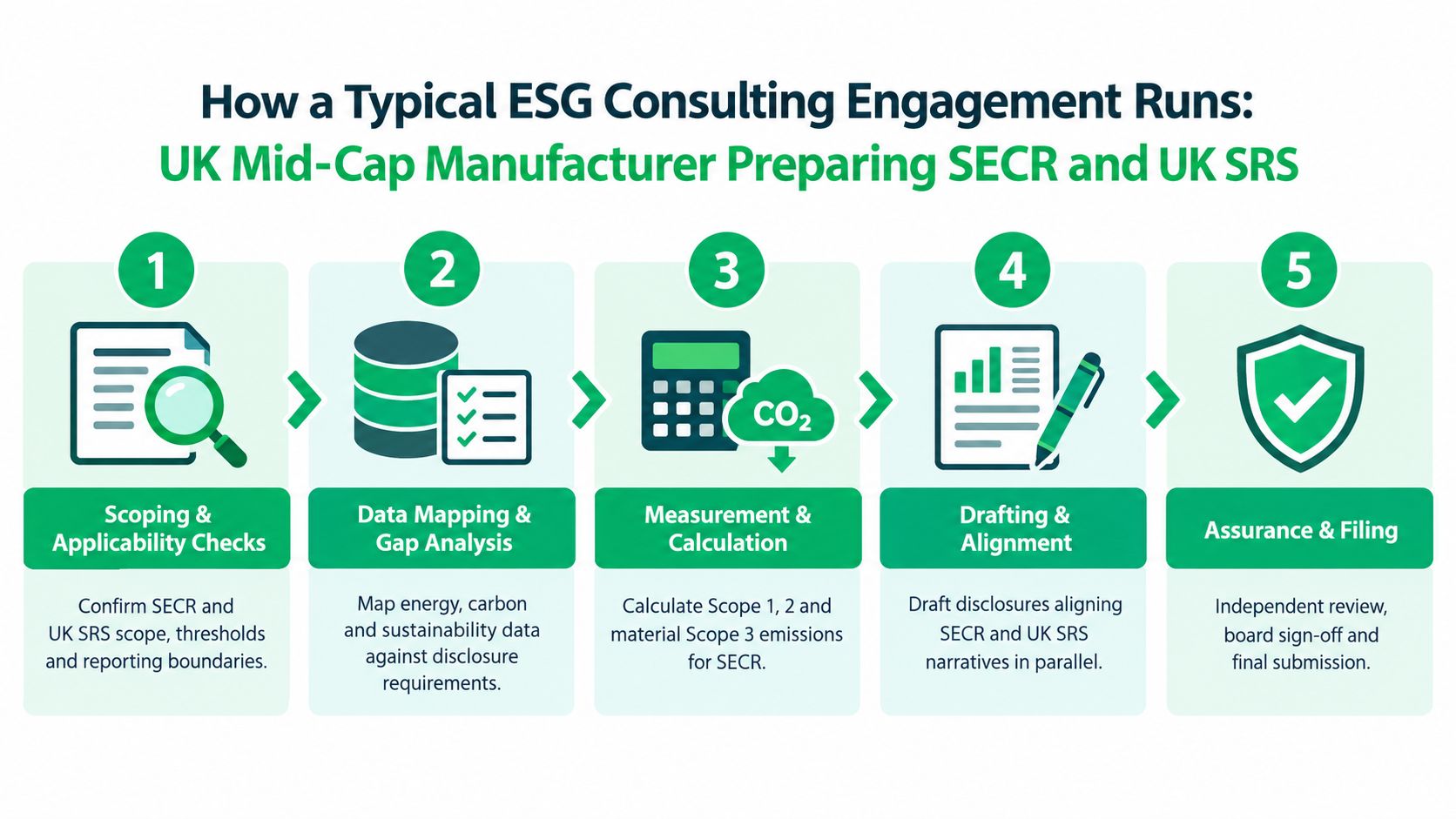
A normal engagement is less glamorous than most pitch decks suggest. Take a mid-cap UK manufacturer preparing SECR while also getting ready for future UK SRS-style reporting. The work is usually won or lost in the first few weeks, when someone has to decide what the reporting boundary is and where the evidence will come from.
Here's the process in one view:
Phase one and two
The engagement opens with scoping and applicability checks. That means legal entity review, organisational boundary decisions, and testing which obligations bite. If the group structure is messy, this alone can save a lot of wasted effort.
Then comes data mapping. The consultant pulls data from ERP exports, utility invoices, half-hourly electricity records where available, fuel card reports, landlord statements, refrigerant logs and procurement records. The aim isn't to gather everything. The aim is to gather what can be evidenced, repeated and signed off.
Phase three and four
Next comes the calculation layer. The consultant builds the greenhouse gas inventory, documents assumptions and maps evidence to each line item. At the same time, they start drafting the SECR narrative and energy-efficiency actions.
For organisations also preparing for more formal sustainability reporting, the gap between “we have data” and “we have reportable data” becomes obvious. UK SRS is currently voluntary, with the government publishing S1 and S2 for voluntary use while future mandatory adoption remains subject to later decisions, as noted in the government response on UK Sustainability Reporting Standards.
A short explainer often helps internal teams align before drafting starts:
Phase five and the pinch points
The final phase is management review, board sign-off and assurance handover. By this point, the consultant should have prepared a pack that lets auditors or reviewers test reported figures without pulling the whole team back into first principles.
The pinch points are predictable:
- Estimated inputs: especially where invoices are missing or sites report late.
- Landlord-controlled electricity: common in leased buildings and often badly documented.
- Scope 3 boundaries: especially purchased goods, waste, business travel and upstream transport.
- Method changes: where prior-year treatment doesn't match current expectations.
Consultants earn their fee. Not by writing more. By stopping weak evidence from reaching the board.
Why Senior-Led Delivery Changes the Value
Most buyers still focus on the logo on the proposal. They should focus on who is doing the work.
ESG engagements fail in a very specific way. A junior-heavy team gathers data, builds a reasonable draft, and gets through internal review. Then the auditor, external reviewer or board asks basic questions about scope, assumptions or evidence lineage. Nobody on the working team can answer without escalating. Time goes. Costs rise. Confidence falls.
The staffing model matters more than the pitch
A senior-led model changes the economics because the hard calls get made early.
| Dimension | Junior-staffed model | Senior-led fixed-fee model |
|---|---|---|
| Scoping | Broad and defensive. More work is included than needed. | Tighter. Inapplicable workstreams are rejected early. |
| Methodology | Built after drafting starts, often reactively. | Designed at the start and used throughout. |
| Evidence trail | Spread across emails, spreadsheets and ad hoc folders. | Structured into workpapers and source-linked controls. |
| Board readiness | Narrative may look polished but weak points remain hidden. | Risks, assumptions and decisions are surfaced before sign-off. |
| Assurance support | Auditor questions trigger rework. | Auditor questions are anticipated in the original pack. |
Where the fee is actually earned
The cheap-looking model often costs more because it pushes interpretation to the end. That's backwards.
Senior practitioners add value in three places:
- Scope discipline: they stop you paying for work you don't need, especially where obligations are narrower than internal stakeholders assume.
- Cleaner evidence: they build workpapers that can survive sample testing, rather than leaving a slide deck and a trail of half-finished spreadsheets.
- Faster sign-off: they prepare methodology, assumptions and governance papers in a form the board and auditor can use.
In ESG reporting, the auditor is often the real customer of the output. If the pack doesn't work for them, it doesn't work.
The point is simple. Seniority isn't a luxury line item. In audit-facing ESG work, it's often the cheapest way to avoid rework.
When ESG Consulting Is Actually Necessary and When to Defer
Not every business needs a broad ESG programme right now. Some do. Many don't. The decision should start with legal exposure and procurement pressure, not with vague talk about best practice.
The UK government's sustainability reporting guidance makes this distinction clear enough in practice. UK SRS is not currently mandatory and is available for voluntary use, while future requirements for certain entities may come later. At the same time, procurement and sector rules are already pushing demand for Carbon Reduction Plans, NHS Green Plans and supply-chain disclosure, as set out in the UK sustainability reporting guidance 2025 to 2026.
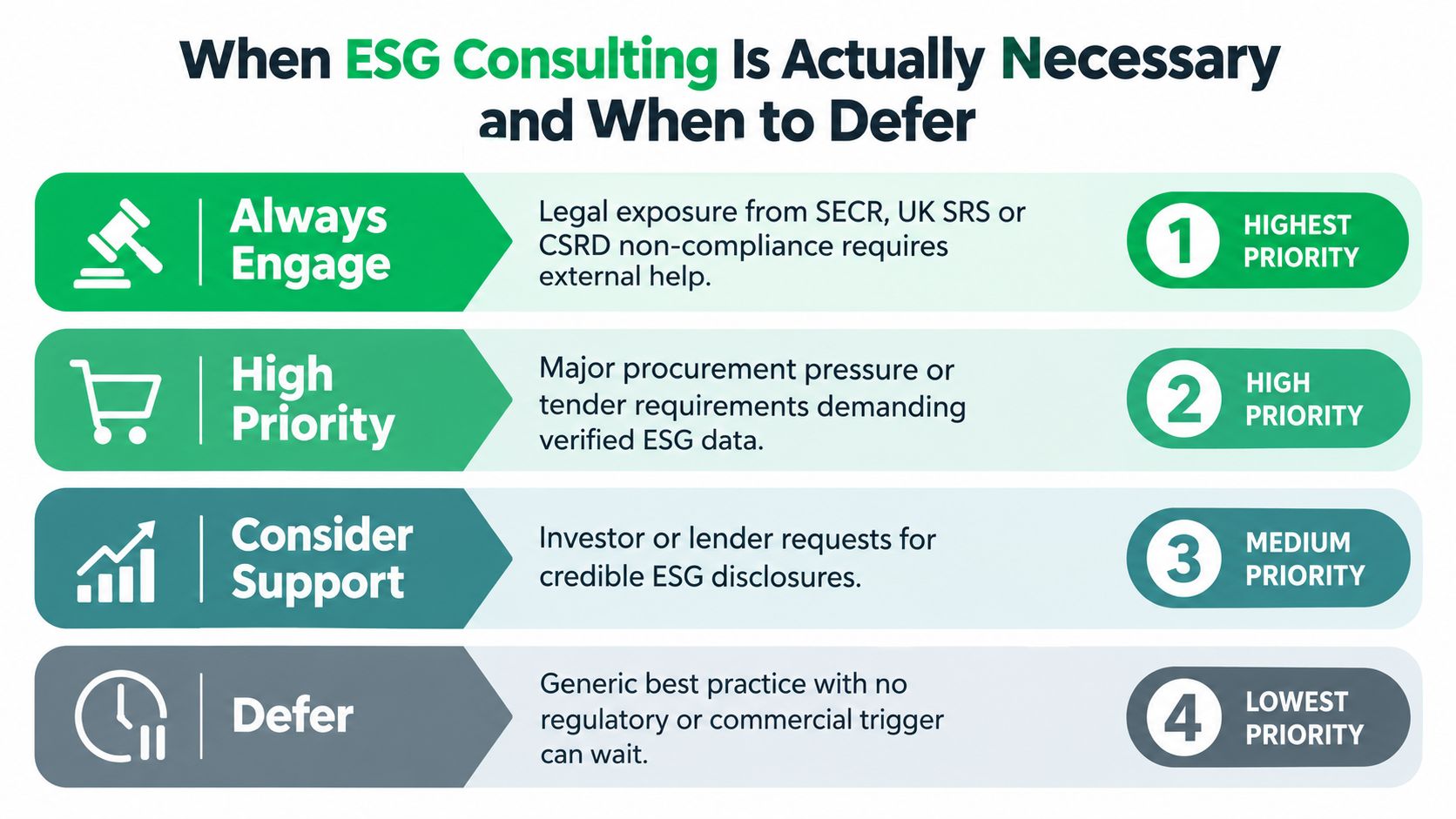
Use a priority filter
Always engage
Bring in specialist help if you're in scope for mandatory reporting or technical compliance work.
- SECR for an in-scope entity: because the annual report figure has to be right.
- ESOS compliance: because methodology, coverage and sign-off requirements are technical.
- UK SRS or CSRD readiness for a live reporting need: because architecture decisions made early will affect later assurance.
- Tender or supplier questionnaires requiring ESG evidence: because weak data can block revenue.
Engage selectively
These are useful workstreams, but only if they tie to a clear reporting, investor or customer need.
- Scope 3 baselining
- Science-based target work
- Double materiality assessment
- Board governance enhancement
Defer
These can wait if there's no legal or commercial trigger.
- Generic board awareness sessions
- Voluntary reporting for sub-threshold firms
- Net-zero vision statements without delivery logic
- Bespoke strategy decks built before the baseline exists
One common mis-buy
The worst purchase is a polished climate strategy presentation when the immediate risk is poor SECR data, incomplete energy evidence or a weak methodology note. Boards like strategy. Auditors test numbers. Buy in that order and you'll waste money.
Choosing an ESG Consultant and What Good Output Looks Like
Cheap ESG advice is expensive when your finance team has to rebuild the numbers six months later.
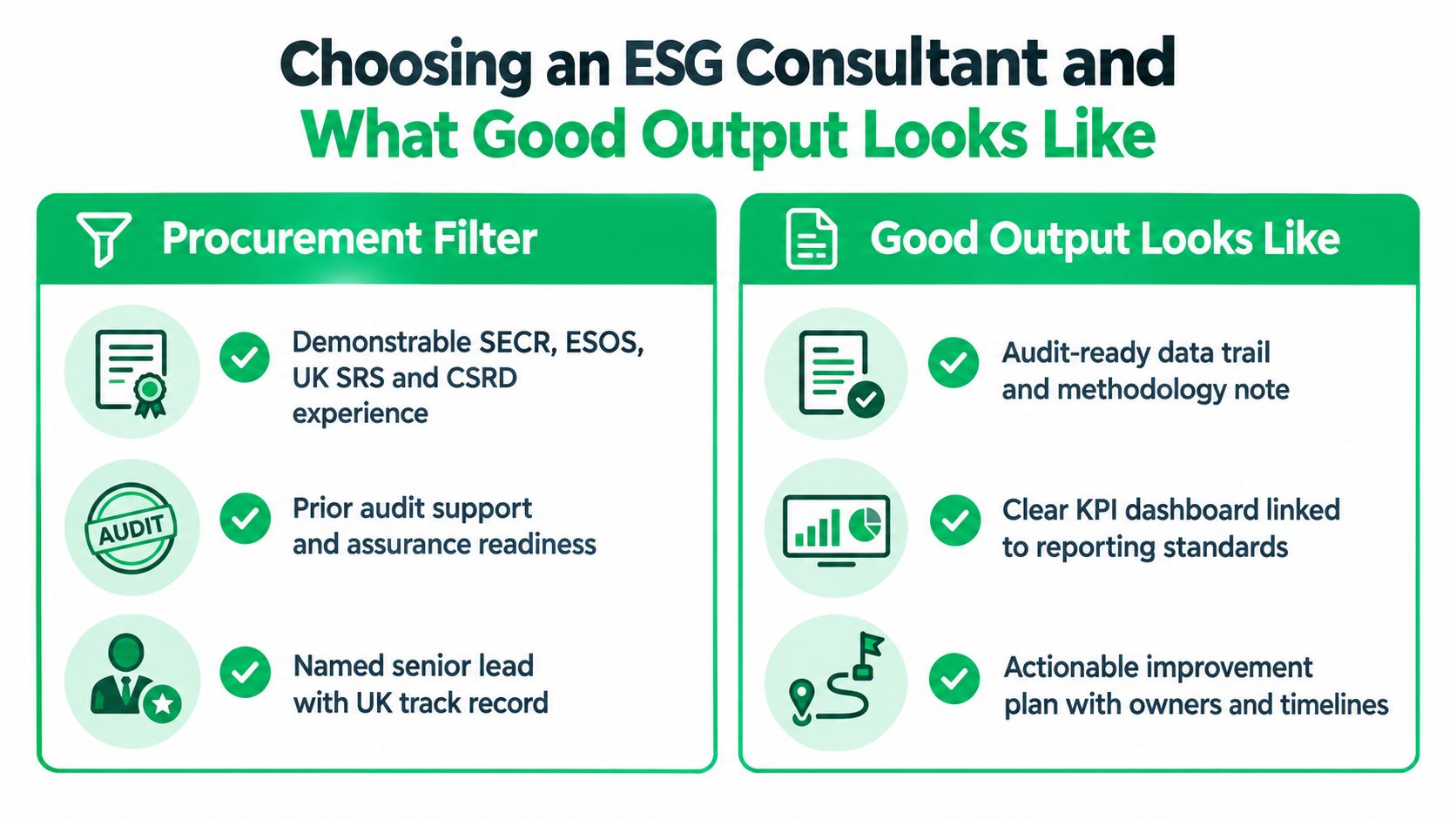
A good consultant gives you a repeatable reporting process, clear ownership, and evidence that stands up to board review and audit challenge. A weak one gives you a glossy document, a few workshops, and a problem that returns next year. Judge proposals on that basis.
The procurement filter
Start with who will do the work. If the senior person only appears in the pitch, walk away. ESG reporting, energy compliance, and disclosure design are detail-heavy jobs. They need senior judgement during scoping, methodology choices, and final review, not after the draft has gone wrong.
Then test the proposal against five points:
- Named senior lead: one person accountable from scoping to sign-off.
- Relevant UK delivery history: direct experience with the reporting or compliance work you need.
- Defined deliverables: fixed scope, clear outputs, and no vague advisory drift.
- Evidence method: a clear explanation of how figures are traced back to invoices, meter data, activity data, and assumptions.
- Applicability discipline: someone willing to say, plainly, what does not apply to your business.
If you want a practical benchmark, review what a sustainability reporting consultant should hand over and compare that with the proposal in front of you.
What good output actually looks like
Good output looks like a finance-grade working pack. It supports reporting this year and cuts effort next year.
Expect to receive:
- A populated disclosure pack
- Calculation workings
- A data lineage document
- A control matrix linking reported figures to source evidence
- A decision-ready transition or action plan
- A handover pack that lets finance run the process again
That is where consultants earn their fee. Not in presenting ESG as a vision exercise, but in turning a messy reporting-operating-model problem into a documented process with evidence, controls, and clear owners.
If you need ESG work done properly, ESG Consulting helps UK organisations turn SECR, ESOS, UK SRS, CSRD and carbon reporting into auditable evidence, not just presentation material. Each engagement is senior-led from scoping to sign-off, with fixed deliverables and a clear view of what is and isn't in scope. Visit ESG Consulting if you need a reporting pack that will stand up to board review and external challenge.
More from the blog
· 12 min read · Regulation
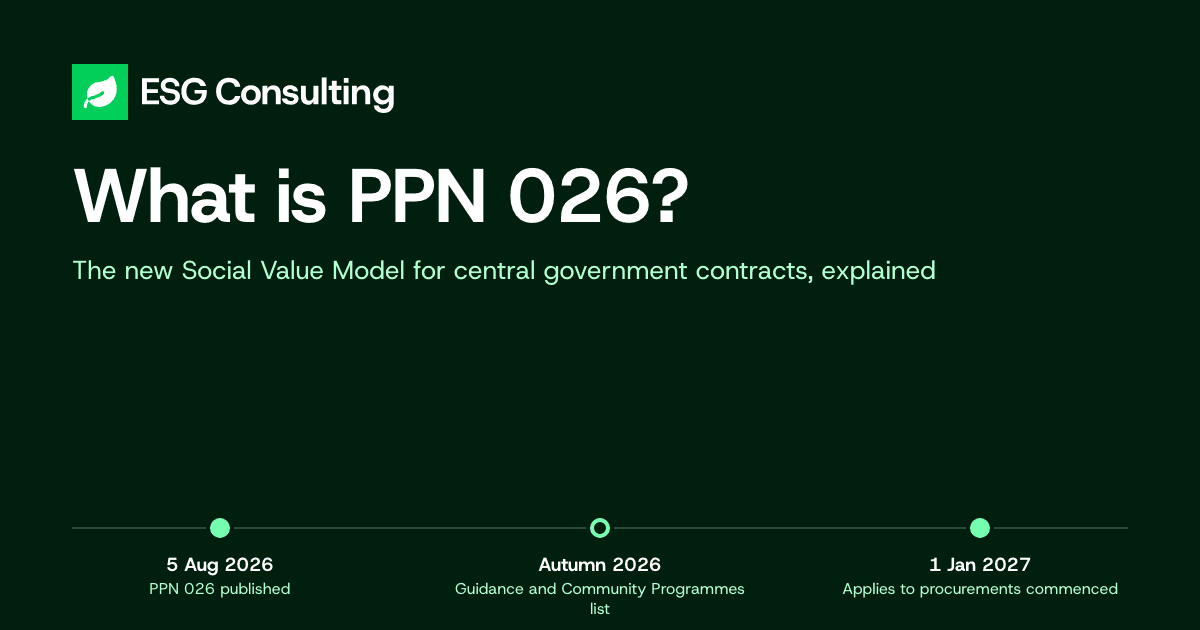
What is PPN 026? The new Social Value Model
PPN 026 replaces PPN 002 as the Social Value Model for central government contracts from 1 January 2027. Scope, the 10% and 20% weightings and the six criteria.
Read article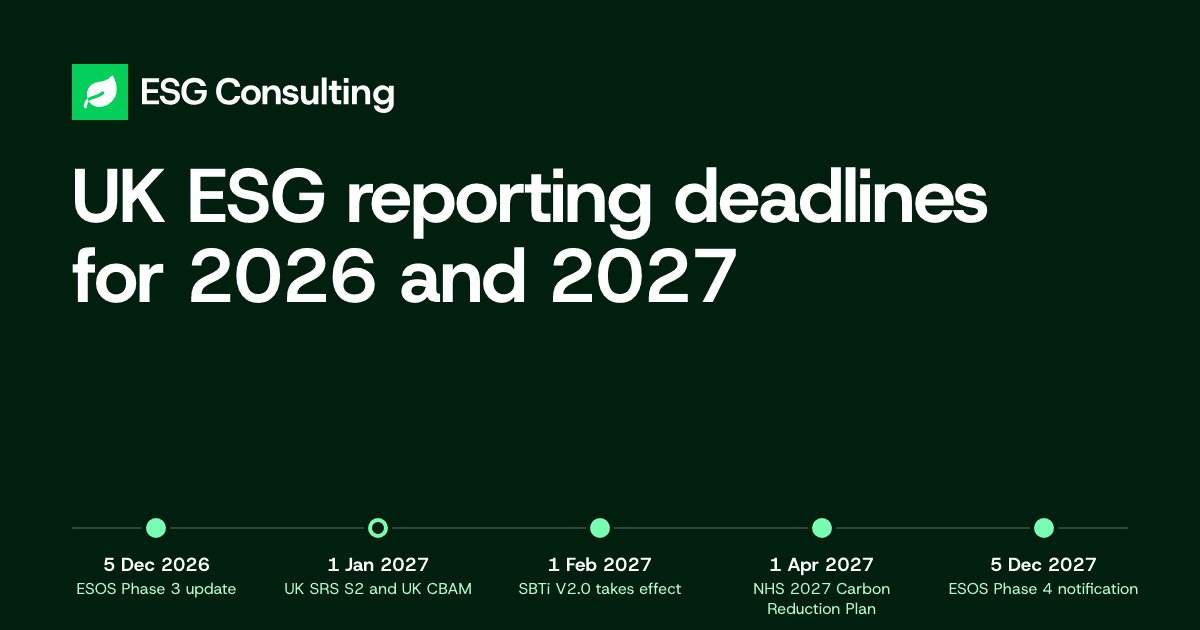
· 14 min read · Regulation
UK ESG reporting deadlines for 2026 and 2027
Every UK ESG reporting date to December 2027 - UK SRS, ESOS, SECR, UK CBAM, CSRD, SBTi, PPN 026 and the NHS - each marked mandatory, proposed or voluntary.
Read article