
carbon management, ESG reporting, Scope 3 emissions, net zero strategy, SECR compliance
Practical Carbon Management for UK Organisations
By ESG Consulting Team · · 11 min read
You can have the dashboard, the monthly pack, and the board slide deck looking tidy while the underlying evidence trail is already breaking down. One site uses a spreadsheet from last year, another team has a different emissions factor file, and procurement is still chasing supplier data that never arrives in a usable format. That is the carbon management problem in UK organisations now, not the absence of ambition, but the absence of traceable, defensible data.
Table of Contents
- The Reality of UK Carbon Management Today
- Building an Audit-Proof Emissions Inventory
- Tackling Scope 3 and Supply Chain Blind Spots
- Designing Sequenced Decarbonisation Pathways
- Navigating Offsets and Reporting Frameworks
- Your Carbon Management Maturity Checklist
The Reality of UK Carbon Management Today
UK carbon management now sits inside a much tougher operating environment than many boards expected. Territorial emissions have fallen sharply, with the UK down 53% since 1990 and final 2024 emissions estimated at 373 million tonnes of carbon dioxide equivalent, but that headline progress doesn't remove the reporting burden sitting inside organisations' own data stacks, systems, and supply chains. The UK is now more than halfway to its 2050 net zero target, and the pace of reduction has more than doubled since the Climate Change Act introduced legally binding carbon budgets in 2008 UK carbon footprint statistics, Climate Change Committee progress report.
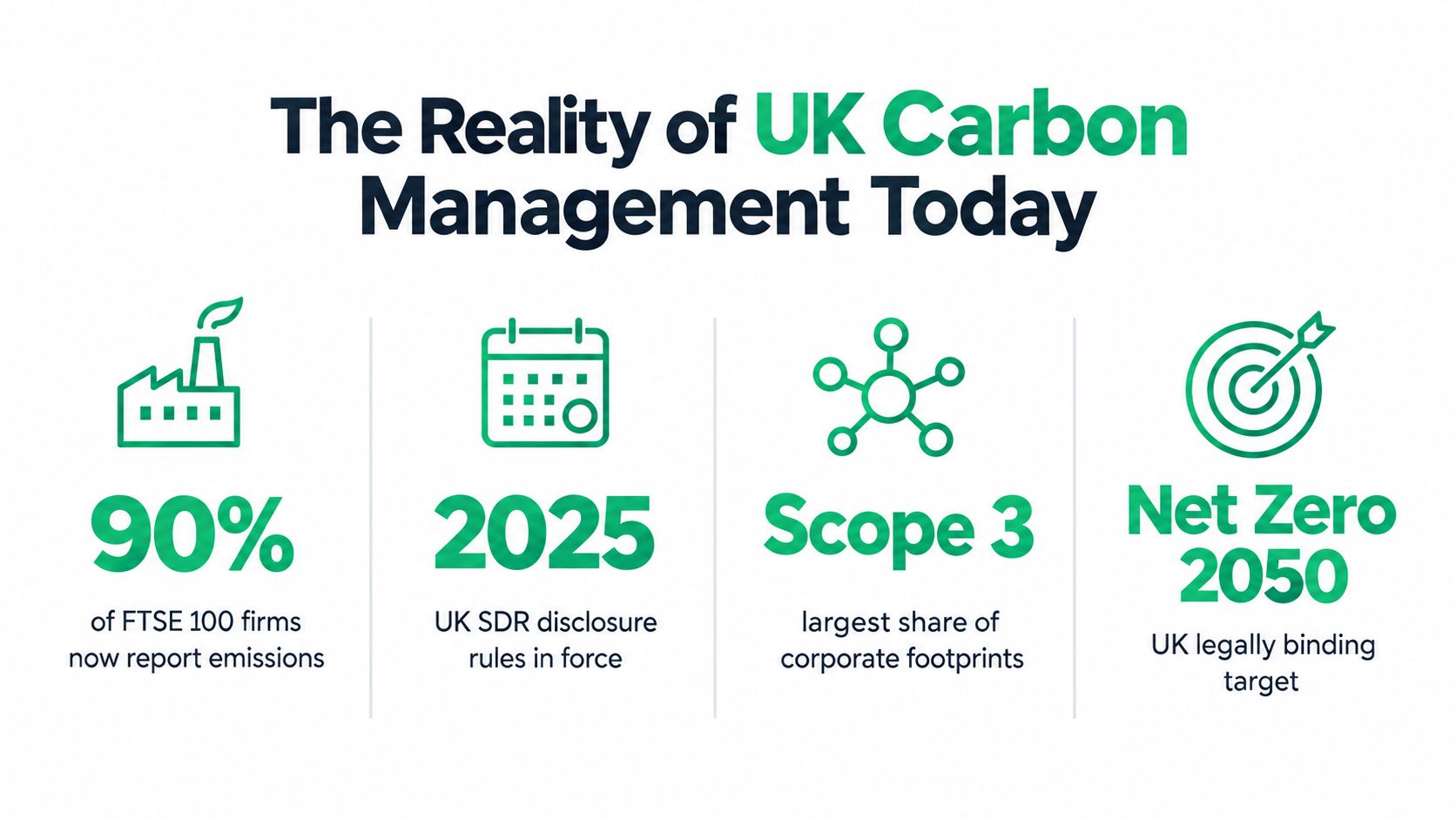
Territorial progress does not tell the whole story
A board that only looks at operational emissions is flying blind. The UK's consumption-based carbon footprint was estimated at 699 million tonnes CO2e in 2023, while total consumption-based CO2 emissions were 548 million tonnes, both still far above the territorial total and heavily shaped by imported goods and services in the wider value chain UK consumption-based footprint. That gap matters because it exposes where procurement, logistics, and product design carry carbon risk that never shows up in a narrow facilities ledger.
Practical rule: if your carbon management plan only covers energy bills and fleet fuel, it's a compliance draft, not a credible operating model.
Carbon management is now a data governance discipline
That shift explains why investors, buyers, and public-sector portals keep asking for evidence rather than slogans. In practice, carbon management now means knowing where every figure came from, who approved it, whether it can be reproduced, and how it will stand up if an external assurer challenges the source trail. The Climate Change Act's carbon budgeting system matters here because it shows the national direction of travel, sustained policy-backed delivery beats isolated target statements, and the same logic applies inside companies that want to survive scrutiny Climate Change Committee progress report.
The hard lesson for UK organisations is simple. Environmental ambition is no longer enough on its own. If your inventory cannot explain why a source changed, cannot trace a factor back to its origin, or cannot reconcile a prior year after a methodology update, then the issue isn't just sustainability, it's control environment weakness.
Building an Audit-Proof Emissions Inventory
An audit-proof inventory starts with the same discipline national inventory teams use, trace every figure back to source, keep the archive intact, and make it easy to test. The most common failure isn't a missing target, it's a weak evidence chain. Unstructured spreadsheets, untitled tabs, uncited factors, and copy-paste files make it hard to defend even a sensible estimate once assurance begins.
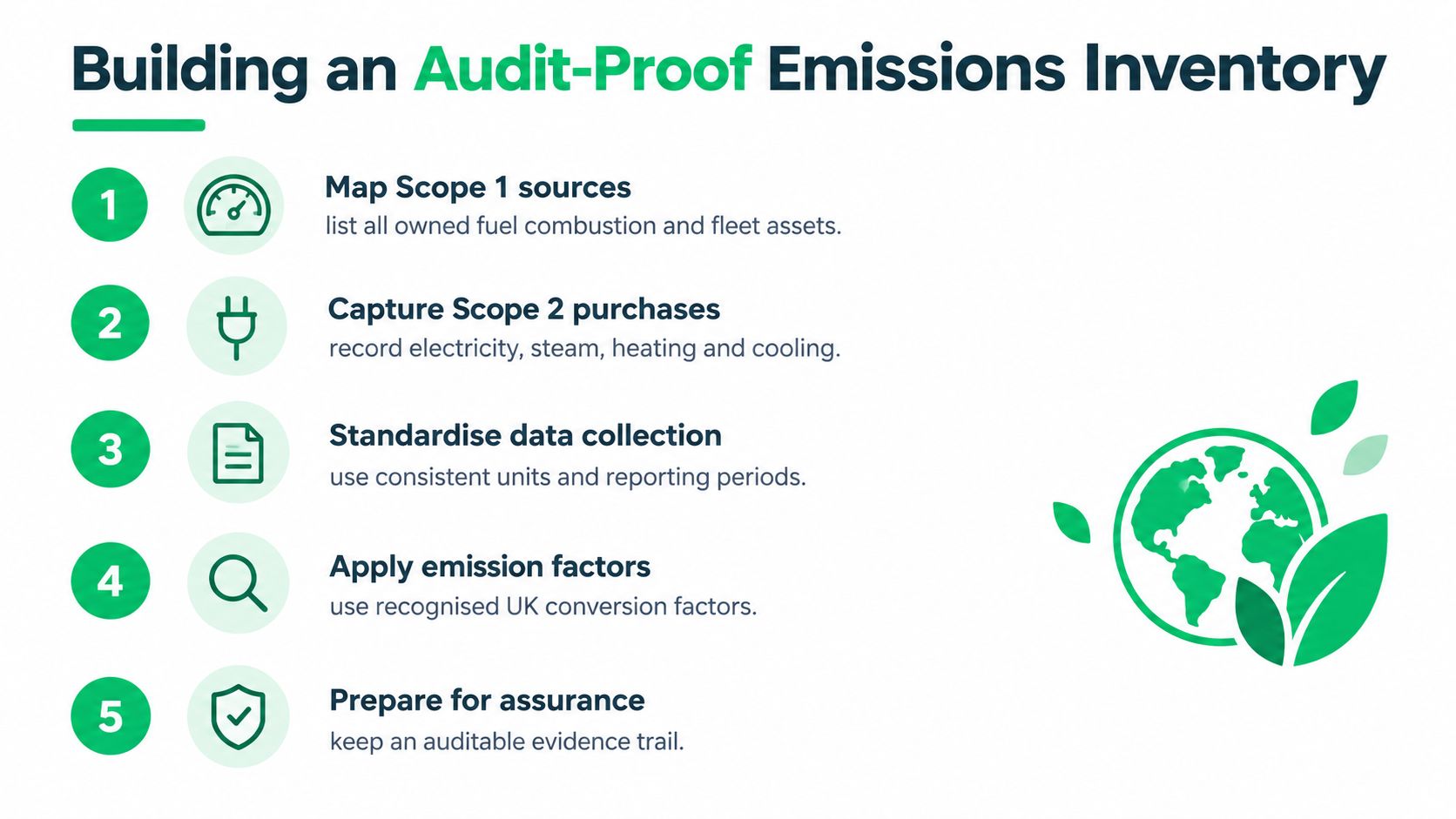
Start with traceability, not presentation
Build the inventory as a controlled record, not a presentation layer. The Climate Change Committee's inventory guidance points to what good practice looks like, data logged, numbered, source-referenced, checked for consistency, and able to support prior-year recalculation when methods change Climate Change Committee progress report. That's the level of traceability you need if SECR or ESOS data is going to survive internal challenge and external assurance.
Use a simple control logic:
- Define the boundary clearly. Know which sites, assets, and operations sit inside the reporting perimeter.
- Collect activity data at source. Keep meter reads, fuel logs, invoices, and energy bills, not just summary totals.
- Store evidence files centrally. Archive the original documents, the calculation workbook, and the approval trail together.
- Document factors and methods. Record why a specific emissions factor was used and which period it applies to.
- Reconcile before sign-off. Test for unexplained variances, then resolve them before the final pack is issued.
Treat prior-year restatements as normal, not embarrassing
Method changes happen. Suppliers update disclosures, meter coverage improves, and teams realise a site was categorised incorrectly. Good carbon management doesn't hide those changes, it recalculates the baseline cleanly and explains the movement.
Keep a formal “why did this source change since last year” review in the close process. If the answer lives only in someone's inbox, the control doesn't exist.
The boards that get this right stop treating emissions work as a one-off reporting sprint. They build a repeatable process with ownership, version control, and sign-off discipline. That matters because when the numbers are consistent, the company can move from crisis correction to actual management.
Tackling Scope 3 and Supply Chain Blind Spots
Scope 3 is where many UK carbon programmes stall, because teams confuse imperfect data with unusable data. The official UK guidance is explicit that Scope 3 data often lacks the quality needed for reliable decision-making, which is exactly why the task is to manage uncertainty well, not pretend it does not exist UK Sustainability Reporting Guidance.
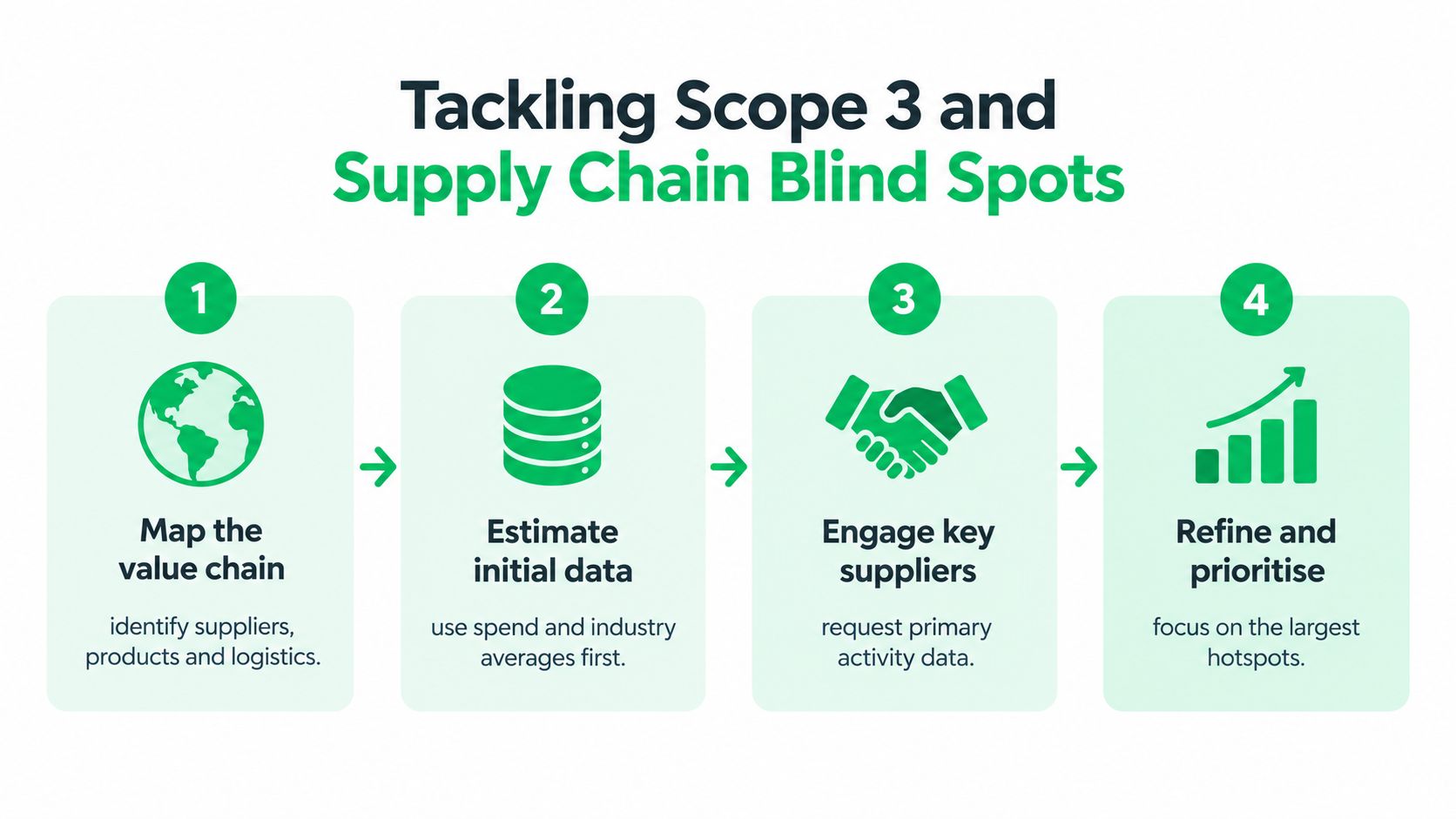
Use materiality to decide where precision matters
Not every category deserves the same effort. The point is to map the value chain, find the hotspots, and then decide where primary supplier data is worth the chase. That is where materiality becomes operational, not just a disclosure word. If a category is immaterial, a proxy may be enough. If it is strategically important, the company needs better data and clearer contractual expectations.
The practical sequence is straightforward:
- Map the value chain. Identify suppliers, logistics, purchased goods, travel, and downstream use where relevant.
- Estimate first, then refine. Use spend-based or industry-average proxies to get coverage quickly.
- Target the hotspots. Focus supplier engagement on the categories that drive the most risk or spend.
- Document uncertainty. Record which figures are estimates, which are measured, and which still need confirmation.
Supplier engagement beats perfectionism
Many teams wait for “perfect” supplier datasets and end up with nothing usable. That's a mistake. What works is a staged approach, ask for the data you need, accept reasonable proxies where necessary, and improve the dataset over time. A well-run value chain programme should also help you spot where major customers will ask difficult questions before the questions arrive.
If you need a primer on the concept itself, the internal guide on what Scope 3 emissions are is a useful reference point. The key operational point is that Scope 3 is not a reason to delay reporting, it's a reason to build a better supplier data process.
The companies that get this right stop treating Scope 3 as a side project. They turn it into procurement discipline, supplier communication, and a managed evidence trail.
Designing Sequenced Decarbonisation Pathways
A net zero target without a sequence is just a promise with a date on it. The UK's own decarbonisation record shows that sustained delivery matters more than a single headline goal, with 69% of total reductions against the 1990 baseline achieved since 2008 and the pace of decarbonisation more than doubling over that period Climate Change Committee progress report. That is the model corporates should copy, layered actions, not aspiration-heavy one-pagers.

Sequence reductions by feasibility and timing
Good abatement plans start where the organisation can move fastest, then build toward heavier capital decisions. Energy efficiency, controls optimisation, procurement changes, and operational discipline usually come before larger retrofit or replacement work because they are easier to sequence and easier to verify. That doesn't make them trivial, it makes them practical.
Board test: if every action in the plan depends on next year's budget, next year's supplier behaviour, or next year's policy change, the pathway is undercooked.
A sequenced pathway should show:
- What can happen now. Low-friction measures that reduce waste or improve control.
- What needs capital. Larger interventions that require approvals, lead times, or procurement cycles.
- What depends on suppliers. Changes that rely on contract updates or shared data.
- What remains residual. Emissions that are hard to remove and need separate treatment.
Tie reduction plans to procurement reality
For many organisations, the carbon plan fails at the handoff between sustainability and procurement. If buying teams are still optimising on unit price alone, the reduction pathway will drift. Public-sector buyers, NHS trusts, and larger customers already expect emissions-related evidence in procurement settings, so the plan has to be usable inside tenders, not just inside a strategy deck. A carbon reduction plan that can't support commercial conversations is not yet operational.
The internal guide on decarbonisation strategy is relevant here because reduction only becomes real when milestones, owners, and implementation timing are written into the business plan. That's what separates a target from a pathway. Later, when the board reviews progress, the right question is not whether the target still exists, it's whether the sequence is still working.
Navigating Offsets and Reporting Frameworks
Offsets are where many otherwise serious programmes lose credibility. The problem is not that offsets have no place at all, it's that they're too often used to patch over incomplete reduction work or to make reporting look cleaner than the evidence supports. Public-sector guidance for 2025-26 now adds a minimum reporting requirement for offsets used, which increases scrutiny on whether a claim reflects genuine decarbonisation or an accounting choice UK Sustainability Reporting Guidance.
Build one data engine for multiple frameworks
The cleaner route is to run one solid emissions dataset that can feed several obligations at once. SECR, ESOS, TCFD-style climate disclosure, transition planning, and internal board reporting all need different outputs, but they depend on the same underlying controls: activity data, factor management, source traceability, and review discipline. If those controls are weak, every framework becomes a separate fire drill.
That's why the most useful reporting architecture is not a stack of disconnected templates. It's a single carbon data engine with layered outputs. You should be able to answer the same question, “where did this figure come from?”, whether the audience is the board, the audit team, a buyer, or a regulator.
Treat offsets as residual, not central
The right role for offsets is narrow. They belong after direct reduction measures have been planned, sequenced, and evidenced, not before. If an organisation is using offsets to fill gaps caused by missing Scope 1 or Scope 2 data, that's a governance problem disguised as climate action.
If you need structured support on the reporting side, carbon reduction plan guidance is useful because procurement-facing disclosures need the same traceability as investor-facing ones. Boards should also keep the language disciplined, say what has been reduced, what is still being measured, and what has been offset. Anything less starts to blur the line between decarbonisation and presentation.
The practical insight is that frameworks don't create complexity, poor data architecture does. Once the evidence trail is stable, the rest becomes repetition with different labels.
Your Carbon Management Maturity Checklist
A mature carbon management programme is easy to spot because it behaves like a control system, not a campaign. The board gets consistent numbers, the evidence trail is intact, and the team can explain variances without improvising. The opposite is just as visible, data collected late, recalculated badly, and no one quite sure which workbook is the current one.
Check your current position against these markers
- Inventory control is clear. Scope boundaries, source files, and version history are documented, and the team knows who owns each dataset.
- Prior-year changes are explained. Method updates, factor changes, and recalculations are logged rather than hidden inside a final report.
- Scope 3 is being managed deliberately. Material categories are identified, proxies are documented, and supplier requests are prioritised.
- Reduction is sequenced. The plan shows timing, owners, dependencies, and the actions that can be delivered.
- Offsets are restrained. They're tracked transparently and used only where the organisation has already pursued direct reduction.
- Board reporting is decision-ready. The pack links emissions data to risk, investment, procurement, and compliance choices.
- Assurance readiness is real. Someone could follow the trail from the headline number to the original source without gaps.
If your team can't rebuild last quarter's figures from source files, you don't yet have a reporting system. You have a summary.
The most useful next step for many organisations is not a bigger sustainability narrative, it's a tighter operating model. Tighten data ownership, clean up the evidence trail, and remove ambiguity in how figures are compiled. That usually exposes the genuine bottlenecks fast.
For boards, the question is no longer whether carbon management matters. It's whether the organisation can prove what it says, improve what it measures, and withstand an audit without scrambling for missing evidence.
ESG Consulting supports UK organisations with carbon reporting, Scope 3 inventories, net zero strategy, and disclosure readiness across SECR, ESOS, UK SRS, TCFD, and related frameworks. If you need a programme that can stand up to assurance and board scrutiny, visit ESG Consulting to discuss the right next step for your organisation.
More from the blog
· 12 min read · Regulation
What is PPN 026? The new Social Value Model
PPN 026 replaces PPN 002 as the Social Value Model for central government contracts from 1 January 2027. Scope, the 10% and 20% weightings and the six criteria.
Read article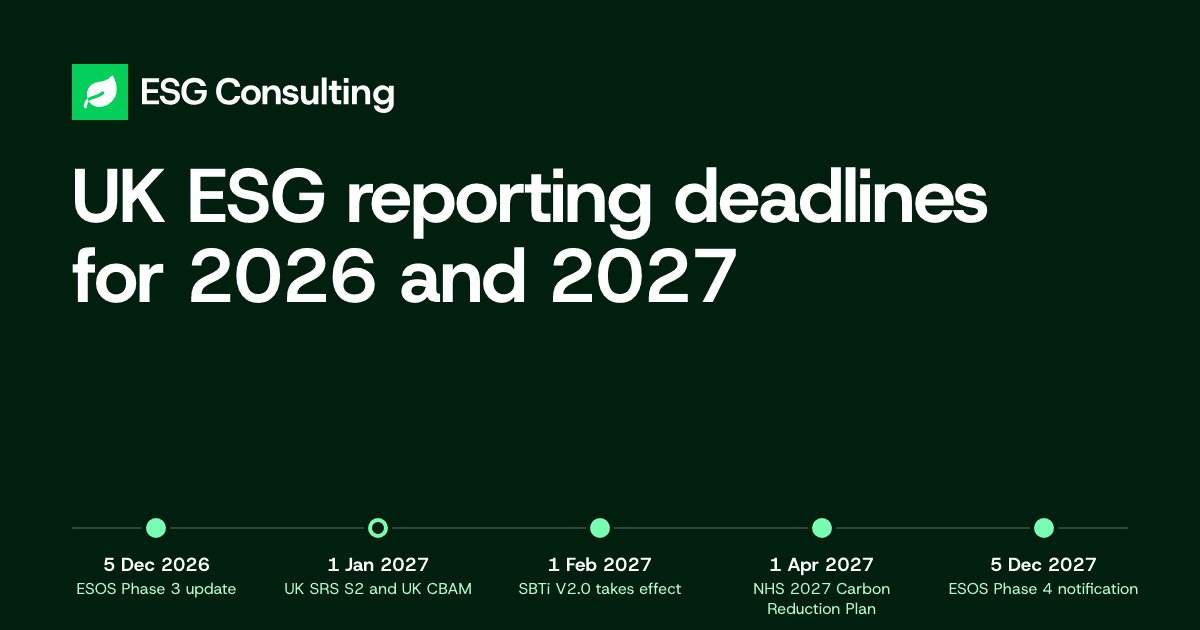
· 14 min read · Regulation
UK ESG reporting deadlines for 2026 and 2027
Every UK ESG reporting date to December 2027 - UK SRS, ESOS, SECR, UK CBAM, CSRD, SBTi, PPN 026 and the NHS - each marked mandatory, proposed or voluntary.
Read article