
decarbonisation strategy, net zero pathway, UK carbon reduction, Scope 3 abatement, climate transition plan
Decarbonisation Strategy: A Costed Roadmap to Net Zero
By ESG Consulting Team · · 15 min read
The most expensive mistake in a UK decarbonisation strategy is not missing a target, it's announcing one before you've secured the grid, the capital, and the evidence trail to deliver it. The Climate Change Committee says the UK has already cut emissions by 50.4% versus 1990 levels, yet only 15 of 31 assessed indicators are currently on track and just 5 of 22 benchmarked indicators are on track in the latest reporting cycle, which is exactly what delivery drift looks like in practice CCC 2025 progress report.
That gap matters because the policy horizon is now hard, not rhetorical. The UK's legally binding net zero target is at least 100% emissions reduction by 2050, with an at least 68% reduction by 2030 and at least 81% by 2035 versus 1990 levels, and the government's own strategy says it will decarbonise all sectors of the economy to get there Net Zero Strategy. For boards, that means the question is no longer whether to act, it's whether the plan is sequenced well enough to survive budget scrutiny, grid reality, and assurance.
Table of Contents
- Why Most UK Decarbonisation Strategies Under-Deliver
- Build the Baseline Before You Scope Measures
- Compare Abatement Levers by Cost and Readiness
- Sequence a Costed Pathway That Actually Executes
- Prioritise Scope 3 Where It Is Decision-Useful
- Governance and Reporting That Survives Assurance
- Your First 90 Days and a Realistic Closing View
Why Most UK Decarbonisation Strategies Under-Deliver
Most published UK decarbonisation plans look credible because they are heavy on targets and light on execution. They talk about 2050 net zero, sometimes add a polished transition narrative, and often stop there. That is not a strategy, it's a presentation.
The hard truth is that abatement happens on site, inside operating constraints, with named owners and a capital envelope. The government's Net Zero Strategy says whole-economy modelling indicates industrial emissions could need to fall by 87-96% by 2050, with interim reductions of 43-53% by 2030 and 63-76% by 2035 versus 2019 levels Net Zero Strategy. Those numbers are not a branding exercise, they're a warning that the pathway is steep and front-loaded.
Ambition on slides is not abatement on the P and L
The usual failure mode is simple. A sustainability team drafts a net zero commitment, procurement adds a few supplier asks, and finance signs off a broad ambition without a sequenced capex plan. Then the year-one delivery work turns up obstacles, grid delays, asset lives, utility constraints, and no one has pre-agreed which project loses funding when the first estimate moves.
Practical rule: if a measure doesn't have a site owner, a funding source, and a delivery date, it isn't a measure yet.
UK industrial policy makes this even more obvious. The government's Industrial Decarbonisation Strategy expects industrial emissions to fall by around two thirds by 2035 and by at least 90% by 2050 versus 2018 levels, with specific enabling milestones on clusters, hydrogen and low-carbon energy supply Industrial Decarbonisation Strategy. That is a delivery blueprint, not a slogan.
A board-ready decarbonisation strategy should therefore start with what can be physically installed, what can be financed, and what can be proven in audit. Anything else is aspiration dressed up as governance.
Build the Baseline Before You Scope Measures
A serious decarbonisation strategy begins with an auditable baseline, not with a menu of favourite technologies. If you skip that step, you end up comparing measures that don't sit on the same boundary, use different emission factors, and cannot survive assurance. The result is predictable, the board approves a plan that looks neat and fails the first time someone asks for evidence.
Start with Scope 1, Scope 2, and material Scope 3 categories, and make sure the data can stand up to external review under ISO 14064-1 style evidence discipline. Separate market-based and location-based Scope 2 reporting, reconcile utility invoices to meter reads, and split top-down emissions estimates against bottom-up site calculations until the numbers line up. If they don't line up, the problem is usually data quality, not “methodological nuance”.
The policy horizon also needs to be built into the baseline. Your current year has to be tested against the 2030, 2035, and 2050 milestones, because capital cycles don't wait for distant targets to become convenient. If a fleet refresh lands before a grid upgrade, or a furnace replacement is due before low-carbon fuel supply exists, the plan has to say that clearly.
Baseline inputs that need to exist before measure selection
| Input | Scope | Source | Assurance Level |
|---|---|---|---|
| Utility invoices and meter data | Scope 1 and 2 | Energy, facilities and finance records | High, if reconciled to invoices |
| Fuel purchase and combustion records | Scope 1 | Operations and procurement records | High, if traceable to contracts |
| Purchased electricity allocation | Scope 2 | Supplier statements and metered use | High, if market-based and location-based values are both retained |
| Travel and commuting data | Scope 3 | HR, travel booking and expense systems | Medium, if sampled and corroborated |
| Purchased goods and services spend | Scope 3 | ERP and procurement systems | Medium, if supplier-specific factors are not yet available |
| Capital goods and project pipeline | Scope 3 | Capex planning and asset registers | Medium, if tied to approved projects |
| Supplier-specific emission factors | Scope 3 | Supplier disclosures and questionnaires | High, where validated by evidence |
For a practical internal starting point, a carbon reduction plan framework can help structure the first pass at inventory discipline, provided it is used as a baseline tool rather than a box-ticking exercise. See the approach set out in this UK carbon reduction plan guide.
The point is not to chase perfection on day one. The point is to get to a defensible baseline fast enough that the measures you choose later are priced, prioritised, and owned properly.
Compare Abatement Levers by Cost and Readiness
UK heavy emitters need to stop treating every abatement lever as if it were equally deployable. It isn't. Some measures can land inside a normal capex cycle, others are hostage to networks, supply chains, or industrial clusters, and some are still dependent on infrastructure that doesn't yet exist at the scale needed.
What can move now and what still needs infrastructure
Energy efficiency is the cleanest first move because it usually sits closest to the plant, the building, or the process line. It doesn't solve every emissions problem, but it does reduce load and makes the rest of the pathway easier to finance. If a site is still wasting energy through controls, compressed air, or heat loss, it should not be asking for hydrogen headlines.
On-site electrification is more powerful, but only if the grid connection and electrical capacity are real. The UK's recent flexibility push, including 7.6 GW across 16 long-duration energy storage projects and 137 GWh of storage capacity in the 2026 Clean Flexibility Roadmap update, shows the system is moving, but not fast enough to pretend every site can electrify on demand CCC 2026 progress report. Storage helps, but it doesn't cancel queue risk.
Fuel switching to biomethane can be useful in narrow cases, but it depends on supply, contract quality, and whether the site's thermal demand is a good fit. Hydrogen, whether blue or green, remains more constrained because the government's own industrial evidence says limited low-carbon hydrogen supply is already constraining fuel switching in chemicals, glass, and iron and steel Energy Innovation Needs Assessment. CCUS is essential for some cluster pathways, but it belongs in a coordinated industrial system, not as a lone-site fantasy.
Practical rule: if a lever depends on a network, treat the network as a project deliverable, not a background assumption.
The most deliverable combinations inside a three-year capex window are usually efficiency, controls, selected electrification, and targeted site utility upgrades. Hydrogen and CCUS belong in longer-horizon planning, tied to cluster readiness and infrastructure commitments. The right question is not which lever sounds boldest, it's which lever can be installed, commissioned, and evidenced on time.
| Lever | Abatement Cost (£/tCO2e) | Readiness (TRL) | Infrastructure Dependency |
|---|---|---|---|
| Energy efficiency | Case-specific, usually lowest | High | Low, mostly site internal |
| On-site electrification | Case-specific | High to medium | Grid capacity and connection timing |
| Biomethane fuel switching | Case-specific | Medium | Gas supply and contract quality |
| Hydrogen | Case-specific | Medium to low | Hydrogen production, transport and distribution |
| Electrified heat | Case-specific | High to medium | Power availability and load management |
| CCUS in clusters | Case-specific | Medium | Capture, transport and storage network |
The policy logic already points in this direction. The Industrial Decarbonisation Strategy expects four low-carbon industrial clusters by 2030, at least one net zero industrial cluster by 2040, around 20 terawatt hours of industrial energy supply switched from fossil fuels to low-carbon alternatives by 2030, 10 GW of low-carbon hydrogen production capacity by 2030, and 20-30 MtCO2 of total emissions capture per year in the cluster and CCUS pathway Industrial Decarbonisation Strategy. That is a system build-out, not a single-project buying list.
Sequence a Costed Pathway That Actually Executes
A board will only back a decarbonisation strategy if it reads like a capital programme, not a wish list. That means sequencing by operational reality, then funding reality, then evidence reality. If those three don't line up, the plan will die in the first budget round.
Use three horizons, not one shopping list
The cleanest structure is to split measures into quick wins, scale, and material phases. Quick wins are the things that reduce energy use, sharpen controls, and prove the governance model. Scale measures are the ones that need site engineering and moderate capex. Material measures are the long-lead items that depend on grid, supplier, or cluster development.
For each measure, assign four things. First, the owner. Second, the capex band. Third, the interim KPI. Fourth, the gating condition that must be met before spend starts.
| Horizon | Measure | Annual abatement (tCO2e) | CAPEX band | Owner | Interim KPI |
|---|---|---|---|---|---|
| 0 to 2 years | LED and controls upgrade | Site-specific | Low | Facilities | Verified electricity reduction against baseline |
| 0 to 2 years | Building management system tuning | Site-specific | Low | Operations | Reduction in out-of-hours energy use |
| 0 to 2 years | Leak detection and repair | Site-specific | Low | Engineering | Fewer repeat losses on compressed air or gas systems |
| 3 to 7 years | Electrification of low-temperature heat | Site-specific | Medium | Plant manager | Grid connection secured before procurement |
| 3 to 7 years | On-site solar with storage | Site-specific | Medium | Energy lead | Commissioned generation matched to load profile |
| 3 to 7 years | EV fleet transition | Site-specific | Medium | Fleet manager | Charging infrastructure in place |
| 8 to 15 years | Hydrogen pilot | Site-specific | High | Strategy director | Supply contract and safety case signed off |
| 8 to 15 years | CCUS readiness | Site-specific | High | Technical director | Cluster access pathway confirmed |
| 8 to 15 years | Supplier contract decarbonisation clauses | Scope 3 | Low to medium | Procurement | Low-carbon terms in renewals |
The gating criteria matter more than the slide deck. A process line should not be electrified until the grid connection offer is secured. A hydrogen pilot should not be signed before safety, supply, and offtake are understood. A supplier programme should not start with weak generic commitments, it should start with the top contracts where procurement can move behaviour.
Practical rule: no funding release without an evidence pack, an owner, and a dated milestone.
Capex blockers are usually mundane. Boards worry about capex appetite, debt covenants, asset lives, and whether the project creates stranded equipment before it pays back. That is why the funding route matters. Some projects belong on the balance sheet, some suit a lease or PPA structure, and some should wait until the business case can withstand a higher hurdle rate.
The right output is a Gantt-style pathway that finance can read in one sitting. If it doesn't show spend, timing, and dependency clearly, it's not ready.
Prioritise Scope 3 Where It Is Decision-Useful
The best Scope 3 programmes are narrow at the start and broad later. The worst ones try to map everything, then fund nothing. Under the UK sustainability reporting direction, the useful question is not “can we report every category?” It's “which categories change decisions now?”
That is why first-cycle funding should go to auditable and decision-useful categories. In most large UK organisations, that usually means purchased goods and services, capital goods, upstream transport, and employee travel where spend data is already strong. Product use-phase modelling should wait until product data is reliable enough to support it. Universal coverage looks neat on paper, but it often creates weak assurance and unreliable prioritisation.
Fund the categories procurement can actually move
The strongest lever is procurement, not reporting completeness. Start with the top suppliers, embed low-carbon clauses in renewals, and require better data where spend is concentrated. Where supplier spend is already material, use hybrid modelling that can move from spend-based estimates to supplier-specific factors as evidence improves.
For organisations that already need a practical procurement-facing framework, a focused Scope 3 emissions guide can help teams separate useful categories from noise.
Practical rule: do not fund a category because it is fashionable. Fund it because a buyer, lender, or board member will act on the result.
Franchise, leasing, and investment categories should sit in a separate workstream with treasury and property owners, not buried inside sustainability reporting. If you try to force every category into the same workplan, accountability gets diluted and assurance gets messy.
One more point boards should hear plainly. Scope 3 can dominate the footprint of many listed companies, but generic factors and unverified spend create fragile disclosure. The right answer is not to pretend completeness, it is to build a defensible set of categories first and expand only when the data earns it.
Governance and Reporting That Survives Assurance
A decarbonisation strategy fails quickly when nobody has real authority over it. Sustainability teams can design the plan, but they usually can't reallocate capex, change plant priorities, or resolve covenant issues. Put the accountable role with the person who can move money and operations, usually the CFO or COO.
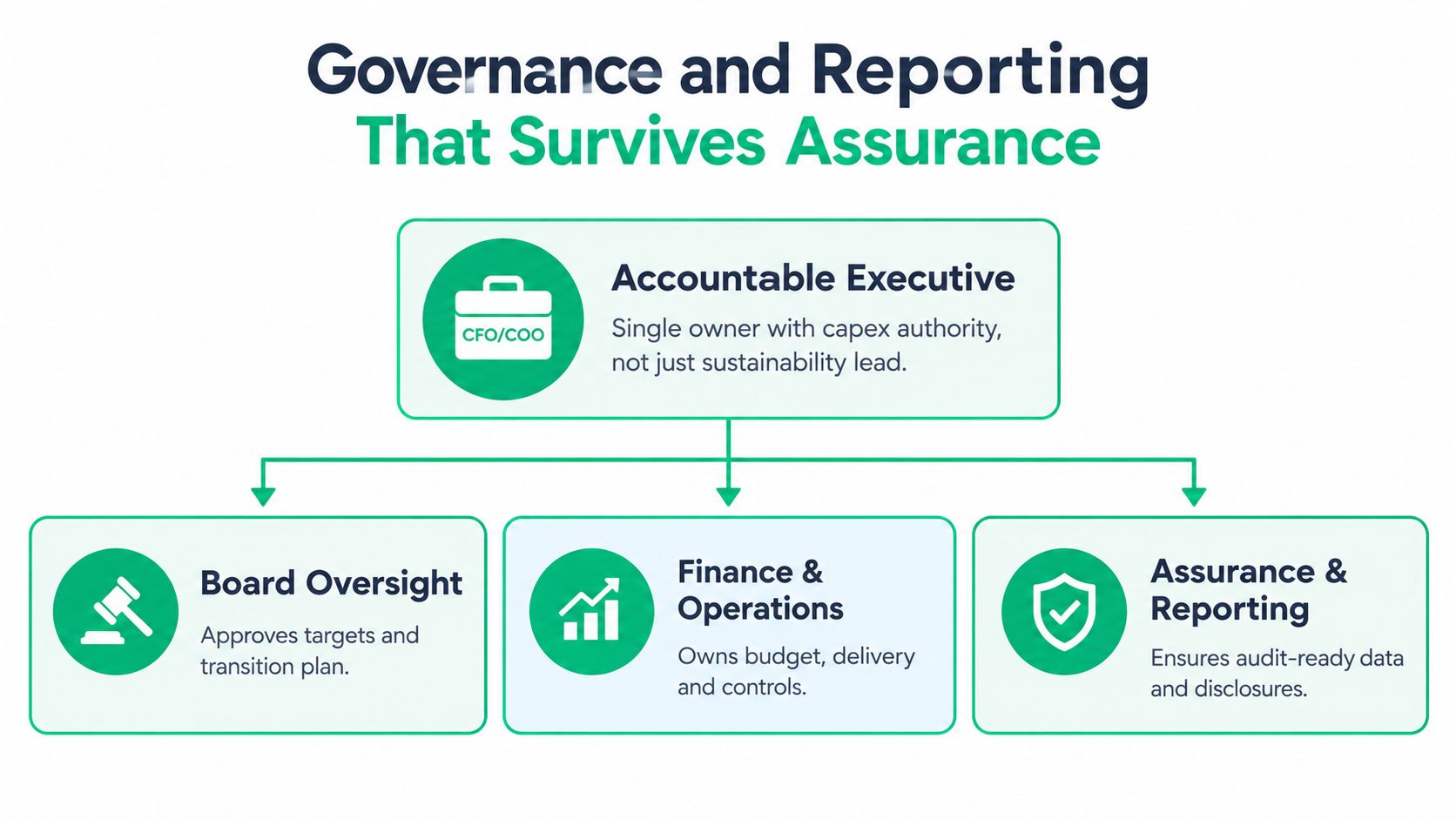
Build the reporting line around decision rights
The board climate committee should review the same things every quarter. Abatement delivered versus plan. Capex spent versus forecast. Milestone slippage. KPI variance. Those are the numbers that tell you whether the transition is real or just well narrated.
The Transition Plan Taskforce structure is the right discipline for disclosure, because it forces alignment across ambition, strategy, capital allocation, engagement, metrics, and governance. A useful internal read is the sustainability reporting consultant guidance for how to make that evidence chain hold together across reporting cycles.
A few controls should be mandatory:
- Board ownership: appoint one executive owner with capex authority.
- Audit trail: keep utility, gas, fuel and electricity evidence under third-party review first.
- Disclosure discipline: report what was missed, what shifted, and why.
- Assurance sequencing: start with Scope 1 and 2, then move to Scope 3 categories that are auditable.
- Funding linkage: make transition spend compete inside the main capex envelope, not an isolated ESG budget.
The point is simple. Investors and regulators are usually more forgiving about a missed target than they are about a glossy report that can't be supported. If the evidence chain is weak, the whole transition plan is weak.
For organisations wanting delivery support, ESG Consulting works on costed decarbonisation pathways, transition planning aligned to the Transition Plan Taskforce framework, and reporting that is built to survive assurance. That matters because governance is where ambition becomes finance, and finance becomes delivery.
Your First 90 Days and a Realistic Closing View
The first 90 days should produce momentum, not a polished deck. If the work is done properly, the end state is a baselined plan, one funded pilot, and a board that knows exactly what comes next. Anything less is just motion.
Days 1 to 30, 31 to 60 and 61 to 90
Days 1 to 30. Lock the data audit, appoint the accountable executive, and freeze the boundary set for Scope 1, Scope 2, and the first material Scope 3 categories. Pull utility, fuel, and procurement records into one working file, and identify the gaps that need supplier or site follow-up.
Days 31 to 60. Complete the baseline, draft the transition architecture, and rank the measures by readiness and capex. At this point, the board should see which projects can move now, which need a connection or contract, and which belong in the next planning cycle.
Days 61 to 90. Submit the first capex case, secure sign-off on one pilot, and publish a transition plan that is honest about dependencies. Keep the claims tight, the assumptions explicit, and the evidence traceable.
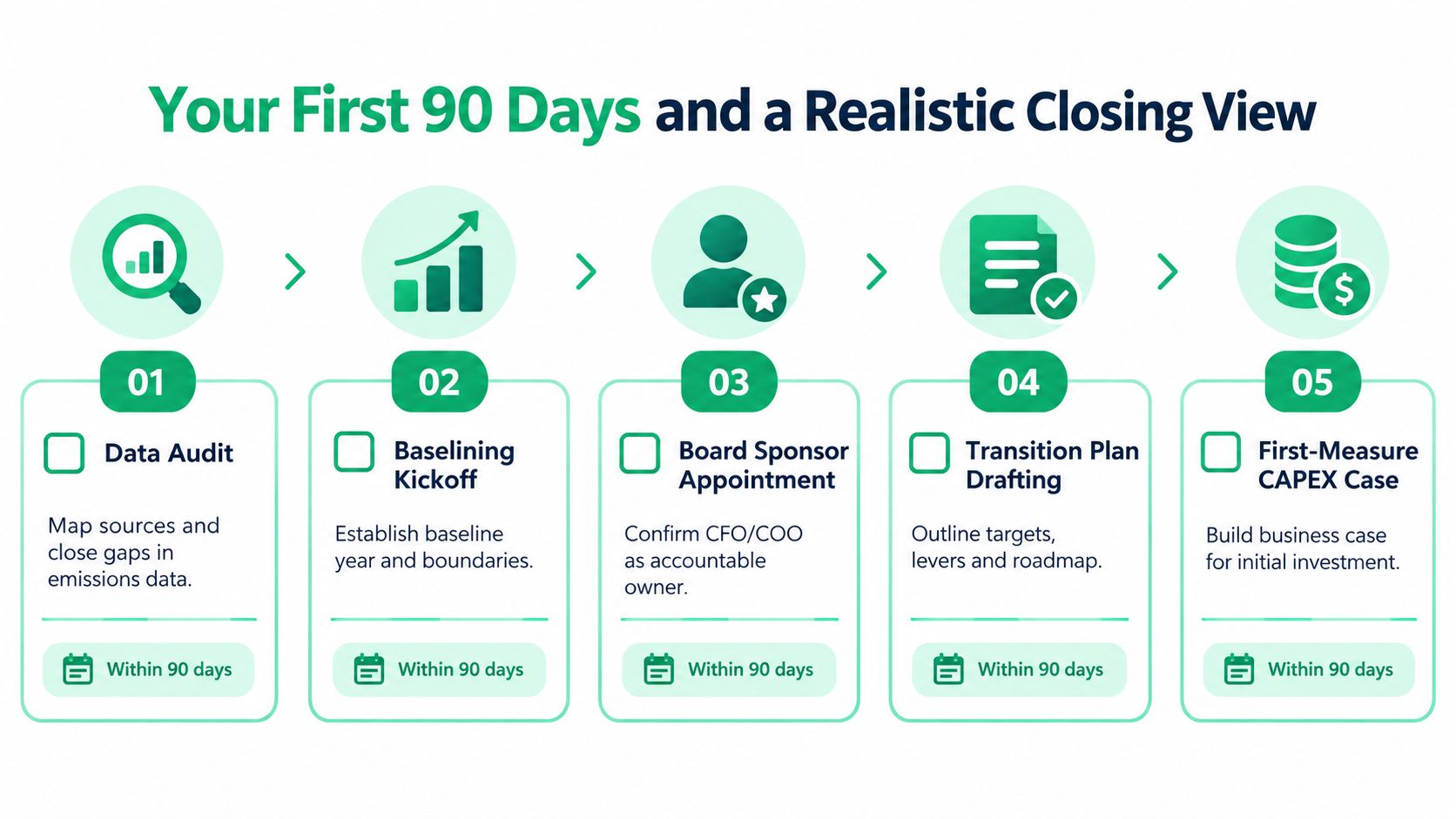
The closing view is blunt. UK ambition is not the problem, delivery is. Grid connection queues, storage build-out lag, capex constraints, and Scope 3 data realism are the binding limits, not the absence of a slogan. The organisations that win this will be the ones that sequence properly, fund the right things first, and stop pretending every lever is equally ready.
If you need a board-ready decarbonisation strategy that starts with a credible baseline, a sequenced capex plan, and an evidence trail that can survive assurance, talk to ESG Consulting. We help UK organisations turn net zero ambition into a costed pathway, a TPT-aligned transition plan, and disclosures that stand up in front of finance, auditors, and buyers.
More from the blog

· 12 min read · Regulation
What is PPN 026? The new Social Value Model
PPN 026 replaces PPN 002 as the Social Value Model for central government contracts from 1 January 2027. Scope, the 10% and 20% weightings and the six criteria.
Read article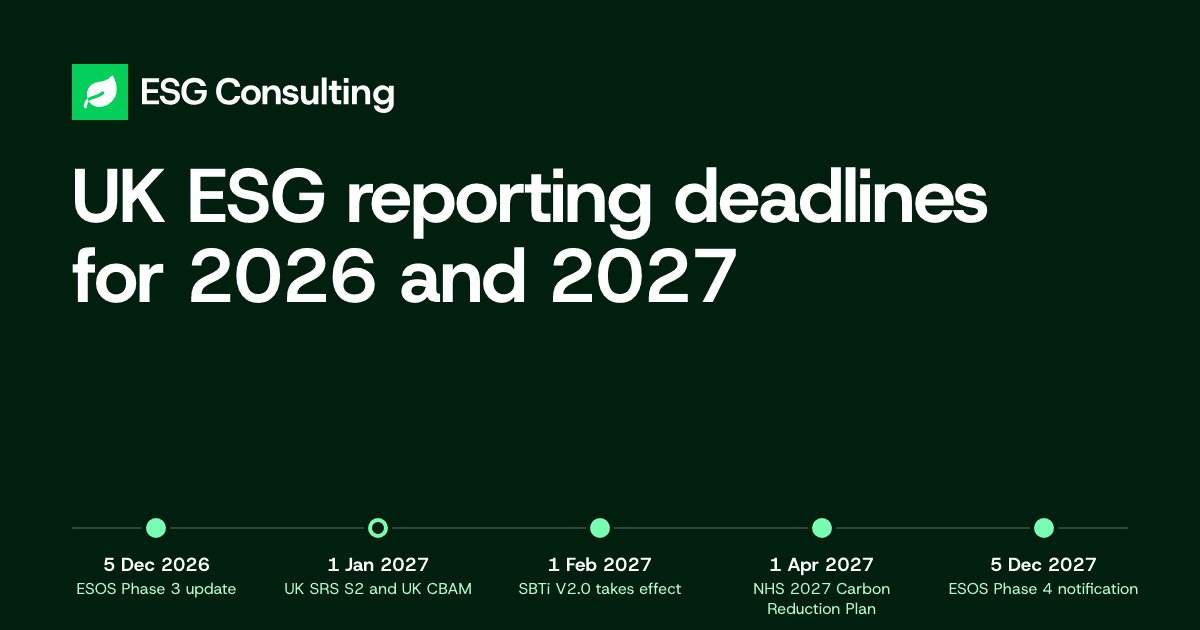
· 14 min read · Regulation
UK ESG reporting deadlines for 2026 and 2027
Every UK ESG reporting date to December 2027 - UK SRS, ESOS, SECR, UK CBAM, CSRD, SBTi, PPN 026 and the NHS - each marked mandatory, proposed or voluntary.
Read article